






Biotech status update – Outlook Therapeutics (OTLK)
OTLK after the 31 Dec 2025 CRL: Lytenava’s US path just became even narrower
This brief update complements the original deep dive prepared before the 31 December 2025 PDUFA. It focuses on the new Complete Response Letter (CRL) that the FDA has issued for ONS-5010/Lytenava, how Outlook Therapeutics is framing the decision, how the market and retail communities reacted, and what changes in the risk map for this single-asset retina story.
News of the day – what happened on 31 Dec 2025
CRL update
Snapshot after the decision
- On 31 December 2025, the FDA issued another Complete Response Letter (CRL) for the resubmitted ONS-5010/Lytenava BLA, stating that it cannot approve the application in its current form for wet age-related macular degeneration.
- According to the company, the agency said the additional mechanistic and natural-history analyses in the resubmission did not change its previous view: one adequate trial supports efficacy, but the FDA still wants confirmatory evidence and has not specified what type of data would be acceptable.
- This is now the third CRL for the same programme (after letters in 2023 and August 2025), turning Lytenava into one of the more persistent regulatory sagas in the wet AMD space.
- The stock reacted with a sharp sell-off: regular-session and after-hours trading together translated into a collapse well above 60%, effectively pricing out most of the near-term US approval narrative and pushing the focus back on Europe and balance-sheet risk.
In practice, the 31 December 2025 PDUFA that once looked like a “make-or-break” date has produced neither: there is still no US approval, but the FDA also has not given a clear, concrete roadmap. That ambiguity is now the central risk factor in the story.
1. What the new CRL actually says (based on company disclosure)
As with most CRLs, the full text is not public. The only detailed description comes from Outlook Therapeutics’ own press release and specialised ophthalmology coverage. In summary:
- The FDA confirmed that it cannot approve the BLA in its current form for wet AMD.
- The agency acknowledged the presence of one adequate and well-controlled study that demonstrates efficacy, but reiterated that this is not sufficient on its own and again requested confirmatory evidence of efficacy.
- The additional mechanistic and natural-history data submitted with the resubmission were explicitly described as not changing the previous conclusion.
- Crucially, the company states that the FDA has not yet indicated what type of confirmatory evidence – for example a full new trial, a specific design, or a particular analysis – would be considered adequate.
From a trader’s point of view, this matters more than any technical nuance in the letter. It means the US path is no longer just “do the additional analyses and wait 60 days”, but a vaguer request for more robust efficacy support whose scope is still undefined.
2. How the company is framing the decision
In its communication, Outlook Therapeutics describes the decision as disappointing and says it disagrees with the FDA’s stance, while reiterating that it believes the NORSE dataset is sufficient for approval. At the same time, management emphasises three elements:
- The company remains “fully committed” to pursuing approval in the United States and is evaluating all available regulatory pathways, which could include additional dialogue with the agency or new study proposals.
- It continues to highlight that Lytenava is already authorized in the EU and UK and commercially available in Germany and the UK, with plans to expand into additional European markets.
- It underlines the clinical and economic rationale for an on-label bevacizumab formulation as an alternative to compounded Avastin and premium anti-VEGFs, especially in public health systems under cost pressure.
Put simply, the official message is: “we disagree, we still believe in the product, we will keep pushing both in the US and ex-US.” The problem is that investors have now heard versions of this message after three separate CRLs, which naturally erodes confidence in how much leverage the company really has in its discussions with the agency.
3. Market reaction and retail sentiment
3.1 Price action
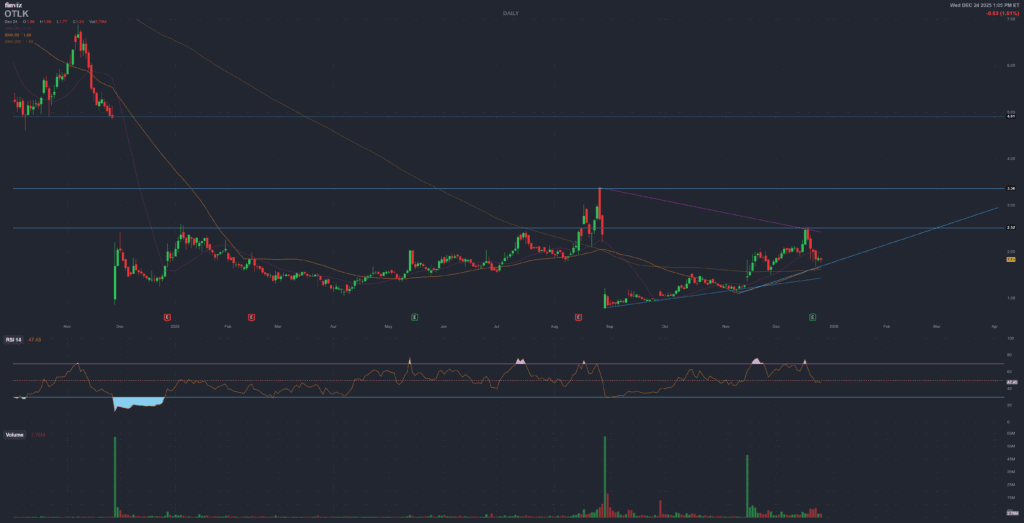
The immediate market reaction was brutal. The stock sold off hard into and after the announcement, with combined regular and after-hours trading resulting in a drawdown that wiped out most of the “PDUFA premium” built in during the resubmission phase. Volumes were significantly above average, a typical pattern when a binary event resolves against consensus expectations.
3.2 Retail communities
In the weeks before the decision, retail discussions on platforms like Reddit and Stocktwits had shown a strong belief that the combination of EU/UK approvals, prior FDA dialogue and a Class 1 resubmission made this PDUFA a high-probability event. The new CRL forces a sharp reassessment:
- Some long-time bulls interpret the decision as overly conservative or “political” and continue to point to European authorisations as proof that the drug works in the real world.
- Others accept that three consecutive CRLs centred on efficacy concerns are a major structural red flag and question whether further capital should be committed at all.
- A third group treats OTLK increasingly as a trading vehicle rather than a long-term investment, focusing mainly on volatility, short interest and squeeze potential after extreme moves.
As always, this kind of social-media sentiment is a real-time snapshot of emotions, not a probability model. It is useful as a thermometer of greed and fear, not as a decision engine.
4. What changes in the OTLK risk map after this CRL
Relative to the original deep dive published before the PDUFA, several elements move in a clear direction:
- US binary becomes long-dated: the clean “yes/no by 31 Dec 2025” setup is gone. Any future attempt will require fresh negotiation and possibly new data, which takes time and money and has no guaranteed outcome.
- European execution rises in importance: with the US uncertain, the company needs to demonstrate that the European launch can scale beyond symbolic revenue and support a credible business case on its own or in partnership.
- Dilution risk increases: absent a rapid inflection in ex-US revenue, further equity raises or strategic transactions move higher in the list of likely tools to keep the company funded.
- Volatility stays elevated: after such a severe repricing, OTLK can continue to see large percentage swings even on modest news-flow, simply because the float and sentiment structure are typical of a high-risk small cap.
The core takeaway is that the US upside has not disappeared completely, but it has shifted from “imminent binary” to “uncertain, longer-term optionality” that may require more clinical work. Any thesis on OTLK from this point forward has to treat that uncertainty, and the funding needed to navigate it, as central rather than secondary.
5. Sources and further reading
- Outlook Therapeutics – official press release on the 31 Dec 2025 CRL (company IR / GlobeNewswire).
- Ophthalmology-focused coverage of the new CRL and prior letters, including timeline of all three FDA decisions for ONS-5010.
- General newswire reports (Reuters and others) on the CRL and stock reaction.
- Financial press summaries on the stock’s move after the decision.
- Community discussions on Reddit (OTLK-focused forums and broader penny stock threads) and Stocktwits streams around the PDUFA window.
- For charts and fundamentals: OTLK page on Finviz (affiliate link via Merlintrader) and primary filings on the SEC website.
Important notice – educational content only (English)
This update is prepared for informational and educational purposes only. It is not investment advice, not a recommendation to buy, sell or hold any security, and not independent “investment research” in a regulatory sense. The information discussed here is based on public sources believed to be reliable at the time of writing, but it may be incomplete or contain errors and it will almost certainly become outdated as new data and filings appear.
Biotech and small-cap stocks are highly speculative and can move violently around clinical and regulatory catalysts such as PDUFAs, trial readouts or partnership news. Any decision to trade or invest in the securities mentioned must be based on your own research, your financial situation and your risk tolerance, ideally with input from a qualified, regulated financial professional. Nothing in this document should be interpreted as a promise of profit, a guarantee of outcome or a solicitation to the public to invest.
For full legal notes, risk disclosures and terms of use, always refer to the official Merlintrader pages dedicated to disclaimer, terms and privacy policy.
Biotech Catalyst Calendar
To put OTLK into the wider context of upcoming biotech events, you can use the Biotech Catalyst Calendar on Merlintrader. It brings together PDUFA dates, clinical readouts and other binary catalysts in a single, continuously updated view.
Access it here: Biotech Catalyst Calendar – full overview
News del giorno – cosa è successo il 31 dicembre 2025
Aggiornamento CRL
Fotografia dopo la decisione FDA
- Il 31 dicembre 2025 la FDA ha emesso una nuova Complete Response Letter (CRL) sulla BLA risottomessa di ONS-5010/Lytenava, dichiarando di non poter approvare l’applicazione nella forma attuale per la degenerazione maculare senile umida (wet AMD).
- Secondo la società, l’agenzia ha precisato che i dati aggiuntivi di tipo meccanicistico e di storia naturale inclusi nella risottomissione non hanno modificato la valutazione precedente: un singolo studio adeguato e ben controllato mostra efficacia, ma la FDA chiede ancora prove confermative e non ha indicato in modo preciso quale tipo di evidenza sarebbe considerata sufficiente.
- Si tratta ormai della terza CRL sullo stesso programma (dopo le lettere del 2023 e di agosto 2025), elemento che rende il percorso regolatorio USA particolarmente accidentato e atipico.
- Il titolo ha reagito con un crollo violento: il movimento combinato tra seduta regolare e after-hours ha sostanzialmente azzerato il “premio PDUFA” costruito nei mesi precedenti e ha riportato il focus su Europa e rischio di finanziamento.
In pratica, la PDUFA del 31 dicembre che sembrava un “dentro o fuori” ha prodotto un esito diverso: nessuna approvazione, ma nemmeno un percorso alternativo chiaro. È proprio questa mancanza di visibilità sul passo successivo a diventare oggi il rischio principale nella storia OTLK.
1. Cosa dice in sostanza la nuova CRL
Come sempre, il testo integrale della Complete Response Letter non è pubblico. Le informazioni arrivano dalla nota ufficiale di Outlook Therapeutics e da articoli specializzati in ambito retina. In sintesi:
- La FDA ribadisce che non può approvare la BLA nella forma attuale per la wet AMD.
- L’agenzia riconosce la presenza di uno studio adeguato e ben controllato che dimostra efficacia, ma afferma che ciò non basta e che servono ancora dati confermativi.
- I dati aggiuntivi di tipo meccanicistico e di storia naturale inseriti nella risottomissione vengono considerati non risolutivi rispetto alle perplessità già espresse.
- Secondo la società, la FDA non ha ancora indicato in modo puntuale quale tipo di studio o evidence package considererebbe adeguato per sbloccare l’approvazione.
Per chi fa trading questo significa che il percorso USA non è più semplicemente “aspettare il verdetto di fine anno”, ma passa per un confronto più lungo e costoso con l’agenzia, con esito finale molto meno definito.
2. Come la società presenta la situazione
Nella propria comunicazione, Outlook Therapeutics definisce la decisione “deludente” e dichiara di non condividerla, sostenendo che l’insieme degli studi NORSE sia sufficiente per l’approvazione. Allo stesso tempo la società insiste su tre messaggi:
- Intenzione di proseguire nel percorso regolatorio USA, esplorando tutte le opzioni possibili, inclusa nuova interlocuzione con la FDA e l’eventuale definizione di ulteriori studi.
- Valorizzazione del fatto che Lytenava sia già autorizzato in UE e UK e disponibile commercialmente in Germania e Regno Unito, con piani di espansione in altri Paesi europei.
- Richiamo continuo al bisogno clinico ed economico di una formulazione oftalmica on-label di bevacizumab, alternativa ai preparati da oncologia allestiti in farmacia ospedaliera.
In termini di percezione di mercato, il messaggio è chiaro: “crediamo ancora nel prodotto e non gettiamo la spugna”. Dopo tre CRL consecutive, però, la credibilità di questa linea si gioca sempre di più sui fatti (dati e numeri di vendita) e sempre meno sulle dichiarazioni.
3. Reazione del mercato e delle community retail
3.1 Prezzo e volumi
La reazione dei prezzi è stata immediata e severa. Il titolo ha perso una quota rilevante della propria capitalizzazione tra fine seduta e after-hours, con volumi nettamente sopra la media. Il mercato ha sostanzialmente “smontato” l’aspettativa di approvazione a breve termine che si era costruita dopo l’accettazione della BLA come risposta di Classe 1.
3.2 Sentiment online
Nelle settimane precedenti, molti commenti su Reddit e Stocktwits presentavano questa PDUFA come un evento ad alta probabilità positiva, facendo leva su approvazioni UE/UK, incontri con la FDA e natura “breve” della review. La nuova CRL ha cambiato bruscamente il tono:
- Una parte degli investitori continua a vedere la decisione come eccessivamente prudente e punta tutto sul fatto che l’Europa abbia già detto sì.
- Un’altra parte considera tre bocciature centrate sull’efficacia come un segnale strutturale e mette in discussione la sostenibilità della storia nel medio periodo.
- Cresce il gruppo di chi guarda a OTLK soprattutto come a un titolo da trading ad alta volatilità, più che come a una posizione di lungo termine.
Come sempre, il sentiment sui social è utile per capire l’umore del momento, ma non sostituisce un’analisi indipendente dei fondamentali e del quadro regolatorio.
4. Come cambia la mappa dei rischi per OTLK
Mettendo a confronto questo aggiornamento con il report originario scritto prima della PDUFA, i principali spostamenti sono:
- Binario USA rinviato: non esiste più una data precisa su cui concentrare lo scenario “sì/no”. Il percorso diventa più lungo, costoso e incerto.
- Europa in primo piano: l’esecuzione in Germania, UK e nei futuri Paesi UE diventa il vero banco di prova della storia, almeno finché la situazione USA resterà sospesa.
- Rischio di diluizione: senza un contributo USA nel breve, il fabbisogno di capitale resta significativo e mette sul tavolo possibili aumenti di capitale o accordi strategici.
- Volatilità strutturale: dopo un crollo di queste dimensioni, è plausibile aspettarsi movimenti percentuali ampi anche su news di secondaria importanza.
In altre parole, la potenziale “optionalità” USA non sparisce, ma si sposta su un orizzonte più lungo e con margini di incertezza maggiori. Qualsiasi strategia su OTLK da qui in avanti deve integrare questo elemento e il costo del tempo necessario per percorrerlo.
5. Fonti e approfondimenti
- Comunicato stampa ufficiale di Outlook Therapeutics sulla CRL del 31 dicembre 2025 e documenti regolatori collegati.
- Articoli specialistici in ambito retina che ricostruiscono la sequenza delle tre CRL per ONS-5010/Lytenava.
- Agenzie di stampa internazionali (tra cui Reuters) e articoli di finanza che descrivono la reazione del mercato e del titolo.
- Discussioni su Reddit (forum dedicati a OTLK e community penny-stock) e flusso di messaggi su Stocktwits nell’area PDUFA.
- Per grafici e dati di base: pagina OTLK su Finviz (link affiliato via Merlintrader) e bilanci ufficiali depositati alla SEC.
Avvertenza importante – solo contenuto informativo
Questo aggiornamento ha esclusivamente finalità informative e didattiche. Non rappresenta consulenza finanziaria, non costituisce raccomandazione personalizzata o generica ad acquistare, vendere o detenere strumenti finanziari e non è “ricerca in materia di investimenti” in senso regolamentare. I dati qui riportati derivano da fonti pubbliche considerate affidabili al momento della stesura, ma possono essere incompleti, contenere errori o non essere più aggiornati quando li leggi.
I titoli biotech e le small cap sono per loro natura molto volatili e speculativi, in particolare intorno ai catalyst regolatori e clinici. Qualsiasi decisione di investimento o trading deve basarsi sulle tue analisi, sulla tua situazione personale e, se necessario, sul parere di un professionista abilitato e indipendente. Nulla di quanto scritto va interpretato come promessa di rendimento, garanzia di esito o sollecitazione al pubblico risparmio.
Per le note legali complete, l’informativa sui rischi e le condizioni d’uso del sito fai sempre riferimento alle pagine ufficiali di Merlintrader dedicate a disclaimer, termini e privacy.
Biotech Catalyst Calendar
Per inserire OTLK nel quadro più ampio degli eventi biotech in arrivo puoi usare il Biotech Catalyst Calendar di Merlintrader, che raccoglie PDUFA, readout clinici e altri catalyst binari in un’unica vista aggiornata di frequente.
Lo trovi qui: Biotech Catalyst Calendar – panoramica completa
Biotech deep dive – Outlook Therapeutics (OTLK)
OTLK and Lytenava into the 31 Dec PDUFA: the next one that can surprise
After two FDA complete response letters and a long detour through Europe, Outlook Therapeutics reaches a new binary moment: a Class 1 resubmission with a 31 December 2025 PDUFA for Lytenava (ONS-5010) in wet age-related macular degeneration. This time, the company comes with approved status in the EU/UK, first real-world sales and a new CEO with commercial DNA.
Today’s key update and why OTLK matters now
News of the day
Snapshot – late December 2025
- The FDA has accepted a new BLA resubmission for ONS-5010 and set a Class 1 PDUFA goal date on 31 December 2025, after a second CRL in August that focused on lack of substantial evidence of efficacy.
- In Europe and the UK, Lytenava is already approved and commercial, with first sales in Germany and the UK started in mid-2025 and support from NICE and other reimbursement bodies for use in wet AMD.
- Fiscal year 2025 results show the first revenue (~1.4 million USD) from Lytenava in Europe, but the company still reported a net loss of more than 60 million USD and ended September with single-digit million cash before new at-the-market proceeds.
- On the market side, OTLK trades around the low-single-digit dollar range, with a relatively modest market cap and double-digit short interest on a float of roughly thirty million shares. That combination keeps the “surprise potential” high in both directions around the PDUFA.
After OMER, AGIO and other recent catalysts, a part of the biotech crowd is explicitly rotating the narrative: right now, in the retina micro-cap corner, it is OTLK’s turn to surprise the market – whether that surprise ends up being pleasant or painful is still completely open.
1. One-paragraph overview: what Outlook Therapeutics is trying to do
Outlook Therapeutics is essentially a single-asset retina story. Everything revolves around ONS-5010 / Lytenava, an ophthalmic formulation of bevacizumab designed to replace the off-label compounding of Avastin for wet age-related macular degeneration (wet AMD) and potentially other retinal indications. The strategic pitch is simple but non-trivial: take a molecule that retina specialists already know extremely well, package it into an approved, on-label, quality-controlled product, and offer payers a cost-effective alternative to premium brands like Eylea or Vabysmo while removing the regulatory grey zone around compounding pharmacies. The EU and UK have already said yes; the remaining question is whether the FDA is finally ready to do the same.
2. Product, trials and European positioning
2.1 Lytenava in wet AMD
Lytenava is a bevacizumab monoclonal antibody formulated specifically for intravitreal use. Mechanistically it is not new: inhibition of VEGF to reduce neovascularisation and leakage in the retina. What is new is the regulatory status and manufacturing path. Rather than relying on oncology vials split into syringes at compounding pharmacies, Outlook produces a dedicated ophthalmic product with retina-friendly concentrations, stability data and regulatory oversight.
In Europe, the drug has centralized marketing authorization and is approved for adults with wet AMD, with UK and EU recognizing Lytenava as the first and only approved ophthalmic bevacizumab for this indication. Several health-technology bodies (NICE in England, SMC in Scotland and others) have issued positive reimbursement recommendations, explicitly positioning it as a cost-effective option versus incumbent anti-VEGFs.
2.2 First real-world launch signals
Commercial launch in Germany and the UK started in 2025, initially with limited volumes but enough to generate the first reported revenue in fiscal 2025 and to prime accounts and prescribers. Early commentary from the company highlights:
- Gradual expansion in the number of accounts ordering Lytenava in both markets.
- Broader physician adoption as retina clinics become familiar with the product.
- Strengthening of market access via national tender frameworks and cost-effectiveness positioning, an important lever in public systems.
- Plans to extend launches to additional EU countries (for example Austria and the Netherlands) where pricing and reimbursement are still being negotiated.
These data points are still small in absolute dollars, but they matter because they turn the story from “pure pre-revenue” into “early commercialization plus binary US event”.
3. Three rounds with the FDA: what went wrong and what has changed
To understand the current PDUFA, it is worth mapping the full regulatory journey. The market’s scepticism does not come out of nowhere; it comes from a sequence of setbacks.
2022–2023 – First BLA and first CRL.
Outlook submits an initial BLA for ONS-5010 in wet AMD, which the FDA accepts with a PDUFA
date in August 2023. At the end of that review, the agency issues a complete
response letter citing chemistry, manufacturing and controls issues and open
inspection observations, plus concerns about the strength of the efficacy package.
2024 – NORSE EIGHT and preparation for resubmission.
The company completes and reports data from the NORSE EIGHT Phase 3 trial,
designed to strengthen the clinical evidence base by comparing ONS-5010 with ranibizumab
(Lucentis) over three months. While the study confirms activity, it does not deliver the kind
of clean superiority that would make the FDA’s job easy, and concerns about statistical
robustness remain part of the background.
August 2025 – Second CRL focused on efficacy.
After a resubmission that had a PDUFA at the end of August 2025, the FDA sends a
second CRL, this time explicitly focused on lack of substantial
evidence of effectiveness after NORSE EIGHT failed to meet its primary endpoint. The
stock collapses and many investors simply write the story off as “over”.
Late 2025 – Type A meeting and Class 1 resubmission.
Outlook requests a Type A meeting to clarify exactly what kind of confirmatory evidence the
agency would accept, then files another resubmission. In November 2025 the
FDA acknowledges the BLA as a complete Class 1 response and sets a new,
short PDUFA date on 31 December 2025.
The key nuance is that the current review is not a full six-month cycle with new pivotal data, but a 60-day Class 1 review focused on the response to a very specific deficiency. That cuts both ways: it means the package is relatively narrow, but it also means the agency has already done most of the heavy lifting on CMC and safety and is now deciding whether Outlook’s confirmatory evidence is enough to cross the line.
For traders, the practical consequence is clear: this is likely the cleanest and most binary decision so far in the OTLK saga. The company has played most of its cards; the next move belongs entirely to the FDA.
4. Financial snapshot: early revenue, heavy losses and a thin cash cushion
Fiscal 2025 is the first year in which Outlook reports product revenue, but it is still a classic development-stage P&L:
| Metric (FY 2025) | Comment |
|---|---|
| Revenue | About 1.4 million USD, almost entirely from Lytenava shipments into German and UK channels. Still negligible relative to total operating expenses. |
| Net loss | More than 60 million USD net loss attributable to common shareholders, slightly improved versus the prior year thanks to lower R&D after completion of NORSE EIGHT. |
| R&D vs SG&A | R&D spending falls as late-stage trials wind down, while SG&A rises due to building European commercial infrastructure. |
| Cash and cash equivalents | Around 8 million USD at the end of September 2025, plus additional cash from at-the-market equity sales after year-end. This is not a comfortable cushion if the US approval is delayed again. |
| Capital structure | The company has already used reverse splits, public offerings and warrant structures to stay funded. More capital raises are likely if the US path remains uncertain. |
In other words, Europe is starting to validate the commercial thesis, but the underlying business is still clearly loss-making, and the balance sheet remains fragile. Any scenario work around OTLK has to treat future dilution as a realistic option, especially in the bear or “no-decision” cases.
5. Competitive landscape: trying to squeeze into a crowded anti-VEGF field
Wet AMD is a large and established market, dominated by Eylea (aflibercept) and Vabysmo (faricimab) with Lucentis (ranibizumab) and its biosimilars still meaningful players. On top of that, off-label Avastin (bevacizumab) has historically been used extensively because of its lower cost, despite being formulated for oncology.
Lytenava’s pitch is therefore not to create a new mechanism, but to take the segment of physicians and payers who are already comfortable with bevacizumab and give them a product that finally matches regulatory expectations:
- Manufactured specifically for ophthalmic use, with appropriate quality controls.
- Approved label for wet AMD, avoiding the legal and regulatory grey zone around compounding.
- Pricing that can undercut premium brands and support health system cost-containment, while still generating a margin for Outlook and its partners.
The flip side is that premium brands have strong clinical data, long-term safety follow-up and entrenched habits. Retina specialists are not guaranteed to switch just because a cheaper, approved bevacizumab appears – particularly if they are comfortable with extended-interval regimens already achieved with Eylea or Vabysmo. That makes the European launch trajectory an important barometer of how much of the theoretical cost-savings story can actually be realised in practice.
6. Management and governance: new CEO, commercial emphasis
After the 2024 turbulence and leadership transition, Outlook now has Bob Jahr as Chief Executive Officer. Jahr comes from a commercial background with more than two decades of experience building and leading sales and marketing teams across multiple therapeutic areas, including rare diseases and oncology. Before joining Outlook, he held senior roles at companies such as Sobi and UCB, where he was involved in launching and scaling billion-dollar assets.
The board and C-suite around him combine:
- Lawrence Kenyon as long-standing CFO, who also served as interim CEO during the transition and knows the capital structure and funding constraints intimately.
- European leadership with market-access expertise, responsible for securing NICE and other reimbursement decisions and leading launch execution in Germany and the UK.
- Clinical and regulatory specialists focused on defending the NORSE dataset and interacting with FDA reviewers during and after the CRLs.
From a trading perspective, the key change is that the company is now run by someone whose core skill is commercial execution, not purely R&D. That aligns with the current phase of the story: the US decision is binary, but even in the bullish scenario the real work will be persuading retina clinics and payers to actually use Lytenava instead of staying with their current anti-VEGF of choice.
7. Retail sentiment and social chatter
Around OTLK there is now a small but very focused retail ecosystem. It is important to treat it for what it is: non-professional trader sentiment, often highly emotional around every regulatory headline.
7.1 Stock-focused communities
- A dedicated subreddit for OTLK investors discusses the TAM for wet AMD (often quoted above 10 billion USD), the cost-savings argument versus Eylea/Lucentis and the possibility that an approved bevacizumab could capture a meaningful niche if payers push for cheaper options.
- The Stocktwits stream has tens of thousands of followers watching the ticker, but aggregate data suggest that message volume is not consistently high compared to other speculative biotech names; activity spikes mainly around CRL and PDUFA headlines.
- On X (Twitter), commentary oscillates between retina specialists focusing on trial design and dosing nuances, and short-term traders treating OTLK as a high-risk, high-reward binary into year-end.
7.2 Narrative currents going into the PDUFA
The dominant narratives visible in public chatter can be simplified into three buckets:
- “Third time lucky.” Supporters argue that EU/UK approval plus real-world use make it politically and clinically awkward for the FDA to reject indefinitely, especially when the goal is to reduce off-label compounding.
- “Data is data.” Skeptics emphasise that the agency has already rejected twice and that NORSE EIGHT did not hit its primary endpoint; from this angle, CRL risk remains very real regardless of external approvals.
- “Volatility is the real product.” A more cynical group is less interested in long-term fundamentals and more interested in the trade: high short interest, low float by biotech standards and a precise binary date. The only thing that matters for them is how crowded each side becomes in the final days.
None of these views is “right” or “wrong” on its own; what matters for a trader is recognising that sentiment can flip very quickly around headlines and that social feeds are not a source of reliable probability estimates. They are a live thermometer of greed and fear in a specific corner of the market, nothing more.
8. Scenario map into 31 December 2025
The point of this section is not to predict, but to organise the moving parts. Around a catalyst like this, the real edge often comes from understanding what has to go right or wrong for each scenario, not from guessing the final yes/no.
8.1 Bull case – clean approval and US launch in 2026
- The FDA considers the Class 1 response sufficient, grants approval for wet AMD with a reasonably usable label and no crippling post-marketing requirements.
- The market shifts its narrative from “serial CRL victim” to “first approved ophthalmic bevacizumab with EU/UK and US coverage”, compressing perceived risk.
- Outlook can raise capital from a stronger position, using both US and ex-US prospects to support a broader launch and possibly partnerships.
- Over time, tender wins, guidelines and payer pressure create a stable, if not explosive, volume base for Lytenava.
In this path, the surprise is mainly for the skeptics: after two CRLs and a long period of doubt, the company finally clears the last regulatory hurdle.
8.2 Base case – mixed outcome, Europe keeps carrying the story
- The decision is not a straightforward approval. Possibilities range from another CRL asking for yet more data to an approval with a restrictive label that limits uptake.
- Europe continues to grow but slower than bulls would like; Lytenava proves useful but not disruptive.
- The company needs further equity raises to bridge the gap, diluting existing holders but staying alive long enough to see what the real European opportunity looks like.
Here the market may oscillate between hope and fatigue, and the real risk becomes the slow grind of dilution rather than a single day’s gap.
8.3 Bear case – third clear rejection and squeezed options
- The FDA sends a new CRL that makes it explicit that, with the current dataset, approval is not going to happen without additional large, expensive trials.
- Investor confidence erodes further; access to capital becomes more difficult and more expensive, forcing aggressive financing or strategic alternatives.
- Even with Europe progressing, the company cannot comfortably fund everything it needs, and balance-sheet risk becomes central.
In this path, the “surprise” is mostly for those who assumed EU/UK approval guaranteed a US green light sooner or later. The FDA has already shown that it is willing to stand alone if it is not convinced by the data.
Whichever path plays out, one thing is unavoidable: OTLK is entering a phase where the news flow will stop being theoretical. The European launch is already providing real numbers, and the FDA decision will lock in a regulatory reality that no amount of social chatter can undo. That is exactly why, in the small-cap retina space, many traders feel that now “it is OTLK’s turn to surprise”.
9. Risk map – what can go wrong even beyond the obvious CRL risk
- Regulatory risk. A third CRL would not be unprecedented in biotech history, and the FDA has already signalled discomfort with the strength of the efficacy package.
- Execution risk in Europe. Even with approvals and reimbursement, converting theoretical cost-savings into broad adoption is not automatic. Retina clinics may stay with their current workflows.
- Dilution and funding risk. The company’s ability to fund operations without severely diluting shareholders hinges on either stronger sales growth or a clear US approval that unlocks better financing terms.
- Competition risk. Anti-VEGF therapy is a brutally competitive space with strong incumbents, biosimilars and pipeline innovations in development.
- Volatility and sentiment risk. Around binary events, positioning can matter more than fundamentals in the very short term. Gaps, squeezes and air-pockets are all possible regardless of which scenario eventually proves “fundamentally correct”.
10. Bottom line
Outlook Therapeutics is no longer just a story about “maybe one day getting approved”. The company now has real approvals and real sales in Europe, a new CEO with a commercial background and a clearly defined, near-term PDUFA line in the sand on 31 December 2025. At the same time, it still carries the scars of two CRLs, an incomplete efficacy narrative and a balance sheet that leaves little room for new surprises of the wrong kind.
For an experienced trader, the interesting part is not treating OTLK as a magic lottery ticket, but recognising that all the ingredients for a violent repricing are present: regulatory history, strong opinions on both sides, short interest, thin float and a specific date. The opportunity, if any, lies in how intelligently one manages that combination relative to personal risk tolerance and position size – not in believing that a third attempt at FDA approval is suddenly risk-free just because Europe has already said yes.
Important notice – educational content only (English)
This report is prepared for informational and educational purposes only. It is not investment advice, not a recommendation to buy, sell or hold any security, and not independent “investment research” in a regulatory sense. The information discussed here is based on public sources believed to be reliable at the time of writing, but it may be incomplete or contain errors and it will almost certainly become outdated as new data and filings appear.
Biotech and small-cap stocks are highly speculative and can move violently around clinical and regulatory catalysts such as PDUFAs, trial readouts or partnership news. Any decision to trade or invest in the securities mentioned must be based on your own research, your financial situation and your risk tolerance, ideally with input from a qualified, regulated financial professional. Nothing in this document should be interpreted as a promise of profit, a guarantee of outcome or a solicitation to the public to invest.
Avvertenza importante – solo contenuto informativo (Italiano)
Questo report ha esclusivamente finalità informative e didattiche. Non rappresenta consulenza finanziaria, non costituisce raccomandazione personalizzata o generica ad acquistare, vendere o detenere strumenti finanziari e non è “ricerca in materia di investimenti” in senso regolamentare. I dati qui riportati derivano da fonti pubbliche considerate affidabili al momento della stesura, ma possono essere incompleti, contenere errori o non essere più aggiornati quando li leggi.
I titoli biotech e le small cap sono per loro natura molto volatili e speculativi, in particolare intorno ai catalyst regolatori e clinici. Qualsiasi decisione di investimento o trading deve basarsi sulle tue analisi, sulla tua situazione personale e, se necessario, sul parere di un professionista abilitato e indipendente. Nulla di quanto scritto va interpretato come promessa di rendimento, garanzia di esito o sollecitazione al pubblico risparmio.
Per le note legali complete, l’informativa sui rischi e le condizioni d’uso del sito, fai sempre riferimento alle pagine ufficiali di Merlintrader dedicate a disclaimer, termini e privacy policy.
Biotech Catalyst Calendar
If you want to see OTLK in the broader context of all upcoming PDUFAs and major readouts, you can use the dedicated Biotech Catalyst Calendar on Merlintrader. It aggregates the main FDA dates, clinical events and other binary catalysts in a single, regularly updated view.
Access it here: Biotech Catalyst Calendar – full overview
Aggiornamento del giorno e perché OTLK conta adesso
News del giorno
Fotografia a fine dicembre 2025
- La FDA ha accettato una nuova risottomissione della BLA per ONS-5010 e ha fissato una PDUFA di Classe 1 al 31 dicembre 2025, dopo una seconda CRL ad agosto incentrata sulla mancanza di evidenza di efficacia.
- In Europa e Regno Unito, Lytenava è già approvato e in commercio, con le prime vendite in Germania e UK dal 2025 e pareri positivi di rimborsabilità da parte di NICE e altri enti.
- Il bilancio 2025 mostra i primi ricavi (circa 1,4 milioni di dollari) da Lytenava, ma la società resta in perdita oltre i 60 milioni e con una cassa ancora sottile prima dei nuovi aumenti di capitale.
- In borsa OTLK gira nell’area 1,8–2,0 dollari, con capitalizzazione sotto i 100 milioni e short float a doppia cifra su un flottante di circa 30 milioni di azioni: miscela perfetta per movimenti violenti se la liquidità aumenta.
Dopo una lunga serie di catalyst in altre biotech, una parte del retail ha spostato il focus: nel micro-universo retina, adesso è il turno di OTLK di sorprendere. La sorpresa, però, può essere sia positiva sia negativa.