DISCLAIMER — Not financial advice. Educational content only, not an offer or solicitation to buy or sell any security. Biotech and small/mid-cap stocks are highly speculative and volatile and can result in a partial or total loss of capital. Do your own research and consult a licensed advisor where appropriate. / Contenuti a solo scopo informativo e didattico, non costituiscono consulenza finanziaria né offerta o sollecitazione al pubblico risparmio ai sensi delle normative CONSOB e SEC. Le azioni biotech e le small/mid cap sono strumenti altamente speculativi e volatili e possono comportare la perdita parziale o totale del capitale investito. Si raccomanda di effettuare sempre le proprie ricerche e, se necessario, di rivolgersi a un consulente abilitato.

Merlintrader Trading Pub
Biotech catalyst news and analysis. FDA PDUFA tracker
Merlintrader Trading Pub
Biotech catalyst news and analysis. FDA PDUFA tracker
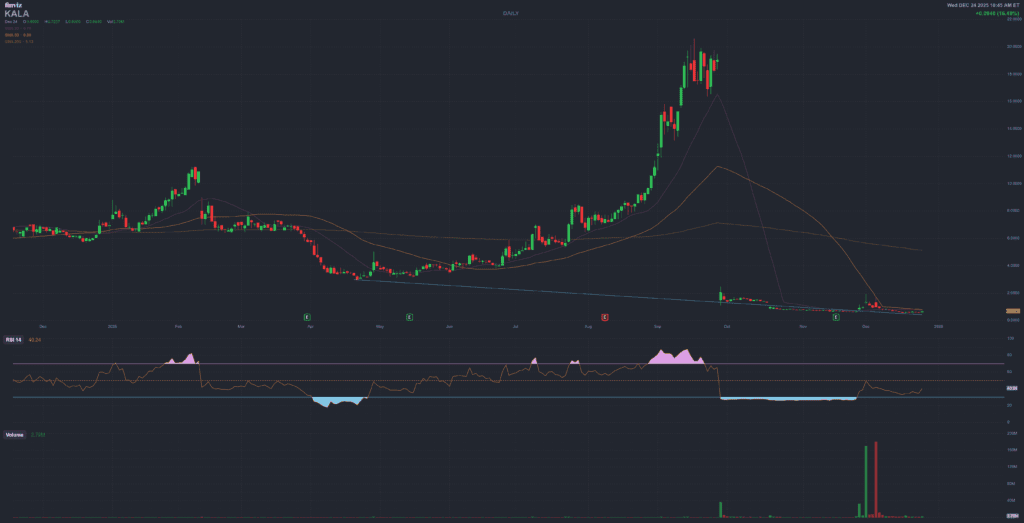
KALA BIO, Inc. – NASDAQ: KALA
KALA after KPI-012: trial collapse, Oxford default and the “ATM closed” financing bounce
KALA BIO has gone from Phase 2b hope story to distressed nano-cap in a few months: KPI-012 failed, the lender swept cash after a default, and the company survived via a rescue deal with David Lazar plus a $10M registered direct offering priced at-the-market. Here’s what that actually means for the equity.
Last price (approx.)
~0.57–0.60 USD
Nano-cap, intraday swings >10% are common.
Market cap
~6M USD
Down ≈90% vs. 12 months ago.
52-week range
0.51 – 20.60 USD
From reverse-split highs to penny territory.
Data are approximate snapshots around December 24, 2025, based on public quotes and may move quickly in this type of stock.
News of the day – “ATM closed”, direct offering done
In early December, KALA closed a $10M registered direct offering of common stock, priced “at-the-market” under Nasdaq rules, selling 10M shares (or pre-funded warrants) at $1.00 each. H.C. Wainwright acted as placement agent, and proceeds are earmarked to repay debt and fund general corporate purposes. :contentReference[oaicite:4]{index=4}
Just days earlier, the company entered into a separate $6M securities purchase agreement with activist investor David E. Lazar, who simultaneously became CEO and Chairman. The deal involves preferred stock in two tranches and is explicitly framed as a rescue financing after lender Oxford Finance had declared default, swept most of KALA’s cash and threatened foreclosure. :contentReference[oaicite:5]{index=5}
On trading desks and social channels this combination has been simplified to “ATM closed + Lazar in”, and any green day is read as a relief move that dilution from this particular deal is now known and (partly) digested. The hard part is understanding what business, if any, is left behind the ticker.
Executive summary – from single-asset platform to distressed shell?
KALA’s story up to September 2025 was built almost entirely on KPI-012, a mesenchymal stem cell secretome (MSC-S) therapy for persistent corneal epithelial defect (PCED), supported by Orphan and Fast Track designations and a Phase 2b trial (CHASE) that bulls hoped would be “pivotal-like”. :contentReference[oaicite:6]{index=6}
On September 29, the company reported that CHASE failed its primary endpoint and key secondaries, with no meaningful difference vs placebo. Within hours the board voted to cease development of KPI-012 and the entire MSC-S platform, cut the workforce by 51% and “explore strategic options”. :contentReference[oaicite:7]{index=7}
The failure cascaded into the balance sheet. On September 29, lender Oxford Finance sent a default notice, accelerated roughly $29.1M of loan obligations and later swept substantially all of KALA’s cash. The Q3 2025 10-Q openly states there is substantial doubt about the company’s ability to continue as a going concern, warning that shareholders could see little or no recovery in a bankruptcy scenario. :contentReference[oaicite:8]{index=8}
The December Lazar and direct-offering deals therefore do not represent “growth capital”, but an attempt to keep the listing alive and gain time. Whether KALA becomes a turnaround/roll-up vehicle under Lazar or drifts towards a restructuring remains an open question – and that is exactly what this report tries to unpack.
Lead asset discontinued
Loan default & cash sweep
Going-concern warning in 10-Q
New activist CEO (Lazar)
$16M+ recent equity financing
Low float, retail-driven tape
1. Today’s news in context – what “ATM closed” actually is
1.1 The $10M registered direct offering
On December 4, KALA announced a $10M registered direct offering under its shelf registration, selling 10M common shares (or pre-funded warrants) at $1.00 per share, described as “priced at-the-market under Nasdaq rules”. The deal closed on December 5, with H.C. Wainwright as sole placement agent. :contentReference[oaicite:16]{index=16}
Management stated that net proceeds will be used primarily to repay debt and for working capital, i.e. this is not growth capital for new clinical trials but an attempt to stabilise the balance sheet after the Oxford default and cash sweep.
1.2 The Lazar preferred deal
In parallel, on December 1 KALA entered a $6M securities purchase agreement with investor David E. Lazar, involving new series of preferred stock and related warrants. Following the deal, Lazar became CEO and Chairman of the company. :contentReference[oaicite:17]{index=17}
A prior 8-K and third-party summaries describe Lazar’s role as a turnaround-oriented control investor, with positions in multiple distressed micro-caps where the typical playbook involves restructuring or reverse mergers rather than traditional drug development.
1.3 Where the “ATM” talk comes from
KALA has long maintained at-the-market equity programmes under its 2020 and 2023 shelf registrations, selling shares via Jefferies over time. :contentReference[oaicite:18]{index=18} Ahead of the December transactions, commentary from filings and analysis sites highlighted that the company might tap up to $10M more through an ATM to address the Oxford default, adding pressure to an already heavily diluted stock. :contentReference[oaicite:19]{index=19}
The combination of the Lazar preferred deal and the one-shot direct offering, together with language in filings that KALA “will not make any sales of common stock under its at-the-market offering programme” while these structured financings are in place, is what many traders are condensing into “ATM closed”. :contentReference[oaicite:20]{index=20}
1.4 Why the stock is bouncing despite brutal dilution
On paper, the combination of a 6M USD preferred deal and a 10M USD direct at $1.00 is massively dilutive compared to a stock now trading well below that level. Yet in the context of going-concern warnings, foreclosure threats and essentially no pipeline, some retail traders interpret “funding + CEO + no more ATM for now” as a reason for a short squeeze or dead-cat bounce rather than a death sentence.
From a balance-sheet perspective, though, the new capital only partly patches a hole created by years of burn, a failed Phase 2b and a 29M USD accelerated loan. The equity still sits at the very bottom of the capital structure.
2. Pipeline: KPI-012’s rise and fall, and what’s left
2.1 KPI-012 and the MSC-S platform
KALA’s original pitch was an MSC-S (mesenchymal stem cell secretome) platform for rare corneal and retinal diseases. Lead candidate KPI-012 was a topical biologic designed to promote corneal healing in PCED, with follow-on potential in limbal stem cell deficiency (LSCD) and other rare corneal diseases. :contentReference[oaicite:21]{index=21}
The company consistently highlighted:
- Orphan and Fast Track designations for PCED in the U.S. :contentReference[oaicite:22]{index=22}
- Favourable Phase 1b data (8/8 patients improving, 6/8 fully healed within 4 weeks).
- An estimated ~100,000 PCED patients in the U.S. and ~238k across U.S./EU/Japan. :contentReference[oaicite:23]{index=23}
2.2 CHASE Phase 2b: what went wrong
The CHASE Phase 2b trial enrolled 79 PCED patients across 37 sites in the U.S. and Latin America and was meant to double as a pivotal-like study for a future BLA if results were strong. :contentReference[oaicite:24]{index=24}
Topline data in late September 2025 were unequivocal:
- The study did not meet its primary endpoint of complete healing at Week 8 as measured by fluorescein staining.
- Key secondary endpoints also failed to reach statistical significance, with no meaningful difference between either KPI-012 dose and placebo. :contentReference[oaicite:25]{index=25}
In response, the board formally decided to cease development of KPI-012 and the MSC-S platform and to implement a 51% workforce reduction. :contentReference[oaicite:26]{index=26}
2.3 KPI-014 and any remaining R&D
Official pipeline materials still mention KPI-014, a preclinical secretome programme for inherited retinal diseases such as retinitis pigmentosa and Stargardt disease, positioned as a gene-agnostic neuroprotective approach. :contentReference[oaicite:27]{index=27}
However, recent SEC filings and the Q3 10-Q make clear that KALA has significantly reduced R&D spend and is focused on preserving cash while evaluating strategic options. There is no concrete clinical timeline for KPI-014 or any new asset, and the company currently has **no active late-stage programme**.
Practically, this means that KALA is no longer a conventional “pipeline story” – whatever value remains will likely come from corporate transactions, debt restructuring or the potential acquisition/licensing-in of external assets under the Lazar regime.
3. Management: from Bazemore to Lazar
3.1 Pre-September: Bazemore and ophthalmology-heavy leadership
Until October 2025, KALA was led by Todd Bazemore, a commercial-side executive with a long history in respiratory and orphan-disease biotech. He joined KALA in 2017, became interim CEO in early 2025 and was formally appointed CEO in September, just weeks before the CHASE readout. :contentReference[oaicite:28]{index=28}
The broader management team (Brazzell, Kharabi, etc.) is made up of ophthalmology veterans with deep clinical and business-development backgrounds. This helped KALA build credibility with cornea KOLs and secure grants and prior financings.
3.2 Post-trial: exits, default and the arrival of Lazar
The CHASE failure triggered a chain of governance events:
- September 28: board decision to cease KPI-012/MSCS development and cut staff by ~51%. :contentReference[oaicite:29]{index=29}
- Late September–October: Oxford default notice, acceleration of ~29.1M USD debt and cash sweep. :contentReference[oaicite:30]{index=30}
- October 19: termination of Bazemore as CEO and President. :contentReference[oaicite:31]{index=31}
- November: 0.375M USD emergency convertible loan to keep the lights on. :contentReference[oaicite:32]{index=32}
- December 1: appointment of David E. Lazar as CEO and Chairman, plus the 6M USD preferred agreement. :contentReference[oaicite:33]{index=33}
Lazar is best known as an activist / special-situations investor involved in micro-cap restructurings and reverse mergers across several tickers, often combining control stakes with complex preferred structures. :contentReference[oaicite:34]{index=34}
3.3 How to read the Lazar era
For long-term biotech specialists, the arrival of Lazar is a signal that KALA is likely to operate more as a financial engineering vehicle than as a classic ophthalmology development company – at least in the near term. Typical playbooks in comparable situations include:
- Settling or restructuring secured debt on discounted terms.
- Using remaining listing value plus cash to acquire or merge with a private asset (sometimes unrelated to the original therapeutic area).
- Running lean operations with minimal R&D until a new story is ready to sell to the market.
None of this is inherently good or bad; it just means that any investment thesis on KALA today is **more about corporate transactions and capital structure** than about PCED or retinal disease science.
4. Financial position, Oxford default and going-concern risk
4.1 Q3 2025 numbers in plain English
The Q3 2025 10-Q paints a stark picture:
- Cash & cash equivalents: 21.1M USD (down from 51.2M USD at end-2024). :contentReference[oaicite:35]{index=35}
- Debt: 26.9M USD outstanding under the Oxford Finance loan, all classified as current after acceleration. :contentReference[oaicite:36]{index=36}
- Net loss Q3 2025: ~7.6M USD; nine-month loss ~27.7M USD, reduced mainly by non-cash gains from remeasuring contingent consideration after ceasing KPI-012. :contentReference[oaicite:37]{index=37}
- Stockholders’ equity: flipped from +12.3M USD at end-2024 to a -8.7M USD deficit at September 30, 2025. :contentReference[oaicite:38]{index=38}
Management explicitly states that existing cash “will not be sufficient to fund operating expenses, lease and debt service obligations through November 2025” and that these conditions “raise substantial doubt” about the company’s ability to continue as a going concern. :contentReference[oaicite:39]{index=39}
4.2 Oxford default and cash sweep
On September 29, Oxford Finance sent a default notice under the Loan Agreement, citing a “material adverse change” following the KPI-012 failure and demanding immediate repayment of about 29.1M USD. Interest shifted to a default rate, and the lender soon after swept substantially all of KALA’s cash from its accounts. :contentReference[oaicite:40]{index=40}
Subsequent filings describe intense negotiations, the 375k USD high-interest convertible bridge loan and the need to secure additional financing quickly to avoid foreclosure on remaining assets. :contentReference[oaicite:41]{index=41}
4.3 Do the December financings “fix” the problem?
Combining the 6M Lazar preferred and the 10M direct offering gives KALA headline access to roughly 16M USD before fees, subject to tranche conditions. This is **less than the accelerated loan balance** and must also fund ongoing public-company costs, severance, legal bills and any new strategic initiative. :contentReference[oaicite:42]{index=42}
In other words:
- The financings reduce immediate collapse risk and may give KALA negotiating leverage with Oxford.
- They do not remove the going-concern uncertainty, especially if no clear new business plan emerges.
- They come at the cost of **very heavy dilution** to existing common shareholders, with more possible if additional equity or reverse splits are used to maintain the Nasdaq listing.
5. Analyst and retail sentiment
Sentiment snapshot based on analyst notes, Stocktwits streams, Reddit threads (r/pennystocks,
r/KalaStock) and Yahoo/other forums. These are mostly non-professional trader communities and
should be treated strictly as a mood indicator, not as research. :contentReference[oaicite:43]{index=43}
5.1 Street view: from speculative “derisking play” to restructuring case
Before the CHASE data, a few specialists still pitched KALA as a high-risk, high-reward “derisking play” on PCED with Orphan/Fast Track angles. That narrative effectively ended on September 29, when the trial failure, workforce cuts and the decision to discontinue KPI-012 were followed in quick succession by analyst downgrades to Neutral and commentary focusing on cash burn and balance-sheet stress. :contentReference[oaicite:44]{index=44}
Post-Q3 2025 and Oxford default, written coverage tends to frame KALA less as a development company and more as a distressed equity stub with:
- no active lead asset,
- accelerated secured debt,
- going-concern language in SEC filings,
- and now an activist CEO with a record in micro-cap turnarounds.
5.2 Retail chatter: from “KALA to the moon” to wounded meme
On Stocktwits and Reddit, KALA has spent months oscillating between hype-driven multi-bagger threads (“my rocket stock bet for next week KALA”, “anyone wants to make money? get on KALA”) and brutally honest posts reminding readers that KPI-012 has been scrapped, Oxford defaulted and management itself flagged going-concern risk. :contentReference[oaicite:45]{index=45}
Recent sentiment clusters roughly into three camps:
- Short-term traders focusing on float size (~5–9M shares depending on the source), intraday volume spikes and potential short squeezes, largely ignoring fundamentals. :contentReference[oaicite:46]{index=46}
- Opportunistic “turnaround” bulls arguing that Lazar might bring in a new asset or engineer a reverse merger, making the current market cap look tiny relative to a possible future story.
- “Reality check” posters who explicitly call out the trial failure, loan default and high risk of restructuring, warning that common equity could still go to zero even after the financing bounce. :contentReference[oaicite:47]{index=47}
5.3 Takeaway on sentiment
The important point is that most of the volume in KALA is not long-horizon, fundamentals-driven capital. The tape is dominated by short-term speculation on news headlines (“ATM closed”, “Lazar in”, “debt deal coming?”) and technical factors such as float, borrow cost and message-volume spikes.
For anyone analysing the name, it is more useful to track SEC filings, Oxford negotiations and concrete strategic announcements than to follow every swing in social sentiment, which can flip from fear to euphoria within a single session.
6. Scenarios: what could the next 12–24 months look like?
Turnaround / reverse-merger scenario
New asset + restructured balance sheet
Under a constructive path, Lazar negotiates a discounted settlement with Oxford, uses the new capital plus any incoming cash from asset sales or partnerships to clean up the balance sheet and injects or acquires a new clinical asset into the KALA shell. The company stabilises Nasdaq compliance (possibly with further reverse splits) and gradually rebuilds a pipeline in ophthalmology or a different niche. In this world, today’s valuation could end up looking like a distressed-equity entry point – but it requires a long list of things to go right.
“Zombie” public shell scenario
Prolonged drift with repeated small financings
Another plausible outcome is that KALA remains listed but operates as a thinly traded shell: minimal staff, no meaningful R&D, sporadic small deals and repeated minor equity raises to cover running costs. occasional spikes in the share price occur around rumours or low-float squeezes, but the fundamental picture for common shareholders does not improve materially. This is not a collapse, but it is also far from the biotech growth story many early investors had in mind.
Downside / restructuring scenario
Formal restructuring with little left for equity
Given the going-concern language, secured debt load and lack of revenue, a harder outcome cannot be excluded: if negotiations with Oxford and new investors fail to yield a sustainable plan, the board could decide that a formal restructuring or bankruptcy process is in shareholders’ best interests (or simply unavoidable). SEC summaries already warn that in such a case it is “highly unlikely” that any cash would be available for distribution to common stockholders after creditors are paid. :contentReference[oaicite:48]{index=48}
Important disclaimer – high-risk micro-cap, no investment advice
This article is an independent editorial analysis based on public information (SEC filings, official company press releases, reputable news outlets and widely used market data providers). It is intended solely for educational and informational purposes and does not constitute investment advice, solicitation, recommendation or invitation to buy or sell any financial instrument.
KALA BIO is a highly speculative, loss-making micro-cap biotechnology issuer with a history of clinical failure, heavy dilution, loan default and explicit going-concern warnings in its own financial statements. The company currently has no approved products and no active lead programme, and common equity sits behind secured creditors and preferred holders in any restructuring. An investment in such securities can result in a total loss of capital.
Any decision to trade or invest should be taken independently, ideally with the support of a qualified financial advisor and in full awareness of the regulatory frameworks applicable in your jurisdiction (including SEC and CONSOB rules where relevant), your personal financial situation and your risk tolerance. Nothing in this report should be interpreted as a price target, rating, suitability opinion or guarantee of future performance.
Some external links may refer to partners or tools with which Merlintrader trading Blog may have referral or affiliate agreements (for example Finviz, Seeking Alpha, Stocktwits and similar platforms). If you subscribe or purchase services through those links, the site may receive a commission; this never changes your price as an end user.
KALA BIO, Inc. – NASDAQ: KALA
Dopo KPI-012: default con Oxford, Lazar al comando e rimbalzo “ATM chiuso”
KALA BIO è passata in pochi mesi da storia PCED in fase 2b a nano-cap in grave difficoltà: KPI-012 ha fallito, il finanziatore ha dichiarato default e ha portato via la cassa, la società si è salvata in extremis con un deal da 6M USD con David Lazar e un direct offering da 10M USD “at-the-market”. Qui proviamo a capire cosa resta davvero dietro il ticker.
Prezzo recente (indicativo)
~0,57–0,60 USD
Nano-cap, movimenti giornalieri anche >10%.
Market cap
~6M USD
Circa -90% negli ultimi 12 mesi.
Range 52 settimane
0,51 – 20,60 USD
Dai massimi post reverse-split ai minimi “penny”.
I dati sono uno snapshot approssimativo intorno al 24 dicembre 2025 e possono cambiare rapidamente su un titolo di questo tipo.
News del giorno – “ATM chiuso”, direct offering completato
A inizio dicembre KALA ha chiuso un registered direct offering da 10M USD sotto lo shelf attivo, vendendo 10M azioni (o pre-funded warrant) a 1,00 USD l’una, “priced at-the-market” secondo le regole Nasdaq. H.C. Wainwright ha agito come placement agent e la società ha indicato che userà i proventi principalmente per ripagare il debito e finanziare esigenze generali. :contentReference[oaicite:49]{index=49}
Pochi giorni prima KALA aveva annunciato un accordo da 6M USD in azioni privilegiate con l’investitore David E. Lazar, che dal 1° dicembre è diventato amministratore delegato e presidente del CdA. L’operazione arriva dopo che il finanziatore Oxford Finance aveva dichiarato il default sul prestito, accelerato circa 29M USD di obbligazioni e di fatto azzerato la cassa con uno sweep. :contentReference[oaicite:50]{index=50}
Nel linguaggio da chat room, il pacchetto è diventato “ATM chiuso + Lazar al volante”, e ogni seduta verde viene letta come un rimbalzo di sollievo post-aumento più che come un miglioramento strutturale del business.
Executive summary – da single-asset PCED a equity distressed
Fino a fine settembre 2025 la narrativa di KALA ruotava quasi interamente intorno a KPI-012, terapia MSC-S per persistent corneal epithelial defect (PCED) con Fast Track e Orphan Drug, in fase 2b (studio CHASE) con ambizioni “pivotal-like”. :contentReference[oaicite:51]{index=51}
Il 29 settembre la società comunica che CHASE non ha centrato l’endpoint primario né i principali secondari, senza differenze significative rispetto al placebo. Il CdA decide di interrompere lo sviluppo di KPI-012 e dell’intera piattaforma MSC-S e approva un taglio del personale del 51% per preservare la cassa. :contentReference[oaicite:52]{index=52}
Nel giro di pochi giorni il finanziatore Oxford Finance invia un default notice, accelera circa 29,1M USD di debito e procede alla “cash sweep” dei conti della società. Nel 10-Q Q3 2025 KALA scrive nero su bianco che esiste “substantial doubt” sulla capacità di continuare l’attività nei 12 mesi successivi e che in caso di procedura concorsuale è altamente improbabile che resti valore per gli azionisti ordinari. :contentReference[oaicite:53]{index=53}
Gli accordi di dicembre con Lazar e il direct da 10M USD vanno quindi letti più come manovra di salvataggio e ponte per un eventuale “nuovo KALA” che come benzina per portare KPI-012 sul mercato (quel capitolo è chiuso). La vera domanda ora è se la società diventerà un veicolo di turnaround/merger o se finirà in una ristrutturazione più dura.
KPI-012 e MSC-S cancellati
Default sul prestito Oxford
Going-concern in bilancio
Nuovo CEO attivista (Lazar)
16M+ USD di nuovi equity deal
Float ridotto, tape guidato dai retail
1. Cosa significa davvero la news di oggi
1.1 Il direct da 10M USD
Il 4 dicembre KALA ha annunciato un registered direct offering da 10M USD sotto lo shelf, vendendo 10M azioni (o pre-funded warrant) a 1,00 USD per azione, “priced at-the-market”. La chiusura è avvenuta il 5 dicembre, con H.C. Wainwright come unico placement agent. :contentReference[oaicite:61]{index=61}
I proventi netti sono destinati a ripagare parte del debito e finanziare il capitale circolante: non parliamo quindi di soldi per espandere trial clinici, ma di ossigeno per gestire la fase post-default.
1.2 L’accordo con Lazar
Il 1° dicembre la società ha annunciato un accordo da 6M USD in azioni privilegiate con l’investitore David E. Lazar, che contestualmente è stato nominato CEO e presidente del board. :contentReference[oaicite:62]{index=62}
Lazar non è un CEO “classico” di biotech ma un investitore special situations con un curriculum fatto di micro-cap in difficoltà, ristrutturazioni, reverse merger e ricapitalizzazioni aggressive. :contentReference[oaicite:63]{index=63}
1.3 Da dove viene il mantra “ATM chiuso”
Negli anni KALA ha usato diversi programmi di at-the-market equity offering (ATM) sotto i propri shelf registration, vendendo azioni a mercato attraverso Jefferies. :contentReference[oaicite:64]{index=64}
A inizio dicembre alcuni articoli e note ricordavano che la società poteva ancora raccogliere fino a 10M USD via ATM, con evidenti timori di ulteriore diluizione selvaggia per gli azionisti. :contentReference[oaicite:65]{index=65}
La combinazione di:
- accordo strutturato con Lazar,
- direct da 10M USD una tantum,
- dichiarazioni nelle filing secondo cui la società non effettuerà vendite di azioni ordinarie sotto il programma ATM mentre questi accordi sono in vigore,
è ciò che la community ha riassunto in “ATM chiuso”, anche se tecnicamente parliamo più di sospensione della finestra ATM che di eliminazione definitiva dello strumento. :contentReference[oaicite:66]{index=66}
2. Pipeline: ascesa e caduta di KPI-012
2.1 Com’era la storia fino all’estate
Il sito corporate di KALA racconta ancora la storia della piattaforma MSC-S per malattie rare della superficie oculare e della retina, con KPI-012 come candidato di punta per PCED e possibili estensioni a LSCD e altre patologie corneali. :contentReference[oaicite:67]{index=67}
Il target era allettante: PCED ha un’incidenza stimata di ~100.000 pazienti negli USA e ~238.000 fra USA/UE/Giappone, con nessuna terapia approvata che copra tutte le eziologie. KPI-012 aveva già mostrato dati positivi in fase 1b su 8 pazienti, con guarigione completa in 6 casi entro 4 settimane. :contentReference[oaicite:68]{index=68}
2.2 Il fallimento di CHASE e lo stop
Lo studio CHASE (Phase 2b) doveva essere la prova del nove. A fine settembre, però, il comunicato stampa è chiarissimo:
- endpoint primario di completa guarigione a Week 8 non centrato,
- nessuna significatività statistica sui secondari principali,
- assenza di differenze significative fra KPI-012 e placebo. :contentReference[oaicite:69]{index=69}
Il giorno prima dell’annuncio il board decide di chiudere KPI-012 e l’intera piattaforma MSC-S e approvare una riduzione del personale del 51% per preservare cassa mentre si esplorano “opzioni strategiche”. :contentReference[oaicite:70]{index=70}
2.3 KPI-014 e “nuove storie” possibili
Sulla carta rimane il programma preclinico KPI-014 per malattie retiniche ereditarie (retinite pigmentosa, Stargardt, ecc.), con approccio neuroprotettivo gene-agnostico. :contentReference[oaicite:71]{index=71}
Nei fatti, tra tagli di personale, default sul debito e going-concern, ogni nuovo sviluppo R&D richiederebbe ulteriori capitali e un piano industriale chiaro. È molto più probabile che l’eventuale “nuova pipeline” arrivi da un asset esterno da conferire in KALA sotto la regia di Lazar che da una lenta ripartenza dell’ex piattaforma interna.
3. Management: da Bazemore a Lazar
3.1 La fase Bazemore
Fino a ottobre 2025 la guida operativa era affidata a Todd Bazemore, manager con oltre 30 anni di esperienza commerciale (Sunovion, Dyax, Santhera) e forte esposizione a malattie rare e respiratorie. Entrato in KALA nel 2017, è stato COO per anni, poi interim CEO da febbraio 2025 e CEO “pieno” da settembre 2025. :contentReference[oaicite:72]{index=72}
3.2 La rottura di settembre–ottobre
Il fallimento di CHASE e il default con Oxford innescano:
- decisione del CdA di interrompere KPI-012/MSCS e tagliare il 51% del personale,
- notifica di default di Oxford e accelerazione del debito con sweep della cassa,
- licenziamento di Bazemore come CEO e Presidente il 19 ottobre,
- prestito convertibile di emergenza da 375k USD per arrivare al filing del 10-Q. :contentReference[oaicite:73]{index=73}
3.3 L’era Lazar
Dal 1° dicembre il timone passa a David E. Lazar, che oltre a guidare KALA mantiene ruoli di controllo in diverse micro-cap quotate (OpGen, Indaptus Therapeutics, altre), spesso in contesti di ristrutturazione aggressiva. :contentReference[oaicite:74]{index=74}
In pratica questo sposta il focus:
- da “biotech ophthalmology in sviluppo” a veicolo di special situations,
- da KPI-012 a operazioni su capitale, debito e M&A,
- da logica “trial → approval” a logica “deal → nuova storia → nuovo ciclo di equity”.
4. Bilancio, default e rischio going-concern
4.1 Numeri Q3 2025
Dal 10-Q Q3 2025:
- Cassa e equivalenti: 21,1M USD (da 51,2M a fine 2024). :contentReference[oaicite:75]{index=75}
- Debito: 26,9M USD verso Oxford, tutto corrente dopo l’accelerazione. :contentReference[oaicite:76]{index=76}
- Perdita netta Q3: ~7,6M USD; ~27,7M USD nei primi nove mesi 2025. :contentReference[oaicite:77]{index=77}
- Patrimonio netto: da +12,3M USD a fine 2024 a -8,7M USD al 30 settembre 2025. :contentReference[oaicite:78]{index=78}
La società dichiara esplicitamente che la cassa al 30 settembre 2025 non è sufficiente a coprire costi operativi, leasing e servizio del debito oltre novembre 2025 e che ciò genera “substantial doubt” sulla continuità aziendale. :contentReference[oaicite:79]{index=79}
4.2 Default Oxford e sweep della cassa
Il 29 settembre Oxford invia una default notice citando una “material adverse change” legata al fallimento di KPI-012, dichiara immediatamente esigibili tutte le obbligazioni (~29,1M USD) e applica il tasso di interesse di default. Nei giorni successivi procede a prelevare sostanzialmente tutta la cassa di KALA dai conti. :contentReference[oaicite:80]{index=80}
4.3 I nuovi soldi bastano?
Sommando:
- 0,375M USD del prestito convertibile,
- fino a 6M USD del deal Lazar,
- 10M USD del registered direct,
parliamo di poco più di 16M USD lordi (al netto di commissioni e tranche condizionate), meno della somma del debito accelerato e comunque da dividere fra spese operative, legali, costi di ristrutturazione e qualsiasi investimento futuro. :contentReference[oaicite:81]{index=81}
Conclusione secca: il rischio finanziario resta elevatissimo. I nuovi capitali comprano tempo e potere negoziale con Oxford, ma non cancellano né il debito né la mancanza di un asset in sviluppo avanzato.
5. Sentiment analisti / retail
Osservazioni basate su note di ricerca, flussi Stocktwits, thread Reddit (r/pennystocks,
r/KalaStock) e forum vari. Sono comunità di trader non professionisti: utili come termometro
dell’umore, non come bussola operativa. :contentReference[oaicite:82]{index=82}
5.1 “Street”
Prima del readout di CHASE alcuni analisti raccontavano KALA come small-cap speculativa ma con un potenziale importante in caso di dati positivi (PCED, orfana, nessun concorrente diretto). Dopo il fallimento, il tono si sposta rapidamente su:
- assenza di pipeline attiva,
- struttura finanziaria fragilissima,
- default e rischio ristrutturazione,
- necessità di equity massiccio per sopravvivere. :contentReference[oaicite:83]{index=83}
5.2 Community retail
Su Stocktwits e Reddit il titolo è diventato un caso da manuale:
- Prima di settembre: thread entusiasti tipo “KALA con enorme upside al readout”, focus su designazioni regolatorie e potenziale Orphan. :contentReference[oaicite:84]{index=84}
- Dopo il flop: post drammatici sulle perdite, accuse agli analisti e al management, downgrade a raffica e domande su possibili cause collettive.
- Nelle ultime settimane: miscuglio di thread tipo “rocket stock bet” e post estremamente lucidi che ricordano trial fallito, default, going-concern e rischio azzeramento. :contentReference[oaicite:85]{index=85}
5.3 Messaggio di fondo
Il punto chiave è che gran parte del flusso su KALA oggi non parla di PCED, PCED-unmet need o neuroprotezione retinica, ma di float, short interest, volumi e “possibile squeeze”. Chi ragiona in ottica fondamentale deve quasi filtrare via questi segnali, guardare ai documenti SEC e alle mosse di Lazar/Oxford e solo dopo decidere se ha senso seguire ancora la storia o no.
6. Possibili scenari a 12–24 mesi
Scenario “turnaround / reverse-merger”
Nuovo asset + debito ristrutturato
Lazar riesce a chiudere un accordo favorevole con Oxford (haircut, conversione parziale, ecc.), porta in KALA un asset esterno o una società privata tramite reverse merger e ricostruisce una pipeline su cui riaccendere l’interesse istituzionale. Nasdaq viene mantenuto, magari con ulteriori reverse split. È lo scenario che i bull sperano, ma richiede molte caselle che si incastrano perfettamente.
Scenario “zombie shell”
Società quotata ma senza vera traiettoria
KALA resta quotata ma di fatto opera come shell: staff minimo, R&D quasi nullo, piccoli deal spot per tenere aperta la struttura, ricorrenti aumenti di capitale di dimensione limitata. Il titolo ogni tanto fa rally violenti guidati dai retail e poi si sgonfia. Per chi entra in ottica investimento di lungo periodo, è uno scenario poco attraente.
Scenario “hard downside”
Ristrutturazione formale / procedura concorsuale
Se il dialogo con Oxford e gli investitori non porta a un piano credibile e finanziabile, il CdA potrebbe concludere che una procedura formale (Chapter 11 o equivalente) sia inevitabile. Nelle stesse filing KALA avverte che, in tale scenario, è “altamente improbabile” che resti cassa da distribuire agli azionisti comuni dopo aver soddisfatto creditori e privilegiati. :contentReference[oaicite:86]{index=86}
Disclaimer importante – nessun consiglio finanziario
Questo articolo è una sintesi editoriale indipendente basata su fonti pubbliche (documenti SEC, comunicati ufficiali della società, principali testate di informazione finanziaria e data provider riconosciuti). Ha scopo esclusivamente informativo e didattico e non costituisce in alcun modo raccomandazione, consulenza personalizzata o sollecitazione all’investimento.
KALA BIO è una micro-cap biotech ad alto rischio, con un asset principale appena interrotto, forte leva finanziaria, default su un prestito garantito e richiamo esplicito al rischio di non continuità aziendale nei propri bilanci. Investimenti in titoli di questo tipo sono altamente speculativi e possono portare alla perdita integrale del capitale.
Ogni decisione operativa dovrebbe essere presa in autonomia, idealmente con il supporto di un consulente finanziario abilitato e nel rispetto dei quadri normativi applicabili (SEC, CONSOB e altre autorità competenti), tenendo conto della propria situazione patrimoniale, orizzonte temporale e tolleranza al rischio. Nulla di quanto scritto va interpretato come target price, rating, opinione di appropriatezza o garanzia di performance futura.
Alcuni link presenti nel testo possono rimandare a strumenti o piattaforme con cui Merlintrader trading Blog ha accordi di affiliazione (ad esempio Finviz, Seeking Alpha, Stocktwits, ecc.). Se l’utente sottoscrive servizi tramite tali link, il sito può ricevere una commissione; il prezzo finale per l’utente non cambia.
Biotech Catalyst Calendar
Vuoi seguire in anticipo le prossime PDUFA, letture di fase 2/3 e date chiave come quelle che hanno cambiato la storia di KALA? Nella pagina dedicata trovi il calendario aggiornato dei catalyst biotech curato da Merlintrader.
Scanner for active traders

Try ChartsWatcher free, then unlock 10% OFF with SAVE10
ChartsWatcher is a real-time scanner for momentum traders: fast movers, unusual volume and rotations — so you can focus on the few tickers that matter right now, instead of watching hundreds of charts.
Start with the free version. When you upgrade, use SAVE10 for 10% OFF your first paid period.
Start free – then use SAVE10
No credit card required to start. Apply SAVE10 when upgrading.
Recommended platform

One platform. All your brokers.
Medved Trader connects multiple brokers in one workspace, with pro charts, hotkeys and fast execution — without changing your broker accounts.
A single cockpit for positions, Level II and multi-broker order routing, built for active day & swing traders.
Get 1 Month Free ➔
Multi-broker workflow + customizable layouts in one platform.
 Monica.im – the AI assistant I use every day
If you find value in the work I publish on Merlintrader and want a practical AI assistant for research and writing, you can sign up using this referral link. Click here to try Monica.im and support the site
Find out how I use AI on Merlintrader: AI, retail and Merlintrader
Disclosure: some of the links in the promotional blocks above are affiliate or referral links. If you choose to subscribe or sign up through them, Merlintrader may receive a small commission or benefit at no extra cost to you.