Three Year-End PDUFA Cases: CORT, VNDA and OTLK Under the Lens
Three very different stories that retail traders are watching as year-end “last shots”: a profitable mid-cap, a specialty pharma in full dialogue with the FDA, and a microcap coming out of a double CRL.
Instead of a sterile list of dates, this piece focuses on context: how Corcept Therapeutics (CORT), Vanda Pharmaceuticals (VNDA) and Outlook Therapeutics (OTLK) are approaching their regulatory events, what their cash situation looks like, what the retail chatter is, and what kind of narrative one can realistically expect in a positive or negative outcome.
Relacorilant’s filing for endogenous Cushing syndrome is mainly backed by the long-term GRACE study, supported by GRADIENT, which shows clinically relevant improvements in blood pressure, glycemic control, body weight and composition versus baseline in treated patients.
- Indication: patients with endogenous Cushing syndrome with signs and symptoms of hypercortisolism.
- GRACE provides the core efficacy and safety backbone for the NDA; GRADIENT adds evidence in specific subgroups.
- Not every endpoint is poster-perfect, but the efficacy signal is real and consistent.
Unlike many small-cap biotechs, this PDUFA is not the company’s only “all-in” shot. It is one step in a broader cortisol-modulation platform, which also includes oncology: Corcept has a relacorilant NDA in platinum-resistant ovarian cancer already accepted, with PDUFA slated for mid-2026.
Corcept sits in the rare category of biotech companies that are already profitable. The existing product Korlym generates substantial revenue and the company has even been using cash for share repurchases.
- Annual revenue in the high hundreds of millions of dollars.
- Cash, equivalents and marketable securities in the 500+ million USD range as of late 2025.
- Limited debt; the question is growth trajectory rather than survival.
The real financial risk is not a going-concern issue, but a growth issue: how much does the story de-rate if the PDUFA goes badly and the second relacorilant pillar (Cushing) fails to materialize as expected.
On social channels and message boards, the story is typically compressed into two extreme narratives:
- Bull take: “profitable company + second Cushing drug + oncology coming = structural rerating if the FDA approves”.
- Bear take: “FDA may not forgive missed or messy endpoints in some studies, and Korlym-related legal overhangs remain a risk”.
There are the usual “no brainer approval” posts, but because this is a cash-generating name, the investor base is more mixed than in a pure microcap; fundamental investors are present alongside short-term traders.
4. What to expect if the decision is positive or negative
If approved: the narrative shifts from “single-pillar Korlym story” to a two-pillar Cushing franchise, with potential share shift from Korlym to relacorilant if safety and manageability are perceived as superior. Analysts will likely focus on:
- the real addressable Cushing market for relacorilant;
- how much business could migrate from Korlym to the new drug;
- synergy with the oncology story already queuing up for 2026.
If a CRL arrives: Corcept does not disappear, but the perception resets: growth expectations are revised down and attention shifts to oncology and the rest of the pipeline. Retail will polarize between those who see the CRL as a temporary setback and those who view it as a signal that the platform is worth less than hoped.
Tradipitant is an NK1 receptor antagonist that Vanda has been developing for years in multiple indications. For prevention of motion sickness–induced vomiting, it has two positive Phase 3 trials and a supportive open-label safety study.
- NDA for motion sickness under review with a December 30, 2025 PDUFA date.
- FDA and Vanda are already discussing labeling, which is usually a sign of a fairly advanced and orderly review process.
- A previous partial clinical hold has been lifted, with FDA acknowledging the primarily acute/event-driven use of the drug.
The narrative hook is straightforward: a potential “first new motion sickness drug in over 40 years” in a space dominated by old antihistamines and scopolamine patches.
Vanda is not a tiny biotech: it already markets Hetlioz and Fanapt, which generate revenue, although profitability is modest and legal disputes have weighed on the story.
- Cash, cash equivalents and marketable securities around 300 million USD as of late 2025.
- Diversified pipeline (sleep, psychiatry, jet lag), but several open fronts with the FDA.
- Tradipitant is perceived as a key catalyst to prove Vanda can still bring new indications all the way through.
On X, Reddit and Stocktwits the tone is classic “niche potential game-changer”:
- Recurring tagline: “first new pharmacologic treatment for motion sickness in 40+ years”.
- Some traders treat it as a binary year-end play with entries close to the date.
- Others highlight Vanda’s uneven regulatory/legal track record and the risk of additional FDA requests, even late in the process.
In parallel, a narrative has emerged around potential use of tradipitant for GLP-1–induced nausea (semaglutide-style drugs), which taps into the very popular “obesity/weight loss” theme and attracts speculative attention.
4. Possible post-PDUFA scenarios
If approved: Vanda would own a differentiated asset in an area where the need is not life-or-death, but the impact on daily life is very tangible (travel, cruises, sports, work environments).
- Being the first new dedicated treatment helps positioning and messaging.
- Logical extensions to other nausea contexts (e.g. GLP-1–induced) could broaden the story.
- Execution would support the idea of Vanda as an active developer, not just a defender of legacy products.
If rejected or delayed: the story shifts to a company spending heavily on R&D without converting pipeline into actual products.
- Investors would focus on the cost of any new development cycle.
- Management could face stronger pressure from shareholders.
- The question becomes whether the existing portfolio alone justifies the valuation.
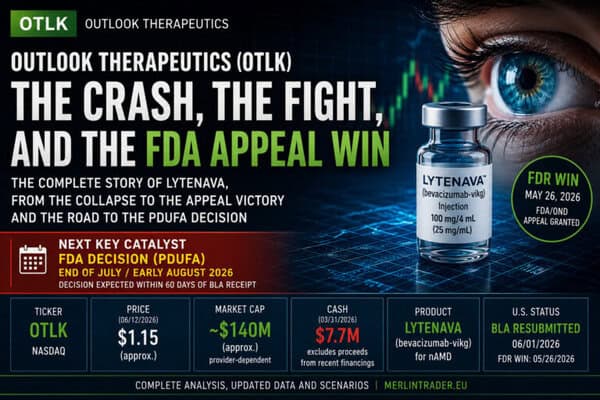
LYTENAVA (ONS-5010, bevacizumab-vikg) is an ophthalmic formulation of bevacizumab for neovascular wet AMD. The US story has already been through two full FDA review cycles:
- First CRL with requests for additional evidence to support efficacy and comparability.
- Second BLA resubmission with an August 27, 2025 PDUFA, which ended in a second CRL over insufficient efficacy evidence.
- After a Type A meeting, Outlook filed an updated BLA that the FDA has accepted as a complete Class 1 response, setting a new PDUFA goal date of December 31, 2025 on a 60-day review clock.
- The underlying issue remains the same: providing robust clinical evidence of efficacy, not just CMC or paperwork fixes.
In parallel, the company has obtained marketing authorization in the EU and started rollout of LYTENAVA in Germany and the UK, with adoption in settings like NHS Scotland.
Here the picture is the opposite of CORT: Outlook is a small-cap essentially focused on a single asset, with limited cash and heavy burn.
- As of late 2025, cash and equivalents are in the tens of millions of USD range, after multiple raises.
- Annual losses remain large, with no other products that could quickly change the equation.
- Medium-term survival hinges on further capital, partnerships, or a much stronger ramp in EU revenue, which is still very early.
This is the textbook “high regulatory leverage + thin cash” setup that speculative retail loves, and most institutional investors treat with significant caution.
Despite the August CRL, the speculative narrative never really died; the new December 31 PDUFA has simply reset the countdown:
- Many posts lean on “already approved in Europe, so it is only a matter of time before FDA says yes”.
- Others treat the stock as a lottery ticket: small float, big volatility, quick in-and-out around any rumor about the new BLA review.
- More technical discussions stress that after two CRLs, a short Class 1 review does not guarantee that the efficacy debate is over.
The “first ophthalmic bevacizumab approved in the EU” angle is objectively strong, but the US remains by far the largest market. Without a credible, durable US path, the investment thesis is radically different.
4. What is really being priced into the December 31 decision?
There is again a date on the calendar. Around the December 31, 2025 PDUFA, the market is watching:
- whether the FDA is willing to clear the updated package without demanding yet another full clinical program;
- whether Outlook can finance any additional requirements without destructive dilution;
- how fast LYTENAVA sales can ramp in Europe and other regulated markets if the US label arrives.
In practice, even with a date back on the table, many remaining holders think in terms of “full recovery or near-zero” over a multi-year horizon, not small percentage moves around the decision.
Tre PDUFA di fine anno: CORT, VNDA e OTLK sotto la lente
Tre storie molto diverse che il retail guarda come “ultimi colpi” di fine 2025: una mid-cap profittevole, una specialty pharma in piena negoziazione con la FDA e una microcap reduce da doppia CRL.
Invece di una lista anonima di date, qui mettiamo il focus sul contesto: come arrivano Corcept Therapeutics (CORT), Vanda Pharmaceuticals (VNDA) e Outlook Therapeutics (OTLK) ai loro eventi regolatori, che tipo di cassa hanno, come ne parla il retail e cosa ha senso aspettarsi a livello di narrativa in caso di esito positivo o negativo.
Relacorilant arriva al filing per la sindrome di Cushing endogena appoggiandosi soprattutto allo studio di lungo periodo GRACE, supportato da GRADIENT, che mostra miglioramenti clinicamente rilevanti su pressione arteriosa, controllo glicemico, peso e composizione corporea rispetto al basale nei pazienti trattati.
- Indicazione: pazienti con Cushing endogeno con segni/sintomi di ipercortisolismo.
- GRACE fornisce il backbone principale per la NDA; GRADIENT aggiunge evidenza su sottogruppi e safety.
- Non tutti i dettagli degli endpoint sono da “poster perfetto”, ma il segnale di efficacia è robusto.
A differenza di molte small cap biotech, qui la PDUFA non è l’unico “all-in”, ma uno step in una piattaforma più ampia basata sulla modulazione del cortisolo, che include anche l’oncologia: Corcept ha già una NDA per tumore ovarico platino-resistente accettata, con PDUFA nel 2026.
Corcept rientra nella categoria rara delle biotech che generano già utili: il farmaco esistente Korlym porta ricavi sostanziali e la società utilizza parte della liquidità anche per buyback.
- Ricavi annui nell’ordine di diverse centinaia di milioni di dollari.
- Cassa, equivalenti e marketable securities nell’ordine dei 500+ milioni di dollari a fine 2025.
- Debito contenuto; il tema non è la sopravvivenza ma la traiettoria di crescita.
Il vero rischio finanziario non è tanto il going concern, quanto il profilo di crescita: quanto la storia si ridimensiona se la PDUFA andasse male e il secondo pilastro relacorilant (Cushing) non si materializzasse.
Nelle discussioni retail la storia viene spesso compressa in due narrazioni estreme:
- Versione bull: “azienda già profittevole + secondo farmaco in Cushing + oncologia in arrivo = rerating strutturale se la FDA approva”.
- Versione bear: “la FDA potrebbe non chiudere un occhio su endpoint mancati o ambigui, e restano i contenziosi legali su Korlym”.
Non mancano i post in stile “no brainer approval”, ma la presenza di ricavi e cassa fa sì che la platea sia più mista rispetto alla microcap classica: accanto agli swing trader ci sono investitori più fondamentali.
4. Cosa aspettarsi in caso di esito positivo o negativo
Se approvato: la narrativa passa da “azienda monogamba su Korlym” a franchise Cushing a due pilastri, con eventuale spostamento di quota prescrizioni verso relacorilant se il profilo di sicurezza/gestione sarà percepito migliore. Gli analisti si concentreranno su:
- dimensione reale del mercato indirizzabile per relacorilant;
- quanta parte del business può migrare da Korlym al nuovo farmaco;
- sinergia con la story oncologica già in fila per il 2026.
Se arriva una CRL: Corcept non sparisce, ma la percezione cambia: vanno ricalibrate le stime di crescita e l’attenzione si sposta su oncologia e resto della pipeline. Il retail tenderà a polarizzarsi fra chi legge la CRL come “incidente di percorso” e chi la vede come segnale che la piattaforma valga meno del previsto.
Tradipitant è un antagonista del recettore NK1 che Vanda sviluppa da anni in più indicazioni. Per la prevenzione della nausea/vomito da motion sickness ha alle spalle due studi di Fase 3 positivi e uno studio di sicurezza in open-label.
- NDA per motion sickness in revisione con PDUFA al 30 dicembre 2025.
- La FDA ha avviato le discussioni di labeling, segno che il processo è in fase avanzata.
- È stato rimosso un partial clinical hold sull’esposizione prolungata, con la FDA che riconosce l’uso prevalentemente acuto/event-driven del farmaco.
Il gancio narrativo è semplice: possibile “primo nuovo farmaco per motion sickness dopo oltre 40 anni” in un’area dominata da antistaminici storici e scopolamina.
Vanda non è una microcap: ha già prodotti come Hetlioz e Fanapt che generano ricavi, anche se la redditività non è particolarmente brillante e i contenziosi legali hanno pesato sulla percezione esterna.
- Cassa, equivalenti e titoli a breve nell’ordine dei circa 300 milioni di dollari a fine 2025.
- Pipeline diversificata (disturbi del sonno, psichiatria, jet lag), ma con vari fronti aperti con la FDA.
- Tradipitant è percepito come catalyst chiave per dimostrare che Vanda sa ancora portare nuove indicazioni fino in fondo.
Su X, Reddit e Stocktwits il tono è quello tipico da “potenziale game-changer di nicchia”:
- Tagline ricorrente: “primo trattamento farmacologico per motion sickness dopo oltre 40 anni”.
- Una parte della community la tratta come giocata binaria di fine anno, con ingressi a ridosso della data.
- Un’altra parte sottolinea il track record regolatorio/legale non sempre lineare di Vanda e il rischio di ulteriori richieste FDA anche a ridosso della PDUFA.
In parallelo si è accesa la narrativa su un possibile uso di tradipitant nella nausea indotta da GLP-1 (farmaci tipo semaglutide), tema che incrocia il filone “obesità” e piace molto al retail più speculativo.
4. Possibili scenari post-PDUFA
Se approvato: Vanda avrebbe in mano un asset differenziante in un’area dove il bisogno non è vitale, ma l’impatto sulla vita quotidiana è concreto (viaggi, crociere, lavoro, sport).
- Essere il primo nuovo trattamento dedicato aiuta il posizionamento di marketing.
- Estensioni logiche verso altre forme di nausea (GLP-1 ecc.) possono ampliare la storia.
- L’esecuzione positiva rafforzerebbe l’idea di Vanda come developer attivo e non solo difensore di prodotti legacy.
Se non approvato o rinviato: la storia rischia di diventare quella di una società che spende molto in R&D senza riuscire a trasformare pipeline in prodotti.
- Il focus si sposta sul costo di un eventuale nuovo ciclo di sviluppo.
- Possibile aumento della pressione degli azionisti sul management.
- La domanda diventa se il portafoglio esistente sia sufficiente a giustificare la capitalizzazione.
LYTENAVA (ONS-5010, bevacizumab-vikg) è una formulazione oftalmica di bevacizumab per la degenerazione maculare neovascolare (wet AMD). Negli USA la storia è già passata per due giri completi con la FDA:
- Prima CRL con richiesta di ulteriore evidenza a supporto di efficacia e comparabilità.
- Seconda sottomissione con PDUFA al 27 agosto 2025, chiusa a fine agosto con una seconda CRL per evidenza di efficacia ritenuta insufficiente.
- Dopo un Type A meeting, Outlook ha presentato una BLA aggiornata che la FDA ha giudicato risposta completa di Classe 1, fissando una nuova PDUFA al 31 dicembre 2025 con finestra di revisione di 60 giorni.
- Il nodo resta lo stesso: fornire dati clinici solidi di efficacia, non solo aggiustare il dossier CMC.
In parallelo l’azienda ha ottenuto autorizzazione all’immissione in commercio in UE e avviato le vendite di LYTENAVA in Germania e Regno Unito, con adozione in contesti come NHS Scotland.
Qui il quadro è diametralmente opposto a CORT: Outlook è una small cap di fatto concentrata su un unico asset, con cassa limitata e forte burn.
- A fine 2025 la cassa ed equivalenti si collocano nell’ordine di poche decine di milioni di dollari, dopo varie raccolte di capitale.
- La perdita annua resta significativa, senza altri prodotti in grado di cambiare rapidamente la situazione.
- La sopravvivenza di medio periodo dipende da ulteriore capitale, partnership, o da una forte crescita dei ricavi UE, ancora all’inizio.
È il prototipo di storia “alta leva regolatoria + cassa corta” che il retail più speculativo ama e che molti istituzionali guardano con grande prudenza.
Nonostante la CRL di agosto, la narrativa speculativa non si è spenta; la nuova PDUFA del 31 dicembre ha semplicemente fatto ripartire il conto alla rovescia:
- Molti post insistono su “già approvata in Europa, quindi è solo questione di tempo perché anche la FDA dica sì”.
- Altri trattano il titolo come lottery ticket: float ridotto, volatilità elevata, ingressi e uscite rapide su ogni rumor relativo alla nuova revisione FDA.
- Nelle discussioni più tecniche si sottolinea che, dopo due CRL, un riesame veloce di Classe 1 non garantisce che il dibattito sull’efficacia sia chiuso.
La narrativa “primo bevacizumab oftalmico approvato in UE” è oggettivamente forte, ma il mercato USA resta di gran lunga il più grande. Senza un percorso USA credibile e sostenibile, la tesi di investimento cambia radicalmente.
4. Cosa sta davvero prezzando il mercato per il 31 dicembre?
C’è di nuovo una data in calendario. Intorno alla PDUFA del 31 dicembre 2025 il mercato guarda a:
- se la FDA riterrà sufficiente il pacchetto aggiornato senza richiedere un ulteriore programma clinico completo;
- se Outlook riuscirà a finanziare eventuali richieste aggiuntive senza diluire in modo distruttivo gli azionisti attuali;
- quanto rapidamente potranno crescere le vendite di LYTENAVA in Europa e in altri mercati regolati nel caso di via libera USA.
In pratica, anche con una data sul tavolo, molti holder rimasti ragionano in termini di “recupero totale o quasi azzeramento” su orizzonte pluriennale, più che di piccole oscillazioni attorno all’evento.







 Monica.im – the AI assistant I use every day