Cannabis Sector Hub
Cannabis Stocks Hub 2026: U.S. Medical Rules, European Risks and Company Updates
Updated October 17, 2026. DEA has filed its response on the September 23 GAO report in the broader Schedule III proceeding, opposing additional briefing while leaving admissibility to the Administrative Law Judge; the filing does not itself lift the stay or finalize rescheduling. Minnesota, Oklahoma, Massachusetts and Washington remain the key recent state developments.
The April medical-cannabis order and broader U.S. rescheduling remain separate. The September 29 DEA stay remains in place in the broad case. A Government response filed October 9 addresses the September 23 GAO report, argues against additional briefing, and leaves admissibility to the Administrative Law Judge; it is not itself a ruling lifting the stay or a final Schedule III decision. The Treasury/IRS priority plan lists future Section 280E guidance, but Merlintrader has found no public announcement of implementation guidance. State rules keep moving independently. Dated sector news below, with official sources where available.
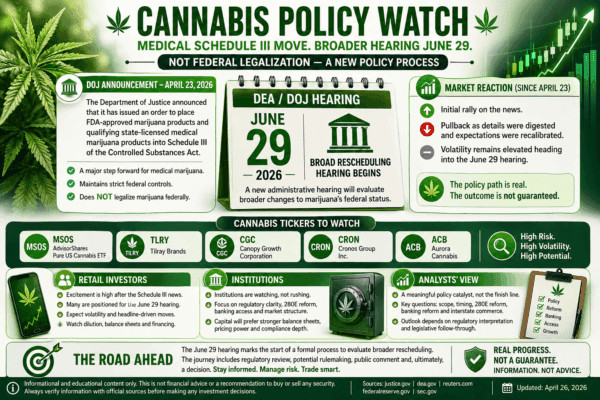
But the importance of this moment is not just political or symbolic. The market reaction reflects something deeper: the possibility that a Schedule III shift could materially change the financial profile of many operators by easing one of the sector’s heaviest structural burdens. That is why this development is being read not simply as another policy update, but as a possible reset point for an industry that has spent years trying to survive.
This does not mean full federal legalization. It does not mean that all companies suddenly become healthy, investable, or equally positioned to benefit. And it does not erase the sector’s long history of weak execution, uneven regulation, excessive dilution, and broken expectations. Many of those issues remain very real.
Even so, the current backdrop matters because it reopens a question the market had increasingly pushed aside: whether cannabis is still a structurally damaged story, or whether policy, discipline, and market selectivity may finally be starting to align in a more meaningful way.
This page is built around that question. Not as a one-day trading post, and not as a promotional page for the sector, but as a long-term reference point for readers who want a broader and more balanced view of the cannabis space, its history, its recurring momentum cycles, its major public names, and the companies that could shape its next phase.
The intention is to make this hub a neutral, objective, and continuously useful information point on the cannabis sector and the stock tickers most directly involved in it. That means following both policy and fundamentals, both opportunity and risk, and both the legacy names that came to define the sector and the emerging stories that may matter in the next cycle.
What this hub will cover
- Major cannabis policy and regulatory developments
- The sector’s historical boom, collapse, and restructuring phases
- The best-known cannabis stocks and the newer names worth watching
- The difference between narrative-driven rallies and structural change
How this page approaches the sector
- With a neutral and data-aware perspective
- Without treating every rally as proof of a full recovery
- Without assuming all companies benefit in the same way
- With attention to both upside, limits, and unresolved risks
The objective is simple: to build a page that remains useful over time for readers looking for a more serious, structured, and objective way to follow the cannabis sector and the companies most exposed to its next chapter.
Sector news · updated October 17, 2026
Cannabis sector news: the dated record
Regulatory, legal and company developments, newest first, each with its date and source; the federal hearing narrative is in the Federal File below. Proposals, effective rules and court steps are labeled as such: a bill or a draft rule is not law, and a stayed proceeding is not a decision.
October 2026
October 14
Illinois — hemp-derived products above 0.4 mg total THC per container become cannabis on November 12Illinois Department of Revenue Bulletin FY 2027-04 implements Public Act 104-0463. Beginning November 12, 2026, consumable or topical hemp products containing more than 0.4 mg of total THC per container — including THCa and specified cannabinoids with similar effects — no longer meet the state definition of hemp and are treated as cannabis. They may be grown only by Illinois Department of Agriculture cannabis cultivators and sold only through licensed cannabis dispensaries under the Cannabis Regulation and Tax Act. Compliant final consumer hemp cannabinoid products remain lawful but are subject to testing, labeling and child-resistant packaging requirements.
Illinois says enforcement begins November 12 regardless of the later federal enforcement timeline. Businesses holding noncompliant inventory face potential seizure and civil or criminal consequences if they possess or sell newly classified cannabis without the required license.
Illinois Department of Revenue — FY 2027-04 · Illinois General Assembly — Public Act 104-0463
October 14
Federal — ALJ grants reply and orders Government response by October 21Administrative Law Judge Derek C. Julius granted leave to file a reply concerning admission of the September 23 GAO report and deferred ruling on whether that report enters the record. The order also directs the Government to respond by October 21, 2026 to the motion seeking to reopen the hearing for additional evidence and testimony. The broader Schedule III proceeding remains stayed; the October 21 deadline is procedural, not a rescheduling decision date.
DEA — NPRM 2026 docket and October 14 order
October 9 — newly published filing
Federal — DEA files response on the GAO report in the Schedule III proceedingIn DEA Docket No. 1362 / Hearing Docket No. 26-96, the Government filed a response addressing the September 23 GAO report that triggered the September 29 stay. DEA argues that the report’s procedural-recordkeeping criticisms do not establish flaws in the scientific findings underlying the proposed move to Schedule III, opposes additional briefing over the GAO report, and leaves admissibility of the report to the Administrative Law Judge. This filing does not itself lift the stay, issue a recommended decision, or finalize rescheduling.
DEA — marijuana rescheduling regulatory actions
October 12
Minnesota publishes required medical-product listOCM published guidance GM-2026-08 on October 12. Medical-endorsed manufacturers must produce high-medical-need products; medical-endorsed retail locations must stock the specified types from January 1, 2027. The list covers CBD-only, high-CBD, balanced THC/CBD and high-THC formulations, with requirements varying by delivery method. Retailers must carry at least one of the listed high-THC types. The listed types currently have no adult-use approval.
Minnesota OCM: GM-2026-08 · OCM: retail start date
October 12
Oklahoma clarifies November 1 packaging transitionOMMA clarified HB 4454 on October 12: products produced, processed, packaged or transferred to dispensaries from November 1 must meet the new requirements. Transfers of noncompliant products are prohibited from that date. Dispensaries may retain, display and sell inventory compliant with the previous labeling rules. Enforcement begins November 1, 2026.
Oklahoma OMMA: HB 4454 clarification
October 9
Massachusetts: cultivation moratorium extended; license-extension conditions updatedThe October 9 bulletin confirms the October 8 vote: the pause on new adult-use cultivator applications and microbusiness applications without majority equity ownership continues through June 30, 2027. Microbusiness applicants majority-owned by eligible SEP participants or EEAs are exempt.
A separate bulletin allows HCA-related license extensions of up to 365 days. New extensions from October 8 require good standing with the Department of Revenue, all required tax returns filed and a prorated fee. Requests must precede expiration; the Commission directs filing at least 14 days ahead. No additional HCA-related extensions will be granted after November 9, 2027; earlier extensions retain their terms until expiry.
CCC: cultivation moratorium · CCC: license extensions
October 9
Washington — medical-cannabis certification rulemaking formally openedThe Washington State Liquor and Cannabis Board filed CR-101 preproposal WSR 26-21-011 on October 9, formally opening rulemaking on Medical Cannabis Certification after accepting the underlying petition on October 7. The project is still at the preproposal stage: no final rule, certificate or effective date exists yet. The state process may create a formal way for licensed operators to document medical-cannabis activities, but it does not by itself guarantee federal DEA registration, banking access or Section 280E relief.
Washington LCB — current rulemaking activity
October 8
Tilray: revenue grows, cannabis sales and adjusted EBITDA declineFor Q1 FY2027 ended August 31, Tilray reported US$257.1 million revenue (+23% year over year), including US$56.1 million cannabis revenue versus US$64.5 million a year earlier. Net loss was US$40.0 million; adjusted EBITDA (non-GAAP) fell to US$9.2 million from US$10.2 million. FY2027 adjusted EBITDA guidance remains US$68–75 million. The results replace the previously scheduled earnings event.
Tilray: October 8 results
October 7 — portal verified
DEA portal lists dedicated medical-marijuana Form 225 categoriesThe DEA’s official new-registration portal now lists Medical Marijuana Manufacturer, Medical Marijuana Distributor and Medical Marijuana Analytical Lab under Form 225, alongside the separate medical-dispensary category under Form 224. This is an operational development for the medical supply chain; the portal’s availability does not establish that an applicant has received a registration. October 7 is our verification date, not a confirmed launch date. It does not resolve the broader rescheduling proceeding or establish new IRS guidance on Section 280E.
DEA: new-registration portal · DEA registration information
October 5–6
Curaleaf raises its Aurora offer and extends it to December 4Curaleaf lifted the cash portion to US$1.00 and the exchange ratio to 0.4013 Curaleaf share per Aurora share, raised the cap to US$6.00 and moved expiry to 11:59 p.m. MT on December 4, 2026. It is an amended unsolicited offer, not an agreed deal.
Curaleaf 8-K, October 6 · Curaleaf announcement (SEC exhibit)
October 5
Ohio — packaging, potency and quantity limits take effectRule 1301:18-4-06 caps THC at 90%, flower at one ounce per package, vapes and other concentrates at 2 g per device or container, adult-use edibles at 10 mg per serving and 100 mg per package, and adult-use beverages at 10 mg per container.
Ohio Admin. Code 1301:18-4-06
October 5
Ohio — new limits on non-cannabis ingredientsRule 1301:18-6-07 bans nicotine, melatonin, alcoholic beverages, dietary supplements and vitamins in cannabis products, allows caffeine only in narrow approved cases, and bars MCT oil, squalene, squalane, vitamin E acetate and propylene glycol from smoked or vaped products.
Ohio Admin. Code 1301:18-6-07
October 5
Ohio — every cannabis ad now needs prior written approvalRule 1301:18-4-22 requires written approval from the Division of Cannabis Control before any ad runs, bans billboards, broadcast, transit and stadium advertising and prize-based promotions such as contests and raffles, and requires age affirmation on licensee websites.
Ohio Admin. Code 1301:18-4-22
October 5
New Jersey — notice of enforcement action against Magic Garden BotanicalsThe official slides of the Cannabis Regulatory Commission’s October 5, 2026 special meeting list matter INV-132-2026, a notice of enforcement action against Magic Garden Botanicals LLC (Cultivator License #C000146). The slides describe the alleged violations as unapproved and unsecured outdoor cultivation on the licensed premises without Commission approval and failure to ensure that plants were properly tracked in Metrc; the item is presented for a Commission vote. As of October 7 the Commission’s resolutions page, which lists 2026 resolutions only through August 6, shows no corresponding resolution, so the outcome and any penalty are not confirmed by an official document.
NJ-CRC — October 5 meeting slides · NJ-CRC — resolutions
October 1
Connecticut — flat 10.75% adult-use cannabis taxA 10.75% tax on gross receipts replaces the THC-based tax; with the 6.35% sales tax and 3% municipal tax, a $22 sale totals $26.43. The Social Equity and Innovation Account share rises from 65% to 70% for fiscal 2027–2028.
Connecticut DRS — cannabis tax · DRS — 2026 tax developments
October 1
Connecticut — out-of-state medical patients can now buyRegistered patients and caregivers from other states may buy up to 5 ounces a month at dispensary facilities and hybrid retailers with their home credential and photo ID; home grow is not allowed, and sales are reported in the state prescription-monitoring system.
Connecticut DCP — out-of-state patients · DCP — out-of-state patient FAQs
October 1
California — new pesticide-testing thresholdsThe DCC rule DCC-2025-03-R is in force: Table 1 action levels apply until April 1, 2028, when new Table 2 action levels and quantitation limits take over. It is separate from the AB 1965 testing law.
California DCC — DCC-2025-03-R
October 1
Maryland — medical-cannabis protection for fire and rescue staffChapter 183 (SB 439) bars discipline of firefighters, EMTs, cardiac rescue technicians and paramedics for holding a valid medical certification or testing positive while certified; employers can still ban on-duty use or impairment.
Maryland General Assembly — SB 439
October 1
Michigan — Muha Meds Ypsilanti license revokedThe Cannabis Regulatory Agency revoked the adult-use retailer license of Budbridge LLC and fined it $251,250 for split transactions that bypassed purchase limits, plus ID, tracking and security violations.
Michigan CRA — final order
October 1
Connecticut — broad October 1 rule packageNew rules on retesting and remediation, 60-day disposal of failed batches, potency caps (flower up to 35% THC, many manufactured products up to 70%, several concentrate categories without a ceiling), 30-day credit limits, single-employee transport under new security rules, wider adult-use access to some medical-only product forms with a 14-day medical priority, 24-hour retention of age-verification data and THC beverages.
Connecticut DCP — notices · DCP — potency thresholds
October 1
New York — provisional retail licenses extended to 2028Resolution 2026-77 moves the provisional-license deadline for CAURD and adult-use retailers from December 31, 2026 to December 31, 2028, including qualifying provisional licenses issued through December 31, 2027.
New York OCM — Resolution 2026-77
October 1
New York — capped nursery-license window from November 5Resolution 2026-76 opens a nursery-license application period on November 5, 2026 that closes after the first 50 submissions.
New York OCM — Resolution 2026-76
October 1
New York — Gotham Buds penalty on sole-control rulesResolution 2026-78 imposes a $35,000 penalty and gives the licensee 90 days to file a revised operating agreement, with escalating penalties and possible suspension if it does not comply.
New York OCM — Resolution 2026-78
October 1
Missouri — testing guidance for ingestible RSO and FECOThese products remain concentrates subject to inhalation testing thresholds; ingestion-only products that fail them but stay below infused-product failure limits may request a variance, which is not automatic and requires ingestion-only instructions.
Missouri DCR — guidance
October 1
Canada — technical amendments effective October 1Health Canada aligned certain Cannabis Regulations provisions with the new Controlled Substances Regulations, a technical compliance change.
Health Canada — updates
Late September 2026
September 30
Missouri — emergency agent-card rule in force; licensing amendments proposedProposed amendments to 19 CSR 100-1.070 and 1.100 are open for comment November 2–December 2, 2026; a separate emergency amendment on agent-card background checks took effect September 30.
Missouri DCR — rule status
September 14–30
Companies — Trulieve, Cronos, Tilray, Canopy, Organigram, AuroraTrulieve joined the S&P Total Market and Completion indices; Cronos held its first Investor Day on September 24; Tilray released fiscal Q1 2027 results on October 8; see the latest entry above; Canopy’s September 25 meeting was adjourned for lack of quorum and reconvenes October 23; Organigram held its investor session on September 30; Curaleaf (September 14) and Aurora (September 23) filed applications with the Alberta Securities Commission over Aurora’s ATM share issuances and Curaleaf’s bid circular.
Trulieve — index inclusion · Cronos — Investor Day · Tilray — results date · Curaleaf notice of variation (ASC application)
September 29
Federal — DEA stays the broader rescheduling hearingThe Chief ALJ paused the case while weighing a motion to add the September 23 GAO report to the record; government responses are due October 13. It is not a rejection of Schedule III, and the April medical order remains a separate track. As of October 6 no later DEA step was posted.
DEA — rescheduling actions · Stay and Briefing Order (PDF)
September 29
Michigan — 20 grower licenses revoked and a $2 million fineGP Holdings LLC (Millie Montana Industries) lost 20 medical Class C grower licenses and was fined $2 million after an administrative law judge recommended liability for all 35 alleged violations, including flower packages that contained no THC.
Michigan CRA — announcement
September 29
IRS — Section 280E enters the priority guidance planThe 2026–2027 Treasury/IRS plan lists future 280E guidance as a work priority with no deadline; no implementation guidance has been issued, and Bulletin 2026-41 contains none.
Treasury/IRS — priority plan · IRS — Bulletin 2026-41
September 29
Pennsylvania — Ryan’s Law clears committee, not enactedSB 1035, on compassionate medical access for terminally ill patients in health-care facilities, passed the Senate Law & Justice Committee 11-0; it has not passed the full Senate.
Pennsylvania General Assembly — SB 1035
September 27
California — AB 1965 and AB 2250 signedAB 1965 adds off-the-shelf testing, certificates of analysis on request and laboratory performance testing; AB 2250 clarifies cannabinoid enforcement and excludes qualifying CBN isolate from “cannabis concentrate” from January 1, 2028.
AB 1965 · AB 2250
September 26
Montana — third-party and operational-control rules in forceLicensees must disclose covered third-party arrangements before work begins and identify every person with day-to-day operational control and document their Montana residency, updating the state within 30 days of a change.
Montana DOR — third-party relationships · Montana DOR — operational control
September 26
Canada — Health Canada proposes simpler tracking reportsA Canada Gazette I proposal would cut inventory classes from 14 to seven and repeal federal tracking reports for provincial bodies, distributors and retailers; comments are due November 10, 2026. Federal licence-holder changes would apply from January 1, 2028.
Canada Gazette — proposed order
September 25
Massachusetts — discount advertising still restrictedA Commission bulletin confirms that adult-use websites and menus may not advertise sales, discounts or promotions; a broader regulatory overhaul is heading to draft votes in December.
CCC — advertising bulletin · CCC — regulatory overhaul
September 18–25
North Carolina and Pennsylvania — policy work, no market openingNorth Carolina’s advisory council published draft licensing recommendations, and Pennsylvania’s Senate Democratic Policy Committee held an adult-use hearing; neither creates a legal market.
NCDHHS — advisory council · Pennsylvania Senate — policy hearings
Late September
Maryland — draft rule amendments, not yet effectiveDraft changes to COMAR 14.17 cover conditional licenses, ownership transfers, the micro-dispensary staff cap, advertising and labeling; the informal-feedback deadline was October 7 and a formal comment period would follow.
Maryland Cannabis Administration — draft regulations
September 23
Federal — GAO finds gaps in DEA and FDA scheduling proceduresThe GAO recommended formal scheduling procedures and the agencies agreed; the report does not decide marijuana’s schedule.
GAO-26-108623
Early and mid-September 2026
September 16
Federal — CLAIM Act reintroducedThe bill would shield insurers serving state-legal cannabis businesses from certain federal liability; it is a proposal, not law.
U.S. House — announcement
September 8–16
Companies — Aurora, Tilray and Cronos updatesAurora reaffirmed expected sequential growth for fiscal Q2 2027; Tilray issued 2,841,650 shares in exchange for US$12 million of notes due June 2027; Cronos extended the CanAdelaar long-stop date to October 15.
Tilray filing · Cronos 8-K · Aurora release (SEC)
September 15
Supreme Court — residency-preference petition docketedPeridot Tree’s petition (No. 26-343) challenges in-state preferences in cannabis licensing; a response is due October 15 and the Court has not agreed to hear the case.
Supreme Court docket
July 29 / September 15
Germany — flower out of statutory reimbursement; access curbs only proposedSince July 29 cannabis flower is no longer reimbursed by statutory health insurance, while extracts and specified medicines remain covered; proposed doctor-contact and mail-order limits are not yet law.
German Health Ministry · SGB V §31
Mid-September
Florida — 22 new initial medical treatment-center licensesThe state listed licenses MMTC-2026-0029 to 0050; each still needs cultivation, processing and dispensing approvals before selling, and the related application rule is only proposed.
Florida OMMU — MMTC list · OMMU — notices
September 9–14
Netherlands and France — evidence and transition, not a market openingThe Dutch WODC follow-up found no clear effects yet from the regulated-supply experiment; France keeps trial patients in a transition until after the forthcoming HAS opinion.
WODC · French government
September 14
Maryland — final cannabis regulations effective September 14A final package on licensing, operations, products and packaging, including sublingual pouches, took effect September 14.
Maryland Register — final action
September 11
Rhode Island — December 11 deadline for over-limit hemp productsBulletin 2026-7 requires licensed hemp businesses to remove products above 0.4 mg total THC per container before December 11, 2026; the Commission notes the date could shift with further federal delay or guidance.
Rhode Island CCC — bulletins
September 4–11
Nebraska — medical-cannabis laws survive two challengesThe Supreme Court affirmed the ruling in Kuehn v. Evnen and dismissed Kuehn v. Pillen for lack of standing, without prejudice; implementation continues.
Kuehn v. Evnen · Kuehn v. Pillen
September 10
Illinois — 37 dispensaries licensed to serve medical patientsExisting adult-use dispensaries received medical licenses under the SB 3222 opt-in, the largest expansion of medical access in about a decade.
Illinois Governor — announcement
September 9
Federal — appeals court declines to stay the April medical orderThe D.C. Circuit denied a stay of the order moving FDA-approved and state-licensed medical marijuana products; the merits challenge continues.
DOJ — scope of the medical order · D.C. Circuit docket
September 9
Virginia — draft retail-market rulesThe Cannabis Control Authority released draft retail regulations; the official timeline targets retail sales from July 1, 2027.
Virginia CCA — retail timeline
September 8
Federal — GAO: cannabis banking access remains difficultGAO-26-107498, dated August 7 and released September 8, documents continuing barriers to accounts, loans and payments for state-legal cannabis businesses; it does not change banking law.
GAO-26-107498
September 2–8
Companies — Aurora and Curaleaf set out their positions on the bidAurora’s board recommended that shareholders reject Curaleaf’s offer on September 2; Curaleaf replied the same day and issued a fact sheet on September 8. These are the parties’ own positions.
Aurora — SEC · Curaleaf — September 2 · Curaleaf — September 8
September 4
Ohio — injunction limits SB 56 hemp enforcement for plaintiffsA federal court protected the named plaintiffs from enforcement of SB 56’s amended hemp definition while their products remain federally lawful; SB 56 is not struck down statewide.
Court order, Doc. 50
September 3
Connecticut — medical sales without a pharmacist on siteTrained registered employees at hybrid retailers and dispensary facilities may complete medical sales without a pharmacist physically present, subject to training, audit and pharmacist-availability requirements.
Connecticut DCP — notices
September 2
Federal — hemp deadline partly extended into lawH.R. 6500, signed September 2, postpones most federal hemp restrictions from November 12 to December 11, 2026; limits on cannabinoids the plant cannot naturally produce keep the November 12 date.
White House · Text, Section 2019
Earlier context still relevant
August 31
California — AB 2249 on youth-appealing marketingThe law tightens packaging, labeling and advertising rules that appeal to children; most changes become operative in 2028.
Governor of California
June 24–25
Federal — SAFE Banking Act introducedS.4942 and H.R.9471 would give banks protections for serving state-legal cannabis businesses; both are proposals, not law.
Senate bill · House bill
Company-specific detail is in the individual stock hubs listed in the directory at the top of this page.
Sector Context
Scope of the historical discussion below: conditional references to a Schedule III move concern broader rescheduling and its possible extension beyond the medical categories already covered by the April order. Company-specific tax treatment is not established by a sector headline.
How the Sector Got Here, and What Schedule III Would Actually Change
The policy question only makes sense against the sector’s own history. Four phases explain why cannabis equities trade the way they do.
To understand why the current policy shift matters, it helps to remember how the cannabis sector got here: through one of the most aggressive hype cycles of the past decade, followed by years of disappointment, dilution, and broken expectations.
Cannabis has already lived through multiple lives in the public market. It has been treated as a legalization revolution, a retail-momentum obsession, a speculative bubble, a growth story, a policy trade, and later as a cautionary tale in capital destruction. That history matters because today’s enthusiasm is not arriving in a vacuum. It is arriving in a sector that has already burned through several cycles of hope.
For a period, the industry was one of the market’s most powerful thematic trades. Investors looked at expanding legalization, growing public acceptance, and the prospect of a massive North American market and concluded that cannabis companies were early-stage leaders of a future consumer and healthcare category. For a while, the market rewarded that belief aggressively.
Phase 1
The boom: legalization optimism and momentum-driven valuations
Between the late 2010s and the first major legalization waves, cannabis became one of the market’s purest momentum stories. Names such as Canopy Growth, Aurora Cannabis, and Tilray turned into symbols of a new sector that many believed could scale rapidly across recreational, medical, consumer packaged goods, and international markets.
Valuations expanded much faster than business quality. Capital was abundant, expectations were enormous, and the market often priced the industry as if large-scale legalization and easy growth were only a matter of time.
Phase 2
The collapse: oversupply, weak execution, dilution, and fading trust
What followed was a painful unwind. Many companies were not prepared for the operational complexity of the business they had promised. Oversupply hit several markets. Margins disappointed. Cost structures remained heavy. Regulatory fragmentation made scale harder than expected. And as financing conditions changed, dilution became a recurring feature rather than an exception.
The result was severe capital destruction. Share prices collapsed, credibility deteriorated, and much of the sector shifted from “future growth leader” status to a collection of distressed or deeply discounted stories struggling to prove they could survive.
Phase 3
The survivors: a more selective market begins to emerge
Over time, the story changed again. The market became less interested in broad cannabis enthusiasm and more focused on which operators had discipline, geographic advantages, medical exposure, better balance sheets, or a more realistic path to sustainable cash generation. That did not fix the sector, but it did begin to separate legacy hype from actual resilience.
In that environment, the sector stopped looking like a single uniform trade. U.S. operators, Canadian LPs, hybrid retail-platform models, and internationally exposed medical players increasingly had to be evaluated on very different terms.
Phase 4
The current moment: not a clean slate, but a genuine reopening of the story
That is why the current Schedule III discussion matters. It does not erase the sector’s failures, and it does not guarantee a new bull market. But it does reopen the possibility that cannabis may once again be judged not only through the lens of past disappointment, but also through the lens of meaningful structural change.
If the policy backdrop improves while a more selective and disciplined market framework is already in place, then the next phase of the sector may look very different from the last one. Less fantasy-driven, more financially grounded, and more uneven across individual names.
The history of cannabis stocks is not just a story of hype and collapse. It is also a story of recurring reinvention. The question now is whether this new phase will produce another temporary momentum wave — or the first truly more durable reset the sector has seen in years.
That history is the reason the current policy debate matters, and also the reason it is not a solution on its own. Here is what a move to Schedule III would genuinely change, and what it would leave untouched.
The possible move from Schedule I to Schedule III matters because it could improve the operating and financial profile of the sector in ways that go far beyond headline psychology. But it is just as important to understand what this shift would not solve.
For years, one of the biggest structural pressures on U.S. cannabis operators has not simply been stigma or limited institutional participation. It has been the harsh financial reality of operating in a federally prohibited category while still trying to function as a normal business. That is why the current Schedule III discussion matters so much: it raises the possibility of a tangible improvement in how the sector is treated at the federal level, especially on the tax side.
If cannabis were moved to Schedule III, the biggest immediate read-through would likely be on tax treatment, earnings quality, and cash-flow sustainability. That is the part of the story the market is reacting to most aggressively, because it speaks directly to survival, not just symbolism.
What could materially improve
- Tax burden: a Schedule III move could reduce the extreme pressure linked to Section 280E, which has long prevented normal operating deductions for many U.S. cannabis businesses.
- Profitability optics: if effective tax rates improve, reported earnings and operating leverage could look materially different for some companies.
- Cash generation: less tax distortion could improve free cash flow, balance-sheet flexibility, and near-term financial resilience.
- Sector legitimacy: even without full legalization, a lower schedule could help shift perception among investors, lenders, and counterparties.
- Research backdrop: the sector could also benefit from a more workable framework for scientific and medical research over time.
What would still remain unresolved
- No full federal legalization: Schedule III would not mean a fully legal national cannabis market.
- No automatic banking revolution: access to capital and traditional banking could improve at the margin, but many constraints would still remain.
- No clean interstate commerce framework: the market would still be fragmented by state-level rules and federal contradictions.
- No universal company reset: weak operators would still face the consequences of dilution, leverage, poor execution, or bad capital allocation.
- No instant end to complexity: regulatory, legal, political, and operational friction would still remain part of the sector’s DNA.
In other words, Schedule III is not a magic solution. It would be more accurate to view it as a structural upgrade that could make the sector more financially workable, while still leaving major pieces of the broader legal and commercial framework unresolved.
That distinction matters because cannabis stocks have repeatedly rallied in the past on narratives that sounded transformative but later proved incomplete. This time, the potential benefit appears more concrete than many earlier headline cycles, but that does not mean it should be exaggerated into a full reset of every problem the sector has accumulated.
The names most likely to benefit would not necessarily be the loudest or most speculative. In many cases, the more important beneficiaries could be the operators whose businesses are already functioning at a meaningful scale, but whose reported economics have been heavily distorted by the federal tax structure. For those companies, policy does not need to become perfect to become highly relevant.
The key takeaway is simple: Schedule III would not finish the cannabis story, but it could materially improve the economics of surviving in it. That is why the market is reacting so strongly — and why the next phase of the sector may increasingly depend on which companies can convert policy relief into real operating strength.
And here is the honest version of the argument on both sides: the reasons this cycle could break the pattern, and the reasons it may not.
Cannabis has already gone through multiple cycles of optimism and disappointment. Each time, the narrative sounded compelling. Each time, reality proved more complex. The current moment raises a familiar question: is this the beginning of a new phase — or just another temporary rotation?
There are reasons to take the current setup more seriously than in the past. For the first time in years, the discussion is not centered only on legalization headlines or speculative demand projections, but on actual structural changes that could improve the financial mechanics of the sector.
Why this cycle could be different
- Potential improvement in tax treatment, directly impacting profitability
- More selective market after years of capital destruction
- Stronger focus on execution, margins, and cash flow
- Clearer separation between resilient operators and weaker structures
- Reduced reliance on pure narrative-driven valuation expansion
Why it may not be
- Policy momentum may still fall short of full structural reform
- Banking and regulatory complexity remain unresolved
- Retail-driven momentum could dominate again in early phases
- Weak balance sheets and dilution risk are still present
- The sector has repeatedly overestimated the pace of change
In that sense, the most realistic view may not be fully bullish or fully skeptical. The cannabis sector does not need perfect conditions to improve. It only needs enough structural relief to make survival less punitive and capital allocation more rational.
What happens next will likely depend less on broad sector enthusiasm and more on individual company positioning. The next phase may not reward “cannabis” as a theme, but rather specific operators with the right structure, discipline, and exposure.
The key takeaway is not that the sector is “fixed,” but that it may finally be entering a phase where differentiation matters more than narrative. And in that kind of environment, the outcome is rarely uniform — but often more meaningful.
News Timeline
The Story in Motion: the 2026 Federal File
What follows is the part of the story that has not been resolved yet. It is kept in date order, and it is updated as the file moves.
This section is the running account of the federal cannabis story: what has actually happened, in order, with the dates that can be checked against primary sources. It is updated as the file moves, so a reader arriving today does not have to reconstruct eight months of headlines. Historical snapshot as of September 11, 2026; see the October 4 update below for the current federal status.
April 23
One order splits the file in two
Acting Attorney General Todd Blanche signed a final order placing FDA-approved marijuana products, and marijuana products sold under a state medical license, into Schedule III. At the same time he opened an expedited administrative hearing on the broader question: whether marijuana as a whole should move out of Schedule I.
From that day the story stopped being a single question and became two. One piece was already in force and immediately real for medical operators. The other was still to be argued, and it is the one the market has been trading ever since. The distinction matters because headlines routinely collapse the two into a single word, rescheduling, as if one outcome settled both.
The same week, Treasury and the IRS said tax guidance would follow, including how Section 280E applies to businesses that run several activities at once and a transition rule tied to the first full taxable year containing the effective date of the order. Tax treatment, not scheduling language, is where the cash difference lives.
May
The order goes to court before it goes to market
Three petitions challenging the April order reached the D.C. Circuit and were consolidated: Smart Approaches to Marijuana together with the National Drug and Alcohol Screening Association on May 4; Indiana, Nebraska and Louisiana on May 22, with Louisiana later withdrawing; New Directions Addiction Recovery Services on May 28.
At that stage, the court had not reached the merits and was working through threshold questions: whether any petitioner had standing, whether implementation should be paused while the case proceeded, and whether supporters of rescheduling could intervene. Update: the September 9 order denied the stay and the companies’ intervention request, allowed amicus participation, and left the merits unresolved. This is the part of the story that moves without any announcement, and it can produce a headline on a day when nothing else is scheduled.
June 29 – July 15
Two weeks in a room with no cameras
The evidentiary hearing ran at the DEA hearing facility in Arlington, Virginia, presided over by Chief Administrative Law Judge Derek C. Julius. The government appeared as the formal proponent of Schedule III. The seven designated participants selected by the agency came from drug-testing interests, law enforcement, opposing states, physicians and impaired-driving advocates. No outside organization supporting the change was on the list.
There was no livestream, phones and recordings were barred, and information reached the outside world through official orders, attorneys and reporters in the room. The hearing closed on schedule and produced no ruling. That combination, high stakes and low visibility, is what made the following weeks so easy to fill with rumor.
July
A deadline appears, and a separate risk turns out to have died months earlier
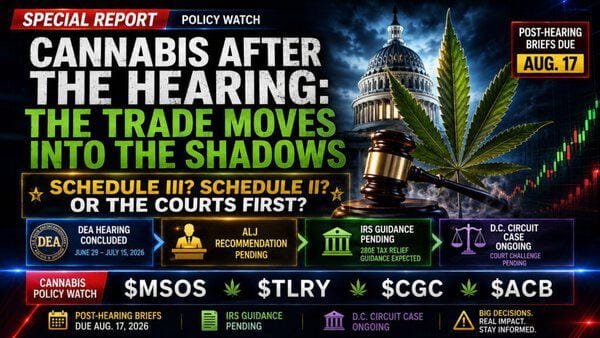
Chief Administrative Law Judge Derek C. Julius signed a July 16 order setting August 17 for optional transcript corrections and optional post-hearing briefs. The order is now posted on the DEA’s official rescheduling page and limits briefs to fifty double-spaced pages, in 12-point type with one-inch margins. This confirms the procedural deadline; it is not a recommended decision and does not determine the final rule.
Two other things happened in July that belong in the record. The congressional attempt to defund rescheduling, approved in committee last September, had already been dropped from the bicameral spending deal in January and the House passed the final text 397 to 28, leaving the long-standing protection for state medical cannabis laws in place. And on July 16 Senate Democrats filed the Cannabis Administration and Opportunity Act, which would remove cannabis from the Controlled Substances Act entirely. Neither event changes the DEA proceeding. The first removed a risk the market never priced; the second is a marker, not a path.
Late July
The numbers arrive, and the story leaves the courtroom
While the policy file went quiet, the companies reported. Tilray closed fiscal 2026 with record net revenue of $915.5 million and record adjusted EBITDA of $61.1 million on July 28. SNDL published second-quarter results the same day, having closed the Parallel asset acquisition on July 27. Aurora headed into its first quarter of fiscal 2027 after its Safari Flower Company subsidiary secured EU-GMP certification.
Away from the tickers, the first second-order effects of the April order started to surface. The FAA said it is weighing new marijuana standards for pilots and air traffic controllers. Hemp restrictions produced a wave of state-level litigation, with new rules taking effect in Texas and businesses suing officials in Virginia, where the attorney general also opened an enforcement effort. Delaware moved the other way and signed a law regulating and taxing hemp THC drinks. The pattern is consistent: the federal decision is stalled, and the practical consequences are being written elsewhere.
August 2
The hemp deadline moves, and the trade-off is not the obvious one
Senate Appropriations leaders released the text of a continuing resolution funding federal agencies through December 11. Inside it are provisions delaying the redefinition of hemp, the rule that from November 12 would have limited legal hemp products to 0.4 milligrams of total THC per container, to the same December 11 date. The delay carries a carve-out: synthetic cannabinoids that a cannabis plant cannot naturally produce would still be recriminalized on November 12 as originally planned.
Two qualifications matter. The House has already passed its own version of the resolution with no hemp language, so the provision has to survive another vote in both chambers before it becomes law. And the effect on licensed marijuana operators is not straightforward: survey work published in late July found that state hemp bans push consumers toward licensed marijuana retailers, which means a delay of the federal ban postpones a competitive tailwind rather than removing a threat.
August 5–11
Results improve selectively, then Curaleaf targets Aurora
Aurora reported C$67.6 million of first-quarter fiscal 2027 net revenue, including C$43.3 million from international medical cannabis, with C$3.4 million of adjusted EBITDA, negative C$5.8 million free cash flow and C$149.1 million of cash and short-term investments with no debt. Canopy Growth reported C$81.2 million of revenue, up 13 percent, a 31 percent adjusted gross margin and a C$3.2 million adjusted EBITDA loss; free cash outflow widened to C$25.7 million.
Cronos posted record second-quarter net revenue of US$53.0 million and US$13.1 million of adjusted EBITDA, backed by US$827.0 million of cash, short-term investments and deposits. Organigram reported record third-quarter net revenue of C$105.8 million and C$13.4 million of adjusted EBITDA, but free cash flow remained negative C$3.9 million; its C$105.5 million net income was driven mainly by non-cash fair-value gains.
On August 11 Curaleaf announced an intention to launch an unsolicited bid for Aurora. The stated terms are 0.3463 Curaleaf subordinate voting share plus US$0.75 in cash for each Aurora share, with an indicated value of US$4.00 and a US$5.00 cap. The bid was formally commenced on August 18, when Curaleaf filed the offer and circular with the SEC on Schedule 14D-1F and Form F-80. It was originally set to expire at 5:00 p.m. Mountain Time on December 1, 2026 (October 6 update: Curaleaf has since raised the offer to US$1.00 in cash plus 0.4013 Curaleaf share per Aurora share, with a US$6.00 cap, and extended expiry to December 4; see the October 5–6 entry in the sector news), and carries no financing or due-diligence condition, and as of August 19 Aurora has filed no formal response.
SNDL also completed the EU-GMP audit of its Atholville facility. Certification is expected within 90 days but had not yet been issued as of August 13.
Primary sources:
Aurora results,
Canopy results,
Cronos results,
Organigram results,
Curaleaf proposal,
Aurora response, and
SNDL audit update.
August 13
The DEA deadline is official; the broad decision is still open
The DEA has now posted Judge Julius’s order for transcript corrections and post-hearing briefs. Optional corrections and briefs are due August 17, and briefs may not exceed fifty pages. That removes the earlier source gap around the deadline.
The key distinction has not changed: there is still no recommended decision and no final rule rescheduling marijuana as a whole. The next federal headline can move the sector, but the official record does not yet support claims that the outcome is settled.
DEA rescheduling docket ·
July 16 order (PDF)
August 17
Every party files, and the evidentiary record closes
The post-hearing briefs were filed on the deadline, and they run to 274 pages in total. The Government brief, signed by James J. Schwartz and Jarrett T. Lonich, asks the tribunal to recommend that marijuana be transferred from Schedule I to Schedule III. Against it stand a joint brief from Smart Approaches to Marijuana together with Idaho, Indiana and Nebraska, signed by John M. McNichols and Patrick F. Philbin, and separate briefs from the Tennessee Bureau of Investigation, the National Alcohol and Drug Screening Association, DUID Victim Voices with Kenneth Finn, and the pharmacist Phillip Drum, whose filing is dated August 14. Louisiana, designated in April, had already withdrawn in June by order of the judge, which is why it does not appear in the joint state brief.
The legal fight is narrower than the public argument. It turns on currently accepted medical use, and on which test measures it. The opposing parties argue that the traditional five-part test is the correct one and that marijuana fails it. The Government replies that an Office of Legal Counsel opinion binding on the DEA found the five-part test insufficient because it ignores state-sanctioned medical use, and that the two-part test used by HHS is legally sufficient. On the factual side the Government leans on the HHS review: more than 30,000 practitioners treating over six million patients across 43 jurisdictions, which in its reading defeats the lack-of-accepted-safety finding required for Schedule I. The opponents answer that the proponent of rescheduling carries the burden of proof under 21 C.F.R. 1316.56 and has not met it, and one of them adds a jurisdictional argument: that the Attorney General had no authority to issue the notice of proposed rulemaking at all, which would make any resulting rule contrary to law under the Administrative Procedure Act.
Two points frame what happens next. The briefs are closing arguments, not a decision: what comes next is a recommended decision from the Chief Administrative Law Judge, then twenty days for exceptions, then the DEA Administrator, and none of those steps has a date. And the briefs themselves are still not published on the DEA page, which now lists procedural orders and all eleven corrected hearing transcripts, so the filings continue to circulate as a document set published by trade press rather than through the agency.
DEA rescheduling docket ·
Post-hearing briefs report (Marijuana Moment)
August 28
Status report: the corrected record is public, but the legal and tax catalysts are still pending
On August 20 Chief Administrative Law Judge Derek C. Julius ordered corrections across all eleven hearing days after reviewing submissions from the Government and several opposing parties. The thirteen-page order describes misattributions, mistranscriptions and spelling errors; the DEA then published the corrected Day 1 through Day 11 transcripts by the August 26 deadline. Most changes are technical, but several alter meaning: examples include “CS-III” becoming “CS-I,” “illegal” becoming “legal,” “increase” becoming “decrease,” 0.2 becoming 0.02, and “there’s adulterants” becoming “there’s no adulterants.” The corrected versions, not earlier drafts or social-media excerpts, are now the record to use.
This completes a record-quality step; it does not decide the case. As of August 28 the DEA page contains the correction order, the eleven corrected transcripts and procedural orders, but no recommended decision and no final rule moving marijuana as a whole to Schedule III. The sequence is still a recommended decision, twenty days for exceptions, and then action by the DEA Administrator, with no fixed date for any of those steps. The 274-page post-hearing brief set also remains outside the official DEA page: the Government asks for Schedule III, while all seven outside designated participants oppose the move.
The implementation gap is just as important. Treasury and the IRS announced on April 23 that Section 280E guidance would address mixed medical/adult-use businesses and a transition rule. The authoritative IRS bulletin published through IRB 2026-35, dated August 24, contains no 280E, marijuana, cannabis or Schedule III guidance. The April medical categories remain in force, but the allocation and transition mechanics are not final until the promised guidance is actually published.
Political pressure has increased without changing the law. In an August 18 letter, Representatives Dina Titus, David Joyce, Ilhan Omar and Greg Steube asked the Administration to answer by September 30 how the medical Schedule III framework affects patient and caregiver cultivation, mixed licences, 280E relief, DEA registration and enforcement, Medicare or insurance coverage, and privacy. The letter creates an information deadline, not a rule or a guaranteed outcome.
A separate hemp track also remains open. The Senate passed amended H.R. 6500 by 90–6 on August 8; Section 2019 would defer most of the new federal hemp restrictions from November 12 to December 11, while leaving specified synthetic-product restrictions on the earlier timetable. The House has not concurred in the Senate amendment, so the delay is not law as of August 28 and November 12 remains the operative statutory date. This funding-bill issue is separate from the DEA’s broader marijuana case.
September 9 update: the legislative status described here as of August 28 was superseded by the signing of H.R. 6500; see the September 2 entry.
The market read-through is therefore procedural rather than a new cash-flow catalyst. The corrected transcripts improve the reliability of the record, but they do not themselves switch off 280E. U.S. multi-state operators and the MSOS basket remain the direct tax-sensitive exposure if usable relief is confirmed; Tilray, Canopy Growth, Aurora and Cronos remain primarily headline, sentiment and capital-flow exposures to the federal file rather than automatic beneficiaries of U.S. 280E relief.
DEA docket and corrected transcripts ·
August 20 correction order (PDF) ·
Treasury/IRS 280E announcement ·
IRB 2026-35 (PDF) ·
Senate-amended H.R. 6500 ·
Senate vote 228 ·
August 18 House letter report (Marijuana Moment)
Merlintrader background: inside the 274-page post-hearing brief set ·
what moved after the DEA hearing
September 2
Hemp: the partial extension becomes law
H.R. 6500 is law: the White House announced the signature on September 2. Section 2019 postpones most federal hemp restrictions from November 12 to December 11, 2026. The November 12 timetable remains for the exceptions covering products containing cannabinoids the plant cannot naturally produce. This is a partial, temporary extension, separate from the DEA marijuana proceeding.
The continuing resolution funds federal activities through December 11: September 30 remains the fiscal year end, but is no longer the current funding deadline.
White House · Text, Section 2019
September 2–8
Aurora and Curaleaf: the two positions on the bid
Aurora released its board’s unanimous recommendation to reject the bid on September 2. Curaleaf responded on September 2 and issued a September 8 fact sheet challenging Aurora’s arguments and defending its proposal. These are the parties’ positions: the releases announce neither a completed merger nor increased consideration.
Aurora — SEC · Curaleaf — September 2 · Curaleaf — September 8
September 8
GAO: banking access remains difficult
GAO-26-107498, dated August 7 and publicly released September 8, documents continuing barriers to accounts, loans and payments for U.S. cannabis businesses. Compliance costs and legal risks remain relevant. The report does not enact banking reform.
GAO-26-107498
The next price-sensitive headline does not have to come from the administrative law judge. Three other channels are live, and two of them have already produced concrete action.
The first is tax. Treasury and the IRS have said guidance is coming on how Section 280E applies after the April order, including apportionment for businesses that hold both medical and adult-use licences. For operators still filing under 280E, that guidance is worth more than any scheduling wording, because it decides how much cash the business keeps.
The second is the D.C. Circuit, where the consolidated challenge to the April order remains a separate live risk. A ruling there would not be about whether cannabis is dangerous; it would be about whether the Attorney General had the authority to reschedule a subset of marijuana by category of licence. Update as of September 11: the D.C. Circuit denied the motion for a stay on September 9, leaving the April medical order in effect while the litigation continues. This is not a final ruling on the merits or a decision rescheduling marijuana as a whole. An adverse ruling would reach back into a piece of the case the market already treats as settled. Public docket mirror.
The third is the health bureaucracy. In April the Centers for Medicare and Medicaid Services launched an initiative covering up to $500 a year of hemp-derived products for eligible Medicare patients, focused on CBD but allowing up to 3 milligrams of total THC per serving. A lawsuit by legalization opponents seeking to stop it was dismissed and is now on appeal. This is the least discussed part of the story and the only one that has already moved federal money.
| Date | Event | Status |
|---|
| August 5, 2026 | Aurora Q1 FY2027: C$67.6m revenue; C$3.4m adjusted EBITDA; C$149.1m liquidity; no debt | Released |
| August 6, 2026 | Cronos Q2: record US$53.0m revenue; US$13.1m adjusted EBITDA | Released |
| August 7, 2026 | Canopy Q1 FY2027: C$81.2m revenue; 31% adjusted gross margin; C$3.2m adjusted EBITDA loss | Released |
| August 11, 2026 | Organigram Q3: record C$105.8m revenue; C$13.4m adjusted EBITDA; negative C$3.9m free cash flow | Released |
| August 11, 2026 | Curaleaf announces its intention to bid for Aurora; the formal offer follows on August 18 (expiry later extended to December 4) | Proposed |
| August 17, 2026 | Post-hearing briefs filed: the Government asks for Schedule III, all seven designated parties ask that marijuana stay in Schedule I | Filed |
| August 18, 2026 | Curaleaf formally commences the take-over bid for Aurora; offer originally open to December 1, 2026, extended October 6 to December 4 | Commenced |
| August 20–26, 2026 | The ALJ orders transcript corrections; the DEA publishes all eleven corrected hearing days | Completed, procedural |
| September 2, 2026 | H.R. 6500 signed | Enacted |
| September 14–15, 2026 | High Tide: previously announced Q3 results/webcast dates, September 14–15 (past calendar entry) | Historical schedule announced August 25 |
| September 25, 2026 | Canopy meeting adjourned for lack of quorum | Past event; reconvenes October 23 |
| September 30, 2026 | Response date requested by four bipartisan House members on 280E, registration, patients, coverage and enforcement | Past requested deadline; no outcome established here |
| September 30, 2026 | Organigram: OG Investor Session, 4:00 p.m. ET | Session held; company follow-up confirms the event |
| October 7, 2026 | Maryland — informal feedback on draft amendments | Past informal-feedback deadline; not an adoption |
| October 8 2026 | Tilray Q1 FY2027 results | Released October 8 |
| October 13 2026 | Government response to DEA motion; not a decision date | Scheduled / conditional as described |
| October 15 2026 | SNDL shareholder vote on proposed consolidation | Scheduled / conditional as described |
| October 15 2026 | CanAdelaar contractual long-stop; not guaranteed closing | Scheduled / conditional as described |
| October 15 2026 | Peridot Tree: response due on certiorari petition | Scheduled / conditional as described |
| October 23 2026 | Canopy reconvened meeting 1 p.m. ET; proxy deadline 9 a.m. ET | Scheduled / conditional as described |
| November 3 2026 | Curaleaf Q3 results after close; call 5 p.m. ET | Scheduled / conditional as described |
| November 10 2026 | CTSO proposal: 45-day consultation ends | Scheduled / conditional as described |
| November 12 / December 11, 2026 | Hemp: partial extension to December 11; exceptions for cannabinoids the plant cannot naturally produce remain on November 12 | Enacted |
| November 18 2026 | Tilray annual meeting, 11 a.m. EST | Scheduled / conditional as described |
| December 4, 2026 | Curaleaf offer expiry, 11:59 p.m. MT, extended on October 6 from December 1; subject to its terms | Scheduled / conditional as described |
| December 11, 2026 | Current federal funding deadline following H.R. 6500 | Signed into law |
| No fixed date | Recommended decision, then 20 days for exceptions, then the DEA Administrator | Open |
How the market has actually priced all this: between July 24 and August 3, Tilray rose 19.6 percent, Canopy Growth 7.7 percent and Aurora 6.0 percent, while Cronos was flat, SNDL fell 1.6 percent and the MSOS ETF of U.S. operators fell 1.2 percent. The move sits in the Canadian and international names, on earnings, and not in the U.S. operator basket that policy would drive. As of August 19, Aurora is a separate event-driven situation with a live take-over bid on the table, while the broader federal policy trade still awaits the judge’s recommended decision and any final DEA action. Primary sources for this section: the DEA rescheduling page, the July 16 and August 20 orders, the corrected transcripts, Treasury and IRS materials, the Federal Register, Senate records, company results releases, and the Curaleaf and Aurora statements.
Historical status as of September 11: the DEA rescheduling page lists no broad recommended decision or broad final rule, and Internal Revenue Bulletins 2026-36 and 2026-37 do not contain the announced 280E implementation guidance. On September 9, the D.C. Circuit denied the motion to stay the April medical order; the underlying merits challenge remains pending.
D.C. Circuit docket. H.R. 6500 has enacted the partial hemp extension. Rescheduling, tax treatment and banking access remain separate questions.
DEA ·
IRB 2026-36 ·
IRB 2026-37Sector Map
The Map: Companies, Categories and the Ticker Universe
The last piece is practical: who the companies actually are, how they differ, and where each name trades.
The cannabis sector is no longer a single uniform trade. Over time, it has evolved into a fragmented landscape made up of different business models, regulatory exposures, and financial profiles.
Understanding this distinction is essential. The impact of policy changes, including a potential Schedule III shift, will not be evenly distributed across the sector. Some companies are directly exposed to U.S. operating dynamics, others are more sensitive to sentiment, and others still operate in hybrid or international frameworks.
What follows is a simplified map of the main groups that currently define the cannabis equity landscape.
Legacy Names
These are the companies that defined the original cannabis boom. They attracted early capital, built large-scale operations, and became the public face of the sector during its most aggressive growth phase.
Today, many of these names are still widely followed, but their role has shifted. They are no longer pure growth stories, and are often evaluated through restructuring, balance sheet strength, and strategic repositioning.
ACB
CGC
TLRY
U.S. Operators (MSOs)
U.S.-focused operators represent one of the most structurally important segments of the sector. Their performance is closely tied to state-level markets, regulatory frameworks, and the federal policy environment.
These companies are often the most directly exposed to changes such as tax treatment and regulatory easing, making them key beneficiaries in any meaningful policy shift.
GTBIF
CURLF
TRLV
Canadian LPs
Canadian licensed producers were central to the initial cannabis expansion narrative. Over time, they have faced oversupply, pricing pressure, and structural inefficiencies that forced significant adjustments.
Today, their performance is often more influenced by sentiment, international opportunities, and strategic diversification rather than direct exposure to U.S. federal policy.
ACB
TLRY
CGC
Hybrid & Emerging Models
A newer layer of the sector includes companies combining cannabis with retail, distribution, or alternative revenue streams. These models are often more complex but can provide different types of resilience.
Some of these names attract strong retail attention, while others are attempting to build more sustainable operating frameworks beyond the traditional cultivation model.
SNDL
HITI
MRMD
This segmentation does not capture every nuance of the sector, but it provides a useful starting point. As the policy environment evolves, the differences between these groups are likely to matter more — not less.
In previous cycles, cannabis often traded as a single theme. Going forward, the sector may behave more like a differentiated ecosystem, where outcomes depend increasingly on structure, execution, and positioning rather than narrative alone.
The cannabis sector is spread across different listing venues. Some of the best-known names trade on major U.S. exchanges, while many of the most important U.S. operators remain in the OTC market. For that reason, it helps to separate the ticker universe by market structure.
NASDAQ / NYSE
TRLV — Trulieve Cannabis (NYSE)
ACB — Aurora Cannabis
TLRY — Tilray Brands
CGC — Canopy Growth
SNDL — SNDL
CRON — Cronos Group
OGI — Organigram
VFF — Village Farms
HITI — High Tide
IMCC — IM Cannabis
IIPR — Innovative Industrial Properties
MAPS — WM Technology
SMG — Scotts Miracle-Gro
TPB — Turning Point Brands
YCBD — cbdMD
GRAM — Gold Flora
Trulieve uses NYSE ticker TRLV. Its uplist followed a restructuring and deconsolidation of mixed medical/adult-use operations; it does not imply automatic NYSE access for other MSOs. Trulieve announcement
OTC Market
CURLF — Curaleaf Holdings
GTBIF — Green Thumb Industries
CRLBF — Cresco Labs
VRNOF — Verano Holdings
AYRWF — Ayr Wellness
TRSSF — TerrAscend
AAWH — Ascend Wellness
JUSHF — Jushi Holdings
FFNTF — 4Front Ventures
PLNHF — Planet 13 Holdings
GLASF — Glass House Brands
MRMD — MariMed
CNTMF — Cansortium / Fluent
STHZF — StateHouse Holdings
LOWLF — Lowell Farms
SHWZ — Schwazze
DBCCF — Decibel Cannabis
CBWTF — Auxly Cannabis Group
CBSTF — The Cannabist Company
ROMJF — Rubicon Organics
GRUSF — Grown Rogue International
CNPOF — RIV Capital
UNRV — Unrivaled Brands
TLLTF — TILT Holdings
CWBHF — Charlotte’s Web
Sector ETFs
MSOS — AdvisorShares Pure US Cannabis ETF
MJ — ETFMG Alternative Harvest ETF
YOLO — AdvisorShares Pure Cannabis ETF
CNBS — Amplify Seymour Cannabis ETF
This ticker block is designed as a practical market map. It separates the main publicly traded cannabis names by listing venue, making it easier to understand why some companies trade with broader retail visibility while others remain concentrated in the OTC space despite their strategic importance to the sector.
 Umbria