DISCLAIMER — Not financial advice. Educational content only, not an offer or solicitation to buy or sell any security. Biotech and small/mid-cap stocks are highly speculative and volatile and can result in a partial or total loss of capital. Do your own research and consult a licensed advisor where appropriate. / Contenuti a solo scopo informativo e didattico, non costituiscono consulenza finanziaria né offerta o sollecitazione al pubblico risparmio ai sensi delle normative CONSOB e SEC. Le azioni biotech e le small/mid cap sono strumenti altamente speculativi e volatili e possono comportare la perdita parziale o totale del capitale investito. Si raccomanda di effettuare sempre le proprie ricerche e, se necessario, di rivolgersi a un consulente abilitato.

Merlintrader Trading Pub
Biotech catalyst news and analysis. FDA PDUFA tracker
Merlintrader Trading Pub
Biotech catalyst news and analysis. FDA PDUFA tracker
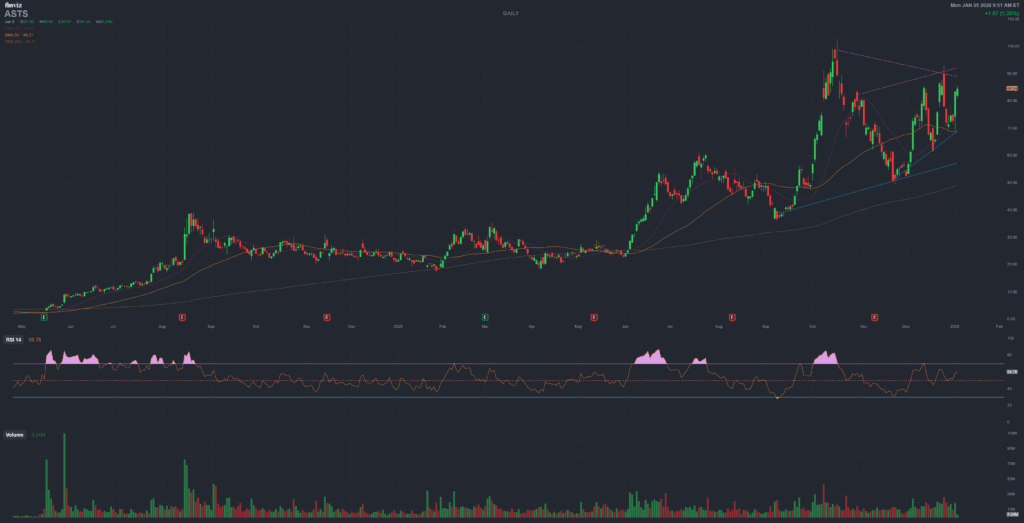
AST SpaceMobile (ASTS) – Direct-to-Cell at Scale: 2025–2026 Deep Dive
Complete overview of the most talked-about direct-to-cell stock: technology, last 12 months, financials, ownership, analyst views, sentiment and key catalysts into 2026.
Key snapshot (as of Q4 2025):
- Building the first space-based cellular broadband network that connects directly to standard 4G/5G smartphones (no new hardware on the phone).
- Six operational satellites in orbit: BlueWalker 3 (prototype, 2022), five BlueBird Block-1 (launched on a Falcon 9 in Sept 2024) and the first next-gen BlueBird 6 Block-2 launched on India’s LVM3 on 23 Dec 2025.
- BlueBird 6 carries a phased-array antenna of about 2,400 ft² (≈223 m²) and a mass of ~6,100 kg, making it the largest commercial comms array and the heaviest payload ever launched by LVM3 into LEO.
- Over $1.0 billion in aggregate contracted revenue commitments from telecom partners and about $3.2 billion in total liquidity (cash, restricted cash and available ATM facility), according to the Q3 2025 business update.
- More than 50 mobile network operators signed, with potential coverage of nearly 3 billion subscribers worldwide.
- Q3 2025: revenue $14.7M, net loss $122.9M, cash and equivalents ~$1.20B, long-term debt ~$698M.
The equity story is simple to summarize but hard to execute: huge addressable market and major partners on one side, very high capex, losses and strong competition (Starlink/T-Mobile and others) on the other.
1. Business model – what they are trying to build
AST SpaceMobile wants to operate a global constellation of low Earth orbit satellites that act as “cell towers in space”, using standard licensed mobile spectrum leased from carriers.
- Service concept:
- Direct connectivity from satellite to unmodified 4G/5G phones.
- Focus on “dead zones” and under-served areas, not replacing terrestrial networks.
- Designed for both commercial and government applications (emergency, disaster, defence).
- Revenue model:
- Wholesale model: AST sells capacity to mobile network operators (MNOs).
- Multi-year commercial agreements with a mix of minimum revenue commitments, prepayments and revenue-sharing.
- MNOs package the service as satellite roaming, emergency coverage or premium remote-area data.
- Long-term potential:
- Hundreds of millions of people with partial or no coverage today.
- Analysts frame the combined satellite broadband + direct-to-device market in the high tens to hundreds of billions of dollars globally over the long term.
2. Timeline – last 12–18 months in a straight line
2.1 2024–early 2025: technical proof and first commercial tests
- Sept 2024 – BlueBird 1–5 launch:
- Five BlueBird Block-1 satellites launched on a single Falcon 9.
- Each satellite with a 693 ft² (≈64 m²) antenna – at the time the largest commercial comms array in LEO.
- AT&T agreement (2024):
- Definitive commercial agreement to use AT&T spectrum in the U.S.
- 2024–2025 trials: two-way voice calls, text messaging and data from regular smartphones using AT&T’s core network.
- Vodafone & Bell Canada tests:
- Satellite video calls and broadband tests in Europe (Vodafone) and Canada (Bell), again with standard phones and no terrestrial coverage.
2.2 2025: large contracts, capital and Q3 inflection
- 2025 – capital structure:
- New long-term debt raised (convertible and other notes), which pushes long-term debt to about $698M by Q3 2025.
- Business update highlights total pro-forma liquidity of ~$3.2B (cash, restricted cash plus ATM facility).
- New MNO deals:
- Expanded agreements with AT&T, Vodafone, Bell Canada.
- Commercial agreement with Verizon in 2025 for U.S. direct-to-cell service starting in the 2026 timeframe.
- 10-year agreement with stc Group (Saudi Arabia) including a $175M prepayment.
- 10 Nov 2025 – Q3 2025 results & business update:
- GAAP revenue: $14.7M (mainly U.S. Government contract milestones and gateway deliveries).
- Net loss: $122.9M (−$0.45 per share).
- Cash and cash equivalents: ~$1.204B; restricted cash: ~$15.8M.
- Total assets: ~$2.55B; total liabilities: ~$0.92B; equity: ~$1.63B.
- Over $1B in aggregate contracted commercial revenue commitments from partners and confirmation of ~$3.2B in total liquidity.
2.3 Dec 2025 – BlueBird 6, the first Block-2 satellite
- 23 Dec 2025 – BlueBird 6 launch on LVM3 (India):
- First Block-2 satellite, with an antenna of nearly 2,400 ft² (≈223 m²).
- Mass ~13,450 lb (≈6,100 kg), the heaviest payload ever carried to LEO by LVM3.
- Largest commercial communications array currently in LEO.
- Designed to deliver roughly ten times the data capacity of Block-1 BlueBirds.
3. Financial profile – where the numbers really are
3.1 Income statement (Q3 2025)
- Revenue:
- Q3 2025: $14.7M (vs $1.1M in Q3 2024).
- 9M 2025: $16.6M (vs $2.5M in 9M 2024).
- Operating expenses Q3 2025 (rounded):
- Engineering services and related: ≈$40.8M.
- General & administrative: ≈$29.8M.
- Research & development: ≈$5.5M.
- Depreciation & amortization: ≈$12.7M.
- Total operating expenses: ≈$94.4M.
- Net loss:
- Q3 2025 net loss attributable to common stockholders: ≈$122.9M.
- 9M 2025 net loss: ≈$268M.
So far, AST is still firmly in “heavy investment” mode: revenue is finally non-trivial but still small compared to the cost base.
3.2 Balance sheet – cash, debt and assets
- Cash and equivalents (30 Sep 2025): ~$1,204M.
- Restricted cash: ~$15.8M.
- Property and equipment, net: ~$1,008M (mainly satellites and ground infrastructure).
- Total assets: ~$2,551M.
- Long-term debt, net: ~$697.6M (up from ~$155.6M at 31 Dec 2024).
- Total liabilities: ~$924.9M.
- Total stockholders’ equity: ~$1,626M.
Management and several independent analyses define the pro-forma liquidity (cash, restricted cash, plus ATM facility) at about $3.2B, enough to fund current deployment plans for dozens of satellites if budgets are respected.
4. Commercial traction – partners and contracted revenue
4.1 Key operators
- AT&T – definitive commercial agreement; multiple successful tests (voice, SMS, data) over AT&T spectrum and core network in the U.S.
- Verizon – commercial agreement announced in 2025; expected commercial service for U.S. customers starting in 2026.
- Vodafone – leading partner in Europe; satellite video calls and data tests using standard phones in zero-coverage areas in the UK and other markets.
- Bell Canada – tests covering voice, video and data in Canada.
- stc Group (Saudi Arabia) – 10-year agreement including a $175M prepayment, part of the $1B+ total contracted commitments.
- In total, AST reports partnerships with more than **50 mobile network operators**, with potential reach of almost **3 billion subscribers** worldwide.
4.2 “Over $1 billion in contracted revenue commitments”
In the Q3 2025 business update, AST states it has secured more than $1.0B in aggregate contracted commercial revenue commitments. These include:
- minimum revenue commitments for future services,
- prepaid capacity (like the stc prepayment),
- multi-year revenue-sharing and usage-based components tied to network deployment.
This is not guaranteed annual revenue, but it does show that large operators are willing to contract real money against AST’s roadmap, not just sign non-binding MOUs.
5. Competition – who else is in direct-to-device
- SpaceX Starlink + T-Mobile – Starlink already has several million broadband customers and has announced plans to offer text and then voice/data direct-to-cell in partnership with T-Mobile, using modified Starlink satellites and acquired spectrum.
- Lynk Global – focuses on basic text and IoT services, already has regulatory approvals and early service in some markets.
- Apple / Globalstar – emergency SOS and text services integrated into recent iPhone models.
- Other projects – Iridium/Qualcomm initiatives, regional initiatives in China and India, and various smaller players.
AST’s differentiation is the ambition to provide full 4G/5G broadband to standard phones, not just low-bandwidth SOS/text. The risk is that Starlink and others can leverage existing infrastructure and cash flows to move quickly and compress margins in the most lucrative segments.
6. Ownership structure – insiders, institutions, short interest
6.1 Share counts and insider control
- As of November 2025, shares outstanding:
- Class A: ~277.6M.
- Class B: ~11.2M.
- Class C: ~78.2M.
- Founder/CEO Abel Avellan holds a very large stake (over 200M shares across classes), effectively controlling a big portion of the voting power.
- Strategic anchors include large positions held by Rakuten and Vodafone-related entities.
6.2 Institutional investors
- Institutional ownership estimates are around 60% of the float.
- Top holders include large asset managers such as BlackRock, Vanguard and others, plus strategic investors like Alphabet.
- Total institutional holders: several hundred, with more than 150M shares reported across 13F and similar filings.
6.3 Short interest
- Mid-December 2025:
- Shares sold short: ~38M.
- Short interest: roughly 15–25% of free float depending on definition and source.
- Days to cover: around 3 days.
Bottom line: ASTS is heavily owned by insiders and institutions, but also heavily shorted. This combination explains the extreme volatility and the potential for sharp squeezes or reversals around news.
7. Analyst views – ratings and price targets
- Most coverage lists ASTS as a Buy or Strong Buy, with 8–12 analysts depending on the aggregator.
- Recent consensus 12-month target prices cluster in the $45–75 range, with lows around $30 and highs around $95.
- As the stock has recently traded near or above some of these targets, part of the analyst community is in “catch-up” mode, revising models after the rally.
- At least one major house (UBS) has downgraded the stock to Hold with a target cut (for example 62→42 in late 2025), citing:
- stronger competition from Starlink,
- uncertainty on the speed of monetization of the $1B+ commitments,
- and execution risk on satellite deployment.
8. Sentiment – how the crowd sees ASTS
8.1 Reddit and retail
- ASTS is one of the most discussed space stocks on Reddit (r/ASTSpaceMobile, r/stocks, and other trading subs), often mentioned together with Rocket Lab as the “pair” leading the space theme.
- Typical bull points:
- unique technology and massive BlueBird 6 hardware,
- big-name partners (AT&T, Verizon, Vodafone, stc),
- $1B+ in contracted revenue commitments and strong liquidity.
- Typical bear points:
- very high valuation vs current revenue,
- big negative cash flow and need to execute flawlessly,
- competition from Starlink and others.
8.2 Media
- Positive coverage from outlets focused on growth/innovation, which frame ASTS as a “Starlink rival” with large upside if execution works.
- More cautious takes from traditional equity research and some financial media, which highlight missed revenue expectations in Q3 2025 versus consensus, even though the stock has still rallied strongly during 2025.
9. Key risks – where the story can break
- Execution and delays – Decent revenue guidance for H2 2025 and beyond depends on timely deployment of additional satellites and successful integration with MNOs. Delays or technical issues would hit the credibility of the roadmap.
- Capital intensity – Building and launching dozens of large satellites is extremely expensive. Even with current liquidity, overruns could force more debt or equity issuance.
- Competition – Starlink/T-Mobile and other initiatives can erode margins or capture the most profitable customer segments.
- Regulatory and spectrum – Using terrestrial mobile spectrum from space is still a new area, with evolving regulation and potential conflicts in some jurisdictions.
- Valuation and volatility – With revenue still small and expectations very high, any disappointment on launches, contracts or financials can trigger large drawdowns.
10. 2026+ outlook – what really matters from here
- Launch cadence – number and timing of additional Block-2 BlueBird launches in 2026; each successful launch reduces technical risk and increases capacity.
- Conversion of commitments into revenue – how much of the >$1B in contracted commitments turns into recognized revenue in 2026–2027.
- Service quality and KPIs – real-world performance in early commercial deployments (latency, speeds, reliability) and user adoption metrics at partner MNOs.
- New deals or strategic moves – additional MNOs, government contracts or potential strategic partnerships that could reinforce or de-risk the story.
- Balance sheet evolution – ability to stick close to current capex plans without repeated, heavy dilution or expensive debt.
ASTS is, in practice, a long-duration, high-risk bet on a specific vision of global connectivity. The last year has substantially de-risked the technology and commercial interest, but the heavy part of the execution – deploying a full constellation and turning commitments into cash – still lies ahead.
Key official sources and useful links
Selection of primary documents and resources used for this overview:
- AST SpaceMobile – Quarterly results (10-Q, 10-K, presentations)
- Form 10-Q – Quarter ended 30 Sep 2025 (SEC)
- Business Update and Q3 2025 Results – Exhibit 99.1
- Space.com – BlueBird 6 launch article
- ISRO – LVM3 M6 / BlueBird Block-2 mission page
- Fintel – ASTS institutional holders
- MarketBeat – ASTS short interest
- Reddit – r/ASTSpaceMobile community
AST SpaceMobile (ASTS) – Direct-to-Cell in grande scala: analisi 2025–2026
Panoramica completa del titolo direct-to-cell più discusso: tecnologia, ultimi 12 mesi, numeri reali, struttura azionaria, analisti, sentiment e catalyst verso il 2026.
Fotografia rapida (fine 2025):
- Sta costruendo la prima rete di broadband cellulare spaziale che si collega direttamente a smartphone 4G/5G standard, senza telefoni satellitari dedicati.
- Sei satelliti operativi in orbita: il prototipo BlueWalker 3, cinque satelliti commerciali BlueBird Block-1 (lancio Falcon 9 a settembre 2024) e il primo Block-2 next-gen BlueBird 6 lanciato su LVM3 il 23 dicembre 2025.
- BlueBird 6 ha un’antenna phased-array di circa 2.400 ft² (≈223 m²) e una massa di ~6.100 kg: il più grande array commerciale e il payload più pesante mai messo in LEO da LVM3.
- Oltre 1 miliardo di dollari di “contracted revenue commitments” da operatori telco e circa 3,2 miliardi di liquidità totale (cassa, cassa vincolata e ATM) secondo il business update Q3 2025.
- Più di 50 operatori mobili partner, con copertura potenziale di quasi 3 miliardi di utenti.
- Q3 2025: ricavi 14,7M$, perdita netta 122,9M$, cassa ed equivalenti ~1,204B$, debito LT ~697,6M$.
In sintesi: enorme mercato potenziale e partner di primo livello da un lato, capex molto elevato, perdite pesanti e concorrenza forte dall’altro. È una scommessa ad alto beta su una visione specifica del futuro delle telecom.
1. Modello di business – cosa vuole diventare AST
AST SpaceMobile vuole operare una costellazione globale di satelliti in orbita bassa che agiscono come “torri cellulari nello spazio”, usando lo spettro mobile concesso dagli operatori.
- Servizio:
- connessione diretta satellite-telefono per smartphone 4G/5G non modificati,
- target primario: aree senza copertura o con copertura scarsa,
- applicazioni sia commerciali sia governative (emergenza, difesa, ecc.).
- Ricavi:
- modello wholesale: AST vende capacità agli operatori mobili (MNO),
- contratti multi-anno con minimi garantiti, prepagamenti e revenue-sharing,
- gli MNO confezionano il servizio come roaming satellitare, copertura d’emergenza o pacchetti premium per aree remote.
- Potenziale di lungo periodo:
- centinaia di milioni di persone con copertura insufficiente o nulla,
- diverse analisi collocano il TAM globale (broadband satellite + direct-to-device) nell’ordine di decine/centinaia di miliardi di dollari nel lungo periodo.
2. Timeline – ultimi 12–18 mesi
2.1 2024–inizio 2025: prova tecnica e prime demo commerciali
- Settembre 2024 – lancio BlueBird 1–5:
- cinque satelliti BlueBird Block-1 lanciati su Falcon 9,
- ognuno con antenna di 693 ft² (≈64 m²), all’epoca il più grande array commerciale in LEO.
- Accordo AT&T (2024):
- accordo commerciale definitivo per usare lo spettro AT&T negli USA,
- 2024–2025: demo di chiamate voce, SMS e dati via satellite integrati nel core AT&T.
- Vodafone e Bell Canada:
- videochiamate e test broadband in UK e Canada con smartphone standard in aree senza copertura terrestre.
2.2 2025: contratti, funding e Q3
- 2025 – struttura del capitale:
- nuovo debito a lungo termine (in parte convertibile) che porta il debito LT a ~697,6M$ al 30/09/2025,
- business update Q3: liquidità complessiva pro-forma ~3,2B$ fra cassa, cassa vincolata e ATM.
- Nuovi accordi MNO:
- rafforzamento delle partnership con AT&T, Vodafone, Bell Canada,
- accordo commerciale con Verizon per servizi direct-to-cell negli USA a partire dal 2026,
- accordo decennale con stc Group con prepagamento da 175M$.
- 10 novembre 2025 – Q3 2025 risultati + update:
- ricavi GAAP: 14,7M$,
- perdita netta: 122,9M$ (−0,45$/azione),
- cassa + equivalenti: ~1,204B$; cassa vincolata: ~15,8M$,
- attivi totali: ~2,55B$; passivo totale: ~0,92B$; equity: ~1,63B$,
- oltre 1B$ di ricavi commerciali contrattualizzati e 3,2B$ di liquidità pro-forma.
2.3 Dicembre 2025 – BlueBird 6 (Block-2)
- 23 dicembre 2025 – lancio BlueBird 6 su LVM3:
- primo satellite Block-2,
- antenna phased-array di quasi 2.400 ft² (≈223 m²),
- massa ~6.100 kg, payload più pesante mai messo in LEO dal LVM3,
- capacità dati ~10× superiore rispetto ai Block-1.
3. Profilo finanziario – numeri aggiornati
3.1 Conto economico Q3 2025
- Ricavi:
- Q3 2025: 14,7M$ (vs 1,1M$ Q3 2024),
- 9M 2025: 16,6M$ (vs 2,5M$ 9M 2024).
- Costi operativi Q3 2025 (arrotondati):
- engineering/servizi: ~40,8M$,
- G&A: ~29,8M$,
- R&D: ~5,5M$,
- D&A: ~12,7M$,
- Opex totale: ~94,4M$.
- Perdita netta:
- Q3 2025: ~122,9M$,
- 9M 2025: ~268M$.
3.2 Stato patrimoniale
- Cassa & equivalenti (30/09/2025): ~1,204B$.
- Cassa vincolata: ~15,8M$.
- Property & equipment, net: ~1,008B$.
- Attivi totali: ~2,551B$.
- Debito LT, netto: ~697,6M$.
- Passivo totale: ~924,9M$.
- Patrimonio netto: ~1,626B$.
La combinazione cassa + debito crea una struttura “carica” ma, per ora, con abbondante liquidità per finanziare il piano di lancio di ulteriori satelliti.
4. Traction commerciale – partner e impegni di ricavo
4.1 Partner principali
- AT&T – accordo commerciale, test voce/SMS/dati integrati.
- Verizon – accordo commerciale annunciato nel 2025, avvio servizi dal 2026.
- Vodafone – demo videochiamata e dati in UK e altri Paesi europei.
- Bell Canada – test completi in Canada.
- stc Group – contratto 10 anni, 175M$ di prepagamento.
- In totale: oltre 50 operatori mobili partner, con copertura potenziale vicina a 3 miliardi di utenti.
4.2 Oltre 1B$ di “contracted revenue commitments”
Nel business update Q3 2025 AST dichiara “over $1 billion in aggregate contracted commercial revenue commitments”:
- contratti firmati con MNO con minimi garantiti,
- prepagamenti (es. stc),
- componenti di revenue-sharing che partiranno con il rollout dei servizi.
Non sono ricavi garantiti anno per anno, ma sono impegni contrattuali reali che danno sostanza alla pipeline commerciale.
5. Concorrenza – chi corre nella stessa direzione
- Starlink + T-Mobile – costellazione già attiva per broadband, spettro dedicato e piano per servizi direct-to-cell (prima testo, poi voce/dati).
- Lynk Global – servizi base (SMS, IoT) in alcune aree, con autorizzazioni regolatorie già in tasca.
- Apple / Globalstar – SOS e messaggistica satellitare integrata negli iPhone recenti.
- Altri – iniziative Iridium/Qualcomm, progetti locali in Cina/India, ecc.
Il vantaggio di AST è l’obiettivo dichiarato di fornire broadband 4G/5G “pieno” agli smartphone. Il rischio è che player già in cassa positiva (Starlink in primis) arrivino sul mercato direct-to-device con risorse e velocità superiori.
6. Ownership – insider, istituzionali, short
6.1 Azionariato
- Azioni in circolazione (novembre 2025, tutte le classi):
- Class A ~277,6M,
- Class B ~11,2M,
- Class C ~78,2M.
- Fondatore/CEO Abel Avellan – possiede oltre 200M di azioni tra le varie classi, con controllo sostanziale.
- Anchors strategici – Rakuten, Vodafone-linked entities, altri.
6.2 Istituzionali
- ownership istituzionale stimata intorno al 60% del float,
- principali detentori: BlackRock, Vanguard, altri asset manager globali, più investitori strategici come Alphabet,
- oltre 600 istituzionali complessivi secondo vari tracker.
6.3 Short interest
- a metà dicembre 2025:
- circa 38M di azioni short,
- short interest stimato fra 15 e 25% del float (a seconda della fonte),
- days to cover intorno ai 3 giorni.
Mix finale: forte presenza insider/strategici, base istituzionale ampia e short aggressivi. È un titolo strutturalmente destinato a movimenti molto violenti su ogni news importante.
7. Analisti – rating e target
- la maggior parte degli analisti coprenti ha rating Buy / Strong Buy,
- i target price 12 mesi si muovono grosso modo tra 30 e 95$, con medie recenti fra 45 e 75$ a seconda dell’aggregatore,
- una parte della ricerca è in ritardo rispetto al rally recente (prezzo >80$), quindi i target non sono ancora pienamente allineati al livello attuale,
- almeno una casa importante (UBS) ha portato il rating a Hold e abbassato il target su timori di:
- concorrenza Starlink più aggressiva del previsto,
- monetizzazione più lenta degli 1B$ di commitments,
- rischio di execution sull’espansione della costellazione.
8. Sentiment – cosa si legge in giro
8.1 Reddit / retail
- ASTS è uno dei nomi più discussi nei thread “space stocks”; spesso citato in coppia con Rocket Lab.
- I bull puntano su:
- hardware unico (BlueBird 6) e tecnologia dimostrata,
- partner di peso (AT&T, Verizon, Vodafone, stc),
- contratti >1B$ e liquidità 3,2B$.
- I bear sottolineano:
- ricavi ancora piccoli rispetto alla capitalizzazione,
- burn elevato e dipendenza da execution perfetta,
- concorrenza in aumento.
8.2 Media
- media pro-growth lo raccontano come “rival di Starlink” con potenziale enorme se il piano viene eseguito,
- media più prudenziali evidenziano i miss su alcune attese di consenso Q3, la struttura di costo e la valutazione già molto tirata dopo il rally 2025.
9. Rischi principali
- Esecuzione tecnica – serve mettere in orbita decine di satelliti Block-2 e integrarli con le reti MNO senza grossi incidenti o ritardi.
- Capex e debito – il piano è capital-intensive; se i costi superano il budget, potrebbero servire altre emissioni (debito o equity).
- Concorrenza – Starlink/T-Mobile e altri possono ridurre il pricing e prendersi i segmenti più redditizi.
- Regolatorio e spettro – regole su uso dello spettro mobile da parte dei satelliti ancora in evoluzione.
- Valutazione – a ricavi attuali bassi e aspettative altissime, qualsiasi delusione può generare drawdown pesanti.
10. Outlook 2026+ – cosa tenere d’occhio
- Cadence dei lanci Block-2 – numero e tempistica dei prossimi BlueBird,
- Conversione degli 1B$ di commitments in ricavi – quanto entra davvero a conto economico 2026–2027,
- Performance del servizio – KPI reali su velocità, latenze e affidabilità,
- Nuovi accordi o mosse strategiche – ulteriori MNO, contratti governativi, partnership,
- Evoluzione della struttura finanziaria – capacità di eseguire il piano con l’attuale combinazione di cassa e debito senza ricorrere troppo spesso a nuova equity.
ASTS è, in pratica, una scommessa di lungo periodo su un certo modo di risolvere il problema della connettività globale. La parte “dimostrare che funziona” ha fatto passi avanti enormi; la parte “costruire una costellazione completa e generare cash flow sostenibile” è quella che deciderà se questa storia resta un hype o diventa un caso di successo.
Fonti ufficiali e link utili
Se vuoi verificare i numeri direttamente dalle fonti:
- AST SpaceMobile – Quarterly Results (10-Q, 10-K, presentazioni)
- Form 10-Q – trimestre chiuso al 30/09/2025
- Business Update + risultati Q3 2025 (Exhibit 99.1)
- Space.com – articolo sul lancio di BlueBird 6
- ISRO – pagina missione LVM3-M6 / BlueBird Block-2
- Fintel – holders istituzionali ASTS
- MarketBeat – short interest ASTS
- Reddit – community r/ASTSpaceMobile
Scanner for active traders

Try ChartsWatcher free, then unlock 10% OFF with SAVE10
ChartsWatcher is a real-time scanner for momentum traders: fast movers, unusual volume and rotations — so you can focus on the few tickers that matter right now, instead of watching hundreds of charts.
Start with the free version. When you upgrade, use SAVE10 for 10% OFF your first paid period.
Start free – then use SAVE10
No credit card required to start. Apply SAVE10 when upgrading.
Recommended platform

One platform. All your brokers.
Medved Trader connects multiple brokers in one workspace, with pro charts, hotkeys and fast execution — without changing your broker accounts.
A single cockpit for positions, Level II and multi-broker order routing, built for active day & swing traders.
Get 1 Month Free ➔
Multi-broker workflow + customizable layouts in one platform.
 Monica.im – the AI assistant I use every day
If you find value in the work I publish on Merlintrader and want a practical AI assistant for research and writing, you can sign up using this referral link. Click here to try Monica.im and support the site
Find out how I use AI on Merlintrader: AI, retail and Merlintrader
Disclosure: some of the links in the promotional blocks above are affiliate or referral links. If you choose to subscribe or sign up through them, Merlintrader may receive a small commission or benefit at no extra cost to you.