DISCLAIMER — Not financial advice. Educational content only, not an offer or solicitation to buy or sell any security. Biotech and small/mid-cap stocks are highly speculative and volatile and can result in a partial or total loss of capital. Do your own research and consult a licensed advisor where appropriate. / Contenuti a solo scopo informativo e didattico, non costituiscono consulenza finanziaria né offerta o sollecitazione al pubblico risparmio ai sensi delle normative CONSOB e SEC. Le azioni biotech e le small/mid cap sono strumenti altamente speculativi e volatili e possono comportare la perdita parziale o totale del capitale investito. Si raccomanda di effettuare sempre le proprie ricerche e, se necessario, di rivolgersi a un consulente abilitato.

Merlintrader Trading Pub
Biotech catalyst news and analysis. FDA PDUFA tracker
Merlintrader Trading Pub
Biotech catalyst news and analysis. FDA PDUFA tracker
Single-ticker deep dive · Autoimmune / Lupus Nephritis
Aurinia Pharmaceuticals (AUPH) – From PDUFA “Cult Stock” To Real Lupkynis Growth Story
AUPH has been on every biotech retail watchlist since the January 22, 2021 FDA approval of LUPKYNIS (voclosporin) for lupus nephritis. The buyout never came, but the company did the one thing that really matters: it built a profitable, growing LN franchise. This report walks through the cult history, the current numbers, retail sentiment, insider and institutional positioning, and the catalysts that still matter going into 2026, with links to the primary filings and official releases.
News of the day & recent drama
Recent events that still shape the tape
Sept–Nov 2025 · FDA LinkedIn controversy, lawsuit & Q3 beat
Aurinia sues FDA CDER chief after a LinkedIn post hits Lupkynis, while Q3 results force a 2025 guidance raise
On September 29–30, 2025, newly appointed FDA CDER director George Tidmarsh posted on his personal LinkedIn that LUPKYNIS (voclosporin) has “significant toxicity” and “has not been shown to provide a direct clinical benefit for patients,” explicitly calling out Aurinia’s drug and vowing to re-evaluate surrogate endpoints used for approval. Coverage by FiercePharma, Sherwood e Nasdaq/RTTNews document how the post knocked AUPH down roughly 16–20% intraday and wiped out around 300–350 M USD in market cap, before being deleted.
Aurinia immediately issued a statement reaffirming the favourable benefit/risk profile of LUPKYNIS, pointing back to the AURORA 1 and AURORA 2 clinical programs and to guideline endorsements (ACR, KDIGO, ICER). On November 2, 2025, the company filed a defamation lawsuit in U.S. federal court accusing Tidmarsh of using his FDA position to pursue a personal vendetta against board chair Kevin Tang, as reported by STAT, The Washington Post, The Wall Street Journal and others.
That same week, Tidmarsh was placed on leave and then resigned as CDER chief. While the regulatory drama dominated headlines, the underlying fundamentals told a very different story: in the Q3 2025 earnings release, Aurinia reported total revenue of 73.5 M USD (+8% YoY; +25% ex-Japan milestone), LUPKYNIS net product sales of 70.6 M USD (+27% YoY) and net income of 31.6 M USD, and raised 2025 guidance to 275–280 M USD total revenue and 265–270 M USD net product sales.
This split—short-term volatility on social-media drama vs. steady compounding in the P&L—is an excellent snapshot of what AUPH has become in 2025–2026.
1. Executive summary – what AUPH is today
Aurinia in early 2026 is not the same company traders were playing into the January 22, 2021 FDA approval of LUPKYNIS (voclosporin). It is now:
- A single-product autoimmune player with a de-risked, approved oral therapy for LN, embedded in major guidelines: ACR 2024 LN guideline summary, KDIGO 2024 LN guideline, and NICE TA882.
- A company with solid growth and improving profitability: 2024 total revenue 235.1 M USD and LUPKYNIS net product sales 216.2 M USD (FY 2024 earnings release), followed by 205.9 M USD total revenue and 197.2 M USD LUPKYNIS net product sales in the first nine months of 2025 (Q3 2025 release).
- Guided 2025 total revenue of 275–280 M USD and net product sales of 265–270 M USD, raised twice during 2025 as LUPKYNIS momentum accelerated after guideline updates (Seeking Alpha coverage, Nasdaq article).
On the pipeline side, AUR200 (aritinercept), a dual BAFF/APRIL inhibitor, delivered positive Phase 1 single-ascending-dose data with robust IgA/IgM/IgG reductions and monthly dosing potential in June 2025, per the official Aurinia press release.
For a catalyst-oriented biotech trader, the key shift is:
- No more binary PDUFA risk – LUPKYNIS was fully approved in 2021; the next moves are about utilisation and competition, not approvability.
- The stock trades as a mid-cap autoimmune growth story: 2024 net income 5.8 M USD and 2025 year-to-date net income 76.4 M USD through Q3 (FY 2024 10-K, Q3 2025 8-K exhibit).
- Ownership is institutional-heavy – roughly 50–55% of shares are held by institutions and funds, with Tang Capital, BlackRock, Vanguard and others listed among the top holders. Tang Capital and related entities alone beneficially own ~8–9% of the company according to Schedule 13D/A filings.
- Insiders have been net buyers, led by board chair Kevin Tang, who has added over 2.8 M shares since late 2024 and around 1.3 M shares between 1–5 August 2025 in the 10–12 USD range (Investing.com, StockCircle insider history, Nasdaq insider summary).
- Short interest ~7% of float, based on recent short-interest summaries, gives a non-trivial squeeze component, but we’re far from meme-stock extremes.
In short: emotionally, AUPH is still a “cult stock”. Fundamentally, it has become a fairly rare thing in biotech – a single-asset name that actually executed on launch and now lives or dies primarily on growth and capital allocation, not on binary trial readouts.
2. Quick data – valuation, balance sheet, positioning
Share price (approx.)
~15.3 USD
Early Jan 2026, near recent highs
52-week range
~6.6 – 16.5 USD
Stock more than doubled from 2024 lows
Market cap
≈ 2.0–2.1 B USD
Mid-cap autoimmune, per major data providers
2024 LUPKYNIS sales
216.2 M USD
+36% vs 2023 (158.5 M USD)
2025 guidance
275–280 / 265–270 M
Total revenue / net product sales, raised twice in 2025
9M 2025 net income
76.4 M USD
Diluted EPS 0.55 USD
Cash & investments
351.8 M USD
As of 30 Sep 2025; 12.2 M shares repurchased for 98.2 M USD YTD
Insider ownership
≈ 10–11%
Heavily concentrated in Tang Capital / Kevin Tang
Short interest
≈ 7% float
Per recent short-interest snapshots (MarketBeat / Nasdaq)
Analyst consensus
Hold
7 analysts; avg PT ~17–18 USD
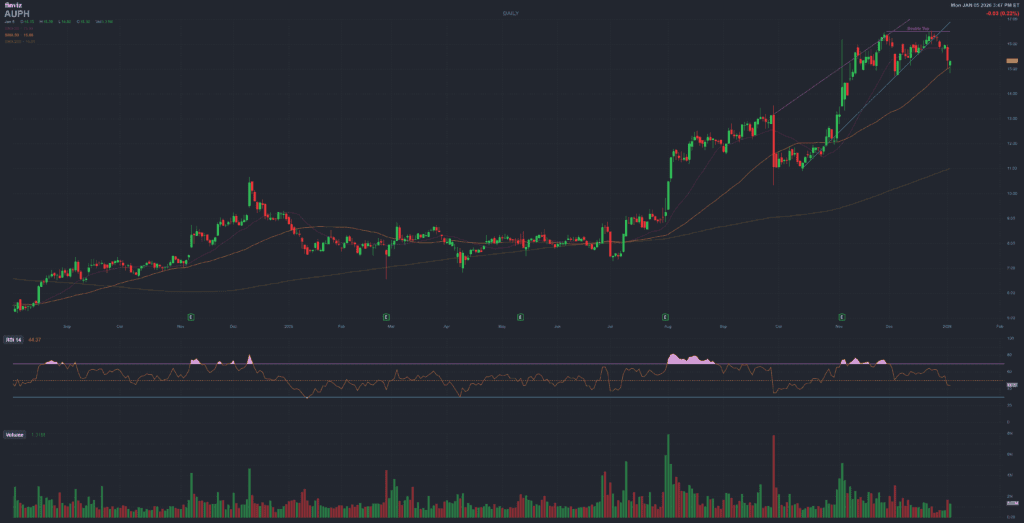
Finviz daily chart for AUPH (last ~12 months). Affiliate parameter on the URL may track outgoing clicks from Merlintrader; chart image and data courtesy of Finviz.
3. The “cult stock” arc – from PDUFA 2021 to strategic review
3.1 The PDUFA build-up (2020–Jan 2021)
In 2020, voclosporin’s NDA for lupus nephritis was accepted by the FDA with Priority Review and a PDUFA date of January 22, 2021. Around the same time, ICER’s 2021 evidence report on LN clearly stated that both belimumab and voclosporin provided a net health benefit over standard therapy and that voclosporin’s price represented “intermediate” long-term value for money.
Reddit DDs and WSB-style threads from that period painted AUPH as:
- One of the “cleanest” PDUFA setups of the year.
- A lupus nephritis game-changer, with peak sales models well north of 1.5–2.0 B USD in optimistic scenarios.
- A potential M&A magnet if the approval came through.
The setup checked every box for a retail cult name: clear binary date, credible Phase 3 data (AURORA 1; see Lancet AURORA 1 paper), and a valuation that, on paper, left upside vs. the most bullish peak-sales curves.
3.2 Approval, spike, and the first wave of frustration
On January 22, 2021, the FDA approved voclosporin (LUPKYNIS) as the first FDA-approved oral therapy for adult LN, a fact also emphasised in multiple later clinical and health-economics analyses (US cost-effectiveness study). The stock rallied and traded in the 20–30 USD zone, but then:
- The launch played out during the Covid era, with all the complications that implied for new-drug uptake.
- Physicians needed time to integrate an oral calcineurin inhibitor into LN practice, balancing efficacy with safety and monitoring requirements.
- The gap between peak-sales fantasies and the reality of first-year launch curves created disappointment.
AUPH drifted lower, and the PDUFA euphoria gave way to complaints about “failed rocket launches.” Yet the ticker stayed glued to many watchlists because the fundamental thesis (LN is serious, voclosporin works, oral CNI niche is valuable) still made sense.
3.3 Buyout rumours and the 2023 strategic review
From 2021 through 2023, a constant background hum of M&A speculation surrounded Aurinia. Pieces on TipRanks, Nasdaq and others highlighted potential interest from larger pharma players; some investors treated AUPH almost purely as a take-out lottery.
When the board eventually announced a formal strategic review, including the possibility of a sale, that narrative reached a climax. However, as later summarised in multiple shareholder communications and financial media coverage, the process ended without a deal. For a chunk of the retail base, this was the “betrayal moment”: threads on r/AUPH and similar spaces turned sharply critical of management and the board.
3.4 2024–2025: the slow grind that changed the story
While the M&A storyline fizzled, the underlying business started to deliver:
- For 2024, total revenue reached 235.1 M USD and net product sales 216.2 M USD, up 34% and 36% versus 2023 respectively (FY 2024 press release).
- Cash flow from operating activities for 2024 was 44.4 M USD, versus a 33.5 M USD use of cash in 2023, and the company repurchased 6.1 M shares for 41.0 M USD (2024 10-K).
- In Q1, Q2 and Q3 2025, each quarterly, earnings, release showed double-digit revenue growth and expanding net income.
By late 2025, articles such as “Assessing Aurinia Pharmaceuticals After Its 80% 2025 Rally” on Yahoo Finance were framing AUPH as a stock that had quietly delivered ~80% gains in a year and more than doubled over a multi-year period, powered by execution rather than pure speculation.
4. Business today – LUPKYNIS, guidelines, Otsuka
4.1 Product and indication
LUPKYNIS (voclosporin) is an oral calcineurin inhibitor indicated, in combination with background immunosuppression, for adults with active lupus nephritis. LN is one of the most severe and costly manifestations of systemic lupus erythematosus (SLE).
The AURORA trial programme (for example, the AURORA 1 Phase 3 Lancet paper) demonstrated that a voclosporin-based triple therapy regimen (voclosporin + MMF + low-dose steroids) significantly improved complete renal response versus standard of care alone, with acceptable long-term safety documented in the AURORA 2 extension and subsequent integrated analyses.
4.2 Guidelines: from “interesting option” to embedded standard
Several high-profile documents now explicitly place voclosporin at the centre of LN management:
- The 2024 ACR Lupus Nephritis guideline summarised (ACR press release, guideline summary PDF) recommends triple immunosuppressive therapy, including regimens anchored on a calcineurin inhibitor (voclosporin) plus MMF and low-dose steroids as an attractive first-line option.
- The KDIGO 2024 guideline also highlights voclosporin-based triple therapy as a key approach for preserving kidney function and controlling proteinuria across multiple LN classes.
- NICE Technology Appraisal TA882 (official guidance) and Aurinia’s own press release confirm voclosporin (LUPKYNIS) with MMF as a recommended option for adults with active LN in England and Wales.
- Independent groups like ICER have concluded that voclosporin provides a net health benefit and an “intermediate” long-term value for money at current pricing (ICER LN report).
For a growth story, this matters: AUPH is no longer fighting just to prove voclosporin belongs in LN algorithms; it is now working from within them.
4.3 Ex-US partner: Otsuka
Outside the US, Aurinia has partnered with Otsuka Pharmaceutical via a December 2020 collaboration and license agreement (Aurinia PR, Otsuka news release). Key terms:
- 50 M USD upfront payment.
- Up to 50 M USD in regulatory and reimbursement milestones.
- Tiered royalties from 10–20% on net sales in Otsuka territories (EU, UK, Japan and selected other countries).
Otsuka has since obtained European Commission approval (2022) and launched LUPKYNIS in the EU and Japan (FirstWord Pharma coverage), creating a royalty and manufacturing-services revenue stream for Aurinia that appears in the “license, collaboration and royalty revenue” line of the quarterly releases.
5. Growth engine & catalysts 2026+
5.1 Financial trajectory – what the numbers say
The growth pattern from early 2024 through Q3 2025 is consistent and well documented in Aurinia’s own press releases and SEC filings:
- Full year 2024: total revenue 235.1 M USD, net product sales 216.2 M USD, net income 5.8 M USD, operating cash flow 44.4 M USD (FY 2024 press release).
- Q1 2025: total revenue 62.5 M USD (+24% YoY), LUPKYNIS net product sales 60.0 M USD (+25% YoY) (Q1 2025 PR).
- Q2 2025: total revenue 70.0 M USD (+22% YoY), LUPKYNIS 66.6 M USD (+21% YoY), H1 2025 operating cash flow 45.5 M USD (57.0 M USD ex-restructuring cash payments) (Q2 2025 PR).
- Q3 2025: total revenue 73.5 M USD (+8% YoY; +25% adjusted), LUPKYNIS 70.6 M USD (+27% YoY), nine-month total revenue 205.9 M USD (+17%), nine-month LUPKYNIS 197.2 M USD (+24%), nine-month net income 76.4 M USD (EPS diluted 0.55 USD), operating cash flow 90.0 M USD (Q3 2025 PR).
This is why multiple recent commentaries (e.g. Yahoo Finance, analyst blogs) frame AUPH as an 80% 2025 gainer driven by EPS beats and guidance raises, rather than by speculative rumours alone.
5.2 Pipeline: AUR200 as “chapter two”
AUR200 (aritinercept) is a dual BAFF/APRIL inhibitor intended for multiple autoimmune indications. On June 30, 2025, Aurinia released positive Phase 1 SAD results in healthy volunteers:
- Study in 61 subjects tested single SC doses from 5 to 300 mg; no treatment-related ≥ Grade 3 AEs, no treatment-related SAEs, no discontinuations (Phase 1 PR).
- Mean reductions at day 28 of up to 48% (IgA), 55% (IgM) and 20% (IgG), consistent with potent and durable pharmacodynamic effects.
- PK / PD profile supportive of once-monthly dosing, with plans to initiate clinical studies in at least two autoimmune diseases in the second half of 2025.
AUR200 is still early, but it is a credible candidate to diversify Aurinia away from a pure single-asset profile if Phase 2 data confirm the mechanistic promise.
5.3 Practical catalysts to watch (2026+)
- FY 2025 print & 2026 guidance – expected around late February 2026, based on the timing of the 2024 release. Key questions: do they beat 275–280 M USD revenue guidance, and what growth range do they commit to for 2026?
- Further guideline & payer traction – how fast the 2024 ACR and KDIGO guidelines plus NICE TA882 translate into deeper LN penetration, especially as more real-world data from registries like ENLIGHT-LN are presented (ACR abstracts).
- Ex-US ramp with Otsuka – updates on EU and Japan uptake, milestones and manufacturing revenue.
- AUR200 trial starts and early readouts – actual Phase 2 protocols, first patient in, and initial biomarker/safety updates will influence how much value investors assign to the pipeline beyond LUPKYNIS.
- Any renewed strategic activity – after the 2023 review ended without a sale, the market no longer “needs” M&A to justify AUPH, but credible offers from larger autoimmune players would still be a meaningful upside scenario.
6. Retail sentiment – chats, drama and where the crowd stands
AUPH’s retail story has gone through several phases:
- 2019–2020: PDUFA run-up, LN data hype and early DDs across r/biotechstocks and similar forums.
- 2021–2022: initial approval euphoria, then frustration as the share price failed to deliver an instant multi-bagger.
- 2023: a strategic review with no deal, leaving many investors feeling misled.
- 2024–2025: a more mature phase where cash flow and EPS start to matter more than message-board speculation.
Insider buying wave (Dec 2024 – Aug 2025)
A series of open-market purchases by Kevin Tang and Tang Capital – documented in SEC filings and summarised by sites like StockCircle, Investing.com and Dataroma – became a recurring talking point on Stocktwits and Reddit, often used as shorthand for “the smart money is doubling down”.
FDA LinkedIn post & lawsuit (Sept–Nov 2025)
Coverage by FiercePharma, STAT, Washington Post and others, plus Stocktwits coverage like “FDA turmoil spills over to Aurinia Pharma”, framed Tidmarsh’s LinkedIn post as an unjustified attack that temporarily tanked the stock. Many retail comments openly used words such as “stock manipulation” and “personal vendetta”.
2025 performance & “derisked” basket role
In 2025, a growing subset of Reddit and Stocktwits posts started to reference AUPH as the “boring, derisked” autoimmunity anchor position inside otherwise speculative biotech baskets. In other words, the cult name that actually prints cash, as opposed to the umpteenth pre-clinical moonshot.
Short float around 7% with roughly 5–6 days to cover, per recent MarketBeat / Nasdaq data.
Retail is still vocal, but big price moves increasingly coincide with earnings, guidance and legal headlines, not just with social-media noise.
7. Insiders – who is really on the line
Insider ownership is in the low double digits, but heavily concentrated. The central figure is Kevin C. Tang, founder of Tang Capital Management and current chair of Aurinia’s board. His background and role are laid out in detail in the 2025 proxy materials (DEF 14A / 15 April 2025).
7.1 Tang’s 2024–2025 buying
- According to Tang Capital’s Schedule 13D/A, Tang Capital and related entities purchased about 2.8 M AUPH shares between September 2024 and early 2025, for roughly 23.5 M USD, giving them beneficial ownership of ~10.0 M shares as of March 2025.
- Subsequent Form 4-tracked open-market purchases in mid-2025 total another ~1.3 M shares between 1–5 August 2025 in the 10–12 USD range, for an estimated ~13.6 M USD, per Investing.com, StockTitan Form 4 summary and StockCircle.
- A Nasdaq insider snapshot from May 2025 notes that Tang had made three purchases totalling ~1.2 M shares for ~10.8 M USD, with no reported sales (Nasdaq).
For sentiment, this matters more than any PowerPoint: the person with the most information and the most skin in the game repeatedly adding shares in the high single-digit to low double-digit range is an anchor point many traders use when judging downside.
7.2 Insider ownership profile
Insider ownership ≈ 10–11%
Net insider buying since late 2024
Key insider: Kevin C. Tang (Chair, Tang Capital)
Other executives have occasional stock-based comp sales, but the dominant signal is the consistent accumulation by Tang and Tang-related funds.
8. Institutions, float and short interest
AUPH is now firmly in institutional territory. According to the Yahoo! Finance holders page and other ownership trackers:
8.1 Ownership breakdown (indicative)
| Holder type | Approx. stake | Comments |
|---|---|---|
| Institutional investors | ≈ 50–55% of shares | Over 350 reporting holders; Tang Capital, BlackRock, Vanguard, NEA and multiple ETFs among the largest positions. |
| Insiders & related | ≈ 10–11% | Heavily concentrated in Tang Capital / Kevin Tang; detailed in 13D/A and proxy filings. |
| Public float | ≈ 118 M shares | Liquid enough for active managers and factor / small-cap ETFs. |
| Short interest | ≈ 7% of float | 8–9 M shares short; days-to-cover ~5–6 based on recent market data. |
Simply Wall St and other ownership-centric platforms explicitly refer to Aurinia as “favourite among institutional investors”, reflecting this structure.
8.2 How this shapes trading dynamics
- Large institutional rotations can move the stock materially even without clinical news.
- The short base is big enough to matter on upside surprises, particularly if combined with positive legal or guideline news, but it is not at meme-stock levels.
- Insider and Tang ownership provide an alignment that many small/mid-cap biotechs, where insiders hold very little, simply do not have.
9. Analysts – how the Street frames AUPH
Aggregators like MarketBeat, Yahoo! and TipRanks currently show:
Consensus rating
Hold
About 7 analysts, split between Hold and Buy
Average 12-month PT
≈ 17–18 USD
Implied upside in the low-teens % area from current levels
PT range
~15 – 21 USD
With 21 USD at the upper end from more bullish notes
For example:
- Earlier in 2025, Jefferies had AUPH at Hold with a 10 USD PT even while disagreeing with Tidmarsh’s negative interpretation of the data, arguing that AURORA results clearly showed benefit (Investing.com).
- Later in 2025, other notes (including 21 USD PT calls) framed the stock as modestly undervalued versus discounted cash-flow models, but acknowledged that the market had already priced in a substantial portion of the near-term LUPKYNIS ramp (analyst PT article).
The general takeaway is that the Street sees AUPH as fundamentally sound and modestly undervalued, but no longer deeply mispriced – further upside is expected to come from sustained execution or a second asset, not from the market “discovering” the story for the first time.
10. Key risks – what can go wrong from here
- Single-product dependency. LUPKYNIS accounts for almost all revenue. Any negative safety signal, reimbursement setback or guideline change would directly hit the P&L.
- Competition in LN. Belimumab (Benlysta) and other biologics or combinations occupy overlapping territory. Future entrants or evolving standard-of-care could pressure LUPKYNIS’ share or pricing power.
- Pipeline execution risk. AUR200 is still early stage; disappointing Phase 2 outcomes would keep Aurinia in a single-asset box for longer.
- Regulatory and political noise. The Tidmarsh episode shows how quickly regulatory commentary can trigger large drawdowns, even if the controversy later resolves in Aurinia’s favour.
- Legacy expectations. Some long-time holders still anchor on pre-2021 M&A fantasies at much higher prices. Their selling on strength could cap rallies even if the underlying business performs well.
11. Bottom line – how to think about AUPH in 2026
AUPH in 2026 is not a pre-revenue binary bet and not a broken PDUFA story either. It is:
- A mid-cap autoimmune company with a de-risked, guideline-embedded LN drug that is growing revenue and net income at solid double-digit rates.
- A name with strong insider alignment and heavy institutional ownership, plus a moderate short base that can add fuel to upside surprises.
- A former “cult stock” where the emotional roller-coaster (PDUFA hype, buyout rumours, strategic review, FDA LinkedIn drama) still matters for sentiment, but where the tape now follows earnings, guidance and pipeline progress more than message-board noise.
This report does not tell you to buy or sell AUPH. It maps what the company has actually done since that famous January 22, 2021 date, and what the current growth and risk profile look like if you strip away nostalgia. For a catalyst-oriented investor, the focus has clearly shifted from “will it be approved?” to “how long and how fast can it compound LN cash flows, and will AUR200 (or another asset) turn Aurinia into a multi-product autoimmune platform?”
12. Key primary sources & further reading
- Company financials & pipeline
- FY 2024 results & 2025 guidance (Aurinia PR)
- 2024 Form 10-K (SEC)
- Q1 2025 results (Aurinia PR)
- Q2 2025 results (Aurinia PR)
- Q3 2025 results & guidance raise (Aurinia PR)
- AUR200 Phase 1 positive results (Aurinia PR)
- Collaboration & license agreement with Otsuka (Aurinia PR)
- Aurinia comments on 2024 ACR LN guideline
- Guidelines & health-economics
- ACR 2024 LN guideline summary
- ACR 2024 LN guideline – PDF summary
- KDIGO 2024 Lupus Nephritis guideline
- NICE TA882 – Voclosporin for LN
- ICER final report on belimumab & voclosporin in LN
- Cost-effectiveness of voclosporin in U.S. managed care (Kennedy et al., 2024)
- Long-term voclosporin treatment impact on renal outcomes (Rovin et al., 2025)
- Clinical trials
- AURORA 1 Phase 3 trial (Lancet, 2021)
- AURORA 2 extension trial (NCT03597464)
- Regulatory / legal controversy
- FiercePharma – CDER chief LinkedIn post on LUPKYNIS
- FiercePharma – Tidmarsh resignation & Aurinia lawsuit
- STAT – Tidmarsh accused of harming Tang/Aurinia
- Washington Post – top FDA drug regulator resigns after Aurinia lawsuit
- BMJ – overview of Tidmarsh lawsuit and voclosporin comments
- Ownership & sentiment
- Tang Capital 13D/A filing (March 2025)
- StockCircle – Kevin Tang insider trades
- Yahoo! Finance – major holders & institutional breakdown
- Stocktwits News – “FDA turmoil spills over to Aurinia Pharma”
Biotech Catalyst Calendar – keep the bigger picture in view
LUPKYNIS is just one piece of the biotech catalyst puzzle. To track upcoming PDUFA dates, clinical readouts and key events across the sector, you can always refer to the dedicated Biotech Catalyst Calendar on Merlintrader.
Important disclaimer (EN)
This report is for educational and informational purposes only and does not constitute investment advice, an offer to buy or sell any financial instrument, or a recommendation of any specific security, strategy or product. Biotech and healthcare equities are highly volatile and can lead to substantial losses, including the total loss of invested capital. Always do your own due diligence and, if needed, consult a qualified financial professional before making investment decisions.
Data and opinions in this report are based on public sources believed to be reliable (company filings, FDA documents, official press releases, major financial and medical news outlets, and peer-reviewed literature), but no guarantee is given as to their accuracy or completeness. This content may reference third-party services such as Finviz, Seeking Alpha, Stocktwits and others; any affiliate links are clearly marked and do not change the nature of the analysis.
For full legal and risk disclosures, please refer to Merlintrader’s official pages:
https://merlintrader.com/disclaimer/
https://merlintrader.com/condizioni-duso-e-info-privacy/
Scheda singolo titolo · Autoimmune / Lupus nefritico
Aurinia Pharmaceuticals (AUPH) – Dal “cult stock” del lupus a vera storia di crescita LUPKYNIS
AUPH è nei radar dei trader biotech retail da prima dell’approvazione FDA del 22 gennaio 2021 su LUPKYNIS (voclosporin) per il lupus nefritico. Il buyout che molti si aspettavano non è mai arrivato, ma nel frattempo l’azienda ha fatto la cosa che conta davvero: ha costruito un business profittevole e in crescita sulla nicchia LN. Questa scheda ripercorre la storia “cult”, i numeri aggiornati, il sentiment retail, la posizione di insider e istituzionali e i catalyst che contano entrando nel 2026, con link diretti alle fonti ufficiali.
News del giorno & ultimi sviluppi pesanti
Eventi recenti che ancora condizionano il grafico
Settembre–Novembre 2025 · Caso LinkedIn / FDA e Q3 sopra le attese
Aurinia fa causa al capo CDER dell’FDA dopo un post contro LUPKYNIS, mentre la trimestrale costringe a rialzare la guidance 2025
A fine settembre 2025, il direttore del Center for Drug Evaluation and Research (CDER) dell’FDA, George Tidmarsh, pubblica su LinkedIn un post in cui definisce LUPKYNIS “significativamente tossico” e privo di “beneficio clinico diretto”, promettendo una revisione degli endpoint surrogati. Il post, ampiamente ripreso da FiercePharma, Sherwood e Nasdaq/RTTNews, provoca un calo intraday di ~16–20% su AUPH prima di essere cancellato.
Aurinia risponde con un comunicato ufficiale in cui ribadisce il profilo beneficio/rischio favorevole di LUPKYNIS, richiamando i trial AURORA e il supporto di ACR, KDIGO, NICE e ICER. Il 2 novembre 2025 l’azienda deposita una causa per diffamazione in tribunale federale USA, accusando Tidmarsh di aver usato il proprio ruolo all’FDA per danneggiare finanziariamente Aurinia e il chairman Kevin Tang; la vicenda è descritta in dettaglio da STAT, Washington Post e Wall Street Journal.
Nello stesso periodo Aurinia pubblica i conti del Q3 2025: nella trimestrale ufficiale leggiamo ricavi totali 73,5 M USD, vendite LUPKYNIS 70,6 M USD (+27% a/a), utile netto 31,6 M USD e rialzo della guidance 2025 a 275–280 M USD di ricavi e 265–270 M USD di vendite prodotto.
In pratica: la volatilità di breve è ancora fortemente influenzata dal rumore politico/regolatorio, ma il driver vero del titolo resta la traiettoria di crescita di LUPKYNIS e la capacità di mantenere margini e cassa in salita.
1. Executive summary – cos’è AUPH oggi
All’inizio 2026 Aurinia è:
- una società autoimmuni focalizzata su LUPKYNIS (voclosporin), terapia orale per il lupus nefritico approvata permanentemente dalla FDA nel 2021 e inserita nelle principali linee guida: ACR 2024 LN, KDIGO 2024, NICE TA882.
- un’azienda con numeri reali: nel 2024 ricavi totali 235,1 M USD e vendite LUPKYNIS 216,2 M USD, entrambe in crescita a doppia cifra vs 2023 (comunicato FY 2024); nei primi 9 mesi 2025 ricavi 205,9 M USD e vendite LUPKYNIS 197,2 M USD (Q3 2025).
- una storia che guida il 2025 con ricavi attesi 275–280 M USD e vendite LUPKYNIS 265–270 M USD, dopo due revisioni al rialzo nel corso dell’anno (Seeking Alpha, Nasdaq).
In parallelo, AUR200 (aritinercept), inibitore duale BAFF/APRIL, ha mostrato risultati di Fase 1 positivi con riduzioni robuste di IgA, IgM, IgG e profilo compatibile con somministrazione mensile (PR ufficiale del 30 giugno 2025).
In ottica “trader di catalyst”:
- non c’è più rischio PDUFA – l’approvazione è storia chiusa dal 2021, ora il focus è su volumi, concorrenza e margini;
- il titolo si comporta come mid-cap growth autoimmuni: utile netto positivo e in forte crescita (5,8 M USD nel 2024, 76,4 M USD nei primi 9 mesi 2025) e cassa operativa in forte aumento (10-K 2024, 8-K Q3 2025);
- la proprietà è fortemente istituzionale (circa metà delle azioni in mano a fondi ed ETF, come si vede dalla pagina Holders di Yahoo Finance), con Tang Capital e soci che detengono una quota importante documentata nelle sched 13D/A;
- gli insider sono compratori netti (Kevin Tang e Tang Capital hanno accumulato oltre 2,8 M di azioni da fine 2024, di cui ~1,3 M ad agosto 2025 in area 10–12 USD – vedere StockCircle, Investing.com);
- lo short interest (~7% del float) aggiunge un po’ di “benzina” ai movimenti, ma non siamo in area meme stock.
In sintesi: AUPH resta un nome “storico” nella memoria dei retail, ma la narrativa oggi è molto più da esecuzione che da scommessa binaria.
2. Dati rapidi – valutazione, bilancio, struttura del capitale
Prezzo (stima)
~15,3 USD
Inizio 2026, vicino ai massimi annuali
Range 52 settimane
~6,6 – 16,5 USD
Il titolo ha più che raddoppiato dai minimi
Market cap
≈ 2,0–2,1 B USD
Mid-cap autoimmuni
LUPKYNIS 2024
216,2 M USD
+36% vs 2023 (158,5 M USD)
Guidance 2025
275–280 / 265–270 M
Ricavi totali / vendite LUPKYNIS
Utile netto 9M 2025
76,4 M USD
EPS diluito 0,55 USD
Cassa + investimenti
351,8 M USD
30/09/2025; 12,2 M azioni riacquistate (98,2 M USD)
Insider
≈ 10–11%
Concentrati su Tang Capital / Kevin Tang
Short interest
≈ 7% del float
8–9 M azioni short; days-to-cover ~5–6
Consensus analisti
Hold
Target medio intorno a 17–18 USD
Grafico daily AUPH (ultimo anno circa) da Finviz. Il parametro di affiliazione serve solo per tracciare i click in uscita da Merlintrader.
3. La storia “cult” – dalla PDUFA 2021 allo strategic review
3.1 Prima dell’esame: il 2020 e l’approvazione del 22 gennaio 2021
Nel 2020 l’NDA di voclosporin per lupus nefritico viene accettata dall’FDA con Priority Review e PDUFA fissata al 22 gennaio 2021. Nello stesso periodo ICER pubblica il report finale su belimumab e voclosporin in LN, dichiarando che entrambe le terapie offrono un beneficio netto rispetto allo standard e che voclosporin, pur costoso, rientra in un intervallo di “valore intermedio” nel lungo termine.
Nei forum biotech la narrativa è quella classica da PDUFA “pulita”: dati AURORA convincenti (vedi studio AURORA 1 su Lancet), potenziale di picco vendite molto alto, valutazione considerata modesta rispetto ai modelli più ottimistici.
3.2 Approvazione, spike e prime delusioni
Il 22 gennaio 2021 arriva l’approvazione FDA di LUPKYNIS come prima terapia orale approvata per l’LN adulto (riconosciuta, fra gli altri, da ICER e da lavori di health-economics come Kennedy et al. 2024). Il titolo sale nella fascia 20–30 USD, ma:
- il lancio avviene in pieno contesto Covid;
- i clinici devono prendere confidenza con un nuovo CNI orale in una malattia complessa;
- la curva di adozione reale è più lenta di quella sognata da molti retail.
Il prezzo scende e si crea frustrazione. Ma il ticker resta sui radar proprio perché il razionale clinico/economico non cambia.
3.3 Rumors di buyout e strategic review 2023
Tra 2021 e 2023 si susseguono articoli e note che ipotizzano un’acquisizione da parte di big pharma (Bristol Myers e altri vengono citati in più occasioni). Quando il board annuncia una vera e propria “strategic review” che include la possibilità di vendita, parecchi investitori danno quasi per scontato un deal.
Il processo però si chiude senza offerta. Nei commenti su r/AUPH e nei forum dedicati partono critiche feroci a management e board. È il momento in cui molti “mollano” la storia, convinti che il grosso sia stato perso.
3.4 2024–2025: niente matrimonio, ma il business esegue
Intanto, lontano dai thread, LUPKYNIS fa il suo lavoro:
- nel 2024 i ricavi totali raggiungono 235,1 M USD e le vendite LUPKYNIS 216,2 M USD (+34% e +36% vs 2023);
- il cash flow operativo passa da –33,5 M USD (2023) a +44,4 M USD (2024), con 6,1 M azioni riacquistate per 41 M USD;
- nei primi 3 trimestri 2025 la crescita continua e la guidance viene alzata due volte fino a 275–280 M USD di ricavi e 265–270 M USD di vendite LUPKYNIS.
A fine 2025 articoli come “Assessing Aurinia After Its 80% 2025 Rally” iniziano a raccontare AUPH come un titolo che ha fatto +80% nell’anno grazie a numeri e guidance, più che a sogni di buyout.
4. Il business oggi – LUPKYNIS, linee guida, Otsuka
4.1 Prodotto e indicazione
LUPKYNIS (voclosporin) è un inibitore della calcineurina orale indicato, in combinazione con immunosoppressori di base, per pazienti adulti con lupus nefritico attivo. Il LN è una delle complicanze più gravi e costose del lupus sistemico.
I trial AURORA (per esempio l’analisi pubblicata su Lancet) mostrano che un regime “triplo” con voclosporin + MMF + steroidi a basso dosaggio migliora in modo significativo la risposta renale completa rispetto allo standard, con profilo di sicurezza accettabile nel lungo termine (AURORA 2 e analisi integrate).
4.2 Linee guida: da opzione “nuova” a standard codificato
Alcuni punti chiave:
- il riassunto ACR 2024 delle linee guida LN e il relativo PDF (guideline summary) raccomandano la tripla terapia immunosoppressiva, inclusi regimi basati su CNI (voclosporin) come prima linea;
- le linee KDIGO 2024 arrivano a conclusioni simili sulla logica della tripla terapia per preservare la funzione renale;
- NICE con la TA882 (voclosporin + MMF per LN adulto) e il comunicato di Aurinia (PR NICE recommendation) confermano l’uso di LUPKYNIS in UK come opzione rimborsata;
- ICER nel report 2021 (ICER LN) valuta voclosporin come terapia con beneficio netto e valore economico “intermedio” nel lungo periodo.
In altre parole, non si parla più di “tentativo off-label” ma di un farmaco inserito nel cuore delle raccomandazioni ufficiali.
4.3 Partnership ex-US con Otsuka
Fuori dagli USA, Aurinia ha stretto nel 2020 una collaborazione con Otsuka Pharmaceutical (PR Aurinia, PR Otsuka).
- 50 M USD di upfront + fino a 50 M USD in milestone regolatorie/rimborso;
- royalty a scaglioni dal 10 al 20% sulle vendite nette nei territori Otsuka;
- milestone aggiuntive su determinate soglie di vendite.
Otsuka ha ottenuto l’approvazione EMA nel 2022 e lanciato LUPKYNIS in UE e Giappone (FirstWord Pharma), generando royalty e ricavi di servizi di manufacturing che compaiono nella voce “License, collaboration and royalty revenue” delle trimestrali.
5. Motore di crescita & catalyst 2026+
5.1 Traiettoria finanziaria
I dati pubblici di Aurinia (PR e filing SEC) mostrano una crescita abbastanza lineare:
- ricavi 2024: 235,1 M USD; vendite LUPKYNIS: 216,2 M USD; utile netto: 5,8 M USD; cassa operativa: 44,4 M USD;
- Q1 2025: ricavi 62,5 M USD (+24% a/a), LUPKYNIS 60,0 M USD (+25% a/a);
- Q2 2025: ricavi 70,0 M USD (+22% a/a), LUPKYNIS 66,6 M USD (+21% a/a), cassa operativa H1 45,5 M USD (57,0 M USD al netto dei pagamenti di ristrutturazione);
- Q3 2025: ricavi 73,5 M USD, LUPKYNIS 70,6 M USD (+27% a/a), ricavi 9M 205,9 M USD, utile netto 9M 76,4 M USD.
È la classica trasformazione da “story stock” a “execution story”: i grafici annuali ormai hanno più senso se letti insieme a PR e tabelle dei conti che non solo guardando al passato PDUFA.
5.2 Pipeline: AUR200 come secondo atto
AUR200 (aritinercept) è un inibitore BAFF/APRIL con ambizioni multi-indicazione nelle autoimmuni. Il PR del 30 giugno 2025 (Aurinia) riporta:
- 61 soggetti sani, single-ascending-dose SC tra 5 e 300 mg;
- nessun SAE correlato, nessun AE ≥ Grade 3 correlato, nessuna interruzione per eventi avversi;
- riduzioni medie a Day 28 fino al 48% (IgA), 55% (IgM), 20% (IgG);
- profilo PK/PD compatibile con somministrazione mensile.
L’obiettivo dichiarato è avviare studi clinici in almeno due malattie autoimmuni nella parte finale del 2025/inizio 2026. Se le Fasi 2 confermeranno sicurezza e segnale di efficacia, AUR200 potrebbe diventare un secondo pilastro serio accanto a LUPKYNIS.
5.3 Catalyst concreti per il 2026 e oltre
- Trimestrale Q4 2025 e guidance 2026 – verità su quanto hanno centrato/superato la guidance 2025 e su che tipo di traiettoria mettono sul piatto per il 2026;
- Penetrazione LN post-linee guida – numeri su nuovi pazienti, durata media terapia, confronto con Benlysta e altri farmaci, dati real-world da registri come ENLIGHT-LN;
- Ramp ex-US Otsuka – ritmo di adozione in Europa, UK, Giappone e milestone/royalty correlate;
- Avvio e primi aggiornamenti AUR200 – design, arruolamento, primi segnali PD/clinici;
- Eventuale ritorno del tema M&A – non è più il “core” della tesi, ma un’offerta credibile da parte di uno dei grandi player autoimmuni avrebbe ovviamente impatto importante sul prezzo.
6. Sentiment retail – chat, discussioni e memoria emotiva
La community retail ha attraversato varie fasi con AUPH:
- 2019–2020: hype su dati LN e PDUFA imminente;
- 2021–2022: approvazione, spike, poi discesa e delusione per il “rocket” mancato;
- 2023: strategic review senza esito, con accuse al board di aver giocato troppo duro sul buyout;
- 2024–2025: fase più matura, in cui flussi di cassa e utili entrano finalmente nella discussione.
Acquisti insider 2024–2025
La scia di acquisti di Tang e Tang Capital, dettagliata in sched 13D/A, StockCircle e articoli come “Aurinia Pharma director Tang buys $13.59m in shares”, ha cambiato nettamente il tono su Stocktwits e Reddit: “se lui compra così pesante a 10–12, forse non siamo messi male”.
Caso LinkedIn / FDA e causa Aurinia
Dopo il post di Tidmarsh e il crollo del titolo, articoli come FiercePharma, STAT e Washington Post hanno raccontato la vicenda, mentre su Stocktwits (es. “FDA turmoil spills over to Aurinia Pharma”) molti utenti parlavano apertamente di “manipolazione” e vendetta personale contro Tang.
Ruolo nel portafoglio biotech 2025
Nei thread che discutono portafogli a tema biotech, AUPH viene sempre più spesso vista come posizione “derisked e profittevole” da affiancare a microcap speculative. Non è più il biglietto della lotteria, ma la componente più solida del paniere.
Short float intorno al 7%, days-to-cover intorno a 5–6.
La voce dei retail conta ancora, ma rispetto al passato il titolo segue molto di più i numeri e le news legali che non i thread da soli.
7. Insider – chi si gioca davvero la pelle
La quota insider complessiva è intorno al 10–11%, ma fortemente concentrata. La figura centrale è Kevin C. Tang, fondatore di Tang Capital e chairman del board, il cui profilo è descritto nel dettaglio nella delega 2025 (DEF 14A).
7.1 Gli acquisti 2024–2025 di Tang
- la sched 13D/A di marzo 2025 mostra acquisti aggregati di ~2,8 M azioni da settembre 2024 a inizio 2025 (circa 23,5 M USD), per una partecipazione di ~10,0 M azioni;
- successivamente, fra 1 e 5 agosto 2025, Tang/Tang Capital acquistano ~1,3 M azioni in area 10–12 USD, per ~13,6 M USD, come riportato da Investing.com, StockTitan e StockCircle;
- un riepilogo Nasdaq di maggio 2025 segnala tre acquisti per ~1,2 M azioni (~10,8 M USD) e nessuna vendita da parte di Tang (Nasdaq).
Per molti lettori questo vale più di tante parole: chi è più vicino ai dossier clinici, economici e legali compra pesante in area 7–12 USD e non vende.
7.2 Profilo di ownership insider
Insider ~10–11% del capitale
Flusso netto di acquisti dal 2024
Figura chiave: Kevin C. Tang (Chairman)
8. Istituzionali, float e short interest
AUPH oggi è un titolo “da fondi”, con una base retail importante ma non dominante. Dalla pagina Holders di Yahoo e da altri tracker:
8.1 Breakdown indicativo
| Tipo di holder | Quota stimata | Note |
|---|---|---|
| Istituzionali | ~50–55% | Oltre 350 soggetti; tra i maggiori Tang Capital, BlackRock, Vanguard, NEA, ETF small/mid-cap. |
| Insider | ~10–11% | Concentrati su Tang e veicoli collegati (vedi 13D/A e DEF 14A). |
| Float | ~118 M azioni | Liquidità adeguata a fondi attivi e ETF. |
| Short interest | ~7% del float | 8–9 M azioni short, days-to-cover nell’ordine di 5–6. |
Piattaforme come Simply Wall St descrivono Aurinia come “favourite among institutional investors”, proprio perché più della metà del capitale è in mano a soggetti professionali.
8.2 Impatto sui movimenti
- le rotazioni degli istituzionali possono muovere il titolo in modo importante anche senza news cliniche;
- la componente short è sufficiente per creare squeeze su news positive forti, ma non è a livelli da “mania”;
- l’allineamento insider (Tang) + istituzionali rende la struttura di governance meno improvvisata rispetto a molte microcap biotech.
9. Analisti – come la vede la Street
Secondo aggregatori come MarketBeat, Yahoo e TipRanks:
Rating medio
Hold
7 analisti circa (misto Hold/Buy)
Target medio 12M
~17–18 USD
Upside teorico a una cifra medio-alta
Forchetta target
~15 – 21 USD
Con i target più “bullish” a 21 USD
Alcuni esempi:
- Jefferies in precedenza manteneva Hold con TP 10 USD nonostante contestasse la lettura negativa di Tidmarsh sui dati di voclosporin (Investing.com);
- note successive (es. analisi con TP 21 USD) parlano di valutazione “moderatamente a sconto” rispetto a DCF e multipli di settore, ma riconoscono che una parte del rerating è già stata fatta nel 2025.
Il messaggio di fondo: il consenso non considera AUPH un affare clamoroso, ma nemmeno un titolo tirato; l’upside ulteriore passa per: continuità di crescita LUPKYNIS, conferme su AUR200 e gestione ordinata del contenzioso regolatorio.
10. Rischi chiave – dove può saltare la storia
- Dipendenza da un solo prodotto. LUPKYNIS è praticamente tutto; se per qualunque motivo il farmaco viene penalizzato (safety, rimborso, concorrenza, guideline) l’impatto è diretto e pesante.
- Concorrenza in LN. Belimumab e altri farmaci attuali/futuri giocano sullo stesso campo; combinazioni e nuovi standard potrebbero ridurre spazio o pricing power di voclosporin.
- Esecuzione su AUR200. Se le Fasi 2 non confermano il potenziale visto in Fase 1, Aurinia rischia di rimanere single-asset più a lungo del gradito.
- Rumore regolatorio/politico. Il caso LinkedIn/FDA mostra come un singolo post possa bruciare centinaia di milioni di market cap in un giorno, anche se poi la vicenda si chiude a favore dell’azienda.
- Aspettative dei “vecchi” holder. Chi è entrato ai tempi del sogno buyout 30+ USD potrebbe continuare a vendere su forza, limitando il rerating anche a fronte di buoni numeri.
11. Sintesi finale – come inquadrare AUPH nel 2026
AUPH nel 2026 è un ibrido particolare:
- porta ancora addosso l’etichetta di “cult stock” degli anni PDUFA 2020–2021;
- ha numeri da mid-cap autoimmuni con crescita double-digit e utili in forte miglioramento;
- ha una pipeline in partenza (AUR200) che può o meno diventare un vero secondo motore.
Le domande giuste non sono più “la FDA approva?” o “domani arriva il buyout?”, ma:
- per quanto tempo LUPKYNIS può crescere a questi ritmi, tenendo conto di linee guida, concorrenza e pricing;
- se AUR200 riuscirà davvero a trasformare Aurinia in una piattaforma multi-prodotto;
- come verranno gestiti i rapporti con regolatori, payers, vecchi e nuovi azionisti, alla luce anche del contenzioso con l’ex capo CDER.
Questa scheda non è un invito a comprare o vendere, ma una fotografia a tutto campo: AUPH non è più il biglietto della lotteria legato solo alla PDUFA e non è il “morto” che alcuni temevano dopo lo strategic review senza esito. È una storia di esecuzione su una nicchia autoimmune ben definita, con una base di retail nostalgici, una presenza istituzionale forte e un set di numeri che, per una volta, reggono il peso dei vecchi sogni.
12. Fonti principali e link utili
- Finanziari & pipeline
- Risultati FY 2024 (PR Aurinia)
- Form 10-K 2024 (SEC)
- Risultati Q1 2025 (PR)
- Risultati Q2 2025 (PR)
- Risultati Q3 2025 & guidance raise
- AUR200 – risultati Fase 1 (PR)
- Accordo di collaborazione con Otsuka (PR)
- Commento Aurinia sulle linee guida ACR 2024
- Linee guida & valutazioni
- ACR – comunicato linee guida LN 2024
- ACR 2024 LN – PDF riassuntivo
- KDIGO 2024 LN guideline
- NICE TA882 – voclosporin per LN
- ICER – report finale su LN (belimumab & voclosporin)
- Studio di costo-efficacia di voclosporin negli USA (Kennedy et al. 2024)
- Trial clinici
- AURORA 1 (Phase 3) – paper su Lancet
- AURORA 2 – extension trial (NCT03597464)
- Controversia FDA / LinkedIn
- FiercePharma – post LinkedIn su LUPKYNIS
- FiercePharma – dimissioni Tidmarsh & causa Aurinia
- STAT – accuse di “vendetta personale” contro Tang
- Washington Post – overview caso Tidmarsh/Aurinia
- BMJ – analisi sulla causa e sul post LinkedIn
- Ownership & insider
- Tang Capital – 13D/A 2025
- Storico insider di Kevin Tang (StockCircle)
- Yahoo Finance – principali holder
- Stocktwits News – “FDA turmoil spills over to Aurinia Pharma”
Biotech Catalyst Calendar – il quadro generale
LUPKYNIS è solo un tassello del mosaico biotech. Per avere sempre sott’occhio PDUFA, letture cliniche e catalyst delle small e mid-cap del settore, puoi fare riferimento al Biotech Catalyst Calendar curato su Merlintrader.
Disclaimer importante (IT)
Questo report ha finalità esclusivamente informative e didattiche e non costituisce in alcun modo consulenza finanziaria, raccomandazione personalizzata, sollecitazione all’investimento o offerta al pubblico di prodotti finanziari. Le azioni biotech e healthcare sono strumenti ad alto rischio, soggetti a forte volatilità e potenziale perdita integrale del capitale investito. Prima di assumere decisioni di investimento è opportuno effettuare le proprie verifiche e, se necessario, rivolgersi a un consulente abilitato.
Dati e informazioni sono tratti da fonti pubbliche ritenute affidabili (filing SEC, documenti regolatori, comunicati ufficiali, principali testate finanziarie e letteratura scientifica), ma non se ne garantisce l’accuratezza o completezza. Il testo può citare servizi di terzi (Finviz, SeekingAlpha, Stocktwits, ecc.) e includere link di affiliazione; questi non modificano in alcun modo il contenuto analitico.
Per l’informativa completa su rischi, limitazioni di responsabilità e privacy, fare riferimento alle pagine ufficiali di Merlintrader:
https://merlintrader.com/disclaimer/
https://merlintrader.com/condizioni-duso-e-info-privacy/
Scanner for active traders

Try ChartsWatcher free, then unlock 10% OFF with SAVE10
ChartsWatcher is a real-time scanner for momentum traders: fast movers, unusual volume and rotations — so you can focus on the few tickers that matter right now, instead of watching hundreds of charts.
Start with the free version. When you upgrade, use SAVE10 for 10% OFF your first paid period.
Start free – then use SAVE10
No credit card required to start. Apply SAVE10 when upgrading.
Recommended platform

One platform. All your brokers.
Medved Trader connects multiple brokers in one workspace, with pro charts, hotkeys and fast execution — without changing your broker accounts.
A single cockpit for positions, Level II and multi-broker order routing, built for active day & swing traders.
Get 1 Month Free ➔
Multi-broker workflow + customizable layouts in one platform.
 Monica.im – the AI assistant I use every day
If you find value in the work I publish on Merlintrader and want a practical AI assistant for research and writing, you can sign up using this referral link. Click here to try Monica.im and support the site
Find out how I use AI on Merlintrader: AI, retail and Merlintrader
Disclosure: some of the links in the promotional blocks above are affiliate or referral links. If you choose to subscribe or sign up through them, Merlintrader may receive a small commission or benefit at no extra cost to you.