AI transparency: articles and reports are produced with the help of artificial intelligence and checked through a process that does not constitute specialist validation. They may contain errors: verify relevant information with independent sources. Read the full disclaimer.
HOVR New Horizon Aircraft Ltd 2New Horizon Aircraft (HOVR) – Hybrid eVTOL Small Cap Between Dream and Execution | Merlintrader trading Blog
Small-cap deep dive · Hybrid eVTOL / Advanced Air Mobility
New Horizon Aircraft (HOVR) – Hybrid eVTOL Small Cap Between Dream and Execution
Horizon Aircraft (NASDAQ:HOVR) wants to build one of the first hybrid eVTOL “heli-planes” capable of vertical takeoff and 500+ mile wing-borne cruise. After a 2025 rally, government grants and a rare full-wing transition test have put the Cavorite X7 on the eVTOL map – but the company is still pre-revenue, capital-hungry and years away from commercial service. This report lays out the story, numbers, retail hype and real risks behind one of the more interesting micro eVTOL bets.
Ticker: HOVR · NASDAQ Small CapSector: Hybrid eVTOL / Advanced Air MobilityStage: Pre-revenue, developmentTheme: Defense + Regional Air MobilityUpdated: Jan 2026
News of the day – grants, F1 tech and a bigger bet on “all-weather” eVTOL
Latest developments that still drive the narrative
Oct–Dec 2025 · INSAT grant + Motion Applied partnership
Government money and Formula 1 DNA behind the Cavorite X7
In October 2025 Horizon announced an INSAT (Initiative for Sustainable Aviation Technology) grant to fund “Project CRYSTAL”, a 10.5 M CAD all-weather eVTOL programme focused on icing detection and protection. Horizon will receive about 2.0 M CAD in non-dilutive proceeds, working with the Flight Test Centre of Excellence (3C) and the University of Toronto on a propulsion system that can operate in conditions where most helicopters are grounded.
Two weeks earlier, the company had disclosed more than 3.4 M CAD in cumulative NSERC federal research grants supporting hybrid eVTOL development. And in December 2025 Horizon partnered with Motion Applied, the former high-performance technology arm of McLaren’s Formula 1 team, to design the motor system for the Cavorite X7’s fan-in-wing architecture.
Together, these headlines reinforce the core message Horizon wants investors to hear: serious engineering partners, non-dilutive funding, and a focus on real-world, all-weather operations rather than glossy urban air-taxi demos.
1. Executive summary – what HOVR is (and is not)
New Horizon Aircraft Ltd. (doing business as Horizon Aircraft) is a Canadian aerospace OEM developing the Cavorite X7, a seven-seat hybrid-electric eVTOL aimed at regional air mobility and special-mission markets. The aircraft combines:
Vertical lift using 14 ducted fans embedded in the wings and forward fuselage.
Transition to conventional wing-borne flight with a Pratt & Whitney PT6A turboprop for cruise.
Advertised cruise speed around 250–280 mph and 500+ mile range with fuel burn ~30% below comparable helicopters.
The company reached a key technical milestone in May 2025 when its large-scale, 50% prototype completed full wing transition – a rare achievement for fan-in-wing designs. Videos and independent coverage in aviation media confirm successful hover, transition and wing-borne flight of the demonstrator.
Financially, HOVR is still a pre-revenue development story. The FY 2025 10-K shows:
Net income of ~5.2 M CAD driven mainly by a one-time ~21.4 M CAD gain from terminating a Forward Purchase Agreement, not by operating profit.
Operating expenses of ~13.6 M CAD, including ~3.7 M CAD of R&D and ~9.9 M CAD of G&A.
Cash in the mid-teens of millions (USD equivalent), which management claims is enough to fund the full-scale demonstrator over the next ~18 months if plans hold.
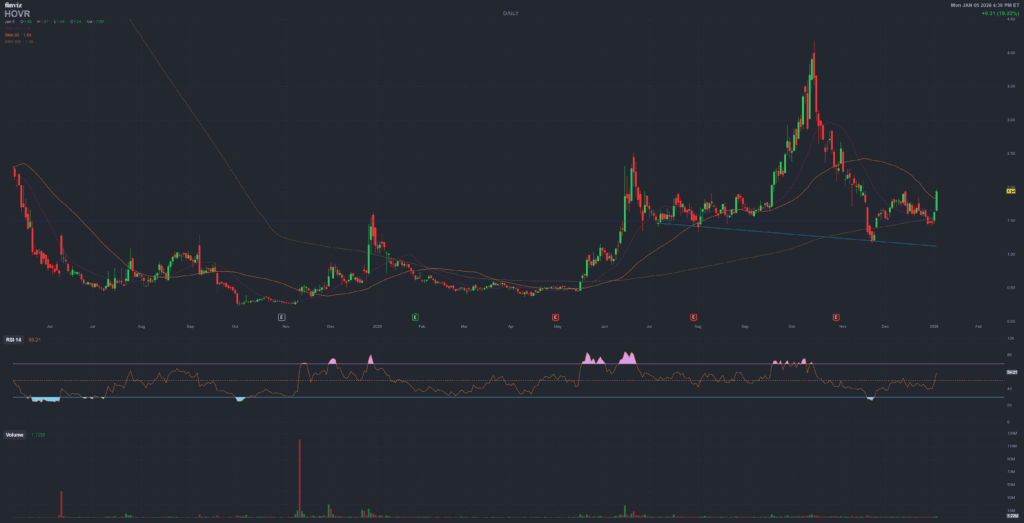
The auditors have still raised “going concern” doubts, warning that Horizon will need additional capital to bridge the long path to certification and commercial operations. In parallel, the stock went through a +300% meme-style rally in June 2025, then a partial retrace, and as of early 2026 trades around 1.94 USD for a ~80 M USD market cap.
Bottom line: this is a high-beta engineering bet on a hybrid eVTOL concept that has cleared some important technical hurdles, but remains years away from revenue and heavily dependent on continued funding.
2. Quick data – valuation, runway, trading profile
Daily range today ~1.65–1.97 USD; +19% vs previous close 1.63 USD
52-week range
0.35 – 4.18 USD
Extreme volatility; multi-bag from 2024 lows then sharp drawdowns
1-year performance
≈ +180–190%
Indicative one-year gain from early 2025 lows
Market cap
~80 M USD
Micro/small-cap, thin institutional coverage
Float
≈ 16–20 M shares
Free float estimated from June 2025 data
FY 2025 net income
≈ 5.2 M CAD
Primarily driven by non-cash gain from Forward Purchase Agreement termination
FY 2025 operating expenses
13.6 M CAD
R&D ~3.7 M; G&A ~9.9 M
Cash (May 31, 2025)
~15–17 M USD
Company claims 18+ months liquidity for demonstrator build
Short interest
low–single digit %
Tickeron reported ~1.8% of float short in June 2025
Institutional ownership
Limited
Nasdaq institutional holdings page currently lists minimal data
3. Story arc – from SPAC to “mini V-22” hype and back to reality
3.1 SPAC origins (2023–2024)
Horizon’s route to public markets was classic 2020s SPAC:
Pono Capital Three, a blank-check company listed on Nasdaq, announced a business combination with Robinson Aircraft (Horizon Aircraft) in August 2023.
The deal closed in January 2024; the combined entity was renamed New Horizon Aircraft Ltd. and began trading as HOVR, with warrants under HOVRW.
Like many small SPACs, redemptions and transaction costs left Horizon with less cash than originally hoped, forcing a mix of later equity raises, strategic investments and warrant-related funding to build its runway.
3.2 2024–early 2025: funding, early testing, listing issues
Through late 2024 the company secured an 8.4 M USD strategic investment and separate warrant exercises worth roughly 2.7 M USD in gross proceeds, while working through SEC filings and Nasdaq listing requirements. At one point Horizon received a “going concern” flag from its auditor and fell out of compliance with minimum bid-price rules, only to regain compliance in June 2025 after the stock rallied back above the threshold.
3.3 2025: technical milestones and the +300% June breakout
2025 is when HOVR really caught the eye of speculative traders:
In May, the large-scale Cavorite X7 prototype successfully performed full wing transition from vertical to wing-borne flight and back – a major de-risking milestone.
A June 2025 analysis by Tickeron highlighted a +302% move in the stock during the month and social-media chatter projecting targets above 2.5 USD if momentum persisted. Volume spiked to over 17 M shares on the breakout day.
Retail traders on Reddit and X started framing HOVR as a “mini V-22” or “poor man’s Joby/Archer” with multi-bag potential if the full-scale demonstrator and certification campaign go well.
3.4 FY 2025 10-K: accounting profit, real losses and a long runway ahead
The August 2025 Form 10-K is sobering reading. Yes, the company reports 5.2 M CAD in net income – but only because of a sizeable non-cash gain from terminating a Forward Purchase Agreement inherited from the SPAC structure. Core operations remain loss-making, with double-digit million CAD in annual cash expenses and essentially no product revenue. Management openly acknowledges that further equity and/or debt financing will be required, and the auditor explicitly raises “substantial doubt” about Horizon’s ability to continue as a going concern without new capital.
Put differently: 2025 gave investors impressive engineering videos, meaningful grants and high-volatility rallies – but financially Horizon is still very much a burn-cash-to-build-metal story.
4. Business model & technology – what is the Cavorite X7 trying to be?
4.1 Core concept
The Cavorite X7 is positioned as a hybrid-electric eVTOL for regional air mobility and dual-use missions. Key design themes:
Hybrid power: electric fans for vertical lift, driven by batteries and/or generators, combined with a PT6A turboprop for efficient cruise.
Fan-in-wing “HOVR Wing”: 14 electric fans embedded in wing and canard, covered in cruise to reduce drag once the aircraft transitions to wing-borne flight.
Performance targets: ~7 occupants (pilot + 6), 500+ mile range, ~250–280 mph cruise, and up to 1,500–1,800 lb payload depending on takeoff mode.
Mission set: medevac, remote community logistics, fire fighting support, disaster relief, offshore operations, and eventually military / government contracts.
4.2 Recent technical milestones
Full wing transition (May 2025): independent coverage by aviation outlets (AOPA, Zag Daily, AAM International, The Sun’s tech section) confirms the large-scale prototype successfully performed vertical takeoff, transition to wing-borne flight, cruise, and vertical landing.
Full-scale demonstrator programme: by September 2025 the company stated it had completed architecture work for a full-scale non-conforming prototype, targeting initial test flights within ~18 months.
Hydrogen collaboration: a July 2025 GlobeNewswire release announced a collaboration with ZeroAvia to explore using the ZA600 hydrogen-electric powertrain in a hydrogen-powered variant of the X7.
All-weather ambition: Project CRYSTAL (INSAT grant) aims to develop an all-weather eVTOL propulsion/icing protection package and certify the Cavorite X7 for flight into known icing (FIKI), a capability rare even among conventional helicopters.
Motion Applied partnership: in December 2025 Horizon partnered with Motion Applied, the former high-performance tech arm of McLaren’s F1 operation, to help design the motor system for the fan-in-wing architecture – good external validation of the engineering seriousness.
4.3 Business model & monetisation path
Horizon’s 10-K and investor-relations materials sketch a multi-pronged monetisation strategy:
Aircraft sales: primary revenue driver; initial focus on early-adopter fleets in medevac, remote logistics, government and defence.
Licensing of technology: the HOVR wing / fan-in-wing IP is protected by dozens of patents and could in theory be licensed to other OEMs, though this is speculative.
Government and defence contracts: the dual-use pitch is that Cavorite X7 can slot into missions where helicopters are currently used but with lower operating costs and emissions.
Non-dilutive funding: multiple grants (NSERC, INSAT, other Canadian programmes) help offset R&D burn but are not a substitute for major equity raises down the line.
Importantly, management itself does not expect commercial deliveries until closer to 2028–2029 at best, with full certification likely near the end of the decade. That sets expectations: HOVR is not about near-term revenue beats; it is about whether the company can survive financially long enough to reach that point.
5. Growth drivers & catalysts – what could actually move the needle?
5.1 Near-term (2026–2027)
Full-scale demonstrator roll-out: proof that Horizon can build, ground-test and fly a full-scale Cavorite X7 will be the single most important near-term milestone.
Expanded government grants: additional NSERC/INSAT or defence-related grants would extend runway and validate relevance to Canadian aerospace priorities.
More technical updates: icing-system tests under Project CRYSTAL, hydrogen-propulsion feasibility work with ZeroAvia, and progress reports from Motion Applied on motor systems.
Stock market angle: any combination of good engineering news and capital raises on acceptable terms can trigger sharp moves in a low-float, high-beta stock like HOVR.
5.2 Medium term (2028+)
Certification & early sales: successfully clearing certification with Transport Canada, then EASA/FAA, and landing initial firm orders or framework agreements.
Defence or emergency-services contracts: even a modest contract in medevac or search-and-rescue could change how the market views the company.
Industrial partnerships: deeper ties with established aerospace primes (engine makers, airframers, defence integrators) could de-risk execution and reduce the need for Horizon to scale alone.
5.3 Reality check
The 10-K is candid: Horizon does not expect to deliver aircraft before the late 2020s, and will require significant additional capital along the way. The company is effectively inviting investors to fund:
several more years of R&D,
a high-stakes certification programme,
build-out of manufacturing, support and sales infrastructure.
Whether the stock ultimately rewards that patience depends less on the short-term trading setups and more on whether HOVR can “graduate” from engineering project to commercially credible OEM.
6. Retail sentiment – where the hype lives
HOVR sits at the intersection of three “hot” themes for retail traders: SPAC nostalgia, eVTOL hype, and high-beta microcaps. A few datapoints:
A June 2025 Tickeron blog noted a +302% gain in the stock that month, a market cap near 72 M USD and social-media chatter projecting targets above 2.5 USD if momentum persisted.
A Reddit thread on r/TheRaceTo10Million in late 2025 features comments like “only stock I keep outside retirement accounts”, “realistically we’ll see $9 by mid next year”, and multi-bag scenarios up to 80–100 USD if the aircraft succeeds.
Other posters explicitly compare Horizon to Joby, Archer and even Tesla in terms of potential upward re-rating if it captures a slice of helicopter or regional-jet economics.
Reddit – r/TheRaceTo10Million
“I am very long on HOVR… Realistically I think we’ll see $9 by mid next year, then it’ll take off when the full size production model gets close. If solid testing and validation occur, it could be $80–$100 conservatively.”
The tone is classic speculative microcap: long time horizons in theory, but with expectations that re-rating comes well before any actual revenue.
Social / AI-driven analyses
AI-driven comparison tools and small-cap research notes (for example from Zacks Small-Cap Research) highlight Horizon as a differentiated hybrid-eVTOL play with government support – but also emphasise non-trivial dilution risk and long timelines.
Trading pattern
Price action is highly sensitive to press releases: grants, partnerships and technical updates often trigger double-digit intraday moves; negative news (e.g. going-concern comments) has historically produced sharp drawdowns.
Small float + speculative community = frequent spikes and air-pockets.Any position sizing around HOVR has to respect this volatility profile.
7. Insiders – who is buying, who is selling
Unlike some more mature names, Horizon does not yet have a large, stable insider ownership block comparable to AUPH/Tang. Instead, insider activity so far has been a mix of:
equity grants and non-open-market transactions related to the SPAC and de-SPAC process;
occasional open-market sales by executives as options vest or compensation is monetised.
For example, July 2025 TipRanks-tracked data highlight a sale of 50,000 shares (≈89,000 USD) by a senior executive (Head of People & Strategy). Other SEC filings show CFO Brian Merker disposing of stock in non-open-market transactions linked to compensation structures. There are also historical issuances to SPAC sponsors and PIPE investors.
Insider ownership: modest, fragmented
Recent notable trade: 50k share sale (Jul 2025)
No large “anchor” insider buyer equivalent to Tang/AUPH
For a speculative engineering story this is not abnormal, but it does mean investors cannot lean on a high-conviction insider accumulation signal as a safety net.
8. Institutions, float structure and warrants
Because HOVR is a recent, small SPAC de-SPAC, its cap table has a few quirks:
Legacy SPAC shareholders and PIPE investors hold various series of warrants and preferred shares in addition to common stock.
The Nasdaq “institutional holdings” page currently lists limited data, suggesting that dedicated institutions are still a minority; much of the float appears to be in the hands of retail and small funds.
Public warrants (HOVRW) at 11.50 USD and additional private / Meteora warrants create potential dilution if the stock ever trades substantially higher.
Class
Key points
Common shares
Trade as HOVR; float estimated ~16–20 M shares; total shares higher due to sponsor/sponsor-related holdings.
Public warrants
HOVRW, strike 11.50 USD; represent upside leverage but also future dilution if in-the-money.
Preferred / other
Series A preferred and Meteora warrants from various financing deals; terms detailed in 10-K and 424B filings.
Practically this means that if HOVR ever delivers a multi-bagger move, the fully-diluted share count could end up significantly above the current float – a standard SPAC overhang that long-term investors should keep in mind.
HOVR is still under-followed by major Wall Street houses, but we can piece together how more specialised analysts view it:
Zacks Small-Cap Research published a detailed note in August 2025 describing Horizon as a technically credible hybrid-eVTOL player with a differentiated fan-in-wing design, valuable partnerships (ZeroAvia, MT-Propeller, high-profile designers from Lilium, etc.) and meaningful government backing – while also stressing that the company is pre-revenue, capital-intensive and facing long timelines.
Seeking Alpha ran an article entitled roughly “This Mini V-22 eVTOL Promises Big Range – But Investors Face a Rough Flight Ahead,” praising the Cavorite concept and test progress but warning about going-concern language, heavy dilution risk and intense competition from better-funded peers like Joby, Archer and Lilium.
AI-driven comparison tools (Danelfin, Tickeron, etc.) tend to score HOVR high on growth/volatility potential but low on fundamentals, often flagging negative earnings quality and weak balance-sheet strength despite the headline 2025 profit.
In summary, specialised coverage broadly agrees on three points:
Technically and conceptually, Cavorite X7 is interesting and the May 2025 transition test is a big deal.
Financially, Horizon is still a development-stage venture that will almost certainly require more equity issuance.
Risk/reward skews towards “venture-like” rather than “traditional industrial small cap”.
10. Key risks – why this is strictly high-risk capital
Pre-revenue, long timeline. Horizon does not expect significant operating revenue for several years; investors are funding R&D and certification, not a near-term cash-flow story.
Going-concern flag. The 2025 audit explicitly raises doubts about Horizon’s ability to continue as a going concern without fresh capital. Grants help, but equity/dilution is almost certainly coming.
Capital intensity. Building and certifying a hybrid eVTOL is extraordinarily expensive; cost overruns or delays could quickly drain available cash.
Regulatory risk. Certification frameworks for eVTOLs are still evolving; requirements could tighten, causing delays or forcing design changes.
Competitive landscape. Large, well-funded players (Joby, Archer, Lilium, Vertical Aerospace, legacy OEMs) are sprinting toward similar markets with deeper pockets and larger engineering teams.
Execution risk. Horizon must simultaneously master advanced aerodynamics, hybrid propulsion, software, supply chain, certification, manufacturing and customer support – a tall order for a ~80 M USD microcap.
SPAC overhang & dilution. Legacy warrants and preferred shares create potential dilution, especially if the stock ever trades near or above warrant strikes.
Extreme volatility. The +300% June 2025 move, followed by sharp corrections, illustrates how brutal swings can be. This is not a “sleep-well-at-night” holding.
11. Bottom line – how to frame HOVR
New Horizon Aircraft sits in the “venture wrapped in a stock ticker” category. On one side of the ledger:
A distinctive hybrid-eVTOL concept with real hardware flying and a rare full wing transition already achieved.
Meaningful non-dilutive grants and collaboration with credible partners (ZeroAvia, Motion Applied, academic and test-centre teams in Canada).
A microcap base that can move violently on news, for better or worse.
On the other side:
No material revenue yet, with many years and hundreds of millions of dollars of work likely required before true commercial operations.
Going-concern language, heavy reliance on equity markets and SPAC-style dilution risks.
A crowded eVTOL field where better-funded players are racing toward similar goals.
This report does not recommend buying or selling HOVR. It frames the trade: a small, technically serious eVTOL developer that has already delivered some engineering “proof points”, but that remains a very long-dated, high-risk bet on the future of regional air mobility and on management’s ability to finance the journey without wiping out shareholders in the process.
Biotech Catalyst Calendar – zooming out from a single ticker
Even when you’re focused on a niche small cap like HOVR, keeping an eye on sector-wide catalysts helps with timing and risk management. Merlintrader’s Biotech Catalyst Calendar tracks upcoming PDUFA dates, major readouts and regulatory decisions across the healthcare and biotech universe – a useful complement to any high-beta satellite positions.
Important disclaimer (EN)
This report is for educational and informational purposes only and does not constitute investment advice, an offer to buy or sell any financial instrument, or a recommendation of any specific security, strategy or product. Aerospace and eVTOL equities are highly speculative and can lead to substantial losses, including the total loss of invested capital. Always do your own due diligence and, if needed, consult a qualified financial professional before making investment decisions.
Data and opinions in this report are based on public sources believed to be reliable (company filings, official press releases, regulatory documents and major news outlets), but no guarantee is given as to their accuracy or completeness. This content may reference third-party services such as Finviz, TradingView, Stocktwits and others; any affiliate links are clearly marked and do not change the nature of the analysis.
Small cap approfondita · Hybrid eVTOL / Advanced Air Mobility
New Horizon Aircraft (HOVR) – La small cap hybrid eVTOL tra sogno ed esecuzione
Horizon Aircraft (NASDAQ:HOVR) vuole costruire uno dei primi eVTOL ibridi al mondo capace di decollare in verticale e volare in crociera a oltre 500 miglia di raggio. Dopo un rally violento nel 2025, grant governativi e un raro test di “full wing transition” hanno portato il Cavorite X7 sotto i riflettori. Ma l’azienda è ancora pre-ricavi, asset-light e molto dipendente da nuova finanza. Questa scheda prova a mettere ordine fra storia SPAC, tecnica, hype retail e rischi reali.
Ticker: HOVR · NASDAQ Small CapSettore: Hybrid eVTOL / AAMStadio: pre-ricaviTema: Difesa + mobilità regionaleAggiornato: gennaio 2026
News del momento – grant, F1 e la scommessa “all-weather”
Gli ultimi sviluppi che contano davvero
Ott–Dic 2025 · Grant INSAT + partnership Motion Applied
Soldi pubblici e tecnologia da Formula 1 dietro il Cavorite X7
A ottobre 2025 Horizon annuncia un grant INSAT (Initiative for Sustainable Aviation Technology) per finanziare “Project CRYSTAL”, un programma da 10,5 M CAD dedicato a sistemi eVTOL “all-weather” in condizioni di ghiaccio. Horizon riceverà ~2,0 M CAD di fondi non diluitivi, lavorando con il Flight Test Centre of Excellence (3C) e la University of Toronto su sistemi di rilevazione ghiaccio e protezione.
Poche settimane prima la società aveva comunicato che, insieme ai partner, ha superato 3,4 M CAD di grant NSERC cumulati per la ricerca su eVTOL ibridi. A dicembre 2025 arriva poi la partnership con Motion Applied, ex divisione high-tech di McLaren F1, per lo sviluppo del sistema motore del Cavorite X7.
Il messaggio, per chi guarda al titolo, è chiaro: partnership ingegneristiche serie, denaro non diluitivo e focus su operazioni reali (anche in condizioni meteo dure), non solo concept da brochure.
1. Executive summary – cosa è (e cosa non è) HOVR
New Horizon Aircraft Ltd. è un OEM aerospaziale canadese che sviluppa il Cavorite X7, un eVTOL ibrido a 7 posti pensato per la mobilità aerea regionale e per missioni dual-use (civile/difesa). Il progetto unisce:
decollo/atterraggio verticale tramite 14 ventole elettriche incassate nelle ali e nel muso;
crociera su ala portante con turboprop Pratt & Whitney PT6A per l’avanzamento;
target di velocità ~250–280 mph, raggio oltre 500 miglia e consumi inferiori ai classici elicotteri.
A maggio 2025 il prototipo in scala (~50%) ha completato con successo la transizione completa da hover a volo su ala e ritorno – un traguardo non banale per l’architettura “fan-in-wing”, confermato da più testate aeronautiche indipendenti.
Sul piano dei numeri però, Horizon è ancora una storia pre-ricavi. Il 10-K 2025 mostra:
utile netto 5,2 M CAD, dovuto quasi interamente a un gain contabile (~21,4 M CAD) legato alla chiusura di un accordo di Forward Purchase;
spese operative per ~13,6 M CAD (R&D ~3,7 M; G&A ~9,9 M);
cassa nell’ordine delle decine di milioni, che secondo il management basta per completare il dimostratore full-scale in ~18 mesi.
Nonostante ciò, il revisore solleva seri dubbi di going concern: senza nuova finanza (equity, debito, grant) il piano non è sostenibile. Nel frattempo il titolo ha vissuto un rally da +300% a giugno 2025 e, dopo vari su e giù, oggi gira intorno a 1,94 USD di prezzo e ~80 M USD di capitalizzazione.
In altre parole: HOVR è una scommessa di ingegneria ad alto beta su un concetto ibrido interessante, che ha fatto passi avanti importanti ma resta lontano anni da ricavi significativi.
2. Dati rapidi – valutazione, runway, profilo di trading
Range giornaliero ~1,65–1,97 USD; +19% vs chiusura precedente 1,63 USD
Range 52 settimane
0,35 – 4,18 USD
Volatilità estrema, multi-bag dai minimi 2024
Performance 1 anno
≈ +180–190%
Stima one-year da inizio 2025
Market cap
~80 M USD
Micro/small cap, copertura limitata
Float stimato
≈ 16–20 M azioni
Dati giugno 2025, float ridotto
Utile netto FY 2025
≈ 5,2 M CAD
Quasi tutto da gain contabile, non da margini operativi
Spese operative FY 2025
13,6 M CAD
R&D ~3,7 M; G&A ~9,9 M
Cassa (31/05/2025)
~15–17 M USD
Runway ~18 mesi dichiarata dal CFO
Short interest
basso-singola cifra
Tickeron indicava ~1,8% del float short a giugno 2025
Istituzionali
Limitati
Dati Nasdaq parziali; quota retail importante
3. Story arc – dalla SPAC al “mini V-22” e ritorno sulla terra
3.1 Origini SPAC (2023–2024)
HOVR nasce dall’unione fra Pono Capital Three (SPAC quotata al Nasdaq) e Robinson Aircraft (Horizon Aircraft):
accordo di business combination annunciato ad agosto 2023;
chiusura a gennaio 2024, con cambio nome in New Horizon Aircraft Ltd. e ticker HOVR/HOVRW per azioni e warrant;
come molte SPAC small-cap, forte impatto delle redemption e necessità di ulteriori round per rafforzare la cassa.
3.2 2024–inizio 2025: funding, primi test, problemi di listing
Fra fine 2024 e inizio 2025 Horizon:
chiude un investimento strategico da ~8,4 M USD e sfrutta l’esercizio di warrant per altri ~2,7 M USD di proventi lordi;
pubblica filing con linguaggio di “going concern” e finisce sotto i minimi di prezzo richiesti dal Nasdaq, per poi tornare compliant a giugno 2025 grazie a un rally violento.
3.3 2025: milestone tecnica e rally +300%
Il 2025 è l’anno in cui HOVR entra nei radar degli speculatori:
a maggio il prototipo in scala del Cavorite X7 completa la transizione ala/hover – evento coperto da AOPA, Zag Daily, AAM International, ecc.;
a giugno un report Tickeron mette in evidenza un +302% di performance mensile e un picco di volumi oltre 17 M di azioni, con social che parlano di target sopra 2,5 USD;
alcuni thread su Reddit/X iniziano a chiamarlo “mini V-22” o “Joby/Archer low cost” con potenziale multi-bagger se il dimostratore full-scale e la certificazione andranno bene.
3.4 10-K 2025: profitto contabile, realtà operativa e warning
Il 10-K di agosto 2025 è il classico bagno di realtà:
l’utile di 5,2 M CAD deriva in larga parte da un gain una tantum sulla chiusura di un accordo di Forward Purchase;
le spese operative sono da azienda in piena fase di sviluppo (R&D + G&A oltre 13 M CAD);
il revisore inserisce esplicitamente un richiamo alla capacità di continuare come going concern in assenza di nuova finanza.
Insomma: 2025 porta video spettacolari e grant importanti, ma sul piano finanziario Horizon resta un progetto ad alto assorbimento di capitale.
4. Modello di business & tecnologia – cosa vuole diventare il Cavorite X7
4.1 Concetto base
Il Cavorite X7 punta a essere un “heli-plane” ibrido per la regional air mobility:
motori elettrici per il sollevamento verticale, alimentati da batterie/generatori;
turboprop PT6A per la crociera su ala, con le ventole di ala chiuse per ridurre la resistenza;
7 posti (pilota + 6 pax), payload stimato 1.500–1.800 lb, velocità e raggio nettamente superiori a un elicottero tradizionale;
use case: medevac, collegamenti con comunità remote, logistica critica, antincendio, missioni governative e difesa.
4.2 Milestone tecniche recenti
Full wing transition (maggio 2025): il prototipo in scala completa decollo verticale, transizione e volo su ala, atterrando di nuovo in VTOL. Pochi eVTOL fan-in-wing possono vantare un test simile documentato.
Programma dimostratore full-scale: a settembre 2025 Horizon dichiara conclusa la fase di architettura del prototipo full-scale, con primo volo previsto in ~18 mesi.
Collaborazione con ZeroAvia: studio di una versione a idrogeno con powertrain ZA600, con l’obiettivo di arrivare a un VTOL a emissioni quasi azzerate per tratte regionali.
Project CRYSTAL / INSAT: programma per sviluppare un sistema eVTOL “all-weather” certificabile per volo in condizioni di ghiaccio, con grant da 2,0 M CAD a favore di Horizon.
Accordo con Motion Applied: design del sistema motore affidato all’ex divisione high-tech di McLaren F1, altro segnale di serietà ingegneristica.
4.3 Modello di monetizzazione
Dai documenti IR e 10-K la strategia appare multipla:
vendita di aeromobili (core business, con focus iniziale su flotte medevac, emergenza e difesa);
licensing di tecnologia (HOVR wing/fan-in-wing) verso altri OEM, ipotesi ancora tutta da dimostrare;
contratti governativi o military per missioni dove oggi operano elicotteri convenzionali;
grant e finanziamenti non diluitivi per allungare la runway mentre si sviluppa il prodotto.
La stessa Horizon non si aspetta consegne significative prima del 2028–2029. Per un investitore questo significa accettare consapevolmente una timeline da venture capital, non da industriale tradizionale.
5. Driver di crescita & catalyst – cosa può spostare davvero l’ago
5.1 Breve termine (2026–2027)
roll-out e primi voli del dimostratore full-scale Cavorite X7;
nuovi grant e programmi con NSERC/INSAT e altri enti canadesi;
aggiornamenti tecnici su icing, idrogeno, architettura motore;
eventuali aumenti di capitale gestiti in modo ordinato (o al contrario, diluitivi).
5.2 Medio termine (fine decade)
percorso di certificazione con Transport Canada, poi EASA/FAA;
primi ordini vincolanti da operatori civili o militari;
partnership industriali con big dell’aerospazio che possano accelerare certificazione e industrializzazione.
5.3 Realismo
Il 10-K parla chiaro: niente consegne prima della seconda metà degli anni ’20, verosimilmente vicino al 2030. In questo arco temporale il fattore critico non è solo la tecnologia, ma la capacità di Horizon di:
tenere sotto controllo i costi di sviluppo;
finanziarsi senza diluire eccessivamente gli azionisti;
restare competitivo rispetto a colossi come Joby, Archer, Lilium & co.
6. Sentiment retail – dove nasce l’hype
HOVR sta in mezzo a tre narrative molto amate dai retail: SPAC, eVTOL e microcap ad alto beta. Alcuni segnali:
il report Tickeron di giugno 2025 sottolinea un +302% nel mese e forte traffico social con target sopra 2,5 USD;
il thread su r/TheRaceTo10Million mostra utenti che dichiarano di essere “very long”, con target 9 USD a un anno e scenari 80–100 USD in caso di successo del programma;
in diversi confronti fra titoli eVTOL, Horizon viene descritta come “mini-Joby” o “versione ibrida e più pratica” rispetto a player full-electric.
Reddit – r/TheRaceTo10Million
“Only stock I keep outside of retirement accounts… Realisticamente 9$ a metà anno prossimo, poi se il modello full-scale funziona può arrivare molto più in alto.”
Ricerca small-cap / AI
Note come quella di Zacks e alcuni tool AI vedono in Horizon un ibrido interessante con buoni partner, ma insistono su timeline lunghe e rischio di diluizione importante.
Pattern di trading
Il titolo reagisce in modo amplificato a ogni PR: grant e milestone tecniche generano spike a doppia cifra, news negative e warning su cassa causano drawdown altrettanto violenti.
Float ridotto + community speculativa = grande sensibilità a news e volumi.Su titoli così serve sempre position sizing “da casino controllato”, non da core holding.
7. Insider – chi compra e chi vende
A differenza di AUPH, qui non abbiamo (ancora) un “anchorman” insider fortissimo. L’attività finora è un mix di:
assegnazioni di azioni/option legate alla SPAC e ai piani di stock-based compensation;
vendite episodiche da parte di executive quando maturano le quote.
TipRanks segnala ad esempio una vendita da 50.000 azioni (~89.000 USD) a luglio 2025 da parte di un dirigente (Head of People & Strategy). Altri filing mostrano movimentazioni non-open-market del CFO collegate a compensi. Non emergono per ora acquisti open-market massicci da parte del top management.
Insider: quota modesta, frammentata
Trade visibile: vendita 50k azioni (luglio 2025)
Nessun “mega insider buyer” in stile Tang/AUPH
8. Istituzionali, struttura del capitale e warrant
Essendo una de-SPAC recente e di piccola taglia, HOVR ha una struttura azionaria più complessa di una small cap classica:
common shares HOVR con float relativamente basso;
warrant pubblici HOVRW a 11,50 USD di strike e altri warrant/strumenti collegati agli sponsor e a investitori Meteora;
Series A preferred e altre classi di equity legate a round specifici.
Strumento
Note
Azioni ordinarie
HOVR, float stimato ~16–20 M azioni; numero totale più alto includendo sponsor e preferenziali.
Warrant pubblici
HOVRW, strike 11,50 USD; importante potenziale di diluizione se il titolo dovesse salire molto.
Warrant/Preferred vari
Termini specifici nei filing 424B/10-K; rappresentano un ulteriore “tetto” implicito al rerating nel lungo periodo.
Chi entra su HOVR deve quindi ragionare su base fully-diluted, non sul solo numero di azioni attuali.
9. Analisti & terze parti – fra entusiasmo tecnologico e warning
La copertura “istituzionale” è ancora sottile, ma qualche voce autorevole esiste:
Zacks Small-Cap Research descrive Horizon come player ibrido con tecnologia interessante, buon team e governo canadese molto presente, ma insiste su rischio di diluizione e timeline lunghe;
un articolo su Seeking Alpha (titolo tipo “Mini V-22 con grande range, ma volo turbolento per gli investitori”) riconosce il valore della fan-in-wing e del test di transizione, ma sottolinea going concern, cash burn e concorrenza spietata nel settore;
tool AI come Danelfin/Tickeron danno spesso punteggi elevati su momentum/volatilità, ma bassi su fondamentali e qualità degli utili (dato il peso del gain contabile nel 2025).
Tradotto: chi analizza i numeri in profondità vede in HOVR una scommessa potenzialmente interessante, ma non certo una “value stock” tradizionale.
10. Rischi chiave – perché è solo per capitale ad alto rischio
Pre-ricavi e timeline lunga. I primi ricavi materiali sono lontani anni; nel frattempo l’azienda brucia cassa su R&D e certificazione.
Going concern nel 10-K. Il revisore segnala dubbi sulla capacità di continuare in assenza di nuova finanza.
Capex/R&D intensivo. Sviluppare un eVTOL ibrido certificabile richiede capitali molto più elevati di quelli oggi a bilancio.
Rischio regolatorio. Le regole per eVTOL sono ancora in evoluzione; cambi di standard possono generare ritardi e costi extra.
Concorrenza. Joby, Archer, Lilium, Vertical e altri hanno più capitale, più persone e più visibilità. HOVR deve ritagliarsi una nicchia chiara.
Overhang SPAC & diluizione. Warrant e preferred possono aumentare il numero di azioni in circolazione in modo significativo se il titolo sale.
Volatilità estrema. +300% in un mese e poi drawdown pesanti: HOVR è adatto solo a chi accetta oscillazioni violente.
11. Sintesi finale – come inquadrare HOVR nel portafoglio
New Horizon Aircraft è, a tutti gli effetti, una startup di ingegneria quotata. Da un lato:
concept ibrido interessante, test di transizione riuscito, partnership tecniche credibili;
grant governativi che riducono (un po’) il peso del burn;
stock piccolo e volatile, capace di muoversi tanto su ogni news.
Dall’altro:
assenza di ricavi e percorso di certificazione lunghissimo;
warning di going concern, bisogno strutturale di nuova finanza;
concorrenza fortissima e struttura SPAC con potenziale diluizione importante.
Questa scheda non è una raccomandazione di acquisto o vendita, ma una mappa: HOVR non è un’industriale “cheap”, è una scommessa ad alto rischio su un progetto che può funzionare molto bene o non arrivare mai al traguardo. Chi decide di giocarci deve farlo con capitale che può permettersi di perdere, inserendo il titolo in una logica di portafoglio speculativo e non di core holding.
Anche quando analizzi una small cap eVTOL come HOVR, tenere d’occhio i catalyst di settore aiuta a capire flussi di rischio e sentiment complessivo. Il Biotech Catalyst Calendar di Merlintrader raccoglie PDUFA, letture cliniche e date chiave sull’universo healthcare/biotech, utile come complemento a qualsiasi portafoglio ad alto beta.
Disclaimer importante (IT)
Questo report ha finalità esclusivamente informative e didattiche e non costituisce in alcun modo consulenza finanziaria, raccomandazione personalizzata, sollecitazione all’investimento o offerta al pubblico di prodotti finanziari. Titoli aerospaziali ed eVTOL sono strumenti altamente speculativi, soggetti a forte volatilità e potenziale perdita integrale del capitale investito. Prima di assumere decisioni di investimento è opportuno effettuare le proprie verifiche e, se necessario, rivolgersi a un consulente abilitato.
Dati e informazioni sono tratti da fonti pubbliche ritenute affidabili (filing SEC, documenti regolatori, comunicati ufficiali, principali testate finanziarie e scientifiche), ma non se ne garantisce l’accuratezza o completezza. Il testo può citare servizi di terzi (Finviz, TradingView, Stocktwits, ecc.) e includere link di affiliazione; questi non modificano in alcun modo il contenuto analitico.
 Umbria