DISCLAIMER — Not financial advice. Educational content only, not an offer or solicitation to buy or sell any security. Biotech and small/mid-cap stocks are highly speculative and volatile and can result in a partial or total loss of capital. Do your own research and consult a licensed advisor where appropriate. / Contenuti a solo scopo informativo e didattico, non costituiscono consulenza finanziaria né offerta o sollecitazione al pubblico risparmio ai sensi delle normative CONSOB e SEC. Le azioni biotech e le small/mid cap sono strumenti altamente speculativi e volatili e possono comportare la perdita parziale o totale del capitale investito. Si raccomanda di effettuare sempre le proprie ricerche e, se necessario, di rivolgersi a un consulente abilitato.

Merlintrader Trading Pub
Biotech catalyst news and analysis. FDA PDUFA tracker
Merlintrader Trading Pub
Biotech catalyst news and analysis. FDA PDUFA tracker
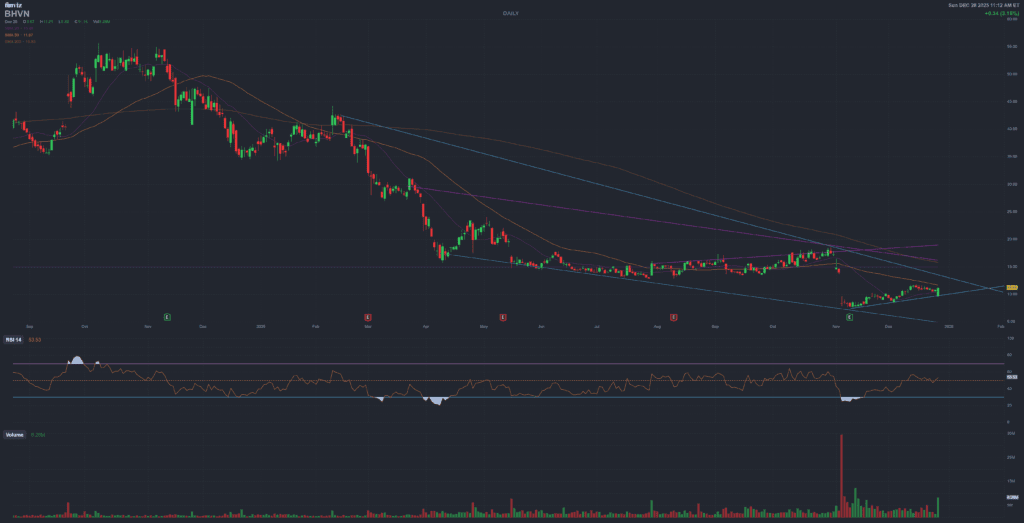
Biohaven (BHVN) – BHV-7000 Depression Trial Miss on Christmas Eve
On December 24, 2025, after the closing bell, Biohaven’s Kv7 drug BHV-7000 failed a Phase 2 proof-of-concept trial in major depressive disorder. The miss capped a brutal year that already included a bipolar-mania trial failure and an FDA rejection in another program, leaving the stock more than 70% down year-to-date.
News of the day
24 December 2025 – Biohaven reports that BHV-7000 did not meet the primary endpoint in a six-week Phase 2 MDD study
(MADRS change vs placebo). Shares fall about 16–17% after hours. Management says it will stop psychiatric trials
with BHV-7000 and focus 2026 resources on immunology, obesity and epilepsy.
The depression study was supposed to show that modulating Kv7.2/7.3 channels could translate into meaningful antidepressant effects with a clean safety profile. Instead, BHV-7000 failed to separate from placebo on the primary endpoint, with only “hypothesis-generating” trends in more severe subgroups – while the drug’s safety remained largely intact.
1. Crash snapshot – what happened to BHVN on Christmas Eve
Biohaven’s press release on December 24 confirmed that the Phase 2 proof-of-concept study of BHV-7000 in adults with major depressive disorder did not meet its primary endpoint: improvement in Montgomery-Åsberg Depression Rating Scale (MADRS) score over six weeks versus placebo. Some subgroups with more severe baseline depression showed trends favouring BHV-7000 on primary and secondary measures, but these were explicitly labelled as “hypothesis-generating” rather than positive results.
Safety looked clean. Adverse events were mostly mild or moderate and resolved spontaneously. The only treatment-emergent events occurring in more than 5% of patients were headache (10.7% vs 9.9% on placebo) and nausea (4.2% vs 5.6% on placebo), with a low incidence of central nervous system events – in line with BHV-7000’s lack of GABA activity seen in earlier Phase 1 work.
The stock reaction was immediate: BHVN fell roughly 16–17% after hours on December 24 and remained under pressure the following sessions, leaving shares down more than 70% for 2025 after an earlier bipolar-mania trial failure in March and an FDA complete response letter in November for the separate drug troriluzole (Vyglxia) in spinocerebellar ataxia.
Crash in one sentence: a Kv7 antidepressant that many saw as “nice optionality” on top of the epilepsy story
turned into a second mood-disorder failure for BHV-7000, hitting sentiment in a name that had already taken heavy damage in 2025.
2. Timeline – how we got from Kv7 enthusiasm to a second mood-disorder miss
Here is a condensed timeline of the key scientific and corporate steps that led up to the MDD miss on Christmas Eve.
2019–2024 – Building the BHV-7000 Kv7 story
Early 2020s
Discovery and early studies
Biohaven identifies BHV-7000 as a potent, selective activator of Kv7.2/7.3 potassium channels – a target with
proven anti-seizure effects and emerging support in mood and pain models. Preclinical work shows robust anti-seizure activity
in maximal electroshock tests, with minimal impact on motor behaviour and limited GABAA activity, hinting at a cleaner
tolerability profile than older Kv7 activators.
2023
EEG biomarker and Phase 1 safety data
Phase 1 SAD/MAD and EEG studies demonstrate that BHV-7000 is well tolerated at doses up to 100 mg single and
120 mg multiple daily dosing, with low rates of CNS adverse events and EEG changes consistent with target engagement but without
the sedation pattern seen with many anti-seizure drugs. These data pave the way for late-stage trials in epilepsy and mood disorders.
Late 2024
CNS Summit poster – MDD & bipolar trial designs unveiled
At the 2024 CNS Summit, Biohaven presents a poster describing two late-stage studies:
a Phase 2 monotherapy trial in MDD and a Phase 2/3 inpatient trial in bipolar mania.
Both use BHV-7000 75 mg once daily versus placebo, with MADRS as the primary endpoint in MDD and Young Mania Rating Scale (YMRS)
in bipolar mania. Expectations build that a differentiated Kv7 mechanism could offer efficacy with better tolerability.
2025 – Bipolar miss, CRL shock and the MDD failure
3–4 March 2025
Bipolar mania Phase 2/3 fails
Biohaven announces that BHV-7000 fails to improve mania symptoms in a pivotal Phase 2/3 bipolar trial, missing the primary YMRS endpoint.
Shares fall sharply, but management and some analysts stress that bipolar mania was a high-risk, low-visibility indication and that the real
value of BHV-7000 lies in depression and epilepsy.
5 November 2025
FDA rejects Vyglxia (troriluzole)
The FDA issues a complete response letter declining to approve troriluzole for a rare neurodegenerative disorder, citing concerns about the use of
external controls and real-world evidence. Biohaven’s stock drops over 40% on the news, and the company initiates portfolio prioritisation.
Nov 2025
Insider buying and new financing
Despite volatility, insiders – including CEO Vlad Coric – buy millions of dollars of BHVN shares around a $7.50 public offering.
QuiverQuant data show at least 11 “Buy” or “Outperform” ratings and a median Street price target around $30,
with multiple banks still calling the stock a high-potential pipeline play.
24 December 2025
MDD Phase 2 misses; psychiatric program halted
Biohaven reports that BHV-7000 did not beat placebo on MADRS improvement in the Phase 2 MDD trial,
though trends favoured BHV-7000 in more severe patients. The company states that it will not pursue further psychiatric trials
with BHV-7000 and will instead channel 2026 resources into immunology, obesity and epilepsy programs. Shares fall ~16–17% after hours and
more than 70% year-to-date.
3. Biohaven and its CEO – who is steering this?
3.1 Biohaven in a nutshell
Biohaven today is essentially “New Biohaven” – the successor to the original company that developed the migraine drugs Nurtec ODT and Zavzpret and sold its CGRP portfolio to Pfizer in 2022 for roughly $13 billion. The current Biohaven Ltd. is a clinical-stage biotech focused on:
- Kv7 ion-channel modulation – BHV-7000 and related programs for epilepsy and previously mood disorders.
- MoDE™ and TRAP™ degraders – extracellular protein degraders like BHV-1300 (IgG), BHV-1400 (IgA nephropathy), BHV-1600 (cardiomyopathy).
- TYK2/JAK1 immunology (BHV-8000) – targeting Alzheimer’s, ARIA and multiple sclerosis.
- Myostatin / activin pathway – including taldefgrobep alfa in obesity and neuromuscular disease.
The company describes itself as working across immunology, obesity, neuroscience and oncology, with a heavy emphasis on rare disease and high-unmet-need neurology. BHV-7000 is the flagship of the Kv7 platform, with Phase 3 trials in focal and generalized epilepsy still ongoing despite the mood-disorder setbacks.
3.2 CEO Vlad Coric – track record before BHV-7000
Dr. Vlad Coric is not a newcomer to CNS drug development:
- Led Biohaven through the approvals of Nurtec ODT and Zavzpret and the subsequent multibillion-dollar Pfizer CGRP deal.
- Over 20 years of experience at Yale School of Medicine and Bristol-Myers Squibb in neuroscience and other therapeutic areas, involved in programs such as Abilify, Opdivo, Yervoy, Daklinza and Sunvepra.
- Associate Clinical Professor of Psychiatry at Yale, former chief of Yale’s Clinical Neuroscience Research Unit and director of its OCD Research Clinic, with more than 70 peer-reviewed publications.
In other words, Biohaven is led by a CEO with deep CNS credentials and a history of value creation – which is exactly why investors took the Kv7 mood program seriously and why this second failure matters for trust as much as for valuation.
4. Major depressive disorder and BHV-7000 – theory vs outcome
4.1 Major depressive disorder – crowded, but still under-served
Major depressive disorder (MDD) is common, recurrent and notoriously difficult to treat. Even with modern SSRIs, SNRIs and augmentation strategies:
- Up to 70% of patients have an inadequate response to first-line SSRI therapy.
- A substantial fraction remain refractory to second- and third-line treatments.
- Non-adherence is high, often due to adverse effects, weight gain, sexual dysfunction or emotional blunting.
In this context, a novel mechanism with a cleaner tolerability profile – especially one that might improve anhedonia and motivation – could be very attractive both clinically and commercially. This is the space Biohaven wanted BHV-7000 to occupy.
4.2 BHV-7000 – a selective Kv7.2/7.3 activator
BHV-7000 is a novel, selective activator of Kv7.2/7.3 potassium channels. These channels help set the neuronal “brake” on excitability:
- Preclinical models show that enhancing Kv7 current reduces hyperexcitability in epilepsy and can normalise behaviours linked to depression and mania.
- Phase 1 data suggest BHV-7000 has robust antiseizure activity in animal models, minimal GABAA receptor activity, and a safety profile without the classic CNS adverse events (somnolence, cognitive slowing) seen with many anti-seizure drugs.
- EEG biomarker studies confirm central target engagement without the sedation-type spectral changes typical of older agents.
Conceptually, then, BHV-7000 sits at the intersection of epilepsy (where Kv7 is a validated mechanism) and mood disorders, where hyperexcitability and circuit dysfunction are increasingly recognised contributors. The problem is that good theory and clean Phase 1 data do not guarantee success in real-world Phase 2 and 3 mood trials.
5. The Phase 2 MDD trial – design vs top-line result
5.1 Trial design – on paper, a straightforward proof-of-concept
Phase 2
Monotherapy
Randomized 1:1
Double-blind
Placebo-controlled
According to the CNS Summit poster, clinicaltrials.gov and Biohaven’s own materials, the MDD study was:
- A multicenter, randomised, double-blind parallel-group trial.
- ~300 adults aged 18–75 with moderate-to-severe MDD and anhedonia (HAM-D ≥20, SHAPS ≥20).
- Monotherapy: participants discontinued other antidepressants before entry.
- 1:1 randomisation to BHV-7000 75 mg once daily or placebo for six weeks, after a four-week screening period.
- Primary endpoint: change in MADRS total score from baseline to Week 6.
- Key secondary endpoints: changes in CGI-S, SHAPS, early MADRS/SHAPS at Week 1, and quality-of-life (Q-LES-Q-SF).
In short, this was a fairly classic modern antidepressant trial design, with a single fixed dose intended to test the mechanism efficiently.
5.2 Top-line results – safe, but not effective enough
On December 24, Biohaven reported that the study did not meet its primary endpoint. BHV-7000 failed to show a statistically significant MADRS improvement versus placebo at Week 6. The company highlighted:
- “Trends favouring BHV-7000” in some clinically relevant subgroups, particularly patients with more severe depression at baseline.
- A favourable safety profile with low rates of CNS adverse events, consistent with prior studies.
- Only headache and nausea occurring in more than 5% of patients, and at similar rates to placebo.
- Plans to present full data at a future scientific meeting.
Importantly, Biohaven also stated that, despite these subgroup signals, it does not plan further psychiatric clinical trials with BHV-7000 and will prioritise immunology, obesity and epilepsy programs instead. For MDD and bipolar, BHV-7000 is effectively being retired.
6. Why did BHV-7000 miss in depression? Data vs hypotheses
We still lack full patient-level data and regulator commentary. What follows separates what the public record directly supports from reasonable – but still speculative – explanations.
6.1 What the data and commentary clearly say
- No significant MADRS separation vs placebo. BHV-7000 simply did not improve MADRS scores enough, relative to placebo, to hit the pre-specified statistical bar at six weeks.
- Subgroup trends, not a broad effect. Biohaven notes trends in more severe patients, but calls these “hypothesis-generating” – language that usually signals insufficient robustness for registration.
- Clean tolerability. Across MDD, bipolar and Phase 1, BHV-7000 has consistently shown a benign safety profile, especially regarding sedation and cognitive dulling – making the failure squarely an efficacy problem rather than a safety-driven halt.
- MDD trial difficulty and placebo noise. Sell-side analysts and commentators flag MDD as a “challenging indication” with high variability and placebo effects; some explicitly say they expected the study to be hard to win cleanly.
- Strategic shift, not just bad luck. Biohaven explicitly states that it will cease psychiatric development of BHV-7000, reallocating capital toward epilepsy and non-CNS immunology / obesity programs. This is a portfolio choice as much as a scientific verdict.
6.2 Informed hypotheses (labelled as such)
Several plausible factors likely contributed, even if they are not fully quantified yet:
- High placebo response and trial execution risk. Six-week MDD monotherapy trials with intensive contact and monitoring are notorious for strong placebo improvements. Analysts at William Blair and others specifically highlighted the role of placebo effects and trial-execution difficulty when reacting to the miss.
- Single fixed dose, unknown dose–response. The trial used 75 mg once daily. If the Kv7 mechanism needs either higher exposure for robust antidepressant effects or a more personalised dosing strategy, a fixed-dose design may under-estimate true potential.
- Mechanistic mismatch in depression vs epilepsy. Kv7 activation is a validated way to reduce seizure-related hyperexcitability. But the causal role of Kv7 dysfunction in human depression is less direct than in epilepsy; positive preclinical models do not guarantee clinical effect across a heterogeneous MDD population.
- Statistical power and heterogeneity. With ~300 patients, the study had reasonable but not unlimited power. If BHV-7000 benefits only a subset of MDD patients – for example, those with specific circuit-level hyperexcitability – the overall average could remain non-significant.
- Psychiatric fatigue after bipolar failure. After the bipolar mania miss earlier in 2025, the bar for continuing psychiatric investment likely rose internally. A marginal win might have kept the mood program alive; a clean miss practically guaranteed a pivot.
Educational takeaway: the failure says more about the difficulty of translating Kv7 modulation into
broad-population antidepressant benefit than it does about its antiseizure potential, which still rests on
separate Phase 3 epilepsy trials.
7. Analyst and market reaction – from pipeline darling to “show me epilepsy”
7.1 Before the MDD miss – bullish pipeline story
Heading into late 2025, despite the bipolar and Vyglxia setbacks, Biohaven was still widely viewed as a high-potential, high-risk pipeline story:
- QuiverQuant tracked 11 Buy/Outperform ratings and zero Sell ratings, with a median target around $30.
- Analysts from Citi, BTIG, TD Cowen, UBS, Raymond James, BofA and Baird all had Buy or Strong Buy ratings as recently as autumn 2025.
- Insider buying – including multi-million-dollar purchases by CEO Vlad Coric and directors – was interpreted by some as a vote of confidence.
The common narrative was that despite near-term volatility, Biohaven’s platforms (Kv7, MoDE/IgG, IgA, oncology ADCs, TYK2/JAK1) could justify far higher valuations if even a subset of programs delivered.
7.2 After Christmas Eve – cautious, but still pipeline-focused
Post-announcement, the tone shifted but did not collapse completely:
- Reuters and others highlighted a ~15–17% drop on the news and a >70% decline year-to-date for BHVN.
- Stocks-and-news outlets reported that the trial miss was “disappointing but not shocking”, with several firms emphasising that expectations for MDD were limited and that the key catalyst remains the Phase 3 epilepsy data in 2026.
- A Seeking Alpha news summary noted that Wall Street analysts largely defended the stock, encouraging investors to focus on the upcoming epilepsy read-outs and on Biohaven’s broader immunology and obesity platforms.
In other words, the market reaction reflects both a direct markdown of psychiatric optionality and a growing insistence on hard epilepsy data before giving the Kv7 mechanism full credit.
8. Retail sentiment and social chatter – Christmas-Eve pain, but still “bullish” pockets
This section summarises sentiment from Reddit, Stocktwits and X as reported by data aggregators. It refers to non-professional trader comments and is included only as a sentiment gauge, not as any kind of recommendation.
8.1 Into the read-out – high hopes for “epilepsy + depression”
In the months leading up to the MDD read-out:
- Reddit and X threads often framed BHV-7000 as a potential dual-franchise drug – anti-seizure and antidepressant – with comments citing clean Phase 1 data and the bipolar trial as an unfortunate but non-fatal setback.
- Some retail traders treated the MDD read-out as a “free call option” on top of the epilepsy story, taking sizeable positions close to the event despite the earlier bipolar miss.
- QuiverQuant data show BHVN increasingly searched and discussed among retail-oriented communities as 2025 progressed, in parallel with news of insider buying and the November public offering.
Expectations were not as euphoric as in some small-cap biotech bubbles, but sentiment was clearly skewed to the upside on the chance of a clean antidepressant signal.
8.2 After the miss – top-trending on Stocktwits, bruised but not dead
After the December 24 announcement:
- A Stocktwits news piece reported BHVN as the top-trending equity ticker in pre-market trading two days later, with the stock down around 14–15% and message volume “extremely high”.
- Interestingly, the same data showed overall sentiment still in “bullish” territory, as many users framed the dip as another opportunity to average down ahead of epilepsy and obesity catalysts.
- QuiverQuant noted that BHVN was among the most-searched tickers around Christmas Eve, reflecting a spike in retail attention.
- A separate Quiver article highlighted the tension between recent insider buying at higher prices and dilution concerns around the November offering, with social media split between “insider confidence” and “funding risk” narratives.
For traders, the main lesson is not whether those bullish or bearish takes are “right”, but that sentiment
can stay aggressively speculative even after a high-profile miss – especially when a second, more visible catalyst (epilepsy) is still ahead.
9. What remains in Biohaven’s pipeline after the BHV-7000 MDD exit?
9.1 BHV-7000 – now an epilepsy-first asset
With MDD and bipolar off the table, BHV-7000 reverts to what many analysts have always viewed as its core: epilepsy and potentially rare epileptic encephalopathies.
- Rise and related studies in focal epilepsy – Phase 3 trials in adults with refractory focal seizures, using extended-release BHV-7000 as adjunctive therapy.
- Idiopathic generalized epilepsy (IGE) program – trials in generalised tonic-clonic seizures.
- KCNQ2 developmental and epileptic encephalopathy – preclinical and early clinical exploration in a ultra-rare Kv7.2 loss-of-function population.
If these epilepsy programs succeed, BHV-7000 could still become a significant franchise, potentially with a differentiated tolerability profile. But the mood-disorder dreams are effectively gone for now.
9.2 Beyond Kv7 – degraders, immunology and obesity
Even after the MDD miss, Biohaven’s pipeline remains broad:
- BHV-1300 / BHV-1310 / BHV-1400 / BHV-1600 – MoDE™-based degraders targeting IgG, IgA and autoantibodies in diseases like Graves’, myasthenia gravis, IgA nephropathy and peripartum cardiomyopathy.
- BHV-8000 – a brain-penetrant TYK2/JAK1 inhibitor in Phase 1 for Alzheimer’s disease, multiple sclerosis and prevention of amyloid-therapy-induced ARIA.
- Taldefgrobep alfa – a myostatin/activin pathway modulator in obesity and neuromuscular disease, now moving into Phase 2b for obesity.
- ADC programs – including BHV-1510 (Trop2 ADC) and BHV-1530 (FGFR3 ADC) in oncology.
The strategic challenge is no longer “does Biohaven have enough shots on goal?” but whether it can finance them on acceptable terms and execute cleanly after a bruising year.
10. Scenarios from here – purely educational, not a recommendation
These scenarios are not forecasts and definitely not advice. They are simply a structured way to think about what the next chapters might look like.
Scenario A – Epilepsy delivers and BHV-7000 becomes a core franchise
In this optimistic – but still plausible – scenario:
- Phase 3 epilepsy trials show clear efficacy and tolerability advantages vs standard anti-seizure drugs.
- Regulators accept the data, leading to approvals in focal and generalized epilepsy and possibly later in KCNQ2 DEE.
- BHV-7000 revenue and real-world data eventually overshadow the psychiatric failures, reframing 2025 as a painful but temporary detour.
Here, the MDD miss is seen as a failed expansion attempt, not a verdict on the core value of the Kv7 platform.
Scenario B – Mixed epilepsy data, platform diversification matters more
A more nuanced outcome:
- Epilepsy data are positive but not spectacular – perhaps showing parity with best-in-class competitors rather than a step-change.
- Biohaven leans harder into MoDE degraders, TYK2/JAK1 and obesity, turning into a multi-platform story where no single asset dominates.
- Valuation depends heavily on how much investors trust management after several misses and how cleanly execution improves.
In this world, BHVN is less of a “one big bet” and more an R&D platform, with corresponding volatility and dispersion of opinions.
Scenario C – Further disappointments and heavier restructuring
In a downside scenario:
- Epilepsy data underwhelm or reveal safety issues, undermining the Kv7 thesis altogether.
- Additional programs stumble, raising capital becomes increasingly dilutive, and the board considers strategic alternatives.
- Biohaven ends up monetising IP and data through asset sales, partnerships or M&A rather than as an independent growth story.
This is not pre-ordained, but it is precisely the kind of path investors in highly experimental biotech need to think about – especially after a year like 2025.
For catalyst-focused traders, the key lesson is familiar:
even sophisticated mechanisms and experienced management teams can deliver sharp downside when pivotal or proof-of-concept trials miss.
Size, diversification and scepticism toward “sure-thing” narratives remain essential.
11. Sources and further reading
Selected primary and secondary sources used for this overview (press releases, SEC filings, company materials and major news outlets; no low-quality blogs).
- Biohaven Phase 2 BHV-7000 MDD press release (top-line data, safety and strategy shift).
- Biohaven Kv7 platform page and pipeline overview (mechanism and broader programs).
- CNS Summit 2024 poster on BHV-7000 in MDD and bipolar (trial designs and endpoints).
- ASCP 2024 poster on BHV-7000 Phase 1 SAD/MAD (safety and EEG biomarker data).
- Reuters coverage of the BHV-7000 depression trial miss and stock reaction.
- FierceBiotech on the BHV-7000 bipolar mania trial failure.
- Reuters on the FDA CRL for troriluzole (Vyglxia).
- Stocktwits news summary on the MDD trial and analyst reactions.
- QuiverQuant article on insider buying, ratings and price targets.
- Yale Ventures profile of CEO Vlad Coric and Biohaven CEO biography PDF.
12. Disclaimer – educational only
This article is for educational and informational purposes only. It is not, and must not be interpreted as, investment advice, investment research, a recommendation to buy, sell or hold any financial instrument, or a solicitation to engage in any investment activity.
The information is based on publicly available sources believed to be reliable at the time of writing, but no representation or warranty is given as to its accuracy or completeness. Biotech and small-cap securities are highly volatile and speculative; investors can lose all or a substantial portion of their capital. Past performance and past clinical data are not indicative of future results.
Readers remain solely responsible for their own investment decisions and should consult qualified, independent financial and legal advisers before taking any action. The author and Merlintrader trading Blog accept no liability for any direct or indirect loss arising from the use of this material.
For full legal and risk disclosures, including privacy and terms of use, please refer to: Merlintrader – Disclaimer and Terms of use & privacy information.
Biohaven (BHVN) – Il tonfo di BHV-7000 nello studio sulla depressione
Il 24 dicembre 2025, a mercati chiusi, Biohaven ha comunicato il fallimento dello studio di Fase 2 con BHV-7000 nel disturbo depressivo maggiore. Il titolo ha perso circa il 16–17% nel dopo-borsa, chiudendo un 2025 già durissimo, tra fallimento nel disturbo bipolare e bocciatura FDA di un altro asset.
News del giorno
24 dicembre 2025 – Biohaven annuncia che BHV-7000 non raggiunge l’endpoint primario nello studio di Fase 2 sulla depressione maggiore
(variazione MADRS a 6 settimane vs placebo). Il titolo crolla nel dopo-borsa.
La società comunica che non proseguirà gli studi psichiatrici sul farmaco e concentrerà le risorse 2026 su immunologia, obesità ed epilessia.
Questo studio doveva dimostrare che modulare i canali Kv7.2/7.3 potesse tradursi in un effetto antidepressivo clinicamente rilevante, con un profilo di tollerabilità pulito. In pratica BHV-7000 non è riuscito a staccarsi dal placebo sull’endpoint primario, con solo segnali “ipotesi-generanti” nei pazienti più gravi – mentre la safety è rimasta buona.
1. Crash snapshot – cosa è successo a BHVN la vigilia di Natale
Il comunicato del 24 dicembre conferma che lo studio di Fase 2 di proof-of-concept con BHV-7000 nel disturbo depressivo maggiore non centra l’endpoint primario: miglioramento del punteggio MADRS a 6 settimane rispetto al placebo. Alcuni sottogruppi di pazienti più gravi mostrano trend favorevoli, ma la stessa Biohaven li definisce “ipotesi-generanti”.
Sul fronte sicurezza, il profilo è buono: eventi avversi per lo più lievi o moderati, che si risolvono spontaneamente. Gli unici eventi oltre il 5% sono cefalea (10,7% vs 9,9% placebo) e nausea (4,2% vs 5,6% placebo), con bassa incidenza di eventi a carico del SNC – coerente con l’assenza di attività GABA di BHV-7000 vista negli studi precedenti.
In borsa il verdetto è rapido: BHVN perde circa 16–17% nel dopo-borsa del 24 dicembre e rimane sotto pressione nei giorni successivi, portando il drawdown 2025 a oltre -70%, dopo il fallimento della Fase 2/3 nel disturbo bipolare a marzo e la lettera di completa risposta FDA per Vyglxia a novembre.
Riassunto in una frase: un tentativo di estendere la storia Kv7 alla depressione si traduce in un secondo flop
nei disturbi dell’umore, in un anno già segnato da una bocciatura regolatoria pesante.
2. Timeline – dall’entusiasmo per Kv7 al secondo flop nei disturbi dell’umore
Qui sotto una timeline sintetica degli eventi chiave che portano al comunicato del 24 dicembre.
2019–2024 – Costruzione della storia BHV-7000
Primi anni 2020
Scoperta e primi studi
Biohaven sviluppa BHV-7000 come attivatore selettivo dei canali Kv7.2/7.3,
target già validato nell’epilessia e con razionale crescente nei disturbi dell’umore e nel dolore.
I modelli preclinici mostrano forte attività anti-crisi, minima interferenza motoria e poca attività GABA,
suggerendo un profilo di tollerabilità più pulito rispetto agli activator Kv7 di prima generazione.
2023
Dati EEG e safety di Fase 1
Gli studi di Fase 1 (SAD/MAD) e biomarcatori EEG dimostrano che BHV-7000 è ben tollerato
fino a dosi elevate, con effetti EEG compatibili con il target ma senza il pattern di sedazione tipico di molti antiepilettici.
Il pacchetto apre la strada a studi di Fase avanzata in epilessia, MDD e disturbo bipolare.
Fine 2024
Poster CNS Summit – design degli studi MDD e bipolare
Al CNS Summit 2024 Biohaven presenta un poster che descrive due studi late-stage:
Fase 2 in MDD e Fase 2/3 nel disturbo bipolare maniacale,
entrambi con BHV-7000 75 mg QD vs placebo. MADRS è l’endpoint primario in MDD, YMRS nel bipolare.
L’idea è offrire una nuova opzione con meccanismo innovativo e migliore tollerabilità.
2025 – Fallimento nel bipolare, CRL e miss in MDD
3–4 mar 2025
Fallimento nella mania bipolare
Biohaven annuncia che BHV-7000 non migliora i sintomi maniacali nello studio pivotale di Fase 2/3,
mancando l’endpoint YMRS. Il titolo scende, ma molti commentatori considerano la mania un’indicazione ad alto rischio,
mantenendo le aspettative su depressione ed epilessia.
5 nov 2025
CRL FDA per Vyglxia (troriluzole)
La FDA rifiuta l’approvazione di Vyglxia per una malattia neurodegenerativa rara,
criticando l’uso di controlli esterni e real-world data. Il titolo perde oltre il 40% in una seduta,
e Biohaven annuncia una revisione delle priorità di portafoglio.
Nov 2025
Aumenti di capitale e acquisti insider
Nonostante la volatilità, il CEO Vlad Coric e altri insider acquistano milioni di dollari di azioni BHVN
attorno a un aumento da 175 milioni a 7,50 dollari.
I dati QuiverQuant mostrano 11 rating Buy/Outperform e target medi intorno ai 30 dollari.
24 dic 2025
Miss in MDD e stop alla psichiatria
Biohaven comunica che BHV-7000 non batte il placebo in MDD.
Pur segnalando trend favorevoli nei pazienti più gravi, la società annuncia che non proseguirà studi psichiatrici
con il farmaco, concentrando invece il budget 2026 su immunologia, obesità ed epilessia.
Il titolo crolla nel dopo-borsa e chiude l’anno con un drawdown superiore al 70%.
3. Biohaven e il suo CEO – chi guida la barca
3.1 Biohaven oggi
L’attuale Biohaven Ltd. è la “nuova” Biohaven, nata dopo la vendita a Pfizer del portafoglio CGRP (Nurtec e Zavzpret) per circa 13 miliardi di dollari nel 2022. Oggi la società si presenta come biotech focalizzata su:
- Modulazione dei canali Kv7 – BHV-7000 e altri progetti in epilessia.
- Degrader extracellulari (MoDE e TRAP) – BHV-1300, BHV-1400, BHV-1600 per malattie autoimmuni, renali e cardiache.
- Immunologia cervello-mirata (BHV-8000) – TYK2/JAK1 per Alzheimer, ARIA, sclerosi multipla.
- Myostatin/activin e obesità – taldefgrobep alfa in Fase 2b nei disturbi metabolici.
Il Kv7 rimane comunque il pezzo più “visibile” per il mercato: BHV-7000 è in Fase 3 nelle epilessie focali e generalizzate, con l’ambizione di offrire un antiepilettico più tollerabile di molti standard attuali.
3.2 Vlad Coric – curriculum prima dei guai di BHV-7000
Il CEO Vlad Coric è un profilo forte nel mondo CNS:
- Ha guidato Biohaven attraverso le approvazioni di Nurtec ODT e Zavzpret e il deal miliardario con Pfizer.
- Oltre 20 anni di esperienza tra Yale School of Medicine e Bristol-Myers Squibb, coinvolto in programmi come Abilify, Opdivo, Yervoy, Daklinza e Sunvepra.
- Professore associato di Psichiatria a Yale, ex responsabile della Clinical Neuroscience Research Unit e della OCD Research Clinic, autore di oltre 70 pubblicazioni peer-reviewed.
Proprio per questo il mercato aveva preso sul serio la scommessa Kv7 nella depressione. I fallimenti 2025 non cancellano il curriculum, ma alzano l’asticella di quanto il mercato chiederà in termini di execution.
4. Disturbo depressivo maggiore e BHV-7000 – teoria contro realtà
4.1 Disturbo depressivo maggiore – mercato affollato, bisogni ancora enormi
Il disturbo depressivo maggiore (MDD) è diffusissimo e spesso cronico. Nonostante un’ampia scelta di SSRI, SNRI e combinazioni:
- Fino al 70% dei pazienti non ha risposta adeguata alla prima linea SSRI.
- Una quota significativa resta refrattaria anche a seconda e terza linea.
- L’aderenza è scarsa, complice il peso degli effetti collaterali e della “anestesia emotiva”.
In questo contesto una molecola con meccanismo nuovo e migliore tollerabilità può fare molta differenza – ed è esattamente la casella che BHV-7000 provava a occupare.
4.2 BHV-7000 – attivatore selettivo di Kv7.2/7.3
BHV-7000 è un attivatore selettivo dei canali Kv7.2/7.3, canali del potassio che modulano l’eccitabilità neuronale:
- Nei modelli preclinici riduce l’iper-eccitabilità alla base delle crisi epilettiche e di alcuni fenotipi correlati al tono dell’umore.
- Gli studi di Fase 1 mostrano buona tollerabilità e assenza dei classici effetti sedativi/cognitivi di molti antiepilettici.
- Studi EEG confermano l’engagement del target nel SNC senza i pattern tipici di sonnolenza marcata.
Sulla carta, quindi, Kv7 rappresenta un ponte tra epilessia e mood disorder. I numeri di MDD e bipolare, però, per ora non hanno validato questa estensione del razionale.
5. Lo studio di Fase 2 in MDD – design e risultato
5.1 Design – un classico studio antidepressivo di prova concetto
Fase 2
Monoterapia
Randomizzato 1:1
Doppio cieco
Controllato vs placebo
In base a poster e registri, lo studio MDD è:
- Multicentrico, randomizzato, in doppio cieco.
- ~300 adulti (18–75 anni) con episodio depressivo moderato-severo e anedonia.
- Monoterapia: sospensione dei farmaci antidepressivi prima dell’ingresso.
- Randomizzazione 1:1 a BHV-7000 75 mg QD o placebo per 6 settimane, dopo screening di 4 settimane.
- Endpoint primario: variazione del punteggio MADRS dalla baseline alla settimana 6.
- Secondari chiave: CGI-S, SHAPS, early readout a 1 settimana, qualità di vita (Q-LES-Q-SF).
5.2 Risultato topline – sicurezza ok, efficacia insufficiente
Nel comunicato del 24 dicembre Biohaven dichiara che lo studio non raggiunge l’endpoint primario. BHV-7000 non mostra un miglioramento MADRS statisticamente superiore al placebo alla settimana 6. La società sottolinea:
- Trend favorevoli in alcuni sottogruppi clinicamente rilevanti, soprattutto nei pazienti più gravi.
- Profilo di tollerabilità favorevole, con eventi avversi per lo più lievi o moderati.
- Cefalea e nausea come unici eventi sopra il 5%, a frequenze simili al placebo.
- Intenzione di presentare i dati completi a un prossimo congresso.
Contestualmente Biohaven comunica che, pur riconoscendo i segnali nei sottogruppi, non continuerà lo sviluppo psichiatrico di BHV-7000, riorientando il budget verso immunologia, obesità ed epilessia.
6. Perché BHV-7000 è fallito nella depressione? Dati e ipotesi
Mancano ancora i dati di dettaglio paziente per paziente. Qui separiamo quanto emerge direttamente dalle fonti da ciò che è un ragionamento a scenari.
6.1 Cosa dicono chiaramente dati e commenti
- Nessuna separazione MADRS vs placebo. L’effetto medio del farmaco non è sufficiente per raggiungere la significatività statistica.
- Sottogruppi con trend, non con prove robuste. I segnali nei pazienti più severi sono esplicitamente definiti “ipotesi-generanti”.
- Tollerabilità buona. Il problema è l’efficacia, non la safety: il profilo di eventi avversi resta favorevole.
- Difficoltà intrinseca degli studi MDD. Vari analisti ricordano che i trial antidepressivi sono soggetti a enorme variabilità e forte risposta placebo.
- Scelta strategica netta. Dopo il flop nel bipolare e la CRL, la dirigenza sceglie di chiudere il capitolo psichiatrico di BHV-7000, concentrando le risorse sulle aree dove vede più probabilità di successo.
6.2 Ipotesi ragionate (indicate come tali)
Tra i possibili fattori che possono aver contribuito:
- Risposta placebo elevata. Studi di 6 settimane, con contatti frequenti e wash-out di altre terapie, tendono a mostrare grossi miglioramenti anche nel braccio placebo.
- Dose fissa. Il trial utilizza solo 75 mg QD. Se il meccanismo Kv7 richiedesse esposizioni diverse o un aggiustamento individuale, il design potrebbe aver sottostimato il potenziale reale.
- Mismatch meccanicistico. Che i canali Kv7 siano un target chiave nell’epilessia è consolidato; il loro ruolo nella fisiopatologia della depressione è molto meno lineare.
- Eterogeneità del MDD. Se il beneficio si concentra in sottogruppi particolari, la media globale può restare “piatta”.
- Stanchezza verso il filone psichiatrico. Dopo il flop nella mania, serviva probabilmente un risultato molto convincente per proseguire. Un miss netto rende più facile chiudere il capitolo e rifocalizzare il portafoglio.
Morale didattica: il fallimento dice soprattutto quanto sia difficile trasformare un buon razionale Kv7
in beneficio antidepressivo su ampia scala, più che demolire automaticamente la tesi sull’epilessia.
7. Reazione di analisti e mercato – da “pipeline story” a “fatemi vedere l’epilessia”
7.1 Prima del miss – ancora molto ottimismo di fondo
Nonostante il 2025 difficile, fino a novembre il quadro era ancora costruttivo:
- Secondo QuiverQuant c’erano 11 rating Buy/Outperform e nessun Sell, con target medi intorno ai 30 dollari.
- Citi, BTIG, TD Cowen, UBS, Raymond James, BofA, Baird e altri mantenevano raccomandazioni positive.
- Gli acquisti insider, inclusi quelli di Coric, venivano letti come segnale di fiducia nel medio periodo.
La narrativa era quella di una società con tanti “proiettili” in pipeline, dove qualche inciampo era messo in conto.
7.2 Dopo la vigilia di Natale – più prudenza, ma focus sull’epilessia
Dopo il comunicato su MDD:
- Le news headline parlano di calo di ~15–17% e di un drawdown annuo superiore al 70%.
- Diversi commenti sintetizzano la view come “deludente ma atteso” e spostano esplicitamente l’attenzione sulle letture di Fase 3 in epilessia nel 2026.
- Una nota di Seeking Alpha sottolinea che molti analisti difendono comunque il titolo, vedendo nel Kv7 per l’epilessia e nei degrader immunologici le vere chiavi di valore.
In pratica, MDD viene declassato a tentativo fallito, mentre la posta principale si sposta sulle crisi epilettiche e sugli altri programmi core.
8. Sentiment retail e chatter social – dolore di breve, hype su epilessia
Qui riassumiamo il sentiment da Reddit, Stocktwits e X riportato da aggregatori. Si tratta di commenti di trader non professionisti, utili solo come termometro di umore del mercato.
8.1 Prima del dato – scommessa “epilessia + depressione”
Nei mesi precedenti:
- Discussioni su Reddit e X dipingono spesso BHV-7000 come possibile franchise doppio (epilessia + MDD), con la mania già vista come indicazione bonus.
- Molti retail leggono l’MDD come optionalità “gratuita” rispetto alla storia di base sull’epilessia.
- I dati su ricerche ticker e messaggi mostrano un’attenzione crescente man mano che si avvicinava la lettura, complice anche l’insider buying.
8.2 Dopo il miss – trending su Stocktwits, ma sentiment ancora “bullish”
Dopo il comunicato:
- Un articolo Stocktwits segnala BHVN come ticker azionario più trending nel pre-market successivo.
- Nonostante il calo a doppia cifra, il “sentiment meter” di Stocktwits risulta ancora in area bullish, con volume di messaggi “estremamente alto”.
- QuiverQuant evidenzia BHVN tra i ticker più cercati il 24 dicembre, mentre un altro report discute la combinazione di forti acquisti insider e timori di diluizione.
Lezione: anche dopo un tonfo importante, il retail può restare molto aggressivo,
soprattutto se percepisce un “prossimo grande catalyst” (in questo caso, i dati di Fase 3 in epilessia).
9. Cosa resta in pipeline dopo l’addio a MDD e bipolare
9.1 BHV-7000 – ora soprattutto epilessia
Chiusa la parentesi psichiatrica, BHV-7000 torna a essere, di fatto, un asset incentrato sull’epilessia:
- Rise e affini – studi di Fase 3 nelle epilessie focali refrattarie con formulazione a rilascio prolungato.
- Programma nelle epilessie generalizzate idiopatiche – generalised tonic-clonic.
- Exploration KCNQ2 DEE – possibili sviluppi in una encefalopatia epilettica ultra-rara legata a mutazioni Kv7.2.
Se questi programmi andassero bene, BHV-7000 potrebbe comunque diventare un franchise importante. Ma la “gamba” MDD/bipolare non fa più parte del quadro.
9.2 Oltre Kv7 – degraders, immunologia, obesità
Anche senza MDD, il portafoglio Biohaven è ben popolato:
- BHV-1300/1310/1400/1600 – degraders MoDE contro IgG, IgA e autoanticorpi in malattie autoimmuni, nefrologiche e cardiache.
- BHV-8000 – inibitore TYK2/JAK1 brain-penetrant per Alzheimer, ARIA e SM.
- Taldefgrobep alfa – modulatore myostatin/activin per obesità e patologie neuromuscolari.
- ADC oncologici – BHV-1510, BHV-1530 e altri progetti in onco-ematologia.
La sfida non è tanto la mancanza di progetti, quanto la capacità di finanziarli e portarli avanti in maniera credibile dopo un anno di colpi duri.
10. Scenari possibili – solo a scopo didattico
Gli scenari che seguono non sono previsioni e non sono una raccomandazione. Servono solo a ragionare in modo strutturato su come potrebbe evolvere la storia.
Scenario A – Epilessia forte e “redenzione” di BHV-7000
In questo scenario:
- Le Fasi 3 in epilessia mostrano efficacia chiara e buon profilo di tollerabilità.
- Arrivano approvazioni in epilessie focali e generalizzate e, più avanti, in KCNQ2 DEE.
- La narrativa di mercato si sposta dal fallimento in MDD al successo come antiepilettico di nuova generazione.
Scenario B – Dati misti, conta di più il resto della pipeline
Qui:
- I dati in epilessia sono positivi ma non eclatanti rispetto ai competitor.
- Biohaven punta più forte su MoDE, TYK2/JAK1 e obesità, diventando una “platform company” con più pilastri e meno dipendenza da un singolo asset.
- La valutazione dipende soprattutto dalla fiducia nell’esecuzione futura, dopo gli errori del 2025.
Scenario C – Ulteriori delusioni e ristrutturazione pesante
Nel caso peggiore:
- I dati in epilessia non sono convincenti o emergono problemi di safety.
- Altri programmi chiave deludono e la società è costretta ad aumenti di capitale molto diluitivi o a valutare la vendita di asset.
- La creazione di valore passa più da M&A e monetizzazione della IP che da una crescita autonoma.
Non è detto che vada così, ma è il tipo di scenario che chi investe in biotech sperimentali deve sempre tenere in conto.
Per chi fa trading sui catalyst, la lezione è la solita:
meccanismi eleganti e management esperto non eliminano il rischio di tonfi pesanti quando i trial falliscono.
Size prudente, diversificazione e scetticismo verso i “quasi garantiti” restano fondamentali.
11. Fonti e approfondimenti
Principali fonti primarie e secondarie utilizzate (comunicati ufficiali, documenti SEC, materiale aziendale e testate di qualità).
- Comunicato Biohaven sullo studio di Fase 2 MDD con BHV-7000.
- Pagina ufficiale Kv7 di Biohaven e overview della pipeline.
- Poster CNS Summit 2024 su BHV-7000 in MDD e bipolare.
- Poster ASCP 2024 su BHV-7000 (studi di Fase 1 SAD/MAD).
- Articolo Reuters sul fallimento dello studio MDD e la reazione del titolo.
- FierceBiotech sul fallimento nello studio bipolare.
- Reuters sulla CRL FDA per Vyglxia.
- Articolo Stocktwits sullo studio MDD e le reazioni degli analisti.
- Report QuiverQuant su acquisti insider, rating e target.
- Profilo Yale Ventures di Vlad Coric e biografia ufficiale Biohaven.
12. Disclaimer – solo a scopo informativo
Questo articolo ha esclusivamente finalità informative e didattiche. Non costituisce e non deve essere interpretato come consulenza in materia di investimenti, raccomandazione personalizzata, ricerca in materia di investimenti, sollecitazione al pubblico risparmio o offerta di strumenti finanziari.
Le informazioni sono basate su fonti ritenute affidabili al momento della redazione, ma non se ne garantisce accuratezza o completezza. I titoli biotech e le small cap sono per loro natura altamente speculativi e volatili; è possibile perdere una parte rilevante o la totalità del capitale investito. Rendimenti e dati clinici passati non sono indicativi di risultati futuri.
Ogni decisione di investimento rimane a esclusivo carico del lettore, che dovrebbe rivolgersi a consulenti finanziari e legali abilitati prima di assumere qualunque decisione. L’autore e Merlintrader trading Blog declinano ogni responsabilità per eventuali perdite dirette o indirette derivanti dall’uso di questo materiale.
Per testi completi su rischi, responsabilità, privacy e trattamento dati si vedano: Disclaimer Merlintrader e Condizioni d’uso e info privacy.
Biotech Catalyst Calendar
Per contestualizzare storie singole come Biohaven e BHV-7000,
incrocia sempre i catalyst sui singoli titoli con una vista ampia del calendario eventi (PDUFA, letture di trial, CRL, ecc.).
Apri il Biotech Catalyst Calendar
Scanner for active traders

Try ChartsWatcher free, then unlock 10% OFF with SAVE10
ChartsWatcher is a real-time scanner for momentum traders: fast movers, unusual volume and rotations — so you can focus on the few tickers that matter right now, instead of watching hundreds of charts.
Start with the free version. When you upgrade, use SAVE10 for 10% OFF your first paid period.
Start free – then use SAVE10
No credit card required to start. Apply SAVE10 when upgrading.
Recommended platform

One platform. All your brokers.
Medved Trader connects multiple brokers in one workspace, with pro charts, hotkeys and fast execution — without changing your broker accounts.
A single cockpit for positions, Level II and multi-broker order routing, built for active day & swing traders.
Get 1 Month Free ➔
Multi-broker workflow + customizable layouts in one platform.
 Monica.im – the AI assistant I use every day
If you find value in the work I publish on Merlintrader and want a practical AI assistant for research and writing, you can sign up using this referral link. Click here to try Monica.im and support the site
Find out how I use AI on Merlintrader: AI, retail and Merlintrader
Disclosure: some of the links in the promotional blocks above are affiliate or referral links. If you choose to subscribe or sign up through them, Merlintrader may receive a small commission or benefit at no extra cost to you.