






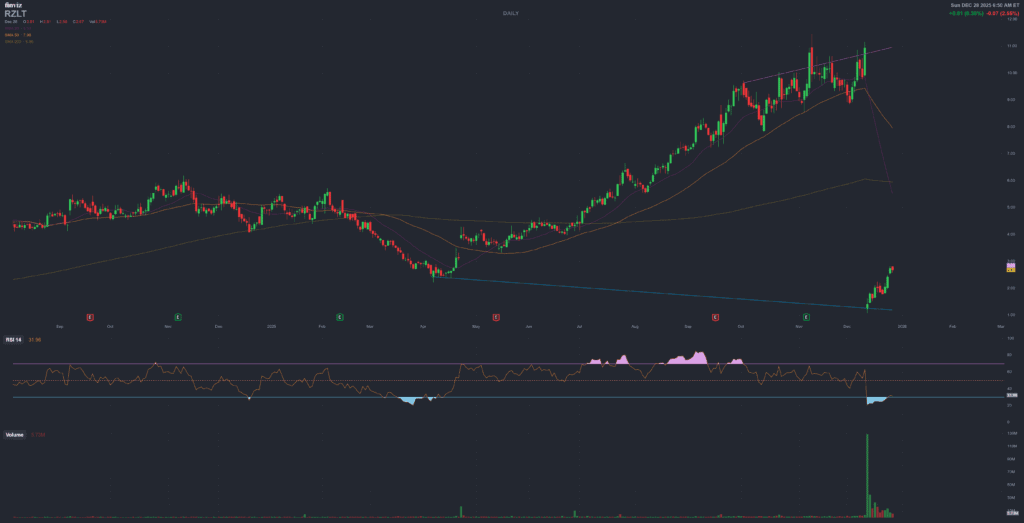
Rezolute (RZLT) – When a Breakthrough Story Breaks Down
From FDA Breakthrough Therapy Designation and glowing Phase 2 data to an 80–90% one-day crash after the sunRIZE Phase 3 failure in congenital hyperinsulinism. This is a full timeline of what went right, what went wrong, and what is left.
News of the day
11 December 2025 – sunRIZE Phase 3 fails to meet primary and key secondary endpoints in congenital hyperinsulinism.
RZLT collapses ~85–90% intraday, wiping out hundreds of millions in market cap.
sunRIZE was supposed to be the pivotal trial to turn ersodetug – an insulin receptor antibody for hyperinsulinism – into the first broadly active, non-surgical therapy for congenital hyperinsulinism (cHI). Instead, the data showed only a marginal benefit over placebo, with families in the control arm improving almost as much as the drug arm.
1. Crash snapshot – what actually happened to RZLT
On 11 December 2025 Rezolute released topline sunRIZE Phase 3 data in congenital hyperinsulinism. The trial did not meet its primary endpoint (change in weekly hypoglycemia events by self-monitored blood glucose) and did not meet its key secondary endpoint (time in hypoglycemia by continuous glucose monitoring). At the top 10 mg/kg dose, hypoglycemia events were reduced by about 45%, but placebo improved by around 40%, wiping out statistical significance.
Markets reacted brutally. Different sources report intraday declines of roughly 82–90%, with the stock falling from around 11 dollars to near 1–1.5 dollars in a single session, briefly halting for volatility. Ratings agencies and law firms quickly followed with downgrades and an investigation announcement.
Crash in one sentence: a single-asset, late-stage rare-disease bet that had been
framed as “de-risked” by Breakthrough Therapy status and strong Phase 2 data saw its pivotal trial
fail against an unexpectedly strong placebo response.
2. Timeline – from promising antibody to unexpected Phase 3 failure
Below is a condensed timeline of key events leading up to the sunRIZE read-out and the crash.
2018–2023 – Building the ersodetug story
Pre-2022
Early development of RZ358 / ersodetug
Rezolute licenses and develops RZ358 (later renamed ersodetug), a fully human monoclonal antibody
targeting the insulin receptor to counteract hypoglycemia driven by hyperinsulinism, including
congenital hyperinsulinism (cHI) and tumor-induced hyperinsulinism (tHI).
2022
Phase 2b RIZE trial completes
The global, multi-center Phase 2b RIZE study (RZ358-601) shows meaningful reductions in hypoglycemia events
and duration in cHI patients on background standard therapies, with a favourable safety profile.
These data later underpin regulatory designations and investor optimism.
Dec 2023
sunRIZE Phase 3 initiated
Rezolute announces the start of sunRIZE (RZ358-301), a pivotal Phase 3, double-blind, placebo-controlled trial
in cHI patients aged 3 months to 45 years with persistent hypoglycemia despite standard of care.
2024
Partial clinical hold and resolution
The FDA imposes a partial clinical hold due to rat liver toxicity signals in preclinical studies.
After additional toxicology work shows the findings are strain-specific and not human-relevant,
the hold is lifted in September 2024, with age and dose restrictions for U.S. participants.
sunRIZE can fully proceed with U.S. enrolment.
2024–2025 – From Breakthrough status to crash
Jan 2025
Breakthrough Therapy Designation
The FDA grants Breakthrough Therapy Designation to ersodetug for hypoglycemia due to cHI,
based largely on Phase 2b RIZE data showing ≥75% improvements in hypoglycemia in many patients,
without clinically significant hyperglycemia.
H1 2025
sunRIZE enrolment completes; second Phase 3 launched
Rezolute completes sunRIZE enrolment (around 56 patients, more than a dozen countries) and initiates
upLIFT, a second Phase 3 program of ersodetug in tumor-induced hyperinsulinism, largely U.S.-based.
Mid-2025
Publication and conference buzz
Phase 2 data for ersodetug in cHI are published in peer-reviewed journals and presented at endocrinology meetings,
reinforcing the narrative of a promising, universal insulin receptor–targeted therapy.
Sept–Nov 2025
Guidance: topline data in December
In fiscal 2025 and early fiscal 2026 updates, management reiterates that topline sunRIZE data are expected
in December 2025. Cash resources are described as sufficient into mid-2027,
framing the read-out as a major but “funded” binary event.
Early Dec 2025
Social and analyst optimism peaks
Social-media tracking shows increasing chatter on X about the upcoming pivotal data, with many retail investors
expecting a positive read-out and potential standard-of-care status in cHI. Sell-side targets
for RZLT are mostly in the double-digit range.
11 Dec 2025
sunRIZE fails; stock collapses
Topline data show no statistically significant difference between ersodetug and placebo on primary or key secondary endpoints.
The stock crashes 80–90% intraday; Wedbush downgrades to Neutral with a 1 dollar target,
other firms slash targets sharply though some maintain Buy ratings on residual optionality.
Mid–late Dec 2025
Legal and research overhang
A shareholder-rights law firm opens an investigation into Rezolute, focusing on whether prior communications
about ersodetug may have been overly optimistic. Independent research notes that the company still has
the tumor hyperinsulinism Phase 3 ongoing, but the balance-sheet and financing risk profile have changed.
3. Company and CEO – who is behind Rezolute?
Rezolute in a nutshell
Rezolute is a late-stage, rare-disease biotech focused on improving outcomes for patients with hypoglycemia caused by hyperinsulinism, primarily congenital hyperinsulinism and tumor-induced hyperinsulinism. The company was founded in 2010 and is headquartered in Redwood City, California.
According to its latest filings, Rezolute has no approved products and no product revenue. The investment story up to December 2025 was almost entirely tied to ersodetug, with a smaller, earlier-stage ophthalmology asset (RZ402 for diabetic macular edema) in the background.
The company raised substantial capital to push ersodetug through two Phase 3 programs, extending its cash runway into mid-2027 before the sunRIZE read-out. After the failure, the key debate is how long that runway really lasts if programs are redesigned and whether additional financing will be needed on far worse terms.
CEO profile – Nevan Charles Elam, J.D.
Rezolute’s founder and CEO, Nevan Elam, is not a typical first-time biotech CEO. His CV blends law, large-cap pharma, and prior company building:
- Former Senior Vice President at Nektar Therapeutics, where he ran the Pulmonary Business Unit and spun out assets (Aerogen, Pearl Therapeutics – later sold to AstraZeneca for around 1 billion dollars).
- Co-founder and Chief Financial Officer of e2open, a supply-chain platform company that later listed publicly.
- Early-career corporate partner at Wilson Sonsini Goodrich & Rosati, advising tech and biotech names including Genentech and Hewlett-Packard and negotiating the sale of Steve Jobs’ NeXT to Apple.
- Board roles across several U.S. and international healthcare companies, including Savara in rare lung disease.
On paper, this is a management team with deep rare-disease and endocrinology expertise. That’s part of why the market treated the sunRIZE program as relatively de-risked right up to the read-out.
4. The disease and the drug – why ersodetug looked like a game changer
Congenital hyperinsulinism – a brutal starting point
Congenital hyperinsulinism (cHI) is a rare pediatric condition in which the pancreas secretes too much insulin, driving frequent, severe hypoglycemia. Untreated or poorly controlled, it can cause permanent neurological damage, seizures, and even death in infants and children.
Standard treatments are a patchwork: diazoxide (which many children do not tolerate or respond to), octreotide or other somatostatin analogues, continuous feeding or parenteral dextrose, and in extreme cases near-total pancreatectomy – itself leading to lifelong diabetes and exocrine insufficiency.
So the unmet need is enormous: a systemic therapy that can dampen excessive insulin action across tissues, regardless of the underlying genetic mutation, without causing chronic hyperglycemia.
Ersodetug – mechanism of action
Ersodetug (RZ358) is a fully human monoclonal antibody that binds the insulin receptor in an allosteric fashion. Instead of shutting insulin signalling off completely, it is designed to dial down over-activation in insulin-sensitive tissues such as liver, muscle and fat:
- Acts as a negative allosteric modulator of the insulin receptor, reducing downstream signalling when insulin levels are excessive.
- Acts downstream of the pancreas, theoretically making it agnostic to the genetic cause of hyperinsulinism.
- Aim: improve glucose levels in all forms of hyperinsulinism (congenital and tumor-induced) without triggering dangerous hyperglycemia.
In Phase 2b RIZE, ersodetug produced significant reductions in hypoglycemia events and time in hypoglycemia, with many patients achieving ≥75% improvement and no clinically meaningful hyperglycemia. These results convinced regulators to grant Breakthrough Therapy status and investors to treat cHI as a high-probability approval path.
5. The sunRIZE Phase 3 trial – design vs reality
Trial design – what was supposed to happen
RZ358-301 (sunRIZE)
Randomized
Double-blind
Placebo-controlled
Global, multi-center
sunRIZE enrolled around 56 patients aged 3 months to 45 years with a confirmed diagnosis of congenital hyperinsulinism, who continued to experience hypoglycemia despite standard of care. Key features:
- Parallel-arm design with multiple doses of ersodetug, including a top 10 mg/kg regimen.
- Randomisation vs placebo, all on optimized background therapy.
- Primary endpoint: change in average weekly hypoglycemia events measured by self-monitored blood glucose.
- Key secondary endpoint: change in time in hypoglycemia by continuous glucose monitoring (CGM).
Based on Phase 2, the company and many analysts expected a clear separation from placebo – enough for a relatively clean regulatory path in cHI, particularly under Breakthrough designation.
Top-line results – what actually came out
On 11 December 2025, Rezolute announced that sunRIZE failed its primary and key secondary endpoints. The key numbers from the top dose:
| Ersodetug 10 mg/kg | Placebo | |
|---|---|---|
| Change in weekly hypoglycemia events (SMBG) | ≈ 45% reduction | ≈ 40% improvement |
| Change in time in hypoglycemia (CGM) | ≈ 25% reduction | ≈ 5% increase |
Statistically, this was not enough: the delta between arms was too small to reach significance on the pre-specified endpoints. The company also reported rare serious hypersensitivity reactions leading to discontinuation in two patients, though overall safety was still described as acceptable relative to other biologics.
CEO Nevan Elam and analysts highlighted one common theme: an unexpectedly strong placebo response in a small, ultra-rare pediatric trial where families intensified monitoring and care during the study, improving outcomes even without active drug.
6. Why did sunRIZE fail? What we know vs what is speculation
We do not have full patient-level data yet, and regulators have not weighed in publicly. What follows is a reasoned, educational interpretation based on available information, not a definitive verdict.
6.1 Factors supported by available data
- High placebo response. Both hypoglycemia events and time in hypoglycemia improved substantially in the placebo arm. In ultra-rare pediatric trials, awareness and monitoring typically intensify, leading to better glucose management even without the investigative drug.
- Endpoint choice and variability. The primary endpoint relied on self-monitored blood glucose logs, which are susceptible to behavioural changes (more frequent checks, diet adjustments, changes in background therapy) that may not be balanced despite randomisation in a 50-ish patient study.
- Sample size and power. If the true drug effect is meaningful at the bedside but smaller than Phase 2 suggested, a ~56-patient study may be underpowered to separate drug from placebo on strict statistical thresholds.
- Safety profile. Serious allergic reactions were rare but real. For any salvage strategy or new trial, regulators will weigh these risks against the size and clarity of benefit.
6.2 Areas where we are (informed) guessing
Several points are necessarily speculative until more data are shared. They are important to understand the range of possible explanations:
- Expectation bias from open-label Phase 2. RIZE was not placebo-controlled; caregivers and investigators knew patients were receiving active drug. That context tends to favour stronger apparent responses than a blinded Phase 3.
- Disease heterogeneity. cHI includes multiple genetic subtypes and differing severity. If some subgroups respond very well and others barely respond, averaging over all of them may dilute the signal.
- Optimised standard of care. Sites participating in a pivotal trial often raise their standard practice (more aggressive glucose monitoring, more structured feeding), shrinking the incremental room left for the new drug.
- Protocol tweaks to satisfy regulators. Age and dose restrictions imposed by the FDA when lifting the partial hold may have led to a patient mix or dosing pattern that differed from Phase 2, nudging efficacy below expectations.
Bottom line: the available evidence suggests that ersodetug is biologically active
(Phase 2 and real-world data are hard to ignore),
but the pivotal trial design, sample size and placebo response together prevented a clean, registrational win in cHI.
7. Analyst and market reaction – from “derisked” to “show me”
7.1 Before the crash – bullish consensus
Prior to December 2025, Rezolute enjoyed a supportive analyst backdrop:
- Multiple firms rated RZLT as Outperform/Buy with double-digit price targets, framing ersodetug as a high-probability approval in cHI with additional upside in tumor hyperinsulinism.
- Some quantitative services described the stock as undervalued on a price-to-book and DCF basis, with fair value estimates significantly above the then-trading price.
- Zacks upgraded Rezolute to a “Buy” earlier in 2025, citing improved earnings prospects if ersodetug progressed smoothly.
In short: many investors treated the Phase 3 as a confirmatory step, not a coin-flip.
7.2 After sunRIZE – target cuts and investigations
Post-read-out, the tone shifted sharply:
- Wedbush downgraded Rezolute from Outperform to Neutral with a 1 dollar price target, essentially treating the cHI program as severely impaired and focusing on residual value in tumor hyperinsulinism and cash.
- Guggenheim cut its target from around 15 to 6 dollars but maintained a Buy rating, arguing there is still a path forward if tumor hyperinsulinism data are positive and if some cHI value can be salvaged.
- HC Wainwright reduced its target from around 14 to 5 dollars while keeping a Buy rating, pushing expected launch timelines out and emphasising increased risk, not a complete write-off.
- A well-followed independent analyst on Seeking Alpha downgraded RZLT to Sell, arguing that the risk/reward after the failure no longer justified long exposure for most investors.
- Hagens Berman, a shareholder-rights law firm, announced an investigation into whether Rezolute’s prior communications about ersodetug’s efficacy and prospects may have been misleading. These are allegations and not, by themselves, proof of wrongdoing.
The consensus now looks more like “show me”: investors want clear evidence that either (a) a cHI path still exists, or (b) tumor hyperinsulinism and other indications can justify the remaining valuation.
8. Retail sentiment and social chatter – hope, hype and anger
For catalyst traders, what happened around sunRIZE is also a case study in how social sentiment behaves around a highly anticipated read-out. This section summarises non-professional sentiment from Reddit, Stocktwits and X, as reported by aggregators – it is not investment advice.
8.1 Before the data – “Breakthrough means it’s almost done, right?”
In the week leading up to the read-out, monitoring tools and news summaries highlighted an uptick in RZLT mentions on X and Stocktwits:
- Many posts emphasised the FDA Breakthrough Therapy designation and Phase 2 success as signs that Phase 3 was “derisked”.
- Some threads compared RZLT to successful rare-disease plays that saw multi-bagger moves on approval.
- Position sizing, in many cases, appeared aggressive relative to account size, typical of “all-in binary event” retail trades.
In hindsight, this is a textbook example of over-confidence in late-stage biotech, where strong Phase 2 and regulatory enthusiasm do not guarantee a clean Phase 3 win.
8.2 After the crash – bagholders, blame and “lottery ticket” thinking
Immediately after the press release and price collapse:
- Reddit and Stocktwits comments swung from enthusiasm to anger and disbelief. Many self-described bagholders expressed frustration that a Breakthrough-designated drug could fail outright.
- Some users blamed management messaging for “over-hyping” the program; others pointed to the small sample size and ultra-rare nature of cHI as excuses rather than explanations.
- A subset of traders started framing RZLT as a lottery-ticket rebound, arguing that any salvage in cHI or success in tumor hyperinsulinism could yield a multi-bagger from post-crash lows.
Educational takeaway: social sentiment often overshoots in both directions –
from “almost guaranteed win” to “total zero” – even when the truth is somewhere in between and highly uncertain.
9. What is left in Rezolute’s pipeline after sunRIZE?
9.1 Congenital hyperinsulinism (cHI) – salvage or sunset?
After a failed registrational trial, there is no easy regulatory path. However, the story is not automatically “dead”:
- More than 50 children from sunRIZE reportedly remain on ersodetug in an extension study, with some weaned off other therapies, suggesting individual-level benefit for at least a subset of patients.
- Breakthrough Therapy designation technically remains in place, but its practical value is unclear after a failed Phase 3.
- Rezolute has announced that it is “conducting a thorough evaluation” of the data, which may include subgroup analyses (by genotype, baseline severity, age) and endpoint re-examination.
In theory, options include:
- A smaller, focused trial in a genetically or clinically defined subgroup that showed strong benefit.
- Alternative endpoints or composite measures that better capture real-world benefit.
- Compassionate-use or expanded access with data collection, but this alone is unlikely to support approval.
All of these would require time, money, and regulatory buy-in – and investors now know that nothing is guaranteed.
9.2 Tumor hyperinsulinism (tHI) and other assets
sunRIZE is not the only Phase 3 program:
- upLIFT – Phase 3 trial of ersodetug in tumor-induced hyperinsulinism (e.g. insulinomas, other islet-cell tumours) is ongoing, with topline data currently expected in the second half of 2026.
- Real-world expanded-access data in tHI have shown promising improvements in glucose control, including the ability to reduce parenteral dextrose and discharge patients from hospital in some cases.
- RZ402 – an oral plasma kallikrein inhibitor being developed for diabetic macular edema, which remains earlier-stage and has been in the background of the investment narrative.
Whether investors give credit to tHI and RZ402 will depend heavily on Rezolute’s ability to preserve cash, communicate clearly about strategy changes, and rebuild trust after the cHI disappointment.
10. Scenarios from here – not a recommendation
This section is purely educational. It sketches possible strategic paths; it is not a forecast, and it is not advice to buy, sell or hold any security.
Scenario A – Narrowed cHI focus plus tHI execution
In this scenario, Rezolute:
- Identifies a subgroup of cHI patients (e.g. specific genotypes or severe phenotypes) with strong benefit in sunRIZE and the extension study.
- Engages regulators to discuss whether those data, plus new analyses, could support a label in a narrower population or whether another, smaller trial would be required.
- Executes cleanly on upLIFT in tumor hyperinsulinism, aiming for an approval path there to anchor the commercial story.
This path offers upside but would require precise data work, transparent communication, and additional capital – probably dilutive at current share prices.
Scenario B – Pivot to tHI and M&A / out-licensing
Another path is to treat cHI as “wounded but not dead,” while focusing energy on tumour hyperinsulinism:
- Prioritise upLIFT and treat tHI as the main registrational opportunity, with cHI potentially revisited later.
- Explore out-licensing or regional partnerships for ersodetug to share risk and reduce the cash burden.
- Position RZ402 and any earlier-stage assets as optionality for longer-term value or a strategic sale.
In this view, RZLT evolves from a “pure cHI bet” into a more complex rare-disease platform – but that transition is happening under the shadow of a recent high-profile failure.
Scenario C – Restructuring and value realisation
If capital markets remain closed or dilutive financing becomes unacceptable, the board might:
- Consider strategic alternatives, including sale of the company or individual assets.
- Restructure the cost base to extend runway, slowing or cancelling some development programs.
- Focus on preserving value in core intellectual property and datasets for potential acquirers.
This scenario is less exciting for growth investors but can still matter for creditors and longer-term strategic players.
For catalyst traders, the main lesson is not “RZLT is good/bad,” but that even
Breakthrough-designated, apparently de-risked late-stage programs can fail hard.
Position sizing, diversification and scepticism about “sure things” remain critical in this corner of the market.
11. Sources and further reading
Selected primary and secondary sources used for this overview (regulatory filings, company communications and major news outlets; no low-quality blogs).
- Rezolute investor relations – sunRIZE Phase 3 topline press release and company background.
- Ersodetug (RZ358) mechanism of action and hyperinsulinism program pages on Rezolute’s official website.
- Phase 2b RIZE study publications in peer-reviewed journals and conference abstracts describing efficacy and safety in congenital hyperinsulinism.
- Rezolute 10-K and 10-Q filings detailing pipeline, cash position, risk factors and clinical timelines.
- FDA Breakthrough Therapy and orphan-drug designation announcements (congenital and tumor hyperinsulinism).
- Reuters, Fierce Biotech and other major outlets on the sunRIZE failure and resulting share-price collapse.
- Analyst updates from firms such as Wedbush, Guggenheim, HC Wainwright and others regarding downgrades and revised price targets.
- Hagens Berman shareholder investigation announcement relating to RZLT.
- QuiverQuant, Stocktwits news and other sentiment trackers summarising retail chatter on RZLT before and after the read-out.
12. Disclaimer – educational only
This article is for educational and informational purposes only. It is not, and must not be interpreted as, investment advice, investment research, a recommendation to buy, sell or hold any financial instrument, or a solicitation to engage in any investment activity.
The information is based on publicly available sources believed to be reliable at the time of writing, but no representation or warranty is given as to its accuracy or completeness. Biotech and small-cap securities are highly volatile and speculative; investors can lose all or a substantial portion of their capital. Past performance and past clinical data are not indicative of future results.
Readers remain solely responsible for their own investment decisions and should consult qualified, independent financial and legal advisers before taking any action. The author and Merlintrader trading Blog accept no liability for any direct or indirect loss arising from the use of this material.
For full legal and risk disclosures, including privacy and terms of use, please refer to: Merlintrader – Disclaimer and Terms of use & privacy information.
Rezolute (RZLT) – Quando una storia “Breakthrough” si rompe
Dalla Breakthrough Therapy Designation della FDA e dai dati brillanti di Fase 2 a un crollo in un giorno dell’80–90% dopo il fallimento della Fase 3 sunRIZE nell’ipoglicemia iperinsulinemica congenita. Qui ricostruiamo la timeline completa: cosa ha funzionato, cosa no e cosa resta in piedi.
News del giorno
11 dicembre 2025 – la Fase 3 sunRIZE non raggiunge l’endpoint primario né quelli secondari chiave nell’ipoglicemia da iperinsulinismo congenito.
RZLT crolla di circa l’85–90% intraday, bruciando in poche ore gran parte della capitalizzazione.
sunRIZE doveva essere lo studio registrativo che trasformava ersodetug – un anticorpo contro il recettore dell’insulina – nella prima terapia sistemica davvero efficace per l’iperinsulinismo congenito (cHI). Invece, i dati hanno mostrato un vantaggio solo marginale rispetto al placebo, con i pazienti di controllo migliorati quasi quanto quelli in trattamento.
1. Crash snapshot – cosa è successo davvero a RZLT
L’11 dicembre 2025 Rezolute pubblica i dati topline di Fase 3 sunRIZE nell’iperinsulinismo congenito. Lo studio non centra l’endpoint primario (variazione degli episodi ipoglicemici settimanali monitorati dal paziente) e non centra l’endpoint secondario chiave (tempo in ipoglicemia misurato in CGM). Al dosaggio più alto di 10 mg/kg si vede un calo di circa il 45% degli eventi ipoglicemici, ma il braccio placebo migliora di circa il 40%: troppo poco per una significatività statistica.
Il mercato non perdona: diverse fonti riportano un calo intraday dell’80–90%, con il titolo che passa da circa 11 dollari alla fascia 1–1,5 dollari in poche ore, con anche sospensioni per eccesso di volatilità. Nel giro di pochi giorni arrivano tagli di rating e target price, oltre all’annuncio di un’indagine di uno studio legale specializzato in azioni collettive.
Crash in una frase: una scommessa single-asset in fase avanzata,
presentata come “de-rischizzata” da Breakthrough e da una Fase 2 brillante,
va a sbattere contro un placebo sorprendentemente forte e una statistica che non perdona.
2. Timeline – dal racconto perfetto al tonfo
Qui sotto una timeline sintetica degli eventi che hanno portato al fallimento di sunRIZE e al crollo del titolo.
2018–2023 – Costruzione della storia ersodetug
Pre-2022
Sviluppo iniziale di RZ358 / ersodetug
Rezolute acquisisce e sviluppa RZ358 (poi rinominato ersodetug), un anticorpo monoclonale umano
contro il recettore dell’insulina per contrastare l’ipoglicemia da iperinsulinismo,
sia congenito sia legato a tumori secernenti insulina.
2022
Completamento dello studio di Fase 2b RIZE
Lo studio globale di Fase 2b RIZE (RZ358-601) mostra riduzioni significative di eventi ipoglicemici
e del tempo in ipoglicemia nei pazienti con cHI, con un profilo di sicurezza favorevole.
Questi dati alimentano le successive designazioni regolatorie e l’ottimismo del mercato.
Dic 2023
Avvio della Fase 3 sunRIZE
Rezolute annuncia l’avvio di sunRIZE (RZ358-301), Fase 3 pivotale, randomizzata,
in doppio cieco vs placebo, in pazienti cHI da 3 mesi a 45 anni con ipoglicemia persistente
nonostante la terapia standard.
2024
Partial clinical hold e revoca
La FDA impone un partial clinical hold per segnali di tossicità epatica in studi preclinici su ratti.
Dopo ulteriori studi che dimostrano un problema specifico di ceppo e non rilevante per l’uomo,
il blocco viene revocato a settembre 2024, con restrizioni su età minima e dosaggi per i pazienti USA.
sunRIZE può proseguire pienamente anche negli Stati Uniti.
2024–2025 – Dalla Breakthrough al crash
Gen 2025
Breakthrough Therapy Designation
La FDA concede la Breakthrough Therapy Designation a ersodetug per l’ipoglicemia da cHI,
basandosi sui dati di Fase 2b RIZE con miglioramenti ≥75% dell’ipoglicemia in molti pazienti
senza iperglicemia clinicamente rilevante.
H1 2025
Completamento dell’arruolamento e seconda Fase 3
Rezolute completa l’arruolamento in sunRIZE (circa 56 pazienti in oltre una dozzina di Paesi)
e avvia upLIFT, seconda Fase 3 di ersodetug nell’iperinsulinismo da tumori,
principalmente negli Stati Uniti.
Metà 2025
Pubblicazioni e buzz congressuale
I dati di Fase 2 su ersodetug nel cHI vengono pubblicati e presentati a congressi di endocrinologia,
rafforzando il racconto di una terapia “universale” mirata al recettore dell’insulina.
Set–Nov 2025
Guidance: dati topline a dicembre
Nelle comunicazioni di fine anno fiscale 2025 e inizio 2026, il management ribadisce
l’attesa di dati topline da sunRIZE a dicembre 2025.
La cassa viene descritta come sufficiente fino a metà 2027,
incorniciando la lettura come evento binario sì, ma “finanziato”.
Inizio dic 2025
Picco di ottimismo su social e analisti
Tool di monitoraggio mostrano un aumento del chatter su RZLT su X,
con molti retail convinti che la Breakthrough e la Fase 2 rendano la Fase 3 quasi una formalità.
I target degli analisti restano in gran parte a doppia cifra.
11 dic 2025
sunRIZE fallisce; il titolo collassa
I dati topline mostrano assenza di significatività statistica sia sull’endpoint primario sia su quello secondario chiave.
Il titolo crolla dell’80–90% intraday; Wedbush taglia a Neutral con target 1 dollaro,
altri broker riducono i target in modo aggressivo, qualcuno mantiene comunque Buy sulla base dell’opzionalità residua.
Metà–fine dic 2025
Ombra legale e revisione strategica
Uno studio legale annuncia un’indagine a tutela degli azionisti su eventuali comunicazioni troppo ottimistiche.
Ricerche indipendenti ricordano che resta in piedi la Fase 3 in tumor hyperinsulinism,
ma che il profilo di rischio su cassa e raccolta capitale è cambiato radicalmente.
3. Società e CEO – chi c’è dietro Rezolute?
Rezolute in breve
Rezolute è una biotech late-stage specializzata in malattie rare, con l’obiettivo di migliorare la gestione dell’ipoglicemia da iperinsulinismo (congenito e da tumori). Fondata nel 2010, ha sede a Redwood City, California.
Dalle ultime relazioni risulta zero fatturato da prodotti e nessun farmaco approvato. La tesi di investimento fino a dicembre 2025 era quasi interamente appesa a ersodetug, con un asset oftalmologico (RZ402 per l’edema maculare diabetico) in fase più precoce sullo sfondo.
La società ha raccolto capitale per finanziare due Fasi 3 su ersodetug, dichiarando una runway di cassa fino a metà 2027 prima della lettura di sunRIZE. Dopo il fallimento, la vera domanda è quanto questa runway sia ancora realistica se bisogna ridisegnare i programmi e quanto diluitivo sarà l’eventuale prossimo aumento.
Profilo del CEO – Nevan Charles Elam, J.D.
Il fondatore e CEO, Nevan Elam, non è il classico primo-timers della biotech. Il suo curriculum incrocia law firm, big pharma e company building:
- Ex Senior Vice President in Nektar Therapeutics, responsabile della Pulmonary Business Unit, con spin-off di asset (Aerogen, Pearl Therapeutics – venduta poi ad AstraZeneca per circa 1 miliardo di dollari).
- Co-fondatore e CFO di e2open, piattaforma di supply chain poi quotata.
- All’inizio carriera, partner corporate in Wilson Sonsini Goodrich & Rosati, con clienti come Genentech e Hewlett-Packard e il deal per la vendita della NeXT di Steve Jobs ad Apple.
- Ruoli in vari board nel mondo healthcare, incluso Savara nelle malattie polmonari rare.
Il team complessivo porta competenze robuste in malattie rare e metabolismo. Anche per questo, fino all’ultimo, il mercato ha trattato sunRIZE più come conferma che come coin-flip.
4. Malattia e farmaco – perché ersodetug sembrava “il” game changer
Iperinsulinismo congenito – punto di partenza brutale
L’iperinsulinismo congenito (cHI) è una malattia pediatrica rara in cui il pancreas secerne troppa insulina, generando ipoglicemie severe e ripetute. Se non controllate, possono causare danno neurologico permanente, crisi convulsive e morte.
Le terapie standard sono un patchwork: diazossido (che molti bambini non tollerano o non rispondono), analoghi della somatostatina, infusioni continue di glucosio o alimentazione forzata, fino alla pancreatectomia quasi totale con conseguenze croniche importanti.
Il bisogno non soddisfatto è enorme: una terapia sistemica che abbassi l’azione insulinica in eccesso, indipendentemente dalla mutazione genetica, senza portare il paziente nella direzione opposta (iperglicemia cronica).
Ersodetug – meccanismo d’azione
Ersodetug (RZ358) è un anticorpo monoclonale umano che si lega al recettore dell’insulina in modo allosterico. Non “spegne” l’insulina, ma mira a modularne verso il basso il segnale quando è eccessivo:
- Agisce come modulatore allosterico negativo del recettore dell’insulina, riducendo il signalling a valle in presenza di iperinsulinemia.
- Lavora a valle del pancreas, in teoria indipendentemente dalla genetica specifica dell’HI.
- Obiettivo: migliorare la glicemia in tutte le forme di iperinsulinismo (congenito e da tumori) senza scatenare iperglicemia patologica.
Nella Fase 2b RIZE, ersodetug ha mostrato riduzioni significative degli eventi ipoglicemici e del tempo in ipoglicemia, con molti pazienti oltre il 75% di miglioramento e senza iperglicemia clinicamente importante. Da qui Breakthrough, designazioni addizionali e narrativa da “standard of care in arrivo”.
5. Lo studio sunRIZE – design sulla carta vs realtà
Design – come doveva andare
RZ358-301 (sunRIZE)
Randomizzato
Doppio cieco
Controllato vs placebo
Globale, multi-centro
sunRIZE arruola circa 56 pazienti con diagnosi confermata di cHI, da 3 mesi a 45 anni, con ipoglicemie persistenti nonostante la terapia standard ottimizzata. Punti chiave:
- Design a bracci paralleli con più dosaggi di ersodetug, incluso il top a 10 mg/kg.
- Randomizzazione vs placebo, tutti su best standard of care possibile.
- Endpoint primario: variazione degli episodi ipoglicemici settimanali misurati tramite automonitoraggio glicemico.
- Endpoint secondario chiave: variazione del tempo in ipoglicemia tramite sensori CGM.
Sulla base della Fase 2, molti si aspettavano una chiara separazione dal placebo e una traiettoria regolatoria relativamente pulita in cHI, anche grazie alla Breakthrough.
Risultati topline – come è andata davvero
L’11 dicembre 2025 Rezolute comunica che sunRIZE non raggiunge né l’endpoint primario né quello secondario chiave. I numeri chiave al dosaggio massimo:
| Ersodetug 10 mg/kg | Placebo | |
|---|---|---|
| Variazione episodi ipoglicemici settimanali (SMBG) | ≈ 45% riduzione | ≈ 40% miglioramento |
| Variazione tempo in ipoglicemia (CGM) | ≈ 25% riduzione | ≈ 5% aumento |
Statisticamente non basta: il delta tra i bracci è troppo piccolo per una significatività sugli endpoint pre-specificati. Nel pacchetto di sicurezza compaiono anche reazioni di ipersensibilità gravi in due pazienti, che portano a stop del trattamento, anche se nel complesso il profilo di safety viene ancora descritto come accettabile per una terapia biologica.
Elam e vari analisti convergono su un tema: risposta placebo sorprendentemente forte in un trial pediatrico ultra-raro, con famiglie che intensificano monitoraggio e gestione della glicemia indipendentemente dal farmaco.
6. Perché sunRIZE è fallito? Cosa sappiamo e cosa stiamo deducendo
Non abbiamo ancora i dati completi paziente per paziente e le autorità non si sono espresse in dettaglio. Quanto segue è un’analisi ragionata a fini didattici, non una sentenza definitiva.
6.1 Fattori supportati dai dati disponibili
- Risposta placebo molto alta. Sia gli eventi ipoglicemici sia il tempo in ipoglicemia migliorano in modo importante anche nel braccio placebo. In studi pediatrici ultra-rari, il solo entrare in un trial porta spesso famiglie e centri ad alzare lo standard di cura.
- Endpoint e variabilità. L’endpoint primario si basa su diari SMBG, per loro natura sensibili a cambiamenti di comportamento (più controlli, dieta, aggiustamenti terapia di fondo) che in una coorte di 50-60 pazienti possono sbilanciare la variabilità residua.
- Dimensione campionaria e potenza. Se l’effetto reale del farmaco è clinicamente utile ma più modesto di quanto emerso in Fase 2, un trial con ~56 pazienti rischia di essere sotto-potenziato.
- Sicurezza. Le reazioni allergiche gravi sono rare ma ci sono. In un eventuale piano di salvataggio o nuovo studio, la bilancia rischio-beneficio andrà pesata con molta attenzione.
6.2 Dove stiamo ragionando “a scenari”
Alcune spiegazioni sono inevitabilmente ipotesi informate, finché non ci saranno analisi più dettagliate:
- Bias da Fase 2 open-label. RIZE non era controllata con placebo; tutti sapevano che i pazienti ricevevano il farmaco. Questo tipo di setting tende a sovrastimare il beneficio rispetto a un vero doppio cieco.
- Eterogeneità del cHI. Il cHI copre mutazioni e fenotipi diversi. Se alcuni sottogruppi rispondono molto e altri poco, la media globale rischia di non “uscire” in statistiche classiche.
- Standard of care ottimizzato. I centri che entrano in uno studio registrativo spesso migliorano ulteriormente il proprio standard di gestione. Se tutti alzano l’asticella, lo spazio residuo per mostrare l’effetto del farmaco si restringe.
- Aggiustamenti richiesti dalla FDA. Le restrizioni su età minima e dosaggi per la revoca del partial hold potrebbero aver cambiato il mix di pazienti e l’esposizione rispetto alla Fase 2.
In sintesi: tutto suggerisce che ersodetug sia biologicamente attivo (Fase 2 ed estensioni lo indicano),
ma combinazione di design, statistica e risposta placebo ha impedito il “corridor” registrativo che molti si aspettavano in cHI.
7. Reazione di analisti e mercato – da “derisked” a “mostratemi i fatti”
7.1 Prima del tonfo – consenso molto rialzista
Prima di dicembre 2025 il quadro degli analisti era decisamente positivo:
- Più case avevano rating Outperform/Buy con target price a doppia cifra, presentando ersodetug come asset ad alta probabilità di approvazione in cHI con extra optionalità in tumor hyperinsulinism.
- Alcuni modelli DCF suggerivano un fair value ben superiore al prezzo di mercato, anche per via del focus su malattia ultra-rara e potenziale pricing elevato.
- Zacks aveva alzato Rezolute a “Buy” nel 2025, legando l’upgrade alla maggiore visibilità su pipeline e potenziale di utili futuri.
In pratica, molti trattavano la Fase 3 più come una conferma formale che come un salto nel buio.
7.2 Dopo sunRIZE – tagli, downgrade e ombre legali
Dopo il comunicato, il tono cambia drasticamente:
- Wedbush passa da Outperform a Neutral con target a 1 dollaro, trattando il programma cHI come profondamente compromesso e concentrandosi su cassa e optionalità residua.
- Guggenheim taglia il target da circa 15 a 6 dollari, ma resta su Buy, ipotizzando ancora una possibile via d’uscita se tumor HI e un eventuale salvataggio cHI andassero a buon fine.
- HC Wainwright riduce il target da ~14 a 5 dollari mantenendo Buy, ma sposta in avanti di almeno un anno la timeline attesa di entrata a mercato.
- Un’analisi indipendente molto letta su Seeking Alpha passa a Sell, sostenendo che dopo il fallimento il profilo rischio/rendimento non è più attraente per la maggior parte degli investitori.
- Lo studio legale Hagens Berman annuncia un’indagine su eventuali comunicazioni troppo ottimistiche da parte di Rezolute su efficacia e prospettive commerciali di ersodetug. Si tratta di allegazioni, non di prove di illecito.
Il nuovo mood di mercato è: “mostratemi qualcosa”. Senza dati solidi su sottogruppi cHI e su tumor HI, il beneficio del dubbio non è più automatico.
8. Sentiment retail e chatter social – speranza, hype e rabbia
Per chi fa trading su catalyst, quello che è successo intorno a sunRIZE è anche un case study su come si muove il sentiment retail prima e dopo un evento binario. Qui riassumiamo commenti da Reddit, Stocktwits e X riportati da aggregatori; si tratta di opinioni di trader non professionisti, non di raccomandazioni.
8.1 Prima dei dati – “Con la Breakthrough è quasi fatta, no?”
Nei giorni precedenti la lettura, strumenti di monitoraggio mostrano:
- Un aumento delle menzioni di RZLT su X e Stocktwits, con entusiasmo concentrato su Breakthrough e Fase 2.
- Paragoni con altre storie rare-disease finite bene, con ragionamenti del tipo “se funziona, questo va a multipli”.
- Size spesso molto grandi rispetto al portafoglio, tipiche del “tutto su un evento binario”.
Col senno di poi, è l’ennesimo esempio di over-confidence su una biotech late-stage: design complesso + popolazione ultra-rara ≠ certezza di approvazione.
8.2 Dopo il tonfo – bagholder, blame game e “lotteria”
Dopo il comunicato e il crollo:
- I commenti su Reddit e Stocktwits passano in poche ore da entusiasmo a frustrazione, con molti bagholder che faticano ad accettare un fallimento così netto con Breakthrough in mano.
- Una parte della community accusa il management di aver “messo il fiocco regalo” alla storia, altri attribuiscono tutto a statistica e natura ultra-rara della malattia.
- Compaiono subito post che rileggono RZLT come “lottery ticket” di rimbalzo dal livello 1–2 dollari, puntando su qualsiasi segnale positivo da tumor HI o da analisi di sottogruppo cHI.
Lezione didattica: il sentiment social tende a esagerare in entrambe le direzioni.
Prima tutto rose e fiori, poi “zero totale”, spesso senza passare per una valutazione fredda dei numeri.
9. Cosa resta nella pipeline dopo sunRIZE?
9.1 cHI – salvataggio o fine corsa?
Dopo un fallimento in Fase 3 registrativa non esiste una scorciatoia, ma non è automatico che la storia sia finita:
- Oltre 50 bambini dello studio sunRIZE proseguono con ersodetug in studio di estensione, con alcuni in grado di ridurre altre terapie di supporto.
- La Breakthrough su cHI formalmente esiste ancora, ma il suo peso reale dopo un fallimento di Fase 3 è tutto da capire.
- Rezolute ha dichiarato di voler effettuare una revisione approfondita dei dati, presumibilmente con analisi per sottogruppi (genetica, severità, età) ed endpoint alternativi.
Possibili opzioni (teoriche):
- Nuovo trial più piccolo e mirato in un sottogruppo che mostra beneficio marcato.
- Endpoint compositi o diversi, che catturino meglio il beneficio clinico reale.
- Estensioni ed expanded access con raccolta dati, pur sapendo che da sole difficilmente bastano per un’approvazione piena.
Tutto questo costa tempo, denaro e credibilità. Il mercato ora prezza proprio il dubbio che la combinazione di questi tre elementi sia gestibile.
9.2 Tumor hyperinsulinism (tHI) e altri asset
sunRIZE non è l’unico programma di Fase 3:
- upLIFT – Fase 3 di ersodetug nell’iperinsulinismo da tumori (insulinomi e altri tumori delle cellule beta), in corso con dati attesi nella seconda metà del 2026.
- Dati di uso compassionevole in tHI mostrano miglioramenti importanti del controllo glicemico, con riduzione delle infusioni di glucosio e dimissioni anticipate in alcuni pazienti.
- RZ402 – inibitore orale di kallikreina plasmatica per l’edema maculare diabetico, asset più early-stage che finora non ha guidato la narrativa di borsa.
Il peso che il mercato attribuirà a tHI e RZ402 dipenderà molto dalla capacità di Rezolute di preservare cassa, comunicare una strategia credibile e ricostruire fiducia dopo la botta cHI.
10. Scenari possibili – non è una raccomandazione
La sezione è solo didattica: non è una previsione e non è un invito a comprare, vendere o tenere il titolo.
Scenario A – Focus cHI ristretto + esecuzione su tHI
In questo scenario Rezolute:
- Identifica un sottogruppo cHI (per genetica o severità) con beneficio clinico netto in sunRIZE e nell’estensione.
- Discute con le agenzie se quei dati, magari con analisi aggiuntive, possano supportare un’indicazione ristretta o richiedano un nuovo studio più piccolo.
- Porta avanti upLIFT in tumor HI come pilastro registrativo, cercando un primo lancio lì.
Scenario con upside teorico, ma che richiede ancora data-work molto fine, comunicazione trasparente e nuove risorse finanziarie in un momento scomodo.
Scenario B – Pivot deciso su tHI e deal / M&A
Altra possibilità: trattare cHI come “ferito ma non morto”, spostando il baricentro su tumor HI:
- Priorità a upLIFT, con cHI in stand-by o ricollocato in progetti di nicchia o uso compassionevole.
- Ricerca di partner regionali o globali per condividere il rischio regolatorio/commerciale di ersodetug.
- Posizionamento di RZ402 e pipeline early come optionalità per M&A o licensing sul medio periodo.
In questo scenario, RZLT diventa più una “piattaforma rare-disease” che una scommessa binaria su un solo trial, ma fa i conti con la perdita di fiducia legata al fallimento più visibile.
Scenario C – Ristrutturazione e valorizzazione degli asset
Se il mercato del capitale resta difficile e le condizioni di raccolta diventano proibitive, il board potrebbe valutare:
- Opzioni strategiche, fino alla vendita della società o dei singoli asset.
- Taglio strutturale dei costi per allungare la runway, rallentando o fermando alcuni programmi.
- Focus sulla conservazione del valore in IP, dati e design di studio in ottica vendita a player più grandi.
Scenario meno “sexy” per chi cerca growth esplosiva, ma rilevante per come verrà prezzato il rischio di ulteriore distruzione di capitale.
La lezione per chi fa trading sui catalyst non è “RZLT è da comprare / vendere”,
ma che anche progetti con Breakthrough, dati Fase 2 forti e management navigato possono fallire in Fase 3.
Size, diversificazione e diffidenza verso i “quasi garantiti” restano fondamentali.
11. Fonti e approfondimenti
Selezione di fonti primarie e secondarie utilizzate (comunicati ufficiali, SEC filing e testate di qualità; niente blog di bassa qualità).
- Area investor di Rezolute – comunicato sui risultati di Fase 3 sunRIZE e documenti societari.
- Pagine ufficiali su ersodetug (RZ358), iperinsulinismo e pipeline sul sito Rezolute.
- Pubblicazioni e abstract della Fase 2b RIZE su riviste peer-reviewed e congressi (endocrinologia / metabolismo).
- 10-K e 10-Q di Rezolute, con dettagli su pipeline, cassa, fattori di rischio e timeline cliniche.
- Comunicati su Breakthrough Therapy e designazioni orfane in cHI e tumor HI.
- Reuters, Fierce Biotech e altre testate di rilievo sul fallimento di sunRIZE e il crollo di borsa.
- Note degli analisti (Wedbush, Guggenheim, HC Wainwright, ecc.) su downgrade e tagli dei target.
- Comunicati dello studio Hagens Berman sull’indagine a tutela degli azionisti RZLT.
- Tool di sentiment (QuiverQuant, news Stocktwits ecc.) che riassumono il chatter retail su RZLT prima e dopo la lettura.
12. Disclaimer – solo a scopo informativo
Questo articolo ha esclusivamente finalità informative e didattiche. Non costituisce e non deve essere interpretato come consulenza in materia di investimenti, raccomandazione personalizzata, ricerca in materia di investimenti, sollecitazione al pubblico risparmio o offerta di strumenti finanziari.
Le informazioni sono basate su fonti ritenute affidabili al momento della redazione, ma non se ne garantisce in alcun modo accuratezza o completezza. I titoli biotech e le small cap sono per loro natura altamente speculativi e volatili; è possibile perdere una parte rilevante o la totalità del capitale investito. Rendimenti e dati clinici passati non sono indicativi di risultati futuri.
Ogni decisione di investimento rimane a esclusivo carico del lettore, che dovrebbe rivolgersi a consulenti finanziari e legali abilitati prima di assumere qualunque decisione. L’autore e Merlintrader trading Blog declinano ogni responsabilità per eventuali perdite dirette o indirette derivanti dall’uso di questo materiale.
Per i testi completi su rischi, responsabilità, privacy e trattamento dati si vedano: Disclaimer Merlintrader e Condizioni d’uso e info privacy.
Biotech Catalyst Calendar
Se ti occupi di trading su catalyst (PDUFA, letture di trial, dati di estensione ecc.),
ricordati di incrociare sempre storie singole come quella di Rezolute con una visione più ampia del calendario eventi.
Apri il Biotech Catalyst Calendar