DISCLAIMER — Not financial advice. Educational content only, not an offer or solicitation to buy or sell any security. Biotech and small/mid-cap stocks are highly speculative and volatile and can result in a partial or total loss of capital. Do your own research and consult a licensed advisor where appropriate. / Contenuti a solo scopo informativo e didattico, non costituiscono consulenza finanziaria né offerta o sollecitazione al pubblico risparmio ai sensi delle normative CONSOB e SEC. Le azioni biotech e le small/mid cap sono strumenti altamente speculativi e volatili e possono comportare la perdita parziale o totale del capitale investito. Si raccomanda di effettuare sempre le proprie ricerche e, se necessario, di rivolgersi a un consulente abilitato.

Merlintrader Trading Pub
Biotech catalyst news and analysis. FDA PDUFA tracker
Merlintrader Trading Pub
Biotech catalyst news and analysis. FDA PDUFA tracker
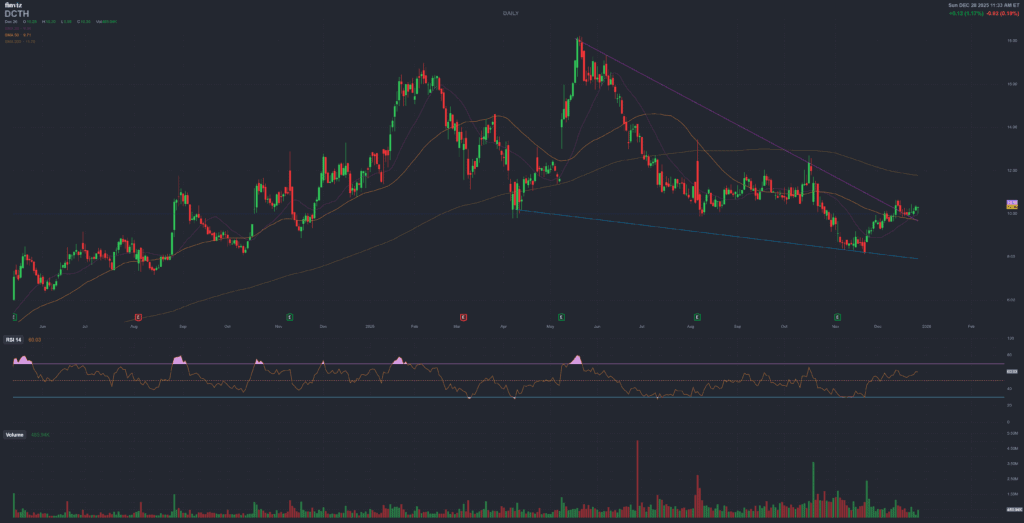
Delcath (DCTH) – A Rare Biotech Buyback Story
In November 2025, Delcath Systems authorized a $25 million share repurchase program while trading near a 52-week low, in a sector where most small-cap oncology names are still issuing stock and warrants. For value-oriented investors, a profitable micro-cap liver cancer company with no debt, high gross margins and a buyback is a very different narrative from the usual “please fund my Phase 2”.
News of the day
20 November 2025 – Delcath’s board authorizes a $25 million share repurchase program,
at a time when the stock has dropped more than 50% in six months and trades close to its 52-week low
around $8 per share. The program can be executed via open-market and privately negotiated transactions,
with no fixed end-date, funded from cash and operating cash flow.
In oncology, investors are used to one pattern: equity offerings, ATMs, warrant deals, and constant dilution. Delcath is doing the opposite – after FDA approval of HEPZATO KIT™ and the first year of real commercial ramp, it is signalling that it has enough cash and confidence to start retiring shares.
1. Buyback snapshot – what exactly did Delcath announce?
On 20 November 2025, Delcath’s board approved a share repurchase program of up to $25 million of the company’s outstanding common stock. The key points:
- The program allows buybacks “from time to time” in the open market or through privately negotiated transactions.
- Execution is subject to market conditions and other factors, with no fixed end-date disclosed.
- The press coverage emphasised that the move comes as Delcath’s stock trades near its 52-week low around $8, after dropping more than 50% from a high above $18 earlier in 2025.
- With a market cap in the $280–360M range and no debt, Delcath highlighted a healthy balance sheet with more cash than debt and positive operating cash flow.
Using the 10-K and 10-Q share counts, Delcath had about 35 million shares outstanding in mid-2025. If the entire $25M were deployed at roughly $10 per share, the company could retire around 2.4M shares – roughly 7% of the float. That is not a token programme: it meaningfully shifts the per-share math if executed.
In a sector where “capital allocation” usually means new warrants and discounted offerings, a
$25M buyback from a still-small, recently commercial oncology company is a strong signal –
both about management’s confidence and about the transition from survival mode to cash-generating mode.
2. Timeline – from serial dilution to returning cash
To understand why this buyback is unusual, you need the backstory: years of capital raises, FDA approval, and then a surprisingly fast move into positive EBITDA.
2.1 Pre-approval: financing the platform
Up to 2020
Classic micro-cap oncology pattern
Delcath spends years as a development-stage specialty oncology company,
focused on percutaneous hepatic perfusion for liver tumors. Like most micro-cap biotechs,
it relies on repeated public offerings and warrant deals to finance operations.
May 2020
$22M Nasdaq uplisting offering
The company prices a ~$22M public offering of common stock and warrants in connection with an uplisting to Nasdaq,
a classic “raise to survive and reach the pivotal catalyst” step.
Mar 2023
Up to $85M structured financing
Delcath raises $25M in a March 2023 private placement tied to preferred stock and multi-tranche warrants,
with the potential to bring in up to an additional $60M upon FDA approval of HEPZATO KIT and achievement
of $10M in quarterly U.S. revenue. Again: highly dilutive if fully exercised.
Aug 2023
FDA approval of HEPZATO KIT
The FDA approves HEPZATO KIT as a liver-directed treatment for adult patients with unresectable hepatic metastases
from uveal melanoma with limited extrahepatic disease – the first and only approved liver-directed therapy in this setting.
Commercial ramp in the U.S. begins in early 2024.
2.2 Post-approval: commercial ramp and then buyback
2024
Still raising capital
Delcath continues to shore up the balance sheet via a $7M private placement,
the ability to issue additional equity from a shelf registration, and use of ATMs.
For investors this still looks like the usual early-launch playbook: “approve, then keep raising into the ramp”.
Q3 2024
First signs of scale
Preliminary Q3 2024 results show quarterly revenue of $11.2M, including $10M from HEPZATO in the U.S.,
signalling that the launch is gaining traction and the revenue base is becoming meaningful.
Q3 2025
Positive EBITDA and cash flow
For Q3 2025, Delcath prints $20.6M in revenue (up from $11.2M),
gross margin of 87%, net income of $0.8M, adjusted EBITDA of $5.3M, and $88.9M in cash and investments with no debt.
The company guides to $83–85M 2025 revenue, 85–87% gross margins and positive adjusted EBITDA and cash flow every quarter of 2025.
Nov 2025
$25M buyback authorised near 52-week low
With the stock having fallen from a high above $18 to just over $8 and market cap around $280–300M,
Delcath’s board authorises a $25M share repurchase program.
It is one of the very few small oncology names pivoting from “please give us cash” to “we’re buying our own stock”.
3. Business fundamentals – what exactly does Delcath do?
3.1 Interventional oncology for liver-dominant cancers
Delcath is an interventional oncology company. Its core technology is percutaneous hepatic perfusion (PHP): a liver-directed procedure that floods the liver with high-dose melphalan while filtering drug from the circulation before blood returns to the body, limiting systemic exposure.
- HEPZATO KIT™ – FDA-approved in the U.S. for adult patients with uveal melanoma with unresectable hepatic metastases involving less than 50% of the liver and limited extrahepatic disease.
- CHEMOSAT® – a similar system used in Europe and the UK under device regulations.
- HEPZATO is delivered via a complex team-based procedure (interventional radiologist, perfusionist, anaesthesiologist, medical oncologist, ICU team) under a REMS program.
In the pivotal FOCUS study, HEPZATO KIT achieved an objective response rate of roughly 36% in metastatic uveal melanoma, with a median duration of response around 14 months and acceptable but non-trivial toxicity. For a setting with very poor prognosis and limited options, this is clinically meaningful and underpins the commercial opportunity.
3.2 Q3 2025 by the numbers
The Q3 2025 results help explain why Delcath feels comfortable returning capital:
| Metric (Q3 2025) | Value | vs Q3 2024 |
|---|---|---|
| Total revenue | $20.6M | $11.2M |
| HEPZATO revenue (U.S.) | $19.3M | $10.0M |
| CHEMOSAT revenue (EU) | $1.3M | $1.2M |
| Gross margin | 87% | 85% |
| Net income | $0.8M | $1.9M |
| Adjusted EBITDA | $5.3M | $1.0M |
| Operating cash flow | +$4.8M | –$3.6M |
| Cash & investments | $88.9M | n/a |
| Debt | $0 | $0 |
Management guided to full-year 2025 CHEMOSAT + HEPZATO revenue of $83–85M (about 150% volume growth vs 2024), gross margins of 85–87% and positive adjusted EBITDA and cash flow every quarter of 2025. This is very different from a typical pre-revenue biotech.
4. CEO and management – who is deciding to buy back stock?
4.1 Gerard Michel – CFO background turned CEO
Delcath’s CEO, Gerard Michel, took the role in 2020. He has a long background in finance and operations at small and mid-cap healthcare companies, including senior roles at Vericel and other device/biotech firms, and is described in several profiles as an operator focused on capital discipline and execution rather than pure blue-sky R&D.
Third-party governance data show:
- CEO tenure >5 years.
- Meaningful stock ownership (roughly 1% of shares).
- Compensation tilted toward equity and performance rather than pure salary.
In 2024–2025, Delcath also added a new COO (Martha Rook), CMO/CTO and a more commercial-heavy leadership team – reinforcing the shift from pure development to commercial and capital-allocation mode.
4.2 From dilution machine to buyback – a capital-allocation pivot
Historically, Delcath behaved like most micro-cap lifescience names:
- Multiple public offerings and follow-ons in 2015–2020.
- A 2020 Nasdaq uplisting with associated equity raise.
- The 2023 preferred/warrant financing linked to HEPZATO approval and revenue milestones.
- 2024 private placement, shelf and ATM facilities for additional equity issuance.
Against this background, authorising a $25M buyback:
- Signals that management believes the stock is undervalued versus its fundamentals and growth prospects.
- Shows confidence that the company can fund HEPZATO commercial expansion and pipeline trials (e.g. colorectal and breast cancer studies) without returning to emergency equity raises.
- May help offset past and future dilution from warrants, options and stock-based compensation.
For value-oriented investors, the interesting part is not just the buyback itself, but the sequence:
heavy dilution to finance approval, then a pivot to repurchases once the product is launched and cash flow flips positive.
5. Why this buyback is unusual in oncology/biotech
In mega-cap pharma, buybacks are routine. In small oncology names with single products and active pipelines, they are rare – especially this early after launch. Here is why the DCTH case stands out.
5.1 Typical pattern: dilution and more dilution
- Pre-revenue biotechs and med-techs almost always rely on serial equity offerings, warrant deals and ATMs to fund R&D and early commercialisation.
- Even after an initial approval, it is common to see multiple follow-on raises to pay for sales expansion, post-marketing commitments and new trials.
- Cash burn and binary risk usually make buybacks a low priority: every dollar is precious for trials and launch, and investors worry more about runway than about per-share metrics.
Delcath clearly followed that script through 2023 and into 2024. What changed is the pace at which HEPZATO started throwing off high-margin revenue – and management’s willingness to translate that into capital returns.
5.2 DCTH’s situation today
- Commercial product with rapidly growing sales and high gross margin (mid-80s%).
- Positive adjusted EBITDA and positive operating cash flow by Q3 2025, with guidance to stay positive each quarter.
- Cash and investments close to $90M, no debt.
- Stock down more than 50% from its 2025 high, trading near the 52-week low when buyback was authorised.
Put differently: this is one of the rare small oncology names that has both cash-flow visibility and a depressed share price, which is exactly the combination that makes a buyback interesting from a value-investor perspective – provided, of course, that management is not underestimating future capital needs.
6. Analysts and market reaction – value signal or PR move?
6.1 Analyst stance
Before the buyback announcement, several sell-side firms already rated Delcath as a Buy/Overweight, with price targets generally in the high-teens to mid-20s – implying substantial upside from the single-digit lows hit in November 2025.
- HC Wainwright has repeatedly raised its target over 2023–2024, most recently into the low-20s while maintaining a Buy rating.
- Stephens initiated coverage mid-2024 with an Overweight rating and a mid-20s target.
- Craig-Hallum initiated at Buy in 2024.
After Q3 2025, commentary from various outlets described Delcath’s quarter as a “revenue miss vs expectations but solid operational progress”, with focus on HEPZATO growth, CHOPIN data and the colorectal cancer Phase 2 start. The buyback announcement was generally framed as a vote of confidence.
6.2 Retail and “value” chatter
On social platforms and retail-oriented news feeds, the buyback triggered a different sort of discussion:
- Some traders focused on near-term technicals – a potential floor near the 52-week low and the idea that buyback demand could help absorb selling into weakness.
- Others, more fundamentally oriented, highlighted the “oddity” of a micro-cap oncology name that:
- is already EBITDA-positive;
- has no debt and almost $90M in cash;
- is voluntarily retiring stock while many peers dilute at the first opportunity.
- There are also sceptical voices: some argue that, given Delcath’s pipeline ambitions, every dollar should go into trials rather than buybacks, and that the move could be seen as management trying to support the share price after guidance cuts.
For a value-type investor, the question is not “is buyback good or bad?” in abstract, but whether this particular company
can realistically fund its growth and clinical ambitions and retire shares without coming back to the market later with a big equity deal.
7. The “value investor” angle – how might a fundamental investor read this?
None of this makes Delcath a safe or low-risk stock – it is still a small, single-product oncology company. But the buyback changes the conversation from “pure binary biotech” to “capital allocation case”. Here are some key lenses.
7.1 What looks attractive to value-minded investors
- Buyback yield – $25M vs a ~$360M market cap is roughly a 7% potential buyback yield if fully executed, on top of any underlying earnings yield.
- Improving unit economics – 87% gross margin, growing adjusted EBITDA and positive operating cash flow suggest the business has real operating leverage as HEPZATO volumes scale.
- Clean balance sheet – nearly $90M in cash and investments, no debt, reducing solvency risk.
- Mispricing narrative – the repurchase program was launched when the stock was down more than 50% from its 52-week high, supporting a management narrative of “the market is under-valuing our progress”.
7.2 What still looks risky or unclear
- Concentration risk – HEPZATO for metastatic uveal melanoma is currently the main revenue driver; other indications (colorectal, breast, additional mUM combinations) are still in development.
- Execution risk – HEPZATO adoption depends on specialised centres, REMS training, and procedure logistics; scaling from 25 centres to a much larger installed base is not guaranteed.
- Long-term capital needs – Phase 2 and potential Phase 3 trials in colorectal and breast cancer, plus post-marketing work and potential EU expansion, will require cash. If these costs exceed internal generation, Delcath may still need future equity raises, partially offsetting buyback benefits.
- Valuation uncertainty – even with positive EBITDA, small-cap med-tech valuations swing wildly around each catalyst, and the market may continue to price in a significant risk discount.
In other words: the buyback strengthens the “value” case, but does not cancel clinical, execution or regulatory risk.
It should be seen as one piece of the puzzle, not a magic shield.
8. Scenarios from here – not a prediction, not a recommendation
The range of outcomes is still wide. This section sketches possible paths; it is not a forecast and not a call to buy or sell.
Scenario A – HEPZATO ramps, trials deliver, buyback looks brilliant
- Delcath hits or beats its $83–85M 2025 revenue range and continues double-digit growth into 2026–2027.
- Phase 2 trials in liver-dominant metastatic colorectal cancer (and possibly breast cancer) produce compelling data, opening larger addressable markets.
- The $25M buyback is largely executed around depressed prices, significantly boosting EPS and consolidating ownership.
In this optimistic case, value investors will later point to the 2025 buyback decision as a classic contrarian, anti-dilution move at a moment of mispricing.
Scenario B – Solid but not spectacular growth, balanced capital allocation
- HEPZATO growth moderates but remains healthy; 2025–2026 results track close to guidance.
- Trials show mixed but usable data; new indications are possible but require additional investment.
- Delcath executes the buyback partially, while also using equity selectively to fund larger trials or partnerships.
Here, the buyback still improves per-share metrics but is remembered as part of a broader, pragmatic capital-allocation toolkit, not a once-in-a-lifetime value inflection.
Scenario C – Clinical or commercial setbacks, buyback looks premature
- HEPZATO uptake stalls (competition, reimbursement, logistics) or safety concerns emerge.
- New trials disappoint, shrinking the long-term opportunity.
- Cash burn accelerates again, and Delcath needs to issue equity at prices not much higher than (or lower than) where it bought shares back, effectively undoing much of the buyback benefit.
In this downside scenario, critics will argue that funds used for repurchases should have been conserved for trials or risk mitigation.
Whatever scenario you consider more likely, the key is to treat the buyback as a data point about management’s view of intrinsic value and risk,
not as a guarantee of positive returns. Position sizing, diversification and respect for biotech risk remain essential.
9. Sources and further reading
Selected primary and secondary sources (press releases, SEC filings, company materials and major news outlets).
- Delcath Systems press releases and SEC 8-K/10-Q/10-K filings, including Q3 2025 results and 2025 guidance.
- Delcath Systems board authorises $25M share repurchase program (company statement and SEC filing, covered by Investing.com, TipRanks and others).
- Delcath Systems Q3 2025 results coverage (BusinessWire, Investing News Network, GuruFocus, ChartMill, Taurigo and earnings transcript summaries).
- HEPZATO KIT official site and prescribing information (indication, REMS, FOCUS trial efficacy and safety).
- FDA approval notice for melphalan/HEPZATO KIT as liver-directed therapy for metastatic uveal melanoma.
- Delcath corporate and management profiles, including CEO and executive team biographies (Simply Wall St, MarketScreener, GlobalData).
- Historical financing announcements (public offerings, private placements, warrant financings, ATM/ shelf registrations).
- Analyst rating and target-price summaries from MarketScreener, Benzinga and related sources.
10. Disclaimer – educational only
This article is for educational and informational purposes only. It is not, and must not be interpreted as, investment advice, investment research, a recommendation to buy, sell or hold any financial instrument, or a solicitation to engage in any investment activity.
The information is based on publicly available sources believed to be reliable at the time of writing, but no representation or warranty is given as to its accuracy or completeness. Biotech and small-cap securities are highly volatile and speculative; investors can lose all or a substantial portion of their capital. Past performance and past clinical data are not indicative of future results.
Readers remain solely responsible for their own investment decisions and should consult qualified, independent financial and legal advisers before taking any action. The author and Merlintrader trading Blog accept no liability for any direct or indirect loss arising from the use of this material.
For full legal and risk disclosures, including privacy and terms of use, please refer to: Merlintrader – Disclaimer and Terms of use & privacy information.
Delcath (DCTH) – Una storia di buyback rara nel biotech
A novembre 2025, Delcath Systems ha autorizzato un programma di riacquisto azioni da 25 milioni di dollari, mentre il titolo scambiava vicino ai minimi a 52 settimane, in un settore dove la regola sono ancora gli aumenti di capitale e la diluizione. Per chi guarda al “value”, una micro-cap di oncologia del fegato già profittevole, senza debito e con un buyback non è esattamente la storia biotech standard.
News del giorno
20 novembre 2025 – Il board di Delcath autorizza un programma di riacquisto fino a 25 milioni di dollari di azioni ordinarie,
proprio mentre il titolo ha perso oltre il 50% in sei mesi e tratta attorno a 8 dollari,
minimo di periodo. Il programma può essere eseguito sul mercato o tramite transazioni private,
finanziato con cassa e flussi operativi.
Nel biotech oncologico gli investitori sono abituati a vedere ATM, warrant e aumenti di capitale in serie. Delcath sta facendo il contrario: dopo l’approvazione FDA di HEPZATO KIT™ e il primo anno di vero ramp commerciale, manda il segnale che oggi può permettersi di restituire capitale agli azionisti.
1. Buyback snapshot – cosa ha annunciato Delcath
Il 20 novembre 2025 il board di Delcath ha approvato un programma di riacquisto fino a 25 milioni di dollari di azioni ordinarie. I punti principali:
- Riacquisti “di volta in volta” sul mercato o tramite transazioni negoziate privatamente.
- Nessuna scadenza rigida indicata; esecuzione subordinata alle condizioni di mercato.
- L’annuncio arriva mentre il titolo scambia vicino al minimo a 52 settimane intorno a 8 dollari, dopo un drawdown di oltre il 50% dal massimo di periodo sopra i 18 dollari.
- La società sottolinea una posizione patrimoniale con più cassa che debito (in realtà nessun debito) e flussi di cassa operativi positivi.
Sulla base di circa 35 milioni di azioni in circolazione, un buyback pienamente eseguito a 10 dollari significherebbe ritirare qualcosa come 2,4 milioni di azioni, pari a circa il 7% del capitale. Non è cosmetica: è un intervento che cambia le metriche per azione se portato avanti con convinzione.
In un “quartiere” in cui la norma sono ATM e aumenti scontati, un buyback da 25 M$ dopo così poco tempo dall’avvio commerciale
è un segnale forte sia sulla percezione di undervaluation sia sulla fiducia del management nel profilo di cassa di HEPZATO.
2. Timeline – da macchina di diluizione a ritorno di capitale
Per capire perché questo buyback è interessante, bisogna guardare a come Delcath è arrivata qui: anni di aumenti, approvazione FDA, ramp commerciale e, solo dopo, la decisione di riacquistare azioni.
2.1 Prima dell’approvazione – finanziare la piattaforma
Fino al 2020
Pattern classico micro-cap
Delcath è per anni una specialty-pharma in sviluppo, focalizzata sulla perfusione epatica per tumori del fegato,
con portafoglio di brevetti e trial di Fase 2/3. Il modello di finanziamento è quello tipico:
offerte pubbliche, warrant e diluizione ripetuta.
Maggio 2020
Offerta da 22 M$ e uplisting Nasdaq
La società annuncia un’offerta pubblica da circa 22 M$ in concomitanza con l’uplisting al Nasdaq Capital Market –
un passo necessario per arrivare al catalyst regolatorio.
Marzo 2023
Finanziamento strutturato fino a 85 M$
Delcath chiude un private placement da 25 M$ in azioni privilegiate e warrant,
con ulteriori tranche potenziali legate all’approvazione HEPZATO e al raggiungimento di 10 M$ di ricavi trimestrali –
struttura chiaramente diluitiva se completamente esercitata.
Agosto 2023
Approvazione FDA di HEPZATO KIT
La FDA approva HEPZATO KIT come trattamento epatico diretto per adulti con melanoma uveale metastatico a fegato dominante.
Il lancio commerciale negli USA parte nei primi mesi del 2024.
2.2 Dopo l’approvazione – ramp, profitti e buyback
2024
Ancora raccolta capitale
Nel 2024 Delcath completa un private placement da 7 M$,
registra un nuovo shelf da 150 M$ e dispone di un ATM: il copione è ancora quello “approvo e continuo a raccogliere”.
Q3 2024
I primi numeri seri
I dati preliminari Q3 2024 mostrano ricavi trimestrali per 11,2 M$, di cui 10 M$ da HEPZATO negli USA –
segnale che il ramp sta iniziando a pesare davvero sul conto economico.
Q3 2025
EBITDA e cassa operativa positivi
Nel Q3 2025 i ricavi salgono a 20,6 M$ (19,3 M$ HEPZATO, 1,3 M$ CHEMOSAT),
gross margin 87%, utile netto 0,8 M$, adjusted EBITDA 5,3 M$,
cassa e investimenti per 88,9 M$ e nessun debito,
con guidance a 83–85 M$ di ricavi 2025 e cashflow positivo ogni trimestre.
Novembre 2025
Buyback da 25 M$ vicino ai minimi
Con il titolo dimezzato rispetto ai massimi annuali e capitalizzazione sui 280–300 M$,
il board autorizza un programma di riacquisto da 25 M$.
Rarità assoluta in una micro-cap di oncologia epatica appena uscita dal tunnel regolatorio.
3. Fondamentali di business – cosa fa davvero Delcath
3.1 Oncologia interventistica per tumori epatici
Delcath è un’azienda di oncologia interventistica. La tecnologia chiave è la perfusione epatica percutanea (PHP): issolare il flusso epatico, saturare il fegato con alte dosi di melphalan e filtrare il sangue prima che torni in circolo, limitando l’esposizione sistemica.
- HEPZATO KIT™ – approvato FDA come trattamento epatico diretto per mUM con metastasi epatiche non resecabili (<50% del fegato) e malattia extraepatica limitata.
- CHEMOSAT® – versione dispositiva utilizzata in Europa e UK.
- Il trattamento richiede REMS, team multidisciplinare e centri di riferimento specializzati.
Nello studio pivotale FOCUS HEPZATO ha mostrato un tasso di risposta obiettiva intorno al 36% e una durata mediana di risposta di circa 14 mesi – numeri significativi in una patologia con prognosi molto sfavorevole.
3.2 Q3 2025 in numeri
I dati Q3 2025 spiegano perché Delcath sente di potersi permettere un buyback:
| Indicatore (Q3 2025) | Valore | vs Q3 2024 |
|---|---|---|
| Ricavi totali | 20,6 M$ | 11,2 M$ |
| Ricavi HEPZATO (USA) | 19,3 M$ | 10,0 M$ |
| Ricavi CHEMOSAT (EU) | 1,3 M$ | 1,2 M$ |
| Gross margin | 87% | 85% |
| Utile netto | 0,8 M$ | 1,9 M$ |
| Adjusted EBITDA | 5,3 M$ | 1,0 M$ |
| Cassa operativa | +4,8 M$ | -3,6 M$ |
| Cassa + investimenti | 88,9 M$ | n.d. |
| Debito | 0 | 0 |
La guidance 2025 parla di ricavi CHEMOSAT+HEPZATO per 83–85 M$, gross margin 85–87% e adjusted EBITDA/cashflow positivi in ogni trimestre. Numeri molto diversi dalla classica biotech pre-ricavi.
4. CEO e management – chi decide di riacquistare azioni?
4.1 Gerard Michel – profilo da CFO operativo
L’amministratore delegato Gerard Michel guida Delcath dal 2020. Background da CFO/operativo in diverse realtà med-tech, con forte focus su structure finanziaria, controllo costi ed execution.
I dati di governance indicano:
- Tenure da CEO superiore a 5 anni.
- Quota azionaria personale non banale.
- Compenso legato in larga parte a equity e performance.
A partire dal 2024 il team si arricchisce anche di COO, CMO/CTO e figure commerciali senior, segno di un passaggio deciso dalla “fase laboratorio” alla “fase azienda che deve allocare capitale”.
4.2 Da diluizione a buyback – cambio di paradigma
Fino al 2023 Delcath è il classico titolo dove gli azionisti si aspettano nuove emissioni a ogni step:
- Follow-on, private placement, warrant, ATM e shelf registration da 150 M$.
- Strutture di finanziamento collegate a milestone regolatorie e di ricavo (HEPZATO).
Il buyback da 25 M$:
- È un messaggio di fiducia nel valore intrinseco rispetto ai prezzi correnti.
- Suggerisce che, secondo il management, la combinazione HEPZATO + pipeline può essere sostenuta con la cassa attuale e i flussi generati.
- Aiuta a compensare, almeno in parte, la diluizione passata (warrant, opzioni, equity comp).
5. Perché questo buyback è fuori dal coro nel biotech
Nelle big-pharma il riacquisto azioni è routine; nelle small biotech con un solo prodotto commerciale è raro. Vediamo perché DCTH fa eccezione.
5.1 Il copione standard: solo aumento di capitale
- La stragrande maggioranza delle small-cap biotech vive di offerte azionarie ricorrenti.
- Dopo l’approvazione, il pattern tipico è: “equity raise per la forza vendita, equity raise per i nuovi trial, equity raise per tutto il resto”.
- In questo contesto il buyback è visto quasi come un lusso, spesso mal tollerato dagli investitori che temono per la runway.
5.2 Il quadro specifico di DCTH
- Prodotto già approvato con ramp e margini molto alti.
- EBITDA rettificato e cassa operativa positivi già nel 2025.
- Bilancio senza debito e cassa vicina ai 90 M$.
- Prezzo azione più che dimezzato dai massimi annuali al momento dell’annuncio.
È proprio la combinazione di profittabilità emergente e prezzo depresso a rendere questo buyback interessante per chi ragiona in ottica value, pur con tutte le cautele del caso su rischio clinico e di esecuzione.
6. Analisti e mercato – segnale value o semplice PR?
6.1 Posizionamento degli analisti
Prima del buyback diversi broker già vedevano Delcath come storia interessante:
- HC Wainwright con rating Buy e target price via via alzati fino all’area 20+ dollari.
- Stephens con rating Overweight e target a metà 20.
- Altri broker con view positive sulla combinazione ramp HEPZATO + espansioni di indicazione.
Dopo il Q3 2025, molti commenti parlano di “ricavi sotto le attese ma progressi operativi solidi”, e il buyback viene generalmente interpretato come un signal di fiducia.
6.2 Chatter retail e value
Sulle piattaforme retail il tono è più emotivo:
- C’è chi legge il buyback come floor tecnico vicino ai minimi, nella speranza che gli acquisti societari assorbano le vendite.
- Altri, più fondamentali, sottolineano quanto sia raro vedere una micro-cap oncologica con cassa netta, EBITDA positivo e buyback autorizzato.
- I più scettici temono che il programma venga usato solo per “tenere su” il prezzo in vista di possibili deal futuri.
7. L’angolo degli investitori “value”
Nulla di tutto questo rende DCTH un titolo “sicuro”, ma il buyback cambia la conversazione: da pura scommessa binaria a caso concreto di allocazione del capitale.
7.1 Cosa può piacere a chi guarda ai fondamentali
- Buyback yield intorno al 7% potenziale su capitalizzazione di ~360 M$.
- Unit economics interessanti: margini lordi quasi 90%, EBITDA positivo in rapido aumento.
- Bilancio pulito, senza leva finanziaria.
- Narrativa di mispricing: buyback annunciato proprio vicino al minimo di periodo dopo un forte drawdown.
7.2 I punti che restano delicati
- Rischio concentrazione: oggi il motore vero è HEPZATO in mUM; colorectal, breast e altre indicazioni sono ancora in sviluppo.
- Rischio esecuzione sulla diffusione dei centri e la complessità della procedura.
- Fabbrisogno futuro di capitale: i trial di Fase 2/3 sulle nuove indicazioni costano, e non è detto che la sola cassa generata basti in tutti gli scenari.
- Valutazione ancora volatile e molto sensibile a ogni nuovo dato clinico.
In pratica: il buyback rende la storia più interessante per i “value”, ma non elimina il rischio tipico di una small-cap di oncologia.
8. Scenari da qui in avanti – solo a scopo didattico
Non è una previsione né un consiglio operativo, ma un modo per strutturare i possibili percorsi.
Scenario A – HEPZATO accelera, il buyback sembra geniale
- Il ramp 2025–2026 conferma la guidance o la batte nettamente.
- I trial su colorectal e altre indicazioni portano dati forti.
- Il buyback viene eseguito in buona parte vicino ai minimi, migliorando nettamente EPS e ownership per azione.
Scenario B – Crescita decente, allocazione del capitale bilanciata
- La crescita resta buona ma non esplosiva.
- Delcath esegue una parte del buyback e usa in parallelo equity mirata o partnership per finanziare la pipeline.
- Il buyback resta un elemento positivo ma non il driver principale della tesi.
Scenario C – Intoppi clinici/commerciali, buyback prematuro
- HEPZATO non scala come previsto o emergono criticità di safety/competizione.
- Nuovi trial danno risultati deludenti.
- La società torna a dover raccogliere capitale a prezzi non entusiasmanti, e il buyback si rivela, col senno di poi, uso poco prudente della cassa.
Per chi fa trading o investing su storie come Delcath, il punto non è “buyback sì o no” in assoluto,
ma valutare se, nel quadro complessivo, questo movimento sposta davvero l’ago della bilancia sul valore per azione nel medio-lungo periodo.
9. Fonti e approfondimenti
Principali fonti primarie e secondarie utilizzate (comunicati ufficiali, filing SEC, materiale aziendale, articoli di testate finanziarie).
- Comunicato Delcath e filing 8-K sul programma di riacquisto da 25 M$.
- Risultati e conference call Q3 2025, guidance 2025 e dati finanziari dettagliati.
- Scheda e sito ufficiale di HEPZATO KIT, informazioni di prescrizione e dati dello studio FOCUS.
- Nota FDA di approvazione come terapia epatica diretta nel melanoma uveale metastatico.
- Profili management & governance (Michel, Rook, Pennell ecc.).
- Storico delle operazioni di funding (follow-on, private placement, warrant, ATM, shelf 2024).
- Sintesi rating e target price (HC Wainwright, Stephens, Craig-Hallum e altri).
- Articoli Reuters, WSJ, GuruFocus, ChartMill, ecc., su risultati trimestrali e dinamica del titolo.
10. Disclaimer – solo a scopo informativo
Questo articolo ha esclusivamente finalità informative e didattiche. Non costituisce e non deve essere interpretato come consulenza in materia di investimenti, raccomandazione personalizzata, ricerca in materia di investimenti, sollecitazione al pubblico risparmio o offerta di strumenti finanziari.
Le informazioni sono basate su fonti ritenute affidabili al momento della redazione, ma non se ne garantisce accuratezza o completezza. I titoli biotech e le small cap sono altamente speculativi; è possibile perdere una parte rilevante o la totalità del capitale investito. Rendimenti e dati clinici passati non sono indicativi di risultati futuri.
Ogni decisione di investimento rimane a esclusivo carico del lettore, che dovrebbe rivolgersi a consulenti finanziari e legali abilitati prima di assumere qualunque decisione. L’autore e Merlintrader trading Blog declinano ogni responsabilità per eventuali perdite dirette o indirette derivanti dall’uso di questo materiale.
Per i testi completi su rischi, responsabilità, privacy e trattamento dati si vedano: Disclaimer Merlintrader e Condizioni d’uso e info privacy.
Biotech Catalyst Calendar
Anche quando si parla di buyback e “value”, storie come Delcath vanno sempre lette dentro un calendario catalyst più ampio
(dati di trial, approvazioni, CRL, ecc.).
Apri il Biotech Catalyst Calendar
Scanner for active traders

Try ChartsWatcher free, then unlock 10% OFF with SAVE10
ChartsWatcher is a real-time scanner for momentum traders: fast movers, unusual volume and rotations — so you can focus on the few tickers that matter right now, instead of watching hundreds of charts.
Start with the free version. When you upgrade, use SAVE10 for 10% OFF your first paid period.
Start free – then use SAVE10
No credit card required to start. Apply SAVE10 when upgrading.
Recommended platform

One platform. All your brokers.
Medved Trader connects multiple brokers in one workspace, with pro charts, hotkeys and fast execution — without changing your broker accounts.
A single cockpit for positions, Level II and multi-broker order routing, built for active day & swing traders.
Get 1 Month Free ➔
Multi-broker workflow + customizable layouts in one platform.
 Monica.im – the AI assistant I use every day
If you find value in the work I publish on Merlintrader and want a practical AI assistant for research and writing, you can sign up using this referral link. Click here to try Monica.im and support the site
Find out how I use AI on Merlintrader: AI, retail and Merlintrader
Disclosure: some of the links in the promotional blocks above are affiliate or referral links. If you choose to subscribe or sign up through them, Merlintrader may receive a small commission or benefit at no extra cost to you.