DISCLAIMER — Not financial advice. Educational content only, not an offer or solicitation to buy or sell any security. Biotech and small/mid-cap stocks are highly speculative and volatile and can result in a partial or total loss of capital. Do your own research and consult a licensed advisor where appropriate. / Contenuti a solo scopo informativo e didattico, non costituiscono consulenza finanziaria né offerta o sollecitazione al pubblico risparmio ai sensi delle normative CONSOB e SEC. Le azioni biotech e le small/mid cap sono strumenti altamente speculativi e volatili e possono comportare la perdita parziale o totale del capitale investito. Si raccomanda di effettuare sempre le proprie ricerche e, se necessario, di rivolgersi a un consulente abilitato.

Merlintrader Trading Pub
Biotech catalyst news and analysis. FDA PDUFA tracker
Merlintrader Trading Pub
Biotech catalyst news and analysis. FDA PDUFA tracker
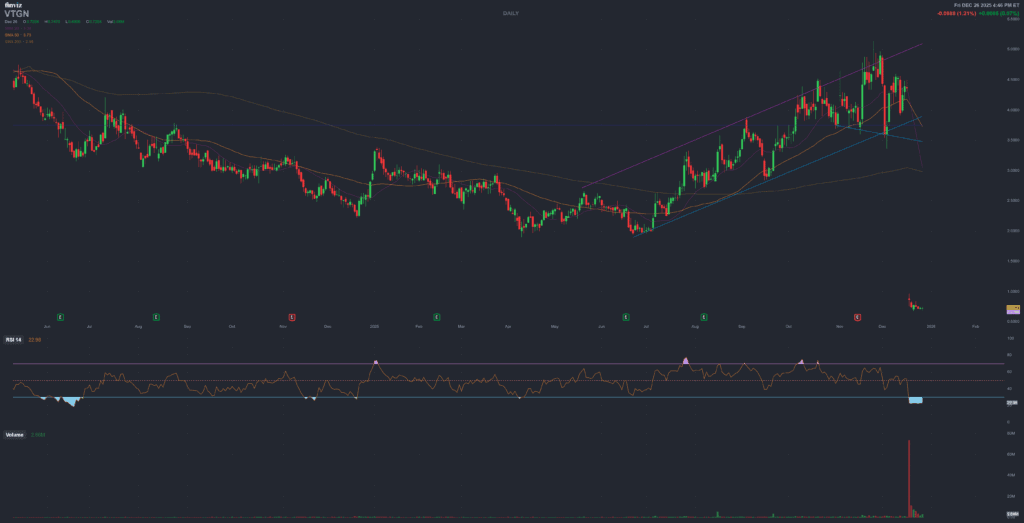
Biotech | VTGN
VistaGen Therapeutics – Social Anxiety & Pherine Story
VTGN – From PALISADE-2 Euphoria to PALISADE-3 Pain, and the Narrow Road to the Next Readout
Editorial for investors and traders who lived the hype, felt the 80% single-day crash after PALISADE-3, and now want to understand what is still left, realistically, in VistaGen’s fasedienol and pherine platform before the next Phase 3 data.
Latest update – December 17, 2025
PALISADE-3 Phase 3 misses the primary endpoint, VTGN collapses
VistaGen announced topline results from PALISADE-3, its Phase 3 public speaking challenge study of intranasal fasedienol for acute treatment of social anxiety disorder (SAD). The study did not show a statistically significant difference versus placebo on the main anxiety scale (SUDS), with essentially overlapping improvements in both arms. Safety remained clean and in line with previous trials.
The market reaction was brutal: VTGN saw an intraday drawdown close to 80% as the “it worked once, it will work again” narrative cracked in a single press release. For traders who bought the story into Q4 2025, this was not just another red day but a real shock.
The central question now is not whether PALISADE-3 went badly – it did – but whether the combination of a past Phase 3 win (PALISADE-2), a clean safety profile and the remaining Phase 3 / Phase 2 studies can still keep a narrow path open for fasedienol and for VTGN as an investment story.
This piece is not a recommendation to buy or sell VTGN. It is meant to reconstruct the sequence from euphoria to crash and to map out, as objectively as possible, what is still on the table for the next 6–12 months.
1. Executive summary – What this article is and what it is not
This article retraces the VTGN story around fasedienol: why so many people believed in it, how expectations built up again into Q4 2025, what exactly broke with PALISADE-3, and what still remains as a realistic – not magical – source of optionality over the next readouts.
It is written with burnt retail traders in mind: people who averaged up on the way to the catalyst, people who woke up to an 80% gap down, people who are now trying to decide whether to close the tab forever or keep one eye on VTGN for a possible “second life” move.
The point is not to sell hope. The point is to put the hope in context: acknowledge that the path for fasedienol is much narrower than a few weeks ago, but also that the program still has structural elements (one prior Phase 3 win, a differentiated mechanism, a relatively clean safety profile and more data to come) that can justify keeping a small but non-zero light on at the end of the corridor.
All comments are strictly informational and educational. No price targets, no “easy multi-bagger” narrative, no trading advice.
2. How we got here – from PALISADE-1 failure to PALISADE-2 miracle and back
2.1 The first crack: PALISADE-1 fails
The PALISADE program did not start with a glory moment. PALISADE-1, the first large Phase 3 study of intranasal fasedienol in SAD, failed its primary endpoint. The placebo effect was strong, the separation between arms was not convincing, and many investors quickly wrote off the whole pherine concept as another CNS mirage.
Still, the safety profile looked clean and consistent, and management kept insisting that signal and study design details justified another properly powered shot on goal.
2.2 The shock upside: PALISADE-2 delivers
In August 2023, PALISADE-2 hit. This time the trial did show a statistically significant benefit of fasedienol over placebo on the SUDS scale in the public speaking challenge. For the first time in over 15 years, there was a positive U.S. Phase 3 readout for an investigational SAD treatment with a new mechanism.
The market’s reaction was extreme: VTGN went through an almost vertical re-rating, with intraday gains that made the ticker one of the most talked-about names on Reddit, Stocktwits and trading discords. The message boards filled with comments about “a new standard of care for social anxiety” and “the first real alternative to benzos and SSRIs”.
2.3 Rebuilding the registration story
From that point, the messaging was clear: PALISADE-2 had opened the door, but regulators would want at least one additional positive late-stage study plus a safety database and some form of repeat-exposure data. VistaGen positioned PALISADE-3 and PALISADE-4 as two parallel, registration-directed Phase 3 studies, both using the same public speaking challenge paradigm, while also planning:
- An open-label safety extension trial for longer-term exposure.
- A repeat-dose Phase 2 study to get closer to real-world patterns of use in SAD.
- Further analyses on biomarkers and subgroups to strengthen the mechanistic story.
For investors, the clean narrative became: “We already have one positive Phase 3. If either PALISADE-3 or PALISADE-4 also works, plus clean safety, this can be NDA-ready.”
VTGN & fasedienol timeline (simplified)
| Year / Date | Event | Impact on narrative |
|---|---|---|
| 2022 | PALISADE-1 Phase 3 fails primary endpoint in SAD. | Confidence breaks |
| Aug 2023 | PALISADE-2 Phase 3 shows statistically significant benefit. | Story reborn |
| 2024 | PALISADE-3 and PALISADE-4 Phase 3 studies launched as registration-directed program. | High expectations |
| Jan 2025 | Repeat-dose Phase 2 study of fasedienol initiated. | Real-world angle |
| Q2–Q3 2025 | Company guides for PALISADE-3 topline in Q4 2025; PALISADE-4 to follow. | Run-up phase |
| Dec 17, 2025 | PALISADE-3 topline: no significant difference vs placebo; stock crashes. | Confidence shock |
| Next 6–12 months | PALISADE-4 and repeat-dose data expected; corporate strategy review. | Narrow corridor |
The sequence matters: regulators will look at the entire package – one failed Phase 3, one positive, one negative (PALISADE-3) and whatever PALISADE-4 + repeat-dose deliver – not just at single headlines.
3. PALISADE-3 – What we actually learned (and what we did not)
3.1 The hard facts
PALISADE-3 was a Phase 3, randomized, double-blind, placebo-controlled trial using the same public speaking challenge as the earlier studies. Patients were dosed intranasally with fasedienol or placebo shortly before the speech task. The primary endpoint was the change in Subjective Units of Distress (SUDS) from pre- to post-challenge.
The topline press release was blunt: the least-squares mean change in SUDS was almost identical in the two arms, with a non-significant difference, and no clear advantage on secondary endpoints. In other words, this was not a marginal “trend in the right direction”; this was essentially a placebo match, at least at the topline level.
3.2 Placebo, design, or drug?
Whenever a program alternates failures and successes, the debate quickly becomes:
- Is this a placebo/measurement problem in highly subjective, situational anxiety?
- Is this a design/operational issue (site variability, training, sample mix)?
- Or is it a drug-level problem, with the “true effect” being too small or fragile?
In its communication after PALISADE-3, VistaGen highlighted again the consistent safety profile, the earlier PALISADE-2 success and the ongoing analyses. This is understandable from a corporate perspective, but from an investor’s standpoint the take-home message is uncomfortable: the evidence base is now mixed and noisy.
A key point: a negative Phase 3 does not delete a prior positive Phase 3. It forces everyone – company, regulators and investors – to ask whether there is a reproducible signal that can be rescued with additional data and a strong safety case, or whether PALISADE-2 was closer to a statistical outlier than to a robust, generalizable effect.
3.3 The psychological impact on investors
For traders who had followed the story, the PALISADE-3 day was the opposite of 2023’s euphoria. Message boards and chats shifted from “this is the future of social anxiety treatment” to raw posts from people watching months of gains and hopes evaporate in a single open.
What matters for the next phase is that many of those who got burned will not simply “forgive and forget”. A portion of the original retail base will leave and never come back, or only re-engage after a clear positive surprise. That in itself changes the structure of future run-ups.
4. What is left on the table – PALISADE-4, repeat-dose, and the pherine platform
4.1 PALISADE-4: the last big binary on fasedienol in SAD
PALISADE-4 is another Phase 3 study in SAD using a public speaking challenge, with design and dosing similar to PALISADE-2 and PALISADE-3. It is part of the same U.S. registration-directed program, and topline results are expected after the PALISADE-3 readout, within a next 6–12 month window based on the company’s own guidance and historical enrollment timelines.
In practical terms, PALISADE-4 is now:
- The only remaining Phase 3 shot on goal for fasedienol in acute SAD.
- A test of whether PALISADE-2’s positive outcome was reproducible or not.
- A key input in any future FDA dialogue about NDA viability.
If PALISADE-4 were to show a clear, statistically solid benefit with a clean safety profile, the company could still attempt to build an NDA case on “two positives vs one negative” plus open-label data and repeat-dose results. It would not be a straightforward path, but in CNS psychiatry the FDA has occasionally considered complex, mixed data packages when unmet need is strong and safety is favorable.
4.2 Repeat-dose Phase 2: closer to real-world use
Beyond single-exposure trials, VistaGen is also running a repeat-dose Phase 2 study of fasedienol in SAD. The goal is to understand how the drug behaves when used repeatedly over time, in a pattern that is closer to how patients might actually use a nasal spray for socially stressful situations.
While this is not a registrational trial, it can:
- Support the real-world plausibility of the mechanism (do patients keep responding?).
- Provide additional safety and tolerability data under repeated exposure.
- Generate exploratory signals in subgroups or patterns of response.
If PALISADE-4 ends up being positive or at least suggestive, this repeat-dose dataset becomes even more important in any regulatory and commercial discussion.
Beyond fasedienol – the pherine pipeline
Even if fasedienol’s path in acute SAD remains uncertain, VistaGen is not a single-asset story. The company is developing a broader pipeline of intranasal pherine product candidates, all leveraging rapid nose-to-brain neurocircuitry modulation:
- PH80 – for menopausal hot flashes (vasomotor symptoms), with exploratory data presented in 2025 showing rapid autonomic effects and continued interest from menopause specialists.
- PH10 (itruvone) – for major depressive disorder, with mechanistic work and early clinical data supporting potential antidepressant effects via non-systemic nasal administration.
- PH15 – for cognitive/mental fatigue, aiming at improving cognitive performance and reaction time in mentally fatigued individuals.
For shareholders, this means that even a worst-case outcome on fasedienol does not automatically reduce VistaGen to zero scientific value. It does, however, make capital allocation, partnering and trial prioritization far more complex – and it changes the balance of power in any future financing round.
In other words: there is a platform with multiple shots on goal, but fasedienol in SAD is still the flagship that defines the perceived quality of that platform.
5. Cash, dilution and runway – why the financial angle matters
No catalyst story exists in a vacuum. In small and mid-cap biotech, the combination of trial outcomes plus balance sheet is what ultimately decides who survives long enough to benefit from the “next try”.
As of the most recent quarterly disclosures, VistaGen reports cash, cash equivalents and marketable securities in the tens of millions of dollars, with language suggesting runway into the second half of the decade after cost-saving measures. At the same time, external analyses of VTGN’s financials highlight negative margins and question how far current resources can realistically go without fresh capital.
Practically, this translates into a few hard truths:
- Big trials are expensive; PALISADE-4 and the repeat-dose study are not free.
- Mixed data reduce negotiating leverage in any future partnership or equity raise.
- The deeper the share price reset after PALISADE-3, the more painful any new financing may become for existing holders.
The “light at the end of the corridor” on the scientific side (PALISADE-4, repeat-dose, platform pipeline) lives next to a very real dilution and going-concern risk on the financial side. Keeping both in view is the only way to avoid turning scientific optionality into a purely emotional bet.
6. Sentiment – what Reddit, Stocktwits and X are actually saying
To understand VTGN after PALISADE-3, it helps to look not just at charts but at the tone of discussion in retail communities:
- On Reddit, VTGN was previously celebrated as a textbook “late-stage CNS winner”, with posts talking about “first positive SAD Phase 3 in 15+ years” and “nasal spray that changes the game”.
- As PALISADE-3 approached, threads appeared with people buying in around several dollars per share, openly calling for a pre-data run toward higher levels if the topline was positive.
- After the December miss, the mood shifted to shock, anger, and resignation – with several posts from traders who lost 50–80% in a single session and stated they were “done with biotech catalysts”.
- At the same time, a minority of posters are already trying to build a new thesis around “post-crash optionality”, pointing to cash on hand, multiple pipeline assets and the remaining PALISADE-4 readout.
Short-term mood: bruised, distrustful
Residual bull camp: “platform, cash, one more shot”
Volatility: extreme, news-driven
All of these comments come from non-professional traders posting on Reddit, Stocktwits and X. They are useful to understand crowd psychology, not as a basis for investment decisions.
7. Scenarios for the next 6–12 months – how the corridor could realistically look
Without pretending to forecast prices, it is possible to outline a few broad scenarios for VTGN’s story from here. None of them is guaranteed, and the real trajectory may end up being a messy mix of several.
7.1 Scenario A – Difficult recovery, but recovery
In this scenario, PALISADE-4 delivers a clear positive signal with good separation from placebo, the repeat-dose study supports sustained effects and safety, and VistaGen manages to keep its balance sheet stable through non-destructive financing or partnerships.
The narrative would become: “This program is noisy, but on balance there is enough evidence plus unmet need to support an NDA discussion.” The market would then reframe VTGN as a controversial but live CNS player with an approvable product candidate and a pherine platform behind it.
7.2 Scenario B – Mixed bag, chronic uncertainty
Here, PALISADE-4 is not a clear win – maybe it shows some signal in subgroups, or borderline significance, but nothing that fully resolves the contradiction between PALISADE-2 and PALISADE-3. Repeat-dose data are interesting but not decisive, and the pipeline outside fasedienol remains early-stage.
VTGN in this world risks becoming a “perpetual maybe” name: too much baggage for mainstream investors, but still attractive for short-term traders and for occasional spikes on any fragment of positive news. The problem is that, in parallel, dilution and competition do not stop.
7.3 Scenario C – Broken flagship, platform salvage
In the most negative scenario, PALISADE-4 fails clearly, repeat-dose results are not compelling, and the company has to acknowledge that fasedienol in acute SAD does not offer a reproducible, clinically meaningful benefit versus placebo.
That would push VistaGen into a difficult pivot: focus on PH80, PH10, PH15 and other pipeline elements, try to preserve cash and possibly seek strategic options. The platform could still hold scientific value, but the public equity story would be severely damaged, and rebuilding confidence would take years.
The uncomfortable truth is that all three scenarios remain plausible. PALISADE-3 did not close the book; it only made the remaining pages harder to write. The small light at the end of the corridor is real, but so are the cracks in the floor between here and there.
8. Bottom line – for the people who got burned and are still reading
If you are reading this after losing money on VTGN, you do not need anyone to explain what an 80% down day feels like. What matters now is to have a clear map of what went right, what went wrong, and what is still structurally possible rather than emotionally desired.
- The hope was not invented. PALISADE-2 did deliver a positive Phase 3 readout in SAD, and fasedienol has a differentiated, rapid-onset mechanism plus a clean safety profile so far.
- The disappointment is real. PALISADE-3 was a meaningful, registration-directed trial – and it failed on its main job: separating drug from placebo in a robust way.
- The future is narrower, not gone. PALISADE-4, the repeat-dose study and the wider pherine pipeline still represent genuine optionality, but with lower probability and higher financing risk than the story had a few months ago.
This is not about turning VTGN into a hero or a villain. It is about owning the whole curve of the story: the wave of optimism after PALISADE-2, the re-construction of the registration plan, the December crash, and the fragile but non-zero space that remains ahead of the next readout.
Disclaimer (EN)
This article is provided for informational and educational purposes only and does not constitute investment advice, recommendation, solicitation or invitation to buy or sell any financial instrument or security. VistaGen Therapeutics (VTGN) and all companies mentioned are presented as case studies in the context of biotech catalyst analysis. The author and Merlintrader trading Blog do not provide individualized advice and are not responsible for any investment decisions taken by readers.
Biotech and small/mid-cap equities are highly speculative and volatile. Clinical, regulatory and financial outcomes can differ materially from expectations, and investors may lose part or all of their capital. Readers are strongly encouraged to perform their own independent research and, where appropriate, consult licensed financial professionals before making any investment decisions.
This content is intended to comply with applicable disclosure principles, including those generally required by CONSOB and EU regulations for Italian readers and by SEC/FINRA good practice principles for U.S. readers. For full legal information, please refer to: Disclaimer and Condizioni d’uso e Privacy on Merlintrader.
Ultimo aggiornamento – 17 dicembre 2025
PALISADE-3 manca l’endpoint primario, VTGN crolla
VistaGen ha pubblicato i risultati topline di PALISADE-3, lo studio di Fase 3 con public speaking challenge dell’inalazione nasale di fasedienol per il trattamento acuto del disturbo d’ansia sociale (SAD). Lo studio non ha mostrato una differenza statisticamente significativa rispetto al placebo sulla scala principale di ansia (SUDS), con miglioramenti sostanzialmente sovrapponibili nei due bracci. Il profilo di sicurezza è rimasto pulito e coerente con i dati precedenti.
La reazione del mercato è stata brutale: VTGN ha visto un drawdown intraday vicino all’80%, mentre la narrativa “ha funzionato una volta, funzionerà ancora” si è spezzata in un unico comunicato stampa. Per chi era entrato sulla storia in vista del catalyst Q4 2025 non è stato un semplice giorno rosso, ma un vero shock.
La domanda centrale ora non è se PALISADE-3 sia andato male – lo è – ma se la combinazione tra una Fase 3 positiva (PALISADE-2), un profilo di sicurezza pulito e gli studi di Fase 3 / Fase 2 ancora in corso può tenere aperto, anche se di poco, il corridoio regolatorio e industriale per fasedienol e per la storia VTGN.
Questo pezzo non è un invito a comprare o vendere VTGN. È un tentativo di ricostruire il film dalla speranza al crollo e di mappare in modo il più possibile oggettivo cosa resta davvero sul tavolo nei prossimi 6–12 mesi.
1. Executive summary – Cosa vuole essere (e cosa non è) questo articolo
Questo articolo racconta la storia VTGN intorno a fasedienol: perché tanta gente ci ha creduto, come si è ricostruita la speranza nei mesi che portavano a Q4 2025, cosa si è esattamente rotto con PALISADE-3 e cosa resta ancora come opzionalità reale nei prossimi readout.
È scritto pensando a chi si è scottato: chi ha mediato al rialzo sulla corsa al catalyst, chi si è svegliato con un gap down all’80%, chi ora deve decidere se chiudere il capitolo VTGN per sempre o tenerlo sul radar come storia che potrebbe avere una seconda vita.
L’obiettivo non è vendere speranza. L’obiettivo è mettere la speranza in prospettiva: riconoscere che il corridoio per fasedienol oggi è molto più stretto di qualche settimana fa, ma anche che il programma mantiene alcuni pilastri (una Fase 3 positiva alle spalle, meccanismo differenziato, sicurezza pulita e altri dati in arrivo) che giustificano ancora una piccola luce in fondo al corridoio.
Nessun target di prezzo, nessun “facile multibagger”, nessun consiglio operativo. Solo contesto.
2. Come ci siamo arrivati – dal fallimento di PALISADE-1 al “miracolo” PALISADE-2, e ritorno
2.1 La prima crepa: PALISADE-1 fallisce
Il programma PALISADE non è iniziato con i fuochi d’artificio. PALISADE-1, il primo ampio studio di Fase 3 di fasedienol nel SAD, non ha centrato l’endpoint primario. Effetto placebo alto, separazione limitata tra i bracci, e molti investitori che hanno archiviato in fretta l’intera idea delle pherine come l’ennesima illusione nel mondo CNS.
Allo stesso tempo, il profilo di sicurezza è apparso pulito e coerente, e il management ha continuato a sostenere che nel rumore dei dati esisteva comunque un segnale, sufficiente per giustificare un secondo tentativo con design più robusto.
2.2 Il colpo di scena: PALISADE-2 funziona
Nell’agosto 2023 arriva il ribaltone: PALISADE-2 centra l’endpoint primario, con un beneficio statisticamente significativo rispetto al placebo sulla scala SUDS nel public speaking challenge. Per la prima volta dopo oltre 15 anni c’è un risultato positivo di Fase 3 in SAD con un meccanismo nuovo.
Il titolo VTGN entra in modalità razzo: spike verticale, discussioni ovunque su Reddit, Stocktwits, Discord. I thread parlano di “nuovo standard per l’ansia sociale” e di “alternativa reale a benzo e SSRI”.
2.3 Ricostruire la storia regolatoria
Da quel momento il messaggio diventa chiaro: PALISADE-2 ha aperto la porta, ma regolatori e clinici vorranno almeno un altro studio tardivo positivo, un database di sicurezza e dati su esposizione ripetuta. VistaGen struttura quindi PALISADE-3 e PALISADE-4 come due Fasi 3 parallele, registrative, più:
- Uno studio in estensione open-label per la sicurezza a più lungo termine.
- Uno studio di Fase 2 a dosi ripetute per simulare pattern d’uso più realistici.
- Analisi aggiuntive su biomarcatori e sottogruppi per rafforzare il razionale.
Per il mercato la formula diventa: “Abbiamo già una Fase 3 positiva. Se anche solo una tra PALISADE-3 e PALISADE-4 funziona, più sicurezza e repeat-dose, l’NDA è almeno discutibile.”
Linea del tempo VTGN & fasedienol (semplificata)
| Anno / Data | Evento | Effetto sulla narrativa |
|---|---|---|
| 2022 | PALISADE-1 di Fase 3 non centra l’endpoint nel SAD. | Fiducia incrinata |
| Aug 2023 | PALISADE-2 di Fase 3 mostra un beneficio significativo. | Storia rianimata |
| 2024 | Avvio di PALISADE-3 e PALISADE-4 come programma di Fase 3 registrativo. | Aspettative elevate |
| Gen 2025 | Avvio dello studio di Fase 2 a dosi ripetute in SAD. | Angolo “real world” |
| Q2–Q3 2025 | Guidance: topline di PALISADE-3 in Q4 2025, PALISADE-4 a seguire. | Fase di run-up |
| 17 dic 2025 | Topline di PALISADE-3: nessuna differenza significativa vs placebo; crash del titolo. | Shock di fiducia |
| Prossimi 6–12 mesi | Attesi i dati di PALISADE-4 e dello studio a dosi ripetute; revisione strategica. | Corridoio stretto |
I regolatori guarderanno il pacchetto completo – una Fase 3 fallita, una positiva, una negativa (PALISADE-3) e quello che faranno PALISADE-4 + repeat-dose – non il singolo titolo di giornata.
3. PALISADE-3 – Cosa abbiamo davvero imparato (e cosa no)
3.1 I fatti nudi
PALISADE-3 è uno studio di Fase 3 randomizzato, in doppio cieco, controllato con placebo, basato sullo stesso paradigma di public speaking challenge già usato prima. I pazienti ricevevano fasedienol o placebo per via nasale poco prima della prova di speaking. Endpoint primario: variazione della scala SUDS pre-post challenge.
Il comunicato è stato diretto: la variazione media SUDS è praticamente identica fra i due bracci, con differenza non significativa, e nessun vantaggio chiaro sugli endpoint secondari. Non è un “quasi” positivo: è, topline alla mano, una sostanziale parità con il placebo.
3.2 Placebo, design o farmaco?
Quando un programma alterna fallimenti e successi, il dibattito si polarizza su tre direzioni:
- Problema di placebo/measurement in un ambito molto soggettivo come l’ansia situazionale?
- Problema di design/operativo (eterogeneità dei centri, training, composizione del campione)?
- Oppure problema di farmaco, con un effetto vero troppo piccolo o troppo fragile?
VistaGen, dopo PALISADE-3, ha sottolineato ancora una volta la sicurezza, il successo di PALISADE-2 e le analisi in corso. Comprensibile dal lato aziendale; dal lato investitore, però, il messaggio è chiaro: oggi l’evidenza è mista e rumorosa.
Un punto chiave: una Fase 3 negativa non cancella una Fase 3 positiva. Costringe però tutti – azienda, regolatori, investitori – a chiedersi se esista un segnale riproducibile recuperabile con ulteriori dati e safety forte, o se PALISADE-2 sia stato più vicino a un colpo di fortuna statistico che a un effetto robusto.
3.3 L’impatto psicologico su chi è investito
Per chi seguiva la storia da mesi, il giorno di PALISADE-3 è stato l’esatto opposto del 2023. I thread sono passati dal “questo è il futuro del trattamento dell’ansia sociale” a post molto crudi di gente che vedeva svanire in un colpo guadagni e speranze accumulati nel tempo.
Molti di quelli che si sono scottati non torneranno semplicemente a comprare “al prossimo comunicato”. Una parte della base retail si è bruciata e si sposterà altrove. Questo, da solo, cambia la struttura dei possibili run-up futuri.
4. Cosa resta sul tavolo – PALISADE-4, dosi ripetute e piattaforma pherine
4.1 PALISADE-4: l’ultimo grande binary su fasedienol nel SAD
PALISADE-4 è l’altra Fase 3 in SAD con public speaking challenge, con design e dosaggio molto simili a PALISADE-2 e PALISADE-3. Fa parte dello stesso programma registrativo USA, e i risultati topline sono attesi nei prossimi mesi, dopo il readout di PALISADE-3, in una finestra temporale ragionevole di 6–12 mesi secondo la guida e i tempi di arruolamento storici.
In pratica, PALISADE-4 è oggi:
- L’unico colpo di Fase 3 rimasto per fasedienol nel SAD acuto.
- Il test decisivo sulla riproducibilità del risultato di PALISADE-2.
- Un tassello chiave in qualsiasi discussione futura su un’eventuale NDA.
Se PALISADE-4 dovesse mostrare un beneficio netto e robusto con buona separazione dal placebo, fasedienol potrebbe ancora essere proposto in ottica NDA su “due Fasi 3 positive e una negativa” più dati open-label e repeat-dose. Non sarebbe una strada semplice, ma in psichiatria CNS la FDA ha talvolta considerato package complessi quando l’unmet need è forte e la sicurezza buona.
4.2 Fase 2 a dosi ripetute: più vicina alla realtà
Oltre alle esposizioni singole, VistaGen sta portando avanti uno studio di Fase 2 a dosi ripetute di fasedienol. L’obiettivo è capire come si comporta il farmaco quando usato più volte nel tempo, in modo più simile a come un paziente potrebbe realmente usare uno spray nasale per situazioni socialmente stressanti.
Questo studio non è registrativo, ma può:
- Rafforzare la plausibilità “real world” (la risposta si mantiene? si attenua?).
- Aggiungere ulteriore safety sotto esposizione ripetuta.
- Generare segnali esplorativi su sottogruppi o pattern di risposta.
Se PALISADE-4 dovesse essere positivo o almeno suggerire un segnale, il dataset a dosi ripetute diventerebbe ancora più centrale in qualsiasi confronto con i regolatori.
Oltre fasedienol – la pipeline di pherine
Anche se il percorso di fasedienol nel SAD acuto resta incerto, VistaGen non è una “one-trick pony”. L’azienda sta sviluppando una pipeline più ampia di prodotti intranasali pherine, tutti basati sulla modulazione rapida delle neurocircuiterie naso-cervello:
- PH80 – per le vampate in menopausa (sintomi vasomotori), con dati esplorativi presentati nel 2025 che mostrano effetti rapidi su marker autonomici e l’interesse del mondo menopausa.
- PH10 (itruvone) – per la depressione maggiore, con lavori meccanicistici e dati precoci che suggeriscono un potenziale antidepressivo via somministrazione nasale non sistemica.
- PH15 – per la fatica mentale e il calo cognitivo associato, con l’obiettivo di migliorare performance e tempi di reazione in contesti di affaticamento.
Per gli azionisti questo significa che anche in uno scenario negativo su fasedienol la piattaforma mantiene contenuti di valore scientifico. Resta però il problema di come finanziare e priorizzare questi programmi se il “big flag” SAD non riesce a passare il vaglio del mercato e dei regolatori.
Tradotto: esiste una piattaforma con più tiri in porta, ma agli occhi del mercato il giudizio finale sulla qualità di quella piattaforma passa ancora da fasedienol nel SAD.
5. Cassa, diluizione, runway – il lato che non si può ignorare
Nessuna storia di catalyst vive nel vuoto. Nel biotech small/mid cap è la combinazione tra risultati clinici e bilancio che decide chi sopravvive abbastanza a lungo da beneficiare del “prossimo tentativo”.
Nelle ultime comunicazioni trimestrali, VistaGen riporta cassa, equivalenti e titoli negoziabili per decine di milioni di dollari e parla di runway estesa nel tempo dopo misure di contenimento. Analisi esterne mettono però l’accento su margini negativi e dubbi sulla sostenibilità oltre i prossimi 12 mesi senza nuovo capitale.
In pratica, questo si traduce in alcune verità scomode:
- Gli studi grandi costano; PALISADE-4 e lo studio a dosi ripetute non si finanziano da soli.
- Dati misti riducono il potere negoziale in eventuali partnership o aumenti di capitale.
- Più il prezzo si è schiantato dopo PALISADE-3, più qualsiasi nuovo aumento rischia di essere doloroso per chi è già dentro.
La “lucina in fondo al corridoio” sul piano scientifico (PALISADE-4, repeat-dose, pipeline pherine) convive con un rischio molto concreto di diluizione e going-concern sul piano finanziario. Tenerli entrambi in mente è l’unico modo per non trasformare l’opzionalità scientifica in una scommessa puramente emotiva.
6. Sentiment – cosa dicono davvero Reddit, Stocktwits e X
Per capire VTGN dopo PALISADE-3 è utile guardare non solo ai grafici, ma anche al tono delle discussioni nelle community retail:
- Su Reddit VTGN era stato celebrato come esempio da manuale di “winner CNS tardivo”, con post che parlavano di “primo studio SAD positivo in 15+ anni” e di spray nasale che “cambia le regole del gioco”.
- Avvicinandosi al catalyst, sono comparsi thread di gente che entrava intorno a diversi dollari per azione, dichiarando apertamente aspettative di run pre-dati verso livelli più alti in caso di topline positivo.
- Dopo il miss di dicembre, il tono è passato a shock, rabbia e rassegnazione – con molti commenti di trader che hanno perso il 50–80% in un solo giorno e dichiarano di essere “chiusi col biotech catalyst”.
- Allo stesso tempo, una minoranza prova già a costruire una nuova tesi sulla “optionalità post-crash”, richiamando cassa, pipeline e il readout ancora aperto di PALISADE-4.
Umore di breve: ferito, diffidente
Zoccolo duro bull: “piattaforma, cassa, un altro colpo”
Volatilità: estrema, guidata dalle news
Tutti questi commenti arrivano da trader non professionisti su Reddit, Stocktwits e X. Servono per leggere il sentiment, non per prendere decisioni di investimento.
7. Scenari per i prossimi 6–12 mesi – come può davvero apparire il corridoio
Senza la pretesa di indovinare i prezzi, si possono comunque delineare alcuni scenari di massima per la storia VTGN da qui in avanti. Nessuno è garantito; la realtà potrebbe essere un mix sporco di più scenari.
7.1 Scenario A – Recupero difficile, ma recupero
In questo scenario PALISADE-4 esce in modo chiaramente positivo, con buona separazione dal placebo, lo studio a dosi ripetute conferma effetti e sicurezza nel tempo e VistaGen riesce a gestire il bilancio con finanziamenti non distruttivi o accordi industriali solidi.
La narrativa diventerebbe: “programma rumoroso ma, nel complesso, con evidenza sufficiente e unmet need forte per una discussione NDA”. Il mercato potrebbe riclassificare VTGN come player CNS controverso ma vivo, con un candidato approvabile e una piattaforma pherine dietro.
7.2 Scenario B – Zona grigia, incertezza cronica
Qui PALISADE-4 non è un vero “home run”: magari mostra segnale in sottogruppi o borderline significativi, ma nulla che risolva davvero il contrasto PALISADE-2 vs PALISADE-3. I dati a dosi ripetute sono interessanti ma non decisivi, e la pipeline oltre fasedienol resta comunque in fasi più precoci.
VTGN in questo mondo rischia di diventare una “perpetual maybe stock”: troppo carica di storia per gli investitori istituzionali più conservativi, ma sempre appetibile per i trader di breve e per spike occasionali su qualunque news positiva. Nel frattempo però diluizione e concorrenza non si fermano.
7.3 Scenario C – Ammiraglia affondata, piattaforma da salvare
Nello scenario più negativo PALISADE-4 fallisce in modo netto, i dati a dosi ripetute non convincono, e l’azienda è costretta a prendere atto che fasedienol nel SAD acuto non offre un beneficio riproducibile e clinicamente rilevante rispetto al placebo.
VistaGen sarebbe costretta a un pivot difficile: concentrare risorse su PH80, PH10, PH15 e sul resto della pipeline, proteggere la cassa e valutare opzioni strategiche. La piattaforma potrebbe conservare valore scientifico, ma la storia di borsa ne uscirebbe pesantemente danneggiata, con tempi lunghi per ricostruire fiducia.
La verità scomoda è che tutti e tre gli scenari restano aperti. PALISADE-3 non ha chiuso il libro; ha solo reso la scrittura delle prossime pagine più difficile. La lucina in fondo al corridoio esiste, ma anche le crepe nel pavimento tra qui e lì sono ben visibili.
8. Bottom line – per chi si è scottato ed è ancora qui a leggere
Se stai leggendo questo pezzo dopo aver perso soldi su VTGN, non hai bisogno che qualcuno ti spieghi che effetto fa un meno 80% in un solo giorno. Quello che serve ora è avere una mappa chiara di cosa è andato bene, cosa è andato male, e cosa resta davvero possibile sul piano strutturale, al netto delle emozioni.
- La speranza non era inventata. PALISADE-2 ha prodotto una Fase 3 positiva nel SAD, e fasedienol ha finora mostrato un meccanismo rapido e un profilo di sicurezza pulito.
- La delusione è reale. PALISADE-3 era uno studio registrativo pesante – e ha fallito nel suo compito principale: separare il farmaco dal placebo in modo robusto.
- Il futuro è più stretto, non azzerato. PALISADE-4, lo studio a dosi ripetute e la pipeline pherine rappresentano ancora opzionalità genuina, ma con probabilità più basse e rischio di finanziamento più alto rispetto a pochi mesi fa.
Non si tratta di assolvere o condannare VTGN, ma di prendersi l’intera curva della storia: l’onda di entusiasmo dopo PALISADE-2, la ricostruzione del piano registrativo, il crollo di dicembre e lo spazio fragile ma non nullo che resta prima del prossimo readout.
Disclaimer (IT)
Questo articolo ha finalità esclusivamente informative ed educative e non costituisce in alcun modo consulenza finanziaria, sollecitazione al pubblico risparmio, offerta o raccomandazione all’acquisto o alla vendita di strumenti finanziari o altri prodotti di investimento. VistaGen Therapeutics (VTGN) e le altre società menzionate sono presentate come casi di studio nel contesto dell’analisi di catalyst biotech.
Il settore biotech e, in particolare, i titoli small/mid cap legati a risultati clinici sono altamente speculativi e volatili. Esiste il rischio concreto di perdita parziale o totale del capitale investito. Ogni lettore è invitato a svolgere in autonomia le proprie analisi e, ove opportuno, a rivolgersi a consulenti finanziari abilitati prima di assumere decisioni di investimento.
I contenuti sono redatti in modo da essere coerenti con i principi generali di trasparenza previsti dalla normativa CONSOB e dalle regole europee per il pubblico italiano, nonché con le buone pratiche di disclosure richieste da SEC/FINRA per il pubblico statunitense. Per le informazioni legali complete si rimanda alle pagine: Disclaimer e Condizioni d’uso e Privacy sul sito Merlintrader.
Biotech Catalyst Calendar
Vuoi tenere d’occhio tutte le date chiave – PDUFA, readout clinici, advisory committee e altri eventi price-sensitive – oltre al caso VTGN? Puoi farlo nella sezione dedicata del Merlintrader trading Blog.
Apri il Biotech Catalyst CalendarScanner for active traders

Try ChartsWatcher free, then unlock 10% OFF with SAVE10
ChartsWatcher is a real-time scanner for momentum traders: fast movers, unusual volume and rotations — so you can focus on the few tickers that matter right now, instead of watching hundreds of charts.
Start with the free version. When you upgrade, use SAVE10 for 10% OFF your first paid period.
Start free – then use SAVE10
No credit card required to start. Apply SAVE10 when upgrading.

Recommended platform

One platform. All your brokers.
Medved Trader connects multiple brokers in one workspace, with pro charts, hotkeys and fast execution — without changing your broker accounts.
A single cockpit for positions, Level II and multi-broker order routing, built for active day & swing traders.
Get 1 Month Free ➔
Multi-broker workflow + customizable layouts in one platform.

 Monica.im – the AI assistant I use every day
If you find value in the work I publish on Merlintrader and want a practical AI assistant for research and writing, you can sign up using this referral link. Click here to try Monica.im and support the site
Find out how I use AI on Merlintrader: AI, retail and Merlintrader
Disclosure: some of the links in the promotional blocks above are affiliate or referral links. If you choose to subscribe or sign up through them, Merlintrader may receive a small commission or benefit at no extra cost to you.


