DISCLAIMER — Not financial advice. Educational content only, not an offer or solicitation to buy or sell any security. Biotech and small/mid-cap stocks are highly speculative and volatile and can result in a partial or total loss of capital. Do your own research and consult a licensed advisor where appropriate. / Contenuti a solo scopo informativo e didattico, non costituiscono consulenza finanziaria né offerta o sollecitazione al pubblico risparmio ai sensi delle normative CONSOB e SEC. Le azioni biotech e le small/mid cap sono strumenti altamente speculativi e volatili e possono comportare la perdita parziale o totale del capitale investito. Si raccomanda di effettuare sempre le proprie ricerche e, se necessario, di rivolgersi a un consulente abilitato.

Merlintrader Trading Pub
Biotech catalyst news and analysis. FDA PDUFA tracker
Merlintrader Trading Pub
Biotech catalyst news and analysis. FDA PDUFA tracker
Language
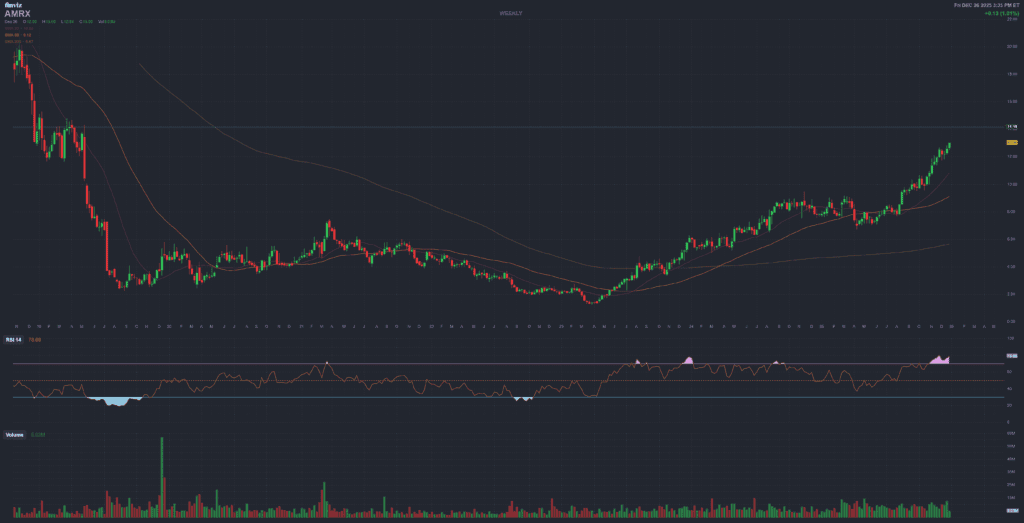
Amneal (AMRX) – Boncresa & Oziltus Enter the Denosumab Battle
FDA approvals for Boncresa and Oziltus, a 5.3B USD Prolia/XGEVA market, and what this means for Amneal’s biosimilars strategy.
Today’s catalyst snapshot
FDA approvals – Boncresa & Oziltus
Prolia/XGEVA market ≈ 5.3B USD (U.S.)
Crowded denosumab biosimilars field
On December 22, 2025 the FDA approved Amneal and mAbxience’s BLAs for
Boncresa (denosumab-mobz), a biosimilar referencing Prolia, and
Oziltus (denosumab-mobz), a biosimilar referencing XGEVA. The two
brands target a combined U.S. market of roughly 5.3 billion dollars over the
last 12 months, but join a denosumab biosimilar segment that has been filling up rapidly
throughout 2024–2025.
This note looks at what these approvals really mean for AMRX: the size of the opportunity, the competitive landscape, the company’s financial posture and how retail traders are reacting on Reddit, Stocktwits and X (non-professional sources).
Quick data panel (AMRX)
Ticker
AMRX (NASDAQ)
Business mix
Affordable Medicines (generics/biosimilars), Specialty, AvKARE
Q3 2025 net revenue
≈ 785M USD (+12% YoY)
Q3 2025 adj. EBITDA
≈ 160M USD (+1% YoY)
Cash & equivalents
≈ 200–250M USD range
Long-term debt
≈ 2.6B USD
Prolia/XGEVA U.S. sales
≈ 5.3B USD (last 12 months)
Biosimilars goal
6 biosimilars across 8 presentations by 2027
1. Executive summary
Amneal has just secured a pair of high-profile approvals: Boncresa and Oziltus, denosumab biosimilars to Amgen’s Prolia and XGEVA. On paper, the prize is obvious: the combined U.S. market for these two reference products is estimated at around 5.3 billion USD for the 12 months ended October 2025.
The catch: denosumab has become one of the most crowded biosimilar arenas in the world. In 2024–2025, multiple other denosumab biosimilars have already been approved, meaning that Boncresa and Oziltus are not early movers but part of a second wave where execution, contracting and pricing discipline will matter as much as – or more than – being “first”.
For AMRX, the approvals:
- Reinforce the strategic shift toward complex generics and biosimilars within the Affordable Medicines segment.
- Come on top of a busy 2025 approval cycle (iohexol, cyclosporine ophthalmic, respiratory products, etc.).
- Add another long-duration, recurring revenue opportunity to a portfolio that has historically been more cyclical.
This report is not about whether the stock is “cheap” or “a buy”. It’s about understanding where Boncresa/Oziltus really sit in the denosumab ecosystem, how they fit into Amneal’s financial picture, and what kind of expectations retail traders are building around AMRX on social media (sources that are, by definition, retail and non-professional).
2. Last 12 months: timeline for AMRX and denosumab
Q1–Q2 2025 – Denosumab biosimilars wave builds
Throughout early 2025, the FDA approves multiple denosumab biosimilars referencing Prolia and XGEVA
from other manufacturers. The denosumab space shifts from a protected Amgen franchise to a rapid
multi-player environment, similar to what has already happened in anti-TNF and some oncology biologics.
30 October 2025 – Q3 2025 results
Amneal reports 785M USD in net revenue (+12% YoY) and 160M USD in adjusted EBITDA.
All three segments (Specialty, Affordable Medicines, AvKARE) grow, with Affordable Medicines up about
mid-single to high-single digits and AvKARE up strongly. Management reiterates the importance of complex
injectables and biosimilars as long-term growth drivers.
Late 2025 – Other FDA approvals
In parallel with denosumab, Amneal secures approvals for a generic Restasis (cyclosporine ophthalmic emulsion),
a generic Omnipaque (iohexol injection), and respiratory products including a generic ProAir HFA and QVAR.
The pipeline of complex generics and biosimilars expands across multiple therapeutic classes, highlighting
that denosumab is part of a broader “complex portfolio” strategy rather than a one-off bet.
22 December 2025 – FDA approves Boncresa & Oziltus
The FDA approves Boncresa (denosumab-mobz) as a biosimilar to Prolia and Oziltus (denosumab-mobz)
as a biosimilar to XGEVA. Under the partnership, mAbxience handles development and manufacturing,
while Amneal holds exclusive U.S. commercialization rights. The company notes that it now has five
commercial biosimilars and remains on track to commercialize six biosimilars across eight presentations
by 2027.
End of 2025 – Market context
IQVIA data cited by Amneal put U.S. annual Prolia + XGEVA sales at roughly 5.3B USD.
Several denosumab biosimilar pairs are already on the market, so Boncresa and Oziltus are entering
a space that is big, but also highly competitive. For investors and traders, the question becomes
less “is there a market?” and more “how much of it can Amneal realistically capture, and at what margin?”
3. Amneal’s business and biosimilars strategy
3.1 Business profile in brief
Amneal is a diversified pharma company with three main segments:
- Affordable Medicines – generics and biosimilars, including complex injectables.
- Specialty – branded portfolio with a focus on CNS and endocrine disorders.
- AvKARE – distribution to the U.S. federal government and institutional markets.
The company has been steadily pivoting toward more complex products, which tend to carry higher barriers to entry and better margins than simple oral generics. Biosimilars, especially in oncology and biologics for chronic diseases, are a core part of this shift.
3.2 Denosumab and the Prolia/XGEVA franchise
Denosumab is a monoclonal antibody targeting RANK ligand, used to prevent bone resorption. In the reference brands:
- Prolia is used primarily in osteoporosis and treatment-induced bone loss.
- XGEVA is used for skeletal-related events in oncology (bone metastases, giant cell tumor, etc.).
Both products carry notable safety considerations, including a boxed warning for severe hypocalcemia in certain populations (especially advanced chronic kidney disease for Prolia), risks of osteonecrosis of the jaw, hypocalcemia, and other serious adverse events. Those same warnings and monitoring requirements carry over to biosimilars, which are expected to share the reference product’s safety profile.
3.3 Boncresa & Oziltus – the Amneal / mAbxience partnership
Under the partnership structure:
- mAbxience is responsible for development and manufacturing of the denosumab biosimilars.
- Amneal holds exclusive U.S. commercialization rights, leveraging its Affordable Medicines segment and AvKARE channel.
- The same molecule (denosumab-mobz) is branded as Boncresa (Prolia biosimilar) and Oziltus (XGEVA biosimilar), mirroring the reference products’ dual positioning.
Strategically, this allows Amneal to participate in both the osteoporosis and oncology sides of the denosumab market without having to carry the full development and manufacturing burden on its own balance sheet.
3.4 Other complex launches around the same time
The denosumab approvals arrive in the context of a broader launch cycle that includes:
- Iohexol injection (first generic Omnipaque) for contrast imaging.
- Cyclosporine ophthalmic emulsion 0.05% (generic Restasis) with launch expected in early 2026.
- Albuterol sulfate inhalation aerosol (generic ProAir HFA) and beclomethasone dipropionate HFA (generic QVAR) in respiratory.
- Brekiya (DHE autoinjector) in the Specialty migraine cluster headaches space.
In other words, Boncresa and Oziltus are important, but they are part of a multi-leg strategy that spans complex injectables, ophthalmology and respiratory generics – not a single “all-or-nothing” bet.
4. Denosumab biosimilars: opportunity and crowding
4.1 Market size
IQVIA data cited in Amneal’s own release estimate that Prolia and XGEVA generated roughly 5.3 billion USD in U.S. sales in the 12 months ended October 2025. That’s a very large revenue pool for any biosimilar manufacturer targeting these reference products.
4.2 Competitive landscape
The flip side is that Prolia/XGEVA are not fresh targets. Throughout 2024 and 2025 the FDA has already approved multiple other denosumab biosimilars – each with its own brands for the osteoporosis and oncology indications. Boncresa and Oziltus join this second wave at a time when payers and providers will have several denosumab options to choose from.
For readers, the implication is simple: this is not a “one biosimilar vs originator” world like some of the earliest biosimilar launches. It is a multi-player competition where:
- Contracting and rebate strategies with payers and GPOs are central.
- Hospital and clinic purchasing behavior can differ significantly from retail.
- Manufacturing reliability and supply continuity are competitive advantages in themselves.
4.3 Safety narrative and boxed warnings
Denosumab’s safety profile is not trivial. In particular:
- Prolia has a boxed warning related to the risk of severe hypocalcemia in patients with advanced CKD.
- Both Prolia and XGEVA have well-documented risks around hypocalcemia, osteonecrosis of the jaw and other serious events.
From a biosimilar perspective, this cuts both ways: on one hand, prescribers already know these risks and how to monitor them; on the other, any quality or supply issues on the biosimilar side will be viewed through the lens of a drug class that already carries serious safety warnings.
5. Financials and balance sheet
In Q3 2025 Amneal reported:
- Net revenue ≈ 785M USD, up about 12% year over year.
- Adjusted EBITDA ≈ 160M USD, up around 1% year over year.
- Growth across all three segments, with Specialty and Affordable Medicines both up mid-single to high-single digits and AvKARE up more strongly.
- Operating cash flow in the low-to-mid hundreds of millions on a trailing twelve-month basis.
- Long-term debt in the ballpark of 2.5–2.6B USD, giving the company a leveraged but manageable capital structure for a generic/specialty player.
The biosimilars push sits at the intersection of two forces:
- The need to offset price erosion and competition in traditional oral generics.
- The desire to build more durable, higher-margin revenue streams without fully exiting the “Affordable Medicines” identity.
Denosumab, with its large reference market and chronic use in many patients, fits this logic – provided that Amneal can secure meaningful share without destroying economics through excessive discounting.
6. Retail sentiment – Reddit, Stocktwits, X (non-professional)
Compared with hyper-speculative biotech names, AMRX sits in a somewhat different corner of the retail universe. Discussions on Reddit, Stocktwits and X do exist, but they tend to be more about “undervalued generics/biosimilars growth story” than about “one binary PDUFA”.
It’s important to stress that all of these platforms are populated by non-professional traders and anonymous users. Posts are not vetted research and often mix solid points with misunderstandings about regulation, pricing and competitive dynamics.
Reddit
The Reddit view on AMRX has evolved from “deep value generic” to “underfollowed growth play with multiple catalysts” over the last couple of years. Long write-ups often focus on:
- Revenue growth outpacing valuation multiples.
- The shift toward complex generics and biosimilars (bevacizumab, denosumab, etc.).
- The idea that the market systematically underprices diversified generic/specialty platforms.
These deep-dive posts can be interesting, but they remain retail opinion pieces, not regulated research. Numbers and assumptions should always be cross-checked against official filings.
Stocktwits
On Stocktwits, AMRX is treated more like a momentum + fundamentals hybrid: people watch new 52-week highs, mention analyst upgrades and react to FDA approvals as short-term trading catalysts. The denosumab news has triggered an uptick in “bullish” tags and chatter about “multi-year growth” from biosimilars, often in very simplified form.
Stocktwits sentiment is a snapshot of retail mood, not a signal that the underlying thesis is correct. It helps to see how crowded a trade is, not whether it is fundamentally sound.
X (Twitter)
On X, coverage is more fragmented: some healthcare accounts look at Amneal’s growing string of FDA approvals, while others lump AMRX into generic “value pharma” baskets. The denosumab approvals have attracted attention mainly because they add AMRX to a high-profile biologics class where many investors already follow the originator and earlier biosimilars.
As always, posts on X should be considered unverified opinions. They can be useful to gauge how much attention a ticker is getting, but not as a replacement for primary sources.
7. Risk map for Boncresa/Oziltus and AMRX
Crowded denosumab biosimilars field
Amneal is not early to denosumab. Several other biosimilars to Prolia/XGEVA have already been approved. Gaining share will depend on contracting, pricing, and the ability to secure preferred status with key payers and institutions, rather than on being “the new biosimilar”.
Pricing pressure and margins
The more competitors enter, the more intense the price erosion is likely to be. While biosimilars can still be margin-accretive relative to older oral generics, too aggressive price competition can compress the economics for everyone involved.
Execution and supply reliability
Manufacturing reliability and supply continuity are critical in biologics. Any disruption on the denosumab line – even if the root cause is at partner level – will be viewed negatively by prescribers, payers and investors, especially given the safety profile of the drug class.
Balance sheet and capital allocation
With long-term debt in the multi-billion range, Amneal has to balance growth investments (new launches, biosimilars, specialty) with debt service and refinancing risk. Overextending on too many fronts at once could pressure leverage metrics.
8. Medium-term scenarios (Denosumab + biosimilars platform)
“Solid contributor” scenario
Boncresa and Oziltus achieve respectable but not dominant share in denosumab, adding a meaningful but not transformative revenue stream on top of other complex launches. AMRX continues to grow mid-single to low-double digits as the portfolio of biosimilars, ophthalmic and respiratory products matures.
“Biosimilars engine” scenario
Amneal successfully leverages the mAbxience partnership and other biosimilar programs to become a recognized name in U.S. biosimilars. Denosumab becomes one of several sizeable biosimilar franchises and investors increasingly value AMRX as a diversified platform rather than primarily a generics player.
“Crowding and margin squeeze” scenario
Competition in denosumab becomes so intense that economics are weaker than expected, and other biosimilar programs see similar pressure. The market continues to value AMRX as a levered generics/specialty hybrid without materially re-rating the stock despite revenue growth.
These scenarios are illustrative only. They are not probabilities, not forecasts and not investment advice.
9. Sources and disclaimers
Main sources used for this report include:
- Amneal Pharmaceuticals press releases and investor presentations (Q3 2025 results and denosumab biosimilars announcement).
- Official FDA biosimilar product lists and denosumab background documents.
- IQVIA-based market data for U.S. Prolia/XGEVA sales as cited by Amneal.
- Reputable financial news coverage summarizing approvals and financial performance.
This report is for informational and educational purposes only and does not constitute investment advice,
an offer, or a solicitation to buy or sell any financial instrument. The information is based on publicly
available sources believed to be reliable but may be incomplete or outdated. Amneal (AMRX), Boncresa and
Oziltus are discussed purely as a case study around biosimilar catalysts; any investment decision remains
solely the responsibility of the reader.
Biotech, biosimilars and small/mid-cap healthcare stocks are highly volatile and can lead to rapid and permanent loss of capital. Readers should perform their own due diligence and, where appropriate, consult a qualified financial advisor.
Biotech, biosimilars and small/mid-cap healthcare stocks are highly volatile and can lead to rapid and permanent loss of capital. Readers should perform their own due diligence and, where appropriate, consult a qualified financial advisor.
Some tools and platforms mentioned in this article may be accessed via affiliate or referral links on
Merlintrader trading Blog. Any such links, when present, help support the site at no additional cost to
the reader and do not change the nature of this content, which is strictly informational and not a
recommendation to use any specific service.
Further legal information and full website policies (Italian):
Disclaimer legale e note informative | Condizioni d’uso e privacy
Disclaimer legale e note informative | Condizioni d’uso e privacy
Amneal (AMRX) – Boncresa & Oziltus entrano nella battaglia del denosumab
Approvazioni FDA per Boncresa e Oziltus, un mercato Prolia/XGEVA da circa 5,3 miliardi di dollari e cosa significa davvero per la strategia biosimilari di Amneal.
Punto di partenza: cosa è successo
FDA – Boncresa & Oziltus approvati
Mercato Prolia/XGEVA ≈ 5,3B USD (USA)
Arena biosimilari denosumab affollata
Il 22 dicembre 2025 la FDA ha approvato le BLAs di Amneal/mAbxience per
Boncresa (denosumab-mobz), biosimilare di Prolia, e
Oziltus (denosumab-mobz), biosimilare di XGEVA. Secondo i dati IQVIA citati
dalla società, le vendite USA combinate dei due originator sono intorno a 5,3 miliardi
di dollari negli ultimi 12 mesi. La torta è enorme, ma il tavolo è ormai pieno di altri
concorrenti biosimilari.
L’obiettivo di questo report è capire dove si collocano Boncresa/Oziltus in questo contesto: quanto vale davvero l’opportunità, quanto è dura la concorrenza, come si inserisce nella struttura finanziaria di AMRX e cosa stanno raccontando i trader retail sui social (fonti retail, non professionali).
Dati rapidi (AMRX)
Ticker
AMRX (NASDAQ)
Segmenti
Affordable Medicines, Specialty, AvKARE
Ricavi netti Q3 2025
≈ 785M USD (+12% a/a)
EBITDA aggiustato Q3 2025
≈ 160M USD (+1% a/a)
Cassa e equivalenti
circa 200–250M USD
Debito a lungo termine
circa 2,6B USD
Vendite Prolia/XGEVA USA
≈ 5,3B USD (ultimi 12 mesi)
Obiettivo biosimilari
6 biosimilari, 8 presentazioni entro il 2027
1. Sintesi
Con Boncresa e Oziltus, Amneal entra finalmente nella partita dei biosimilari di denosumab. Sulla carta il numero è impressionante: il mercato USA combinato di Prolia e XGEVA vale circa 5,3 miliardi di dollari all’anno. Nella realtà, però, siamo ormai nel pieno di una “biosimilar war” dove diversi concorrenti sono già stati approvati.
Per AMRX queste approvazioni:
- Rafforzano il posizionamento nel segmento “Affordable Medicines” ad alto valore (complessi e biosimilari).
- Arrivano in un anno già ricco di approvazioni (iohexol, Restasis generico, prodotti respiratori, ecc.).
- Aggiungono un’altra fonte di ricavi ricorrenti potenzialmente duraturi in un portafoglio storicamente più ciclico.
Non è un report su “comprare o vendere” AMRX, ma un tentativo di rispondere a tre domande:
- Quanta parte del mercato Prolia/XGEVA è realisticamente contendibile per Amneal?
- Quanto la concorrenza biosimilare può comprimere i margini nel medio periodo?
- Come si inseriscono Boncresa/Oziltus nella narrativa che il retail sta costruendo intorno al titolo?
2. Ultimi 12 mesi: timeline AMRX + denosumab
Inizio 2025 – L’ondata denosumab biosimilari
Nel corso del 2024 e dell’inizio 2025 la FDA approva diverse coppie di biosimilari di denosumab
per Prolia/XGEVA. La franchigia di Amgen smette di essere “monopolio” e diventa un mercato a più
giocatori, con logiche simili a quelle già viste in altre classi biologiche mature.
30 ottobre 2025 – Risultati Q3 2025
Amneal chiude il terzo trimestre con circa 785M USD di ricavi netti (+12% anno su anno)
e 160M USD di EBITDA aggiustato. Crescono sia il business Specialty sia l’Affordable
Medicines, mentre la divisione AvKARE continua a spingere sul canale government/istituzionale. La società
ribadisce che i prodotti complessi e i biosimilari sono una delle chiavi di crescita futura.
Autunno 2025 – Altre approvazioni FDA
Prima ancora del denosumab, Amneal ottiene l’ok per iohexol iniettabile (primo generico Omnipaque),
per la ciclosporina oftalmica (Restasis generico, lancio previsto nel 2026) e per prodotti respiratori
come il generico di ProAir HFA e QVAR. È un ciclo lanci molto fitto che rende evidente la volontà
di spingere su prodotti complessi, non solo su commodity generiche.
22 dicembre 2025 – FDA approva Boncresa & Oziltus
La FDA approva Boncresa (biosimilare di Prolia) e Oziltus (biosimilare di XGEVA), entrambi a base di
denosumab-mobz, nell’ambito della partnership con mAbxience. Quest’ultima cura sviluppo e produzione,
mentre Amneal ha i diritti esclusivi di commercializzazione negli Stati Uniti. La società sottolinea
che ora dispone di cinque biosimilari commerciali e punta a portare sul mercato sei biosimilari con
otto presentazioni entro il 2027.
Fine 2025 – Contesto di mercato
I dati IQVIA indicano vendite combinate Prolia/XGEVA in area 5,3 miliardi di dollari solo in USA.
Allo stesso tempo, l’elenco dei biosimilari di denosumab già approvati è lungo. Boncresa e Oziltus arrivano
quindi in un contesto dove la torta è grande, ma le fette sono da conquistare “a gomitate” su prezzo,
contratti e affidabilità di fornitura.
3. Modello di business e ruolo dei biosimilari
3.1 Chi è Amneal oggi
Amneal è un player ibrido: da un lato generici e biosimilari (segmento Affordable Medicines), dall’altro un portafoglio Specialty con farmaci branded in ambito neurologico ed endocrino, più il canale AvKARE per vendite a governo e istituzioni. Negli ultimi anni la direzione è chiara: meno peso alle semplici pillole generiche, più spazio a prodotti complessi e biosimilari.
3.2 Denosumab: Prolia e XGEVA
Denosumab è un anticorpo monoclonale anti-RANKL che riduce il riassorbimento osseo. Prolia è utilizzato soprattutto in ambito osteoporosi e perdita ossea indotta da trattamenti, mentre XGEVA è un pilastro per la prevenzione degli eventi scheletrici in oncologia (metastasi ossee, alcune neoplasie ossee rare, ecc.).
Entrambe le molecole hanno un profilo di sicurezza non banale (ipocalcemia, osteonecrosi della mandibola, effetti avversi seri in popolazioni fragili) e Prolia porta un boxed warning per l’uso in pazienti con insufficienza renale avanzata. I biosimilari, per definizione, ereditano questa fotografia di rischio, con tutte le implicazioni in termini di monitoraggio clinico.
3.3 Boncresa & Oziltus: come funziona la partnership
L’accordo con mAbxience è strutturato in modo da:
- Affidare a mAbxience sviluppo e produzione del denosumab biosimilare.
- Lasciare ad Amneal i diritti esclusivi di commercializzazione negli USA.
- Usare due brand (Boncresa per l’indicazione tipo Prolia, Oziltus per quella tipo XGEVA) per allinearsi al modo in cui i reference sono posizionati nel mercato.
Questo consente ad Amneal di esporsi al flusso ricorrente di denosumab in osteoporosi e oncologia senza dover internalizzare l’intera complessità industriale del biologico, ma al prezzo di dover comunque giocare la partita commerciale in un campo affollato.
4. Denosumab biosimilari: dimensione e affollamento
4.1 Un mercato grande, ma non vergine
Con circa 5,3 miliardi di dollari di vendite combinate Prolia/XGEVA negli USA negli ultimi 12 mesi, il campo denosumab è uno dei più appetitosi tra i biologici in scadenza di esclusiva. Ma non siamo più nella fase “originator + primo biosimilare”: nel 2024–2025 la FDA ha già approvato diverse altre coppie denosumab per Prolia e XGEVA.
Boncresa e Oziltus quindi non arrivano in una terra vergine, ma in un mercato che ha già visto l’ingresso di vari concorrenti, con payor e gruppi d’acquisto che stanno definendo le proprie preferenze.
4.2 Dinamiche di prezzo e contratti
In questo contesto, la domanda non è “ci sarà richiesta per il biosimilare?”, ma:
- Con quali sconti reali rispetto all’originator e agli altri biosimilari?
- Che tipo di accordi di rimborso e rebate Amneal riuscirà a siglare con i principali payor?
- Quanto conterà il canale AvKARE (governo/istituzioni) nel costruire volumi e visibilità?
Più competitor entrano, più la curva di prezzo tende a scendere. Il gioco di Amneal sarà cercare volume sufficiente senza sacrificare del tutto i margini per inseguire quota a ogni costo.
5. Numeri e struttura finanziaria
Dal lato numeri, il Q3 2025 di Amneal racconta una storia chiara:
- Ricavi netti ≈ 785M USD, in crescita del 12% anno su anno.
- EBITDA aggiustato ≈ 160M USD, crescita modesta ma positiva.
- Crescita in tutti i segmenti, con AvKARE che corre più delle altre divisioni.
- Debito a lungo termine attorno a 2,5–2,6B USD, che per una realtà di questo tipo è significativo ma non estremo.
I biosimilari, denosumab incluso, servono a:
- Compensare l’erosione di prezzo sulle vecchie linee di generici orali.
- Aggiungere ricavi più stabili e potenzialmente a margine migliore.
Il rischio, come sempre, è l’equilibrio: investire abbastanza per competere in un’area ad alto valore senza sovraccaricare una struttura già levata di debito.
6. Sentiment retail – Reddit, Stocktwits, X (fonti non professionali)
AMRX, rispetto alle classiche “biotech da PDUFA”, ha un profilo un po’ diverso: più storia industriale, meno binary event. Sui social viene vista spesso come:
- “Value/growth ibrido” nel mondo generici/biosimilari.
- Società che il mercato non prezza pienamente rispetto al ritmo di approvazioni e ricavi.
È fondamentale ricordare che Reddit, Stocktwits e X sono popolati quasi esclusivamente da trader retail e account anonimi: nessuna di queste piattaforme produce ricerche regolamentate.
Reddit
Su Reddit appare una narrativa ricorrente: “AMRX è sottovalutata rispetto alla crescita dei ricavi e alla pipeline di prodotti complessi”. I post più lunghi si concentrano su multipli, leva, crescita prevista dell’utile e pipeline biosimilare/respiratoria, spesso con target price personali.
Interessante come materiale di discussione, ma resta opinione retail non verificata. Numeri e tesi vanno sempre incrociati con filing ufficiali e presentazioni aziendali.
Stocktwits
Su Stocktwits il focus è più tecnico e di breve: nuovi massimi a 52 settimane, reazioni alle approvazioni FDA, upgrade e downgrade. La notizia dei biosimilari di denosumab viene vista come ulteriore spinta a una storia già in trend, con qualche commento che prova a “quantificare” l’impatto sul fatturato in modo non sempre realistico.
Anche qui, si parla di sentimento e momentum, non di fondamentali verificati. Utile per capire quanto è “caldo” il titolo, non per costruire un modello di business.
X (Twitter)
Su X Amneal viene citata sempre più spesso come esempio di mid-cap farmaceutica che si sta costruendo un portafoglio di prodotti complessi. I biosimilari di denosumab vengono letti come un segnale che l’azienda vuole sedersi al tavolo “grande” dei biologici, pur rimanendo nel perimetro delle medicine accessibili.
Come tutto ciò che circola su X, si tratta di opinioni non verificate e non soggette a controllo qualità: possono cambiare tono nel giro di poche sedute a seconda di prezzo e newsflow.
7. Mappa rischi
Affollamento nel denosumab
Boncresa e Oziltus entrano in un’arena già affollata. Se la pressione competitiva sul prezzo sarà molto intensa, il contributo economico netto potrebbe essere inferiore alle aspettative più ottimistiche.
Pressione sui margini
Più biosimilari ci sono, più i payor spingono sugli sconti. Amneal dovrà trovare un equilibrio tra volume e redditività, evitando l’errore di inseguire quota di mercato a scapito dei margini.
Esecuzione industriale
Affidarsi a un partner per produzione e sviluppo aiuta a contenere i costi, ma non elimina il rischio: problemi produttivi o di qualità lato mAbxience impatterebbero direttamente anche Amneal, soprattutto in un contesto di molecole con profilo di sicurezza delicato.
Leva finanziaria
Con un debito importante, la società deve gestire con attenzione la sequenza di lanci, investimenti e rimborsi. Un eventuale rallentamento dell’utile operativo o imprevisti nel roll-out dei prodotti complessi potrebbero complicare il quadro di medio termine.
8. Scenari di medio termine
Scenario “contributo solido”
Boncresa/Oziltus conquistano una quota non dominante ma rispettabile del mercato denosumab, aggiungendo ricavi stabili a un portafoglio già in crescita per altri lanci. AMRX continua a crescere a ritmi interessanti, ma senza trasformarsi in “pure biosimilar story”.
Scenario “motore biosimilari”
Amneal riesce a farsi riconoscere come player di riferimento nei biosimilari (non solo denosumab), con contratti forti, execution solida e pipeline credibile. Il mercato inizia a prezzare il titolo più come piattaforma di complessi/biosimilari che come semplice generics player levato.
Scenario “compressione margini”
La concorrenza in denosumab si traduce in sconti sempre più aggressivi, che insieme a dinamiche simili in altre classi riducono il beneficio economico dei biosimilari. AMRX cresce nei ricavi, ma senza un rerating significativo perché il mercato resta focalizzato sul profilo di rischio/leva.
Anche qui, sono scenari logici e non previsioni o suggerimenti operativi.
9. Fonti e disclaimer
I dati di fatto citati provengono principalmente da comunicati ufficiali di Amneal e mAbxience, dalla lista FDA dei biosimilari approvati, da dati IQVIA riportati nei comunicati e da articoli di testate finanziarie specializzate. Le sezioni “Sentiment” si basano su osservazioni di discussioni pubbliche su Reddit, Stocktwits e X, che restano fonti retail non professionali.
Questo contenuto ha finalità esclusivamente informative e didattiche e non rappresenta in alcun modo una
raccomandazione personalizzata di investimento, né un invito a comprare o vendere strumenti finanziari.
Le informazioni possono essere incomplete o non aggiornate; Amneal (AMRX), Boncresa e Oziltus sono citati
unicamente come caso di studio sui biosimilari. Qualsiasi decisione operativa rimane sotto la piena
responsabilità del lettore.
I titoli healthcare e, in particolare, i produttori di generici e biosimilari, possono essere soggetti a elevata volatilità e a rischi regolatori e industriali significativi. Prima di assumere qualunque decisione è necessario svolgere la propria due diligence e, se opportuno, confrontarsi con un consulente finanziario abilitato.
I titoli healthcare e, in particolare, i produttori di generici e biosimilari, possono essere soggetti a elevata volatilità e a rischi regolatori e industriali significativi. Prima di assumere qualunque decisione è necessario svolgere la propria due diligence e, se opportuno, confrontarsi con un consulente finanziario abilitato.
Alcuni strumenti e piattaforme citati possono essere raggiunti tramite link di affiliazione presenti su
Merlintrader trading Blog. Eventuali commissioni di affiliazione non modificano in alcun modo la natura
informativa di questo articolo e non costituiscono sollecitazione all’uso di specifici servizi.
Biotech Catalyst Calendar
Per tenere traccia in modo ordinato di PDUFA, letture di trial e principali eventi sulle biotech, puoi consultare il calendario catalyst aggiornato: Merlintrader – Calendario Catalyst .
La consultazione del calendario non sostituisce in alcun modo la verifica delle date sulle fonti ufficiali (FDA, EMA, comunicati societari, ClinicalTrials.gov).
Scanner for active traders

Try ChartsWatcher free, then unlock 10% OFF with SAVE10
ChartsWatcher is a real-time scanner for momentum traders: fast movers, unusual volume and rotations — so you can focus on the few tickers that matter right now, instead of watching hundreds of charts.
Start with the free version. When you upgrade, use SAVE10 for 10% OFF your first paid period.
Start free – then use SAVE10
No credit card required to start. Apply SAVE10 when upgrading.
Recommended platform

One platform. All your brokers.
Medved Trader connects multiple brokers in one workspace, with pro charts, hotkeys and fast execution — without changing your broker accounts.
A single cockpit for positions, Level II and multi-broker order routing, built for active day & swing traders.
Get 1 Month Free ➔
Multi-broker workflow + customizable layouts in one platform.
 Monica.im – the AI assistant I use every day
If you find value in the work I publish on Merlintrader and want a practical AI assistant for research and writing, you can sign up using this referral link. Click here to try Monica.im and support the site
Find out how I use AI on Merlintrader: AI, retail and Merlintrader
Disclosure: some of the links in the promotional blocks above are affiliate or referral links. If you choose to subscribe or sign up through them, Merlintrader may receive a small commission or benefit at no extra cost to you.