DISCLAIMER — Not financial advice. Educational content only, not an offer or solicitation to buy or sell any security. Biotech and small/mid-cap stocks are highly speculative and volatile and can result in a partial or total loss of capital. Do your own research and consult a licensed advisor where appropriate. / Contenuti a solo scopo informativo e didattico, non costituiscono consulenza finanziaria né offerta o sollecitazione al pubblico risparmio ai sensi delle normative CONSOB e SEC. Le azioni biotech e le small/mid cap sono strumenti altamente speculativi e volatili e possono comportare la perdita parziale o totale del capitale investito. Si raccomanda di effettuare sempre le proprie ricerche e, se necessario, di rivolgersi a un consulente abilitato.
Merlintrader Trading Pub
Biotech catalyst news and analysis. FDA PDUFA tracker
Merlintrader Trading Pub
Biotech catalyst news and analysis. FDA PDUFA tracker
Language:
EN
IT
Unicycive Therapeutics (UNCY) – Kidney Catalyst Deep Dive 2025
Heavy, filings-based dossier on Unicycive Therapeutics, a kidney-focused biotech now living with an FDA Complete Response Letter on its lead asset and a resubmission plan for 2026. This is a factual map of what we know today, not a recommendation.
News of the day – Legal overhang intensifies (18 December 2025)
Legal / LitigationOn 18 December 2025, law firm Bragar Eagel & Squire announced a new investigation into certain officers and directors of Unicycive Therapeutics. The investigation follows the securities class action already filed in August 2025 over the company’s public statements around the OLC New Drug Application and the June 2025 FDA Complete Response Letter.
In practical terms this does not change day-to-day operations, but it reinforces a clear message: the OLC NDA path and related communication are now under legal as well as regulatory scrutiny.
Executive summary
Unicycive Therapeutics (Nasdaq: UNCY) is a micro/small-cap biotech focused almost entirely on kidney disease. The thesis lives and dies, for now, with a single late-stage asset: oxylanthanum carbonate (OLC, also known as Renazorb), a next-generation lanthanum-based phosphate binder for dialysis patients with hyperphosphatemia.
In June 2025, the FDA issued a Complete Response Letter (CRL) for OLC. The key detail: the deficiency was limited to cGMP issues at a third-party manufacturing vendor, with no concerns raised on pre-clinical, clinical or safety data. The company held a Type A meeting in October 2025 and, as of Q3 2025, reports that it remains on track to resubmit the NDA by year-end, guiding to a potential new PDUFA date in the first half of 2026.
At the same time, Unicycive closed Q3 2025 with approximately 42.7 million dollars in cash and no conventional debt, and states that this cash should fund operations “into 2027”. The company has already gone through a 1:10 reverse split and a very significant round of ATM issuance, with common shares outstanding now above 21 million and a sizeable warrant overhang tied to OLC regulatory and reimbursement milestones.
On the clinical side, the phase 2 data for OLC, now published in the Clinical Journal of the American Society of Nephrology and presented at ASN Kidney Week 2025, show serum phosphate control in over 90 percent of patients and a dramatic reduction in pill burden (roughly halved pill count and seven-fold lower pill volume versus prior therapy). The second asset, UNI-494 for acute kidney injury and delayed graft function, has completed a phase 1 healthy volunteer study and received Orphan Drug Designation, but remains clinically early and years away from potential commercialization.
Around this core, the 2025 story is defined by heavy dilution, multiple law-firm announcements on securities litigation, rising short interest and highly polarized retail sentiment. The result is a textbook high-risk catalyst name: the upside narrative is built around successful OLC re-filing, FDA approval, favorable TDAPA reimbursement and decent market penetration; the downside revolves around further regulatory slippage, limited commercialization traction, continued equity financing and litigation drag.
Quick data panel
Ticker / Exchange
UNCY – Nasdaq Capital Market
Focus
Kidney disease (hyperphosphatemia, AKI / delayed graft function)
Stage
Late stage (OLC post-CRL, NDA resubmission planned) + early stage (UNI-494)
Share price*
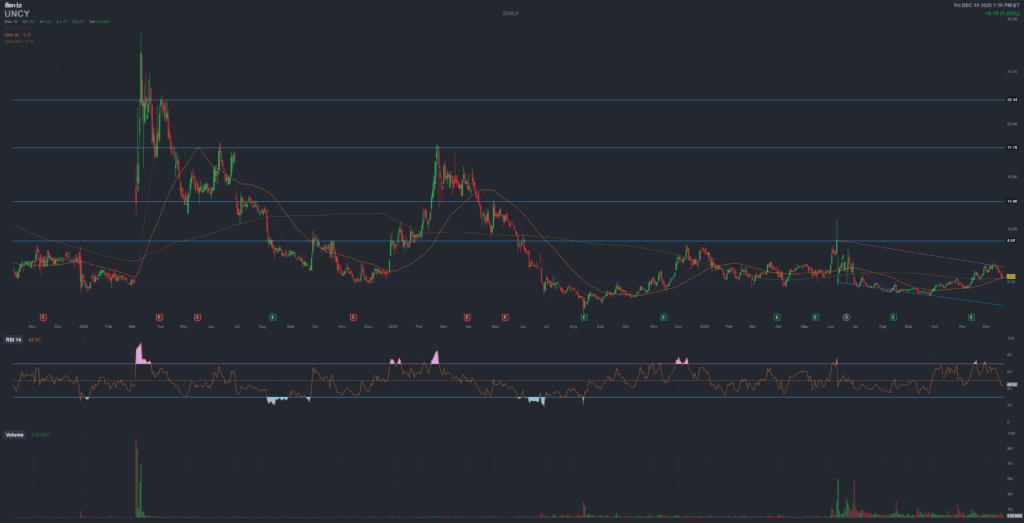
Around 5.5 USD (mid-December 2025, intraday range roughly 5.4–5.9)
Market cap*
Approximately 115–135 million USD (depending on source and timing)
Shares outstanding
20.85 million (30 Sep 2025) – around 21.5 million after Q3 2025 ATM usage
Cash (30 Sep 2025)
42.7 million USD; company guides runway “into 2027”
Debt
No traditional financial debt; warrant liability accounting only
Lead asset
Oxylanthanum Carbonate (OLC, Renazorb) – phosphate binder for dialysis patients
Key regulatory status
CRL on 30 June 2025 for single cGMP deficiency at third-party vendor; no clinical/safety issues reported.
NDA resubmission targeted by end-2025; company expects new PDUFA in 1H 2026 if accepted.
Second asset
UNI-494 – mitochondrial KATP activator for AKI / delayed graft function;
phase 1 completed, Orphan Drug Designation for DGF.
*Price and market cap figures are approximate and snapshot-based; they move intraday and may change materially.
Single-asset heavy
Post-CRL recovery
Kidney / dialysis niche
High dilution risk
Litigation overhang
2025 timeline – from build-up to CRL and resubmission plan
- 31 March 2025FY 2024 results and business update highlight commercial preparations for OLC ahead of the first PDUFA.Tone still optimistic; focus on building a launch-ready infrastructure for a dialysis-market product.
- 10 June 2025Company discloses that FDA has identified cGMP deficiencies at a third-party manufacturing vendor for OLC, ahead of the 28 June PDUFA date.Market reaction is brutal: class-action filings point to a one-day drop above 40 percent as investors process the manufacturing issue and regulatory uncertainty.
- 20 June 2025Unicycive completes a 1:10 reverse stock split and regains compliance with Nasdaq minimum bid rules.Share count is structurally reduced, but economic dilution remains unchanged; volatility increases.
- 28 June 2025Original PDUFA action date for OLC NDA.Outcome is effectively pushed into the CRL two days later, as FDA formalizes its view.
- 30 June 2025FDA issues Complete Response Letter for OLC: single deficiency related to the compliance status of a third-party manufacturing vendor; no issues raised on pre-clinical, clinical or safety data.The stock sells off again; this date becomes the anchor for securities class actions filed later in the year.
- 24 July 2025Phase 2 OLC trial is published in CJASN, confirming that more than 90 percent of patients on OLC reach serum phosphate control with a markedly lower pill burden compared with prior therapy.Scientific validation: the clinical problem is not whether the drug works, but how to navigate CMC and manufacturing.
- August 2025Multiple law firms announce securities class actions on behalf of investors who bought UNCY shares between March 2024 and June 2025, alleging misleading statements around OLC’s regulatory path.Legal risk steps into the foreground; filings highlight the June 10 and June 30 disclosures as key events.
- 15 September 2025Benchmark lifts its price target to the low-20s USD and reiterates a speculative-buy stance.Analyst community, taken as a whole, remains strongly positive on the long-term story despite CRL and lawsuits, with average targets far above the current share price.
- 28 October 2025Type A meeting update: Unicycive reports that FDA has confirmed the CRL revolves around a single manufacturing-vendor deficiency and that no other concerns have been communicated. The company expects to resubmit the OLC NDA before year-end.Key inflection: regulatory path appears technically fixable, but still binary; the stock reprices on resubmission hopes.
- 30 October 2025Company announces upcoming presentation of new OLC data at ASN Kidney Week 2025, emphasizing strong pill-burden reduction.OLC is positioned as a potential best-in-class option for patients with adherence problems on older binders.
- 3 November 2025CEO Shalabh Gupta scheduled for a fireside chat at Guggenheim’s Healthcare Innovation Conference.Management maintains a visible investor-relations profile despite the litigation noise.
- 12 November 2025Q3 2025 results and business update: 42.7 million USD cash, runway into 2027, OLC NDA resubmission still targeted by year-end, and fresh ASN analyses reinforcing the pill-burden advantage.Equity raise via ATM is now visible in the cap table; R&D spending slows while G&A rises sharply.
- 18 December 2025Bragar Eagel & Squire announces an investigation into certain officers and directors of Unicycive, in connection with the existing securities class action.Legal focus intensifies just as investors wait to see whether the company actually files the resubmission by year-end and how FDA responds in 2026.
Sentiment snapshot – traders, forums and short interest
Analyst consensus: generally Buy / Strong Buy
Average 12-month targets: far above spot (multi-fold)
Retail: split between “undervalued” and “burned”
Short interest: meaningful and rising into late 2025
Analysts. Across MarketBeat, Investing and Quiver/HC Wainwright feeds, UNCY typically carries a Buy or Strong Buy rating, with average targets in the mid-double digits (roughly 40–60 USD) and a recent target around 22 USD from HC Wainwright itself. Targets are sensitive to assumptions on OLC approval, TDAPA and commercial uptake, and should be read as optimistic scenarios rather than “base case reality”.
Reddit. On r/pennystocks and r/UNCY, the narrative is textbook high-risk biotech. One cluster of posts presents Unicycive as an “undervalued kidney name” with a large phosphate-binder market and a best-in-class pill burden profile. Another cluster is openly skeptical, questioning whether management has provided a truly clear roadmap to FDA approval after the CRL and pointing out the legal actions and heavy dilution.
Stocktwits and other trading chats. Real-time comment streams focus on catalysts (NDA resubmission, any sign of a new PDUFA date, TDAPA news), intraday volatility after legal headlines, and the tension between bullish analyst targets and the litigation overhang. It is a classic battleground small cap: high reward in best-case scenarios, with a very visible path to severe downside if the regulatory or commercial leg fails.
All of the above reflects sentiment and opinions of non-professional traders and commentators. It is not advice and should not be treated as such.
Pipeline and science – what Unicycive is trying to do
Oxylanthanum Carbonate (OLC / Renazorb) – hyperphosphatemia in dialysis
OLC is a next-generation, nanoparticle-based phosphate binder designed for patients with chronic kidney disease on dialysis who struggle to keep serum phosphate under control. It is a lanthanum-based, non-calcium, non-aluminum agent formulated as small, swallowable tablets rather than large, chalky chewables.
The pivotal open-label phase 2 trial, now published in CJASN, enrolled hemodialysis patients with hyperphosphatemia and titrated OLC to a serum phosphate target. The key findings can be summarized as:
- Serum phosphate control achieved in more than 90 percent of patients at the end of titration.
- Median pill count roughly halved compared with prior phosphate-binder therapy (around three to four OLC tablets per day versus about eight previously).
- Total pill volume reduced by about a factor of seven, reflecting significantly smaller tablets for comparable binding capacity.
- OLC was generally well tolerated; gastrointestinal events occurred but were manageable.
- Systemic absorption of lanthanum was minimal to non-detectable in most patients, consistent with a local-acting binder.
The clinical value proposition, if the drug reaches the market, is not that it opens a new mechanistic space but that it addresses a very practical problem: pill burden and adherence in a population that already swallows a double-digit number of tablets every day.
UNI-494 – mitochondrial protection in AKI / delayed graft function
UNI-494 is a pro-drug related to nicorandil, designed to selectively activate mitochondrial ATP-sensitive potassium channels, with the goal of protecting kidney cells during ischemia-reperfusion injury. The company is initially targeting acute kidney injury and delayed graft function in kidney transplantation, areas with high unmet need and no approved pharmacological therapies.
A first-in-human phase 1 study in healthy volunteers has been completed. Key messages from accessible summaries include:
- Single and multiple ascending dose design, up to 5 days of dosing, with exploratory comparison to nicorandil.
- Acceptable safety and tolerability at lower dose levels; higher doses led to more adverse events and drop-outs, suggesting a relatively narrow therapeutic window.
- Pharmacokinetic data consistent with conversion to nicorandil-like exposure and support for further clinical evaluation.
UNI-494 has received Orphan Drug Designation for the prevention of delayed graft function. At this stage, however, it remains an early-stage asset: the next real inflection would be a phase 2 trial with a clear, clinically meaningful endpoint and a manageable safety profile in a very fragile patient population.
Market context – why hyperphosphatemia and pill burden matter
Hyperphosphatemia is a near-universal issue in dialysis: published data and reviews repeatedly estimate that more than 80 percent of dialysis patients run high serum phosphate, which is associated with higher cardiovascular morbidity and mortality. Despite at least seven approved phosphate binders, a large fraction of patients remains out of target.
There are three main reasons:
- Existing binders often require many tablets per day – in some series, phosphate binders alone account for close to half of a dialysis patient’s entire daily pill burden.
- Tablets are frequently large, chalky, and must be chewed, which is unpleasant and discourages adherence.
- Dialysis patients already manage complex regimens for anemia, blood pressure, bone metabolism and comorbidities; every extra tablet competes with attention and tolerance.
OLC’s core differentiator is straightforward: comparable phosphate control with fewer, smaller tablets. The company repeatedly positions its product as focusing on the “3 Ps” for hyperphosphatemia: potency, pill burden and patient experience. How much that will translate into real-world share gain against entrenched generics and branded competitors depends on pricing, reimbursement (especially TDAPA dynamics), and how aggressively dialysis organizations are willing to change their preferred regimens.
Financials – burn, runway and operating mix
Income statement profile (nine months ended 30 September 2025)
| Line | 9M 2025 |
|---|---|
| Revenue | 0 (no approved products) |
| Research & development | Approximately 6.9 million USD (down about 53 percent versus 9M 2024) |
| General & administrative | Approximately 15.4 million USD (up about 90 percent versus 9M 2024) |
| Total operating expenses | Roughly 22.3 million USD |
| Net loss | About 11.9 million USD (versus 15.2 million USD a year earlier) |
| Q3 2025 net loss | Roughly 6.0 million USD, driven by G&A and warrant-valuation effects |
The drop in R&D reflects winding down of expensive clinical and CMC programs for OLC and UNI-494, while G&A expansion mirrors increased corporate, legal and advisory spend as the company navigates both post-CRL strategy and lawsuits.
Cash, runway and cash flows
| Line | Value |
|---|---|
| Cash & equivalents (30 Sep 2025) | 42.7 million USD |
| Company-stated runway | Into 2027, at the current planning assumptions |
| Net cash used in operations (9M 2025) | Approximately 23.3 million USD |
| Net cash from financing (9M 2025) | Approximately 39.9 million USD (primarily ATM equity issuance) |
In plain language: Unicycive is funding development almost entirely via equity markets. The company has created a cushion that, on paper, should be enough to get through OLC resubmission, a new PDUFA cycle, and some early commercialization work, but further capital will likely be needed if OLC is approved and a more ambitious launch is pursued.
Capital structure, dilution and warrants
The 2024–2025 period reshaped Unicycive’s equity profile. After the 1:10 reverse split, the company leaned heavily on an at-the-market offering program to strengthen its balance sheet around the OLC NDA.
| Metric | Data point |
|---|---|
| Common shares outstanding | 11.38 million at 31 Dec 2024, 20.85 million at 30 Sep 2025, around 21.5 million as of mid-November 2025. |
| ATM activity (2025 YTD) | Roughly 8.0 million shares sold at a volume-weighted average price just under 5 USD, bringing in around 38–39 million USD net. |
| Warrant liability (fair value) | 9.1 million USD as of 30 Sep 2025 (down from 18.9 million USD at 31 Dec 2024). |
| Warrant structure | Several tranches with exercise rights tied to specific milestones: FDA approval of OLC, TDAPA decision, and commercial sales milestones. |
In its own valuation models for the warrants, the company applies probability estimates for key milestones (such as OLC approval and TDAPA) that are well below certainty. Those assumptions are not “odds of success” in a strict statistical sense, but they show that internally Unicycive does not treat regulatory and reimbursement events as guaranteed outcomes.
For any catalyst-focused trader, the key takeaway is simple: if the bullish sequence (approval, TDAPA, credible commercial uptake) plays out, there is room for value creation but also substantial further dilution via warrant exercises and potential new equity raises; if it fails, the capital structure offers little protection.
Management and CEO profile
Shalabh Gupta, MD – Founder, Chairman and CEO
Dr. Shalabh Gupta founded Unicycive in 2016 and has served as Chief Executive Officer, President and Chairman of the Board since then. His profile blends four different angles:
- Physician by training, with clinical work in internal medicine and rehabilitation.
- Former biotech and pharma equity researcher at investment banks, covering US pharma/biotech names.
- Commercial-strategy roles at large biopharma, including work on how to position and launch therapies in competitive markets.
- Serial entrepreneur, with prior companies focused on diagnostics and therapeutics in collaboration with major academic centers and diagnostic players.
The common thread in his public interviews is a focus on underserved patient niches and the idea that kidney disease, especially in dialysis, is a space where small improvements in adherence and symptom control can translate into meaningful gains in quality of life.
Team depth and governance context
Unicycive itself is lean, with roughly twenty-plus employees as of late 2025. Around the CEO, key roles include a seasoned Chief Financial Officer and an executive vice president for corporate strategy with deep experience in renal franchises, including a leadership role in building Renvela (sevelamer) into a blockbuster at a major pharmaceutical company.
On the governance side, the picture is more complex. The company is now the subject of at least one consolidated securities class action and related derivative actions over its 2024–2025 disclosures around OLC and the CRL. Additional law-firm press releases, including the December 2025 investigation, keep the pressure high on how the board and executives framed regulatory risk to the market.
From an outsider’s perspective, Unicycive has a management team that knows the renal market and has seen large-scale launches, but will now have to balance that commercial ambition with strict legal and disclosure discipline.
Retail chatter and sentiment – Reddit, Stocktwits, X
Sentiment around UNCY is one of the most interesting parts of the story. It illustrates how the same set of facts can generate very different mental models in non-professional trading communities.
Reddit – from “undervalued kidney play” to “where is the plan?”
On r/pennystocks and similar boards, long-form posts describe Unicycive as a small company with a potentially large dialysis-market opportunity. Authors highlight:
- OLC’s strong pill-burden reduction versus older phosphate binders.
- A phosphate-binder market often estimated above 2 billion dollars annually, even before considering geographic expansion.
- The fact that the CRL was not about efficacy or safety, reinforcing the narrative of a “fixable technical issue” rather than a broken drug.
In contrast, on r/UNCY itself some threads are distinctly more skeptical. Users question whether management has communicated a truly concrete and time-bound path to approval, or whether the resubmission language remains too high-level. The combination of CRL, share-price collapse in June, and class actions feeds a storyline where trust has to be rebuilt, not assumed.
Stocktwits – pure catalyst energy
On Stocktwits, UNCY behaves like a classic high-beta biotech: bursts of enthusiasm when analyst targets or positive ASN commentary cycle through the feed, followed by sharp drawdowns when legal or CRL-related headlines resurface. Traders track:
- Any hint of actual NDA resubmission and subsequent FDA acceptance.
- Intraday moves tied to law-firm updates and short-interest statistics.
- The tension between a market cap in the hundred-million range and multi-billion estimates for the hyperphosphatemia market.
X (Twitter) – scattered but loud
On X, posts range from frustration at the CRL and lawsuits to bullish reframing of the situation as a “manufacturing-only” setback. Some users emphasize that FDA explicitly did not challenge the clinical or safety package; others focus on the risk that any delay in resubmission or new CMC findings could send the story back to square one.
Again, all these are opinions and reactions from traders and commentators, not from regulators or the company itself. They can be useful to map sentiment and positioning, but they are not a substitute for primary documents.
Bull vs bear – scenario thinking, not advice
Bull case – OLC becomes a real dialysis franchise
- Unicycive files the updated OLC NDA on time and FDA accepts it without new major questions.
- A new PDUFA date is set in the first half of 2026 and culminates in full approval.
- CMS grants TDAPA, giving OLC a temporary reimbursement boost that encourages dialysis chains to adopt the drug.
- The pill-burden advantage translates into meaningful market share versus older binders, even after accounting for generic pricing pressure.
- Equity dilution continues but is offset by growing revenue, and the company either scales a focused commercial organization or signs a favorable partnership.
- UNI-494 advances into phase 2 with a credible early efficacy signal, adding a second-wave kidney story.
In this view, Unicycive evolves from a binary pre-commercial micro-cap into a small renal-focused company with a tangible top line and pipeline optionality. The gap between current price and high analyst targets is interpreted as under-appreciated optionality rather than misplaced optimism.
Bear case – CRL shadow and dilution dominate
- NDA resubmission is delayed, or FDA acceptance triggers additional CMC questions, pushing the new PDUFA date further out.
- Even with approval, TDAPA is not granted or is less favorable than hoped; payers and dialysis chains resist switching from inexpensive legacy binders.
- OLC adoption is slow and pricing must be discounted to win share, compressing margins and limiting the economic impact.
- Equity remains the main source of financing, with repeated raises and warrant exercises causing further dilution and share-price pressure.
- Securities class actions and related investigations drag on for years, generating legal expenses and headline risk, and potentially forcing settlements.
- UNI-494 struggles to show a clean benefit-risk profile in phase 2, leaving the pipeline essentially single-asset.
Under this lens, UNCY looks like many micro-cap biotech stories that never fully escape the cycle of CRL, delay and funding needs. In the extreme, if regulatory or commercial outcomes disappoint, equity value can be severely impaired.
None of these scenarios is a forecast. They are just structured ways to think about how the same company can look very different depending on future regulatory, reimbursement and execution outcomes.
Risk map – where things can go wrong
Regulatory / CMC
Post-CRL uncertainty
OLC already carries one CRL on its record, even if limited to a third-party manufacturing deficiency. Resubmission and new review do not start from a clean slate. Any new CMC issue, data request or inspection finding can delay or derail the program again.
Financing / dilution
Equity-funded business model
The company has no revenue and no conventional debt, but relies heavily on ATM usage and warrant-linked structures. In both positive and negative scenarios, further dilution is likely: to fund launch in the best case, or to keep the lights on if OLC approval slips or underperforms.
Commercial
Crowded phosphate-binder market
Even if approved, OLC will have to win share from entrenched generics and branded competitors in dialysis protocols that have been in place for years. The pill-burden advantage is real, but adoption will depend on pricing, reimbursement, dialysis-chain negotiations and physician comfort with switching.
Legal / governance
Class actions and investigations
The existing securities class actions and the December 2025 investigation into officers and directors introduce incremental uncertainty around potential settlements, legal costs and management attention. Outcomes are inherently hard to predict and can influence both cash needs and market perception.
Sources and further reading (primary and high-quality only)
This report is built primarily from SEC filings, company press releases, peer-reviewed publications and established financial-news outlets. For deeper work, these are the starting points worth bookmarking:
- Unicycive Therapeutics – Investor Relations main site and news archive.
- Form 10-Q for the quarter ended 30 September 2025 – financials, warrant structure, liquidity and legal proceedings.
- Unicycive press releases on OLC NDA acceptance, June 2025 CRL, Type A meeting (October 2025) and Q3 2025 update.
- CJASN 2025 article on the phase 2 OLC trial in maintenance hemodialysis patients.
- ASN Kidney Week 2025 materials and company presentations on OLC pill-burden and adherence data.
- Press releases and summaries on UNI-494 phase 1 completion and Orphan Drug Designation for delayed graft function.
- Public class-action announcements from law firms (Rosen, Pomerantz, others) summarizing alleged misstatements and key dates.
- Analyst and data-provider pages (MarketBeat, Investing, Quiver, etc.) for consensus ratings, targets and short-interest data.
- Retail-sentiment sources: Reddit threads (r/UNCY, r/pennystocks, r/MicroCap), Stocktwits UNCY stream, X/Twitter search for the ticker.
News del giorno – Il peso legale aumenta (18 dicembre 2025)
Legale / ContenziosiIl 18 dicembre 2025 lo studio legale Bragar Eagel & Squire ha annunciato una nuova indagine su alcuni amministratori e dirigenti di Unicycive Therapeutics. L’indagine si aggiunge alla class action già avviata in agosto 2025 sulle comunicazioni pubbliche della società riguardo la domanda di registrazione (NDA) di OLC e la Complete Response Letter (CRL) ricevuta dalla FDA a giugno 2025.
Operativamente non cambia nulla nell’immediato, ma il messaggio è chiaro: il percorso regolatorio di OLC e il modo in cui è stato raccontato al mercato sono ora sotto una lente sia regolatoria sia legale.
Executive summary (IT)
Unicycive Therapeutics (Nasdaq: UNCY) è una micro/small-cap biotech focalizzata quasi esclusivamente sul rene. Ad oggi la tesi gira sostanzialmente attorno a un solo asset avanzato: oxylanthanum carbonate (OLC, noto anche come Renazorb), un fosfato-legante di nuova generazione a base di lantanio per pazienti in dialisi con iperfosfatemia.
A giugno 2025 la FDA ha emesso una Complete Response Letter (CRL) per OLC. Dettaglio cruciale: la CRL riguarda una carenza di conformità cGMP presso un produttore terzo, non punti critici sul pacchetto pre-clinico, clinico o di sicurezza. La società ha svolto un Type A meeting a ottobre 2025 e, nel comunicato sui risultati del Q3 2025, conferma l’obiettivo di ri-presentare l’NDA entro fine anno, indicando come finestra per un nuovo PDUFA la prima metà del 2026.
Sempre nel Q3 2025 Unicycive chiude con circa 42,7 milioni di dollari di cassa e senza debito finanziario tradizionale, dichiarando una runway “fino al 2027”. Nel frattempo c’è stato un reverse split 1:10 e un utilizzo pesante dell’ATM, con azioni in circolazione salite oltre i 21 milioni e un importante overhang di warrant collegati a milestone regolatorie e di rimborso su OLC.
Sul fronte clinico, i dati di fase 2 di OLC, pubblicati sul Clinical Journal of the American Society of Nephrology e presentati all’ASN Kidney Week 2025, mostrano controllo del fosforo sierico in oltre il 90% dei pazienti e una riduzione drastica del pill burden (circa metà delle compresse e volume sette volte inferiore rispetto alla terapia precedente). Il secondo asset, UNI-494 per danno renale acuto e delayed graft function, ha completato uno studio di fase 1 su volontari sani ed ottenuto la designazione di farmaco orfano, ma resta in una fase clinica molto iniziale e lontano da una potenziale commercializzazione.
Attorno a questo nucleo, il 2025 è segnato da forte diluizione, continua attività degli studi legali con più class action, aumento dello short interest e sentiment retail molto polarizzato. Il risultato è il classico profilo high-risk da catalyst: lo scenario positivo passa da un nuovo filing di OLC, approvazione FDA, rimborso favorevole (TDAPA) e penetrazione decente in dialisi; quello negativo da ulteriori ritardi regolatori, trazione commerciale limitata, continuo ricorso al mercato azionario e trascinamento legale.
Quick data panel (IT)
Ticker / Exchange
UNCY – Nasdaq Capital Market
Focus
Malattie renali (iperfosfatemia, AKI / delayed graft function)
Stadio
Tardivo (OLC post-CRL, NDA da ri-presentare) + iniziale (UNI-494)
Prezzo attuale*
Circa 5,5 USD (metà dicembre 2025, range intraday ~5,4–5,9)
Market cap*
Circa 115–135 milioni USD (a seconda della fonte)
Azioni in circolazione
20,85 milioni (30 settembre 2025) – intorno a 21,5 milioni dopo l’uso dell’ATM nel Q3 2025
Cassa (30 settembre 2025)
42,7 milioni USD; runway dichiarata “fino al 2027”
Debito
Nessun debito finanziario classico; solo passività da warrant
Lead asset
Oxylanthanum Carbonate (OLC, Renazorb) – fosfato-legante per pazienti in dialisi
Stato regolatorio chiave
CRL il 30 giugno 2025 per una singola deficiency cGMP di un produttore terzo; nessun problema su dati
clinici o sicurezza. Ri-presentazione dell’NDA prevista entro fine 2025; la società si aspetta
un nuovo PDUFA nella prima metà del 2026 se la domanda viene accettata.
Secondo asset
UNI-494 – attivatore mitocondriale KATP per AKI / delayed graft function;
fase 1 completata, Orphan Drug Designation per DGF.
*Prezzo e capitalizzazione sono valori indicativi di momento; possono variare in modo significativo intraday.
Single-asset pesante
Post-CRL
Niche dialisi/rene
Rischio diluizione elevato
Overhang legale
Timeline 2025 – dal build-up al CRL e al piano di resubmission
- 31 marzo 2025Risultati FY 2024 e business update: focus sulla preparazione commerciale di OLC in vista del primo PDUFA.Il tono è ancora ottimista; l’attenzione è su una struttura pronta al lancio nel mercato della dialisi.
- 10 giugno 2025La società comunica che la FDA ha identificato carenze cGMP presso un produttore terzo di OLC, a poche settimane dalla PDUFA del 28 giugno.La reazione del mercato è violenta: le denunce collettive successive parlano di un crollo oltre il 40% in un solo giorno, mentre gli investitori prezzano l’incertezza regolatoria.
- 20 giugno 2025Unicycive esegue un reverse split 1:10 e torna in regola con i requisiti di prezzo minimo del Nasdaq.La struttura nominale delle azioni cambia, ma la diluizione economica resta quella accumulata; la volatilità aumenta.
- 28 giugno 2025Data PDUFA originaria per l’NDA di OLC.L’esito reale si sposta alla CRL due giorni dopo, quando la FDA formalizza la propria posizione.
- 30 giugno 2025La FDA emette una Complete Response Letter per OLC: unica deficiency legata allo status di conformità cGMP di un fornitore terzo; nessuna criticità indicata sui dati pre-clinici, clinici o di sicurezza.Il titolo scende ancora; questa data diventa il riferimento principale delle class action avviate nei mesi successivi.
- 24 luglio 2025Pubblicazione su CJASN dello studio di fase 2 su OLC: oltre il 90% dei pazienti raggiunge il target di fosforo con pill burden nettamente inferiore rispetto alla terapia precedente.Validazione scientifica: il problema non è l’efficacia del farmaco, ma la gestione del blocco CMC e della supply chain.
- Agosto 2025Vari studi legali annunciano class action per gli investitori che hanno acquistato UNCY tra marzo 2024 e giugno 2025, sostenendo comunicazioni fuorvianti sul percorso regolatorio di OLC.Il rischio legale entra al centro della scena; il focus è sulle disclosure del 10 e 30 giugno.
- 15 settembre 2025Benchmark alza il target price in area low-20s USD e conferma un’impostazione speculativa rialzista.Nel complesso gli analisti restano positivi sul medio-lungo termine, nonostante CRL e contenziosi, con target medi molto sopra il prezzo corrente.
- 28 ottobre 2025Aggiornamento sul Type A meeting: Unicycive riferisce che la FDA ha confermato che la CRL riguarda una sola deficiency del produttore terzo e che non sono emerse altre criticità. La società si aspetta di ri-presentare l’NDA di OLC prima di fine anno.Punto di svolta: il percorso regolatorio appare tecnicamente risolvibile, ma resta binario; il titolo rimbalza sulle aspettative di resubmission.
- 30 ottobre 2025Annuncio di nuove analisi su OLC all’ASN Kidney Week 2025, con enfasi sulla riduzione del pill burden.OLC viene posizionato come possibile opzione “best-in-class” per i pazienti che faticano con i leganti tradizionali.
- 3 novembre 2025Il CEO Shalabh Gupta partecipa a un fireside chat alla Healthcare Innovation Conference di Guggenheim.Il management mantiene una presenza attiva lato investor-relations nonostante il rumore legale.
- 12 novembre 2025Risultati Q3 2025 e business update: 42,7 milioni USD di cassa, runway fino al 2027, resubmission di OLC ancora prevista entro fine anno e nuove analisi ASN sul vantaggio di pill burden.La diluizione da ATM è ormai visibile in bilancio; l’R&D rallenta mentre le spese G&A crescono in modo significativo.
- 18 dicembre 2025Bragar Eagel & Squire annuncia un’investigazione su alcuni dirigenti e amministratori di Unicycive collegata alla class action già esistente.Il focus legale aumenta proprio mentre il mercato attende di capire se la società riuscirà effettivamente a ri-presentare l’NDA entro fine anno e quale sarà la reazione della FDA nel 2026.
Sentiment snapshot – trader, forum e short interest
Consensus analisti: Buy / Strong Buy
Target 12 mesi: multipli del prezzo attuale
Retail: diviso tra “sottovalutata” e “bruciata”
Short interest: significativo e in aumento a fine 2025
Analisti. Su MarketBeat, Investing e flussi collegati a HC Wainwright, UNCY risulta spesso con rating Buy o Strong Buy, target medi in area 40–60 USD e un target recente intorno a 22 USD da parte di HC Wainwright. Si tratta di numeri molto sensibili alle ipotesi su approvazione OLC, TDAPA e penetrazione commerciale; vanno letti come scenari ottimistici, non come “base case garantito”.
Reddit. Su r/pennystocks e in altri thread, Unicycive viene descritta come “kidney play sottovalutata” con un mercato dei fosfato-leganti ampio e un vantaggio netto sul pill burden. Sul subreddit r/UNCY però emergono post più scettici: alcuni utenti chiedono un percorso regolatorio più concreto e time-bound dopo la CRL, e collegano il crollo di giugno alle successive azioni legali e alla diluizione.
Stocktwits e chat di trading. Su Stocktwits UNCY si comporta come una classica biotech ad alta beta: spike di entusiasmo su news positive, analisi ASN o target aggressivi, seguiti da drawdown altrettanto rapidi su notizie legali o richiami alla CRL. I trader guardano soprattutto ai catalyst (resubmission, accettazione dell’NDA, notizie sul TDAPA) e alla distanza fra market cap attuale e stime di mercato per i fosfato-leganti.
X (Twitter). Su X il flusso è misto: c’è chi interpreta il CRL come “solo manufacturing” e chi sottolinea che qualsiasi nuovo ritardo o criticità CMC potrebbe riportare la storia al punto di partenza.
Tutto questo riflette opinioni di trader e commentatori non professionisti. Non è ricerca indipendente né consulenza, e non sostituisce la lettura diretta di filing e documenti ufficiali.
Pipeline e razionale scientifico
Oxylanthanum Carbonate (OLC / Renazorb) – iperfosfatemia in dialisi
OLC è un fosfato-legante a nanoparticelle di nuova generazione, pensato per pazienti con malattia renale cronica in dialisi che faticano a mantenere il fosforo sierico sotto controllo. È basato su lantanio, non contiene calcio né alluminio ed è formulato in compresse piccole da deglutire, invece delle classiche compresse grandi e gessose da masticare.
Lo studio pivotale open-label di fase 2, ora pubblicato su CJASN, ha arruolato pazienti emodializzati con iperfosfatemia e ha titolato OLC verso un target di fosforo. I messaggi chiave sono:
- Controllo del fosforo in oltre il 90% dei pazienti a fine titolazione.
- Pill count mediano circa dimezzato rispetto alla terapia precedente (3–4 compresse/die di OLC vs ~8 di leganti tradizionali).
- Volume totale delle compresse ridotto di circa 7x, grazie alle dimensioni più contenute a parità di capacità di legame.
- Profilo di tollerabilità generalmente buono; eventi gastrointestinali gestibili.
- Assorbimento sistemico di lantanio minimo o non rilevabile nella maggior parte dei pazienti, coerente con un’azione sostanzialmente locale.
Il valore clinico, se il farmaco arriverà sul mercato, è molto “di terra”: meno compresse, meno volume, maggiore probabilità che il paziente riesca a seguire la terapia in un contesto in cui già assume decine di compresse al giorno.
UNI-494 – protezione mitocondriale in AKI / delayed graft function
UNI-494 è un profarmaco correlato a nicorandil, progettato per attivare selettivamente i canali potassio mitocondriali ATP-sensibili, con l’obiettivo di proteggere le cellule renali durante l’ischemia e la riperfusione. I target iniziali sono il danno renale acuto e la delayed graft function dopo trapianto di rene, aree con elevato unmet need e nessuna terapia farmacologica approvata.
Uno studio di fase 1 “first-in-human” su volontari sani è stato completato. Dai riassunti disponibili:
- Studi a dose singola e multipla fino a 5 giorni di somministrazione, con confronto esplorativo con nicorandil.
- Buona tollerabilità ai dosaggi più bassi; a dosi più alte aumentano eventi avversi e drop-out, suggerendo una finestra terapeutica relativamente stretta.
- Dati farmacocinetici coerenti con l’attivazione del meccanismo nicorandil-like e supporto a ulteriori studi clinici.
UNI-494 ha ottenuto la Orphan Drug Designation per la prevenzione della delayed graft function. A oggi rimane comunque un asset “early-stage”: il vero banco di prova sarà una fase 2 con endpoint clinicamente robusti e tollerabilità accettabile in popolazioni estremamente fragili.
Contesto di mercato – perché iperfosfatemia e pill burden contano
L’iperfosfatemia è praticamente la norma nei pazienti in dialisi: molte review stimano che oltre l’80% dei pazienti abbia fosforo elevato, con aumento del rischio cardiovascolare e di mortalità. Nonostante l’esistenza di più di sette fosfato-leganti approvati, una quota importante di pazienti rimane fuori target.
I motivi principali sono tre:
- Molti leganti richiedono numerose compresse al giorno – in alcuni studi i fosfato-leganti rappresentano da soli quasi metà del pill burden quotidiano.
- Le compresse sono spesso grandi, gessose, da masticare: poco piacevoli e scoraggianti per l’aderenza.
- I pazienti in dialisi gestiscono già regimi complessi per anemia, pressione, metabolismo osseo e comorbidità; ogni compressa in più è un compromesso.
Il punto di forza di OLC è lineare: stesso obiettivo di controllo del fosforo, ma con meno compresse e di dimensioni inferiori. L’azienda sintetizza la value proposition nelle “3 P”: potency, pill burden, patient experience. Quanto questo si tradurrà in quote di mercato reali, però, dipenderà da prezzo, rimborsi (in particolare TDAPA) e dalla voglia dei grandi gruppi dialisi di cambiare abitudini consolidate.
Financials – burn, runway e struttura operativa
Conto economico (nove mesi al 30 settembre 2025)
| Voce | 9M 2025 |
|---|---|
| Ricavi | 0 (nessun prodotto approvato) |
| Ricerca & sviluppo | Circa 6,9 milioni USD (–53% vs 9M 2024) |
| Generali & amministrative | Circa 15,4 milioni USD (+90% vs 9M 2024) |
| Totale spese operative | Intorno a 22,3 milioni USD |
| Perdita netta | Circa 11,9 milioni USD (vs 15,2 milioni un anno prima) |
| Perdita netta Q3 2025 | Circa 6,0 milioni USD, spinta da G&A e valutazione warrant |
Il calo dell’R&D riflette la chiusura di programmi clinici e CMC più onerosi per OLC e UNI-494, mentre la crescita del G&A segue il maggior peso di costi corporate, legali e consulenziali nella fase post-CRL.
Cassa, runway e cash flow
| Voce | Valore |
|---|---|
| Cassa & equivalenti (30 sett. 2025) | 42,7 milioni USD |
| Runway dichiarata | Fino al 2027, secondo le ipotesi di piano attuali |
| Cash flow operativo (9M 2025) | Circaa –23,3 milioni USD |
| Cash flow da finanziamento (9M 2025) | Circa +39,9 milioni USD (principalmente ATM equity) |
Tradotto: Unicycive finanzia praticamente tutto via equity. La cassa attuale, sulla carta, dovrebbe bastare per arrivare al nuovo ciclo regolatorio di OLC e ad una prima fase di commercializzazione, ma è verosimile che serviranno altre risorse se l’azienda vorrà spingere davvero il lancio.
Struttura del capitale, diluizione e warrant
Tra 2024 e 2025 la struttura azionaria di Unicycive è cambiata molto. Dopo il reverse split 1:10, la società ha fatto ampio uso dell’ATM per rafforzare il bilancio attorno all’NDA di OLC.
| Metrica | Dato |
|---|---|
| Azioni ordinarie in circolazione | 11,38 milioni al 31/12/2024; 20,85 milioni al 30/09/2025; circa 21,5 milioni a metà novembre 2025. |
| ATM (2025 YTD) | Circa 8 milioni di azioni collocate a un prezzo medio poco sotto i 5 USD, per ~38–39 milioni USD netti in cassa. |
| Passività da warrant (fair value) | 9,1 milioni USD al 30/09/2025 (vs 18,9 milioni USD al 31/12/2024). |
| Struttura warrant | Più tranche collegate a milestone specifiche: approvazione FDA di OLC, decisione TDAPA, milestone di vendite commerciali. |
Nei propri modelli di valutazione dei warrant la società assegna probabilità non banali ma ben inferiori al 100% alle principali tappe (approvazione OLC, TDAPA). Non sono “odds” ufficiali, ma indicano che internamente Unicycive non considera questi eventi come scontati.
Per un trader orientato ai catalyst la morale è chiara: se la sequenza positiva (approvazione, TDAPA, adozione decente) si realizza, c’è spazio per creare valore ma anche per ulteriore diluizione da esercizio dei warrant e nuove emissioni; se invece lo scenario si inceppa, la struttura di capitale offre poca protezione.
Management e profilo del CEO
Shalabh Gupta, MD – Founder, Chairman e CEO
Il dottor Shalabh Gupta ha fondato Unicycive nel 2016 e ne è CEO, Presidente e Chairman del CdA. Il suo profilo incrocia quattro dimensioni:
- Medico di formazione, con esperienza clinica in medicina interna e riabilitazione.
- Ex equity research analyst su pharma/biotech presso banche d’investimento, con copertura di titoli USA.
- Ruoli di strategia commerciale in big pharma, con focus su posizionamento e lancio di farmaci in mercati competitivi.
- Imprenditore seriale, con precedenti società in ambito diagnostica e terapie, in collaborazione con grandi centri accademici e operatori di laboratorio.
Un filo rosso ricorrente nelle sue interviste è l’idea che le nicchie di nefrologia, in particolare la dialisi, siano aree dove piccoli miglioramenti nell’aderenza e nel controllo dei sintomi possono creare benefici concreti per i pazienti.
Team e contesto di governance
Unicycive è una struttura snella, con poco più di una ventina di dipendenti. Intorno al CEO ci sono un CFO con lunga esperienza in biotech e un EVP di corporate strategy con background profondo nelle franchise renali, incluso un ruolo chiave nello sviluppo commerciale di Renvela (sevelamer) fino a livello blockbuster.
Sul fronte governance il quadro è più delicato: la società è oggetto di almeno una class action consolidata e di azioni derivate sulle comunicazioni 2024–2025 relative a OLC e alla CRL. Le ulteriori iniziative annunciate a dicembre 2025 mantengono alta la pressione su come CdA e management hanno descritto al mercato il rischio regolatorio.
Visto dall’esterno, Unicycive ha un team che conosce il mercato renale e ha già gestito grandi lanci, ma dovrà dimostrare di saper conciliare ambizione commerciale e disciplina legale/comunicativa.
Sentiment retail – Reddit, Stocktwits, X
Il sentiment su UNCY è interessante perché mostra bene come lo stesso set di fatti possa generare letture opposte nelle community di trading non professionali.
Reddit – da “kidney play sottovalutata” a “dov’è il piano?”
Su r/pennystocks e simili si trovano analisi lunghe che descrivono Unicycive come una piccola società con accesso a un mercato dialisi potenzialmente ampio. I punti messi in evidenza sono:
- Forte riduzione del pill burden con OLC rispetto ai leganti storici.
- Mercato dei fosfato-leganti spesso stimato oltre i 2 miliardi di dollari l’anno, prima ancora delle espansioni geografiche.
- CRL focalizzata sul manufacturing, non sull’efficacia, letta come “problema tecnico risolvibile” e non come farmaco rotto.
Al contrario, su r/UNCY emergono thread più critici: alcuni utenti chiedono aggiornamenti più precisi sulla tempistica di resubmission e sottolineano il mix di CRL, crollo in giugno e azioni legali come elementi che richiedono un recupero di credibilità.
Stocktwits – energia da catalyst
Su Stocktwits UNCY è la classica micro-cap biotech volatile: fiammate rialziste su news o commenti positivi di analisti, seguite da correzioni rapide appena torna in primo piano il tema CRL/azioni legali. I trader seguono soprattutto:
- Qualsiasi segnale di resubmission effettiva e di accettazione dell’NDA da parte della FDA.
- Movimenti intraday legati ad aggiornamenti legali o dati sullo short interest.
- Il divario tra market cap attuale (centinaia di milioni) e stime di mercato per i fosfato-leganti (diversi miliardi).
X (Twitter) – rumore forte ma frammentato
Su X si alternano post delusi per CRL e cause legali e post che provano a ribaltare la narrativa su un “semplice problema produttivo”. Alcuni sottolineano che la FDA non ha contestato i dati clinici o di sicurezza; altri ricordano che basta un altro intoppo CMC per spostare ancora una volta la timeline.
Anche qui parliamo di opinioni e reazioni, non di documenti ufficiali. Sono utili per capire il sentiment e la posizione del retail, non per sostituire la due diligence sui filing SEC/FDA.
Bull vs bear – scenari, non consigli
Bull case – OLC diventa una vera franchise in dialisi
- Unicycive ri-presenta l’NDA di OLC nei tempi e la FDA la accetta senza nuove obiezioni pesanti.
- Viene fissata una nuova PDUFA nella prima metà del 2026 che si conclude con un’approvazione.
- CMS concede il TDAPA, offrendo un boost temporaneo al rimborso che incentiva i gruppi dialisi a provare il farmaco.
- Il vantaggio di pill burden si traduce in quote di mercato significative rispetto ai leganti più vecchi, anche dopo aver scontato la pressione dei generici.
- La diluizione prosegue ma è bilanciata dalla crescita del fatturato; la società costruisce una forza vendita mirata o chiude una partnership favorevole.
- UNI-494 avanza in fase 2 con un primo segnale di efficacia, creando una “seconda gamba” per la storia renale.
In questo scenario Unicycive passa da micro-cap pre-commerciale binaria a piccola azienda renale con ricavi reali e pipeline optionality. Il gap fra prezzo attuale e target aggressivi degli analisti viene letto come optionality non prezzata, non come ottimismo fuori scala.
Bear case – CRL, diluizione e legali prendono il sopravvento
- La resubmission dell’NDA subisce ritardi, o l’accettazione da parte della FDA apre nuove domande CMC, spostando ancora più in avanti il nuovo PDUFA.
- Anche in caso di approvazione, il TDAPA non arriva o è meno favorevole del previsto; payers e grandi gruppi dialisi preferiscono restare su leganti economici già consolidati.
- L’adozione di OLC è lenta, con necessità di sconti per vincere share, margini compressi e impatto economico limitato.
- La società continua a fare affidamento sui mercati azionari (ATM, nuove emissioni, esercizio di warrant), con ulteriore diluizione e pressione sul prezzo.
- Le class action e le investigazioni legali si trascinano per anni, generando costi, incertezza e possibili esborsi da accordi.
- UNI-494 fatica a mostrare un profilo beneficio/rischio convincente in fase 2, lasciando di fatto la pipeline monogamba su OLC.
In questa lettura UNCY assomiglia a molte micro-cap biotech che non riescono mai a uscire dal ciclo CRL / ritardo / funding. Nel caso peggiore, se la gamba regolatoria e/o commerciale fallisce, la distruzione di valore può essere significativa.
Nessuno di questi scenari è una previsione. Sono solo modi ordinati per ragionare su come la stessa azienda possa apparire molto diversa a seconda degli esiti futuri su regolatorio, rimborso ed execution.
Mappa dei rischi – dove può rompersi la storia
Regolatorio / CMC
Incertezza post-CRL
OLC porta già una CRL sul curriculum, anche se limitata a un produttore terzo. La nuova revisione non riparte da zero. Qualsiasi nuova criticità CMC, richiesta di dati o esito di ispezione può generare ulteriori ritardi o una nuova CRL.
Finanziamento / diluizione
Modello basato sull’equity
Nessun debito pesante, ma forte dipendenza da ATM e strutture legate a warrant. In tutti gli scenari la diluizione è probabile: per finanziare il lancio nello scenario positivo, o per sopravvivere se OLC rallenta o delude.
Commerciale
Mercato dei fosfato-leganti affollato
Anche se approvato, OLC dovrà strappare share a generici e branded consolidati in protocolli di dialisi in piedi da anni. Il vantaggio sul pill burden è reale, ma l’adozione dipenderà da prezzo, rimborso, negoziazioni con le catene di dialisi e comfort dei nefrologi nel cambiare schemi.
Legale / governance
Class action e indagini
Le class action già avviate e l’indagine del dicembre 2025 su amministratori e dirigenti aggiungono un livello di incertezza su possibili accordi, costi legali e tempo del management. Gli esiti sono per definizione difficili da stimare e possono influire sia sulla cassa sia sulla percezione del mercato.
Fonti e letture di approfondimento
Il report si basa principalmente su filing SEC, comunicati ufficiali della società, pubblicazioni peer-reviewed e fonti di news finanziarie consolidate. Per chi vuole proseguire la ricerca, questi sono i punti di partenza più utili:
- Unicycive Therapeutics – sezione Investor Relations e archivio news.
- Form 10-Q per il trimestre chiuso al 30 settembre 2025 – dati finanziari, struttura warrant, liquidità e contenziosi.
- Comunicati Unicycive su accettazione NDA di OLC, CRL di giugno 2025, Type A meeting di ottobre 2025 e update Q3 2025.
- Articolo CJASN 2025 sullo studio di fase 2 di OLC in pazienti emodializzati.
- Materiali ASN Kidney Week 2025 e presentazioni aziendali su OLC e pill burden.
- Comunicati e riassunti su UNI-494 (fase 1 completata, Orphan Drug Designation per DGF).
- Annunci delle class action da parte dei principali studi legali (Rosen, Pomerantz, ecc.).
- Pagine di provider dati/analisti (MarketBeat, Investing, Quiver, ecc.) per rating, target e short interest.
- Fonti di sentiment retail: thread Reddit (r/UNCY, r/pennystocks, r/MicroCap), flusso Stocktwits su UNCY, ricerca per ticker su X/Twitter.
Biotech Catalyst Calendar / Calendario Catalyst Biotech
EN – If you follow names like Unicycive mainly for regulatory and clinical events, you can find an updated overview of upcoming PDUFA dates, readouts and major catalysts across the biotech universe here: Biotech Catalyst Calendar .
IT – Se ti interessano soprattutto i catalyst regolatori e clinici (PDUFA, letture dati, ecc.), trovi una panoramica aggiornata delle prossime date chiave qui: Calendario Catalyst Biotech .
Scanner for active traders

Try ChartsWatcher free, then unlock 10% OFF with SAVE10
ChartsWatcher is a real-time scanner for momentum traders: fast movers, unusual volume and rotations — so you can focus on the few tickers that matter right now, instead of watching hundreds of charts.
Start with the free version. When you upgrade, use SAVE10 for 10% OFF your first paid period.
Start free – then use SAVE10
No credit card required to start. Apply SAVE10 when upgrading.
Recommended platform

One platform. All your brokers.
Medved Trader connects multiple brokers in one workspace, with pro charts, hotkeys and fast execution — without changing your broker accounts.
A single cockpit for positions, Level II and multi-broker order routing, built for active day & swing traders.
Get 1 Month Free ➔
Multi-broker workflow + customizable layouts in one platform.
 Monica.im – the AI assistant I use every day
If you find value in the work I publish on Merlintrader and want a practical AI assistant for research and writing, you can sign up using this referral link. Click here to try Monica.im and support the site
Find out how I use AI on Merlintrader: AI, retail and Merlintrader
Disclosure: some of the links in the promotional blocks above are affiliate or referral links. If you choose to subscribe or sign up through them, Merlintrader may receive a small commission or benefit at no extra cost to you.