





Language:
EN
IT
Castellum, Inc. (CTM) – National Security IT Deep Dive 2025
Filings-based dossier on Castellum, a national-security focused IT and cybersecurity contractor that has just printed its first-ever GAAP net profit while landing record-size defense contracts. Same logic as for biotech: we start from facts, not from the chart.
News of the day – CEO letter and missile-defense contracts (Dec 2025)
Update / ContractsIn early December 2025 Castellum’s CEO Glen Ives released a year-end shareholder letter summarizing a step-change year: record Q3 revenue, the company’s first GAAP net profit, significant debt reduction, and a contract backlog that more than doubled year-on-year. The letter also highlights a 103.3 million dollar NAVAIR Special Missions contract (via GTMR), a 66.2 million dollar NAWCAD Lakehurst prime contract for the SSI subsidiary, and fresh awards under the Missile Defense Agency’s SHIELD IDIQ program.
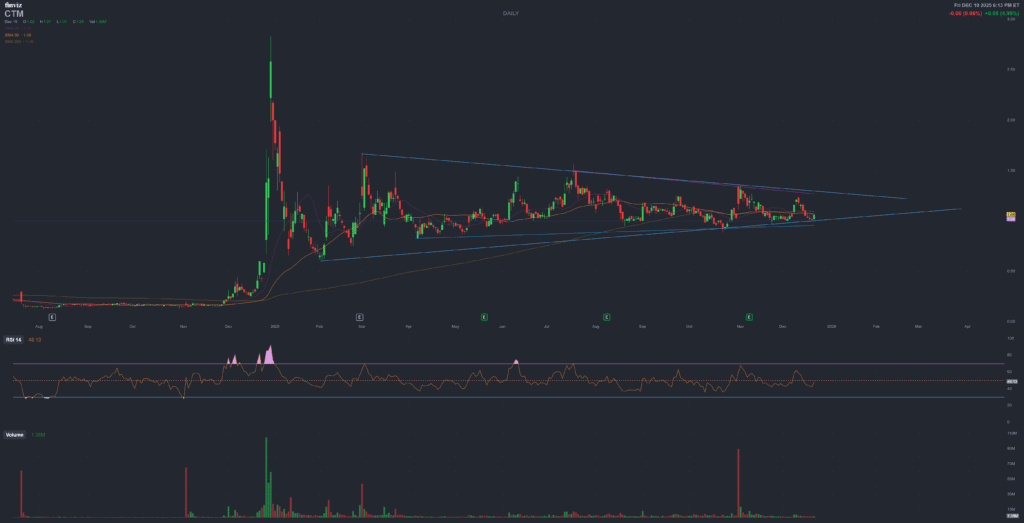
For a small-cap stock priced around one dollar, that combination of new work, cleaner balance sheet and visible pipeline is what has drawn in many retail traders at these levels – and also what can create very sharp moves if expectations and execution drift apart.
Executive summary
Castellum, Inc. (CTM) is a U.S.-based IT and cybersecurity services company focused on national security customers: Department of Defense, intelligence community, and related government agencies. The company provides cyber operations, electronic warfare and information warfare support, software and systems engineering, data analytics and program management for mission-critical programs.
2025 is the first real “pivot” year in the public numbers. After years of losses, Castellum reported its first-ever quarterly GAAP net income in Q3 2025: 14.6 million dollars of revenue, 5.5 million of gross profit, and roughly 0.4 million of net income, with non-GAAP adjusted EBITDA around 1.1 million. Cash at quarter-end was 17.8 million dollars, while total debt was cut to roughly 2.4 million and subsequently reduced further by a 2 million paydown on a key note, bringing long-term debt to zero and leaving only 400 thousand of short-term notes payable.
On the contract side, the company has moved from being a small roll-up to holding several meaningful prime positions. The flagship win is a 103.3 million, five-and-a-half-year NAVAIR Special Missions contract via its GTMR subsidiary. Added on top, a 66.2 million five-year NAWCAD Lakehurst logistics/engineering/cyber contract for SSI, and late-2025 awards under the Missile Defense Agency’s SHIELD IDIQ with multiple Castellum subsidiaries and mentor-protégé JVs as awardees. Backlog as discussed by analysts jumps from roughly 100 million at year-end 2024 to over 220 million by Q3 2025.
The equity story, however, is not a straight line. Castellum arrives at this “breakthrough” moment after a period of substantial net losses, heavy use of equity financing (ATM programs, warrants, preferred stock) and a complex capital structure. The 2024 10-K shows a 44.8 million dollar revenue base with a net loss of 10 million for the year and a cumulative deficit above 54 million, plus sizeable potential dilution from options, warrants and convertible preferreds.
For traders, CTM is therefore a classic two-sided setup. On one side: growing backlog, cleaner debt position, improving operating leverage and a management team with deep experience in defense IT. On the other side: customer concentration in U.S. government work, contract and budget risk, equity-heavy funding history, and a share count plus derivative overhang that can distort any upside move. This report does not try to call the direction; it simply lays out the data and the main moving parts so that anyone looking at the name knows what they actually own.
Quick data panel
Ticker / Exchange
CTM – NYSE American
Sector / Industry
Information Technology – Defense / Cybersecurity services
Business focus
Cybersecurity, electronic warfare, IT and software engineering, systems engineering, data analytics and
program support for U.S. government, defense and selected commercial customers.
Share price*
Around 1.0–1.1 USD (mid-December 2025, intraday), roughly half off the 52-week high near 2.8 USD.
Market cap*
Approximately 95–100 million USD.
Shares outstanding
About 94.6 million common shares as of 30 September 2025; float roughly 75 million shares, insiders about
22 percent.
Employees
Around 238 employees as of year-end 2024, mostly cleared engineers and analysts.
2024 revenue
44.8 million USD (slight decline versus 2023, primarily reflecting divestiture of a subsidiary).
Q3 2025 revenue
14.62 million USD (record quarter; up from 11.61 million in Q3 2024).
Q3 2025 net income
About 0.42 million USD GAAP net income, first profitable quarter; adjusted EBITDA around 1.08 million.
Cash (30 Sep 2025)
17.8 million USD.
Debt (post Nov 2025)
Term debt reduced to zero, with approximately 0.4 million USD of remaining notes payable.
Backlog
About 100.5 million USD total backlog at 31 Dec 2024; commentary from November 2025 points to roughly
221 million USD of backlog by Q3 2025, driven by new prime awards.
*Price and market cap figures are approximate and snapshot-based; they move intraday and may change materially.
National-security IT
Contract roll-up
First GAAP profit Q3 2025
High contract concentration
Equity-heavy funding
2025 timeline – contracts, balance sheet and inflection
- 28 February 2025GTMR subsidiary wins a 103.3 million dollar, five-and-a-half-year NAVAIR Special Missions contract for on-site services and engineering support.This becomes the largest contract in company history and anchors a long multi-year revenue stream.
- 28 February 2025 (same day)Castellum announces unaudited 2024 results: revenue around 44.8 million USD, net loss about 10 million, and ongoing debt-reduction efforts via refinancing and equity.2024 still loss-making, but the debt stack is simplified versus prior years.
- 8 May 2025Q1 2025 10-Q filed: continued revenue growth, but still net loss; details on restructuring of bank debt and notes payable.Sets the base for later debt paydown and positive operating leverage.
- 8 August 2025Q2 2025 results: record quarterly revenue, improving profitability, further debt reduction, and strong cash position; back-to-back organic growth versus 2024.Market starts to notice that top-line growth is real, not only M&A-driven.
- 12 August 2025Partnership with Quarrio to resell “trustworthy” AI/agentic analytics tools to government customers.Positions CTM as a reseller and integrator of specialized AI products rather than a pure services shop.
- 19 August 2025Reseller agreement with Tradewinds Networks (GuardTower AI cybersecurity products), via Advanced Technology Products subsidiary.Extends CTM’s cyber-portfolio towards hardware-assisted threat simulation and defence.
- 14 August 2025Announcement of warrant exercises generating about 4.5 million USD of cash, but increasing share count.Strengthens balance sheet in the near term while adding equity dilution over time.
- 14 October 2025SSI subsidiary adds IT services under SIN 54151S to its GSA Multiple Award Schedule contract, enabling broader competition for federal IT work and onboarding of a mentor-protégé JV.Expands addressable pipeline under a key federal contracting vehicle.
- 31 October 2025SSI wins a 66.2 million dollar, five-year full-and-open prime contract with NAWCAD Lakehurst for logistics, engineering and cyber support.First full-and-open prime (non small-business set-aside) and second-largest award in company history.
- 7 November 2025Q3 2025 “breakthrough” results: revenue 14.6 million USD, first GAAP net profit, adjusted EBITDA ~1.1 million, cash 17.8 million, total debt down to 2.4 million.First clear proof in the numbers that the business model can generate positive earnings and free cash flow on a quarterly basis.
- 13 November 2025Company announces a 2 million dollar paydown on a note payable, effectively reducing long-term debt to zero and leaving 400 thousand dollars of notes payable outstanding.This de-risks the balance sheet but uses part of the newly built cash buffer.
- 8 December 2025Castellum announces multiple awards under the Missile Defense Agency SHIELD IDIQ to SSI and several mentor-protégé joint ventures.Not revenue immediately, but opens access to multi-year programs in missile defense and open-architecture systems with AI/ML components.
- 9 December 2025CEO Glen Ives issues a shareholder update letter summarizing 2025 progress, backlog above 220 million dollars, debt reduction, and priorities for 2026.Key message: management aims to keep growing on full-and-open prime contracts with a strong focus on cash flow, not just quarterly earnings.
Sentiment snapshot – traders, forums and short interest
Analyst bias: generally positive, small coverage
Backlog and contracts: seen as bullish by many retail traders
Dilution and micro-cap risk: main bear points
Retail: high conviction pockets + skeptics
Analysts. Few firms formally cover CTM, but where coverage exists, ratings tend toward Buy with price targets several times above the current share price. The bullish angle emphasizes three pillars: accelerating contract wins, expanding backlog, and visible operating leverage as scale increases. More cautious notes flag the equity-heavy funding model, micro-cap liquidity, and dependence on U.S. defense budgets.
Reddit. On r/pennystocks, r/Shortsqueeze and small Castellum-focused threads, CTM appears regularly as a “contract plus turnaround” idea. Bulls underline the 103.3 million NAVAIR contract, the 66.2 million NAWCAD award, Q3’s first GAAP profit and steep debt reduction. Bears reply with questions about how quickly backlog will translate into margin-rich revenue, whether the share count will keep expanding, and how sustainable the new profitability really is.
Stocktwits and X. On Stocktwits the ticker has thousands of watchers: short-term sentiment swings violently around each press release, with gap-ups on contract wins and earnings, followed by pullbacks as traders take profits or worry about future dilution. On X, the tone ranges from “undervalued micro defense prime” to warnings that backlog alone does not guarantee long-term returns without tight cost control and disciplined capital allocation.
All of this is comment-stream noise, not official guidance. It is useful to understand positioning and psychology, not as a replacement for the primary documents.
Business model and contract engine
What Castellum actually does
Castellum positions itself as a national-security technology services company. Its subsidiaries deliver cybersecurity operations, software and systems engineering, electronic and information warfare support, modeling and simulation, and data analytics. Most of this work is done for the U.S. Department of Defense and related federal agencies; some extends to state/local government and selected commercial clients such as financial and healthcare organizations.
The 10-K and 10-Q describe contracts across:
- Navy and Marine Corps systems engineering, including aircraft-launch and recovery systems software on aircraft carriers.
- Army cyber and electronic warfare support at the staff level, including mission planning and threat analysis.
- C4ISR sensor integration, prototyping and test for NAVSEA and other defense customers.
- Cybersecurity, information assurance and model-based systems engineering work via GTMR, SSI and other acquired entities.
Contract types span firm fixed price, cost-plus and time-and-materials; the mix in 2024 is skewed to T&M, which accounted for more than half of revenue, giving some protection on margins but also tying profitability to utilization and labour cost management.
Prime awards, JVs and backlog build
2025 is where the strategy of building scale through acquisitions and then bidding for larger work starts to show up in numbers:
- GTMR’s 103.3 million NAVAIR Special Missions contract, five and a half years, for on-site special missions management and engineering support.
- SSI’s 66.2 million NAWCAD Lakehurst Mission Operations & Integration prime award, five-year contract for logistics, engineering and cyber services across shipboard systems.
- Multiple awards under the Missile Defense Agency’s SHIELD IDIQ to SSI and mentor-protégé joint ventures, positioning Castellum for AI/ML-enabled missile-defense programs across domains.
Reported backlog at the end of 2024 totals about 100.5 million dollars (funded, unfunded and priced options), of which roughly half is expected to convert to revenue within 24 months. Later analyst work around Q3 2025 references backlog levels slightly above 220 million dollars, implying that big chunks of the NAVAIR and NAWCAD work are now in the book.
For a micro-cap with a market value under 100 million dollars, that order book is significant, but it is not risk-free: most contracts are annual with options, many can be terminated for convenience, and funding depends on U.S. federal budget cycles and program priorities.
Financials – from loss-making roll-up to first profit
From 2023–2024 losses to Q3 2025 profit
| Metric | 2024 (FY) |
|---|---|
| Revenue | 44.8 million USD (–1.1% vs 2023) |
| Gross profit | 18.3 million USD (41% gross margin) |
| Operating loss | 7.2 million USD loss (better than 16.7 million loss in 2023) |
| Net loss | 10.0 million USD (improvement from 17.8 million loss in 2023) |
| Accumulated deficit | 54.1 million USD at 31 December 2024 |
The big 2023 hit includes a 6.9 million dollar goodwill impairment and high non-cash interest and derivative revaluation charges. In 2024, those items reduce materially but the business is still loss-making overall, even as gross margin remains healthy for a services company.
Q3 2025 snapshot
| Metric | Q3 2025 |
|---|---|
| Revenue | 14.62 million USD (vs 11.61 million in Q3 2024) |
| Gross profit | 5.49 million USD |
| Operating income | 0.45 million USD (vs 1.38 million loss a year before) |
| Net income | 0.42 million USD (vs 1.28 million loss) |
| Adjusted EBITDA | ~1.08 million USD |
| Cash at quarter-end | 17.82 million USD |
| Total debt | 2.4 million USD (later reduced further) |
This is the inflection quarter: organic revenue growth, positive operating income, positive net income and positive adjusted EBITDA, with cash building and debt shrinking. The open question is whether this is a stable new level or a one-off spike helped by specific projects and cost actions.
Capital structure and dilution risk
Castellum’s capital structure is the part that many traders underestimate at first glance. After the 2022 uplisting to NYSE American and subsequent acquisitions, the company has financed itself via a mix of bank debt and repeated equity offerings, including pre-funded and regular warrants and multiple shelf-takedowns.
| Item | Key points |
|---|---|
| Common shares | 94.6 million common shares outstanding as of 30 September 2025, up from about 77.1 million at the end of 2024, reflecting ATM usage and warrant exercises. |
| Preferred stock | Series A and Series C preferred outstanding, with the potential to convert into common shares; they also carry dividend obligations. |
| Potential dilutive instruments | As of March 2025, management discloses a maximum potential dilution of roughly 15.9 million shares from options, warrants and convertible preferreds. |
| Debt clean-up | Through 2024 and 2025 the company repaid or refinanced several notes, including Live Oak Bank facilities and promissory notes; by November 2025 long-term debt is essentially gone, leaving about 0.4 million of short-term notes payable. |
In other words, the balance sheet looks better on the “risk of default” axis but still carries a heavy equity component. Any new growth or acquisition push is likely to involve further share issuance, unless the company can scale free cash flow quickly off the new backlog.
Management profile – who is steering CTM
Glen R. Ives – Chief Executive Officer
Glen Ives, a retired U.S. Navy Captain (USN, Ret.), took over as CEO in mid-2024 after previously serving as Chief Operating Officer. His public commentary and the 2024 10-K emphasize a focus on disciplined acquisition-driven growth, building a national-security IT platform with recurring revenue from long-term contracts and multi-agency exposure.
Under his watch, 2025 has seen the first GAAP profitable quarter, record cash, major prime contract wins and substantial debt reduction. At the same time, shareholder letters and risk-factor sections make it clear that the company still views itself as early stage, with significant execution risk and dependence on winning and delivering complex government work.
Finance and strategy bench
The finance side is led by CFO David T. Bell, who joined in 2022 with a background in accounting and finance roles across multiple companies, and has overseen the clean-up of the debt stack and the push to positive quarterly earnings. Strategy and legal are coordinated by EVP Jay O. Wright and other executives with long experience in federal contracting, mergers and acquisitions, and national-security programs.
Headcount is relatively small – about 238 employees – but heavily skewed toward cleared engineers and technical specialists. That concentration of talent is both an asset (sticky client relationships, specialized know-how) and a risk (recruitment and retention in a tight cyber labor market).
Retail chatter and sentiment – how CTM is framed online
On Reddit and other forums, CTM is often framed as “a 100 million dollar micro-cap with 200+ million of backlog and first profit, trading near one dollar.” That meme has obvious appeal – but the way people fill in the details varies widely.
Optimistic framing
Bulls highlight:
- The 103.3 million NAVAIR contract as transformative relative to market cap, with posts calling it “bigger than the whole company.”
- The 66.2 million NAWCAD award and the SHIELD IDIQ as confirmation that Castellum can win full-and-open competitions, not just small-business set-asides.
- Q3 2025 as a proof point that the business can generate positive GAAP earnings and free cash flow, with leverage to scale further as more backlog converts into revenue.
- Substantial insider ownership and active communication from management as signs of alignment with shareholders.
More cautious / bearish framing
Skeptical voices focus on:
- The long history of net losses and equity financing, questioning whether one profitable quarter is enough to declare a durable turnaround.
- The complex and dilutive capital structure (options, warrants, preferred stock) and the possibility of further issuance as the company pursues growth and acquisitions.
- Government contract risk: heavy dependence on U.S. defense budgets, potential delays or cuts under continuing resolutions, and the ability of agencies to terminate contracts for convenience.
- Micro-cap liquidity and volatility: on some days, relatively small order flow can move the price by double digits in either direction.
None of these narratives is “right” by default; they are simply the lenses through which different traders are reading the same filings. The value of a deep-dive like this is to anchor the discussion on actual numbers and contract details rather than slogans.
Bull vs bear – scenario thinking, not a call
Bull case – backlog turns into a scalable platform
- CTM converts a large portion of its 220+ million dollar backlog into revenue over the next three to four years, maintaining or improving gross margins.
- New contract wins under NAVAIR, NAWCAD, SHIELD and other vehicles sustain a visible multi-year pipeline.
- The company keeps operating discipline, turning several quarters of adjusted EBITDA into a pattern of consistently positive cash flow and, eventually, full-year GAAP profitability.
- Debt remains minimal, and any further equity issuance occurs at higher share prices, moderating the impact of dilution.
- Strategic acquisitions are bolt-on and accretive rather than large, risky bets, adding capabilities in AI/ML, cyber and systems engineering around the existing base.
In this world, CTM slowly re-rates from “micro-cap with a story” to “small but credible national-security IT platform”, and the stock price has upside leverage to revenue scale, operating margin and any multiple expansion the market is willing to pay for a cleaner, de-risked profile.
Bear case – backlog and profit prove fragile
- One or more key contracts face delays, reductions or non-renewal, either for budget reasons or due to competition, eroding the revenue base before new wins fill the gap.
- The 2025 margin improvement proves hard to replicate as wage inflation, bid pressure and utilisation swings eat into gross profit.
- Management continues to rely on equity issuance to fund operations and acquisitions, expanding share count and diluting existing holders faster than earnings grow.
- Government budget stress (continuing resolutions, sequestration, changing priorities) leads to slower funding or pauses on programs in CTM’s portfolio.
- Micro-cap volatility plus any negative headlines (for example, contract protests, cyber incidents or accounting issues) drive sharp downside moves, making it harder to raise capital on acceptable terms.
In this world, CTM risks becoming another small government IT roll-up that never quite grows into its capital structure: revenue zig-zags, profit disappears again, and dilution plus risk premium weigh heavily on the share price.
These are frameworks, not predictions. The actual path will depend on contract execution, budget dynamics, hiring, pricing, and capital allocation decisions that cannot be known in advance.
Risk map – key areas to watch
Contract / customer concentration
Heavily exposed to U.S. government
Most revenue comes from U.S. federal defense and security customers. Contracts can be terminated for convenience, delayed, or reduced due to budget decisions and appropriations cycles. A handful of large primes and major contracts drive a big slice of revenue.
Financing & dilution
Equity-funded growth with complex overhang
CTM’s history includes repeated equity raises, pre-funded and regular warrants, and convertible preferreds. Potential dilution from existing instruments is material. Future acquisitions or growth pushes may again lean on equity markets if free cash flow is not enough.
Execution
Integrating acquisitions and scaling delivery
Castellum is the result of multiple acquisitions since 2019. Integrating cultures, systems and contracts, while bidding for larger and more complex work, adds operational risk. Slippage on utilisation, hiring or program management can quickly erode margins.
Macro / budget / politics
Defense budgets and debt ceiling games
The 10-K devotes substantial space to the risk of continuing resolutions, debt ceiling debates and shifting defense priorities. Prolonged budget gridlock or a shift away from CTM’s core mission areas could slow task-order awards and payments, hitting both revenue and cash timing.
Sources and further reading
This report relies primarily on SEC filings, official press releases and reputable data providers. For more detail, the most relevant documents include:
- Castellum, Inc. Form 10-K for the year ended 31 December 2024 (business overview, financials, risk factors).
- Castellum, Inc. Form 10-Q for the quarter ended 30 September 2025 (Q3 financials and balance sheet).
- Press releases: 2024 unaudited results; 103.3 million NAVAIR contract; Q2 and Q3 2025 results; 2 million debt paydown; MDA SHIELD IDIQ awards; CEO shareholder letters of July and December 2025.
- Investor-relations summary pages and contract/backlog commentary from Castellum’s own website and IR materials.
- Data and profiles from sites such as StockAnalysis, StockTitan, Nasdaq, ChartMill and Yahoo Finance for share count, employee numbers, market cap and analyst estimates.
- Reddit threads (r/pennystocks, r/Shortsqueeze, other CTM-focused subs), Stocktwits CTM feed and X/Twitter search for qualitative sentiment and positioning.
News del giorno – Lettera del CEO e contratti difesa (dicembre 2025)
Update / ContrattiA inizio dicembre 2025 il CEO Glen Ives ha pubblicato una lettera agli azionisti che riassume un anno di svolta: ricavi record nel Q3, primo utile GAAP della storia di Castellum, riduzione importante del debito e backlog più che raddoppiata in dodici mesi. Nella stessa comunicazione e nei comunicati correlati vengono richiamati tre pilastri: il contratto NAVAIR da 103,3 milioni tramite GTMR, il contratto NAWCAD Lakehurst da 66,2 milioni per la controllata SSI e i nuovi award sotto l’IDIQ SHIELD della Missile Defense Agency.
Per un titolo intorno a un dollaro, questo mix di ordini multi-anno, bilancio più pulito e pipeline visibile è esattamente ciò che attira molti trader retail su questi livelli – ma è anche la base per movimenti violenti se le aspettative non restano allineate con l’esecuzione reale.
Executive summary (IT)
Castellum, Inc. (CTM) è una società di servizi IT e cybersecurity con focus sui clienti di sicurezza nazionale: Dipartimento della Difesa, comunità intelligence e agenzie federali collegate. Offre cyber operations, supporto a guerra elettronica e information warfare, ingegneria software e di sistemi, data analytics e program management su programmi mission-critical.
Il 2025 è il primo vero anno di svolta nel conto economico. Dopo anni di perdite, nel Q3 2025 Castellum dichiara il primo utile netto GAAP: 14,6 milioni di ricavi, 5,5 milioni di gross profit e circa 0,4 milioni di utile netto, con un adjusted EBITDA intorno a 1,1 milioni. La cassa di fine trimestre è 17,8 milioni, il debito totale scende a circa 2,4 milioni e viene ulteriormente ridotto a novembre con il rimborso di una nota da 2 milioni, lasciando solo 400 mila dollari di notes payable.
Lato contratti, l’azienda passa da “piccolo roll-up” a player con prime contract significativi. Il pezzo forte è un contratto NAVAIR Special Missions da 103,3 milioni su cinque anni e mezzo via GTMR. Si aggiungono un contratto NAWCAD Lakehurst da 66,2 milioni su cinque anni per SSI e, a fine 2025, gli award SHIELD della Missile Defense Agency a SSI e varie joint venture mentor-protégé. La backlog totale viene descritta in area 220+ milioni a Q3 2025, contro i ~100 milioni a fine 2024.
La storia azionaria però non è lineare. Il 10-K 2024 mostra 44,8 milioni di ricavi e una perdita netta di 10 milioni, con deficit cumulato oltre 54 milioni e forte potenziale di diluizione da opzioni, warrant e preferred convertibili. Il modello resta fortemente dipendente da contratti pubblici, appalti competitivi e budget federali.
Per un trader orientato ai catalyst, CTM è quindi una struttura a due facce. Da un lato: backlog in crescita, debito quasi azzerato, margini in miglioramento e management esperto in difesa IT. Dall’altro: concentrazione di clienti, rischio budget/governo, storia di forte uso dell’equity e overhang diluitivo. Qui non c’è una “call” su buy/sell; c’è una mappa dati per capire che cosa c’è davvero dietro al ticker, al netto del rumore di mercato.
Quick data panel (IT)
Ticker / Exchange
CTM – NYSE American
Settore / Industria
IT e servizi – cybersecurity e difesa
Focus di business
Cybersecurity, guerra elettronica, IT e software engineering, systems engineering, data analytics e
program support per clienti governativi USA (difesa, intelligence) e alcuni clienti privati.
Prezzo azione*
Intorno a 1,0–1,1 USD (metà dicembre 2025), circa metà del massimo a 52 settimane (2,8 USD).
Market cap*
Circa 95–100 milioni USD.
Azioni in circolazione
94,6 milioni di azioni ordinarie al 30 settembre 2025; float circa 75 milioni, con ~22% in mano agli
insider.
Dipendenti
Circa 238 dipendenti a fine 2024, in larga parte profili tecnici con security clearance.
Ricavi 2024
44,8 milioni USD (–1,1% vs 2023), ancora con perdita netta significativa.
Ricavi Q3 2025
14,62 milioni USD (vs 11,61 milioni nel Q3 2024), terzo trimestre consecutivo di crescita organica yoy.
Utile netto Q3 2025
Circa 0,42 milioni USD di utile netto GAAP, primo trimestre in utile; adjusted EBITDA ~1,08 milioni.
Cassa (30 sett. 2025)
17,8 milioni USD.
Debito (post nov. 2025)
Debito a lungo termine azzerato, residuo di circa 0,4 milioni USD di note a breve.
Backlog
Circa 100,5 milioni USD a fine 2024; oltre 220 milioni USD intorno al Q3 2025, trainati dai contratti
NAVAIR, NAWCAD e da SHIELD.
*Valori indicativi, presi come fotografia di periodo; possono cambiare in modo significativo nel tempo.
Difesa / cyber
Micro-cap contratti gov
Prima trimestrale in utile
Backlog in crescita
Rischio equity/diluizione
Timeline 2025 – contratti, numeri e turning point
- 28 febbraio 2025GTMR (controllata) si aggiudica un contratto NAVAIR Special Missions da 103,3 milioni USD su cinque anni e mezzo per servizi on-site e supporto ingegneristico.È il più grande contratto mai ottenuto dalla società, e di fatto raddoppia la visibilità sul fatturato multi-anno.
- Febbraio 2025 (stessa data)Pubblicazione dei risultati 2024 non certificati: ricavi ~44,8 milioni USD, perdita netta ~10 milioni, ma con struttura del debito più pulita rispetto agli anni precedenti.L’anno è ancora in rosso, ma la base di partenza per il 2025 è meno carica di interessi e note complesse.
- 8 agosto 2025Q2 2025: ricavi trimestrali record, profittabilità in miglioramento, cassa in aumento e ulteriore riduzione del debito.Secondo trimestre consecutivo di crescita yoy; il mercato inizia a vedere un pattern, non solo one-off.
- 19 agosto 2025Reseller agreement con Tradewinds Networks per i prodotti GuardTower AI, via la controllata Advanced Technology Products.Castellum si posiziona anche come canale per soluzioni AI di terzi, oltre ai propri servizi.
- 14 agosto 2025Esercizio di 3,67 milioni di warrant a 1,22 USD per azione: entrano circa 4,5 milioni di dollari lordi, ma aumenta il numero di azioni.Bilancio più forte, ma inevitabile diluizione per chi era già dentro.
- 14 ottobre 2025SSI aggiunge il SIN 54151S (IT professional services) alla propria GSA MAS: può competere su più RFQ/RFP IT e portare dentro la joint venture mentor-protégé.Espansione del funnel di contratti IT a livello federale.
- 31 ottobre 2025SSI si aggiudica un prime contract full-and-open da 66,2 milioni USD su cinque anni con NAWCAD Lakehurst per supporto logistico, ingegneristico e cyber.Primo award full-and-open senza limiti “small business” e seconda commessa più grande di sempre.
- 7 novembre 2025Q3 2025: ricavi 14,6 milioni, utile operativo 0,45 milioni, utile netto GAAP 0,42 milioni, adjusted EBITDA ~1,08 milioni, cassa 17,8 milioni, debito totale 2,4 milioni.Primo trimestre in utile: segnala che la leva operativa sta iniziando a funzionare.
- 13 novembre 2025Annunciato il rimborso di una nota da 2 milioni USD, con debito a lungo termine azzerato e solo 400 mila USD di note a breve residue.De-risk del bilancio lato leverage, a costo di usare parte della liquidità.
- 8 dicembre 2025Annunciati i contratti SHIELD IDIQ della Missile Defense Agency a favore di SSI e di più joint venture mentor-protégé.Non è fatturato immediato, ma apre accesso a programmi multi-anno su difesa missilistica e architetture aperte con AI/ML.
- 9 dicembre 2025Lettera del CEO agli azionisti: backlog sopra 220 milioni, debito ridotto, focus 2026 su crescita organica, prime contract full-and-open e disciplina su cash flow.Il messaggio è chiaro: l’obiettivo è crescere, ma controllando cassa e rischi, non solo il conto economico trimestrale.
Sentiment snapshot – come viene letta CTM
Analisti: pochi ma generalmente positivi
Backlog forte visto come driver da molti retail
Diluizione e micro-cap: principali paure
Retail: narrative opposte
Analisti. Dove c’è copertura, il titolo è spesso in area Buy, con target multipli rispetto al prezzo attuale. Gli argomenti bullish sono backlog in crescita, contratti sempre più grandi e margini in miglioramento. I più cauti sottolineano però che il modello resta equity-intensive e molto esposto alle decisioni di spesa del governo USA.
Reddit. Su r/pennystocks, r/Shortsqueeze e simili CTM appare spesso come idea “contract-heavy turnaround”. I post positivi mettono in evidenza NAVAIR, NAWCAD, il primo utile GAAP e la riduzione del debito; quelli scettici ricordano la storia di perdite e il rischio che la backlog non si trasformi in margini solidi.
Stocktwits / X. Su Stocktwits e X il titolo si muove a colpi di news: gap up su contratti e trimestrali, gap down quando torna il tema diluizione o il focus si sposta sul fatto che è pur sempre una micro-cap con flottante ampio. Molti commenti ripetono il concetto “backlog non è cash”: finché non si vede la conversione in free cash flow, il rischio resta alto.
Business e motore contratti
Cosa fa davvero Castellum
Castellum si definisce una società di tecnologia per la sicurezza nazionale. Le controllate forniscono servizi di cybersecurity operativa, ingegneria software e di sistemi, supporto a guerra elettronica e information warfare, modellazione/simulazione e data analytics. I principali clienti sono il Dipartimento della Difesa USA, comandi connessi e agenzie federali; una parte più piccola riguarda clienti finanziari, sanitari e altri utenti “heavy data”.
I contratti coprono:
- Ingegneria sistemi per Marina e Marines, inclusi sistemi di lancio/recupero aerei sulle portaerei.
- Supporto cyber ed EW a livello Army staff, con pianificazione missioni e analisi delle minacce.
- Integrazione C4ISR, prototipazione e test per NAVSEA e altri clienti difesa.
- Cybersecurity, information assurance e MBSE per programmi federali e commerciali tramite GTMR, SSI e altre entità acquisite.
Il mix di contratti include FFP, CPFF e T&M; quest’ultimo è più della metà dei ricavi 2024, il che aiuta a proteggere i margini ma rende cruciale la gestione dell’utilizzo e dei costi del personale.
Awards prime, joint venture e backlog
Il 2025 è il primo anno in cui la strategia di acquisizioni e crescita per linee esterne si traduce chiaramente in grandi contratti:
- Contratto NAVAIR Special Missions da 103,3 milioni USD via GTMR.
- Contratto NAWCAD Lakehurst da 66,2 milioni USD su cinque anni per SSI.
- Award multipli all’interno dell’IDIQ SHIELD della Missile Defense Agency a SSI e alle JV mentor-protégé.
La backlog a fine 2024 è di circa 100,5 milioni USD (funded + unfunded + option), con una quota consistente prevista in esecuzione entro 24 mesi. Le analisi successive al Q3 2025 parlano di backlog complessiva poco sopra i 220 milioni, segno che buona parte dei nuovi contratti è ormai entrata nel portafoglio lavori.
Per una società da meno di 100 milioni di market cap è numericamente importante, ma resta esposta ai classici rischi dei contractor federali: rinnovi annuali, opzioni esercitabili a discrezione delle agenzie, possibilità di terminazione per convenience e dipendenza dai cicli di budget di Congresso e amministrazione.
Financials – da roll-up in perdita a primo trimestre in utile
Dal 2023–2024 in rosso al Q3 2025
| Voce | FY 2024 |
|---|---|
| Ricavi | 44,8 milioni USD (–1,1% vs 2023) |
| Gross profit | 18,3 milioni USD (margine lordo ~41%) |
| Perdita operativa | 7,2 milioni USD |
| Perdita netta | 10,0 milioni USD (vs 17,8 milioni nel 2023) |
| Deficit cumulato | 54,1 milioni USD al 31 dicembre 2024 |
Il 2023 incorpora 6,9 milioni di impairment sul goodwill e forti componenti non cash su interessi e derivati; il 2024 migliora, ma resta in perdita. Il 2025 è il primo anno in cui un trimestre mostra un mix decente di crescita, margine e utile.
Snapshot Q3 2025
| Voce | Q3 2025 |
|---|---|
| Ricavi | 14,62 milioni USD (vs 11,61 milioni Q3 2024) |
| Gross profit | 5,49 milioni USD |
| Utile operativo | 0,45 milioni USD |
| Utile netto | 0,42 milioni USD |
| Adjusted EBITDA | Circa 1,08 milioni USD |
| Cassa | 17,8 milioni USD a fine trimestre |
| Debito totale | 2,4 milioni USD, poi ulteriormente ridotto |
Questo trimestre è il primo segnale di sostenibilità: crescita organica, margini buoni per un pure services, utile netto sopra lo zero e bilancio molto più leggero lato debito. Resta da capire quanto sia replicabile nel 2026 se il ritmo di contratti e funding non rallenta.
Struttura del capitale e rischio di diluizione
La parte più delicata per chi guarda CTM solo come “contratto da 100 milioni / titolo da 1 dollaro” è il capitale. Dopo l’uplisting al NYSE American nel 2022 e varie acquisizioni, la società ha fatto largo uso di debt bancario e soprattutto di equity, con shelf S-3, warrant, preferred convertibili e ATM.
| Voce | Punti chiave |
|---|---|
| Azioni ordinarie | 94,6 milioni al 30/09/2025, rispetto a circa 77,1 milioni a fine 2024; la crescita viene da ATM, esercizio warrant e offerte registrate. |
| Preferred | Serie A e Serie C in circolazione, convertibili in azioni ordinarie e con pagamento di dividendi in contanti. |
| Strumenti diluitivi | A marzo 2025 la società indica un potenziale massimo di circa 15,9 milioni di azioni da conversione di preferred, opzioni e warrant. |
| Debito | Nel 2024 viene ripulita buona parte della struttura debito (note Live Oak, Crom, ecc.); a novembre 2025, dopo un paydown di 2 milioni, restano solo 400 mila USD di note payables. |
Quindi: dal punto di vista del rischio default il quadro è migliorato molto; dal punto di vista di chi possiede azioni ordinarie, il punto di attenzione è quanto ancora verrà usato l’equity come leva di crescita nei prossimi anni.
Management – chi guida CTM
Glen R. Ives – CEO
Glen Ives, ex capitano della U.S. Navy (USN, Ret.), è oggi il volto di Castellum per il mercato. Prima COO, è diventato CEO nel 2024. La sua narrativa pubblica è centrata su tre linee: crescita tramite acquisizioni mirate, espansione su prime contract full-and-open e gestione prudente del capitale (meno leva, più cassa).
Il 2025, con il primo trimestre in utile, il debito ripulito e backlog in forte crescita, è coerente con questo racconto; resta da vedere se la traiettoria continua nel 2026 con la stessa disciplina.
CFO e team
Il CFO David T. Bell arriva nel 2022 con background da CPA e ruoli di finanza in più realtà; è lui che si occupa della ristrutturazione del debito e della pulizia degli schemi contabili, con l’obiettivo dichiarato di arrivare a free cash flow positivo. Attorno alla coppia Ives–Bell c’è un team di EVP e general counsel con esperienza pesante in contratti federali, M&A e programmi di sicurezza nazionale.
La struttura è relativamente compatta (238 dipendenti) ma altamente specializzata; questo supporta la capability, ma rende cruciale la retention di persone chiave in un mercato del lavoro molto competitivo lato cyber e defense tech.
Sentiment retail – narrativa long vs narrativa short
Nei forum il titolo viene spesso riassunto così: “micro-cap da 100 milioni con 220+ milioni di backlog e primo trimestre in utile, a un dollaro a share”. Da qui le due narrative che vedi più spesso.
Lato ottimista
Argomenti tipici dei post bullish:
- NAVAIR 103,3 milioni e NAWCAD 66,2 milioni come contratti “trasformativi” rispetto alla capitalizzazione.
- SHIELD come piattaforma di ulteriori task order in un’area (difesa missilistica) considerata strategica nei prossimi anni.
- Miglioramento visibile dei numeri nel 2025 (utile GAAP, cash in crescita, debito in calo).
Lato prudente / scettico
Punti ricorrenti dei post più cauti:
- Anni di perdite e forte uso di equity prima del primo trimestre in utile; il turnaround non è ancora “dimostrato” su base annuale.
- Struttura del capitale complessa, con parecchi warrant e preferred potenzialmente convertibili, più il rischio che, se il prezzo risale, vengano fatte nuove emissioni.
- Dipendenza quasi totale dal budget federale USA, con il rischio di CR prolungate, sequestration e cambi di priorità politiche.
- Volatilità tipica da micro-cap: spread, poca liquidità, movimenti giornalieri a due cifre in entrambe le direzioni.
Bull vs bear – usare gli scenari, non innamorarsi
Bull case – backlog che diventa piattaforma
- La maggior parte dei 220+ milioni di backlog si trasforma in ricavi nei prossimi 3–4 anni.
- Altri award (NAVAIR, NAWCAD, SHIELD, nuovi IDIQ) mantengono il portafoglio carico di opportunità.
- Margini e cash flow continuano a migliorare e la società riesce a finanziare crescita e M&A con mix equilibrato tra cassa ed equity.
- Il mercato inizia a prezzare CTM più come piattaforma stabile di difesa IT che come “penny stock speculative”.
Bear case – backlog fragile, equity pesante
- Alcuni contratti chiave vengono ridotti/non rinnovati, rallentando ricavi e margini proprio mentre i costi fissi crescono.
- Il 2025 positivo non si replica: qualche trimestre torna in perdita e la narrativa “turnaround” si sgonfia.
- Nuove emissioni di equity e exercise di warrant diluiscono ulteriormente gli azionisti storici.
- Budget federale teso, possibili CR lunghe e tensioni sul debito USA rallentano gli ordini e i pagamenti.
Nessuno dei due estremi è garantito; il punto è avere chiari i driver e farsi i conti, non lavorare solo per slogan.
Mappa dei rischi
Concentrazione clienti
Dipendenza dal governo USA
Quasi tutti i ricavi arrivano da contratti con agenzie federali e difesa; contratti terminabili per convenience, soggetti a budget, CR e cambi di priorità politiche.
Diluizione / equity
Struttura di funding pesante sull’azionario
Forte uso di ATM, warrant e preferred; potenziale diluizione da strumenti esistenti e possibili future emissioni se la società vuole accelerare crescita e M&A.
Execution
Integrare acquisizioni e consegnare sui contratti
Molte delle capabilities attuali arrivano da acquisizioni; integrare tutto e allo stesso tempo eseguire su contratti più grandi è complesso. Errori su costi, staffing o delivery possono erodere rapidamente la marginalità.
Macro / politica
Budget difesa e giochi sul debito
Il rischio di CR prolungate, sequestration o cambi di focus (più budget su altri strumenti o teatri) è esplicitamente indicato nei filing. Non è un rischio teorico, ma una variabile da mettere nel modello.
Fonti e materiali utili
Per chi vuole andare a fondo, le fonti chiave sono:
- Form 10-K 2024 di Castellum, Inc. – business, financials, backlog e risk factors.
- Form 10-Q Q3 2025 – bilancio, conto economico e note su cassa/debito.
- Comunicati ufficiali su contratti NAVAIR, NAWCAD e SHIELD, nonché su Q2/Q3 2025 e riduzione debito.
- Lettere agli azionisti 2025 (luglio e dicembre) per il framing strategico del management.
- Pagine dati (StockAnalysis, StockTitan, ChartMill, Yahoo Finance, ecc.) per numero dipendenti, stime e multipli.
- Thread Reddit, feed Stocktwits e timeline X per mappare le narrative retail intorno al ticker CTM.
Biotech Catalyst Calendar / Calendario Catalyst Biotech
EN – If you also trade biotech names around FDA events and clinical readouts, you can find an updated overview of upcoming PDUFA dates, trial data and major catalysts here: Biotech Catalyst Calendar .
IT – Se oltre a CTM segui titoli biotech legati a PDUFA e letture dati, trovi una panoramica aggiornata delle prossime date chiave qui: Calendario Catalyst Biotech .