DISCLAIMER — Not financial advice. Educational content only, not an offer or solicitation to buy or sell any security. Biotech and small/mid-cap stocks are highly speculative and volatile and can result in a partial or total loss of capital. Do your own research and consult a licensed advisor where appropriate. / Contenuti a solo scopo informativo e didattico, non costituiscono consulenza finanziaria né offerta o sollecitazione al pubblico risparmio ai sensi delle normative CONSOB e SEC. Le azioni biotech e le small/mid cap sono strumenti altamente speculativi e volatili e possono comportare la perdita parziale o totale del capitale investito. Si raccomanda di effettuare sempre le proprie ricerche e, se necessario, di rivolgersi a un consulente abilitato.

Merlintrader Trading Pub
Biotech catalyst news and analysis. FDA PDUFA tracker
Merlintrader Trading Pub
Biotech catalyst news and analysis. FDA PDUFA tracker
Category Space
Amazon ($AMZN), Globalstar ($GSAT), and AST SpaceMobile ($ASTS): why Amazon’s Globalstar deal matters far beyond one takeover
Amazon’s move on Globalstar is not just another satellite headline. It is a deeper attempt to own spectrum, device-level connectivity, Apple continuity, and a bigger slice of the space economy at the same time. That has immediate implications for Globalstar, material strategic implications for Amazon, and a more complicated read-through for AST SpaceMobile.
Sidus Space ( $SIDU ): Lonestar StarVault Expansion, FY2025 Deep Dive & the LS-4 Test

Lonestar just expanded its StarVault relationship with Sidus, but the real question is not whether the story sounds exciting. The real question is whether Sidus can convert contracts, hosted payload wins and defense positioning into revenue before burn and dilution overwhelm the setup.
Momentus ( $MNTS ) Deep Dive 2026 UPDATED APRIL15
Momentus is still one of the most binary small-cap space stories on the board, but after the last two weeks it is harder to dismiss the company as a pure concept trade. The central reason is not a promotional headline. It is sequence. For a company like MNTS, sequence is everything.
Voyager Technologies (NYSE: VOYG) — April 2026 deep dive

Voyager Technologies is one of the more interesting space-defense names because it is not a clean, single-theme stock. It is not just a commercial space dream. It is not just a defense contractor. It is not just a speculative “future station” vehicle either. It is a hybrid company where a real operating business in defense and mission services sits next to a very large long-duration bet on the future commercial low-Earth-orbit economy. That mix is what makes VOYG potentially powerful, but it is also exactly what makes it difficult to value.
From Artemis to the Battlefield: why $LUNR, $FLY, $SIDU, $PDYN and $BKSY no longer belong to separate stories
For years, the market framed companies like Intuitive Machines, Firefly, BlackSky, Palladyne AI or Sidus Space as disconnected speculative names orbiting around rockets, satellites or futuristic concepts. That framing is becoming outdated. In 2026, the more useful lens is strategic infrastructure. What matters now is who can move payloads, who can see first, who can process data faster, who can coordinate autonomous systems, and who can fit into the increasingly blurred boundary between civil space, defense tech, sovereign priorities and lunar logistics.
Redwire QKDSat – European Quantum Security and the Broader 2026 Narrative
Redwire’s 2 April 2026 QKDSat announcement matters less for immediate revenue math and more for what it says about the company’s position inside the next layer of European sovereign space infrastructure.
According to publicly reported company news on 2 April 2026, Redwire was awarded a contract connected to the European Space Agency’s Quantum Key Distribution Satellite (QKDSat) program. The mission is framed around a quantum-secure spacecraft and sits within the broader ESA ARTES ecosystem, which is designed to support advanced telecommunications and secure connectivity programs.
Artemis II — A Tribute to the Brave Who Walk Toward the Future

Apollo was one of the defining achievements of the twentieth century, but it also left behind a strange inheritance. It proved that human beings could leave Earth, navigate across cislunar space, land on another world, and come home. Then, after proving it, the United States stopped going. The Moon remained in the cultural imagination, in schoolbooks, documentaries, museum halls, and old family conversations, but not in the rhythm of ordinary current events.
Firefly Aerospace ( $FLY ) Alpha Flight 7 worked

Firefly is easier to understand after March 2026 than it was a few months ago. Alpha Flight 7 reached orbit, delivered a Lockheed Martin payload, performed a stage-two relight, and validated key Block II upgrades ahead of Flight 8. That matters because the company badly needed a clean operational proof point after prior launch and test setbacks. The core story today is no longer “can Firefly do anything?” but “can Firefly string multiple wins together without burning too much cash along the way?”
Sidus Space ( $SIDU )after Q4 2025: our thesis, what is being confirmed, and what still needs to be proven

Sidus Space has become one of those names that attract attention for a reason. It sits at the intersection of several powerful themes — small satellites, on-orbit processing, dual-use space and defense technology, edge AI, and the broader U.S. national-security buildout. But attractive themes alone are not enough. The real question for investors has always been simpler and harder at the same time: is Sidus merely assembling a compelling narrative, or is it actually building a business that can one day justify the story?
Virgin Galactic (SPCE): why the stock jumped after earnings, what the March 30 update really changed, and what the market will watch next

Virgin Galactic’s after-hours rebound was not about a sudden return to revenue. It was about a cleaner execution story: ticket sales reopened at $750,000 per seat, the first of the new SpaceShips is moving into ground testing in April, flight testing is still targeted for Q3 2026, commercial operations remain on track for Q4 2026, and the second ship is now framed for service between late Q4 2026 and early Q1 2027. In a stock as depressed and timeline-sensitive as SPCE, that combination was enough to trigger a sharp relief move.
Top 5 Space Stocks to Watch – April 2026
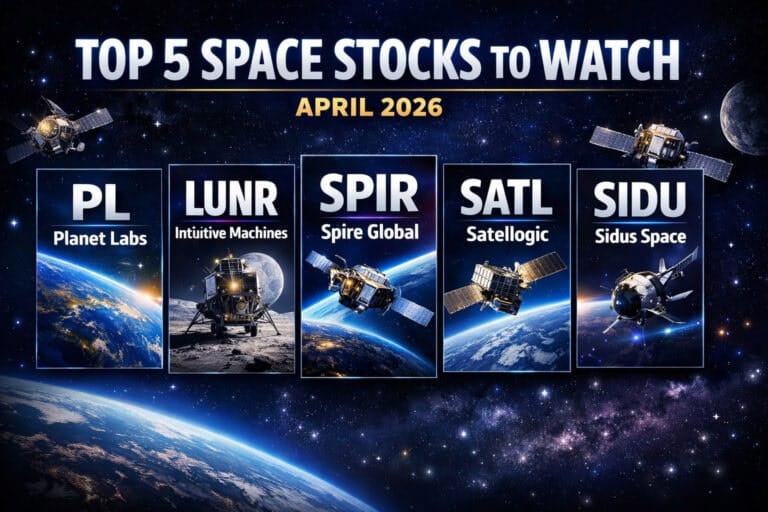
Why space matters again
The listed space sector has matured just enough to become interesting again, but not enough to become comfortable. That tension is exactly what makes it useful. Investors are no longer looking only at “space” as a futuristic headline. They are increasingly focusing on what part of the stack a company really owns: imagery, analytics, launch, orbital infrastructure, communications, mission execution or defense-adjacent data services.
In practice, this means the better stories are no longer the ones with the biggest cosmic vocabulary. They are the ones that can plausibly tie their business to recurring demand, sovereign capability, geospatial intelligence, communications resilience or long-duration technology relevance.
BlackSky (NYSE: $BKSY) deep dive March 2026 (Updated apr 1 ADDENDUM)
BlackSky is one of those names that forces investors to do more work than usual. On the surface, it offers almost everything that can ignite both enthusiasm and skepticism at the same time: space, defense, AI-enabled analytics, government demand, sovereign customers, a proprietary constellation, backlog growth and next-generation satellites. On the other side sit the issues that always make this type of story fragile: GAAP losses, capital intensity, dilution risk, execution risk, uneven revenue conversion and a stock that can move faster than the underlying business.
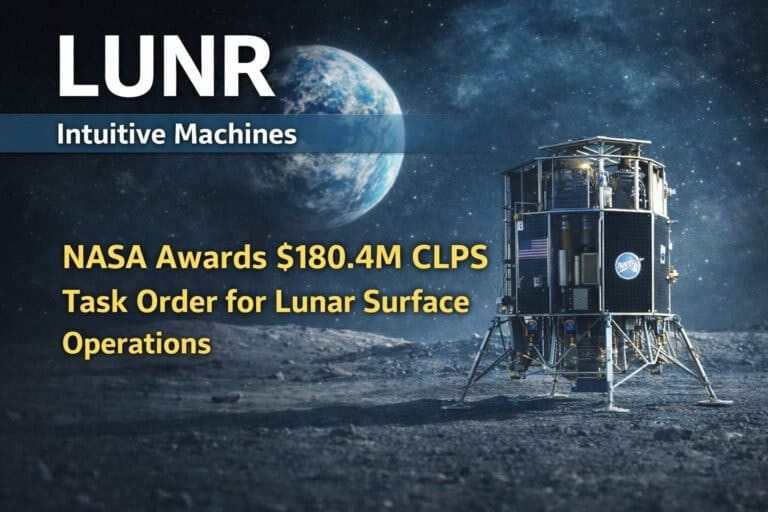
Intuitive Machines ( $LUNR ) Aggressive 2026 Guidance, and the $180.4M NASA CLPS Award
Intuitive Machines is now asking the market to believe two things at the same time. First, that FY2025 weakness was transitional rather than structural. Second, that the combined company after the Lanteris acquisition can grow into a much larger, more diversified space and defense platform without losing control of margins, working capital, or mission execution.
The tension is obvious. On one side, the March 19, 2026 results were underwhelming: full-year revenue of $210.1 million, fourth-quarter revenue of $44.8 million, negative free cash flow of $56.0 million, and a business still relying heavily on external capital to support growth. On the other side, management is now pointing to a very different 2026 picture: full-year revenue guidance of $900 million to $1.0 billion, positive adjusted EBITDA, roughly $943 million of combined backlog as of late February, and then a fresh $180.4 million NASA CLPS award announced on March 24 that pushes the contract narrative forward again.
The problem is that backlog and awards are not the same thing as clean execution. A company can win contracts, accumulate backlog, and still disappoint shareholders if the gross margin profile stays weak, if receivables do not convert into cash in a timely way, if integration creates friction, or if high-visibility missions keep generating mixed operational outcomes. That is why this story now has to be judged on business quality, not just on headline wins.
Sidus Space Inc ( $SIDU ) Space Infrastructure, Commercial Payloads, Capital Pressure and the March 31 Earnings Test
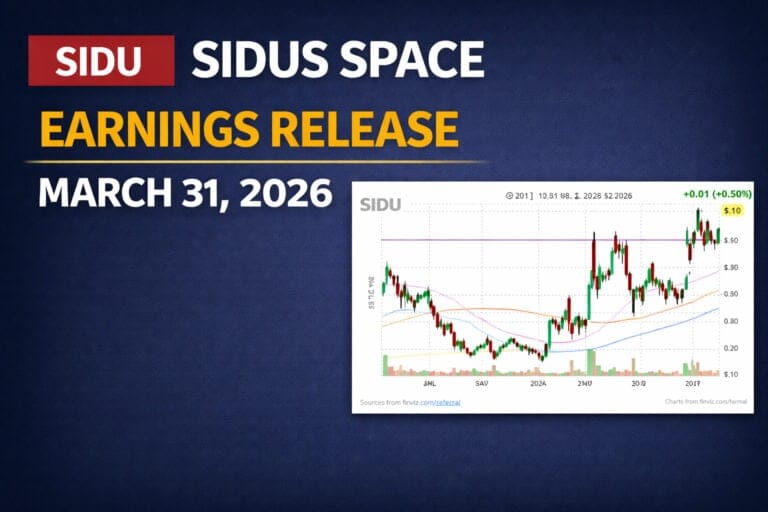
Sidus Space heads into its March 31 earnings event with a familiar mix of promise and pressure. On one side, the company continues to build the narrative it wants the market to believe: a nimble space infrastructure player with satellite heritage, hosted payload capability, and a path toward recurring higher-value data services. On the other side, the financial picture remains fragile, commercial scale is still limited, and capital structure risk has become impossible to ignore.
The stock therefore sits in a classic micro-cap tension zone. Technical milestones and partnerships are real, but the real question is whether they are beginning to translate into more stable revenue visibility. That is why the upcoming earnings call matters so much. It is less about one quarter in isolation and more about whether management can narrow the gap between operational progress and financial credibility.
Spire Global ( SPIR ): Satellite Data Monetization Re-Rated by Execution, Not Hype

Spire Global is no longer an early-stage “space story” being valued on imagination alone. The company has already built and deployed one of the largest listening constellations in low Earth orbit, it has exited a major strategic restructuring, and it now trades on a far more concrete question: can the business convert its satellite infrastructure and government relevance into durable profitability?
That question became more important after the company’s fourth-quarter and full-year 2025 results on March 18, 2026. Reported fourth-quarter revenue was $15.8 million. Because the maritime business was sold in April 2025, the year-over-year comparison needs context: management highlighted that fourth-quarter revenue was up 44% versus the comparable ex-maritime base, while the company also improved non-GAAP gross margin to 43%, reduced operating cash outflow to -$4.3 million, and closed the year with $81.8 million in cash and no debt.
Satellogic ( $SATL )Slingshot expansion, Merlin roadmap and the next defense-style de-risking cycle
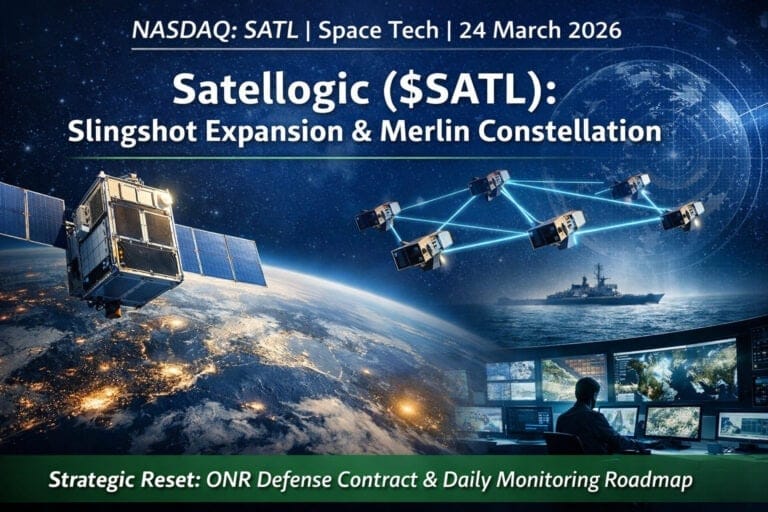
The March 24 update matters because it pushes Satellogic further away from the old “small-cap imagery vendor” label and deeper into a more valuable identity: a company trying to build low-latency, defense-relevant, AI-enabled orbital infrastructure. Slingshot II and III expand the ONR-linked roadmap to eight dedicated ISL-ready assets, while Merlin remains the bigger medium-term prize: a daily global one-meter monitoring architecture meant to scale persistent awareness, not just occasional imaging.
For Merlintrader readers, the setup is familiar. The story you already outlined in earlier SATL pieces still holds: this is a volatile, execution-sensitive space small-cap, but the quality of the narrative has improved. Revenue accelerated sharply in Q4 2025, full-year revenue rose to $17.7 million, the balance sheet is much stronger than a year ago, and remaining performance obligations of $65.1 million give the company more visibility than it used to have. At the same time, the stock is still a classic “prove it” story: the market wants delivery, not just roadmap slides.
Planet Labs after the jump: why these results change the story, and why the hard part starts now
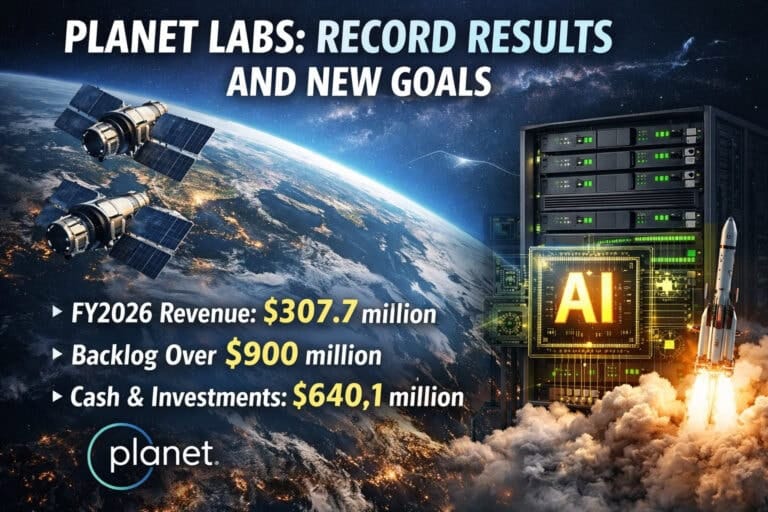
Planet Labs did not rally simply because it posted a good quarter. The market reacted because the company finally delivered a set of numbers strong enough to support a much larger narrative: Planet is no longer being framed only as a satellite-imagery vendor, but as a possible strategic geospatial infrastructure platform sitting at the intersection of sovereign data, defense demand, satellite services and AI-enabled analytics.
Intuitive Machines ( $LUNR ): weak quarter, huge 2026 guide
Intuitive Machines did not just report a mixed quarter. It effectively asked the market to stop thinking of LUNR as a single-mission lunar name and start treating it as a much larger, post-acquisition space infrastructure company built around manufacturing scale, defense programs, GEO communications, civil-space work, and eventually higher-margin network services. That is why these earnings matter. They were less about the quarter just reported and much more about whether investors are willing to believe the company can support a near-billion-dollar 2026 revenue target only a few weeks after absorbing Lanteris.
Satellogic ( $SATL ): Merlin, FY2025 earnings, and the strategic reset behind the stock
This is the continuation of the March SATL work, updated after the March 18 Merlin announcement and the March 19 fourth-quarter and full-year 2025 results. The key point is that these were not just ordinary earnings. Taken together, the two releases tried to reposition Satellogic from a small Earth observation operator into a daily global monitoring platform with sovereign, defense and persistent intelligence relevance.
Planet Labs PBC ( $PL )

Planet Labs—not NVIDIA—officially announced on March 16, 2026 that it is building a GPU-native AI engine for planetary intelligence with NVIDIA. The news matters not because it creates a completely new Planet story, but because it reinforces a strategic transition Merlintrader had already identified: Planet is moving beyond raw imagery delivery toward a faster, higher-value geospatial intelligence layer built on AI processing, semantic search and real-time operational utility.
By Merlintrader | Updated March 17, 2026