DISCLAIMER — Not financial advice. Educational content only, not an offer or solicitation to buy or sell any security. Biotech and small/mid-cap stocks are highly speculative and volatile and can result in a partial or total loss of capital. Do your own research and consult a licensed advisor where appropriate. / Contenuti a solo scopo informativo e didattico, non costituiscono consulenza finanziaria né offerta o sollecitazione al pubblico risparmio ai sensi delle normative CONSOB e SEC. Le azioni biotech e le small/mid cap sono strumenti altamente speculativi e volatili e possono comportare la perdita parziale o totale del capitale investito. Si raccomanda di effettuare sempre le proprie ricerche e, se necessario, di rivolgersi a un consulente abilitato.

Merlintrader Trading Pub
Biotech catalyst news and analysis. FDA PDUFA tracker
Merlintrader Trading Pub
Biotech catalyst news and analysis. FDA PDUFA tracker
Category Weekly Reports
Wall Street weekly recap and next-week setup: why April 6–10 became the market’s strongest week since November
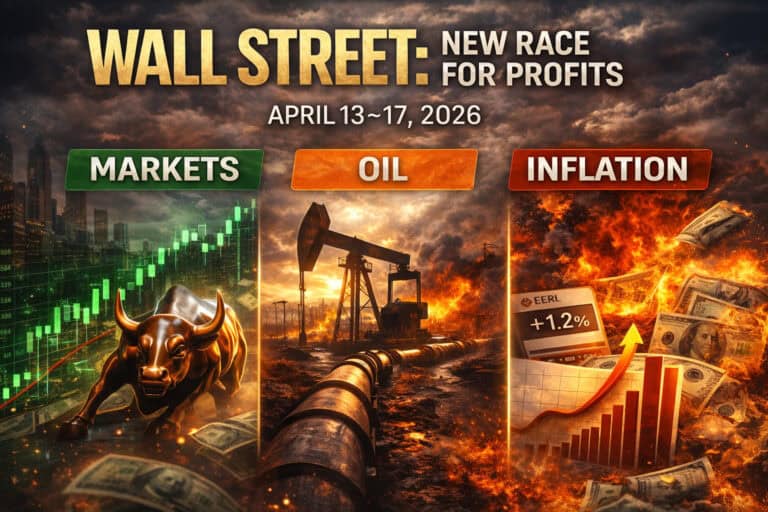
A broad and detailed market recap of the week just ended, plus a forward-looking framework for the next one, with focus on inflation spillover, oil structure, U.S.-Iran diplomacy, bank earnings, producer prices and the increasingly important gap between a stabilizing tape and a still-strained real economy.
Wall Street weekly recap and next-week setup: why March 30–April 3 became a relief week
Executive summary
The week that ended on Friday, April 3, was not a clean return to bullish calm. It was a relief week inside an unresolved macro problem. U.S. markets were closed on Good Friday, so the real trading week ended on Thursday, April 2. By then, the S&P 500 had posted a weekly gain and broken its five-week losing streak, while Wall Street had spent the entire week bouncing between fear of an extended energy shock and hope that the war-driven disruption around Iran and the Strait of Hormuz might not become a permanent economic wound.
Wall Street weekly recap ($SPY) and next-week setup – March 30–April 3
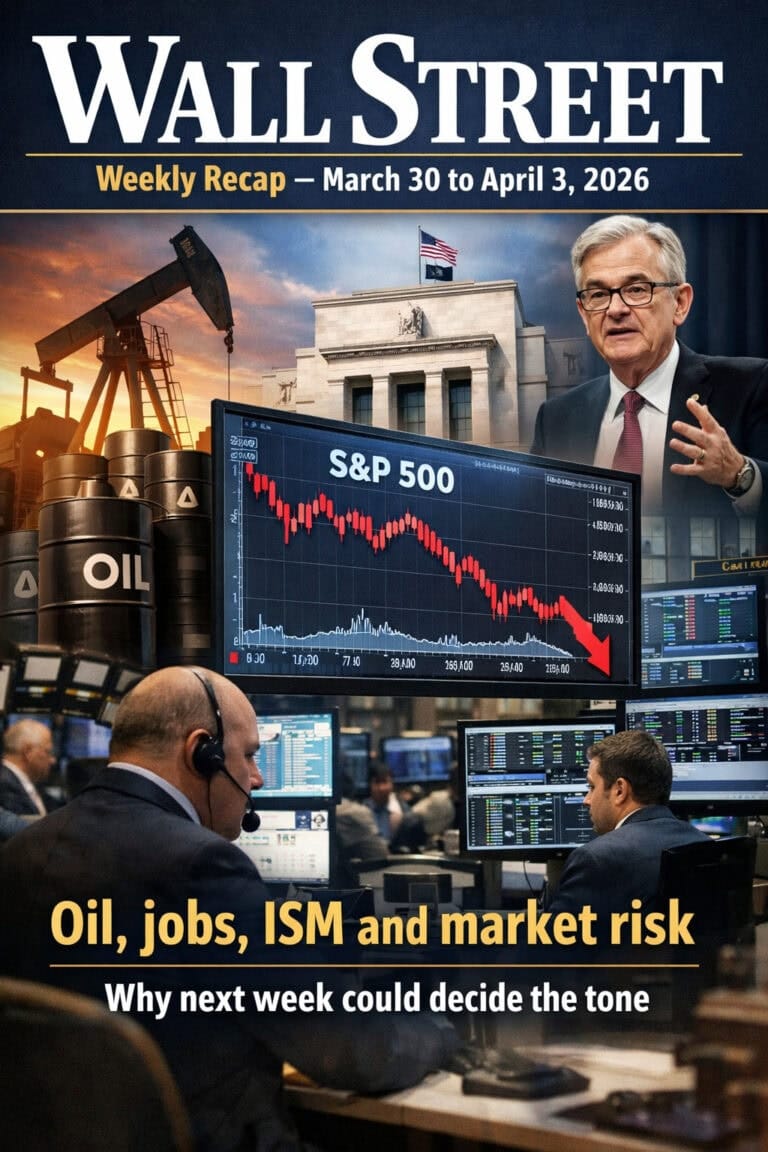
The week that just ended was not simply another ugly week for equities. It was a deeper tightening of market tolerance. By Friday, March 27, the S&P 500 had closed at 6,368.85, the Dow at 45,166.64, the Nasdaq at 20,948.36 and the Russell 2000 at 2,449.70. The S&P 500, Dow and Nasdaq all recorded a fifth straight weekly loss, while the Dow confirmed correction territory from its February high and the Nasdaq and Russell were already there. The message was blunt: this is no longer a market that shrugs off macro stress and instantly rotates back into the same crowded stories.
Weekly recap and next-week setup March 23–27
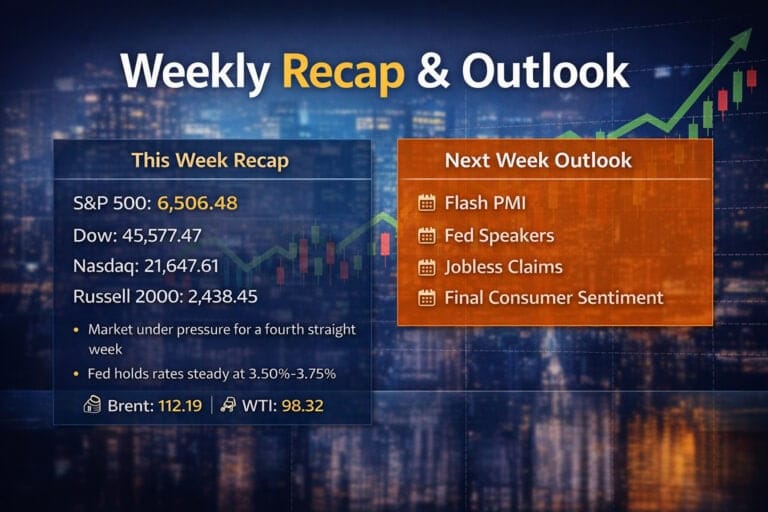
The week that just ended was not simply another down week for U.S. equities. It was a week in which the market became more severe, more selective and much less willing to pay for fragile narratives. The S&P 500 closed Friday at 6,506.48, the Dow at 45,577.47, the Nasdaq at 21,647.61 and the Russell 2000 at 2,438.45, extending the losing streak for the major U.S. indexes to a fourth consecutive week. The Russell 2000 is now in correction territory from its January high, which matters because it says the weakness is not just about a few mega-cap wobbles. The market is repricing risk appetite more broadly, especially for smaller and more rate-sensitive equities
Weekly Market Recap & Next Week Prep — March 15, 2026
The week that ended on Friday, March 13, did not deliver a clean “risk-on” or “risk-off” message. It delivered something more difficult and, for active traders, more important: a selective tape in which macro stress was real, energy shock risk was impossible to ignore, but not every pocket of the market reacted in the same way. That distinction matters. A market that falls together can often bounce together. A market that starts separating winners from losers under pressure is usually telling you that stock-picking, catalyst timing and sector choice are starting to matter more than headline beta.
5 energy stocks under $2 billion to watch in march ( $PUMP $EGY $RNGR $GEOS $KLXE )

This article compares five U.S.-listed energy names below $2 billion in market value that could benefit, directly or indirectly, from a stronger oil tape, firmer field activity, or renewed investor appetite for smaller-cap energy exposure: ProPetro (PUMP), VAALCO Energy (EGY), Ranger Energy Services (RNGR), Geospace Technologies (GEOS) and KLX Energy Services (KLXE).
Weekly Recap & Briefing – Oil Shock, Weak Jobs, Iran War and a More Selective Tape (Mar 2–6, 2026)
The week that closed on Friday 6 March was the first full trading week in which markets had to process the new Middle East war regime rather than just react to a weekend headline. The U.S.–Israeli campaign against Iran and the retaliation that followed kept energy, shipping and inflation risk at the centre of the tape, while the S&P 500 ended the week lower, the VIX climbed to its highest level since April 2025 and Brent crude pushed above 90 dollars a barrel. On top of that, Friday’s U.S. jobs report added a second layer of stress: payrolls unexpectedly fell and the unemployment rate moved up, pushing investors into an awkward mix of growth fear and inflation fear at the same time.
Taxing unrealised gains: why the Dutch “experiment

Taxing unrealised gains: why the Dutch “experiment” is a red line for investors A closer look at the Actual Return Box 3 proposal in the Netherlands, why a 36% tax on unrealised portfolio gains is structurally toxic, and what this…
WAR US–Israel vs Iran, 2026 Small & mid-cap potential “winners & losers”

Focus on factual developments of the last few days (Strait of Hormuz, tankers at anchor, oil spike) and on a sector-based watchlist – not on trying to predict the endgame of the conf
War in Iran 2026 – Geopolitics, Oil Shock Risk and Market Winners & Losers

An editorial look at what the new Iran–Israel–US conflict could mean for global power balances, for oil and shipping routes, and for the sectors and individual stocks that tend to benefit or suffer when the Middle East becomes the epicentre of risk.
EN
IT
Weekly Recap & Briefing – Iran War Risk, Energy Shocks and Catalyst Trading (Feb 23–27, 2026)
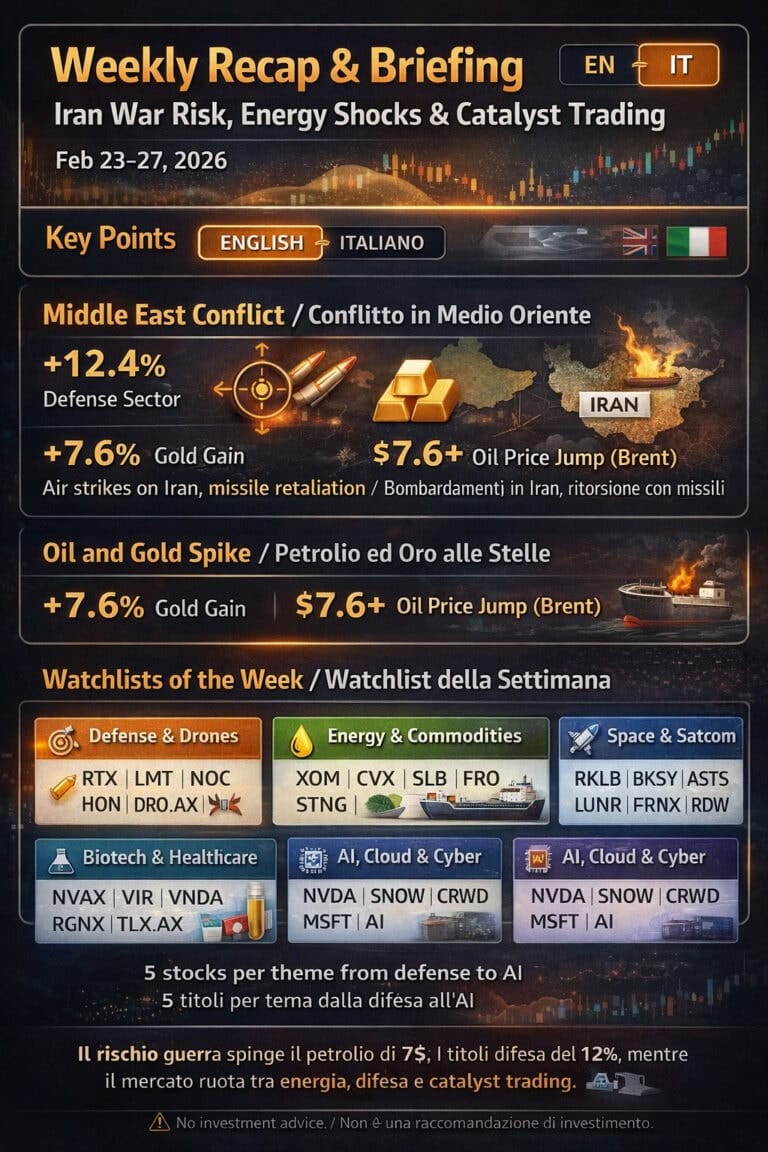
The new week opens with markets forced to reprice global risk after coordinated US–Israel strikes on Iran and retaliatory missile attacks on US bases across the Gulf and on Israel itself. Oil and shipping risk premia jump, while gold and defense stocks rediscover their role as hedges. At the same time, AI and chips are coming off a volatile stretch after Nvidia’s “beat and fade” reaction, Rocket Lab posts record revenue and backlog, and small-cap biotech continues to trade on single-name catalysts rather than broad factor flows. This recap looks at where we are, how the Iran conflict feeds into energy and risk assets, and which names go on the watchlist for the coming days across defense, energy, space, biotech and AI.
Weekly Recap & Briefing – Biotech, Space, Defense & AI Feb 21 2026

This week’s recap walks through a classic “binary” market: indices inch higher while gold hits new records and oil creeps up on tariff and Iran risk. In biotech we see clean wins (VNDA, Telix) versus brutal setbacks (GRAIL, RGNX), while defense and space keep riding record military spending and drone/missile contracts. The briefing for February 23–28 closes with what really matters next: Nvidia’s earnings, the U.S. PPI print, and the first concrete signs from the Pentagon’s USD 1.1bn drone program.
Weekly Market Briefing (February 16–20, 2026)

Wall Street just closed a choppy week where enthusiasm about AI and data-center spend ran into valuation nerves, while inflation data kept the “soft landing” narrative alive. The coming days will be dominated by U.S. GDP, the Fed’s preferred inflation gauge (core PCE), fresh PMIs and a cluster of sector-specific catalysts across biotech, space, defense and AI small/mid caps.
Weekly Briefing Feb 9 2026
Week of 9–15 February 2026 – the setup is unusual: the U.S. government shutdown pushed key releases into the same week, so the market gets a jobs + CPI combo while earnings keep dictating leadership.
Week ahead and recap jan 31 2026
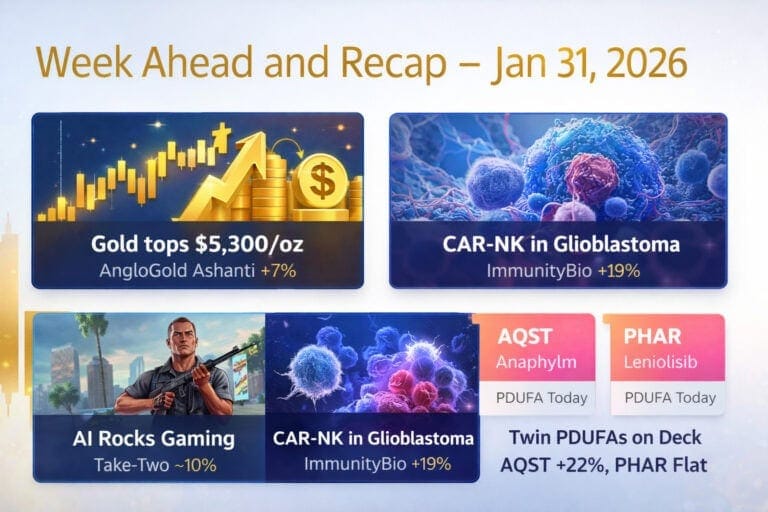
Week Ahead and Recap – January 31, 2026
Gold near record highs, AI shockwaves in gaming, and a cluster of high-grade biotech catalysts from DF-003 in ROSAH syndrome to camizestrant in ESR1-mutant breast cancer. This is your condensed map for the week.
Weekly Briefing – Fed, Geopolitics, GLP-1 Obesity & Small Caps

Going into the 27–28 January FOMC, the message is basically “don’t expect fireworks”: after the 2025 cuts, the Fed keeps describing policy as “well positioned”, with inflation gliding down towards (but not yet at) target and real growth still positive. Futures now see a very high probability of a clean hold next week and push the bulk of any extra easing into late 2026.
Weekly Recap and Briefing Jan 12-17

eek of 12–17 January 2026 – a structured overview of what is really moving markets, geopolitical risk and the most talked-about tickers.
Market Review | Preview for the Week of Jan 12
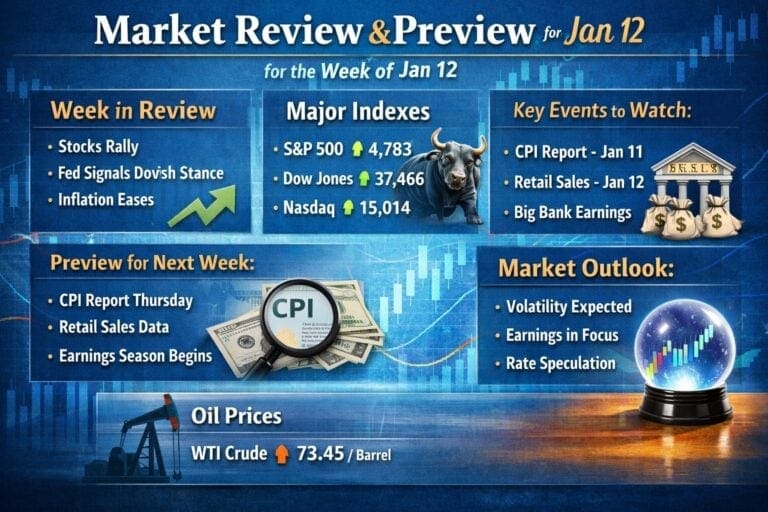
Biotech catalysts, small-cap rotation, space & defence names already on the Merlintrader radar, Trump factor, geopolitics (Ukraine, Red Sea, Venezuela, Greenland) and J.P. Morgan Healthcare Conference 2026.
Weekly Recap & Next Week Prep dec 29- Jan 2
Reality check: end-of-year sessions are thin and noisy. Spikes and air-pockets are common. Treat this week as “information rich” but structurally fragile in terms of liquidity.
Weekly Biotech & Market Recap Dec 22

The week’s backdrop for biotech and small caps sits at the intersection of interest rates, portfolio positioning, US politics and geopolitics. None of these elements decides a trade alone, but together they define the risk corridor in which individual catalysts play out.