






PDUFA catalyst – single-name deep dive
Omeros Corporation (NASDAQ: OMER) – Narsoplimab PDUFA December 26, 2025
Binary FDA decision in a rare, high-mortality indication, backed by a de-risking Novo Nordisk deal and peer-reviewed survival data. This is arguably the most important PDUFA event on the biotech calendar between now and New Year. Fundamentally a bullish setup, but with classic biotech high risk.
Executive alert
FDA decision on narsoplimab (YARTEMLEA) for TA-TMA – PDUFA December 26, 2025
Report date: December 17, 2025 – 9 days to decision
Omeros Corporation is approaching a binary regulatory event: the U.S. Food and Drug Administration (FDA) is scheduled to decide on the Biologics License Application (BLA) for
narsoplimab (to be marketed as YARTEMLEA) in
hematopoietic stem cell transplant-associated thrombotic microangiopathy (TA-TMA) on
December 26, 2025.
This is the company’s most important near-term catalyst and one of the most closely watched PDUFAs into year-end.
- There is currently no FDA-approved therapy for TA-TMA; mortality is historically very high.
- The PDUFA date was extended from late September to December 26 after FDA requested additional analyses, which Omeros has already submitted.
- FDA communication states that, assuming no major deficiencies are identified, label discussions were planned for October 2025 – a constructive sign for a rare disease filing.
Executive summary
Bullish if approved
High risk
Omeros is a Seattle-based biotech focused on complement-mediated diseases. Its lead asset, narsoplimab, is a fully human monoclonal antibody targeting MASP-2 in the lectin pathway of complement. The near-term goal is an FDA approval in transplant-associated thrombotic microangiopathy (TA-TMA), a life-threatening complication of hematopoietic stem cell transplant.
The company previously experienced a setback when its first BLA for TA-TMA was rejected in 2021 due to concerns around trial design and external controls. Since then, Omeros has generated additional data, including an expanded access program and updated analyses, and resubmitted the BLA. In 2025 the FDA accepted the resubmission, assigned a PDUFA date of September 25, then extended the action date to December 26, 2025, stating that, assuming no major deficiencies emerged, label discussions would begin by October. That is a distinctly more collaborative tone than in 2021.
In October 2025, Omeros announced a landmark deal with Novo Nordisk for its MASP-3 antibody Zaltenibart, worth up to 2.1 billion USD in potential value, including 340 million USD in upfront and near-term milestones. The upfront cash of 240 million USD was received at closing on December 1, 2025 and used in part to repay the $67.1 million secured term loan, leaving the company with a much stronger cash position just before the FDA decision.
In practical terms: Omeros arrives at this binary catalyst with peer-reviewed survival data, a more constructive FDA dialogue, and a de-risked balance sheet thanks to Novo Nordisk. If the FDA approves narsoplimab on December 26, OMER transitions from development-stage biotech to commercial orphan player overnight.
Company snapshot – complement, rare disease and platform logic
Omeros Corporation was incorporated in Washington State in June 1994 and is headquartered in Seattle, Washington. Under the leadership of CEO Dr. Gregory A. Demopulos, the company has focused on drug candidates that modulate the complement system and other inflammatory pathways, especially in rare, high-unmet-need indications.
The current strategy is anchored on:
- Complement pathway targeting: MASP-2 (narsoplimab), MASP-3 (Zaltenibart, now partnered with Novo Nordisk), and additional preclinical programs in the lectin and alternative pathways.
- Orphan and specialty indications: TA-TMA post-transplant, paroxysmal nocturnal hemoglobinuria and other alternative-pathway disorders pursued by Novo Nordisk with Zaltenibart, plus Omeros’ OMS1029 and OMS527 programs.
- Economics: focus on settings where high morbidity and mortality justify premium pricing, favourable reimbursement and potentially strong margins if a drug is approved.
Before the Novo deal, Omeros was viewed as financially constrained, with a limited cash runway and meaningful debt. The recent licensing agreement fundamentally changes that picture and gives the company room to operate into and beyond the narsoplimab decision.
Narsoplimab in TA-TMA – from mechanism to survival data
Why this single decision matters so much for OMER
Disease background – TA-TMA after hematopoietic stem-cell transplant
Transplant-associated thrombotic microangiopathy (TA-TMA) is a serious complication that can occur after hematopoietic stem-cell transplantation. It is characterised by microvascular thrombosis, hemolytic anaemia, thrombocytopenia and multi-organ involvement, including renal and neurological damage. Historically, mortality for high-risk TA-TMA has been reported in the range of 60–90 percent, especially when diagnosis is delayed or treatment is purely supportive.
There is currently no FDA-approved therapy specifically indicated for TA-TMA. Management largely relies on:
- Supportive care (transfusions, blood-pressure control, renal support).
- Adjustment of immunosuppressive regimens.
- Occasional off-label use of broader complement inhibitors, without a labelled indication.
Mechanism of action – MASP-2 and the lectin pathway
Narsoplimab is a fully human monoclonal antibody against MASP-2 (mannan-binding lectin-associated serine protease-2), a key protease in the lectin pathway of complement activation. By inhibiting MASP-2, narsoplimab aims to:
- Prevent downstream complement activation and microvascular damage in TA-TMA.
- Leave the classical complement pathway relatively intact, in theory preserving important anti-infective functions.
This more selective targeting differentiates narsoplimab from agents that fully block terminal complement (such as C5 inhibitors), potentially providing a better tolerability balance in heavily immunocompromised transplant patients.
Clinical evidence – pivotal and expanded access data
Omeros’ case with the FDA rests on two main pillars:
1) Pivotal analysis in TA-TMA
- Single-arm trial in adults with high-risk TA-TMA treated with narsoplimab.
- Primary focus on overall survival compared with well-matched external control cohorts.
- Published analyses (including in hematology journals) indicate a significant reduction in mortality risk versus historical controls for both adults and children.
While exact percentage point differences vary by analysis and control set, the consistent message is that survival with narsoplimab appears substantially better than would be expected based on matched historical populations.
2) Expanded access / real-world program
- An expanded access program (EAP) has treated additional TA-TMA patients outside the pivotal trial.
- Data from this EAP, including in adults with high-risk disease, have been used to reinforce and replicate the survival benefit observed in the pivotal setting.
- Peer-reviewed publications report that survival in these real-world patients is consistent with or better than the pivotal dataset, lending weight to the case that the observed effect is not a random artefact.
Overall, the evidence package provides the FDA with two convergent lines of data (pivotal trial and EAP) showing improved survival in a population with otherwise devastating outcomes, using an external-control framework that is relatively common in rare diseases where randomised trials are difficult.
Regulatory trajectory and current positioning
Key regulatory milestones so far:
- Initial BLA rejected in 2021, with FDA flagging concerns about data robustness and external control use.
- In March 2025, Omeros resubmitted a revised BLA incorporating additional analyses and expanded access data; FDA accepted the filing with a PDUFA date of September 25, 2025.
- Following further information requests, the FDA extended the PDUFA date to December 26, 2025, noting that, if no major deficiencies emerged, label discussions would begin no later than October 2025.
- Omeros has publicly stated that all analyses requested by FDA continue to support narsoplimab’s benefit in TA-TMA.
For investors, the tone of communication is key. The extension itself is not unusual for rare disease filings; the important point is that, as of the latest company and regulatory updates, there is no explicit signal of a major unresolved deficiency. That does not remove risk, but it supports the case that an approval or at least an “approvable” outcome is plausible.
Financial profile and Novo Nordisk deal – from tight to “OK” runway
Before the Novo Nordisk agreement, Omeros’ financial situation was fragile. As of September 30, 2025, the company reported roughly 36 million USD in cash and short-term investments and a quarterly cash burn of about 22 million USD, with meaningful debt on the balance sheet. That translated into a limited runway and clear concern about potential dilution if narsoplimab was delayed or rejected.
The Novo Nordisk deal, announced in October and closed on December 1, 2025, changed that picture:
- Upfront and near-term milestones: up to 340 million USD, of which 240 million USD is upfront cash at closing for global rights to Zaltenibart (MASP-3 antibody) in PNH and other indications.
- Total potential value: up to 2.1 billion USD including development, regulatory and commercial milestones plus tiered royalties on net sales.
- Use of proceeds: repayment of the 67.1 million USD term loan; the remaining 17.1 million USD of 2026 notes were still outstanding and expected to be repaid at or before maturity.
- Runway: management said the remaining proceeds should fund more than 12 months of post-closing operations, including the anticipated U.S. launch of narsoplimab.
From a balance-sheet standpoint, Omeros enters the PDUFA window in a far stronger position: cash is no longer the immediate concern. The combination of the Novo cash and potential orphan revenue from TA-TMA is central to the bullish thesis on OMER.
Sentiment and trading behaviour
How the market is pricing this binary decision
Price action and volatility
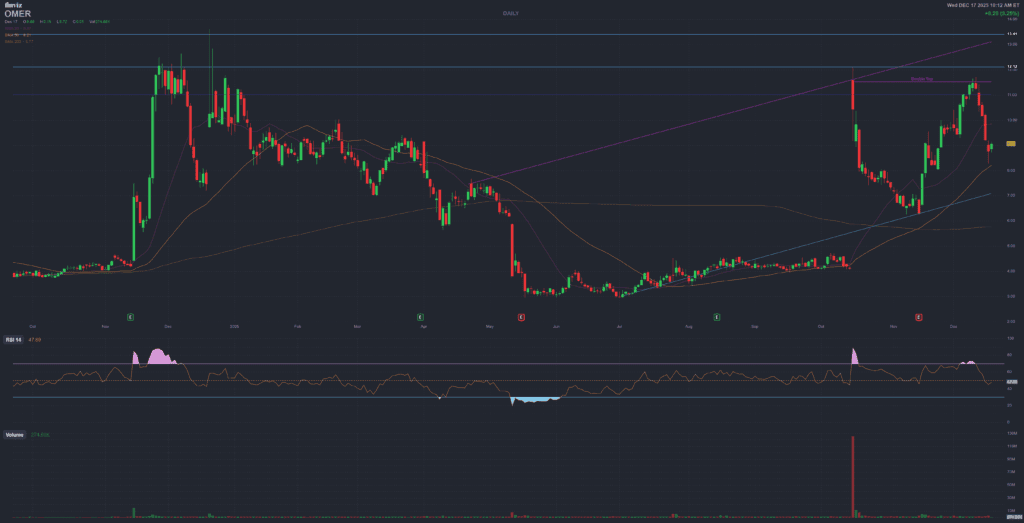
- Over the last 12 months, OMER has traded between roughly 2.95 and 13.60 USD, with pronounced spikes around regulatory and deal headlines.
- The stock surged sharply in October 2025 on the Novo Nordisk deal announcement, more than doubling intraday as investors repriced the balance sheet improvement and strategic validation.
- Since then, OMER has retraced and stabilised in the high single-digit range, as the market digests the deal and turns attention back to the narsoplimab PDUFA catalyst.
- Technical services now classify the stock as high-risk, high-volatility, with daily swings frequently in the 8–11 percent range as traders position into the decision.
Street and retail sentiment
- Analyst coverage is limited but tilts positive: available data points show an average 12-month target around 28 USD with a range of roughly 20–36 USD, and an overall rating of Buy.
-
On retail and social platforms (Stocktwits, Reddit, X), sentiment is polarised:
- One camp focuses on the peer-reviewed survival data, the Novo deal and the lack of any approved TA-TMA therapy, making a strong case for approval and upside.
- The other camp highlights the painful history of the 2021 rejection, the small trial size and the inherent danger of betting heavily on binary events.
- Short-term flows reflect typical catalyst risk positioning: some traders taking profits into strength, others building speculative positions expecting a sharp move after the FDA decision.
All sentiment references here relate to non-professional traders and public commentary. They are useful to understand crowd psychology and positioning but are not a substitute for independent due diligence.
Bull case vs bear case – framing the binary
Bull case – approval and orphan launch
- Regulatory tone improvement: compared with the 2021 rejection, FDA language in 2025 has been more collaborative, with explicit mention of starting label discussions if no major deficiencies arise.
- Peer-reviewed survival benefit: both pivotal and expanded-access data show improved survival in high-risk TA-TMA patients versus matched controls, in publications that have passed external peer review.
- First-in-class orphan position: if approved, narsoplimab would likely be the first and only labelled therapy for TA-TMA, enabling premium pricing and strong bargaining power with payers.
- De-risked balance sheet: Novo Nordisk’s 240 million USD upfront payment and up to 2.1 billion USD total potential deal value validate the complement platform and allow Omeros to fund operations and launch without emergency dilution.
- Optionality beyond TA-TMA: Omeros’ OMS1029 and OMS527 programs, plus Novo’s development of Zaltenibart in PNH and other diseases, provide mid-term catalysts that could add layers of value on top of the TA-TMA base.
- Valuation gap: against a market cap in the ~600 million USD range, a successful TA-TMA launch with orphan economics and a solid rare-disease multiple could, in bullish scenarios, support valuations materially above current levels if execution is strong.
Bear case – rejection, delay or underwhelming launch
- Binary regulatory risk: a negative decision (CRL or non-approval) on December 26 would likely cause a sharp sell-off, reflecting both the immediate setback and investor fatigue after a long regulatory journey.
- Evidence limitations: despite survival improvements, the dataset remains relatively small and relies on external controls. The FDA could still decide that further prospective, randomised data are needed, pushing approval out by years.
- Commercial ceiling: even in an approval scenario, TA-TMA is a small population. If uptake is slower than expected or pricing is challenged, revenue may land at the low end of optimistic scenarios, limiting upside.
- Execution and competition: scaling supply, navigating reimbursement and building a commercial footprint in a complex transplant setting are not trivial. In parallel, other complement inhibitors from larger companies could shape the competitive landscape in related indications.
- Post-deal complacency risk: the Novo money removes immediate financial pressure, but in a rejection scenario it would also mean that the stock may drift for an extended period while new plans are made, with investors reluctant to re-rate until fresh clinical success appears.
From a fundamental perspective, the bull case sees Omeros emerging from December 26 with an approved, first-in-class orphan drug in TA-TMA, a strengthened balance sheet and a clearer strategic path, justifying a significantly higher valuation if launch execution is solid. The bear case sees a renewed setback with the FDA, re-opening concerns about trial design and prolonging the pre-revenue phase despite a healthier cash position. In either case, the stock remains a high-volatility vehicle where position size and risk management are crucial.
Key catalysts and timeline (next 12–18 months)
- December 26, 2025: FDA PDUFA decision for narsoplimab in TA-TMA (binary event).
- Late December 2025 – January 2026: Market reaction and first commentary on label terms, safety language and scope of approved indication (if approval is granted).
- Q1–Q2 2026: Launch preparation and early commercial uptake indicators in U.S. transplant centers; initial commentary from clinicians and payers.
- Mid-2026: Potential European Medicines Agency (EMA) committee opinion on narsoplimab for TA-TMA.
- 2026–2027: Updates on Omeros’ OMS1029 and OMS527 programs and Novo Nordisk’s Zaltenibart program in PNH and related conditions, both of which could reinforce the broader complement platform story.
- 2027 and beyond: Potential guidance on full-year narsoplimab revenues and any move towards profitability if orphan launches perform as expected.
Omeros (OMER) – PDUFA 26 dicembre 2025 in sintesi
Il PDUFA più importante da qui a Capodanno
Omeros Corporation è una biotech di Seattle focalizzata sul sistema del complemento e sulle malattie rare. Il 26 dicembre 2025 la FDA deve decidere sulla richiesta di approvazione di narsoplimab (YARTEMLEA) per la TA-TMA (microangiopatia trombotica associata a trapianto di cellule staminali ematopoietiche). Ad oggi non esiste alcun farmaco approvato per questa indicazione, che ha tassi di mortalità storici molto alti.
Il dossier si basa su:
- uno studio pivotale a braccio singolo con confronto su controlli storici ben selezionati;
- dati addizionali da un programma di accesso allargato (real world) che confermano il beneficio in termini di sopravvivenza;
- una comunicazione FDA nel 2025 più “collaborativa” rispetto al rifiuto del 2021, con estensione del PDUFA da settembre a dicembre per includere analisi aggiuntive, ma senza segnali pubblici di carenze gravi;
In parallelo, Omeros ha chiuso un accordo importante con Novo Nordisk per l’anticorpo MASP-3 Zaltenibart:
- 240 milioni di dollari cash upfront (fino a 340M con milestone ravvicinate);
- valore potenziale complessivo fino a 2,1 miliardi di dollari in milestone + royalties;
- utilizzo dei proventi per estinguere il term loan da 67,1 milioni di dollari; i 17,1 milioni di note 2026 restavano da rimborsare entro o prima della scadenza, con una runway indicata dal management superiore a 12 mesi.
Tradotto: Omeros arriva alla decisione FDA con:
- dati di sopravvivenza pubblicati e peer-reviewed in un’indicazione orfana mortale;
- dialogo FDA meno ostile rispetto al passato;
- bilancio molto più solido grazie al cash upfront di Novo.
Bull case (se approvano il 26/12): Omeros diventa da subito una “orphan commercial story” con primo e unico farmaco approvato in TA-TMA, pricing premium, buona probabilità di rimborso e ulteriore optionalità su OMS1029 e OMS527 e sullo sviluppo di Zaltenibart da parte di Novo.
Bear case: un eventuale rifiuto o una nuova richiesta di trial addizionali farebbe probabilmente crollare il titolo (classico CRL shock), con ritorno alla narrativa “pre-revenue” nonostante il cash in cassa. La storia resterebbe interessante sul lungo periodo, ma con tempi spostati avanti di anni.
Il punto centrale per chi guarda OMER oggi: non stiamo parlando di una microcap da promo, ma di una scommessa binaria su un orphan drug con dati reali e cassa rafforzata. Profilo decisamente speculativo, ma il rapporto rischio/rendimento può essere molto asimmetrico in caso di esito positivo.
Nota: questa è una sintesi in italiano; i dettagli completi (dati, timeline, bull/bear case numerico, analisi di bilancio) sono riportati nella versione inglese del report qui sopra.
Authors

Disclosure: the author currently holds a small personal long position in OMER. This disclosure is provided for transparency and does not change the informational and non-advisory nature of this report.
Research tools and partners
Used for price history, relative performance checks, heatmaps and quick cross-section screening in biotech.
ChartsWatcher is a real-time, next-generation scanner for the US stock market, useful for monitoring intraday flows around catalysts.
Source for earnings call transcripts, consensus estimates, rating changes and curated biotech news flow.
Used to monitor real-time crowd sentiment, message-volume spikes and retail focus around OMER and other catalyst names.
Professional-grade trading and charting platform used operationally for execution and live monitoring.
Independent research hub focused on biotech catalysts, orphan drugs and small-cap trading workflows.
Some of the links above are referral or affiliate links. They do not change the price you pay but may generate a small commission that helps support the site and keep research content freely accessible. You are never required to use them.

Support the project
If this kind of long-form, sourced catalyst work helps you prepare for binary events like the OMER PDUFA, you can support the project with a one-time PayPal donation. It helps keep the content independent and ad-light.
Disclaimers and legal information
SEC-style disclaimer (EN): This report is for informational and educational purposes only. It is not, and should not be interpreted as, an offer to sell or a solicitation of an offer to buy any security, nor as personalized investment, legal, tax or accounting advice. The author is not a registered investment adviser or broker-dealer. Any securities mentioned may be volatile and speculative. Investors should conduct their own independent research and, where appropriate, consult a licensed financial professional before making any investment decisions. Past performance is not indicative of future results; it is possible to lose part or all of the capital invested.
Avvertenza CONSOB-style (IT): Il contenuto di questa pagina ha esclusivamente finalità informative e didattiche e non costituisce in alcun modo consulenza finanziaria personalizzata, sollecitazione del pubblico risparmio o raccomandazione a comprare o vendere strumenti finanziari ai sensi della normativa vigente. L’autore non è un consulente finanziario abilitato all’offerta al pubblico. Qualsiasi decisione di investimento resta sotto la piena responsabilità del lettore, che dovrebbe valutare attentamente la propria situazione patrimoniale e, se necessario, rivolgersi a un professionista abilitato. Gli investimenti in titoli azionari, in particolare nel settore biotech e nelle small cap, possono comportare la perdita parziale o totale del capitale investito.
For full legal notes and privacy information, please refer to:
Disclaimer –
Terms of use and privacy info.
More OMER articles on Merlintrader trading Blog
For readers who want to follow the full “story arc” of Omeros on the site, here are previous deep dives and perspectives published earlier in the year:
Biotech Catalyst Calendar
For an updated overview of all upcoming PDUFA dates, key clinical readouts and other biotech events beyond Omeros, you can check the dedicated Biotech Catalyst Calendar maintained on Merlintrader trading Blog.
Open the Biotech Catalyst Calendar
Open the Biotech Catalyst Calendar
OMER – Full daily chart (Finviz)
×

Data and chart courtesy of Finviz. Use zoom and cursor in your browser for closer inspection of the most recent days into the December 26 PDUFA window.