

Kura Oncology (KURA) – from menin bet to first KOMZIFTI launch
Kura Oncology is a precision oncology company built around one central thesis: targeting oncogenic signalling nodes such as menin and farnesyl transferase can reset the biology of hard-to-treat cancers, especially acute myeloid leukemia (AML). With the US approval of KOMZIFTI (ziftomenib) in November 2025 for adults with relapsed or refractory AML harbouring an NPM1 mutation (see Kura Oncology / Kyowa Kirin FDA approval announcement and the FDA Novel Drug Approvals 2025), Kura has transitioned from a pure development story to a company with an early commercial franchise and a deep pipeline of menin and FTI assets.
The menin field is crowded and moving fast. Syndax’s Revuforj (revumenib) secured an expanded FDA approval in October 2025 for relapsed or refractory AML with a susceptible NPM1 mutation, on top of its earlier indication in KMT2A-rearranged acute leukemias, as described in Syndax company communications (Syndax Pharmaceuticals IR). KOMZIFTI enters this space with a differentiated safety label and a collaboration structure with Kyowa Kirin that offloads part of the commercial and development risk while preserving upside through milestones and profit-sharing.
For a Run-Up style investor, Kura is no longer only about “will the menin trial work?”; it is now about the slope of the launch curve, the race toward frontline AML, and whether the FTI backbone can open a second, independent value driver in solid tumours.
Pipeline – menin, FTIs and beyond
The current Kura story is dominated by menin inhibition in AML, but the pipeline still rests on two pillars: menin (KOMZIFTI and follow-ons) and farnesyl transferase inhibition (next-generation FTIs for solid tumours), as outlined on the company’s official pipeline page.
1. KOMZIFTI (ziftomenib) – commercial menin anchor
KOMZIFTI is an oral small-molecule menin inhibitor designed to disrupt the interaction between menin and KMT2A, a key driver in leukemias with NPM1 mutations and KMT2A rearrangements. The drug received US FDA approval in November 2025 for adult patients with relapsed or refractory AML with a susceptible NPM1 mutation, based on Phase 2 data showing meaningful complete remission rates in heavily pretreated patients. The NDA benefited from Priority Review, Breakthrough Therapy and orphan drug designations, as detailed in Kura/ Kyowa Kirin press releases and the FDA approval summary.
Importantly, regulatory commentary from specialist oncology outlets underlines a safety profile that looks competitive versus Revuforj: while Revuforj carries a boxed warning for QTc prolongation, KOMZIFTI’s label currently includes only a regular warning, and Kura has already signalled discussions with the FDA aimed at potentially softening this over time. Label details are available in official prescribing information and drug information resources linked from the KOMZIFTI product site.
From a development perspective, KOMZIFTI is not meant to remain confined to late-line R/R disease. Ongoing trials include:
– Frontline AML registrational programme (COMET-017 and related), combining ziftomenib with intensive chemotherapy
and with venetoclax/azacitidine in newly diagnosed patients, with top-line data currently guided towards the second half of this decade.
– Combination studies in both newly diagnosed and R/R settings, including triplets with venetoclax and azacitidine and
exploratory work in other menin-sensitive contexts, as discussed in recent Kura conference presentations and updates.
2. Menin follow-ons and potential non-oncology angles
Kura has indicated preclinical work exploring menin inhibition beyond classical AML, with early data presented in 2024 suggesting that menin modulation might have metabolic effects relevant to type 2 diabetes. At this stage these programmes remain early, non-registrational and high-risk, but they illustrate that Kura is not treating ziftomenib as a one-and-done experiment in a narrow slice of AML.
3. FTI backbone – KO-2806 and next-generation farnesyl transferase inhibitors
Before the menin pivot, Kura was best known for its FTI work, including tipifarnib. The company is now repositioning the FTI franchise with KO-2806, a next-generation farnesyl transferase inhibitor being tested in combination with targeted therapies in solid tumours. These programmes are described in more detail in Kura’s pipeline overview and recent investor presentations.
Conference presentations in 2025 highlighted early-stage data and planned updates in indications such as renal cell carcinoma and head-and-neck cancers, including combinations with cabozantinib and other backbones. These studies are not yet at a stage where they drive valuation, but they matter for the longer-term “second leg” of the Kura story if menin becomes crowded and standardised in AML.
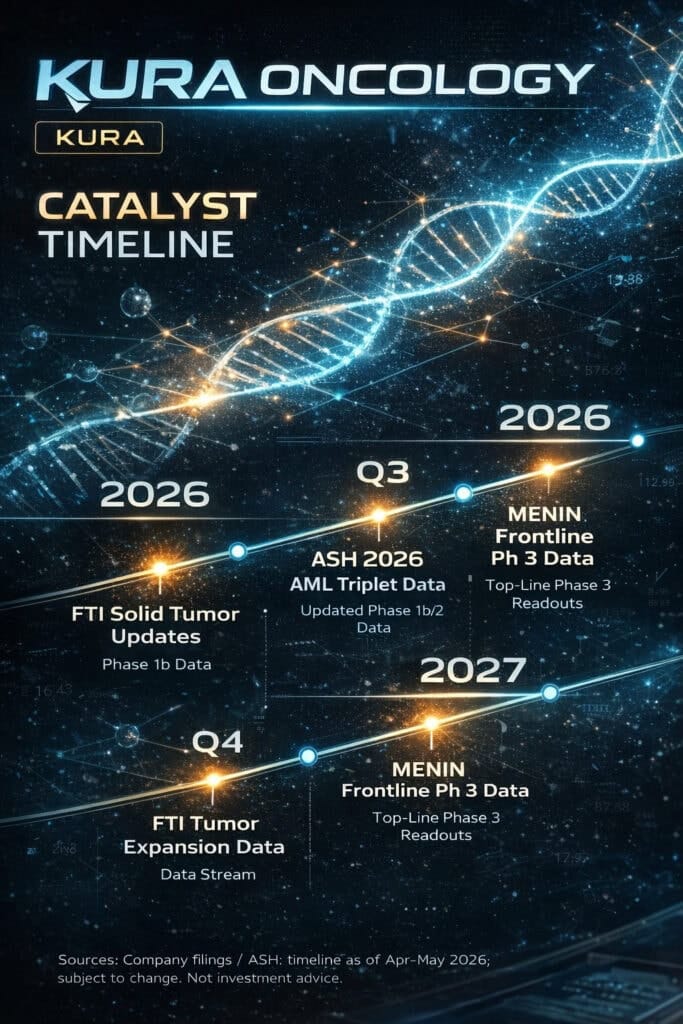
KURA catalyst timeline – from groundwork to 2026 and beyond
Instead of looking only at the next binary, it is useful to walk Kura’s story from the back of the book to the present and then forward. Below is a simplified timeline, starting with the foundations in 2023–2024 and moving into the 2025–2028 catalyst window, reconstructed from company press releases and SEC filings (Kura Oncology news; EDGAR).
Financial profile – cash, burn and runway
Kura enters the KOMZIFTI launch with one of the stronger balance sheets in small/mid-cap biotech, shaped by serial equity raises and the Kyowa Kirin collaboration.
Cash and investments
According to the January 2026 8-K and the “highlights recent accomplishments, preliminary KOMZIFTI product revenue and anticipated 2026 milestones” press release (see Kura Oncology news and EDGAR), Kura closed 2025 with approximately 667.3M USD in cash, cash equivalents and short-term investments. This figure incorporates both the initial KOMZIFTI product revenues and 195M USD in milestone payments recognised in 2025 under the Kyowa Kirin agreement.
Earlier filings and earnings materials had already signalled a strong cash position: Kura had about 455M USD as of Q3 2024 and around 630M USD by mid-2025, before the final wave of milestones associated with regulatory events (per Q3 2024 and Q2 2025 results releases). Across those communications, management has consistently guided that existing cash, combined with expected collaboration revenue, should fund operations through at least 2027, including the ongoing menin frontline programme.
Operating expenses and burn
Historical quarterly reports show a familiar pattern for a late-stage biotech moving into commercial mode: research and development expenses in the 40–70M USD per quarter range as trial activity ramped up, and general and administrative costs rising into the low-30M USD per quarter as the commercial infrastructure for KOMZIFTI was built. The cash burn profile is therefore material but predictable: meaningfully higher than pre-NDA years, but partly offset by non-dilutive milestone inflows from Kyowa Kirin.
Ownership, insiders and float structure
Kura’s shareholder base is heavily institutional, with a relatively small insider stake and a moderate short interest.
Stock-quote and ownership services based on 13F/Section 16 data indicate that (see for example Nasdaq institutional ownership and Finviz):
– Institutional investors hold around 95–96% of the free float, with a roster dominated by specialist healthcare
funds and diversified asset managers.
– Corporate insiders (management and directors) own only around 1–2% of outstanding shares, typical for a biotech
that has raised substantial equity capital through its public life.
– The public float is about 84M shares out of roughly 87M shares outstanding, supporting good daily liquidity.
– Short interest sits in the high-single-digit percentage of float – enough to matter in tape dynamics,
but far from the levels associated with structurally crowded shorts.
Sentiment – Reddit, Stocktwits and X
As always in small/mid-cap biotech, the retail layer matters for volatility but is not the real owner of the float.
A scan of recent discussions on Reddit’s biotech-oriented communities, on Stocktwits streams for KURA and on X around the FDA approval and early KOMZIFTI launch shows a few recurring themes:
– In the days immediately following the approval, many posts framed KURA as a potential “next ten-bagger” based on the idea of
a first-wave menin success and a multi-billion-dollar AML market. A smaller subset of users flagged the competitive presence of
Revuforj and cautioned against extrapolating niche R/R labels to the whole AML landscape.
– More recent comments, especially after the 8-K with preliminary 2025 revenues, have shifted focus to the pace of launch,
questioning whether a 2.1M USD net product contribution in the first few weeks of commercial availability is fast enough and how steep
the 2026 ramp needs to be to support the current valuation.
– Some posts explicitly compare the safety labels of KOMZIFTI and Revuforj, arguing that a less severe QTc warning for KOMZIFTI could
become an important psychological driver for physicians if efficacy proves comparable in frontline combinations.
Analyst view – target ranges and what the Street is paying for
Sell-side consensus is strongly positive on Kura, but it is important to understand what is baked into those targets.
Aggregated data from major broker and data platforms as of late January 2026 show (MarketBeat and similar sources):
– An average 12-month target price for KURA in the area of 32–33 USD, roughly 3–4 times the current share price.
– A wide range of individual targets, with lows around 16 USD and highs up to the mid-70s USD,
reflecting very different assumptions about frontline share, pricing power and competitive intensity in menin inhibition.
– A recommendation skewed toward Buy/Outperform, with around a dozen firms assigning positive ratings and virtually
none on Sell at present.
Risk map and scenario thinking (12–36 months)
For a Run-Up or deep-dive investor, Kura’s risk profile is less about one “black or white” PDUFA, and more about how execution and competition shape the slope of the value curve.
1. Commercial execution risk
KOMZIFTI’s label is focused on adult R/R NPM1-mut AML – a small but high-need niche. Early revenue numbers are modest but in line with a launch that started only in late November. If quarter-on-quarter growth in 2026 underwhelms, the market may start to question whether the NPM1-mut niche is deep enough to justify the current spend profile, even before considering frontline expansion.
2. Competitive menin landscape
Revuforj already covers both NPM1-mut and KMT2A-rearranged disease and has a meaningful head start in some settings. Other menin inhibitors are advancing through development. Kura is betting on a cleaner safety profile and strong combination data, but any sign that efficacy or tolerability is inferior to competitors – especially in frontline – would directly impact the investment case.
3. Regulatory and safety evolution
For now QTc and differentiation-syndrome concerns appear manageable for KOMZIFTI, but menin inhibitors as a class carry risks that regulators monitor closely. Any post-marketing signal triggering a label change, boxed warning or usage restrictions would be a major negative surprise.
4. Cash burn and future financing
The current cash position and Kyowa milestones likely cover multiple years of operations and key frontline trials, but the AML franchise is expensive to build. If frontline timelines slip or the FTI programme requires larger studies than expected, Kura could eventually need additional capital on less favourable terms.
5. FTI and non-menin optionality
KO-2806 and other FTI work are still at a stage where binary outcomes in small studies can move perceived optionality sharply up or down. Positive solid-tumour data could add a second value driver; lacklustre results would not break the Kura story but would remove one of the “free call options” often cited by the bull case.
6. Macro and sector sentiment
As with any loss-making biotech, Kura’s valuation is sensitive to interest-rate regimes and risk appetite for small/mid-cap healthcare. In risk-off phases, even companies with decent cash and a de-risked product can see multiples compress, independent of their individual progress.
Bottom line – how the pieces fit together
Kura is no longer a pure binary PDUFA ticket: it is a complex, multi-year execution story, with a strong balance sheet, a validated mechanism and a quickly crowding field.
On the positive side, Kura now has: (1) an approved menin inhibitor with a potentially cleaner cardiac label than its main competitor; (2) a sizeable cash cushion of roughly two-thirds of a billion dollars and non-dilutive milestone inflows; and (3) a frontline AML programme that, if successful, could expand the addressable population beyond a narrow R/R mutation-defined niche.
On the risk side, the company must prove that it can translate this scientific and financial position into real-world revenue, in a segment where another menin inhibitor is already on the market and where combination regimens are inherently complex. The next 12–24 months are therefore less about new binary approvals and more about the slope of the KOMZIFTI launch trajectory and the credibility of early frontline and combination data.
For an investor using a Run-Up framework, the obvious “single-day” catalyst has already passed, but the calendar is still rich: quarterly launch updates, ASH-style data windows and, further out, frontline readouts and FTI-driven surprises. Position sizing and risk management need to reflect that this is now an execution-heavy story with a long runway, not a one-shot bet.
Disclaimer
This report is provided strictly for educational and informational purposes and reflects a synthesis of publicly available data from company filings, regulatory documents and reputable news sources as of late January 2026. It does not constitute investment, legal, tax or any other form of professional advice, and it does not represent a recommendation to buy, sell or hold any security or financial instrument. Biotech and small-cap stocks are highly volatile and speculative; investors can lose all or a substantial portion of the capital invested.
The author of this report is not a registered investment adviser or broker-dealer and does not provide personalised or regulated financial advice. Readers are solely responsible for their own investment decisions and should consult qualified, licensed professionals in their jurisdiction before acting on any information contained herein. This content is intended for a mixed audience including US and EU readers; it is not a marketing communication or solicitation within the meaning of applicable securities laws (including but not limited to SEC, FINRA, ESMA and CONSOB regulations).
Kura Oncology (KURA) – dal bet sui menin al primo lancio di KOMZIFTI
Kura Oncology è una società di oncologia di precisione costruita attorno a un’idea centrale: colpire nodi chiave del segnale, come menin e farnesyl transferase, può cambiare la storia di tumori difficili come l’AML. Con l’approvazione statunitense di KOMZIFTI (ziftomenib) nel novembre 2025 per adulti con AML recidivata/refrattaria NPM1-mutata (come indicato nei comunicati Kura / Kyowa Kirin e nella lista FDA Novel Drug Approvals 2025), Kura è passata dallo stato di “pure development story” a società con un primo prodotto sul mercato e una pipeline profonda di menin inibitori e FTI.
Il campo dei menin inibitori è affollato e si muove veloce. Revuforj (revumenib) di Syndax ha ottenuto un’estensione di indicazione nell’ottobre 2025 proprio in AML NPM1-mutata, oltre alla precedente indicazione in leucemie KMT2A-riarrangiate, come riportato dalle comunicazioni ufficiali di Syndax (newsflow aziendale). KOMZIFTI entra quindi in un mercato dove esiste già un competitor diretto, ma porta una combinazione di profilo di safety e struttura di partnership con Kyowa Kirin che scarica una parte del rischio commerciale e di sviluppo in cambio di milestone e condivisione degli utili.
Per un investitore orientato ai catalyst, Kura non è più solo “funzionerà il trial di registrazione?”; la partita ora si gioca sulla pendenza della curva di lancio, sulla corsa verso il frontline AML e sulla capacità degli FTI di aprire un secondo motore di valore nei tumori solidi.
Pipeline – menin, FTI e follow-on
Oggi la storia di Kura è dominata dal menin in AML, ma la pipeline resta su due pilastri: menin (KOMZIFTI e potenziali follow-on) e farnesyl transferase inibitori per i tumori solidi, come descritto nella pagina pipeline ufficiale.
1. KOMZIFTI (ziftomenib) – l’ancora commerciale
KOMZIFTI è una piccola molecola orale che inibisce l’interazione menin–KMT2A, cruciale nelle leucemie con mutazione NPM1 o riarrangiamenti KMT2A. La FDA ha approvato nel novembre 2025 il farmaco negli adulti con AML recidivata o refrattaria NPM1-mutata, sulla base di dati di Fase 2 con tassi di risposta completa significativi in pazienti pluripretattati e durate di risposta non banali. Il dossier ha beneficiato di Priority Review, Breakthrough Therapy e orphan drug, come riportato nei comunicati societari (Kura / Kyowa Kirin) e nella documentazione FDA.
Commenti regolatori e articoli specialistici sottolineano un profilo di safety competitivo rispetto a Revuforj: mentre Revuforj porta un boxed warning importante per il QTc, l’etichetta di KOMZIFTI si limita per ora a un warning “standard”, e Kura ha già accennato a discussioni con FDA per una possibile revisione in futuro se i dati real-world resteranno favorevoli. I dettagli sono disponibili nelle informazioni di prescrizione collegate dal sito prodotto komzifti.com.
Sul fronte sviluppo, Kura non intende rimanere confinata alla nicchia R/R:
– Programma registrativo frontline AML (COMET-017 e correlati) con combinazioni di ziftomenib con chemio intensiva
e con venetoclax/azacitidina in nuova diagnosi, con top-line attesi nella seconda metà del decennio.
– Studi di combinazione in setting sia di nuova diagnosi sia recidivato/refrattario, inclusi triplette con
venetoclax e azacitidina e esplorazioni in altri contesti sensibili ai menin inibitori, come discusso in recenti presentazioni
a convegni.
2. Menin follow-on e possibili estensioni extra-oncologia
Kura ha presentato nel 2024 dati preclinici su menin anche fuori dall’AML, con segnali di interesse in ambito metabolico (per esempio nel diabete di tipo 2). Questi programmi sono ancora lontani da qualunque validazione clinica, ma indicano che la società non vede ziftomenib come un singolo esperimento confinato a una nicchia mutazionale.
3. FTI – KO-2806 e la seconda gamba potenziale
Prima della svolta sui menin, Kura era conosciuta soprattutto per il lavoro sui farnesyl transferase inibitori, incluso tipifarnib. Ora il focus è sul next-gen KO-2806, in sviluppo in combinazione con altri target therapy in tumori solidi, all’interno del framework presentato nella pipeline e nelle slide agli investitori.
Presentazioni a conferenze nel 2025 hanno mostrato dati iniziali e piani di aggiornamento in indicazioni come carcinoma renale e tumori testa-collo (per esempio in combinazione con cabozantinib). Non siamo ancora in una fase in cui questi studi spostano i multipli di KURA, ma sul medio termine potrebbero diventare un secondo driver se i risultati saranno convincenti.
Timeline dei catalyst – dalle fondamenta al 2026 e oltre
Piuttosto che guardare solo al “prossimo binary”, ha senso ripercorrere la storia di Kura partendo da dietro verso avanti: dalle fondamenta 2023–2024 al blocco regolatorio 2025, fino alla finestra 2026–2028, usando come base comunicati ufficiali e filing SEC (newsroom Kura; EDGAR).
Profilo finanziario – cassa, burn e runway
Kura affronta il lancio di KOMZIFTI con una delle posizioni di cassa più robuste del comparto small/mid-cap biotech, grazie a raccolte equity e alla struttura della collaborazione con Kyowa Kirin.
Cassa e investimenti
L’8-K di gennaio 2026 e gli aggiornamenti di fine anno indicano una cassa (inclusi equivalenti e investimenti a breve) di circa 667,3M USD a fine 2025. Il numero incorpora sia i primi ricavi netti da prodotto (2,1M USD nel periodo di disponibilità commerciale di KOMZIFTI a fine anno) sia 195M USD di milestone Kyowa riconosciute nel 2025, come riportato nel comunicato “highlights recent accomplishments” e nella documentazione depositata su EDGAR.
Filing precedenti mostrano come Kura avesse già 455M USD di cassa a fine Q3 2024 e circa 630M USD a metà 2025, prima dell’ultima ondata di milestone legate agli eventi regolatori. In più comunicazioni il management ha ripetuto che la cassa esistente, combinata con i ricavi da collaborazione, dovrebbe coprire le operazioni almeno fino al 2027, includendo il programma frontline menin.
Spese operative e burn
Dai conti trimestrali emerge un profilo tipico di una biotech in transizione verso la commercializzazione: spese R&D nell’ordine di 40–70M USD per trimestre con l’intensificarsi dei trial, e G&A in salita verso i 30M USD a trimestre per sostenere la struttura commerciale di KOMZIFTI. Il burn di cassa è quindi significativo ma relativamente prevedibile e viene in parte compensato dai flussi non diluitivi della partnership con Kyowa Kirin.
Azionariato, insider e struttura del float
L’azionariato di Kura è fortemente istituzionale, con una quota insider limitata e uno short interest moderato.
I dati di proprietà azionaria basati su 13F e filing SEC indicano che (fonti come Nasdaq e Finviz):
– Gli investitori istituzionali controllano circa 95–96% del float, con una presenza ampia di fondi
healthcare specializzati e gestori generalisti.
– Gli insider (management e board) possiedono solo circa 1–2% delle azioni in circolazione,
livello tipico per una biotech che ha fatto vari aumenti di capitale.
– Il float è intorno a 84M di azioni su ~87M totali, con buona liquidità giornaliera.
– Lo short interest è nell’alta singola cifra percentuale del float: abbastanza da muovere il titolo su
catalyst positivi o negativi, ma non tale da configurare un “crowded short” estremo.
Sentiment – Reddit, Stocktwits e X
Come spesso succede nelle small/mid-cap biotech, il layer retail non controlla il flottante ma contribuisce parecchio alla volatilità.
Un rapido giro su Reddit (sub biotech-oriented), su Stocktwits ($KURA) e su X negli ultimi mesi mostra alcune linee guida:
– Nei giorni immediatamente successivi all’approvazione, molti commenti hanno incorniciato KURA come possibile “multi-bagger”
sulla spinta dell’idea “menin di prima ondata + mercato AML miliardario”. Una minoranza più scettica ha sottolineato la
presenza di Revuforj e i limiti di una prima etichetta ristretta a un sotto-tipo mutazionale R/R.
– Dopo l’8-K con i numeri preliminari di ricavo, il focus si è spostato sulla velocità del lancio:
2,1M USD di net product nelle ultime settimane del 2025 sono visti da alcuni come “in linea con un lancio embrionale”,
da altri come troppo pochi rispetto alle aspettative incorporate nei target degli analisti.
– Più di un commento mette a confronto le etichette di KOMZIFTI e Revuforj sul fronte QTc,
ipotizzando che un warning meno pesante per KOMZIFTI possa diventare un argomento concreto nella scelta del farmaco,
se le combinazioni mostreranno efficacia comparabile.
Vista degli analisti – range di target e ipotesi implicite
Il consenso sell-side è nettamente positivo su Kura, ma vale la pena capire quali assunzioni sono incorporate nei target.
I dati aggregati dei principali provider a fine gennaio 2026 indicano (MarketBeat e fonti analoghe):
– Un target price medio a 12 mesi nell’area 32–33 USD, circa 3–4 volte il prezzo attuale.
– Un range piuttosto ampio di target, con minimi intorno a 16 USD e massimi sopra 70 USD,
a riflettere ipotesi molto diverse su quota di mercato frontline, pricing e concorrenza nel segmento dei menin inibitori.
– Una prevalenza netta di raccomandazioni Buy/Outperform, con nessun Sell dichiarato in questo momento.
Mappa dei rischi e scenari (12–36 mesi)
Per un investitore orientato ai catalyst, il profilo di rischio di Kura è ormai meno legato a un singolo PDUFA e più a execution e concorrenza.
1. Esecuzione commerciale
L’etichetta di KOMZIFTI è per ora limitata all’AML R/R NPM1-mutata, una nicchia relativamente piccola ma ad alto bisogno. I primi numeri di ricavo sono ancora embrionali ma coerenti con un lancio partito a fine novembre. Se nel 2026 la crescita trimestre su trimestre del fatturato sarà deludente, il mercato potrebbe mettere in discussione la profondità reale di questa nicchia.
2. Concorrenza nel campo dei menin inibitori
Revuforj copre già sia NPM1-mutata sia KMT2A-riarrangiata ed è avanti su alcune traiettorie. Altri menin inibitori sono in sviluppo. Kura punta su un profilo di safety più favorevole e su forti dati di combinazione, ma qualsiasi segnale di inferiorità vs competitor – soprattutto in frontline – impatterebbe direttamente la tesi di investimento.
3. Evoluzione regolatoria e di safety
I menin inibitori sono farmaci complessi, con rischi di sindrome da differenziazione, problemi di QTc e interazioni nelle combinazioni. Eventuali segnali di safety post-marketing, se dovessero portare a boxed warning o restrizioni d’uso, avrebbero un impatto forte sul profilo rischio/rendimento del titolo.
4. Burn di cassa e future raccolte
L’attuale cassa più le milestone Kyowa probabilmente coprono vari anni di attività e trial chiave, ma la costruzione di una franchise AML completa è costosa. Ritardi significativi nei programmi o un’espansione più ambiziosa degli FTI potrebbero richiedere nuova equity in condizioni meno favorevoli.
5. Optionalità FTI e programmi non-menin
KO-2806 e gli altri studi FTI sono ancora in fase in cui piccoli numeri possono ribaltare rapidamente la percezione. Dati convincenti nei tumori solidi aggiungerebbero una seconda gamba alla storia; dati deludenti toglierebbero uno degli elementi più citati nei bull case a medio termine.
6. Macro e sentiment di settore
Come per tutte le biotech in perdita, multipli e valutazione di Kura sono sensibili a tassi, inflazione e appetito per il rischio sulle small/mid-cap sanitarie. Fasi di risk-off possono comprimere i multipli anche in presenza di execution corretta.
Sintesi finale – come si incastrano i pezzi
Kura non è più un “big binary” da PDUFA: è una storia di esecuzione pluriennale, con bilancio forte, meccanismo validato e un campo competitivo che si riempie.
Sul lato positivo Kura può contare su: (1) un menin inibitore approvato con un potenziale vantaggio sul profilo QTc rispetto al competitor principale; (2) una cassa di circa due terzi di miliardo di dollari e flussi non diluitivi da Kyowa; (3) un programma frontline AML che, se andrà a buon fine, può ampliare l’indirizzabile ben oltre la nicchia R/R NPM1-mutata.
Sul lato rischio la società deve dimostrare di saper trasformare questa posizione scientifica e finanziaria in ricavi reali, in un segmento dove un altro menin inibitore è già in commercio e dove le combinazioni sono complesse. I prossimi 12–24 mesi saranno quindi meno una storia di “nuove approvazioni” e più una storia di pendenza del lancio, qualità dei dati di combinazione e credibilità del percorso verso il frontline.
Per un investitore in ottica Run-Up le opportunità non mancano: trimestri di lancio, finestre dati ASH/EHA e, più avanti, readout frontline e possibili sorprese dagli FTI. Ma serve accettare che la fase puramente binaria è passata e che siamo dentro una classica storia di esecuzione su più anni, con volatilità strutturalmente elevata.
Disclaimer
Questo report ha esclusivamente finalità educative e informative e si basa su dati pubblici tratti da filing societari, documenti regolatori e fonti giornalistiche primarie disponibili fino a fine gennaio 2026. Non costituisce in alcun modo consulenza in materia di investimenti, legale, fiscale o di altro genere, e non rappresenta una raccomandazione all’acquisto, vendita o mantenimento di strumenti finanziari.
I titoli biotech e le small-cap sono altamente volatili e speculative; è possibile perdere una parte significativa o la totalità del capitale investito. L’autore del report non è un consulente finanziario abilitato né un intermediario vigilato e non fornisce consulenza personalizzata. Ogni lettore resta pienamente responsabile delle proprie decisioni di investimento e dovrebbe rivolgersi a professionisti qualificati nel proprio ordinamento prima di agire sulla base delle informazioni qui contenute. Il contenuto è rivolto a un pubblico misto (USA/UE) e non costituisce sollecitazione al pubblico risparmio ai sensi delle normative applicabili (incluse, a titolo esemplificativo, quelle SEC, FINRA, ESMA e CONSOB).
Biotech Catalyst Calendar
Per avere una vista aggiornata su PDUFA, dati clinici e principali catalyst nel biotech (inclusi quelli relativi a Kura Oncology), consulta il calendario dedicato sul sito Merlintrader.
Il calendario viene mantenuto e aggiornato manualmente a partire da fonti primarie (FDA, EMA, ClinicalTrials.gov, comunicati ufficiali delle società) e integra sia le date confermate sia le finestre temporali stimate.
Apri il Biotech Catalyst Calendar