DISCLAIMER — Not financial advice. Educational content only, not an offer or solicitation to buy or sell any security. Biotech and small/mid-cap stocks are highly speculative and volatile and can result in a partial or total loss of capital. Do your own research and consult a licensed advisor where appropriate. / Contenuti a solo scopo informativo e didattico, non costituiscono consulenza finanziaria né offerta o sollecitazione al pubblico risparmio ai sensi delle normative CONSOB e SEC. Le azioni biotech e le small/mid cap sono strumenti altamente speculativi e volatili e possono comportare la perdita parziale o totale del capitale investito. Si raccomanda di effettuare sempre le proprie ricerche e, se necessario, di rivolgersi a un consulente abilitato.

Merlintrader Trading Pub
Biotech catalyst news and analysis. FDA PDUFA tracker
Merlintrader Trading Pub
Biotech catalyst news and analysis. FDA PDUFA tracker
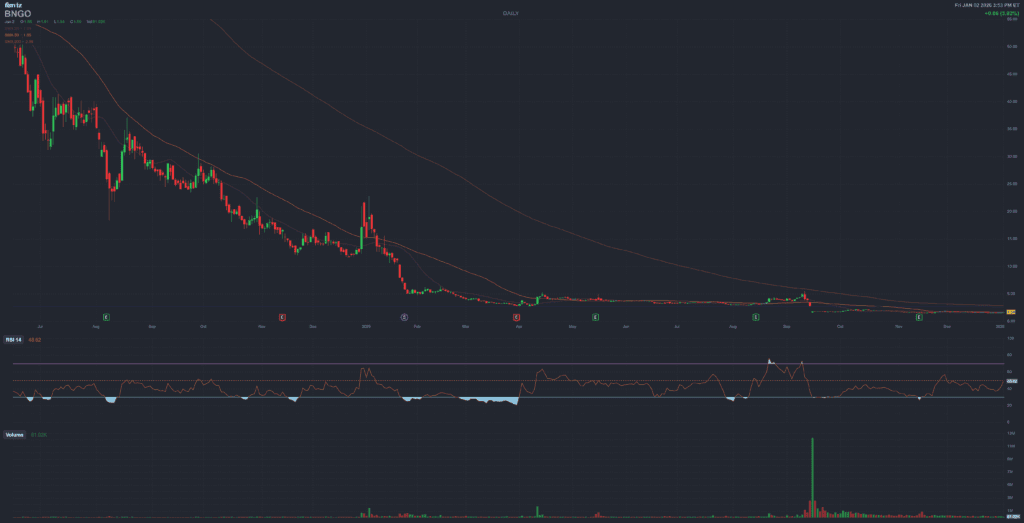
Bionano Genomics (BNGO) – Deep Dive 2026
OPTICAL GENOME MAPPING | SAPHYR & STRATYS | CPT & GOING CONCERN
The Cult of Optical Genome Mapping
High-tech cytogenetics, tiny revenue, massive retail tribe
Bionano Genomics is one of those names where the technology and the share price seem to live in different universes. On the lab side, optical genome mapping (OGM) keeps racking up publications, clinical use-cases and even a Category I CPT code with a 47% reimbursement boost for blood cancers. On the stock side, years of dilution, a 1-for-60 reverse split and repeated going-concern language in filings have turned BNGO into a symbol of “eternal potential with chronic financial stress”.
This report is written for readers who have seen the hype, the memes and the pain, and still want to know: what is really left here? Is Bionano just a relic of the 2020 genomics mania, or a small but real platform inching its way toward a sustainable niche in clinical cytogenetics?
Price action snapshot
BNGO – Daily chart

Core technology
Optical Genome Mapping (OGM)
Saphyr / Stratys systems + VIA software, focused on structural variants.
Installed base
379 OGM systems
Installed base as of Q1 2025, +9% year-over-year.
Revenue & margin
~7–8M$ per quarter
2025 revenue in the high-20M range, gross margin mid-40%s.
Runway
Into early 2026
Runway extended via heavy cost cuts and a small equity raise.
Why look at Bionano now – Between CPT upgrade and cash timer
Block 1 – News layer and setup
In late 2025, CMS confirmed a 47% increase in the 2026 Clinical Lab Fee Schedule payment for the Category I CPT code that covers optical genome mapping in hematologic malignancies. In practice, that means the US reimbursement benchmark for an OGM-based blood cancer test went from roughly $1.260 to around $1.850 per test – a big signal that payers are starting to recognise the value (and cost) of this technology.
At almost the same time, Bionano reported:
- solid gross margins in the mid-40% range,
- operating expenses cut by roughly two-thirds versus a year earlier,
- a cash position that extends runway only into the first part of 2026,
- a stock price that reflects years of dilution, reverse split and investor fatigue.
In other words, the external world is slowly making it easier to monetise OGM in real clinical workflows, just as the internal financial clock is still ticking loudly. For a long-form report, that combination – genuine technological traction versus brutal financial constraints – is exactly where the story gets interesting.
Executive summary – A bullish lens on a stressed balance sheet
What the cult loves, what the filings remind us, and why both matter.
What the bull side sees
- Unique tech: OGM can see structural variants (SVs) that karyotype, FISH and short-read sequencing often miss, at genome-wide scale and with higher resolution than classical cytogenetics.
- Growing clinical evidence: dozens of peer-reviewed papers and eBooks from major centres show OGM picking up Tier 1 variants in leukemias and constitutional disorders that alter diagnosis and risk classification.
- CPT + reimbursement tailwind: a Category I CPT code and a meaningful 2026 CLFS price hike are exactly the type of infrastructure Bionano needed to turn publications into billable tests.
- Installed base: nearly 380 OGM systems placed worldwide, with a strategy focused on “routine users” who keep buying consumables and software.
- Massive retail following: BNGO remains one of the most heavily watched tickers on Stocktwits among small-cap genomics names, with countless long-term holders who know the story inside out.
Real technology edge in SVs
CPT & reimbursement leverage
Sticky installed base
What the bear side keeps repeating
- Tiny revenue vs. ambition: even after years on the market, annual revenue sits in the tens of millions, far below what early bulls imagined.
- Going-concern language: filings explicitly state substantial doubt about the company’s ability to continue operations beyond the current runway without new capital.
- Heavy dilution & reverse split: share count has exploded, and a 1-for-60 reverse split brought the price back into whole-dollar territory without fixing fundamentals.
- Execution risk: converting technical validation and CPT codes into routine, reimbursed clinical adoption is a long, slow and uncertain process.
Going-concern in filings
Years of dilution
Execution risk in adoption
How to read this report
The rest of this report takes a deliberately bullish lens on the technology and the long-term opportunity for OGM, while being blunt about the financial and financing risks. It is the kind of write-up that BNGO fans will want to pass around – but it is not intended to ignore the very real possibility that the balance sheet may need yet another rescue if adoption is slower than hoped.
Technology – What optical genome mapping actually does
Why doctors and lab directors care, beyond the buzzwords.
Optical genome mapping is, at its core, a way to look at chromosomes at high resolution without sequencing every single base. Bionano’s Saphyr and newer Stratys systems take ultra-long DNA molecules, linearise them in nanochannels, label specific motifs and image them to build a map of the genome on the scale of tens to hundreds of kilobases.
In practice, that means:
- Detecting all major classes of structural variants – large insertions, deletions, inversions, translocations, duplications and complex rearrangements – across the genome.
- Doing so with a resolution far better than a conventional karyotype, and often catching events that FISH panels miss because they do not target those regions.
- Offering a single workflow that can, in principle, replace or consolidate multiple legacy cytogenetic tests.
Where OGM shines
- Hematologic malignancies (AML, ALL, MDS) where structural variants drive risk stratification and treatment choices.
- Constitutional cytogenetics: balanced translocations, complex rearrangements, repeat expansions.
- Cases where standard karyotype is “normal” but clinical suspicion remains high.
Several large studies from major centres have shown that OGM picks up Tier 1 variants missed by conventional methods in a meaningful fraction of cases, and often reclassifies risk categories in a way that could alter management.
Where OGM does not replace other tools
- It does not see small single nucleotide variants (SNVs) or tiny indels – short-read or long-read sequencing is still needed for that level of detail.
- Some centromeric and highly repetitive regions remain challenging, even for OGM.
- Many labs still want an NGS-based solution for panels or exomes, and may view OGM as a complement rather than a full replacement.
The realistic bull case is not that OGM kills NGS or karyotype overnight, but that it becomes a key component of a modern cytogenetic workflow for labs that care deeply about structural variant resolution.
Business model – From “sell instruments” to “monetise routine users”
How Bionano tries to turn OGM from cool tech into recurring revenue.
Revenue stack
- Systems (Saphyr / Stratys): capital instruments placed at cytogenetic labs and research centres.
- Consumables: nanochannel array flow cells and reagents, bought repeatedly by routine users.
- Software: VIA and related analysis platforms, increasingly central to the workflow.
- Clinical services / LDTs: OGM-based lab-developed tests (e.g., for hematologic malignancies) that can now bill under Category I CPT codes.
Over the last year, Bionano has explicitly shifted focus away from one-off instrument sales and discontinued some lower-margin clinical services to concentrate on:
- supporting established routine users,
- driving higher utilisation (more flow cells per installed system),
- supporting customers in getting OGM reimbursed in their local systems.
What this means in practice
- Revenue growth is now less about “adding dozens of new systems” and more about how often existing systems are used and billed.
- The company’s guidance to install 15–20 new systems in 2025 is modest in absolute numbers, but targeted at sites likely to become heavy OGM users.
- The long-term value of each placed instrument depends heavily on reimbursement and on OGM being written into lab menus and clinical guidelines.
For investors, the lesson is simple: BNGO is not an Illumina-style “high-throughput sequencing monopoly” story. It is a niche instrument + consumables + LDT play that lives or dies on the depth, not just breadth, of OGM adoption.
Financial profile – Cost cuts, better margins, but the clock is still ticking
What the last few quarters say about runway and risk.
Key recent numbers (high level)
- Quarterly revenue in the mid-single-digit to high-single-digit million range.
- Gross margin improved into the mid-40%s, up from low-30%s a year earlier.
- Operating expenses reduced by roughly two-thirds versus the prior year, thanks to restructuring and headcount cuts.
- Net loss dramatically narrowed compared with past quarters, but still negative.
- Cash and equivalents around the low-30M$ range after a small equity raise, with runway guided into early 2026.
From an operational standpoint, Bionano has clearly done the painful work of shrinking its cost base and improving gross margins. From a balance-sheet standpoint, it is still living quarter to quarter.
Why the going-concern language matters
- When filings explicitly mention “substantial doubt” about the ability to continue operations without new financing, it is not a throwaway line – it is a serious signal from auditors.
- Even strong gross margins and cost cuts cannot fully offset the fact that growth is still small in absolute dollars and the company has limited cash.
- Any slowdown in adoption, delay in reimbursement, or macro shock can bring back the question of further dilution sooner than investors would like.
The entire bullish thesis on BNGO technology has to be layered on top of this reality: unless revenue accelerates and/or non-dilutive capital appears, Bionano may need more equity or strategic capital to get to scale.
Adoption & reimbursement – CPT codes, CLFS and real-world use
Why the 47% CLFS bump is a big deal for a small company.
OGM’s path into real clinical workflows is not just about technical performance; it is about reimbursement and guidelines.
CPT & CLFS
- A Category I CPT code exists for genome-wide cytogenomic analysis using OGM in hematologic malignancies – a crucial milestone for routine billing in the US.
- For 2026, CMS raised the CLFS payment for that code by roughly 47%, bringing it into a range that better reflects the complexity of OGM-based testing.
- This makes it easier for labs to justify offering OGM-based LDTs without losing money on every test.
Clinical footprint
- Installed base: 379 OGM systems at the end of Q1 2025, up 9% year-over-year.
- Focus on “routine users” – labs that run OGM regularly, not just for one project.
- Growing number of peer-reviewed publications and real-world series in hematologic malignancies and constitutional cytogenetics.
- Expert recommendations from some groups that position OGM as a central piece of modern cytogenetic workflows.
For a small company like Bionano, this emerging infrastructure – codes, reimbursement levels, clinical evidence – is the difference between OGM as a cool research toy and OGM as a billable, scalable lab service.
Who owns BNGO – Ownership and analyst view
Retail cult, thin institutional layer and a handful of high-upside targets.
Ownership snapshot
- General public / retail: the vast majority of shares are held by individual investors.
- Institutions: a small slice of the cap table, including a few specialised funds.
- Insiders: a very small percentage relative to total shares; recent filings do not show aggressive insider buying.
- Short interest: non-trivial, reflecting scepticism and trading interest in both directions.
In practice, this means BNGO trades like a classic retail stock: sentiment and social buzz can move it faster than fundamental news at times, especially around earnings and financing events.
Analyst coverage
- Only a small number of analysts cover Bionano, generally with Buy or Speculative Buy type ratings.
- Average 12-month price targets tend to cluster around the mid-single-digit to high-single-digit dollar range, implying several hundred percent upside versus the current share price.
- These targets are usually built on aggressive revenue growth assumptions and a belief that OGM will become a standard component of cytogenetics, at least in certain indications.
- Conversely, the market’s very low current valuation reflects investors who either doubt that scenario or doubt Bionano’s ability to survive long enough to benefit from it.
Analyst targets with big upside
Thin coverage, high uncertainty
Sentiment – Inside the BNGO tribe
How Stocktwits, Reddit and X keep the story alive (for better and worse).
BNGO is one of those tickers where the community is almost a character in the story. If you scroll back to the 2020–2021 period, you find YouTube videos, WallStreetBets threads and Stocktwits posts presenting Bionano as “the next big genomics play”. Years later, much of that early crowd has moved on – but a surprisingly large core remains.
Stocktwits – Thousands of eyes on every move
BNGO’s Stocktwits page has built up one of the largest watcher counts among small genomics names, with message volume that spikes around earnings, offerings and technology updates.
Typical bullish talking points:
- “OGM is the future of cytogenetics, we’re just early.”
- “379 systems is just the start, once CPT & reimbursement are set this scales.”
- “At this market cap, any real adoption or buyout is life-changing.”
These are opinions from non-professional traders. They are useful for gauging mood, not as a source of verified data.
Reddit – DD, nostalgia and bagholder therapy
The r/BNGO subreddit has hosted deep-dive posts explaining OGM in detail, alongside classic “Why you should care about Bionano” threads dating back to the 2021 boom. Today, you find a mix of:
- long DDs on OGM vs NGS and karyotype,
- updates on publications, guidelines and CPT news,
- raw stories from bagholders who rode the stock from pennies to double digits and back down.
Reddit is a great archive of how the narrative evolved, but every number should be cross-checked against official filings.
X (Twitter) – Quick takes on each press release
On X, BNGO usually pops up when:
- a new big heme paper mentions OGM,
- a major conference (ASH, ASHG, AMP) features an OGM session,
- CMS or payers update reimbursement levels.
Threads often alternate between excitement over the tech and frustration at the share price, reflecting the tension at the core of the story.
Again, most accounts are individual traders and scientists; their comments are not investment advice.
Taken together, these platforms show a community that has suffered heavy drawdowns but still believes that OGM is worth fighting for. That loyalty can keep a stock alive much longer than textbooks would predict – but it can’t by itself refill the cash balance or close the gap to profitability.
The Cult of Optical Genome Mapping – A story within the story
A long narrative you can share to explain why BNGO still has a following.
Story box
How a genomics side-show became a multi-year obsession
In the early 2020s, Bionano looked like a side-quest in the broader genomics boom. While everyone talked about mRNA vaccines, CRISPR and exponential drops in sequencing cost, BNGO was this small company talking about optical genome mapping – a technology that did not sequence bases, but looked at chromosomes in unprecedented detail.
The promise was simple and seductive: where short-read sequencing and karyotype struggle with structural variants, OGM would make them visible, actionable and, eventually, routine. The stock reacted the way speculative biotech stocks often do when a good story meets a liquid ticker: it exploded upward.
Then reality showed up.
Revenue came in, but small. Instrument sales took time. Many labs loved the data but were slow to put OGM into their official testing menus. Reimbursement was patchy. Competition for capital – and attention – in genomics remained fierce.
At the same time, Bionano’s cost base remained heavy. The company was investing in R&D, sales, support, software and clinical evidence. Burn was high, and the balance sheet could not sustain that pace forever.
Eventually, the stock gave back most of its early gains. Dilution followed, and then the reverse split: one share for every sixty old ones, a numerical reset that cleans up the ticker but cannot erase the history on long-term holders’ brokerage statements.
Yet, unlike many boom-and-bust names that disappear quietly, Bionano refused to fade.
The company cut costs aggressively, focused on its most committed users, and kept publishing data. Studies from major centres in hematology and rare diseases showed OGM finding clinically relevant structural variants that conventional methods did not catch.
Meanwhile, the external world moved an inch closer. A Category I CPT code arrived for OGM-based cytogenomic testing in blood cancers. Then, in 2025, CMS decided that the 2026 reimbursement level for that code should be raised dramatically, acknowledging that the added information OGM brings is worth paying for.
For the die-hard BNGO bulls, these milestones are vindication: proof that the technology was never the problem, only the timing and the capital structure. For sceptics, they are too little, too late for a company that still trades on fumes.
Somewhere between those two extremes sits the real story:
- A small company that built a genuine, differentiated technology in a corner of genomics that truly matters for some patients.
- A brutal financing history, where early dreams collided with the slow, bureaucratic reality of clinical adoption.
- A community of investors and scientists who, even after the hype has burned off, still care about whether this tool becomes part of everyday medicine.
Whether the cult of OGM ends in a quiet fade-out, a slow grind to profitability, or a strategic transaction where a larger diagnostics player takes over, is impossible to know in advance. What is clear is that Bionano has become more than a pandemic-era chart pattern; it is a live case study in how hard it is to turn real innovation into sustainable business in genomics – and how long a good story can survive in the mind of the market.
Scenarios – Base, bull and bear lenses on BNGO
Not predictions, but frames to avoid getting lost in noise.
Scenario 1
Base case – Survival and slow institutionalisation
- OGM adoption grows steadily among routine users, but remains a niche rather than explosive.
- Revenue climbs gradually from the current tens of millions toward a more sustainable base.
- Cost discipline holds, and modest additional capital (equity or strategic) bridges the gap beyond 2026.
- BNGO trades as a high-risk, high-volatility diagnostics small cap with occasional spikes on news.
Scenario 2
Bull case – OGM becomes a standard cytogenetic backbone
- Major guidelines and large lab networks adopt OGM as a preferred or required test for structural variant analysis in certain heme and constitutional indications.
- Utilisation per system and reimbursement combine to drive revenue growth well above current consensus, with gross margins expanding.
- Bionano reaches breakeven and ultimately profitability, or becomes an acquisition target for a larger diagnostics or life-science-tools company.
- Early believers see a recovery in valuation that more closely reflects the technology’s impact.
Scenario 3
Bear case – Great tech, not enough time or scale
- OGM remains a useful but niche tool, adopted by a limited number of centres without driving enough volume to support Bionano as a standalone public company.
- Revenue growth disappoints, forcing continued dilution or unfavourable financing to keep the lights on.
- Larger players either build their own variants of OGM-like technology or integrate alternative approaches, reducing the strategic appeal of acquiring BNGO.
- In the worst case, assets are sold or licensed on the cheap, and common shareholders see little recovery despite the tech’s scientific merit.
Risk map and disclaimers – Clear boundaries
Scientific, commercial, financial and sentiment risks in one place.
Scientific and adoption risk
Even with strong technical performance, OGM adoption depends on clinicians, guideline committees and lab directors. Competing technologies, budget constraints and inertia can all slow or block uptake.
Commercial and reimbursement risk
CPT codes and CLFS rates are necessary but not sufficient. If individual payers or health systems decide not to reimburse or to favour more established methods, growth may stall.
Financial and dilution risk
Bionano is not yet self-sustaining. Cash runway is limited, and future capital raises – whether equity, debt or strategic – may be needed. Existing shareholders have already experienced significant dilution.
Sentiment and volatility
A large, passionate retail base can amplify both rallies and sell-offs, especially around financing events, earnings and reimbursement headlines. Price moves can be extreme relative to short-term fundamentals.
Important notice – Not investment advice
This report is an educational, informational document. It is not, and must not be interpreted as, a recommendation to buy, sell or hold any security. The content is based on public sources believed to be reliable at the time of writing, but may become outdated or incomplete without notice.
The author is not a licensed financial advisor or portfolio manager. Any reference to scenarios, risks or opportunities is purely illustrative and does not take into account your individual financial situation, objectives or risk tolerance.
Before making any investment decision, you should perform your own research, read the official filings and, where appropriate, consult qualified professionals. For legal information, risk disclosures and terms of use, please refer to:
Some links in this report may refer to partner or affiliate services. Where present, such relationships do not alter the independence of the analysis and do not constitute a recommendation to subscribe or purchase.
Biotech Catalyst Calendar
If you want a broader view of upcoming biotech catalysts – PDUFA decisions, clinical readouts, advisory committees and other key regulatory dates – you can explore the Biotech Catalyst Calendar maintained by Merlintrader trading Blog.
Open Biotech Catalyst CalendarBionano Genomics (BNGO) – Analisi approfondita 2026
OPTICAL GENOME MAPPING | SAPHYR & STRATYS | CPT & GOING CONCERN
Il culto dell’Optical Genome Mapping
Tecnologia forte, ricavi piccoli, community enorme
Bionano Genomics è uno di quei casi in cui tecnologia e grafico sembrano raccontare due storie diverse. Dal lato laboratorio, l’Optical Genome Mapping continua a produrre dati, pubblicazioni e ora anche codici CPT con rimborso in crescita nei tumori del sangue. Dal lato borsa, anni di diluizione, reverse split 1:60 e linguaggio da “going concern” nei filing hanno trasformato BNGO in un simbolo di “potenziale enorme e cassa sempre tirata”.
Questo report è pensato per chi ha visto hype, meme e tonfi e vuole ancora capire: cosa resta davvero qui dentro? Bionano è solo un reperto del boom genomico 2020, o una piccola piattaforma con una tecnologia reale che sta cercando di ritagliarsi uno spazio nella citogenetica clinica moderna?
Fotografia del prezzo
BNGO – Grafico giornaliero
Tecnologia chiave
Optical Genome Mapping
Sistemi Saphyr/Stratys + software VIA, focus sulle varianti strutturali.
Base installata
379 sistemi OGM
Dato fine Q1 2025, +9% anno su anno.
Ricavi & margini
~7–8M$ a trimestre
Ricavi 2025 nell’ordine delle decine di milioni, gross margin mid-40%.
Runway
Fino a inizio 2026
Runway estesa con tagli costi aggressivi e piccole raccolte di capitale.
Perché guardare BNGO adesso – Tra upgrade di rimborso e timer sulla cassa
Blocco 1 – Strato news e contesto
A fine 2025 CMS ha confermato un aumento di circa il 47% nella tariffa CLFS 2026 per il codice CPT di Categoria I che copre i test OGM nei tumori ematologici. Tradotto: il rimborso di riferimento negli USA per un test OGM sui tumori del sangue sale da poco sopra i 1.260$ a circa 1.850$ a test – un segnale forte che i payer iniziano a riconoscere il valore (e il costo) di questa tecnologia.
Nello stesso periodo Bionano ha riportato:
- ricavi trimestrali nell’ordine dei 6–7M$ con margini in netto miglioramento,
- spese operative tagliate di circa due terzi rispetto all’anno precedente,
- una posizione di cassa che copre solo fino ai primi mesi del 2026,
- un prezzo di borsa che incorpora anni di diluizione e sfiducia.
In sintesi: il mondo esterno inizia a rendere più facile monetizzare OGM nei flussi clinici, proprio mentre il timer interno della cassa continua a ticchettare. Per un report lungo, è esattamente la combinazione in cui la storia si fa interessante.
Executive summary – Lente rialzista su un bilancio sotto pressione
Cosa vede il “culto” e cosa ricordano i numeri.
Cosa vede la parte rialzista
- Tech unica: OGM può vedere varianti strutturali che karyotype, FISH e short-read spesso si perdono.
- Evidence crescente: studi real-world in ematologia e genetica costituzionale mostrano SV clinicamente rilevanti non viste dalle tecniche tradizionali.
- CPT + CLFS: codice CPT di Categoria I e aumento importante della tariffa 2026, passo chiave per rendere i test OGM sostenibili a livello economico.
- Base installata: quasi 380 sistemi posizionati, con focus sui “routine users” che consumano flow cell e software.
- Community enorme: BNGO resta uno dei ticker genomici più seguiti su Stocktwits tra le small cap.
Cosa non smette di ripetere il mercato scettico
- Ricavi piccoli: dopo anni, siamo ancora nell’ordine delle decine di milioni l’anno, non centinaia.
- Going concern: nei filing c’è linguaggio esplicito sul dubbio di continuità aziendale senza nuova finanza.
- Diluizione + reverse split: numero di azioni esploso, reverse 1:60, fiducia erosa.
- Rischio di esecuzione: trasformare evidenza scientifica in adozione clinica routinaria è un percorso lungo e accidentato.
Tecnologia – Cosa fa davvero l’Optical Genome Mapping
Perché ai medici interessa, al di là delle slide.
L’Optical Genome Mapping permette di guardare al genoma “in grande”, senza sequenziare ogni singola base. I sistemi Saphyr/Stratys prendono DNA ultra-long, lo linearizzano in nano-canali, marcano motivi specifici e “fotografano” l’architettura cromosomica con risoluzione molto superiore al karyotype classico.
Dove OGM brilla
- Tumori ematologici in cui le varianti strutturali definiscono rischio e scelte terapeutiche.
- Casi costituzionali con traslocazioni bilanciate, riarrangiamenti complessi, espansioni di ripetizioni.
- Situazioni in cui il karyotype è “normale” ma il quadro clinico non torna.
In diversi studi OGM ha identificato varianti Tier 1 non viste da metodi standard, con potenziale impatto diretto sulla classificazione e, in alcuni casi, sulle decisioni terapeutiche.
Dove OGM non sostituisce il resto
- Non vede SNV e piccole indel: lì serve comunque il sequenziamento.
- Alcune regioni centromeriche e altamente ripetitive restano difficili.
- Molti lab preferiscono un approccio combinato OGM + NGS, non uno “o l’altro”.
La tesi realistica non è “OGM elimina il sequenziamento o la citogenetica classica”, ma “OGM diventa un pezzo centrale del workflow citogenetico moderno per alcune indicazioni”.
Modello di business – Da “vendere strumenti” a “monetizzare gli utenti routinari”
Come Bionano prova a trasformare OGM in ricavi ricorrenti.
Le fonti di ricavo
- Sistemi Saphyr/Stratys installati nei lab.
- Consumabili (flow cell, reagenti) per gli utenti che usano OGM in modo routinario.
- Software VIA e piattaforme di analisi.
- Test clinici / LDT OGM-based che fatturano con codici CPT dedicati.
Cosa è cambiato di recente
- meno focus su “piazzare più sistemi possibile”, più focus su chi li usa davvero tutti i giorni;
- uscita da alcuni servizi clinici meno strategici;
- puntare su rimborso, linee guida e “routine users” come vero motore di crescita.
Per un investitore questo significa che la storia non è più “quanti sistemi piazziamo?” ma “quanto produce ciascun sistema in mano ai power user?”.
Profilo finanziario – Margini meglio, ma la cassa conta i mesi
Cosa dicono gli ultimi trimestri su rischio e runway.
Punti chiave recenti
- Ricavi trimestrali nell’ordine di 6–7M$.
- Gross margin salito in area 40–50%, rispetto al 30% scarso di un anno fa.
- Spese operative tagliate di circa due terzi via ristrutturazioni e riduzione headcount.
- Perdita netta molto ridotta rispetto al passato, ma ancora presente.
- Cassa nell’ordine dei 30M$, runway guidato fino a inizio 2026.
Perché il “going concern” è centrale
Anche con margini migliori e costi più bassi, Bionano non è ancora autosufficiente. I filing ricordano chiaramente che, senza nuova finanza o un’accelerazione significativa dei ricavi, la capacità di continuare l’attività oltre la runway dichiarata non è garantita.
Tutta la tesi rialzista su OGM va letta sopra questo strato: il rischio di ulteriori diluizioni o accordi “di sopravvivenza” resta concreto.
Adozione & rimborso – CPT, CLFS e uso reale
Perché il +47% del CLFS non è solo una nota a margine.
CPT & CLFS
- Codice CPT Categoria I per analisi citogenomica genome-wide con OGM nei tumori ematologici.
- Tariffa CLFS 2026 aumentata di circa il 47% rispetto al livello iniziale.
- Per i lab significa più facilità nel proporre LDT OGM-based senza drenare margine su ogni test.
Impronta clinica
- Base installata di 379 sistemi a fine Q1 2025, in crescita anno su anno.
- Focus su utenti routinari, non su installazioni “one-off”.
- Numero crescente di pubblicazioni peer-reviewed e serie real-world.
- Raccomandazioni di alcuni gruppi che posizionano OGM come componente chiave nei flussi di laboratorio moderni.
Per una microcap, questi mattoni – codice, tariffa, evidence – sono la differenza fra un giocattolo da congresso e un servizio di laboratorio che può generare ricavi ricorrenti.
Chi possiede BNGO – Azionariato e analisti
Retail dominante, istituzionali sottili, pochi target ma aggressivi.
Azionariato
- La grande maggioranza delle azioni è in mano agli investitori retail.
- Gli istituzionali ci sono, ma rappresentano solo una fetta ridotta.
- Gli insider detengono una percentuale molto piccola del totale azioni.
- Short interest non banale, con spazio per short squeeze locali ma anche pressione costante.
Analisti
- Pochi analisti coprono il titolo; rating tipicamente Buy/Speculative Buy.
- Target medi intorno ai 7–8$ (post-reverse split), con upside percentuale enorme rispetto ai prezzi attuali.
- Modelli spesso basati su crescita forte dei ricavi e adozione OGM come “quasi standard” in alcune aree.
- Il mercato reale, per ora, sconta uno scenario molto più prudente.
Sentiment – Dentro la tribù BNGO
Come Stocktwits, Reddit e X tengono viva la storia.
BNGO è uno di quei titoli in cui la community ha un ruolo da protagonista. Nel 2020–2021 c’erano thread ovunque, video, post “why you should care”. Oggi il rumore si è abbassato, ma un nucleo fedele continua a seguire ogni news.
Stocktwits – Migliaia di assicurati a ogni mossa
La pagina BNGO su Stocktwits ha accumulato nel tempo un numero molto alto di follower per una small cap di questo tipo. Il titolo entra spesso fra i più discussi quando escono dati o nuove emissioni.
Tra i mantra bullish tipici:
- “OGM è il futuro della citogenetica, il mercato prima o poi se ne accorge.”
- “379 sistemi sono l’inizio, non la fine – ora arriva il rimborso.”
- “Con questa market cap basta poco per cambiare tutto.”
Reddit – DD, nostalgia e terapia di gruppo
Su r/BNGO si trovano ancora post lunghi che spiegano OGM, insieme ai vecchi thread “Bionano Genomics – why you should care”. Oggi la mix è:
- analisi tecnica sul confronto OGM vs NGS/karyotype;
- aggiornamenti su paper, linee guida e rimborso;
- racconti di chi è dentro da anni, tra errori, reverse e ricadute.
X (Twitter) – Reazioni rapide a studi e rimborso
Su X BNGO compare quando:
- escono studi importanti in ematologia con OGM;
- si tiene una sessione grossa a convegni (ASH, ASHG, AMP);
- CMS o payer aggiornano le tariffe.
È il posto dove si vede quanto velocemente viaggia la narrativa, non dove verificare i numeri.
Il culto dell’OGM – Storia nella storia
Perché, nonostante tutto, se ne parla ancora.
Story box
Come una tecnologia di nicchia è diventata un’ossessione di lungo periodo
All’inizio Bionano sembrava un “side quest” nel grande boom della genomica. Mentre tutti parlavano di mRNA, CRISPR e sequencing a basso costo, BNGO raccontava di una tecnologia che non sequenziava tutto, ma guardava la struttura dei cromosomi come non si era mai visto.
La promessa era semplice e potente: dove il sequenziamento corto e il karyotype fanno fatica sulle varianti strutturali, OGM le mette in chiaro, a livello genome-wide. Il mercato, per un po’, ha reagito come fa con molte “story stock”: con un’esplosione di prezzo.
Poi è arrivata la realtà:
i ricavi sono cresciuti, ma non ai livelli sognati; l’adozione nei lab è stata più lenta del previsto; i costi per portare avanti R&D, studi, vendite e supporto erano alti. Quando la cassa ha iniziato a scricchiolare, è arrivata la parte classica: nuove azioni, diluizione, reverse split, lingua di “going concern” nei documenti ufficiali.
In molti casi, storie così muoiono qui. Invece Bionano no.
La società ha tagliato i costi, ha concentrato gli sforzi sugli utenti più attivi e ha continuato a produrre dati. Intanto, il mondo esterno ha fatto un piccolo passo verso di lei: codici CPT, rimborso più alto, studi che mostrano OGM in grado di cambiare la diagnosi in una frazione non banale di pazienti.
Oggi il paradosso è questo: la tecnologia ha più riconoscimento di prima, ma il titolo vale una frazione di quello che valeva ai tempi del boom.
Ed è qui che il “culto dell’OGM” trova il suo terreno:
- chi è convinto che il mercato stia sottovalutando qualcosa di importante;
- chi è rimasto incastrato e spera in un riscatto nel lungo periodo;
- chi vede in Bionano un case study perfetto di quanto sia dura trasformare innovazione vera in business sostenibile.
Che questo culto finisca con un lieto fine, con un tentativo di buyout o con la vendita degli asset a sconto, è impossibile dirlo adesso. Ma se oggi BNGO è ancora oggetto di discussione, è perché racconta bene un pezzo della realtà biotech: la tecnologia può essere avanti, ma senza capitale e tempo a sufficienza non sempre arriva al letto del paziente.
Scenari – Base, bull, bear
Non per prevedere, ma per non farsi travolgere dal rumore.
Scenario 1
Base case – Sopravvivenza e istituzionalizzazione lenta
- OGM cresce come tecnologia di nicchia ma utile; nuovi lab la adottano con calma.
- I ricavi aumentano gradualmente, ma senza esplosioni.
- Servono ancora aggiustamenti di spesa e magari un po’ di capitale extra, ma la storia resta viva.
Scenario 2
Bull case – OGM diventa backbone in alcune aree
- Linee guida e grandi network lab inseriscono OGM come test di riferimento per particolari indicazioni.
- I ricavi raddoppiano/triplicano dai livelli attuali nel giro di qualche anno.
- Bionano arriva a un equilibrio sostenibile o viene acquistata da un big della diagnostica.
Scenario 3
Bear case – Tech buona, ma non abbastanza tempo
- OGM resta una tecnologia apprezzata ma troppo di nicchia per sostenere l’azienda da sola.
- I ricavi non crescono abbastanza in fretta e la cassa si assottiglia.
- Nuova diluizione pesante o vendita degli asset diventano le uniche vie.
Risk map e disclaimer – Paletti chiari
Rischi scientifici, commerciali, finanziari e di sentiment.
Rischio scientifico / adozione
Anche con ottimi dati, l’adozione dipende da medici, lab director e payer. Nuove tecnologie possono restare ai margini se non trovano spazio nei workflow e nei budget.
Rischio commerciale / rimborso
Il fatto che esista un codice CPT e una tariffa CLFS più alta non garantisce che tutti i payer rimborsino allo stesso modo o che ogni lab adotti OGM nelle sue routine.
Rischio finanziario / diluizione
La runway resta limitata. Se i ricavi non accelerano, servono altre mosse: ulteriori emissioni, debito, accordi strategici, con possibili impatti sugli azionisti attuali.
Rischio di sentiment / volatilità
Una base retail molto coinvolta amplifica movimenti in entrambe le direzioni. Nuove offerte di azioni, filing o anche solo rumor possono generare spike o crolli non sempre proporzionati alle notizie.
Avvertenza importante – Nessuna raccomandazione di investimento
Questo report è un documento informativo ed educativo. Non costituisce, e non deve essere interpretato come, una raccomandazione a comprare, vendere o mantenere strumenti finanziari. I contenuti si basano su fonti pubbliche ritenute affidabili al momento della stesura, ma possono diventare superati o incompleti senza preavviso.
L’autore non è un consulente finanziario abilitato né un gestore patrimoniale. Ogni riferimento a scenari, rischi o opportunità è puramente illustrativo e non tiene conto della situazione personale del lettore.
Prima di prendere decisioni di investimento, è opportuno effettuare ricerche autonome, leggere i filing ufficiali e, se necessario, rivolgersi a professionisti qualificati. Per informazioni legali, avvertenze e condizioni d’uso:
Biotech Catalyst Calendar
Se vuoi una panoramica più ampia dei prossimi catalyst biotech – decisioni PDUFA, readout clinici, advisory committee e altre scadenze regolatorie – puoi consultare il Biotech Catalyst Calendar aggiornato su Merlintrader trading Blog.
Apri il Biotech Catalyst CalendarScanner for active traders

Try ChartsWatcher free, then unlock 10% OFF with SAVE10
ChartsWatcher is a real-time scanner for momentum traders: fast movers, unusual volume and rotations — so you can focus on the few tickers that matter right now, instead of watching hundreds of charts.
Start with the free version. When you upgrade, use SAVE10 for 10% OFF your first paid period.
Start free – then use SAVE10
No credit card required to start. Apply SAVE10 when upgrading.
Recommended platform

One platform. All your brokers.
Medved Trader connects multiple brokers in one workspace, with pro charts, hotkeys and fast execution — without changing your broker accounts.
A single cockpit for positions, Level II and multi-broker order routing, built for active day & swing traders.
Get 1 Month Free ➔
Multi-broker workflow + customizable layouts in one platform.
 Monica.im – the AI assistant I use every day
If you find value in the work I publish on Merlintrader and want a practical AI assistant for research and writing, you can sign up using this referral link. Click here to try Monica.im and support the site
Find out how I use AI on Merlintrader: AI, retail and Merlintrader
Disclosure: some of the links in the promotional blocks above are affiliate or referral links. If you choose to subscribe or sign up through them, Merlintrader may receive a small commission or benefit at no extra cost to you.