






Axsome Therapeutics (AXSM) – Deep Dive 2026
CNS | AUVELITY, SUNOSI, SYMBRAVO | AXS-05 PDUFA APRIL 30
The Brainstorm Before the Decision
Alzheimer’s agitation, a crowded CNS pipeline and a retail base watching the April 30 PDUFA
Axsome Therapeutics is no longer just “the Auvelity company”. In 2025 it quietly turned into a multi-product CNS platform with three marketed drugs, a late-stage pipeline and, now, a Priority Review from the FDA for AXS-05 in agitation associated with Alzheimer’s disease – with a PDUFA action date set for April 30, 2026.
This report is written with that deadline in mind. The goal is not to guess the exact outcome, but to understand what Axsome really is going into that decision: how the business model works, how the cash is being used, how strong the retail and institutional support looks, and why the sentiment around AXSM is much more than a simple “PDUFA trade”.
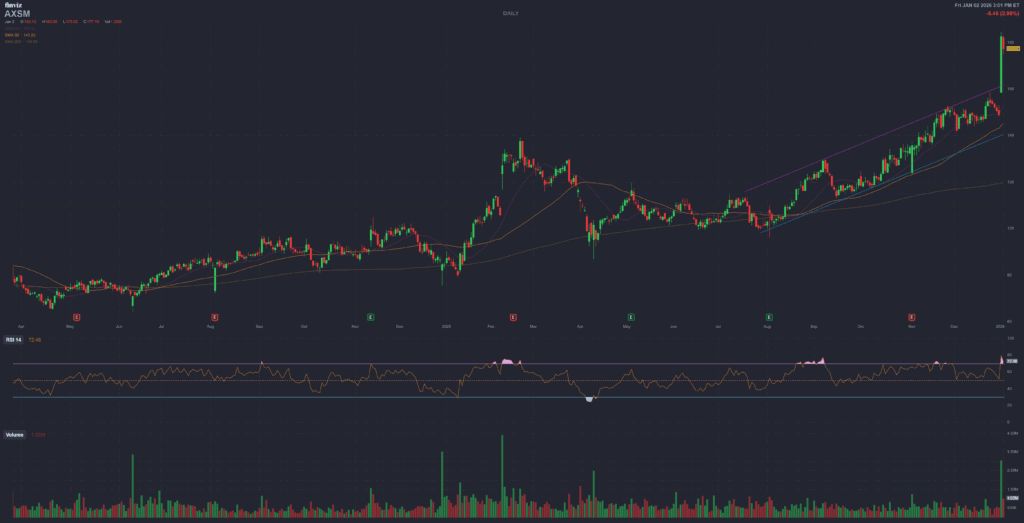
Price action snapshot
AXSM – Daily chart

Marketed products
Auvelity, Sunosi, Symbravo
Q3 2025 net product revenue: $171M, +63% YoY.
Key catalyst
AXS-05 Alzheimer’s agitation
sNDA Priority Review, PDUFA April 30, 2026.
Cash & runway
~$325M (Q3 2025)
Management guides current cash into cash-flow positivity.
Ownership
Mostly institutional + founder
Institutions hold the majority; CEO Herriot Tabuteau retains a meaningful stake.
Why look at Axsome now – The Alzheimer’s agitation PDUFA
Block 1 – News layer and setup
At the end of 2025, the FDA accepted Axsome’s supplemental NDA for AXS-05 in agitation associated with Alzheimer’s disease and granted Priority Review, with an action date of April 30, 2026. That decision sits on top of four Phase 3 trials in Alzheimer’s agitation (three positive, one numerically favourable but not statistically significant) and a strong safety profile relative to existing options.
This is not just “another indication” tacked on to an antidepressant. Agitation touches a large proportion of Alzheimer’s patients, has very limited treatment options and is a daily pain point for caregivers. If AXS-05 secures a label here, it can meaningfully change both the commercial profile of the drug and the way investors think about Axsome’s overall CNS platform.
At the same time, AXSM is trading near all-time highs with a multi-billion market cap, a growing base of institutional holders, and a vocal community of retail investors who follow every data point, every conference presentation and every insider filing. That combination – real products, real revenue, real catalyst and real emotion – is exactly what makes this name worth a long, structured look before April 30.
Executive summary – A bullish lens, with clear strings attached
What Axsome is today, and why the April decision is just one chapter.
What Axsome has already achieved
- Three marketed drugs: Auvelity for major depressive disorder, Sunosi for excessive daytime sleepiness in narcolepsy/OSA, and Symbravo for acute migraine.
- Strong revenue growth: Q3 2025 net product revenue of $171M, up 63% year-over-year, with Auvelity +69% and Sunosi +35% versus the prior year.
- Improving losses, solid cash: net loss in Q3 2025 of $47.2M, narrowed versus the prior year, with $325M in cash and equivalents and guidance that current cash should fund operations into cash-flow positivity under the existing plan.
- Late-stage pipeline: AXS-05 (Alzheimer’s agitation and smoking cessation), AXS-12 (narcolepsy), AXS-14 (fibromyalgia) and multiple Phase 3 programs with solriamfetol (ADHD, MDD with EDS, binge eating disorder, shift-work disorder).
Where the market still hesitates
- Execution risk: Axsome is scaling a commercial infrastructure while simultaneously funding several Phase 3 programs – mistakes here can be expensive.
- Competition: depression and migraine are crowded spaces, and even Alzheimer’s agitation has alternatives (e.g. antipsychotics) with known though imperfect profiles.
- Profitability still ahead: despite rapid revenue growth, the company remains loss-making, and the market is watching closely whether the 2026 profitability targets are realistic.
- Regulatory risk: past bumps such as the refusal-to-file letter for AXS-14 in fibromyalgia are a reminder that not every NDA goes smoothly.
High-level bullish pillars
- Multiple shots on goal: AXSM is not a one-PDUFA story. It already has three products on the market and several late-stage assets that can add indications or open new markets.
- Leverage to a big unmet need: Alzheimer’s agitation is a large, under-served indication where even a modestly effective, well-tolerated option can find real demand.
- Institutional + founder alignment: a high proportion of shares held by funds, plus a founder-CEO with a significant stake, create a different dynamic compared to nanocaps that rely almost entirely on retail.
- Active retail community: Stocktwits, Yahoo boards and Reddit follow AXSM closely – this amplifies both upside and downside moves, but it also means good analysis tends to travel.
Compressed timeline – From “just Auvelity” to platform + PDUFA
A quick chronology to understand how we got to April 30, 2026.
Rather than re-telling every quarter, this timeline focuses on the pivots that still matter today when framing the risk/reward around AXSM.
2022
Auvelity – a new kind of oral antidepressant
The FDA approves Auvelity (dextromethorphan/bupropion) for major depressive disorder, positioning Axsome as a commercial
CNS company and not just a development story. The drug’s mechanism – NMDA modulation and sigma-1 agonism – sets it apart
from generic SSRIs and SNRIs and becomes the backbone of future plans for AXS-05.
2023–2024
Scaling commercial + building the pipeline
Axsome expands its sales force and payer coverage for Auvelity and Sunosi, while pushing multiple Phase 3 programs.
Symbravo, a new migraine drug, gains approval and launches, adding a third commercial pillar. Revenue jumps, but
operating losses remain, as the company chooses growth and pipeline over short-term profitability.
2024–2025
Mixed Alzheimer’s data – but path to filing
AXS-05 shows strong results in some Alzheimer’s agitation studies and misses in another; the stock sells off on the
headline but recovers as management and analysts frame the totality of data and safety profile as sufficient for
a regulatory filing. The company prepares its sNDA package on the strength of three supportive Phase 3 readouts out of four.
Q3 2025
Commercial inflection and sNDA submitted
Q3 2025 net product revenue reaches $171M (+63% YoY) with Auvelity, Sunosi and Symbravo all contributing.
Net loss narrows to $47.2M and cash builds to ~$325M. Axsome submits the sNDA for AXS-05 in Alzheimer’s agitation,
signalling confidence in its dataset and safety.
Dec 2025 – Jan 2026
Priority Review, PDUFA locked
The FDA accepts the sNDA, grants Priority Review and sets an action date of April 30, 2026. The stock reacts sharply,
becoming one of the more closely watched CNS names going into 2026, with sentiment on trading platforms oscillating
between cautious optimism and “this is the catalyst that changes everything”.
The message of this timeline is simple: the April PDUFA is not a binary event on a single-asset microcap. It is a high-impact catalyst layered on top of an already meaningful commercial base and a diversified CNS pipeline.
Business model 2025–2028 – Multi-product CNS engine with leverage
How Axsome makes money today, and where the operating leverage could show up.
Revenue stack – Three pillars already in place
- Auvelity: the main growth driver, with Q3 2025 sales of $136.1M, up 69% year-over-year. Coverage now includes the majority of commercial and government lives in the US, and scripts continue to grow.
- Sunosi: Q3 2025 net revenue of $32.8M, +35% YoY, with broad payer coverage and a clear niche in narcolepsy and OSA-related sleepiness.
- Symbravo: a newer launch in migraine, with Q3 2025 sales of $2.1M as payer coverage ramps and prescribers gain familiarity.
Together, these three products generated $171M in Q3 2025 and are guided by management as the backbone for the transition to profitability, before accounting for any additional indications or new product launches.
Cost structure – Investing ahead of the curve
- R&D expenses in Q3 2025 were $40.2M, slightly down year-over-year as some programs completed trials, but still significant given the number of ongoing studies.
- SG&A reached $150.2M in Q3 2025, up sharply versus the prior year, driven by sales force expansion, direct-to-consumer campaigns for Auvelity and the launch of Symbravo.
- Net loss, however, improved to $47.2M, and cash increased to $325.3M, with management explicitly stating that current cash should fund operations into cash-flow positivity based on the current plan.
For investors, the key is that Axsome is intentionally spending into scale. If revenue continues to grow at high double-digit rates and new indications are approved, the fixed-cost base can generate meaningful operating leverage.
Risk allocation – What’s already de-risked and what isn’t
- Regulatory risk: reduced on Auvelity, Sunosi and Symbravo (already approved), but still present on AXS-05 in Alzheimer’s agitation, AXS-12 in narcolepsy and AXS-14 in fibromyalgia.
- Commercial risk: present in all three marketed products – especially in how quickly Auvelity and Symbravo can capture share against entrenched competitors and generics.
- Financial risk: mitigated by growing revenue and sizable cash, but Axsome remains loss-making and future pipeline setbacks could force reprioritisation of spend.
The bullish reading of this model is that Axsome has already crossed the most dangerous phase of “no products, all burn”. The more cautious reading is that the company still has a lot to prove in terms of disciplined execution and capital allocation across its many opportunities.
Pipeline and catalysts – The CNS map behind the ticker
From Auvelity’s second life to AXS-05, AXS-12, AXS-14 and solriamfetol.
Main late-stage programs at a glance
| Program | Indication(s) | Status | Key upcoming steps |
|---|---|---|---|
| AXS-05 | MDD (as Auvelity), Alzheimer’s agitation, smoking cessation | Approved in MDD; sNDA filed for AD agitation with Priority Review; smoking cessation pivotal planned | PDUFA April 30, 2026 for AD agitation; Phase 2/3 in smoking cessation initiation planned |
| AXS-12 | Narcolepsy (cataplexy) | Positive Phase 3 data, orphan designation | NDA submission planned around late 2025 / early 2026, regulatory feedback and potential approval window 2026–2027 |
| AXS-14 | Fibromyalgia | Preparing for a new Phase 3 trial after a prior regulatory setback | Phase 3 fixed-dose trial initiation (12-week, placebo-controlled) planned in the near term |
| Solriamfetol | ADHD, MDD with EDS, binge eating disorder, shift-work disorder | Multiple Phase 3 trials ongoing or planned | Topline Phase 3 data in BED and SWD expected in 2026; new trials in pediatric ADHD and MDD with EDS starting |
The short version: Axsome is running one of the densest late-stage CNS pipelines in its cap range, with several programs that are not “nice to have”, but potentially meaningful contributors if they land.
Key catalyst map (simplified)
April 30, 2026
PDUFA – AXS-05 in Alzheimer’s agitation
The main near-term event. A positive outcome would add a high-need indication to AXS-05 and significantly expand its
potential revenue base. A negative or highly restrictive decision would not kill the story, but would force investors to
re-weight the pipeline.
2026+
Regulatory path for AXS-12 (narcolepsy)
Following the planned NDA submission for AXS-12 in narcolepsy, regulatory feedback and a potential approval window
represent another important inflection for Axsome’s sleep-disorder franchise.
2026
Phase 3 data with solriamfetol in BED and SWD
Positive data could open additional commercial lines around binge-eating and shift-work disorder, further broadening
Axsome’s reach in disorders of wakefulness and mood.
2026–2027
AXS-14 fibromyalgia – back on track?
After the refusal-to-file episode, the company’s ability to run a clean, well-designed Phase 3 and reach a new filing
will be an important test of execution and regulatory credibility.
Financial profile and runway – Growth now, profits later
How much room Axsome has bought itself, and what needs to happen with it.
Snapshot from Q3 2025
- Net product revenue: $171.0M (+63% YoY, +14% QoQ).
- Auvelity sales: $136.1M (+69% YoY), with broadening coverage and script growth.
- Sunosi revenue: $32.8M (+35% YoY).
- Symbravo: $2.1M in its first full quarter.
- Net loss: $47.2M, improved versus the $64.6M loss a year earlier.
- Cash & equivalents: $325.3M, slightly higher than at year-end 2024.
Management has stated that current cash should be sufficient to fund operations into cash-flow positivity on the current operating plan – which implicitly assumes continued strong revenue growth and no major pipeline disaster.
What the market will watch next
- Whether revenue keeps growing in the 50–60% range over the next few quarters, as some analysts project, or whether growth naturally slows as the base enlarges.
- How SG&A behaves: investors will tolerate high commercial spend into a PDUFA and new launches, but expect operating leverage if multiple indications are approved.
- The pace of R&D spend across the many parallel programs – especially if more than one trial runs into delays or requires redesign.
- Any change in guidance regarding the timing of sustainable profitability (currently seen around 2026+ in some models).
For a long-term holder, the key question is not just “Will AXS-05 be approved?”, but “How much of that revenue drops to the bottom line once the commercial machine is fully built?”.
Who is backing Axsome – Ownership and analyst view
Institutions, insiders and how Wall Street frames the story.
Ownership – Institutions plus a committed founder
- Institutional ownership: the majority of outstanding shares are held by institutional investors and mutual funds, with large positions from names like Vanguard, BlackRock and Wellington.
- Management / insider stake: CEO and founder Herriot Tabuteau, a physician and former healthcare investor, retains a meaningful personal stake (mid-teens percentage range historically), aligning part of his wealth with long-term outcomes for AXSM.
- Float and trading: the high float and strong institutional participation combine with active retail trading to create substantial liquidity and, at times, sharp reactions around news.
High institutional participation
Founder with skin in the game
Liquid float, active trading
Analyst consensus – Strong Buy with high expectations
- Most covering analysts rate AXSM as a Buy / Strong Buy, reflecting confidence in the commercial base and the Alzheimer’s agitation opportunity.
- Recent 12-month price targets cluster around the high-100s, with ranges broadly in the ~$150–220 band depending on assumptions about AXS-05, AXS-12 and solriamfetol.
- Some houses explicitly frame Alzheimer’s agitation as a larger opportunity than major depressive disorder for AXS-05, given the lack of good alternatives and the scale of the unmet need.
- Several models point to first sustained profitability in the second half of 2026 if major catalysts land roughly on schedule.
Consensus: Buy / Strong Buy
Targets embed success in AD agitation
High expectations raise downside if PDUFA disappoints
Sentiment – How the AXSM crowd talks about Axsome
Stocktwits, Reddit and X as a live feed of psychology (non-professional commentary).
For a name like AXSM, sentiment is not a side note; it is part of the trading reality. Between strong news flow and a dense pipeline, the stock is often among the top trending biotech tickers on platforms like Stocktwits, with message volume spiking around trial readouts, earnings and regulatory headlines.
Stocktwits – From mixed data to “extremely bullish”
When mixed Alzheimer’s data came out, AXSM rapidly became one of the most talked-about names on Stocktwits, with sentiment metrics jumping into “extremely bullish” territory even as the share price initially dropped. Later, the Priority Review headlines again pushed AXSM into the top trending list.
Typical bullish themes:
- AXS-05 as a potential game-changer in Alzheimer’s agitation, beyond depression.
- “Multiple shots on goal” across CNS indications, not a one-drug story.
- Confidence that institutional buying will follow successful catalysts.
Posts on Stocktwits are opinions from individual traders, not regulated advice; they can be useful to gauge mood, not as a source of verified data.
Reddit – DD threads, lawsuits and long-term holders
On Reddit, Axsome shows up both in a ticker-focused community and in threads about SEC filings and settlements related to past regulatory communication issues (for example, around AXS-07). Discussions mix genuine due diligence, legal updates and long-term holders recounting the ups and downs of owning AXSM.
Themes you often see:
- Breakdowns of quarterly reports and cash runway charts.
- Debate on whether management has “learned from past regulatory missteps”.
- Speculation on how big Alzheimer’s agitation or narcolepsy could be in revenue terms.
As always, Reddit is great to understand narratives and concerns, but numbers should be cross-checked against official filings.
X (Twitter) – Headlines, hot takes and charts
On X, AXSM tends to spike into view around major news: mixed trial readouts, settlements, approvals and, more recently, the PDUFA announcement. Short threads link to primary sources, chart screenshots frame each move, and hot takes oscillate between “CNS giant in the making” and “too much priced in”.
For a serious investor, X is mostly a way to see how fast stories travel and which narratives get amplified – not a source of primary evidence.
Comments on X are public opinion, often from non-professionals; they should never be used alone to make investment decisions.
The bottom line is that AXSM has become a “crowd-aware” stock: sentiment can intensify moves in both directions, especially around April 30. A thoughtful approach is to treat that as volatility to be understood, not as a substitute for fundamentals.
The Brainstorm Before the Decision – A story within the story
A narrative you can share to explain what AXSM really is in 2026.
Story box
From a single antidepressant to a multi-front bet on brain health
For a while, Axsome looked like “the Auvelity trade”: a small company with a clever twist on depression pharmacology and a shot at carving out a slice of a massive, crowded market. The story could have stopped there – a new drug, a bit of growth, maybe a partnership in the distance.
Instead, the company behaved as if depression was only the first chapter.
While Auvelity was finding its way onto formularies and into prescriptions, Axsome quietly assembled something bigger: a portfolio stretching from narcolepsy and sleep-wake disorders to fibromyalgia, binge eating, shift-work disorder and, most controversially, agitation in Alzheimer’s disease.
At the same time, the CEO at the centre of it, Herriot Tabuteau – physician, ex-hedge fund investor, founder – kept enough skin in the game to make it clear that this was not just a quick biotech flip. The company layered products, trials and indications, knowing that some would inevitably hit bumps with regulators or in the clinic.
That strategy created a strange dynamic in the market.
When data were mixed – as with some of the Alzheimer’s agitation studies – the stock would drop sharply on the first headlines, only to see interest rebuild as people digested the details. When a past NDA ran into trouble, lawsuits followed and threads dissected every line of communication. Yet, across these episodes, Axsome kept doing something many small biotechs fail to do: it kept selling real products and growing revenue at high double-digit rates.
By the time the FDA granted Priority Review for AXS-05 in Alzheimer’s agitation and set an April 30, 2026 PDUFA date, the backdrop had changed dramatically from the days when AXSM was treated as a binary event around a single depression drug.
Now, an investor looking at AXSM has to hold two truths in mind at once:
- The Alzheimer’s agitation decision matters a lot. A positive label could reshape the trajectory of AXS-05 and give Axsome a foothold in a high-need, emotionally charged indication. A negative decision would be a real blow to sentiment and to many models that embed that revenue.
- At the same time, the company is not starting from zero if that happens. It has three marketed products, a rich late-stage pipeline and a commercial machine already in motion.
This is what makes the “brainstorm before the decision” interesting. You are not simply betting on a yes/no from the FDA, but on how a growing CNS platform will evolve under pressure from that decision, from future trials and from the inevitable debates among analysts, funds and retail.
In that sense, April 30 is less the final verdict on Axsome and more a stress test of the entire thesis: can a focused CNS company with multiple marketed products and a dense pipeline turn that complexity into durable value – or will the weight of expectations prove heavier than its current balance sheet and execution can support?
Scenarios – Base, bull and bear lenses around AXSM
Not price targets, but structured ways to think about outcomes.
Scenario 1
Base case – Approval with steady execution
- AXS-05 is approved for Alzheimer’s agitation with a label that is usable in practice.
- Adoption starts gradually, with real momentum building over several years rather than in one quarter.
- Auvelity, Sunosi and Symbravo keep growing at healthy rates, though a bit slower than the current 60%+ comps.
- AXS-12 eventually reaches the market and adds a new revenue line, while solriamfetol contributes from at least one indication.
- Operating leverage emerges in 2026–2027 as revenue overtakes SG&A and R&D growth.
Scenario 2
Bull case – Clean win + strong uptake
- AXS-05 secures an attractive Alzheimer’s agitation label and gains faster-than-expected uptake thanks to high unmet need and acceptable reimbursement.
- AXS-12 and at least one solriamfetol indication add meaningful incremental revenue, turning Axsome into a multi-billion CNS revenue story by the second half of the decade.
- Profitability arrives on schedule or earlier, and the market is willing to pay premium CNS growth multiples for the diversified platform.
- Optional upside from additional indications and/or strategic interest from larger pharma looking to expand their CNS footprint.
Scenario 3
Bear case – Disappointment and crowding
- AXS-05 is rejected for Alzheimer’s agitation, or the label is so restricted that uptake is limited to a narrow niche.
- Revenue growth from current products slows more than expected as competition intensifies and payers push back on pricing.
- Additional pipeline programs encounter delays, negative data or tougher-than-expected regulators.
- Profitability is pushed further out, forcing Axsome to revisit its spending plans and potentially tap capital markets in less favourable conditions.
The value of thinking in scenarios is not to pick one as “the truth”, but to recognise what kind of news belongs in each box. That way, when the April 30 news hits – and the market reacts – you have a framework ready rather than an emotional reaction.
Risk map and disclaimers – Clear boundaries
Scientific, commercial, financial and sentiment risks in one place.
Scientific and regulatory risk
CNS trials are complex and endpoints can be subjective. AXS-05, AXS-12, AXS-14 and solriamfetol still face regulatory scrutiny in new indications, and past successes do not guarantee future approvals.
Commercial and pricing risk
Even approved drugs can underperform if payers resist reimbursement, cheaper generics dominate prescribing behaviour, or competitors launch compelling alternatives in the same indications.
Financial and dilution risk
Axsome is not yet structurally profitable. If revenue growth slows, catalysts slip or the company chooses to accelerate investment in new programs, additional funding – including potential equity issuance – may be needed.
Sentiment and volatility
The same active retail base that can drive interest and liquidity can also amplify drawdowns, especially if expectations around a catalyst like April 30 prove too optimistic or if narrative shifts quickly on social platforms.
Important notice – Not investment advice
This report is an educational, informational document. It is not, and must not be interpreted as, a recommendation to buy, sell or hold any security. The content is based on public sources believed to be reliable at the time of writing, but may become outdated or incomplete without notice.
The author is not a licensed financial advisor or portfolio manager. Any reference to scenarios, risks or opportunities is purely illustrative and does not take into account your individual financial situation, objectives or risk tolerance.
Before making any investment decision, you should perform your own research, read the official filings and, where appropriate, consult qualified professionals. For legal information, risk disclosures and terms of use, please refer to:
Some links in this report may refer to partner or affiliate services. Where present, such relationships do not alter the independence of the analysis and do not constitute a recommendation to subscribe or purchase.
Biotech Catalyst Calendar
If you want a broader view of upcoming biotech catalysts – PDUFA decisions, clinical readouts, advisory committees and other key regulatory dates – you can explore the Biotech Catalyst Calendar maintained by Merlintrader trading Blog.
Open Biotech Catalyst CalendarAxsome Therapeutics (AXSM) – Analisi approfondita 2026
CNS | AUVELITY, SUNOSI, SYMBRAVO | PDUFA AXS-05 30 APRILE
Il brainstorming prima del verdetto
Agitazione nell’Alzheimer, pipeline piena e una base retail che guarda al 30 aprile
Axsome Therapeutics non è più soltanto “l’azienda di Auvelity”. Nel 2025 è diventata, quasi in silenzio, una piattaforma CNS con tre farmaci sul mercato, una pipeline avanzata e, ora, una Priority Review della FDA per AXS-05 nell’agitazione associata alla malattia di Alzheimer – con data PDUFA fissata al 30 aprile 2026.
Questo report è scritto con quella data in mente. L’obiettivo non è indovinare l’esito, ma capire cos’è davvero Axsome alla vigilia del verdetto: come funziona il modello di business, come viene usata la cassa, quanto è solido l’appoggio istituzionale e retail, e perché il sentiment su AXSM è molto più di un semplice “trade da PDUFA”.
Fotografia del prezzo
AXSM – Grafico giornaliero
Farmaci sul mercato
Auvelity, Sunosi, Symbravo
Q3 2025: 171M$ di ricavi prodotto, +63% su base annua.
Catalyst chiave
AXS-05 agitazione Alzheimer
sNDA in Priority Review, PDUFA 30 aprile 2026.
Cassa & runway
~325M$ (Q3 2025)
Il management guida verso cash-flow positivo con la cassa attuale.
Azionariato
Fondi + fondatore
Forte presenza istituzionale e quota rilevante del CEO fondatore.
Perché guardare Axsome adesso – La PDUFA su agitazione Alzheimer
Blocco 1 – Strato news e contesto
A fine 2025 la FDA ha accettato la sNDA per AXS-05 nell’agitazione associata alla malattia di Alzheimer e ha concesso la Priority Review, fissando un action date al 30 aprile 2026. È un catalyst pesante, costruito su quattro studi di Fase 3 (tre chiaramente favorevoli, uno con trend a favore ma senza significatività statistica) e su un profilo di sicurezza interessante rispetto alle opzioni attuali.
Non è un semplice “secondo utilizzo” appiccicato a un antidepressivo. L’agitazione colpisce una porzione enorme dei pazienti Alzheimer, ha pochissime soluzioni pratiche e pesa ogni giorno su caregiver e strutture. Se AXS-05 ottiene la label, può cambiare in modo concreto sia il profilo commerciale del farmaco sia la narrativa complessiva su Axsome.
Allo stesso tempo AXSM viaggia vicino ai massimi storici, con market cap in crescita, forte presenza istituzionale e una community retail che segue ogni dato, ogni call, ogni filing di insider. È questa combinazione – prodotti reali, ricavi in crescita, catalyst regolatorio forte e molta emozione – che rende il titolo un candidato perfetto per una lettura lunga e strutturata prima del 30 aprile.
Executive summary – Lente rialzista, ma con paletti chiari
Cosa è oggi Axsome e perché il verdetto di aprile è solo un capitolo.
Cosa ha già messo a terra Axsome
- Tre farmaci in commercio: Auvelity per il disturbo depressivo maggiore, Sunosi per la sonnolenza diurna eccessiva in narcolessia/OSA, Symbravo per l’attacco acuto di emicrania.
- Crescita forte dei ricavi: 171M$ di net product revenue nel Q3 2025, +63% anno su anno, con Auvelity a +69% e Sunosi a +35%.
- Perdite in riduzione, cassa solida: perdita netta di 47,2M$ nel Q3 (in miglioramento), cassa e equivalenti a 325M$ circa.
- Pipeline avanzata: AXS-05 (agitazione Alzheimer e fumo), AXS-12 (narcolessia), AXS-14 (fibromialgia) e diversi Phase 3 con solriamfetol (ADHD, MDD con EDS, binge eating, shift-work disorder).
Dove il mercato resta prudente
- Rischio di execution: Axsome sta scalando una struttura commerciale mentre finanzia diversi studi di Fase 3 in parallelo – errori qui possono costare cari.
- Concorrenza: depressione ed emicrania sono mercati affollati, e anche nell’agitazione Alzheimer esistono opzioni (imperfette) con cui confrontarsi.
- Redditività ancora da raggiungere: nonostante la crescita, la società è ancora in perdita e gli investitori guardano con attenzione alla credibilità dei target 2026+.
- Rischio regolatorio: episodi come la refusal-to-file su AXS-14 ricordano che non ogni NDA passa liscia al primo tentativo.
Pilastri principali della tesi rialzista
- Più frecce al bersaglio: AXSM non è una scommessa su una singola PDUFA. Ha già tre farmaci a listino e diversi asset late-stage che possono aggiungere linee di ricavo importanti.
- Esposizione a un bisogno enorme: l’agitazione nell’Alzheimer è un buco di mercato dove anche un farmaco moderatamente efficace e ben tollerato può trovare spazio.
- Allineamento istituzionale + fondatore: forte presenza di fondi, un CEO fondatore con quota significativa e una base retail molto attiva è una combinazione rara.
- Community vivace: Stocktwits, Reddit e forum seguono AXSM da vicino – amplificano volatilità, ma aiutano anche la circolazione di analisi approfondite.
Timeline compressa – Da “solo Auvelity” a piattaforma + PDUFA
I passaggi che contano davvero per capire dove siamo oggi.
Invece di passare trimestre per trimestre, questa timeline mette a fuoco i punti di svolta che ancora pesano oggi sul rapporto rischio/rendimento di AXSM.
2022
Auvelity – un antidepressivo orale diverso dagli altri
La FDA approva Auvelity per il disturbo depressivo maggiore. Axsome passa da pura “story biotech”
a realtà commerciale nel CNS. Il meccanismo (modulazione NMDA + agonismo sigma-1) la distingue da SSRI/SNRI
e pone le basi per l’estensione a nuove indicazioni.
2023–2024
Scala commerciale + costruzione pipeline
La società amplia la rete vendite, migliora la copertura payor per Auvelity e Sunosi e porta avanti più studi di Fase 3.
Symbravo viene approvato per l’emicrania e lanciato, creando un terzo pilastro commerciale. I ricavi accelerano,
ma le perdite restano significative per via degli investimenti.
2024–2025
Dati misti su Alzheimer, ma percorso verso il filing
AXS-05 mostra risultati forti in alcuni studi su agitazione Alzheimer e ne manca un altro; il titolo scende
sulla reazione a caldo, ma recupera man mano che si contestualizza l’insieme dei dati e il profilo di sicurezza.
Axsome decide comunque di procedere verso la sNDA, puntando su tre studi favorevoli su quattro.
Q3 2025
Inflection commerciale e sNDA presentata
I ricavi da prodotto raggiungono 171M$ (+63% a/a). La perdita si riduce, la cassa sale a circa 325M$.
La sNDA per AXS-05 nell’agitazione Alzheimer viene inviata alla FDA, segnalando fiducia nei dati e nel profilo di risk/benefit.
Fine 2025 – Inizio 2026
Priority Review e data PDUFA fissata
La FDA accetta il filing, concede la Priority Review e fissa il 30 aprile 2026 come data PDUFA.
AXSM diventa uno dei nomi CNS più osservati per il 2026, con sentiment oscillante tra ottimismo cauto e entusiasmo da “game changer”.
Il messaggio è semplice: la PDUFA non è un evento binario su una microcap senza ricavi. È un catalyst importante innestato su una piattaforma CNS già concreta.
Modello di business 2025–2028 – Motore CNS multi-prodotto
Come guadagna oggi Axsome e dove può uscire la leva operativa.
Pilastro ricavi – Tre asset già in scoreboard
- Auvelity: principale driver, 136,1M$ di vendite nel Q3 2025 (+69% a/a), copertura payor ampia e prescrizioni in crescita.
- Sunosi: 32,8M$ di ricavi (+35% a/a) con buona penetrazione in narcolessia/OSA.
- Symbravo: 2,1M$ nel primo trimestre completo post-lancio, in fase di ramp-up commerciale.
Insieme rappresentano un motore di fatturato che, nelle intenzioni del management, deve portare la società a cash-flow positivo prima ancora di considerare pienamente il contributo di nuove indicazioni.
Struttura costi – Investire ora, fare leva dopo
- R&D: 40,2M$ nel Q3 2025, leggermente in calo anno su anno, ma comunque elevati dato il numero di studi in corso.
- SG&A: 150,2M$ nel Q3 2025, in forte aumento per espansione sales force, campagne DTC su Auvelity e lancio Symbravo.
- Perdita netta: 47,2M$ (in miglioramento) con 325M$ di cassa e guida che parla di sufficienza della cassa corrente fino alla positività di cassa.
Per chi investe, la scommessa è che questa fase di “spesa pesante” venga ripagata da qualche anno di forte leva operativa, se più di un catalyst andrà nella direzione giusta.
Pipeline e catalyst – La mappa CNS dietro il ticker
Dal “secondo atto” di Auvelity ad AXS-05, AXS-12, AXS-14 e solriamfetol.
Programmi principali in sintesi
| Programma | Indicazione/i | Stato | Prossimi passi chiave |
|---|---|---|---|
| AXS-05 | MDD (come Auvelity), agitazione Alzheimer, fumo | Approvato in MDD; sNDA Alzheimer in Priority Review; studio pivotale fumo in arrivo | PDUFA 30 aprile 2026 per agitazione Alzheimer; avvio trial Phase 2/3 nel fumo |
| AXS-12 | Narcolessia (cataplessia) | Dati positivi di Fase 3, orphan designation | NDA verso fine 2025 / inizio 2026, con possibile approvazione nel 2026–2027 |
| AXS-14 | Fibromialgia | Ripianificazione dopo refusal-to-file | Avvio nuovo trial di Fase 3 controllato, 12 settimane |
| Solriamfetol | ADHD, MDD+EDS, binge eating, shift-work disorder | Più studi di Fase 3 in corso o in partenza | Topline BED e SWD nel 2026, avvio nuovi studi ADHD pediatrico e MDD+EDS |
In breve: Axsome ha una delle pipeline CNS late-stage più dense nella sua fascia di capitalizzazione, con diversi asset che possono generare ricavi incrementali non marginali se arrivano in fondo.
Profilo finanziario e runway – Crescita ora, utili più avanti
Quanta strada hanno comprato, e cosa deve succedere lungo quella strada.
Fotografia Q3 2025
- Net product revenue: 171M$, +63% a/a.
- Auvelity: 136,1M$, +69% a/a.
- Sunosi: 32,8M$, +35% a/a.
- Symbravo: 2,1M$ nel primo trimestre completo di vendita.
- Perdita netta: 47,2M$ (in riduzione).
- Cassa: 325,3M$ a fine settembre 2025.
Il management sostiene che la cassa attuale, alla luce del piano operativo, è sufficiente per arrivare alla positività di cassa – ipotesi che naturalmente dipende da execution e tempi dei catalyst.
Cosa guarderà il mercato
- La velocità di crescita dei ricavi nei prossimi trimestri (resta sopra il 50% o rallenta?).
- Il comportamento di SG&A: fino a che punto il mercato accetta spesa alta prima di pretendere leva operativa.
- La disciplina R&D nell’avere tanti studi paralleli senza disperdere risorse.
- Eventuali aggiustamenti alle aspettative di redditività nel 2026+.
Chi sostiene Axsome – Azionariato e sguardo degli analisti
Fondi, management e come viene raccontata la storia da Wall Street.
Azionariato – Istituzionali + fondatore
- Quote istituzionali: la maggioranza delle azioni è in mano a fondi e investitori istituzionali, con posizioni importanti di grandi case globali.
- Management / insider: il CEO fondatore Herriot Tabuteau, medico ed ex-investitore health care, mantiene una quota significativa, legando una parte rilevante del proprio patrimonio al destino di AXSM.
- Float liquido: ampia quota in free float e forte partecipazione retail generano liquidità elevata e reazioni rapide alle news.
Forte presenza di fondi
Fondatore con vera “skin in the game”
Float ampio e liquido
Analisti – Strong Buy carico di aspettative
- La maggior parte delle case assegna rating Buy / Strong Buy su AXSM, con target che riflettono fiducia nella crescita di Auvelity e nella possibilità di successo in agitazione Alzheimer.
- I target 12 mesi si concentrano nella fascia alta dei 100$, con range che in diversi casi vanno circa da 150 a oltre 200$, in funzione delle ipotesi su AXS-05, AXS-12 e solriamfetol.
- Diverse note sottolineano che la sola indicazione agitazione Alzheimer potrebbe valere più della MDD per AXS-05, vista la combinazione di bisogno e mancanza di alternative comode.
- Nelle proiezioni più ottimiste la redditività strutturale arriva nel 2026, se i catalyst maggiori rispettano più o meno la tempistica attesa.
Consensus: Buy / Strong Buy
Target che danno per scontato il successo AD agitation
Aspettative alte = rischio di sell-off se qualcosa va storto
Sentiment – Come la community parla di AXSM
Stocktwits, Reddit e X come feed della psicologia (non professionale).
Su AXSM il sentiment non è un dettaglio secondario. Tra news frequenti e pipeline densa, il titolo è spesso fra i più discussi su piattaforme come Stocktwits, con picchi di messaggi attorno a readout, trimestrali e update regolatori.
Stocktwits – Dai dati misti al “extremely bullish”
In occasione dei dati misti sull’Alzheimer, AXSM è balzata fra i ticker più commentati su Stocktwits, con sentiment passato rapidamente da neutrale a “extremely bullish” mentre il prezzo inizialmente scendeva. Con la Priority Review e la PDUFA in vista, il titolo torna spesso fra i trending.
Tra i messaggi bullish ricorrenti:
- AXS-05 come potenziale cambio di gioco nell’agitazione Alzheimer.
- Piattaforma CNS con “più cartucce” e non singolo asset.
- Fiducia nel fatto che, se i dati saranno forti, i fondi seguiranno.
I post su Stocktwits sono opinioni di trader non professionisti; utili per misurare l’umore, non per verificare numeri.
Reddit – DD, cause legali e holder di lungo periodo
Su Reddit Axsome compare sia in community dedicate sia in thread su filing SEC e cause di classe legate a passati problemi di comunicazione regolatoria (es. AXS-07). Ci sono analisi sui trimestri, discussioni su cash runway e racconti personali di chi è dentro da anni.
Temi tipici:
- Analisi dei bilanci, con tabelle su ricavi e burn.
- Discussioni sul track record regolatorio del management.
- Stime sul potenziale di mercato di agitazione Alzheimer e narcolessia.
Buona fonte per capire narrativa e timori, ma ogni dato va verificato su fonti ufficiali.
X (Twitter) – Titoli e reazioni rapide
Su X, AXSM entra nel flusso soprattutto in corrispondenza di news importanti: dati clinici, approvazioni, accordi legali, annunci sulla PDUFA. Thread brevi, screenshot di grafici e hot take la fanno da padroni.
Per chi analizza seriamente, è uno strumento per misurare la velocità di propagazione delle notizie e vedere quali narrative vengono rilanciate, non una fonte di “verità”.
Anche qui, la maggior parte degli account è composta da trader e appassionati, non da professionisti regolati.
In sintesi AXSM è ormai uno stock “crowd-aware”: il sentiment può amplificare tanto i rally quanto gli affondi, specie attorno al 30 aprile. Capirlo aiuta a non confondere rumore di breve con cambiamenti strutturali.
Il brainstorming prima del verdetto – Storia nella storia
Un racconto da usare per spiegare cos’è AXSM nel 2026.
Story box
Da un singolo antidepressivo a una scommessa ampia sulla salute del cervello
Per diverso tempo Axsome è stata vista come “il trade Auvelity”: una piccola biotech con un’idea intelligente sulla depressione e la possibilità di ritagliarsi un angolo in un mercato enorme ma affollato. La storia poteva finire lì: un nuovo farmaco, un po’ di crescita, magari una partnership.
Invece la società si è comportata come se la depressione fosse solo il primo capitolo.
Mentre Auvelity cercava spazio nelle prescrizioni e sui formulari, Axsome ha costruito qualcosa di molto più largo: una serie di programmi che vanno dalla narcolessia ai disturbi del sonno, dalla fibromialgia al binge eating, fino all’agitazione nell’Alzheimer – uno dei territori più difficili e sensibili della neurologia.
Al centro c’è un CEO medico ed ex-gestore, Herriot Tabuteau, con ancora una quota personale importante. Non il classico manager “di passaggio”, ma un fondatore che vede in AXSM un progetto di lungo periodo, con tutti i rischi e le frustrazioni che questo comporta.
Questa combinazione ha creato una dinamica particolare sul mercato.
Quando arrivano dati misti – come nel caso degli studi su agitazione Alzheimer – il titolo può crollare a doppia cifra sulle prime righe dei comunicati, per poi recuperare man mano che gli investitori più attenti rileggono tabelle e footnote. Quando un NDA va storto, compaiono cause legali e thread su Reddit che analizzano ogni frase usata con la FDA. Eppure, in mezzo a tutto questo, la società continua a fare una cosa che molte small cap non riescono mai a fare: vendere farmaci veri e far crescere i ricavi a doppia cifra alta.
Quando la FDA concede la Priority Review per AXS-05 nell’agitazione Alzheimer, con PDUFA al 30 aprile 2026, lo scenario è quindi molto diverso da quello degli esordi. Non è più una scommessa binaria su “passa/non passa”.
Chi guarda AXSM oggi deve tenere insieme due verità:
- Il verdetto su agitazione Alzheimer conta molto. Una label usabile può cambiare il profilo di AXS-05 e aprire un fronte di ricavi importante. Un no pesante sarebbe un colpo al sentiment e a molti modelli.
- Allo stesso tempo, Axsome non riparte da zero in caso di delusione: ha tre prodotti sul mercato, una pipeline avanzata e un’organizzazione commerciale già in moto.
Il “brainstorming prima del verdetto” serve proprio a questo: non a indovinare la risposta della FDA, ma a capire quale storia stiamo davvero seguendo quando guardiamo quel ticker sullo schermo.
Scenari – Base, bull e bear
Non target price, ma modi diversi di leggere il futuro.
Scenario 1
Base case – Approvazione e execution regolare
- AXS-05 viene approvato con una label utilizzabile nella pratica clinica.
- L’adozione cresce in modo graduale ma costante, con peso crescente nel mix ricavi.
- Auvelity, Sunosi e Symbravo continuano a crescere, pur con tassi un po’ più bassi del +60% attuale.
- AXS-12 e almeno un’indicazione di solriamfetol aggiungono ricavi extra in 2026–2027.
- La leva operativa emerge tra 2026 e 2027, con margini che iniziano ad allargarsi.
Scenario 2
Bull case – Vittoria pulita e uptake forte
- Label per agitazione Alzheimer chiara e appetibile, con uptake più rapido del previsto.
- AXS-12 e più indicazioni di solriamfetol portano Axsome verso ricavi CNS da “mid-cap di fascia alta”.
- La redditività arriva nei tempi o prima, e il mercato assegna multipli da growth CNS premium.
- Opzionale: interesse strategico da parte di big pharma in cerca di piattaforme CNS pronte.
Scenario 3
Bear case – Delusione e affollamento
- AXS-05 viene bocciato o ottiene una label troppo ristretta per essere davvero rilevante.
- La crescita di Auvelity e Symbravo rallenta per concorrenza e pressione sui prezzi.
- Alcuni programmi pipeline incontrano intoppi o delay, chiedendo più cassa del previsto.
- I target di redditività slittano, costringendo a rivedere spesa e, in caso estremo, a nuove raccolte di capitale.
Risk map e disclaimer – Paletti chiari
Rischi scientifici, commerciali, finanziari e di sentiment.
Rischio scientifico e regolatorio
Le patologie CNS sono complesse e gli endpoint possono essere soggettivi. AXS-05, AXS-12, AXS-14 e solriamfetol devono ancora superare test regolatori in nuove indicazioni.
Rischio commerciale e pricing
Anche con l’approvazione, rimborsi e quota di mercato dipendono dai payer, dalla concorrenza e dall’adozione da parte dei clinici.
Rischio finanziario e diluizione
Axsome non è ancora strutturalmente profittevole. Un rallentamento della crescita o problemi nella pipeline possono rendere necessari aggiustamenti di spesa o nuove raccolte.
Rischio sentiment e volatilità
Una base retail molto attiva amplifica le reazioni alle news. Picchi di entusiasmo e di panico possono distorcere il prezzo di breve rispetto ai fondamentali.
Avvertenza importante – Nessuna raccomandazione di investimento
Questo report è un documento informativo ed educativo. Non costituisce e non deve essere interpretato come raccomandazione a comprare, vendere o mantenere strumenti finanziari. I contenuti si basano su fonti pubbliche ritenute affidabili al momento della stesura, ma possono diventare superati o incompleti senza preavviso.
L’autore non è un consulente finanziario abilitato né un gestore patrimoniale. Qualsiasi riferimento a scenari, rischi o opportunità è puramente illustrativo e non tiene conto della situazione personale del lettore.
Prima di prendere decisioni di investimento, è opportuno effettuare ricerche autonome, leggere i filing ufficiali e, se necessario, rivolgersi a professionisti qualificati. Per informazioni legali, avvertenze e condizioni d’uso:
Alcuni link presenti nel report possono rimandare a servizi partner o programmi di affiliazione. Eventuali relazioni di questo tipo non modificano l’indipendenza dell’analisi e non costituiscono in alcun modo un invito a sottoscrivere o acquistare.
Biotech Catalyst Calendar
Se vuoi una panoramica più ampia dei prossimi catalyst biotech – decisioni PDUFA, readout clinici, advisory committee e altre scadenze regolatorie – puoi consultare il Biotech Catalyst Calendar aggiornato su Merlintrader trading Blog.
Apri il Biotech Catalyst Calendar