DISCLAIMER — Not financial advice. Educational content only, not an offer or solicitation to buy or sell any security. Biotech and small/mid-cap stocks are highly speculative and volatile and can result in a partial or total loss of capital. Do your own research and consult a licensed advisor where appropriate. / Contenuti a solo scopo informativo e didattico, non costituiscono consulenza finanziaria né offerta o sollecitazione al pubblico risparmio ai sensi delle normative CONSOB e SEC. Le azioni biotech e le small/mid cap sono strumenti altamente speculativi e volatili e possono comportare la perdita parziale o totale del capitale investito. Si raccomanda di effettuare sempre le proprie ricerche e, se necessario, di rivolgersi a un consulente abilitato.

Merlintrader Trading Pub
Biotech catalyst news and analysis. FDA PDUFA tracker
Merlintrader Trading Pub
Biotech catalyst news and analysis. FDA PDUFA tracker
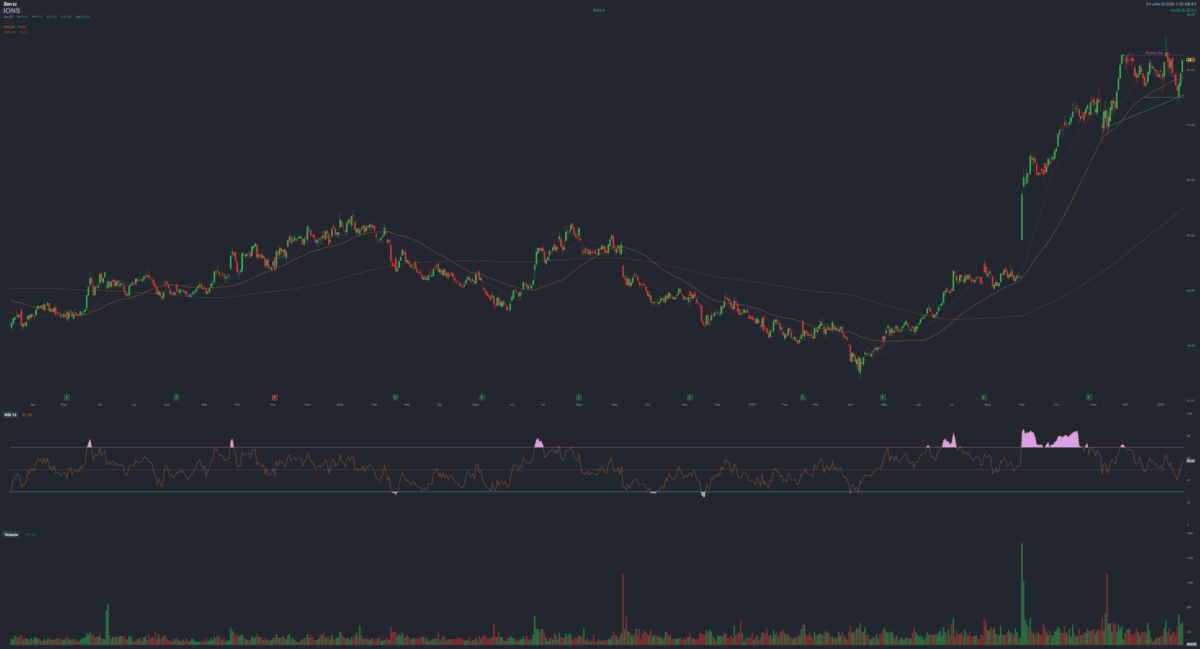

Click on the chart to open the full Ionis (IONS) snapshot on Finviz. Referral link via Merlintrader, with no extra cost for you.
Ionis Pharmaceuticals (NASDAQ: IONS) – 2026 Launch-Year Inflection
Updated deep-dive – Data checked against primary sources up to January 23, 2026
Recent Price (late Jan 2026)
≈ 79 USD
Market Cap
≈ 12.5–13 B USD
52-Week Range
23.95 – 86.15 USD
Revenue (TTM, Q3 2025)
≈ 0.97 B USD
Executive Summary
Ionis Pharmaceuticals is one of the longest-standing RNA-targeted drug platforms in biotech. After decades as a primarily R&D-driven story, the company is now entering a structural transition toward a diversified, commercial-stage rare-disease and specialty pharma profile.
The investment narrative around Ionis into 2026 is built on three verified pillars:
- A portfolio of marketed products anchored by Biogen’s Spinraza and co-commercialised Wainua, plus Ionis’ own Tryngolza in familial chylomicronemia (FCS).
- A late-stage pipeline with multiple near-term regulatory and commercial catalysts: olezarsen in severe hypertriglyceridemia (sHTG), zilganersen in Alexander disease, and bepirovirsen in chronic hepatitis B (partnered with GSK).
- A solid balance sheet with around 2.3 billion USD in cash, cash equivalents and short-term investments at year-end 2024, which management indicates is sufficient to support the current launch and development plan for several years without an immediate need for dilutive financing.
The core question for 2026–2027 is less about technology validation – which is largely de-risked by late-stage
data and regulatory designations – and more about commercial execution: how effectively Ionis and its partners
can turn this pipeline into durable revenues and, ultimately, operating profitability.
Approved and Marketed Products
Spinraza (nusinersen) – Spinal Muscular Atrophy (SMA)
FDA approved 2016 (Biogen)Spinraza is the first antisense oligonucleotide treatment for SMA, developed by Ionis and commercialised by Biogen under a licensing agreement. Ionis receives royalties on global sales.
The drug has an established commercial base and continues to contribute a recurring royalty stream. While newer SMA therapies have entered the market, Spinraza remains an important proof-of-concept for the Ionis platform and a source of relatively low-risk revenue.
Wainua (eplontersen) – Hereditary Transthyretin-Mediated Amyloidosis (hATTR-PN)
US approval: December 2022 (with AstraZeneca)Wainua (eplontersen) is co-developed and co-commercialised with AstraZeneca for patients with hereditary transthyretin-mediated amyloid polyneuropathy (hATTR-PN). The programme has secured approvals in the US and several other markets, with a staggered global roll-out through 2023–2024.
Commercial uptake is still in the early-to-intermediate phase. The royalty and profit-sharing structure provides Ionis with leverage to long-term growth in the ATTR space without bearing all commercial execution risk alone.
Tryngolza (olezarsen) – Familial Chylomicronemia Syndrome (FCS)
US approval: December 19, 2024In December 2024 the FDA approved Tryngolza (olezarsen) for adults with familial chylomicronemia syndrome (FCS), a rare genetic disorder characterised by extremely elevated triglycerides and recurrent pancreatitis attacks. This is one of the first products that Ionis is commercialising directly in a highly targeted orphan indication.
The FCS market is structurally small, but pricing reflects the severity of disease and the lack of effective alternatives. The more strategic angle is that Tryngolza is built on the same antisense platform as Ionis’ broader cardiometabolic portfolio, and early commercial experience will inform future launches.
Late-Stage Pipeline and 2026 Catalyst Map
Olezarsen in Severe Hypertriglyceridemia (sHTG)
Beyond FCS, olezarsen is being developed for a much larger population with severe hypertriglyceridemia. In 2025, Ionis reported positive top-line results from the Phase 3 CORE and CORE2 studies in sHTG:
| Parameter | CORE (50 mg) | CORE2 (80 mg) | Comment |
|---|---|---|---|
| Triglyceride reduction vs baseline | ≈ 63% | ≈ 72% | Placebo-adjusted, sustained over time |
| Acute pancreatitis events | Substantial reduction vs placebo | Reported relative reduction around 80%+ in high-risk patients | |
| Safety and tolerability | Generally consistent with prior antisense experience | No unexpected safety signal reported in top-line data | |
Severe hypertriglyceridemia is a broader, more commercially meaningful market than FCS, with a sizeable subset of patients at risk of pancreatitis despite current therapies. Ionis has indicated that it plans to move olezarsen forward toward regulatory submissions in sHTG based on the Phase 3 data. Concrete filing and decision dates had not yet been published at the time of writing, so 2026 should be seen as the year where final regulatory strategy and potential submission timing become clearer rather than assuming a fixed PDUFA window.
Zilganersen in Alexander Disease
Zilganersen targets glial fibrillary acidic protein (GFAP) for Alexander disease, an ultra-rare, progressive neurodegenerative disorder. In December 2025, Ionis announced positive pivotal data and received both Orphan Drug designation and Breakthrough Therapy designation from the FDA for zilganersen in Alexander disease.
The total patient population is small, but there are currently no approved disease-modifying treatments. If the full dossier supports a clear functional benefit, zilganersen could become the first targeted therapy for this condition. Ionis has guided that it intends to pursue regulatory submissions following the pivotal data; approval timing will depend on the review process, but 2026–2027 is the key window to monitor.
Bepirovirsen in Chronic Hepatitis B (with GSK)
Bepirovirsen is an antisense oligonucleotide licensed to GSK for chronic hepatitis B virus (HBV) infection. In early January 2026, GSK reported that the Phase 3 B-Well programme met its primary endpoint in certain treatment arms, with a proportion of patients achieving loss of hepatitis B surface antigen and undetectable HBV DNA after a finite course of therapy. This is the profile GSK has described as moving toward a “functional cure” concept compared with lifelong nucleos(t)ide analogue treatment.
Detailed data and regulatory interactions are still emerging, but the direction of travel is clear: GSK plans to move toward global regulatory filings if the full dataset supports a favourable benefit–risk profile. For Ionis, bepirovirsen represents a potential royalty and milestone stream in a very large global indication, with upside that will depend on how competitive the final label and real-world adoption prove to be.
In aggregate, the late-stage pipeline that matters for 2026–2027 includes:
olezarsen in sHTG (Ionis-led), zilganersen in Alexander disease (Ionis-led, Breakthrough/Orphan), and
bepirovirsen in chronic hepatitis B (partnered with GSK). The precise calendar is still moving, but the
cluster of regulatory and commercial decisions in this window is what defines 2026 as a potential “launch
inflection” year.
Financial Profile and Cash Runway
Revenue Trajectory
| Year | Total Revenue (USD) | Comment |
|---|---|---|
| 2022 | ≈ 587 M | Baseline year before full contribution from newer programmes |
| 2023 | ≈ 788 M | Strong growth driven by milestones and royalties |
| 2024 | ≈ 705 M | Lumpy year; shift in mix between milestones, royalties and product revenue |
| TTM (to Q3 2025) | ≈ 967 M | Trend reflects increasing recurring components from Wainua and early Tryngolza sales |
The exact quarterly pattern is inherently volatile due to milestone accounting, but the direction is clear: Ionis has already reached an annualised revenue base close to 1 billion USD before the main 2026–2027 launch wave. As more revenue comes from product sales and royalties, the quality and visibility of the top line should gradually improve compared with the older, milestone-heavy model.
Cash, Investments and Financing Risk
Cash, cash equivalents and short-term investments (Dec 31, 2024)
≈ 2.3 B USD
Above company guidance
Near-term equity raise risk
Limited
Cash expected to fund operations for multiple years
In the Q4 2024 results, Ionis indicated that its cash and investments position is sufficient to support the existing launch and development plan well into the second half of the decade, assuming no major negative surprises. This does not mean that future financing is impossible or excluded, but it does significantly reduces the probability of a forced, near-term equity raise purely to fund the current programme.
From a balance sheet standpoint, Ionis enters the 2026 catalyst window in a much stronger position than many
mid-cap biotech peers: a revenue base approaching 1 billion USD TTM and more than 2 billion USD of liquidity
provide a buffer to absorb execution risk and possible delays.
Valuation and Street View
Headline Valuation Multiples
Using a share price around 79 USD and a market capitalisation in the 12.5–13 billion USD range, Ionis trades at roughly 13–14 times trailing twelve-month sales, based on a TTM revenue figure just under 1 billion USD. Various data services quote slightly different ratios depending on the exact time window and enterprise value assumptions, but they all point to a low-teens price-to-sales multiple.
This level is clearly higher than that of many traditional, slower-growth large-cap pharma names, but sits within the range often seen for platform-type biotech companies with established products and visible late-stage optionality. Whether it is attractive or not depends heavily on an investor’s view of how the cardiometabolic and HBV franchises will scale over the next five to ten years.
Analyst Targets and Rating Snapshot
| Metric | Value (approx., early 2026) | Comment |
|---|---|---|
| Average 12-month target price | ≈ 90–100 USD | Cluster of targets in this band across major brokers |
| Highest published target | ≈ 115–120 USD | Bullish scenarios on cardiometabolic and HBV |
| Lowest published target | ≈ 50–55 USD | More conservative stance on execution risk |
| Consensus rating | Moderate Buy / Outperform bias | Majority positive, with a minority of neutral or cautious views |
Overall, Wall Street remains constructively positioned on Ionis: analysts generally accept the scientific platform and see meaningful upside if launches execute well, but the spread in target prices shows that there is no uniform view on how smooth the transition to a fully commercial model will be.
Sentiment, Short Interest and Retail Chatter
Short interest (float, recent)
≈ 6–7%
Moderate, not extreme
Days to cover
≈ 4–5
No obvious squeeze set-up
Short interest is present but not at levels typically associated with aggressive bear positioning or high-probability squeeze dynamics. It is more consistent with a standard hedge against an already re-rated name going into a complex launch cycle.
A scan of recent discussions on Reddit (for example, r/biotech_stocks and similar subreddits), Stocktwits and X (Twitter) around the time of the latest data releases shows a clearly positive bias: many retail traders and investors frame Ionis as a high-quality platform with “real” drugs on the market and a credible path to profitability. At the same time, there are recurring concerns about valuation after the run-up and about the possibility that execution around multiple launches in a short time window could disappoint.
In other words, the dominant retail sentiment is constructive and often enthusiastic, but not blind. The
stock is widely seen as one of the stronger mid-cap biotech platforms, and debates now focus more on timing
and risk-reward than on the viability of the antisense approach itself. As always, comments on these platforms
come from non-professional market participants and should be treated purely as anecdotal sentiment, not as
research or advice.
Key Risks and 2026–2027 Timeline
Illustrative Catalyst Timeline (subject to change)
| Period | Programme | Potential milestone |
|---|---|---|
| 2025–early 2026 | Tryngolza (FCS) | Early launch metrics, label and access refinement |
| 2025–2026 | Olezarsen (sHTG) | Full CORE/CORE2 data presentations, regulatory strategy updates, potential submission plans |
| 2026 | Zilganersen (Alexander disease) | Regulatory submissions in US/EU following Breakthrough/Orphan designations and pivotal data |
| 2026–2027 | Bepirovirsen (HBV, GSK) | Detailed Phase 3 publications, regulatory filings and initial decisions if data support approval |
| 2027+ | Broader cardiometabolic franchise | Further label expansions and follow-on indications based on olezarsen platform |
Key Risk Clusters
Regulatory risk – Even with positive Phase 3 results and regulatory designations, final labels
and approval timing are not guaranteed. Any major delay or unexpected safety concern could affect revenue
trajectories and sentiment.
Commercial execution risk – Ionis is still building its own commercial infrastructure, while
relying on partners such as AstraZeneca and GSK in other programmes. Under-performance in launch execution,
pricing or reimbursement relative to expectations would quickly be reflected in the stock.
Competitive dynamics – In cardiometabolic disease, particularly in hypertriglyceridemia,
competition from GLP-1-based approaches and other emerging modalities may shape how large the addressable
market for olezarsen can become. In HBV, bepirovirsen will have to prove itself against a crowded field of
investigational agents.
Valuation risk – After a strong move in the share price into early 2026, the margin of safety
is thinner than it was when the stock was trading in the mid-20s to 30s. If launches are merely “good”, not
“exceptional”, the multiple could compress.
Synthesis: What the 2026 Window Really Tests
From technology validation to business execution
For most of the past three decades, the Ionis story has been about proving that antisense medicine works in real patients. Spinraza and Wainua have already answered that question. Tryngolza and the broader cardiometabolic portfolio add further confirmation.
The 2026–2027 window is different: it is primarily a test of execution. Can Ionis and its partners translate a now-validated platform into a durable, multi-franchise business that generates recurring cash flows, while managing the operational and competitive complexity that comes with it?
Risk–reward framing
- On the positive side, Ionis enters this phase with tangible products on the market, a deep late-stage pipeline, nearly 1 billion USD in trailing revenues and over 2 billion USD in cash.
- On the negative side, the stock already embeds a meaningful portion of that potential. If several of the main launches slip or underperform at the same time, the current valuation could prove demanding.
This report therefore should be read as a map of moving parts rather than as a directional call. Investors who are interested in the name need to decide how much weight they give to platform quality and balance sheet strength versus the inherent uncertainty of running multiple important launches in parallel.
Verified Sources and References
All factual statements in this report have been checked against primary or high-quality sources available up to January 23, 2026. Key references include:
Company and SEC Filings
Ionis – Investor Relations SEC EDGAR – Ionis Pharmaceuticals (CIK 0000874015)Product and Pipeline Information
Ionis – Corporate site and pipeline overview AstraZeneca – Wainua partnership updates GSK – Bepirovirsen Phase 3 B-Well programme press materialsFinancial and Market Data
StockAnalysis – IONS revenue and TTM data Yahoo Finance – IONS quote, market cap and 52-week rangeSentiment and Short Interest
Short interest and float data (various data providers) Reddit – r/biotech_stocks (sentiment, non-professional discussion) Stocktwits – IONS streamDisclaimer and Legal Notice
This report is provided strictly for educational and informational purposes. It does not constitute investment advice, an offer, solicitation or recommendation to buy or sell any security or financial instrument.
Biotechnology and small-cap equities are inherently risky asset classes. Clinical, regulatory, commercial and financing outcomes can differ materially from expectations and may result in significant capital losses.
Readers should always carry out their own independent due diligence and, where appropriate, consult a qualified financial advisor before making investment decisions. The information and opinions expressed here reflect public data and interpretations as of January 23, 2026 and may change without notice.
Cliccando sul grafico apri la scheda completa di Ionis (IONS) su Finviz. Link di referral via Merlintrader, senza costi aggiuntivi per te.
Ionis Pharmaceuticals (NASDAQ: IONS) – L’anno di svolta dei lanci 2026
Analisi approfondita – Dati verificati su fonti primarie fino al 23 gennaio 2026
Prezzo recente (fine gennaio 2026)
≈ 79 USD
Capitalizzazione
≈ 12,5–13 mld USD
Range 52 settimane
23,95 – 86,15 USD
Ricavi (TTM, Q3 2025)
≈ 0,97 mld USD
Executive Summary
Ionis Pharmaceuticals è una delle piattaforme RNA-mirate più longeve del settore biotech. Dopo decenni in cui il focus principale è stato la ricerca e sviluppo, l’azienda sta entrando in una fase di transizione strutturale verso un profilo più simile a quello di una pharma diversificata su malattie rare e indicazioni specialistiche.
La narrativa di investimento su Ionis verso il 2026 si appoggia su tre pilastri verificabili:
- Un portafoglio di prodotti già sul mercato ancorato a Spinraza di Biogen, a Wainua co-commercializzato, e a Tryngolza per la sindrome da chilomicronemia familiare (FCS) lanciato direttamente da Ionis.
- Una pipeline late-stage con molteplici catalyst regolatori e commerciali a breve-medio termine: olezarsen nella severa ipertrigliceridemia (sHTG), zilganersen nella malattia di Alexander, e bepirovirsen nell’epatite B cronica in partnership con GSK.
- Una struttura patrimoniale solida, con circa 2,3 miliardi di USD in cassa, equivalenti e investimenti a breve a fine 2024, livello che – secondo la stessa società – è sufficiente a sostenere l’attuale piano di lanci e sviluppo per diversi anni senza necessità immediata di ricorrere a nuove emissioni diluitive.
La vera domanda per il biennio 2026–2027 è meno legata alla validazione tecnologica – in buona parte già
conquistata – e molto più all’esecuzione: quanto efficacemente Ionis e i suoi partner riusciranno a trasformare
la pipeline in ricavi ricorrenti e, in ultima analisi, in una traiettoria di profittabilità operativa.
Prodotti approvati e già sul mercato
Spinraza (nusinersen) – Atrofia muscolare spinale (SMA)
Approvato FDA 2016 (Biogen)Spinraza è il primo trattamento a base di oligonucleotidi antisenso per la SMA, sviluppato da Ionis e commercializzato da Biogen in licenza. Ionis riceve royalties sulle vendite globali.
Il farmaco ha ormai una base commerciale consolidata e continua a generare un flusso ricorrente di royalties. Pur in presenza di terapie concorrenti più recenti, Spinraza resta una prova di concetto molto forte per la piattaforma Ionis e una fonte di ricavi relativamente de-rischizzata.
Wainua (eplontersen) – Amiloidosi da transtiretina ereditaria (hATTR-PN)
Approvazione USA: dicembre 2022 (con AstraZeneca)Wainua (eplontersen) è co-sviluppato e co-commercializzato con AstraZeneca per i pazienti con amiloidosi da transtiretina ereditaria a interessamento neuropatico. Il programma ha ottenuto l’approvazione negli Stati Uniti e successivamente in altri mercati, con un roll-out globale distribuito tra 2023 e 2024.
L’adozione commerciale è ancora in fase iniziale–intermedia. La struttura di royalties e profit-sharing offre a Ionis leva sulla crescita di lungo periodo nello spazio ATTR, senza dover sostenere da sola tutto il rischio di esecuzione commerciale.
Tryngolza (olezarsen) – Sindrome da chilomicronemia familiare (FCS)
Approvazione USA: 19 dicembre 2024Nel dicembre 2024 la FDA ha approvato Tryngolza (olezarsen) per gli adulti con sindrome da chilomicronemia familiare, una malattia genetica rara caratterizzata da trigliceridi estremamente elevati e ricorrenti episodi di pancreatite. È uno dei primi prodotti che Ionis commercializza in modo diretto in una indicazione orfana altamente mirata.
Il mercato FCS è strutturalmente piccolo, ma la severità della malattia e l’assenza di alternative efficaci si riflettono in pricing elevato. L’aspetto più strategico è che Tryngolza si basa sulla stessa piattaforma antisenso del portafoglio cardiometabolico più ampio: l’esperienza di questo lancio farà da benchmark per quelli successivi.
Pipeline late-stage e mappa catalyst 2026
Olezarsen nella severa ipertrigliceridemia (sHTG)
Al di là di FCS, olezarsen è sviluppato per una popolazione molto più ampia di pazienti con severa ipertrigliceridemia. Nel 2025 Ionis ha riportato risultati top-line positivi dagli studi di Fase 3 CORE e CORE2 in sHTG:
| Parametro | CORE (50 mg) | CORE2 (80 mg) | Commento |
|---|---|---|---|
| Riduzione dei trigliceridi vs baseline | ≈ 63% | ≈ 72% | Valori aggiustati vs placebo, mantenuti nel tempo |
| Episodi di pancreatite acuta | Riduzione significativa vs placebo | Riduzione relativa nell’ordine dell’80%+ nei pazienti ad alto rischio | |
| Sicurezza e tollerabilità | In linea con l’esperienza precedente sugli antisenso | Nessun segnale di sicurezza inatteso nei dati top-line | |
La severa ipertrigliceridemia è un mercato più ampio e più rilevante in chiave commerciale rispetto a FCS, con un sottogruppo di pazienti a rischio di pancreatite nonostante le terapie correnti. Ionis ha indicato l’intenzione di portare olezarsen verso la fase regolatoria in sHTG sulla base di questi risultati di Fase 3. Al momento della stesura non erano ancora pubblicate date precise di filing o decisione: il 2026 va quindi letto come l’anno in cui si chiarirà la strategia regolatoria definitiva, più che come una finestra PDUFA già fissata.
Zilganersen nella malattia di Alexander
Zilganersen agisce su GFAP (glial fibrillary acidic protein) per la malattia di Alexander, una patologia neurodegenerativa ultra-rara e progressiva. Nel dicembre 2025 Ionis ha comunicato dati pivotal positivi e la ricezione delle designazioni di Orphan Drug e Breakthrough Therapy da parte della FDA per zilganersen in questa indicazione.
La popolazione di pazienti è numericamente ridotta, ma oggi non esistono terapie realmente modificanti la malattia. Se il dossier finale confermerà un beneficio funzionale chiaro, zilganersen potrebbe diventare la prima terapia mirata per questa condizione. L’azienda ha espresso l’intenzione di procedere con le sottomissioni regolatorie; l’orizzonte temporale ragionevole per le decisioni è il biennio 2026–2027.
Bepirovirsen nell’epatite B cronica (con GSK)
Bepirovirsen è un oligonucleotide antisenso concesso in licenza a GSK per l’epatite B cronica. A inizio gennaio 2026 GSK ha riportato che il programma di Fase 3 B-Well ha raggiunto l’endpoint primario in alcuni bracci di trattamento, con una quota di pazienti che ha ottenuto perdita dell’antigene di superficie (HBsAg) e DNA virale HBV non rilevabile dopo un ciclo di terapia finito. È il profilo che GSK descrive come un passo verso un concetto di “cura funzionale” rispetto alle attuali terapie orali croniche.
I dettagli completi e le interazioni regolatorie sono ancora in evoluzione, ma la direzione è chiara: GSK punta a procedere verso filing globali se il dataset completo confermerà un rapporto beneficio–rischio favorevole. Per Ionis, bepirovirsen rappresenta una potenziale fonte di milestones e royalties in una indicazione globale molto ampia, con upside che dipenderà da label finale e adozione nel mondo reale.
Nell’insieme, la pipeline late-stage rilevante per il 2026–2027 comprende: olezarsen in sHTG (guidato da
Ionis), zilganersen nella malattia di Alexander (Ionis, con designazioni Breakthrough/Orphan) e bepirovirsen
nell’epatite B cronica (in partnership con GSK). Il cluster di decisioni regolatorie e commerciali in questo
intervallo temporale è ciò che rende il 2026 un potenziale anno di “inflection” sui lanci.
Profilo finanziario e cassa
Traiettoria dei ricavi
| Anno | Ricavi totali (USD) | Commento |
|---|---|---|
| 2022 | ≈ 587 mln | Anno base prima del pieno contributo dei programmi più recenti |
| 2023 | ≈ 788 mln | Crescita importante trainata da milestones e royalties |
| 2024 | ≈ 705 mln | Andamento “lumpy”; cambiamento nel mix tra milestones, royalties e vendite prodotto |
| TTM (fino a Q3 2025) | ≈ 967 mln | Trend che riflette un peso crescente dei ricavi ricorrenti da Wainua e dalle prime vendite di Tryngolza |
Il profilo trimestrale resta inevitabilmente volatile a causa della contabilizzazione delle milestones, ma la direzione è chiara: Ionis è già arrivata a una base di ricavi annualizzati vicina al miliardo di dollari prima del grosso ciclo di lanci previsto tra 2026 e 2027. Con l’aumento del peso di vendite dirette e royalties, la qualità e la visibilità della top line dovrebbero migliorare rispetto al vecchio modello troppo dipendente dai pagamenti upfront e milestone.
Cassa, investimenti e rischio di funding
Cassa, equivalenti e investimenti a breve (31.12.2024)
≈ 2,3 mld USD
Sopra la guidance della società
Rischio di aumento di capitale nel breve
Limitato
Cassa attesa sufficiente per diversi anni
Nella trimestrale Q4 2024 Ionis ha indicato che la posizione di cassa e investimenti è sufficiente a supportare l’attuale piano di sviluppo e lanci ben oltre la metà del decennio, in assenza di shock negativi rilevanti. Questo non esclude del tutto operazioni di funding future, ma riduce in modo significativo la probabilità di un aumento di capitale “forzato” nel brevissimo periodo solo per finanziare il piano corrente.
Dal punto di vista patrimoniale, Ionis entra nella finestra di catalyst 2026 con una posizione molto più
robusta di molte mid-cap biotech comparabili: base ricavi vicina a 1 miliardo USD TTM e oltre 2 miliardi
di liquidità offrono un cuscinetto per assorbire rischi di esecuzione e possibili ritardi.
Valutazione e view di mercato
Multipli headline
Con un prezzo per azione intorno a 79 USD e una capitalizzazione nell’ordine dei 12,5–13 miliardi di dollari, Ionis tratta su un multiplo prezzo/ricavi sulle dodici mesi intorno alla fascia 13–14x, assumendo ricavi TTM poco sotto 1 miliardo USD. I vari data provider riportano valori leggermente diversi a seconda della finestra e della definizione di enterprise value, ma il quadro resta quello di un multiplo in “low-teens”.
È un livello chiaramente più alto rispetto a molti big pharma a crescita più bassa, ma coerente con i range tipici delle piattaforme biotech con prodotti già approvati e pipeline avanzata. Il fatto che sia attraente o meno dipende in larga parte dal peso che si attribuisce al potenziale del franchise cardiometabolico e di HBV sui prossimi 5–10 anni.
Target prezzo e rating degli analisti
| Metrica | Valore (circa, inizio 2026) | Commento |
|---|---|---|
| Target prezzo medio 12 mesi | ≈ 90–100 USD | Cluster principale di target in quest’area |
| Target massimo pubblicato | ≈ 115–120 USD | Scenari più ottimistici su cardiometabolico e HBV |
| Target minimo | ≈ 50–55 USD | Approcci più conservativi sul rischio esecuzione |
| Rating di consenso | Bias verso “Buy / Outperform” | Maggioranza positiva, minoranza neutrale o cauta |
Nel complesso, la view di Street su Ionis resta costruttiva: la maggior parte degli analisti riconosce la qualità della piattaforma e vede upside tangibile se i lanci funzionano, ma l’ampiezza del ventaglio di target mostra che non c’è una visione univoca sulla fluidità del passaggio a modello pienamente commerciale.
Sentiment, short interest e retail
Short interest (float, recente)
≈ 6–7%
Moderato, non estremo
Days to cover
≈ 4–5
Nessun setup squeeze evidente
Lo short interest è presente ma non a livelli tipici di una scommessa ribassista aggressiva o di un potenziale squeeze imminente. È più coerente con un hedge standard su un titolo che ha già corso molto e che entra in una fase di lanci complessa.
Una lettura dei thread recenti su Reddit (ad esempio r/biotech_stocks e subreddit simili), Stocktwits e X (Twitter) in corrispondenza delle ultime news mostra un bias chiaramente positivo: molti trader e investitori retail descrivono Ionis come una piattaforma di qualità, con farmaci “veri” già approvati e una traiettoria credibile verso la profittabilità. Allo stesso tempo emergono in modo ricorrente dubbi sulla valutazione dopo il forte run-up e sul rischio che l’esecuzione di molti lanci ravvicinati possa non essere lineare.
In sintesi, il sentiment retail è costruttivo e spesso entusiasta, ma non acritico. Il titolo viene percepito
come una delle piattaforme mid-cap più solide del settore, e il dibattito si è spostato più su timing e
rapporto rischio/rendimento che non sulla validità dell’approccio antisenso in sé. Come sempre, si tratta di
opinioni di trader non professionisti, da considerare solo come termometro di sentiment e non come ricerca o
consiglio di investimento.
Principali rischi e timeline 2026–2027
Timeline di massima (soggetta a cambiamenti)
| Periodo | Programma | Possibile milestone |
|---|---|---|
| 2025–inizio 2026 | Tryngolza (FCS) | Metriche iniziali di lancio, ottimizzazione label e accesso |
| 2025–2026 | Olezarsen (sHTG) | Presentazione completa CORE/CORE2, aggiornamenti sulla strategia regolatoria, potenziali piani di filing |
| 2026 | Zilganersen (malattia di Alexander) | Sottomissioni regolatorie in USA/UE dopo designazioni Breakthrough/Orphan e dati pivotal |
| 2026–2027 | Bepirovirsen (HBV, GSK) | Pubblicazioni dettagliate di Fase 3, filing regolatori e prime decisioni se i dati sostengono l’approvazione |
| 2027+ | Franchise cardiometabolico più ampio | Espansioni di label e indicazioni addizionali basate sulla piattaforma olezarsen |
Cluster di rischio principali
Rischio regolatorio – Anche con risultati di Fase 3 positivi e designazioni favorevoli, label
finali e tempistiche di approvazione non sono garantite. Ritardi importanti o problemi di safety inattesi
avrebbero impatto diretto su ricavi attesi e sentiment.
Rischio di esecuzione commerciale – Ionis sta ancora costruendo la propria infrastruttura
commerciale, mentre in altri programmi dipende da partner come AstraZeneca e GSK. Lanci sotto le aspettative
in termini di pricing, rimborso o adozione verrebbero rapidamente riflessi nel titolo.
Competizione – Nell’area cardiometabolica, soprattutto in sHTG, la concorrenza da parte di
approcci basati su GLP-1 e altre piattaforme emergenti potrebbe ridurre la dimensione effettiva del mercato
indirizzabile per olezarsen. In HBV, bepirovirsen dovrà dimostrare un profilo competitivo in un campo già
affollato.
Rischio di valutazione – Dopo il forte apprezzamento del titolo verso inizio 2026, il margine
di sicurezza è più sottile rispetto a quando IONS trattava in area 20–30 USD. Se i lanci si rivelassero solo
“buoni” e non “eccezionali”, il multiplo potrebbe comprimersi.
Sintesi: cosa mette davvero alla prova il 2026
Da “dimostrare la tecnologia” a “costruire il business”
Per gran parte degli ultimi trent’anni la storia di Ionis è stata la storia di una tecnologia da validare: dimostrare che la medicina antisenso funziona su pazienti reali. Spinraza e Wainua hanno già risposto in modo netto a questa domanda. Tryngolza e il portafoglio cardiometabolico aggiungono ulteriore conferma.
La finestra 2026–2027 è diversa: è prima di tutto un test di esecuzione. La domanda chiave è se Ionis e i partner riusciranno a trasformare una piattaforma ormai validata in un business multi-franchise con flussi di cassa ricorrenti, gestendo al tempo stesso la complessità operativa e competitiva che ne deriva.
Come leggere il rapporto rischio/rendimento
- Sul lato positivo, Ionis entra in questa fase con prodotti tangibili già in commercio, una pipeline late-stage profonda, ricavi TTM vicini a 1 miliardo USD e oltre 2 miliardi di liquidità.
- Sul lato negativo, una parte significativa di questo potenziale è già prezzata. Se più di uno dei lanci chiave dovesse subire ritardi o deludere nello stesso arco temporale, l’attuale valutazione potrebbe rivelarsi esigente.
Questo report va quindi letto come una mappa dei driver in movimento e non come una chiamata direzionale sul titolo. Chi valuta IONS deve decidere quanto peso dare alla qualità della piattaforma e alla solidità di bilancio rispetto all’incertezza intrinseca nel gestire molti lanci importanti in parallelo.
Fonti verificate e riferimenti
Tutte le affermazioni fattuali di questo report sono state verificate su fonti primarie o di livello elevato disponibili fino al 23 gennaio 2026. In particolare:
Azienda e documenti SEC
Ionis – Investor Relations SEC EDGAR – Ionis Pharmaceuticals (CIK 0000874015)Informazioni su prodotti e pipeline
Ionis – Sito corporate e panoramica pipeline AstraZeneca – Aggiornamenti su Wainua GSK – Comunicati su bepirovirsen e programma B-WellDati finanziari e di mercato
StockAnalysis – Ricavi e dati TTM su IONS Yahoo Finance – Quotazioni, market cap e range 52 settimaneSentiment e short interest
Dati su short interest e float (vari provider) Reddit – r/biotech_stocks (sentiment, discussioni non professionali) Stocktwits – Stream su IONSDisclaimer e note legali
Questo report ha esclusivamente finalità educative e informative. Non costituisce in alcun modo consulenza in materia di investimenti, né un invito, offerta o raccomandazione all’acquisto o alla vendita di strumenti finanziari.
I titoli biotech e le small-cap sono asset class intrinsecamente rischiose. Gli esiti clinici, regolatori, commerciali e di funding possono discostarsi in modo rilevante dalle aspettative e comportare perdite di capitale significative.
Ciascun lettore deve sempre svolgere una propria due diligence indipendente e, se necessario, consultare un consulente finanziario abilitato prima di assumere decisioni di investimento. Le informazioni e le opinioni qui riportate riflettono dati pubblici e interpretazioni aggiornate al 23 gennaio 2026 e possono cambiare senza preavviso.
Scanner for active traders

Try ChartsWatcher free, then unlock 10% OFF with SAVE10
ChartsWatcher is a real-time scanner for momentum traders: fast movers, unusual volume and rotations — so you can focus on the few tickers that matter right now, instead of watching hundreds of charts.
Start with the free version. When you upgrade, use SAVE10 for 10% OFF your first paid period.
Start free – then use SAVE10
No credit card required to start. Apply SAVE10 when upgrading.
Recommended platform

One platform. All your brokers.
Medved Trader connects multiple brokers in one workspace, with pro charts, hotkeys and fast execution — without changing your broker accounts.
A single cockpit for positions, Level II and multi-broker order routing, built for active day & swing traders.
Get 1 Month Free ➔
Multi-broker workflow + customizable layouts in one platform.
 Monica.im – the AI assistant I use every day
If you find value in the work I publish on Merlintrader and want a practical AI assistant for research and writing, you can sign up using this referral link. Click here to try Monica.im and support the site
Find out how I use AI on Merlintrader: AI, retail and Merlintrader
Disclosure: some of the links in the promotional blocks above are affiliate or referral links. If you choose to subscribe or sign up through them, Merlintrader may receive a small commission or benefit at no extra cost to you.