DISCLAIMER — Not financial advice. Educational content only, not an offer or solicitation to buy or sell any security. Biotech and small/mid-cap stocks are highly speculative and volatile and can result in a partial or total loss of capital. Do your own research and consult a licensed advisor where appropriate. / Contenuti a solo scopo informativo e didattico, non costituiscono consulenza finanziaria né offerta o sollecitazione al pubblico risparmio ai sensi delle normative CONSOB e SEC. Le azioni biotech e le small/mid cap sono strumenti altamente speculativi e volatili e possono comportare la perdita parziale o totale del capitale investito. Si raccomanda di effettuare sempre le proprie ricerche e, se necessario, di rivolgersi a un consulente abilitato.

Merlintrader Trading Pub
Biotech catalyst news and analysis. FDA PDUFA tracker
Merlintrader Trading Pub
Biotech catalyst news and analysis. FDA PDUFA tracker
Distressed biotech turnaround · Aggiornato 5 gennaio 2026
KALA BIO (KALA) – The Lazar Pivot: From KPI-012 Failure to a Clean, Debt-Free Shell
Deep dive on KALA BIO after the CHASE Phase 2b collapse, the Oxford Finance default, David Lazar’s $6M rescue, and the December 26, 2025 completion of the $2M debt settlement that wipes out ~$10.6M in obligations.
Analisi completa di KALA BIO dopo il fallimento del trial CHASE su KPI-012, il default con Oxford Finance, l’ingresso di David Lazar con 6M$ e il completamento del pagamento da 2M$ (26 dicembre 2025) che azzera ~10,6M$ di debito.
0. Merlintrader view – a failed biotech reborn as a Lazar shell
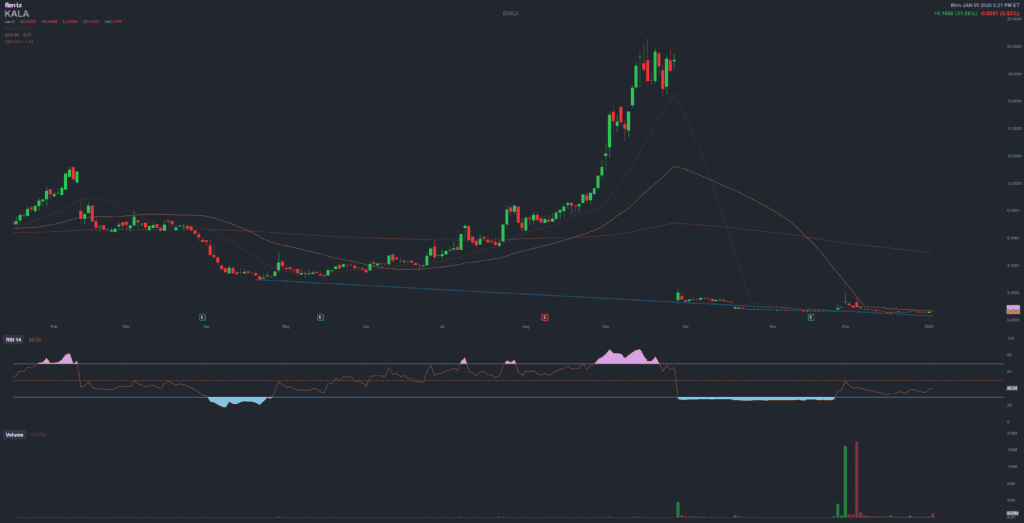
KALA BIO came into autumn 2025 as a textbook Covid–era biotech casualty. On September 29, 2025, the company announced that its Phase 2b CHASE trial of KPI-012 for persistent corneal epithelial defect (PCED) had failed to meet the primary endpoint and key secondary endpoints. Management explicitly stated that it would cease development of KPI-012 and its entire MSC-S secretome platform.
The stock reacted accordingly: various reports note a single-day drawdown of roughly −90% to −92%, with KALA trading near “option value only”. On top of that, KALA was in default with its secured lender Oxford Finance under a 2021 Loan and Security Agreement, with a total obligation of about $10.6M outstanding.
Instead of going quietly into the graveyard, KALA has executed a rare two-step salvage operation:
- New money & new owner: a $6M securities purchase agreement with investor David E. Lazar, who became CEO and Chairman on December 1, 2025.
- Debt cleanse: a settlement with Oxford Finance that allowed KALA to extinguish ~$10.6M of debt with a $2M cash payment, completed on December 26, 2025 and highlighted in the January 5, 2026 press release.
Strategic read: KALA is no longer an R&D story. It is a micro “clean shell” controlled by David Lazar, with debt eliminated, legacy pipeline scrapped, and a clear playbook:
clean balance sheet → raise survivable capital → inject a new asset or execute a reverse merger.
For traders, this is a high-beta “Lazar turnaround” more than a traditional biotech thesis.
This report does not tell you whether to buy or sell KALA. It maps what has actually happened since the CHASE failure, what the Oxford settlement really changed, and where the risk–reward sits if you decide to treat KALA as a Lazar-style special situation.
1. From CHASE failure to default – how we got here
1.1 CHASE Phase 2b miss (September 2025)
On September 29, 2025, KALA announced topline data from the Phase 2b CHASE trial of KPI-012 in PCED:
- The primary endpoint was not met; KPI-012 failed to show superiority versus vehicle.
- Key secondary endpoints also failed to reach statistical significance.
- KALA stated it would cease development of KPI-012 and its MSC-S platform, effectively killing the entire ophthalmic pipeline.
Ophthalmology and biotech media reported a one-day stock collapse of roughly −90% to −92%, with KALA trading down near the equivalent of a broken-lottery-ticket stub.
1.2 Default with Oxford Finance
Even before the CHASE failure, KALA had substantial debt:
- A Loan and Security Agreement signed on May 4, 2021 with Oxford Finance LLC.
- By late 2025, principal + fees under the loan and related agreements had grown to approximately $10.6M.
- On September 29, 2025, Oxford delivered a Default Notice citing events of default under the loan, as disclosed in a Form 8-K.
In the same CHASE failure announcement, KALA said it would preserve cash via restructuring and would work with Oxford while evaluating “strategic alternatives”.
2. The Lazar move – $6M lifeline and change of control
2.1 $6M securities purchase agreement (Dec 1–2, 2025)
On December 1–2, 2025, KALA announced a $6M securities purchase agreement with activist investor David E. Lazar, via a new Series B Convertible Preferred Stock financing.
- Lazar committed $6M in gross proceeds.
- He was appointed CEO and Chairman, effective December 1, 2025, replacing prior CEO Todd Bazemore (who remained on the board).
- Coverage noted that KALA’s market cap at the time was below $10M, effectively giving Lazar control at distressed levels.
Lazar is best known for microcap restructurings and shell clean-ups (Custodian Ventures & co.). The KALA move fits squarely into that pattern.
2.2 Direct offering & additional capital (Dec 2025)
Shortly after the Lazar deal, KALA also completed a $10M registered direct offering of common stock, further boosting liquidity and making it feasible to negotiate a cash-based settlement with Oxford.
3. Oxford Finance loan settlement – from 10.6M exposure to 2M cash
3.1 November 2025: Loan Settlement Agreement
On November 25, 2025, KALA disclosed a Loan Settlement Agreement with Oxford Finance in an 8-K. Key points:
- Total owed under the loan and related agreements: approximately $10.6M.
- Oxford agreed to accept a $2M “Cash Settlement” in lieu of enforcing the full amount, subject to certain timing and structural conditions.
- The original structure contemplated staged payments and a possible “Settlement Stock” component, plus 10% of proceeds from certain equity financings or strategic transactions.
3.2 December 26, 2025: $2M payment and full discharge
In practice, KALA accelerated the settlement. On December 26, 2025, the company paid Oxford $2M in cash. Multiple reports and today’s press release confirm that:
- The entire $10.6M obligation was deemed satisfied.
- All liens and security interests in KALA’s assets held by Oxford were released.
- No further payments under the Oxford loan agreement are due.
3.3 Jan 5, 2026: Press release for the broader market
On January 5, 2026, KALA issued a press release emphasising that it had successfully eliminated the Oxford debt and “strengthened the balance sheet” via the $2M settlement. For many retail traders, this is the first time the full impact of the deal is clearly spelled out, even though the 8-K contained the core details weeks earlier.
4. Capital structure – common, preferred and inducement stock
KALA’s capital structure after years of financings is layered and somewhat messy. As of mid-2025 and into the Lazar era, we can summarise:
4.1 Common stock
- Authorised common stock: 120,000,000 shares (par $0.001).
- Common shares outstanding:
- 6,679,115 as of June 30, 2025.
- 7,021,040 as of August 7, 2025 (10-Q).
- Additional common issued via:
- At-the-market offerings in 2022–2024.
- Several private placements and registered direct offerings, including the December 2025 $10M deal.
- 400,000 inducement shares granted to four new employees on December 30, 2025.
4.2 Convertible preferred
Prior to Lazar’s entry, KALA had multiple series of non-redeemable convertible preferred (Series E, F, G, H, I), all convertible to common subject to caps (9.99–19.99%) and other conditions. The new Series B preferred from the $6M Lazar financing adds another conversion layer.
4.3 Ownership & control – who really drives KALA now?
| Holder / Group | Role | Notes |
|---|---|---|
| David E. Lazar | CEO, Chairman, lead investor | Controls the strategic direction via Series B and board leadership; de facto “sponsor” of the shell. |
| Baker Brothers (legacy) | Historical core holder | Previously held significant stakes in common + preferred; still relevant but less central than pre-Lazar. |
| Other institutions | Minority stakes | Institutional ownership previously ~35–40%; the Lazar deal and later offerings may shift this mix. |
| Retail & traders | Free float | Highly reactive to CHASE news, Lazar PRs and the Oxford settlement narrative. |
5. Strategy & scenarios – what can “New KALA” actually become?
With no active pipeline and no bank debt, KALA is now fundamentally a public vehicle + cash. The key strategic paths:
5.1 Reverse merger with a private company
The textbook Lazar scenario is a reverse merger:
- A private biotech (or adjacent healthcare company) uses KALA’s listing and shell to go public faster.
- Current KALA shareholders get diluted but retain some upside in the merged entity.
- Deal quality (asset, valuations) will determine whether this is a genuine turnaround or just a reshuffle.
5.2 Opportunistic asset acquisition
Alternatively, KALA might in-license or acquire one or more low-cost assets from other distressed biotechs:
- Buying Phase 1/2 assets cheaply in a risk-off market.
- Rebuilding a pipeline over time, rather than via a single transformational merger.
5.3 Zombie-shell risk
The bear scenario: KALA drifts into “zombie shell” mode:
- No meaningful asset/merger announced in 2026.
- Cash slowly consumed by G&A and deal-search expenses.
- Share price grinds lower as speculative interest fades.
6. Retail sentiment – Lazar lotto ticket vs. caution
Forums and social feeds now treat KALA primarily as a Lazar vehicle. Typical comments:
- “If he finds a good asset, this could 5–10x from a $5–6M cap.”
- “High risk, but debt-free and with a fresh CEO is better than the old dead pipeline.”
- “This is gambling on the deal, not on the science anymore.”
Pros: debt cleared, catalyst potential via corporate actions.
Cons: no current pipeline, heavy dilution risk, execution entirely dependent on one key figure.
7. Catalyst map – Q1–Q2 2026
Main potential triggers:
- Corporate housekeeping (Q1 2026): any proxy/meeting to adjust share authorisation, board structure, or other mechanics needed for deals.
- First full post-settlement update: 10-K / earnings call where KALA presents:
- cash balance after Lazar investment, direct offering and Oxford payment;
- updated burn and runway;
- language on “strategic alternatives” and focus areas for asset search.
- Any LOI / non-binding term sheet: even an early-stage agreement for a reverse merger or asset acquisition can move the stock sharply.
No more trial readouts. The new catalyst map is 100% corporate.
8. Risk map – what can still go wrong
- No pipeline → binary “deal or nothing”.
- Dilution. Any real transaction will likely involve heavy issuance of new shares or preferred.
- Governance concentration. Lazar is central. If his interests diverge from minority holders, options are limited.
- Market-structure risk. Microcap, low price, possible future compliance issues with listing rules.
- Time. The longer KALA stays in limbo without a deal, the lower the patience of speculative holders.
9. Bottom line – how to think about KALA post-settlement
KALA BIO is now a Lazar shell with no debt and no pipeline. That can be:
- a platform for a new, higher-quality asset or merger → potential multi-bagger from a low base;
- or a slow-bleed story where nothing compelling arrives before cash and patience run out.
For a catalyst-focused trader, this belongs in the speculative / lotto” bucket, not in the core portfolio. The key question is not “will KPI-012 work?” anymore, but “can Lazar find and execute a deal worth owning?”
Biotech Catalyst Calendar – context beyond a single shell
Anche se KALA oggi è principalmente una special situation di turnaround, il sentiment e i flussi sul settore biotech restano guidati da PDUFA, letture di Fase 3 e grandi eventi regolatori.
Per tenere sotto controllo il quadro generale:
Merlintrader – Biotech Catalyst Calendar
Disclaimer (EN/IT)
This content is for educational and informational purposes only and does not constitute investment advice, an offer to buy or sell securities, or a recommendation of any specific strategy.
Dati e informazioni provengono da fonti ritenute affidabili, ma non se ne garantisce l’assoluta accuratezza o completezza. Prima di investire è opportuno effettuare le proprie verifiche e, se necessario, rivolgersi a un consulente finanziario abilitato.
Per l’informativa completa su rischi, limitazioni di responsabilità e privacy, fare riferimento alle pagine ufficiali di Merlintrader:
https://merlintrader.com/disclaimer/
https://merlintrader.com/condizioni-duso-e-info-privacy/
0. Visione Merlintrader – da biotech fallita a guscio “Lazar”
KALA BIO è arrivata all’autunno 2025 come esempio perfetto di “biotech dell’era Covid” finita male. Il 29 settembre 2025 la società ha annunciato che il trial di Fase 2b CHASE con KPI-012 per i difetti epiteliali corneali persistenti (PCED) non ha raggiunto l’endpoint primario né i principali endpoint secondari. Il management ha dichiarato che avrebbe interrotto lo sviluppo di KPI-012 e dell’intera piattaforma MSC-S secretome.
Il titolo è crollato: diverse fonti riportano un drawdown in una singola seduta di circa −90–92%, con KALA trattata dal mercato come puro “option value”. In parallelo, la società era in default verso il finanziatore senior Oxford Finance su un Loan and Security Agreement del 2021, con un’esposizione complessiva di circa 10,6M$.
Invece di finire direttamente nel cimitero delle small-cap, KALA ha messo a segno una manovra in due tempi:
- Nuovi soldi & cambio di controllo: un accordo da 6M$ con l’investitore David E. Lazar, che il 1° dicembre 2025 è diventato CEO e Chairman.
- Pulizia del debito: un accordo con Oxford Finance che ha permesso a KALA di estinguere ~10,6M$ di esposizione pagando 2M$ cash, con pagamento completato il 26 dicembre 2025 e ribadito nel comunicato del 5 gennaio 2026.
Lettura strategica: KALA non è più una classica “story biotech”. È un micro guscio quotato controllato da David Lazar, senza debito, senza pipeline legacy, con una playbook chiaro:
bilancio pulito → raccogliere capitale “sopportabile” → inserire un nuovo asset o eseguire un reverse merger.
Per un trader, è molto più una Lazar turnaround play che un titolo basato su KPI clinici.
Questo report non ti dice se comprare o vendere KALA. Ti dà la mappa: cosa è successo dopo il disastro CHASE, cosa cambia davvero il settlement con Oxford, e come inquadrare il rischio/rendimento se decidi di trattare KALA come special situation in stile Lazar.
1. Dal fallimento CHASE al default – come ci siamo arrivati
1.1 Fallimento del trial CHASE (settembre 2025)
Il 29 settembre 2025 KALA annuncia i dati top-line del trial di Fase 2b CHASE con KPI-012 in PCED:
- l’endpoint primario non viene raggiunto; KPI-012 non mostra superiorità rispetto al veicolo;
- anche gli endpoint secondari chiave falliscono;
- la società dichiara che interromperà lo sviluppo di KPI-012 e dell’intera piattaforma MSC-S.
La reazione del mercato è violentissima: il titolo perde in una seduta dell’ordine del −90–92%, e KALA viene prezzata come un “ticket di lotteria” quasi senza valore intrinseco.
1.2 Default con Oxford Finance
Già prima di CHASE, KALA aveva sulle spalle un debito importante:
- un Loan and Security Agreement firmato il 4 maggio 2021 con Oxford Finance LLC;
- a fine 2025 esposizione complessiva (principal + interessi/fee) intorno a 10,6M$;
- Oxford invia un Default Notice (comunicato poi in 8-K) richiamando eventi di default sul prestito.
Nella stessa comunicazione del fallimento di CHASE, KALA spiega che ridurrà i costi (tagli di organico, riduzione R&D) e lavorerà con Oxford per esplorare “alternative strategiche” preservando la cassa.
2. La mossa Lazar – 6M$ di lifeline e cambio di controllo
2.1 Accordo da 6M$ (1–2 dicembre 2025)
Il 1–2 dicembre 2025 KALA annuncia un securities purchase agreement da 6M$ con l’investitore attivista David E. Lazar, tramite una nuova Serie B di azioni privilegiate convertibili.
- Lazar immette 6M$ di proventi lordi nella società.
- Viene nominato CEO e Chairman a partire dal 1° dicembre 2025, sostituendo il precedente CEO Todd Bazemore (che resta nel board).
- Al momento del deal, la market cap di KALA era sotto i 10M$, quindi l’operazione di fatto gli affida il controllo a valutazioni da saldo.
Lazar è noto per le operazioni di “rescue” su microcap quotate (Custodian Ventures & simili). La struttura qui è molto coerente con il suo storico.
2.2 Direct offering & altra cassa (dicembre 2025)
Poco dopo l’ingresso di Lazar, KALA chiude anche un registered direct offering da 10M$ di azioni ordinarie. Combinati, investimento Lazar + direct offering creano le condizioni per sedersi al tavolo con Oxford offrendo un settlement cash credibile.
3. Settlement del debito con Oxford – da 10,6M$ a 2M$ cash
3.1 Novembre 2025: Loan Settlement Agreement
Il 25 novembre 2025 KALA deposita un 8-K che descrive un Loan Settlement Agreement con Oxford Finance. I punti principali:
- debito complessivo sotto il Loan and Security Agreement e contratti collegati: ~10,6M$;
- Oxford accetta un “Cash Settlement” da 2M$ invece di richiedere l’intero importo, con pagamenti scaglionati e condizioni su eventuali transazioni future;
- la struttura originaria prevedeva anche la possibilità di “Settlement Stock”, oltre a una percentuale sui proventi di future offerte azionarie o deal strategici.
3.2 26 dicembre 2025: pagamento dei 2M$ e chiusura definitiva
Nei fatti, KALA accelera i tempi. Il 26 dicembre 2025 la società paga a Oxford 2M$ cash; secondo quanto riportato da vari comunicati e news:
- l’intera obbligazione da ~10,6M$ viene considerata integralmente estinta;
- tutti i diritti di pegno e le garanzie reali di Oxford sugli asset di KALA vengono rimossi;
- non restano altre somme dovute a Oxford connesse a quel loan.
3.3 5 gennaio 2026: comunicato per il mercato retail
Il 5 gennaio 2026 KALA pubblica un comunicato che mette in evidenza il risultato finale: il debito con Oxford è stato eliminato pagando 2M$, e il bilancio è ora molto più leggero. Per chi non segue i filing SEC in tempo reale, questo è il momento in cui il “messaggio” arriva davvero a buona parte del mercato.
4. Struttura del capitale – common, preferred e inducement
Dopo anni di finanziamenti, la struttura azionaria di KALA è un po’ affollata. A grandi linee:
4.1 Azioni ordinarie
- azioni ordinarie autorizzate: 120.000.000 (valore nominale 0,001$);
- azioni ordinarie in circolazione:
- 6.679.115 al 30 giugno 2025;
- 7.021.040 al 7 agosto 2025 (10-Q);
- emissioni addizionali tramite:
- at-the-market offering 2022–2024;
- private placement e registered direct offerings, incluso il deal da 10M$ di dicembre 2025;
- 400.000 azioni come inducement grant a quattro nuovi dipendenti (30 dicembre 2025).
4.2 Preferred convertibili
Prima di Lazar esistevano diverse serie di azioni privilegiate convertibili (Serie E, F, G, H, I), con limiti di possesso (9,99–19,99%) e condizioni varie. La nuova Serie B preferita collegata all’investimento da 6M$ aggiunge un ulteriore strato di possibili conversioni.
4.3 Ownership & controllo – chi guida KALA oggi
| Holder / Gruppo | Ruolo | Note |
|---|---|---|
| David E. Lazar | CEO, Chairman, lead investor | Tramite Serie B e leadership nel board, di fatto è lo “sponsor” del guscio e decide la strategia. |
| Baker Brothers (legacy) | Core holder storico | In passato deteneva quote importanti fra common e preferred; ancora rilevante ma meno centrale dopo il deal Lazar. |
| Altri istituzionali | Partecipazioni minori | Ownership istituzionale intorno al 35–40% prima del 2025; la nuova struttura può aver spostato gli equilibri. |
| Retail & trader | Float libero | Molto reattivo alle news: fallimento CHASE, arrivo Lazar, settlement Oxford. |
5. Strategia & scenari – in cosa può trasformarsi la “Nuova KALA”
Senza pipeline attiva e senza debito bancario, KALA è fondamentalmente un veicolo quotato con un po’ di cassa. Le strade principali:
5.1 Reverse merger con una private
Lo scenario più ovvio in stile Lazar è un reverse merger:
- una biotech privata (o società healthcare affine) usa KALA per quotarsi rapidamente al Nasdaq;
- gli attuali azionisti KALA vengono diluiti ma mantengono una quota del nuovo veicolo;
- la qualità dell’asset e le valutazioni di ingresso determineranno se sarà un vero turnaround o solo un cambio di etichetta.
5.2 Acquisizione opportunistica di asset
In alternativa, KALA potrebbe:
- comprare o licenziare asset early stage (Fase 1/2) da altre biotech in difficoltà;
- ricostruire una pipeline passo dopo passo, invece di una fusione “one shot”.
5.3 Rischio “zombie shell”
Lo scenario negativo:
- nessun asset o deal significativo annunciato nel 2026;
- la cassa viene consumata da G&A e costi di scouting;
- il titolo scivola progressivamente mentre l’interesse speculativo si spegne.
6. Sentiment retail – da biotech “morta” a biglietto Lazar
L’evoluzione del sentiment:
- Sett–ott 2025: fallimento CHASE → “KALA è morta” nei forum biotech.
- Dicembre 2025: investimento Lazar + cambio CEO → flussi speculativi; KALA vista come “Lazar shell” più che come biotech clinica.
- Inizio 2026: comunicato sul settlement con Oxford → nuova ondata di interesse quando molti realizzano che 10,6M$ di debito sono stati cancellati con 2M$ di pagamento.
Nei thread più recenti, il linguaggio è esplicito:
- “Se Lazar porta dentro un asset decente, da 5–6M$ di market cap si può fare tanto”.
- “Rischio altissimo, ma meglio un guscio pulito con cash che una pipeline morta e piena di debiti”.
- “Qui non stai più scommettendo sul farmaco, ma su Lazar e sul deal che farà”.
7. Mappa catalyst – Q1–Q2 2026
Catalyst principali potenziali:
- Meeting azionisti / housekeeping societaria: eventuali delibere su aumento autorizzato di azioni, modifiche di governance, aggiustamenti necessari a supportare un’operazione straordinaria.
- Primo aggiornamento post-settlement: 10-K / call in cui KALA:
- mostra la cassa pro-forma (Lazar + direct offering − 2M$ a Oxford);
- esplicita burn rate e runway;
- dà indicazioni sulle “strategic alternatives” che sta valutando.
- LOI / term sheet non vincolante: anche solo un accordo preliminare per asset o reverse merger può generare run-up importanti sul titolo.
Non ci sono più catalyst clinici: la storia ora è totalmente corporate-driven.
8. Mappa dei rischi – cosa può ancora andare storto
- Nessuna pipeline attiva: oggi il valore intrinseco di KALA non viene da un farmaco, ma solo dalla capacità di chi la guida di trovare un nuovo asset.
- Rischio di diluizione massiccia: qualsiasi operazione “vera” (acquisizione, merger) comporterà quasi sicuramente emissione di molte nuove azioni.
- Rischio governance: forte concentrazione di potere su Lazar; se le sue priorità divergono da quelle dei piccoli azionisti, la capacità di difesa è limitata.
- Rischio di struttura di mercato: microcap, prezzo basso, futura possibile pressione da regole di listing se non ci sarà una risalita stabile.
- Rischio tempo: più a lungo KALA rimane senza deal chiaro, più il mercato tenderà a prezzarla come guscio vuoto.
9. Sintesi finale – come inquadrare KALA dopo il “debito zero”
KALA BIO oggi è un guscio Lazar senza debito e senza pipeline. Può diventare:
- la base per un asset o una fusione di qualità → con possibilità di rerating importante da una market cap microscopica;
- oppure una storia di lento consumo di cassa, con nessun deal forte e valore che si diluisce nel tempo.
Per un trader orientato ai catalyst, KALA va nel cassetto “lottery/special situations”, non nel core. La domanda giusta non è più “funzionerà KPI-012?”, ma “Lazar riuscirà a trovare e chiudere un’operazione che valga la pena di tenere in portafoglio?”.
Biotech Catalyst Calendar – il contesto oltre il singolo titolo
Anche se KALA oggi è una special situation più che una “biotech da PDUFA”, il sentiment e i flussi del settore restano legati alle grandi date (PDUFA, Fase 3, ADCOM, ecc.).
Per avere sempre sott’occhio il quadro generale:
Merlintrader – Biotech Catalyst Calendar
Disclaimer (IT/EN)
Questo contenuto ha finalità esclusivamente informative e didattiche e non costituisce consulenza finanziaria, sollecitazione all’investimento o raccomandazione personalizzata. Le microcap biotech/turnaround sono strumenti altamente speculativi e possono portare alla perdita integrale del capitale investito.
Dati e informazioni provengono da fonti ritenute affidabili (filing SEC, comunicati ufficiali, principali agenzie di stampa), ma non se ne garantisce l’accuratezza o completezza. Prima di investire è opportuno effettuare le proprie verifiche e, se necessario, rivolgersi a un consulente finanziario abilitato.
Per la disclosure completa su rischi, responsabilità e privacy:
https://merlintrader.com/disclaimer/
https://merlintrader.com/condizioni-duso-e-info-privacy/
Scanner for active traders

Try ChartsWatcher free, then unlock 10% OFF with SAVE10
ChartsWatcher is a real-time scanner for momentum traders: fast movers, unusual volume and rotations — so you can focus on the few tickers that matter right now, instead of watching hundreds of charts.
Start with the free version. When you upgrade, use SAVE10 for 10% OFF your first paid period.
Start free – then use SAVE10
No credit card required to start. Apply SAVE10 when upgrading.
Recommended platform

One platform. All your brokers.
Medved Trader connects multiple brokers in one workspace, with pro charts, hotkeys and fast execution — without changing your broker accounts.
A single cockpit for positions, Level II and multi-broker order routing, built for active day & swing traders.
Get 1 Month Free ➔
Multi-broker workflow + customizable layouts in one platform.
 Monica.im – the AI assistant I use every day
If you find value in the work I publish on Merlintrader and want a practical AI assistant for research and writing, you can sign up using this referral link. Click here to try Monica.im and support the site
Find out how I use AI on Merlintrader: AI, retail and Merlintrader
Disclosure: some of the links in the promotional blocks above are affiliate or referral links. If you choose to subscribe or sign up through them, Merlintrader may receive a small commission or benefit at no extra cost to you.