DISCLAIMER — Not financial advice. Educational content only, not an offer or solicitation to buy or sell any security. Biotech and small/mid-cap stocks are highly speculative and volatile and can result in a partial or total loss of capital. Do your own research and consult a licensed advisor where appropriate. / Contenuti a solo scopo informativo e didattico, non costituiscono consulenza finanziaria né offerta o sollecitazione al pubblico risparmio ai sensi delle normative CONSOB e SEC. Le azioni biotech e le small/mid cap sono strumenti altamente speculativi e volatili e possono comportare la perdita parziale o totale del capitale investito. Si raccomanda di effettuare sempre le proprie ricerche e, se necessario, di rivolgersi a un consulente abilitato.

Merlintrader Trading Pub
Biotech catalyst news and analysis. FDA PDUFA tracker
Merlintrader Trading Pub
Biotech catalyst news and analysis. FDA PDUFA tracker
Small Caps of the Moment
Opendoor Technologies – OPEN
Opendoor Technologies (NASDAQ: OPEN) is the poster child of the “iBuying” model – buying homes for cash, holding them on balance sheet and reselling them through a digital platform. In terms of pure market cap, Opendoor now sits closer to a mid cap (around 5–6B USD), but it still behaves like a “small cap of the moment” when you look at volatility, risk profile and the way retail and shorts fight over the name. After almost dying in the housing reset, the stock has turned into a 2025 comeback story and, in many ways, a meme/cult name. Revenue is back in the multi-billion range and gross margins have stabilised, but the business is still loss-making and heavily leveraged. This page is a long-form profile: what Opendoor actually does, where the numbers stand, why the stock has gone vertical again and what could go wrong.
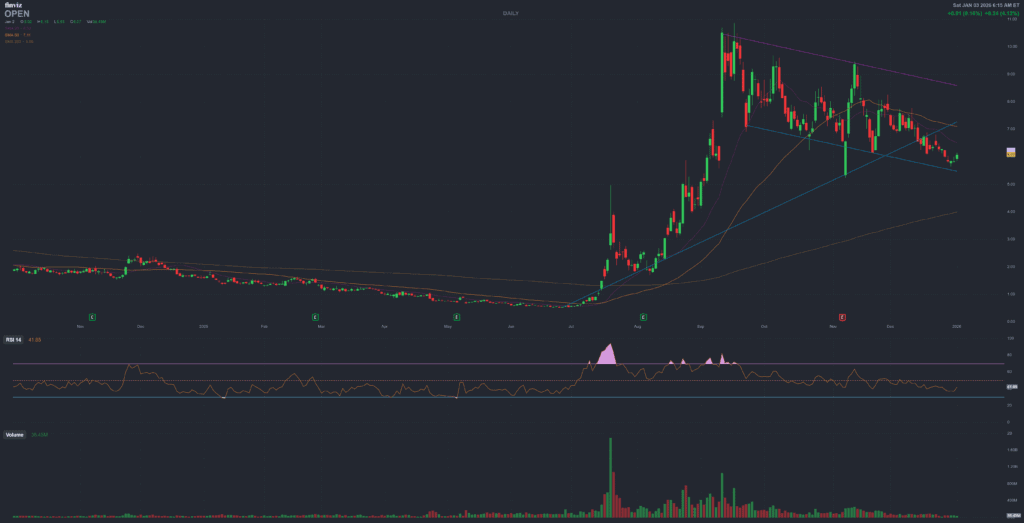
Price chart (Finviz)
Daily candlestick chart with moving averages and volume. Click to open the full interactive page on Finviz (affiliate link). The chart is only a snapshot – useful to see how violent the swings have been in 2025.

0. Why this stock is in the list
- Huge 2025 comeback – after trading below 1 USD, OPEN staged a massive rebound, with the share price up roughly 400–450% in 2025 on the back of retail enthusiasm, leadership changes and a “short squeeze” narrative.
- Real business, real losses – this is not a pre-revenue story. Opendoor generated 3.635B USD of revenue in the first nine months of 2025, but still reported a net loss of 204M USD over the same period.
- Heavy balance sheet usage – the company ended Q3 2025 with 962M USD of cash and 1.79B USD of debt, for a net cash position of about −830M USD. This is not an asset-light software-only model.
- Meme/cult stock dynamics – the “OPEN army” of retail investors has turned the name into a battleground stock against short sellers, helped by a 5.9% disclosed stake from Jane Street and a stream of social media commentary from high-profile investors.
- Management shake-up and AI pivot – 2025 saw the resignation of CEO Carrie Wheeler, the appointment of Shopify’s former COO Kaz Nejatian as CEO, co-founders returning to the board and a push to reframe the story as “Opendoor 2.0” focused on software and AI-driven efficiency.
1. Quick overview – what Opendoor actually does
Opendoor is an iBuyer. Instead of acting purely as a marketplace that matches buyers and sellers, it often stands in the middle:
- uses algorithms and market data to price a home;
- makes a cash offer to the seller and acquires the property;
- holds the home as inventory on its balance sheet;
- resells it, aiming to earn a spread plus service fees and ancillary revenues.
The company makes money from:
- a service charge to sellers (functionally similar to a broker commission but bundled with convenience and timing certainty);
- the gross profit between acquisition price and resale price, net of renovation and holding costs;
- adjacent services such as mortgage, insurance and warranties in some markets.
In 2025, management started to talk more aggressively about “Opendoor 2.0”: shifting from a pure balance sheet-heavy flipper into a more software- and AI-driven real estate platform, with:
- AI-assisted pricing and renovation visualisation for buyers;
- a bigger role for “Key Agent” partners in the ecosystem;
- an explicit goal to reach Adjusted Net Income breakeven by the end of 2026.
2. Key fundamental data (snapshot)
Approximate values – early 2026, rounded and simplified
| Share price | around 5.5–6.0 USD per share (recent prints near 5.8 USD) |
|---|---|
| Market cap | around 5.6–5.8B USD based on recent quotes |
| Revenue (TTM) | about 4.7B USD over the most recent twelve months |
| Q3 2025 revenue | 915M USD (down from 1.377B a year earlier) |
| Q3 2025 net loss | −90M USD; nine-month 2025 net loss −204M USD |
| Gross margin | 7.2% in Q3 2025, around 8.1% for the first nine months of 2025 |
| Cash & equivalents | 962M USD at 30 September 2025 |
| Total debt | about 1.79B USD (non-recourse asset-backed debt plus convertible notes) |
| Net cash | around −830M USD (net debt position) |
| Shareholders’ equity | roughly 811M USD |
| Short interest | roughly 13–15% of float shorted (around 110–120M shares) |
In one line: Opendoor today is a mid-single-digit billion-dollar market cap company with multi-billion revenue, thin gross margins, ongoing net losses and a sizeable net debt position. The equity value is a bet on the company’s ability to make this model consistently profitable and less capital-hungry.
3. Ownership structure – who actually holds OPEN
| Shares outstanding | about 770M shares (771.5M at 30 September 2025) |
|---|---|
| Institutional ownership | roughly 40–60% of shares, depending on dataset |
| Insider ownership | mid-teens % (around 15% reported by some screeners) |
| Short interest | around 13–15% of float shorted, more than 110M shares |
| Notable holder | Jane Street disclosed a 5.9% stake (~44M shares) |
The picture is very different from a typical illiquid micro-cap. Institutions do own a substantial slice of the company, insiders still have meaningful skin in the game and a non-trivial portion of the float is short. That mix – real institutions + strong insiders + high short interest + highly vocal retail base – is exactly the recipe for outsized moves when sentiment flips.
4. 2025 performance – how the stock and the business moved
From an operating angle, 2025 looked like a year of controlled shrink and repair. Revenue for the first nine months of 2025 (3.635B USD) was lower than the same period in 2024 (4.069B USD), but gross profit was far from the disaster seen in 2022, with 293M USD of gross profit and improving contribution margins versus the worst period of the housing shock.
From a stock-price angle, 2025 was the opposite of boring:
- the name moved from sub-1 USD levels into the mid-single-digits;
- year-to-date performance in 2025 hovered around +400–450%;
- volatility was extreme, with repeated squeezes and sharp pullbacks around earnings and news.
The key driver for the rerating was not a sudden explosion in profitability (there isn’t one yet), but a narrative shift: “maybe Opendoor has survived the worst, is rebuilding with new leadership and has a second chance”. The market decided to price that optionality aggressively, helped by the structural short position and social media amplification.
5. Liquidity and volatility – what kind of beast OPEN is
Opendoor trades like a high-beta thematic vehicle tied to U.S. housing and meme-stock flows. Some practical points:
- daily volume is typically tens of millions of shares; on peak days it can go far beyond that;
- intraday swings of ±5–10% are common; double-digit moves on earnings or big news are absolutely on the table;
- a double-digit short float means any sustained move up can force fast covering;
- the “OPEN army” is very active on social channels, which can accelerate moves in both directions.
In other words, OPEN is not a “set and forget” stock. Size, time horizon and risk tolerance matter more than usual. It behaves like a hybrid between a real business and a meme vehicle.
6. Analyst estimates and ratings – what the “official” view looks like
Wall Street’s stance on Opendoor is still largely sceptical. Many analysts point out that:
- the iBuying model remains capital-intensive and operationally complex;
- even with improved unit economics, the company is still losing money and carries substantial debt;
- housing volumes and spreads are sensitive to macro conditions (rates, inventory, local price dynamics).
Several commentaries explicitly stress that the recent surge in the stock is driven more by hype and positioning than by a clear, already-achieved structural profitability. Mean target prices published by brokers are, in many cases, below the current trading range, reflecting caution rather than euphoria.
As always, analyst targets are not guarantees. What matters here is the gap between a very enthusiastic retail narrative and a much colder institutional/analyst view.
7. Outlook and projects – what Opendoor is trying to build
Management’s messaging around “Opendoor 2.0” can be summarised in a few themes:
- AI-driven operations – heavier use of data and AI for pricing, renovation planning and buyer matching, with the ambition to reduce errors, speed up inventory turns and shrink operational overhead.
- Better unit economics – the Q3 2025 materials emphasise contribution margin, contribution profit and adjusted EBITDA, with the goal of reaching Adjusted Net Income breakeven by the end of 2026.
- Less “dumb leverage”, more platform logic – after the painful 2022–2023 period, the company is trying to be more selective in acquisitions, focus on markets where its pricing engine is better calibrated, and expand fee-based products to reduce dependence on pure home-flipping spreads.
- Culture and headcount reset – new chairman Keith Rabois has publicly described the company as “bloated” and talked about potentially cutting a large share of staff as part of a push for efficiency and a more demanding culture.
If this plan works, Opendoor could exit the decade as a leaner, more software-centric housing transaction platform that still does iBuying but in a more disciplined, data-driven way. If it fails, the risk is that the company burns a lot of cash without ever making the economics robust enough.
8. 2025–2026 operational timeline – milestones to keep in mind
-
H1 2025 – stabilisation year
In the first half of 2025 Opendoor generated roughly 2.7B USD in revenue and about 227M USD in gross profit, but still posted a pretax loss of around 114M USD – a reminder that the business can move a lot of houses without yet being structurally profitable. -
Q3 2025 – Opendoor 2.0 & AI messaging
Company holds an “Open House” investor event to present its AI-driven roadmap and re-iterate its plan to get to Adjusted Net Income breakeven by end-2026, while reporting 915M USD revenue and 7.2% gross margin and a net loss of 90M USD. -
Leadership changes in 2025
CEO Carrie Wheeler steps down; Shopify’s Kaz Nejatian becomes CEO; co-founders Keith Rabois and Eric Wu take prominent roles again; Jane Street discloses a major stake. -
2025–2026 – workforce restructuring
Public comments from the new chairman about cutting headcount signal a coming cost and culture reset. The exact execution and impact on operations remain to be seen. -
2026 – profitability checkpoint
Management’s own guidance puts the “Adjusted Net Income breakeven” goal at the end of 2026 on a 12-month forward basis. Every quarter between now and then will be judged against that trajectory.
Unlike a biotech PDUFA, there is no single binary date. The story is a sequence of execution checkpoints on volumes, margins, costs and capital structure.
9. Key 2026 catalysts – where the share price is likely to react
-
Evidence of path to breakeven
Any quarter that shows a clear move towards Adjusted Net Income breakeven – via higher contribution margin, better cost leverage or lower interest burden – will be interpreted as confirmation of the long-term bull case. -
Housing macro (rates, volumes, inventory)
Opendoor’s model is deeply tied to transaction volumes and spreads. Changes in mortgage rates, affordability and local inventory conditions can materially change gross profit without any internal news. -
Capital structure moves
Refinancing of non-recourse debt, convertible note actions or any fresh equity raise will all act as catalysts, either positively (de-risking) or negatively (dilution fears). -
Regulatory or franchise issues
Real estate is heavily regulated at local and national levels. Any change affecting how Opendoor can own, list or transact properties in key markets would matter immediately. -
Short-interest resets
With a double-digit short float, any violent move up or down can trigger squeezes or long liquidations, magnifying the price reaction to otherwise “normal” news.
10. Sentiment (Reddit, Stocktwits, X) – non-professional trader view
Reddit and long-form forums
On Reddit and similar forums, OPEN is discussed both as a turnaround case and as a potential short-squeeze vehicle. Many posts dig into unit economics, market-by-market performance and leadership changes, but the tone is often emotionally invested – holders who rode the rebound are naturally inclined to defend the thesis. These are comments from non-professional traders, not regulated research.
Stocktwits
On Stocktwits, the conversation is almost entirely price-centric: breakouts, gaps, short-squeeze setups. The stock is treated as a high-beta trading instrument, not as a five-year fundamental hold. When volume spikes, the feed fills quickly with short-term calls and charts.
X (Twitter)
On X, Opendoor pops up in threads about housing tech, iBuyers, meme stocks and short squeezes. Some commentators frame it as a “cult stock” rather than a classic meme name, pointing to the combination of strong retail identity (“OPEN army”), high short interest and visible institutional moves like Jane Street’s stake.
Overall sentiment is split: one camp sees Opendoor as a survivor with massive optionality if it cracks the profitability code; the other camp sees a structurally difficult business being temporarily levitated by hype and positioning. Both sides are largely made up of non-professional market participants.
11. Peer group and competitive landscape
Opendoor sits at the intersection of several worlds:
- Traditional brokerages and portals – classic agents and listing platforms that do not put homes on their own balance sheet but compete for seller and buyer attention.
- Other iBuyers and hybrid models – companies that experimented with home-flipping at scale, like Zillow’s now-shuttered iBuying arm, highlighting how difficult the economics can be.
- New housing fintech/platform plays – marketplaces and fintechs that focus on mortgages, title, fractional ownership or agent tools rather than buying houses outright.
What differentiates Opendoor is the scale of its iBuying platform and its renewed attempt to combine balance-sheet-driven transactions with AI-powered software and a stronger agent-centric ecosystem. Whether that hybrid works better than the first generation of pure iBuyers is the core open question.
12. Key questions to monitor
-
Can Opendoor truly reach Adjusted Net Income breakeven by end-2026?
Are quarterly trends in contribution margin, overhead and interest clearly pointing in that direction, or is the target sliding? -
Is the business becoming less capital-intensive?
Are inventory levels, days-in-inventory and debt balances shrinking relative to revenue, or is the model still heavily dependent on leverage? -
How deep are the cost cuts, and do they hurt execution?
Does the planned headcount reduction impair the ability to manage inventory, pricing and operations across many markets? -
Is AI a real edge or just a buzzword?
Do we see tangible, measurable gains from AI and software (better pricing accuracy, faster turns, lower opex), or mostly marketing slides? -
What happens if housing volumes stagnate?
Is the business robust enough to survive another period of low transaction volumes without major dilution or distress?
13. Main risks – the real “but” in the story
- Structural business model risk – large, leveraged home inventories in a cyclical market can generate significant losses when pricing turns against you, as seen in previous years for both Opendoor and other iBuyers.
- Debt and funding risk – with around 1.8B USD of debt and net cash around −830M USD, the company depends on continued access to capital markets and securitisation funding.
- Macro and housing risk – higher rates, lower affordability or regional price declines can compress spreads and slow volumes, hurting margins and increasing inventory risk.
- Execution and culture risk – aggressive headcount cuts and culture changes can backfire if key teams are hollowed out just when the company needs flawless execution.
- Regulatory risk – real estate transactions are regulated market by market; mis-steps or rule changes could limit operations or increase costs in important geographies.
- Sentiment reversal – if the meme/cult element fades while fundamentals are still weak, the stock could re-rate sharply lower as the “hype premium” evaporates.
14. Overall summary – how to frame OPEN in your watchlist
Opendoor today is a high-volatility, high-leverage, execution-heavy turnaround in one of the most cyclical sectors of the economy. It has:
- multi-billion revenue and a real operating platform;
- thin margins, net losses and substantial debt;
- a vocal retail base, a visible short interest and genuine meme/cult dynamics.
The upside scenario is clear: if Opendoor 2.0 manages to turn the iBuying engine into a consistently profitable, AI-assisted transaction machine, with a more balanced capital structure, the current valuation could be a stepping stone rather than a ceiling.
The downside scenario is just as clear: if macro winds turn, unit economics disappoint or access to cheap capital tightens again, a lot of the 2025 rerating can unwind quickly.
For a “small caps of the moment” list, OPEN is a pure example of a stock where business reality, macro, leverage and crowd psychology are all loud. It is not a quiet compounder; it is a moving target that rewards close monitoring and respect for risk.
Biotech Catalyst Calendar
If you follow high-volatility names like OPEN, you may also want to keep an eye on upcoming biotech catalysts (PDUFAs, trial readouts, CRLs, etc.). On Merlintrader trading Blog you’ll find a dedicated calendar with key regulatory and clinical events – all free to browse.
Open the Biotech Catalyst CalendarSmall caps del momento
Opendoor Technologies – OPEN
Opendoor Technologies (NASDAQ: OPEN) è il simbolo del modello “iBuying”: compra case cash, le mette a bilancio come inventario e le rivende tramite una piattaforma digitale. Dal punto di vista della sola capitalizzazione non è più una small cap in senso stretto (oggi è nell’area mid cap, intorno ai 5–6 miliardi USD), ma per volatilità, rischio e dinamiche di flusso continua a comportarsi come una “small cap del momento” nel bene e nel male. Dopo aver rischiato grosso nel reset del mercato immobiliare, il titolo è diventato una delle storie più estreme del 2025, con componenti da meme/cult stock. I ricavi sono tornati in area diversi miliardi, i margini lordi sono meno fragili di un tempo, ma l’azienda perde ancora soldi e porta a bordo parecchio debito. Questa scheda prova a mettere tutto in fila: cosa fa davvero Opendoor, dove sono oggi i numeri, perché il titolo è esploso e quali sono i “ma” veri.
Grafico prezzo (Finviz)
Grafico daily a candele con medie mobili e volumi. Clicca sull’immagine per aprire la pagina completa su Finviz (link affiliato). Serve solo come fotografia della violenza dei movimenti nel 2025, non come segnale operativo.
0. Perché è in questa lista
- Rimbalzo enorme nel 2025 – dopo essere scesa sotto 1 USD, OPEN ha messo a segno un recupero spettacolare, con performance intorno al +400–450% nel 2025, spinta da retail, cambi di management e narrativa short squeeze.
- Business reale, perdite reali – non è una pre-revenue. Opendoor ha generato 3,635 miliardi di USD di ricavi nei primi nove mesi del 2025, ma con una perdita netta di 204M USD nello stesso periodo.
- Uso pesante del bilancio – a fine Q3 2025 la società aveva 962M USD di cassa e 1,79B USD di debito, per una posizione di cassa netta intorno a −830M USD: non esattamente un modello leggero alla “software puro”.
- Dinamiche da meme/cult stock – l’“OPEN army” di investitori retail ha trasformato il titolo in un vero campo di battaglia contro gli short, aiutata dalla disclosure di una quota del 5,9% da parte di Jane Street e da una forte presenza di commenti social di investitori noti.
- Cambio di guida e pivot sull’AI – nel 2025 si sono visti la sostituzione del CEO (da Carrie Wheeler a Kaz Nejatian, ex COO di Shopify), il ritorno dei co-fondatori nel board e un tentativo di riposizionare la storia come “Opendoor 2.0”, più software e AI, meno leva cieca.
1. Panoramica rapida – cosa fa davvero Opendoor
Opendoor è un iBuyer. Invece di limitarsi a mettere in contatto venditori e compratori come un portale classico, entra nel mezzo della transazione:
- stima il valore dell’immobile con algoritmi e dati di mercato;
- fa un’offerta cash al venditore e compra la casa;
- tiene l’immobile come inventario sul proprio bilancio;
- rivende cercando di incassare uno spread, più commissioni e servizi accessori.
Le principali fonti di ricavo sono:
- service fee al venditore (simile a una commissione d’agenzia, ma con in più la certezza del cash e tempistiche rapide);
- margine di rivendita fra prezzo di acquisto e prezzo di vendita, dopo ristrutturazioni e costi di holding;
- servizi collegati (mutui, assicurazioni, garanzie) in alcune aree.
Nel 2025 il management ha iniziato a parlare in modo esplicito di “Opendoor 2.0”:
- uso più spinto di AI per pricing, visualizzazione delle ristrutturazioni e matching con i compratori;
- più enfasi sul ruolo dei “Key Agent” partner nella piattaforma;
- obiettivo dichiarato di arrivare a Adjusted Net Income in pareggio entro fine 2026.
2. Dati fondamentali chiave
Valori indicativi, inizio 2026, arrotondati
| Prezzo | circa 5,5–6,0 USD per azione (ultime chiusure intorno a 5,8 USD) |
|---|---|
| Market cap | intorno a 5,6–5,8 miliardi USD |
| Ricavi TTM | circa 4,7 miliardi USD negli ultimi 12 mesi |
| Ricavi Q3 2025 | 915M USD (in calo da 1,377B USD l’anno prima) |
| Perdita netta Q3 2025 | −90M USD; perdita netta 9M 2025 pari a −204M USD |
| Margine lordo | 7,2% nel Q3 2025, circa 8,1% sui primi nove mesi |
| Cassa | 962M USD al 30 settembre 2025 |
| Debito totale | circa 1,79B USD (debito asset-backed + note convertibili) |
| Cassa netta | circa −830M USD (posizione netta in debito) |
| Patrimonio netto | equity di circa 811M USD a fine Q3 2025 |
| Short interest | circa 13–15% del float venduto allo scoperto (oltre 110M di azioni) |
Tradotto: oggi Opendoor è una società da qualche miliardo di market cap con ricavi importanti ma margini sottili, perdite nette e una quota significativa di debito. Il valore dell’equity è una scommessa sulla capacità di rendere il modello strutturalmente profittevole e meno dipendente dalla leva.
3. Azionariato: istituzionali, insider, short
| Azioni in circolazione | intorno a 770M (771,5M al 30 settembre 2025) |
|---|---|
| Institutional ownership | indicativamente fra il 40% e oltre il 60% delle azioni |
| Insider ownership | intorno al 15% in mano agli insider |
| Short interest | circa 13–15% del float venduto allo scoperto (oltre 110M di azioni) |
| Holder rilevante | Jane Street ha dichiarato una partecipazione del 5,9% (~44M di azioni) |
Il quadro è diverso da quello di una micro cap illiquida: gli istituzionali contano, gli insider non sono assenti e la quota short è significativa. La combinazione istituzionali + insider + short alto + retail molto attivo è esattamente quella che può generare movimenti fuori scala quando il sentiment cambia direzione.
4. Performance 2025: business e prezzo
Sul piano operativo, il 2025 è stato un anno di ridimensionamento controllato e “riparazione”. Nei primi nove mesi Opendoor ha registrato 3,635B USD di ricavi (vs 4,069B USD nel 2024) ma circa 293M USD di margine lordo, nettamente meglio rispetto al periodo più critico del 2022, pur restando in perdita.
Dal lato del grafico, la storia è stata tutt’altro che noiosa:
- il titolo è passato da livelli sotto 1 USD ai mid single digit;
- la performance YTD 2025 si è mossa nell’ordine del +400–450%;
- volatilità elevatissima con spike e correzioni profonde intorno a trimestrali e news.
Il rerating non nasce da una improvvisa esplosione degli utili (non ci sono ancora), ma da un cambio di narrativa: “forse Opendoor ha superato la fase peggiore e ha una seconda chance, con nuova guida e piano operativo diverso”. Il mercato ha deciso di prezzare questa optionalità in modo aggressivo, complice la struttura short e la cassa di risonanza dei social.
5. Liquidità e volatilità
OPEN si comporta come un high-beta legato sia al real estate USA sia al flusso meme/cult.
- volumi giornalieri spesso nell’ordine di decine di milioni di azioni, con picchi molto superiori;
- oscillazioni intraday di ±5–10% sono frequenti; su news importanti i movimenti a doppia cifra non sono rari;
- uno short float a doppia cifra significa che un movimento rialzista può rapidamente trasformarsi in squeeze;
- la community “OPEN army” è molto presente su social, amplificando spesso i movimenti in entrambe le direzioni.
In pratica, non è un titolo “da cassetto”: è un titolo da seguire, dove dimensione della posizione e orizzonte temporale devono essere coerenti con la volatilità intrinseca.
6. Stime e rating degli analisti
La maggior parte degli analisti resta piuttosto fredda. I punti ricorrenti sono:
- il modello iBuying è strutturalmente complesso e intensivo in capitale;
- nonostante il miglioramento dei margini, l’azienda continua a perdere soldi e a portare parecchio debito;
- i volumi e gli spread sono sensibili a tassi, ciclicità immobiliare e dinamiche locali.
Diversi commenti sottolineano che il rally recente è spinto più da hype e posizionamento che da fondamentali già “a posto”. In molti casi i target price medi restano sotto le quotazioni attuali, a testimoniare uno scetticismo di fondo.
Come sempre, i target degli analisti non sono una previsione certa, ma qui aiutano a capire il distacco fra entusiasmo retail e prudenza istituzionale.
7. Prospettive e progetti – cosa vuole diventare Opendoor
La narrativa “Opendoor 2.0” si poggia su alcuni pilastri:
- AI per pricing e operatività – dati e algoritmi per migliorare valutazioni, pianificare ristrutturazioni e velocizzare i cicli di acquisto-vendita, riducendo errori e costi.
- Unit economics migliori – forte focus su contribution margin, contribution profit e Adjusted EBITDA, con target di pareggio sull’Adjusted Net Income entro fine 2026.
- Meno leva “stupida”, più piattaforma – dopo il bagno di sangue del 2022, l’idea è essere più selettivi sulle case da comprare, privilegiare mercati dove il motore di pricing è più affidabile e spingere servizi a fee per ridurre la dipendenza dal puro flipping.
- Reset di cultura e organico – il nuovo chairman ha definito l’azienda “gonfia” e ha parlato apertamente di tagli importanti alla forza lavoro, con ritorno in ufficio e focus su performance.
Se il piano funziona, Opendoor potrebbe uscire dalla decade come piattaforma immobiliare molto più snella e software-centrica. Se non funziona, il rischio è una lunga fase di consumo di cassa senza vera svolta strutturale.
8. Timeline operativa 2025–2026
- H1 2025 – circa 2,7 miliardi di USD di ricavi e 227M USD di margine lordo nel primo semestre, ma ancora una perdita pre-tasse di circa 114M USD: business operativo vivo, ma non “facile”.
- Q3 2025 – evento “Open House” con focus su AI e roadmap “Opendoor 2.0”; ricavi 915M USD, margine lordo 7,2%, perdita netta 90M USD.
- Cambio di leadership 2025 – uscita di Carrie Wheeler, arrivo di Kaz Nejatian come CEO, ritorno dei co-founder nel board, ingresso di Jane Street come azionista di peso.
- 2025–2026 – annunci e implementazione di tagli al personale, con forte attenzione al tema efficienza vs rischio di perdere competenze chiave.
- 2026 – checkpoint cruciale: il target aziendale è di arrivare al pareggio di Adjusted Net Income entro fine anno (su base rolling 12 mesi).
Non c’è una singola data “binaria”: è una sequenza di semafori verdi o rossi su volumi, margini, costi e struttura finanziaria.
9. Catalyst chiave nel 2026
- Avvicinamento (o meno) al pareggio – ogni trimestre che mostra progresso credibile verso il pareggio dell’Adjusted Net Income sarà letto come conferma del lato positivo della storia.
- Macro immobiliare USA – tassi, volumi di compravendite, inventario e prezzi locali possono cambiare parecchio la redditività senza bisogno di news aziendali specifiche.
- Mosse sulla struttura del capitale – rifinanziamenti del debito asset-backed, gestione delle note convertibili o eventuali aumenti di capitale equity saranno catalyst in sé.
- Regolamentazione – cambi normativi a livello locale o nazionale possono limitare l’operatività o aumentare i costi in mercati importanti.
- Reset dello short interest – con short float a doppia cifra, qualsiasi movimento forte può trasformarsi in squeeze o, al contrario, in accelerazione ribassista.
10. Sentiment (Reddit, Stocktwits, X) – commenti di trader non professionisti
Su Reddit e forum lunghi, OPEN viene trattata sia come turnaround che come possibile macchina da short squeeze. Molti utenti fanno analisi sui singoli mercati, sull’effetto dei tassi e sul nuovo management, ma il tono resta spesso emotivo: chi ha cavalcato il rimbalzo tende naturalmente a difendere la tesi. Si tratta di commenti e sentiment di trader non professionisti, non di ricerca regolamentata.
Su Stocktwits il discorso è quasi interamente centrato su grafico, livelli e scenari di squeeze. L’orizzonte medio è di giorni o settimane.
Su X, Opendoor appare in thread su iBuying, real estate tech e meme/cult stock. Alcuni commentatori parlano esplicitamente di titolo “cult” più che di semplice meme, citando la combinazione di comunità retail, short alto e ingressi di player come Jane Street.
Nel complesso il sentiment è polarizzato: da un lato chi vede in Opendoor un sopravvissuto con grande optionalità, dall’altro chi parla di business strutturalmente duro tenuto in piedi dal momentum. Entrambi i fronti sono composti in larga parte da trader non professionisti.
11. Concorrenza e peer group
- Broker tradizionali e portali – agenzie e siti di annunci che non portano case a bilancio ma competono per la relazione con venditore e compratore.
- Altri iBuyer e modelli ibridi – il caso Zillow (uscita dall’iBuying dopo grosse perdite) è spesso citato come esempio dei rischi strutturali del modello.
- Nuovi player “light” – fintech e piattaforme che si concentrano su mutui, title, fractional ownership o servizi per agenti, con modelli meno asset-heavy.
Il tentativo di differenziazione di Opendoor sta proprio nella scala raggiunta sull’iBuying e nella volontà di combinare (finalmente) piattaforma software, AI e leva più controllata. Se basti o meno a rendere il modello sostenibile è la domanda aperta.
12. Domande chiave da monitorare
- Opendoor riuscirà davvero a centrare il pareggio di Adjusted Net Income entro fine 2026?
- Il business sta diventando meno dipendente dalla leva, o continua a richiedere grossi stock di inventario e debito?
- I tagli di personale e il cambio di cultura miglioreranno l’efficienza o rischiano di danneggiare l’esecuzione?
- L’uso di AI porta benefici misurabili (errori in meno, giri di inventario più rapidi, costi più bassi) o resta soprattutto narrativa?
- Cosa succede in uno scenario di nuova debolezza dei volumi immobiliari?
13. Rischi principali
- Modello di business – detenere inventari immobiliari grandi e levereggiati in un settore ciclico può generare perdite rilevanti nei momenti sbagliati, come già visto in passato.
- Debito e funding – con circa 1,8B USD di debito e cassa netta negativa, la società è sensibile all’accesso al credito e al costo della raccolta.
- Rischio macro immobiliare – tassi più alti, domanda debole o cali di prezzo localizzati possono comprimere gli spread e rallentare i volumi, impattando margini e rotazione dell’inventario.
- Execution & cultura – ristrutturazioni aggressive del personale possono generare risparmi ma anche perdita di know-how e frizioni interne proprio mentre serve esecuzione chirurgica.
- Rischio regolatorio – cambi normativi a livello locale o nazionale possono limitare l’operatività o aumentare i costi in mercati importanti.
- Rischio sentiment – se la componente meme/cult si spegne mentre i fondamentali non sono ancora maturi, il repricing al ribasso può essere violento.
14. Sintesi finale
Opendoor oggi è una turnaround ad alta leva e alta volatilità in uno dei settori più ciclici in assoluto. Ha:
- ricavi importanti e una piattaforma operativa reale;
- margini ancora sottili, perdite nette e debito significativo;
- una base retail molto coinvolta, short interest elevato e dinamiche da meme/cult stock.
Lo scenario positivo è chiaro: se “Opendoor 2.0” riuscirà a rendere scalabile e profittevole il modello, con leva sotto controllo e ruolo credibile dell’AI, il rerating del 2025 potrebbe essere solo un primo passo.
Lo scenario negativo è altrettanto evidente: se macro, execution o accesso al capitale girano male, gran parte del rerating potrebbe rientrare.
Come small cap del momento (in senso “comportamentale” più che di market cap pura), OPEN è un caso da seguire più che da banalizzare: business reale, numeri ancora fragili, flussi emotivi fortissimi. Il resto dipende dai criteri personali e dalla propria tolleranza al rischio.
Biotech Catalyst Calendar
Se segui titoli ad alta volatilità come OPEN, può valere la pena tenere d’occhio anche i catalyst biotech (PDUFA, readout clinici, CRL, ecc.). Sul sito trovi un calendario dedicato, aggiornato regolarmente e consultabile gratuitamente.
Apri il Biotech Catalyst CalendarScanner for active traders

Try ChartsWatcher free, then unlock 10% OFF with SAVE10
ChartsWatcher is a real-time scanner for momentum traders: fast movers, unusual volume and rotations — so you can focus on the few tickers that matter right now, instead of watching hundreds of charts.
Start with the free version. When you upgrade, use SAVE10 for 10% OFF your first paid period.
Start free – then use SAVE10
No credit card required to start. Apply SAVE10 when upgrading.
Recommended platform

One platform. All your brokers.
Medved Trader connects multiple brokers in one workspace, with pro charts, hotkeys and fast execution — without changing your broker accounts.
A single cockpit for positions, Level II and multi-broker order routing, built for active day & swing traders.
Get 1 Month Free ➔
Multi-broker workflow + customizable layouts in one platform.
 Monica.im – the AI assistant I use every day
If you find value in the work I publish on Merlintrader and want a practical AI assistant for research and writing, you can sign up using this referral link. Click here to try Monica.im and support the site
Find out how I use AI on Merlintrader: AI, retail and Merlintrader
Disclosure: some of the links in the promotional blocks above are affiliate or referral links. If you choose to subscribe or sign up through them, Merlintrader may receive a small commission or benefit at no extra cost to you.