





Small Caps of the Moment
Planet Labs – PL
Planet Labs PBC (NYSE: PL) runs the largest commercial Earth-imaging constellation in orbit and sells access to a constantly updated stream of satellite data and analytics. In terms of pure market cap Planet is now closer to a mid cap (around 6B USD), but it still behaves like a “small cap of the moment”: volatile, crowded with retail, short interest in the low teens and huge moves around earnings. This page is a long-form profile: business model, key numbers, catalysts, retail sentiment and the real risk map behind the hype.
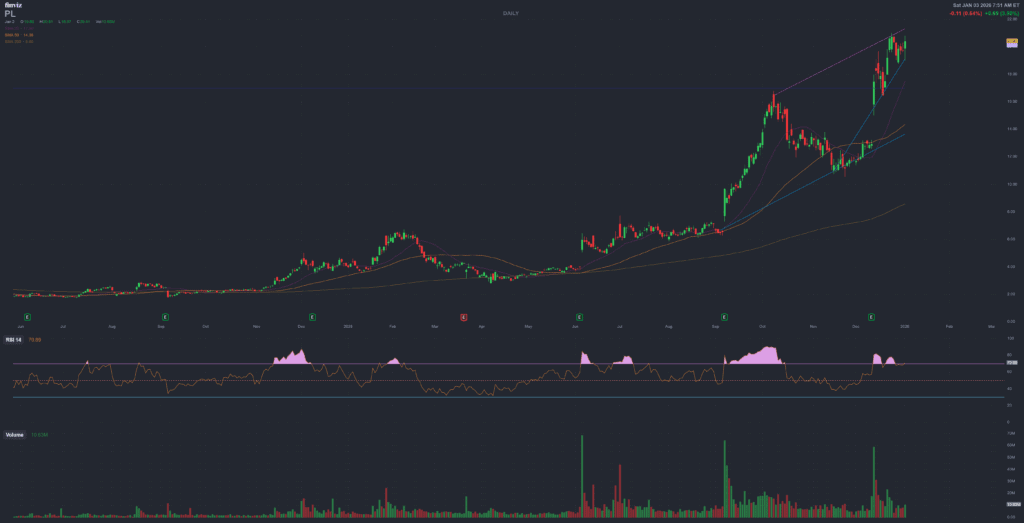
Price chart (Finviz)
Daily candlestick chart with moving averages and volume. Click to open the full interactive page on Finviz (affiliate link). The chart is only a snapshot – useful to see how violent the 2025 move has been.

0. Why this stock is in the list
- Massive 2025 rerating – Planet’s stock is up almost 4x in 2025, with several single-day jumps of 30–50% after earnings and news. It went from being treated as a broken SPAC to a “space + AI + defence” favourite.
- Backlog and cash have exploded – record backlog well above 700M USD, remaining performance obligations multiples of current annual revenue, and end-of-quarter cash and equivalents close to 700M USD.
- Adjusted EBITDA finally positive – the latest quarters show positive adjusted EBITDA, with management promising a path toward sustainable profitability, even if GAAP net income is still deeply negative.
- Prime exposure to geopolitics – contracts with defence and intelligence agencies, NATO and national governments mean Planet sits right in the middle of the “Earth data as critical infrastructure” narrative.
- At the same time, still very high risk – valuation multiples are rich on current revenue, the business is capital-intensive and any slowdown in growth or contracts can hit both the story and the stock hard.
1. Quick overview – what Planet actually sells
Planet is one of the few companies on the market that literally images the entire Earth every day. It operates hundreds of small satellites in low Earth orbit and turns the raw imagery into data products that customers access through a cloud platform and APIs. The satellites themselves are not the product; the real asset is the time-series of images and derived analytics.
The offering can be simplified into three layers:
- PlanetScope and SkySat imagery – daily medium-resolution imagery for global monitoring, and higher-resolution tasking imagery for more focused use cases.
- Analytics and monitoring – change detection, crop health indices, infrastructure monitoring, deforestation alerts, ship tracking and other products built on top of the imagery.
- Dedicated satellite services – building and operating custom Pelican constellations for a single client (for example the 230M USD multi-year contract with an Asia-Pacific customer), with Planet still able to resell data elsewhere.
Customers range from defence and intelligence agencies to agribusiness, insurers, asset managers, energy companies and NGOs. Revenue is mostly subscription-like: multi-year contracts that give clients access to imagery and analytics rather than per-image one-offs.
2. Key fundamental data (snapshot)
Approximate values – early 2026, rounded and simplified
| Share price | around 19–20 USD per share (recent range high teens to just above 20) |
|---|---|
| Market cap | roughly 6.2–6.4B USD |
| Revenue (TTM) | around 280–300M USD |
| Q3 FY26 revenue | about 81M USD, +33% year over year |
| Q3 FY26 net income | net loss of roughly −59M USD |
| Q3 FY26 adjusted EBITDA | about +5.6M USD (positive adjusted EBITDA profit) |
| Gross margin | around 57% (non-GAAP gross margin around 60%) |
| Cash, equivalents and short-term investments | roughly 675–680M USD at the end of the latest quarter |
| Total debt | a few hundred million USD, including convertible notes and lease obligations |
| Backlog | approximately 730M USD |
| RPO (remaining performance obligations) | around 670M USD, up sharply year over year |
| Short interest | roughly 13% of the public float, more than 30M shares sold short |
In one line: Planet is still a loss-making company, but one with hundreds of millions of dollars in cash, a backlog that already exceeds current annual revenue several times and gross margins closer to software than to traditional “space hardware”.
3. Ownership structure – insiders, institutions, shorts
| Shares outstanding | around 770M Class A and B shares combined |
|---|---|
| Institutional ownership | roughly half the float in the hands of funds and long-only institutions |
| Insider & founder ownership | meaningful, but below the “owner-operator” level seen in some small caps |
| Short interest | low-teens percentage of the float, equivalent to several days of average volume |
The mix is interesting: this is not a retail-only stock, but neither is it dominated by a few mega-funds. The presence of material short interest on top of a strong institutional base is exactly what you expect from a controversial growth name: some investors focus on the structural demand for Earth data, others on the burn and valuation.
4. 2025 performance – business and stock
On the operating side, 2025 and the first part of the new fiscal year delivered a clear pattern:
- revenue growth re-accelerating into the high twenties/low thirties percent year over year;
- backlog and RPO growing much faster than revenue, hinting at future visibility;
- adjusted EBITDA flipping positive and staying there for several quarters in a row.
On the stock side, Planet behaved more like a meme/space rocket than a quiet SaaS:
- +300–400% share price move in 2025 after a long period of grinding lower as a post-SPAC laggard;
- single-day jumps of 35–50% after earnings beats and guidance raises;
- a pattern of strong follow-through after good quarters, followed by sharp consolidations whenever financing or dilution worries came back into focus (for example around convertible note offerings).
The key point is that the rerating has been driven by a combination of better numbers and a violent reassessment of the story by investors who had written the company off too early.
5. Liquidity and volatility – trading personality
Planet is now a liquid name: daily volume frequently runs in the 10–20M share range, and on big news days it has traded multiples of that. Combined with a beta well above 2 and double-digit short interest, this produces exactly the behaviour you see on the chart:
- intraday swings of ±5–10% are common even without news;
- post-earnings moves in the 30–50% range are on the table in both directions;
- options activity and gamma positioning matter; some retail traders explicitly treat PL as a short-squeeze candidate rather than a long-term compounder.
For position sizing and risk management, Planet sits in the same bucket as high-beta space, biotech or AI infrastructure names: interesting, but not a stock to ignore for weeks.
6. Analyst estimates and ratings – “official” view
Analysts covering Planet generally agree on a few points:
- the addressable market for Earth-observation data is large and expanding, especially in defence, climate and supply-chain monitoring;
- Planet has a real moat in terms of historical archive and revisit rates – not trivial for new entrants to replicate quickly;
- however, valuation has run ahead of current fundamentals after the 2025 rally, with price-to-sales multiples in the high-teens on trailing revenue and profitability still negative on a GAAP basis.
The consensus is skewed towards “Buy/Outperform”, but with clearly stated concerns: the company has to show it can convert backlog into profitable revenue without eroding margins or resorting to continuous dilution. Some target prices are already below the current spot price, reflecting this tension between excitement and discipline.
7. Outlook and projects – what Planet is trying to build
Planet’s medium-term vision is not just “more satellites” but a full-stack Earth data platform:
- Next-generation Pelican constellation – higher-resolution imaging with faster revisit rates, aimed at defence, intelligence and commercial users who need very fresh, very detailed imagery.
- AI-native analytics – integrating machine learning models directly on the platform and progressively on-orbit, so that customers can receive alerts and insights rather than raw pixels.
- Dedicated constellations as a service – deals where Planet designs, builds, launches and operates satellites for a single client but keeps the ability to monetise residual capacity with others.
- Deeper integration with big cloud players – tighter partnerships with hyperscalers and geospatial platforms so that Planet’s data becomes a default input for a variety of applications.
If this roadmap works, Planet could evolve from “satellite company” to a kind of geospatial data utility, with most of the value in recurring software-like revenue rather than hardware.
8. 2025–2026 operational timeline – key milestones
- Early 2025 – Planet reports improving free cash flow and adjusted EBITDA breakeven, signalling that the cost base is finally starting to scale with revenue.
- Mid 2025 – major multi-year contracts with defence and government customers drive a step-change in backlog and RPO; the market begins to re-rate the name.
- Late 2025 (Q3 FY26) – record quarterly revenue in the low-80M USD zone, backlog above 700M USD, RPO close to that level, adjusted EBITDA positive and raised full-year guidance.
- Convertible notes and capital structure moves – Planet issues convertible debt, triggering short-term volatility as investors weigh dilution risk against the benefit of long-term financing on reasonable terms.
- 2026 – the focal point becomes execution: delivering Pelican satellites on schedule, keeping churn low, expanding high-margin analytics and hitting the updated revenue and profitability targets.
There is no single binary date like a drug approval; instead, Planet is a chain of execution milestones that will either confirm or erode investor confidence quarter by quarter.
9. Key 2026 catalysts – where the share price may react most
- Quarterly earnings vs guidance – any miss on the raised revenue outlook or a step back on adjusted EBITDA could trigger a sharp de-risking; beats with strong backlog growth will likely fuel further squeezes.
- New large contracts or renewals – additional multi-year deals with defence customers, or major renewals with existing agencies, are high-impact headlines.
- Pelican launches and on-orbit performance – successful launches and demonstrated performance (resolution, revisit, uptime) will support the technology story and justify capex.
- Capital structure decisions – any move to refinance, repay or extend convertible notes, or to issue fresh equity, will be read through the lens of dilution vs long-term runway.
- Macro/geo events – conflicts, sanctions, climate-related events and regulatory changes affecting Earth observation can move both demand for Planet’s data and the political perception of the business.
10. Retail sentiment (Reddit, Stocktwits, X) – non-professional traders
Reddit – dedicated subs and “space baskets”
Planet has its own small but vocal subreddit where long-term holders post satellite pictures, contract breakdowns and valuation threads. Many of these users explicitly say they are “in since 4 USD” and see Planet as their favourite way to play the “Earth data as critical infrastructure” theme. Concerns that come up often:
- is a 6B USD market cap on sub-300M USD trailing revenue justified;
- how sustainable is the current price-to-sales multiple if growth slows;
- what happens if defence spending shifts or contracts are delayed.
In parallel, Planet appears frequently in broader “space stocks” threads, usually in the same basket as Rocket Lab, AST SpaceMobile and Redwire. There the tone is more thematic: “if space data and AI become mainstream, PL could be one of the winners”.
Stocktwits – squeeze narratives and momentum trades
On Stocktwits, sentiment meters have repeatedly shown “bullish” to “extremely bullish” readings around earnings and contract news, with message volume spiking on those days. The conversation is heavily focused on:
- short interest percentages and days-to-cover;
- option chains and gamma squeezes;
- intraday charts and key support/resistance levels.
Many posts explicitly frame Planet as a short-squeeze candidate rather than as a steady growth story. It is important to remember that these are comments from non-professional traders, often highly emotional and not based on formal research.
X (Twitter) – space, AI and geopolitics
On X, Planet features in threads about:
- the militarisation of space and the role of commercial providers in defence;
- AI models trained on geospatial data for climate risk, insurance and supply chains;
- the “new space” investment theme more broadly.
Here you see a mix: venture and tech people who focus on product and contracts, and retail traders who mainly celebrate the share price move. Again, these are opinions of unregulated market participants, not investment advice.
Put together, retail sentiment is strongly skewed to the bullish side at the moment, but it is also thin on risk analysis. When expectations become this one-sided, any disappointment can produce outsized downside moves.
11. Peer group and competitive landscape
Planet does not operate in a vacuum. Its competitive set includes:
- Maxar and other high-resolution imagery providers – stronger on very high-resolution imagery and legacy government contracts, but with different revisit and coverage profiles.
- Smaller new-space players – BlackSky, Satellogic and others targeting specific niches or alternative architectures.
- Traditional aerospace and defence primes – large firms that can integrate satellites, launch and analytics in bundled offerings for state customers.
Planet’s pitch is that its unmatched daily coverage and data archive give it a structural advantage in analytics and AI. Whether that translates into durable high-margin revenue is exactly what the next three to five years will reveal.
12. Key questions to monitor
- Can Planet keep revenue growth in the 20–30% range while moving towards GAAP profitability?
- Will the company convert its huge backlog into cash without eroding gross margins?
- How much additional debt or equity will be needed to fund capex and satellite refreshes?
- Will defence and government budgets for commercial Earth imagery continue to expand, or plateau?
- Does the AI narrative translate into concrete, high-margin products rather than marketing slides?
13. Main risks – the real “but” in the story
- Execution risk – delayed launches, technical issues or difficulties scaling analytics could slow growth and damage credibility.
- Valuation risk – after a +300–400% move, even small disappointments can trigger large drawdowns; current multiples leave limited room for error.
- Financing and dilution risk – despite a strong cash balance, Planet still consumes capital and has issued convertible notes; further equity raises would dilute existing holders.
- Customer concentration and policy risk – heavy exposure to government and defence budgets means policy changes, elections or procurement shifts can have outsized impact.
- Competition – other providers may undercut on price, offer different technical trade-offs or bundle imagery with other services in ways that compress margins.
- Sentiment flip – if the “space + AI + defence” narrative falls out of favour, the same retail enthusiasm that pushed the stock up could accelerate the downside.
14. Overall summary – how to frame PL in your watchlist
Planet Labs is no longer a forgotten post-SPAC trading under 5 USD. It is now a multi-billion-dollar, high-volatility play on the idea that daily Earth data and AI-driven geospatial analytics will become core infrastructure for defence, climate and supply chains.
The upside case is straightforward: if Planet keeps executing on launches, wins more large contracts, converts backlog into high-margin recurring revenue and controls dilution, today’s valuation could prove to be a stepping stone rather than a ceiling.
The downside case is equally clear: if growth slows, margins compress, or policy and funding winds change, a lot of the 2025 rerating can unwind very quickly.
For a “small caps of the moment” list, Planet is a textbook example of a stock where technology, geopolitics and crowd psychology collide. It is not a safe haven; it is a sophisticated tool that deserves the same level of homework and risk control you would apply to high-beta biotech or speculative AI names.
Biotech Catalyst Calendar
If you follow high-volatility names like Planet Labs, you may also want to keep an eye on upcoming biotech catalysts (PDUFAs, trial readouts, CRLs, etc.). On Merlintrader trading Blog you’ll find a dedicated calendar with key regulatory and clinical events – all free to browse.
Open the Biotech Catalyst CalendarSmall caps del momento
Planet Labs – PL
Planet Labs PBC (NYSE: PL) gestisce la più grande costellazione commerciale di satelliti di osservazione della Terra e vende accesso continuo a dati e analytics derivati dalle immagini. Come capitalizzazione oggi è più una mid cap (circa 6 miliardi di USD) che una small cap “pura”, ma per volatilità, rischio e comportamento in borsa resta perfettamente in linea con il tema “small caps del momento”: alta beta, forte presenza retail, short interest a doppia cifra e movimenti enormi intorno alle trimestrali. Questa scheda prova a mettere in fila modello di business, numeri, catalyst, sentiment retail e mappa dei rischi.
Grafico prezzo (Finviz)
Grafico daily a candele con medie mobili e volumi. Clicca sull’immagine per aprire la pagina completa su Finviz (link affiliato). Serve solo come fotografia della violenza del movimento del 2025, non come segnale operativo.
0. Perché è in questa lista
- Rerating enorme nel 2025 – il titolo è salito di quasi quattro volte in un anno, con giornate singole da +30–50% dopo trimestrali e news. È passato da ex-SPAC dimenticata a “space + AI + defence play”.
- Backlog e cassa esplosi – portafoglio ordini sopra i 700M USD, RPO multipli dei ricavi attuali e fine trimestre con cassa e equivalenti vicini ai 700M USD.
- Adjusted EBITDA finalmente positivo – gli ultimi trimestri mostrano EBITDA aggiustato in positivo, con il management che promette una traiettoria verso una redditività più strutturale (pur restando in perdita netta GAAP).
- Esposizione diretta alla geopolitica – contratti con difesa, intelligence, NATO e governi nazionali rendono Planet un tassello della narrativa “Earth data come infrastruttura critica”.
- Rischio ancora molto elevato – multipli di valutazione tirati su ricavi attuali, business capital intensive e forte sensibilità a eventuali rallentamenti su crescita e contratti.
1. Panoramica rapida – cosa vende davvero Planet
Planet è una delle poche aziende al mondo che fotografa l’intero pianeta ogni giorno. Opera centinaia di piccoli satelliti in orbita bassa e trasforma le immagini grezze in dataset e indicatori che i clienti consumano tramite piattaforma cloud e API. Il satellite in sé non è il prodotto finale; il valore è nella serie storica di immagini e nelle analytics costruite sopra.
In sintesi, l’offerta si può vedere come tre livelli:
- Immagini PlanetScope e SkySat – copertura giornaliera a media risoluzione e tasking ad alta risoluzione per aree mirate.
- Analytics e monitoraggio – prodotti di change detection, indici per l’agricoltura, monitoraggio infrastrutture, alert su deforestazione, tracking di navi e così via.
- Servizi di costellazione dedicata – progettazione, lancio e gestione di satelliti Pelican per un singolo cliente (come il contratto da 230M USD con un partner Asia-Pacifico), mantenendo la possibilità di rivendere parte dei dati ad altri.
La clientela va dalla difesa alle agri-company, da assicurazioni e asset manager fino a energy e ONG. I ricavi sono in gran parte ricorrenti: contratti multi-anno che danno accesso al flusso dati, non singole vendite di immagini.
2. Dati fondamentali chiave
Valori indicativi, inizio 2026, arrotondati
| Prezzo per azione | intorno a 19–20 USD per azione |
|---|---|
| Market cap | circa 6,2–6,4 miliardi USD |
| Ricavi TTM | circa 280–300M USD |
| Ricavi Q3 FY26 | circa 81M USD, +33% anno su anno |
| Perdita netta Q3 FY26 | intorno a −59M USD |
| Adjusted EBITDA Q3 FY26 | circa +5,6M USD (positivo) |
| Margine lordo | circa 57% (non-GAAP intorno al 60%) |
| Cassa + equivalenti | circa 675–680M USD a fine ultimo trimestre |
| Debito totale | qualche centinaio di milioni USD (note convertibili e lease inclusi) |
| Backlog | circa 730M USD |
| RPO | circa 670M USD, in forte crescita anno su anno |
| Short interest | circa 13% del float, oltre 30M di azioni short |
In una frase: Planet è ancora in perdita, ma con centinaia di milioni in cassa, un portafoglio ordini che vale già diversi anni di ricavi attuali e margini lordi più da software/data company che da “space hardware” tradizionale.
3. Azionariato: istituzionali, insider, short
| Azioni in circolazione | intorno a 770M (classi A e B) |
|---|---|
| Institutional ownership | indicativamente circa metà del flottante in mano a fondi e long-only |
| Insider e founder | presenza non trascurabile, ma non al livello “owner-operator” di alcune small cap |
| Short interest | a doppia cifra (area 13%), pari a diversi giorni di volumi medi |
Il mix è quello tipico dei titoli growth controversi: istituzionali presenti ma non dominanti, insider coinvolti ma non totali, e una porzione importante di float in mano agli short che scommettono su valutazione e rischi esecutivi.
4. Performance 2025: business e prezzo
Sul lato operativo, 2025 e inizio nuovo esercizio mostrano:
- crescita ricavi riaccelerata verso il 30% anno su anno;
- backlog e RPO che crescono molto più velocemente dei ricavi;
- EBITDA aggiustato passato in positivo e ripetuto in più trimestri.
Sul lato grafico, Planet si è comportata più da “razzo” che da SaaS tranquillo:
- movimento di prezzo 2025 nell’ordine del +300–400%;
- giornate singole da +35–50% dopo trimestrali sopra le attese e alzate di guidance;
- forte sensibilità a news su funding e note convertibili, con spike e correzioni altrettanto veloci.
Il rerating è nato sia da numeri migliori sia da una rivalutazione violenta della storia da parte di investitori che avevano completamente “archiviato” il titolo nella categoria ex-SPAC.
5. Liquidità e volatilità
Planet oggi è un titolo liquido, con volumi quotidiani spesso oltre i 10–20M di azioni. Insieme a una beta ben sopra 2 e short interest a doppia cifra, questo produce:
- oscillazioni intraday di ±5–10% anche senza news significative;
- movimenti post-trimestrali di decine di punti percentuali possibili in entrambe le direzioni;
- un ruolo importante di opzioni e gamma, con parte del retail che tratta PL come possibile short squeeze più che come investimento da cassettista.
A livello di gestione rischio, Planet sta nello stesso cassetto di space stocks, biotech speculative e nomi AI ad altissima beta: interessante, ma da maneggiare con cautela.
6. Stime e rating degli analisti
Gli analisti sottolineano in modo abbastanza uniforme che:
- il mercato potenziale per dati satellitari e analytics è grande e in espansione, soprattutto per difesa, clima e supply chain;
- Planet ha un vantaggio reale nella copertura quotidiana globale e nell’archivio storico di immagini;
- ma dopo il rally 2025 la valutazione è tirata, con multipli di price-to-sales elevati e redditività GAAP ancora lontana.
Il consenso pende verso “Buy/Outperform”, ma con tanti caveat: la chiave sarà trasformare backlog in ricavi profittevoli senza massacrare i margini e senza dover emettere nuove azioni ogni volta che serve capitale.
7. Prospettive e progetti
Nel medio termine Planet punta a diventare una vera piattaforma dati geospaziale:
- Costellazione Pelican – imaging a risoluzione più alta e revisit più frequente, soprattutto per difesa e intelligence.
- Analytics “AI-first” – modelli di machine learning integrati direttamente nella piattaforma e, progressivamente, anche on-orbit, per consegnare alert e insight più che semplici immagini.
- Costellazioni dedicate – contratti chiavi in mano dove Planet costruisce e gestisce satelliti per un cliente, mantenendo parte del valore dati per altri utenti.
- Integrazione con i grandi cloud – partnership più strette con hyperscaler e piattaforme geospaziali per rendere i dati Planet un input “di default” per applicazioni terze.
Se il piano funziona, Planet potrebbe passare da “azienda di satelliti” a utility dei dati terrestri con ricavi ricorrenti e margini da software. Se non funziona, resterà un business capital intensive che fatica a trasformare tecnologia in cassa.
8. Timeline operativa 2025–2026
- Inizio 2025 – migliorano free cash flow e EBITDA aggiustato, segnale che i costi iniziano a scalare meglio con i ricavi.
- Metà 2025 – nuovi grossi contratti con difesa/governi portano backlog e RPO su un livello completamente diverso.
- Fine 2025 (Q3 FY26) – ricavi trimestrali record in area 81M USD, backlog oltre 700M, RPO vicini, EBITDA aggiustato positivo e guidance alzata.
- Note convertibili – emissioni di debito convertibile introducono il tema diluizione, ma allo stesso tempo allungano la runway finanziaria.
- 2026 – focus su esecuzione: lancio e messa in opera dei Pelican, mantenimento dei margini, gestione disciplinata di capex e struttura finanziaria.
Non c’è una singola data stile PDUFA: ogni trimestre è un test su crescita, margini, cash flow e gestione del rischio diluizione.
9. Catalyst chiave nel 2026
- Trimestrali in linea o sopra la guidance su ricavi e margini.
- Nuovi grandi contratti multi-anno o rinnovi importanti con clienti difesa/governi.
- Lanci dei Pelican e conferme pubbliche sulle performance effettive in orbita.
- Decisioni su debito convertibile, eventuali rifinanziamenti e possibili aumenti di capitale.
- Eventi macro/geopolitici che aumentano o riducono la priorità per dati di osservazione terrestre.
10. Sentiment (Reddit, Stocktwits, X) – trader non professionisti
Su Reddit esiste un piccolo subreddit dedicato a Planet, dove molti utenti dichiarano di essere “dentro da 4 dollari” e parlano del titolo come della loro scommessa principale su “Earth data come infrastruttura critica”. I thread più lunghi discutono se la capitalizzazione attuale sia giustificata rispetto a ricavi e potenziale, con domande ricorrenti su multipli, crescita e rischio di diluizione.
Nei thread più generali sugli space stocks Planet viene spesso citata accanto a Rocket Lab, AST SpaceMobile e altri titoli new space: la logica è “basket spazio” con PL come componente dati/analytics.
Su Stocktwits i picchi di messaggi arrivano in corrispondenza di trimestrali, contratti o voci di accordi difesa. Il sentiment meter passa facilmente da “bullish” a “extreme bullish”, con molta attenzione a short interest, possibili squeeze e catene di opzioni. L’orizzonte medio dei commenti è di poche sedute.
Su X il titolo entra in discussioni su geopolitica, difesa, clima e AI applicata ai dati satellitari. Qui si incrociano commenti di addetti ai lavori (analisti, persone del settore) e thread di retail che celebrano soprattutto il grafico e il fatto di essere “early” sulla storia.
Tutto questo sentiment è prodotto da trader e investitori non professionisti, spesso molto esposti emotivamente sul titolo: non è ricerca regolamentata, né consulenza, ma un termometro utile per capire dove sono gli eccessi (sia di entusiasmo sia di pessimismo).
11. Concorrenza e peer group
- Maxar e altri fornitori di immagini ad altissima risoluzione.
- Player new space più piccoli (BlackSky, Satellogic, ecc.) con focus su nicchie specifiche.
- Grandi contractor aerospaziali/difesa che possono offrire pacchetti completi (satelliti + lancio + analytics).
Il pitch di Planet è che copertura quotidiana e archivio dati le diano un vantaggio strutturale lato analytics e AI. Nei prossimi anni vedremo se questo si tradurrà in ricavi ricorrenti ad alto margine o se la concorrenza eroderà pricing e quota di mercato.
12. Domande chiave da monitorare
- Planet riuscirà a mantenere crescita ricavi 20–30% portando contemporaneamente la GAAP verso il pareggio?
- Il backlog verrà convertito in cassa senza sacrificare margini lordi e senza eccessiva diluizione?
- Quanto debito/nuovo equity servirà davvero per finanziare satellite refresh e nuovi programmi?
- La domanda di dati di osservazione da parte di difesa e governi continuerà a crescere o rallenterà?
- L’AI resterà narrativa o diventerà un vantaggio competitivo misurabile in prodotti e margini?
13. Rischi principali
- Esecuzione – ritardi nei lanci, problemi tecnici o difficoltà a scalare analytics possono rallentare la crescita e pesare sulla credibilità.
- Valutazione – dopo un rally a più x, gli spazi di tolleranza del mercato sono limitati: delusioni anche moderate possono generare drawdown violenti.
- Finanziamento/diluizione – pur con molta cassa, Planet resta un business che consuma capitale; note convertibili e possibili future emissioni equity sono un rischio per gli attuali azionisti.
- Dipendenza da budget pubblici – contratti difesa/governi sono fondamentali ma esposti a cambi politici, cicli di spesa e decisioni top-down.
- Concorrenza – altri provider possono competere su prezzo, tecnologia o pacchetti integrati, comprimendo i margini.
- Flip di sentiment – se la narrativa “space + AI” perde fascino, la stessa benzina retail che ha spinto il titolo in alto può amplificare la discesa.
14. Sintesi finale
Planet Labs non è più la ex-SPAC da pochi dollari che nessuno guardava: è un titolo volatile, esposto a trend strutturali (dati terrestri, difesa, clima, AI) ma anche a rischi concreti su esecuzione, cicli di spesa pubblica e struttura finanziaria.
Lo scenario positivo è quello di una piattaforma dati che diventa quasi “infrastruttura”: backlog che si trasforma in ricavi ricorrenti, margini in miglioramento, leva più sotto controllo. Lo scenario negativo è quello di un business che resta capital intensive e dipendente da pochi grandi clienti, con oscillazioni forti tra euforia e delusione.
All’interno di una watchlist “small caps del momento”, Planet è un caso da studiare e monitorare, non da seguire per inerzia: storia interessante, numeri in miglioramento, ma profilo di rischio che resta alto e va rispettato.
Biotech Catalyst Calendar
Se segui titoli ad alta volatilità come Planet Labs, può valere la pena tenere d’occhio anche i catalyst biotech (PDUFA, readout clinici, CRL, ecc.). Sul sito trovi un calendario dedicato, aggiornato regolarmente e consultabile gratuitamente.
Apri il Biotech Catalyst Calendar