DISCLAIMER — Not financial advice. Educational content only, not an offer or solicitation to buy or sell any security. Biotech and small/mid-cap stocks are highly speculative and volatile and can result in a partial or total loss of capital. Do your own research and consult a licensed advisor where appropriate. / Contenuti a solo scopo informativo e didattico, non costituiscono consulenza finanziaria né offerta o sollecitazione al pubblico risparmio ai sensi delle normative CONSOB e SEC. Le azioni biotech e le small/mid cap sono strumenti altamente speculativi e volatili e possono comportare la perdita parziale o totale del capitale investito. Si raccomanda di effettuare sempre le proprie ricerche e, se necessario, di rivolgersi a un consulente abilitato.

Merlintrader Trading Pub
Biotech catalyst news and analysis. FDA PDUFA tracker
Merlintrader Trading Pub
Biotech catalyst news and analysis. FDA PDUFA tracker
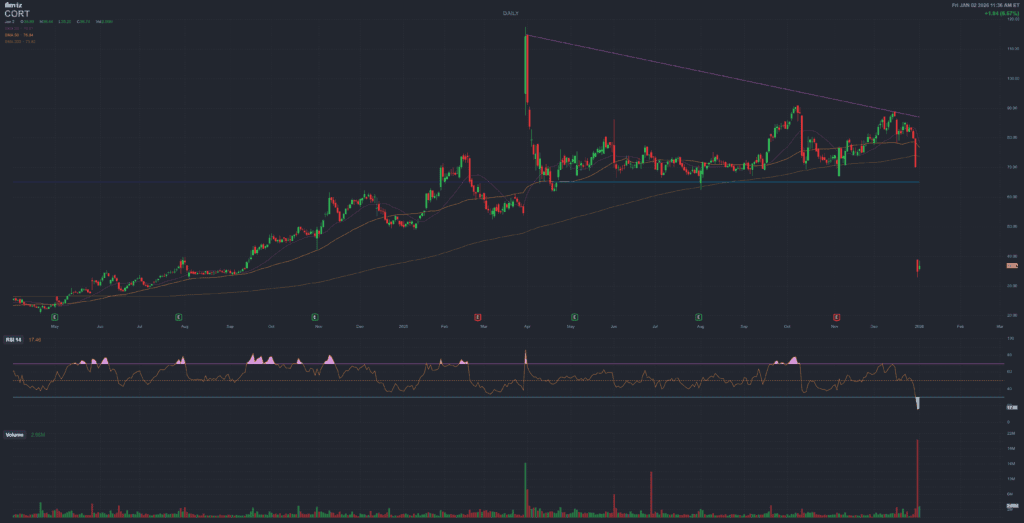
Looking Ahead – CORT After the Cushing CRL
“Guardiamo al futuro!”
On 31 December 2025, the FDA issued a Complete Response Letter (CRL) for Corcept’s relacorilant NDA in hypertension secondary to hypercortisolism (Cushing), wiping out about half of the company’s market cap in a single day. It was a brutal hit – but not a total shutdown of the story.
CRL in one paragraph:
The FDA acknowledged that one of Corcept’s Phase 3 trials in Cushing was successful, but another failed its
primary endpoint. Given this mixed picture, the agency said it could not reach a favorable
benefit-risk assessment without additional evidence of effectiveness and therefore rejected the
NDA via CRL. No insurmountable safety issues were cited; the focus is efficacy and consistency.
This piece is written with a constructive but honest tone: we accept that Cushing has been pushed back by years, but we also map the other arrows in Corcept’s quiver – most notably the ovarian cancer PDUFA on July 11, 2026, the ongoing BELLA and MONARCH studies, and a balance sheet that still looks more like a mid-cap cash machine than an early-stage biotech.
Positive Ovarian PDUFA July 11, 2026 still on track
Reality Cushing delayed, not dead
Structure >$800M revenue, >$500M cash, no funding crunch
Risk Second big binary in mid-2026, high short interest
CRL date (Cushing)
31 Dec 2025
FDA declines to approve relacorilant for hypertension due to hypercortisolism, asking for more
efficacy data; the stock drops ~48–50%.
Ovarian PDUFA (ROSELLA)
July 11, 2026
NDA for relacorilant + nab-paclitaxel in platinum-resistant ovarian cancer accepted; PDUFA set for
11 July 2026.
Q3 2025 snapshot
$207.6M / $524M
Q3 revenue $207.6M (+~14% YoY); 2025 revenue guidance $800–850M; cash and marketable securities
$524.2M as of Sept 30, 2025.
1. What Exactly Happened With the Cushing CRL?
Corcept sought approval for relacorilant to treat patients with hypertension secondary to hypercortisolism (endogenous Cushing). The NDA was based on two Phase 3 trials:
- One trial met its primary endpoint and showed meaningful clinical benefit.
- The second failed its primary endpoint, though several secondary endpoints moved in the right direction.
The FDA’s message can be boiled down to: “We see signal, but not enough consistent evidence to comfortably say yes. Bring more data.”
Analysts like Truist and Piper interpreted the CRL as effectively requiring an additional confirmatory trial, which likely pushes any Cushing approval out by several years. It is a serious blow in terms of timing and near-term revenue expectations, but it is not a safety death sentence for relacorilant.
2. How the Cushing Impasse Could Be Overcome
In its press release, Corcept said it intends to meet with the FDA as soon as possible to discuss the best path forward. Realistically, that means:
- Formal meetings (Type A/B) to dissect the two Phase 3 trials in detail.
- Assessing whether more sophisticated analyses or defined subgroups can strengthen the efficacy story.
- Designing a new confirmatory study with a cleaner, more compelling endpoint strategy.
Nobody should expect the FDA to reverse the decision based on re-argument alone. The base case is that a new trial is needed, implying a potential delay of 3–5 years before Cushing can come back to the approval table.
What keeps this from being a “game over” is that Corcept is not a cash-starved micro-cap. Thanks to Korlym, it generates hundreds of millions in annual revenue and sits on over half a billion dollars in cash and securities. The company can, in principle, afford to run another trial while still investing in oncology and metabolic programs.
3. The Arrows in the Quiver – Key 2026+ Catalysts
3.1 July 11, 2026 – FDA PDUFA (ROSELLA, Platinum-Resistant Ovarian Cancer)
The focal near-term catalyst is the July 11, 2026 PDUFA for relacorilant plus nab-paclitaxel in platinum-resistant ovarian cancer (PROC). The NDA was accepted in September 2025, with the PDUFA date clearly specified in the filing.
ROSELLA has already read out positively:
- ~30% reduction in the risk of progression or death (HR ≈0.70) vs nab-paclitaxel alone.
- Improved PFS and OS, including in patients pre-treated with PARP inhibitors.
- A tolerability profile broadly consistent with prior experience.
Several analysts remain explicitly bullish on the PROC opportunity even after the Cushing CRL, viewing it as a high-need setting where a controlled, randomized Phase 3 already supports approval.
Price impact potential: if July 11 brings a clean FDA approval, CORT could see a significant re-rating – especially if investor sentiment is still depressed by the Cushing news. This is a true binary event.
3.2 EMA Review for Ovarian Cancer
Corcept has also submitted a Marketing Authorization Application (MAA) to the European Medicines Agency for the same PROC indication. EMA timelines are typically 12–18 months, so an EU decision could arrive in late 2026 or 2027.
Dual approval (US + EU) would turn relacorilant into a global oncology franchise, not just a U.S. niche – something the market is not fully pricing in after the CRL shock.
3.3 BELLA – Phase 2 Multi-Arm in Gynecologic Cancers
The BELLA (NCT06906341) study is an open-label, multi-arm Phase 2 evaluating relacorilant + nab-paclitaxel with or without bevacizumab across several gynecologic settings (platinum-resistant and platinum-sensitive ovarian, endometrial).
The trial started in 2025 with an estimated primary completion around late 2026. BELLA matters because it:
- tests relacorilant in broader and earlier-line gynecologic populations;
- can support label expansions beyond PROC or at least strengthen oncology positioning.
3.4 MONARCH – Miricorilant in MASH (Phase 2b)
Miricorilant is a selective GR modulator being developed for MASH/NASH. The MONARCH (NCT06108219) Phase 2b trial is a randomized, double-blind, placebo-controlled study in non-cirrhotic MASH, with 48-week histologic endpoints.
Initial F2b results are unlikely before 2026–2027, but if MONARCH is successful, Corcept would gain a second large-market asset in metabolic liver disease, independent of relacorilant’s Cushing and ovarian paths.
3.5 Korlym and the Teva Situation – Risk, but Also a Cash Buffer
Corcept is not a pre-revenue biotech:
- Korlym, approved for hyperglycemia in endogenous Cushing, remains a substantial business.
- Q3 2025 revenue was $207.6M, up ~14% vs Q3 2024; 2025 revenue guidance stands at $800–850M.
- Cash and securities exceeded $500M at Sept 30, 2025.
Generic pressure from Teva and ongoing patent/antitrust litigation are undeniable risks, but Korlym continues to generate significant cash flow that can fund oncology and MASH programs – and, if needed, a new Cushing study – without dilutive equity raises.
4. Fundamentals: Revenue, Earnings, Cash
Q3 2025 and updated 2025 guidance paint the picture of a profitable specialty pharma:
| Item | Q3 2025 / FY 2025 |
|---|---|
| Quarterly revenue | $207.6M, up about 13–14% vs Q3 2024. |
| 2025 revenue guidance | $800–850M (reduced from prior guidance but still robust). |
| Net income Q3 2025 | $19.7M (diluted EPS ~$0.16), down YoY due to higher R&D and SG&A. |
| Cash & marketable securities | $524.2M as of September 30, 2025. |
| Share repurchases | Corcept repurchased ~$50M of common stock in Q3 2025, signalling confidence pre-CRL. |
Even after the share price collapse, these fundamentals matter: they mean runway and optionality. Corcept can continue investing in ROSELLA follow-through, BELLA, MONARCH and potentially a new Cushing study from a position of financial strength rather than survival mode.
5. Ownership, Short Interest, Insiders and Institutions
5.1 Short interest – high but not absurd
As of the mid-November 2025 reporting date, CORT had roughly 10.2 million shares sold short, about 12% of the public float, with a short-interest ratio of around 14 days to cover.
This is high enough to:
- signal that a non-trivial number of sophisticated investors are betting against Corcept (Cushing, Teva, valuation);
- create the potential for sharp short-covering moves if a major catalyst (e.g. ovarian approval) breaks the bearish thesis.
5.2 Insider ownership – management has real skin in the game
Estimates vary by data provider, but insider ownership is clearly elevated vs typical biotech:
- Low-end estimates: ~11–12% of shares held by insiders.
- Higher estimates (e.g. Fintel): insider holdings on the order of 20–25% of the company.
Either way, senior leadership and founders are heavily exposed to CORT’s equity, which generally aligns their incentives with long-term shareholders – even if it does not guarantee perfect decision-making.
5.3 Institutional base – big names are present
Institutional ownership is in the 70–75% range, with major holders including:
- BlackRock (double-digit percentage of shares),
- Vanguard Group,
- Ingalls & Snyder,
- Renaissance Technologies, and other well-known funds.
The cap table is therefore a mix of:
- substantial institutional long interest,
- material insider stakes,
- a meaningful but not insane short position.
6. Management – Are They Capable of Steering Through This?
6.1 Joseph K. Belanoff, M.D. – Founder CEO
Joseph Belanoff co-founded Corcept and has served as its CEO since 1999 and Board Chair since 2014. He holds a B.A. from Amherst College and an M.D. from Columbia University’s College of Physicians and Surgeons, and has been associated with Stanford University’s Department of Psychiatry and Behavioral Sciences since the early 1990s.
Under his leadership, Corcept:
- brought Korlym from concept to FDA approval and into a sizable commercial franchise;
- built a diversified pipeline of GR modulators (relacorilant, miricorilant, others);
- scaled to hundreds of millions in annual revenue while remaining independent.
6.2 Broader leadership team
The executive team includes:
- William Guyer, PharmD – Chief Development Officer, overseeing clinical development, especially oncology programs like ROSELLA and BELLA.
- Hazel Hunt, Ph.D. – Chief Scientific Officer, leading discovery and scientific strategy around GR modulation.
- J.D. Lyon – Chief Accounting and Technology Officer, managing finance and systems in a now-complex organization.
Criticisms from the market focus less on competence and more on **communication tone** (perhaps too bullish on Cushing) and on an aggressive stance in litigation with Teva. Still, this is a seasoned team that already navigated one drug from early development to a sizeable commercial franchise.
7. Retail Sentiment – From “Can’t Miss” to “Panic but Still Long”
Before the CRL, retail sentiment around CORT on platforms like Stocktwits was strongly euphoric: relacorilant in Cushing was often described as “almost a sure thing”, the ovarian NDA as a formality, and Korlym as an indestructible cash engine.
After the CRL:
- Long-term believers see the −50% move as a buying opportunity, focusing on PROC and MASH.
- Disappointed holders accuse management of overselling the Cushing NDA and under-communicating risk.
- Opportunistic traders are attracted by the “good company, bad headline, huge drop” pattern.
For serious catalyst-driven work, the right stance is to use retail sentiment as a **contrarian indicator** and as a source of links and discussion, but to anchor risk/reward assessments to primary sources – FDA, company filings and actual trial data – rather than to how loudly any side shouts on social media.
8. Scenario Map – Bull, Base, Bear
8.1 Bull Case
- July 11, 2026 PDUFA is positive; relacorilant is approved for PROC with a reasonably broad label.
- EMA grants approval in the EU in 2027, expanding the addressable market.
- BELLA provides supportive data for additional gynecologic uses.
- MONARCH in MASH delivers strong F2b results, justifying a Phase 3 program.
- Korlym erosion is manageable; the Teva litigation resolves without catastrophic outcomes.
In this case, the market could re-rate CORT not only back towards pre-CRL levels but potentially higher, with multiple approved or near-approval products across endocrinology, oncology and metabolism.
8.2 Base Case (Constructively Bullish)
- PROC PDUFA is positive, but uptake ramps gradually rather than explosively.
- EMA takes time; BELLA shows mixed but generally supportive data.
- MONARCH is encouraging but not a slam dunk; further work is needed.
- Korlym declines but remains a meaningful cash contributor for several years.
Under this scenario, CORT has clear upside from current depressed levels, but the journey is choppy and highly execution-dependent.
8.3 Bear Case
- The July 2026 PDUFA is negative or delayed by unexpected FDA requests.
- BELLA and MONARCH fail to show convincing benefit.
- Korlym comes under heavier pressure from generics and/or litigation outcomes.
- A new Cushing trial is launched but viewed as low-probability by the market.
In that world, the re-rating would be much harsher: Corcept would trade more like a high-risk asset with a damaged core thesis and an expensive pipeline rebuild ahead.
9. Bottom Line – “Looking Ahead” Is Not the Same as “No Risk”
The Cushing CRL was a big deal: it removed a near-term approval and pushed a multi-billion-dollar opportunity far into the future. A ~50% share-price collapse in one day was brutal, but not irrational.
At the same time, 2026 is not a barren wasteland for Corcept:
- a well-supported ovarian PDUFA on July 11, 2026,
- a potential EMA approval,
- the multi-arm BELLA study,
- the MONARCH MASH program,
- and a cash-generating Korlym business.
“Guardiamo al futuro” – looking ahead – here means recognising both sides: the damage done and the arrows that remain. Anyone staying in or initiating a position in CORT now should do so knowing that the next major judgement call will come in July 2026, and that the span between now and then will likely be volatile.
Important note
This report is for informational and educational purposes only. It is not investment advice, a recommendation, or a solicitation to buy or sell any security. Biotech catalyst trades are highly risky and may result in a total loss of capital. Always refer to primary sources (company filings, FDA documents, clinical trial registries) and consult a qualified financial advisor before making investment decisions.
This report is for informational and educational purposes only. It is not investment advice, a recommendation, or a solicitation to buy or sell any security. Biotech catalyst trades are highly risky and may result in a total loss of capital. Always refer to primary sources (company filings, FDA documents, clinical trial registries) and consult a qualified financial advisor before making investment decisions.
Guardiamo al futuro! – CORT dopo la CRL su Cushing
Il 31 dicembre 2025 la FDA ha emesso una Complete Response Letter (CRL) sull’NDA di relacorilant nell’ipertensione da ipercortisolismo (Cushing), facendo perdere a Corcept circa metà della capitalizzazione in un solo giorno. Colpo duro, sì – ma non la fine della storia.
CRL in poche righe:
La FDA ha riconosciuto che uno dei trial di Fase 3 è stato positivo, ma un secondo studio
non ha centrato l’endpoint primario. Con questo quadro “misto” l’agenzia ha detto di non poter arrivare a
un rapporto beneficio/rischio favorevole senza ulteriori evidenze di efficacia e ha quindi
respinto l’NDA con una CRL. Non sono stati segnalati problemi di safety insormontabili; il tema è la forza
e la coerenza dell’efficacia.
In questo pezzo cerchiamo di essere costruttivi ma onesti: accettiamo che su Cushing il treno si sia allontanato di qualche anno, ma mappiamo anche le altre frecce nell’arco – in primis la PDUFA ovarica dell’11 luglio 2026, gli studi BELLA e MONARCH, e una struttura di conto economico che assomiglia più a una mid-cap redditizia che a una small-cap in cerca di salvezza.
Positivo PDUFA ovarico 11 luglio 2026 ancora attiva
Reality Cushing rinviato, non morto
Struttura Ricavi >800M$, cassa >500M$, niente aumenti d’emergenza
Rischio Secondo binario forte a metà 2026, short elevato
Data CRL (Cushing)
31 dic 2025
La FDA rifiuta relacorilant per ipertensione da ipercortisolismo chiedendo più dati di efficacia;
il titolo perde ~48–50%.
PDUFA ovarico (ROSELLA)
11 luglio 2026
NDA accettata per relacorilant + nab-paclitaxel in tumore ovarico platino-resistente; PDUFA fissata
ufficialmente per l’11/07/2026.
Q3 2025 ricavi / cassa
$207,6M / $524M
Ricavi Q3 $207,6M (+~14% a/a); guidance ricavi 2025 $800–850M; cassa e titoli $524,2M al 30/9/2025.
1. Cosa è successo davvero con la CRL su Cushing
Corcept cercava l’approvazione di relacorilant come trattamento per pazienti con ipertensione secondaria a ipercortisolismo (Cushing endogeno). L’NDA poggiava su due trial di Fase 3:
- uno positivo sull’endpoint primario, con beneficio clinico chiaro;
- il secondo negativo sull’endpoint primario, pur con endpoint secondari favorevoli.
Il messaggio della FDA, semplificando, è stato: “Vediamo segnali, ma non abbastanza solidi e coerenti per dire sì con tranquillità. Servono più dati.”
Gli analisti hanno letto la CRL come un invito a fare un nuovo trial di conferma, con slittamento di alcuni anni nel potenziale via libera su Cushing. È un colpo pesante sul piano temporale e sulle attese di ricavi, ma non una condanna definitiva per relacorilant.
2. Perché l’impasse Cushing può (in teoria) essere superata
Nel PR, Corcept dichiara di voler incontrare la FDA “il prima possibile” per discutere il percorso futuro. Tradotto in pratica significa:
- meeting formali per analizzare in dettaglio i due Fase 3;
- valutare analisi aggiuntive/sottogruppi che possano rafforzare la lettura dell’efficacia;
- progettare un nuovo studio di conferma con endpoints e design più puliti.
Nessuno si aspetta che la FDA cambi idea solo con argomenti statistici: lo scenario base resta un nuovo trial, quindi un ritardo di 3–5 anni prima di rivedere Cushing sul tavolo approvativo.
La differenza rispetto a molte small-cap è che Corcept può permettersi questo tipo di sforzo: grazie a Korlym e agli altri programmi ha flussi di cassa e risorse sufficienti per continuare a investire in oncologia e MASH senza doversi finanziare a condizioni disperate.
3. Le frecce nell’arco – i catalyst principali 2026+
3.1 11 luglio 2026 – PDUFA FDA per ovarico platino-resistente (ROSELLA)
Il catalyst più evidente è la PDUFA dell’11 luglio 2026 per relacorilant + nab-paclitaxel nelle pazienti con tumore ovarico platino-resistente (PROC).
Lo studio di Fase 3 ROSELLA ha già dato risultati positivi:
- riduzione di circa 30% del rischio di progressione o morte (HR ≈0,70) vs nab-paclitaxel solo;
- miglioramento di PFS e OS, anche nei sottogruppi pre-trattati con PARP-inibitori;
- profilo di tollerabilità in linea con quanto visto in studi precedenti.
Molti analisti, pur tagliando i target price dopo la CRL, restano positivi sulla chance ovarica, perché qui i dati sono già stati letti in Fase 3 e il bisogno clinico è molto alto.
Impatto potenziale: se l’11 luglio arriverà un sì, CORT potrebbe sperimentare un re-rating importante, soprattutto se il sentiment resterà depresso per mesi a causa della CRL su Cushing.
3.2 EMA – revisione europea per la stessa indicazione
Corcept ha anche depositato una MAA all’EMA per relacorilant in combinazione con nab-paclitaxel nel PROC. I tempi europei sono in genere 12–18 mesi, quindi un esito potrebbe arrivare verso fine 2026/inizio 2027.
Una doppia approvazione USA + EU trasformerebbe relacorilant in un vero franchise oncologico globale, non solo statunitense.
3.3 BELLA – Fase 2 multi-arm nei tumori ginecologici
Il trial BELLA (NCT06906341) è uno studio di Fase 2, open-label, multi-braccio che valuta relacorilant + nab-paclitaxel ± bevacizumab in diversi contesti ginecologici (ovario platino-resistente, platino-sensibile, endometriale).
L’avvio è del 2025, con completamento stimato intorno a fine 2026. BELLA è importante perché:
- testa relacorilant in popolazioni più ampie e/o meno pretrattate rispetto a ROSELLA;
- fornisce materiale per eventuali espansioni di label o comunque per consolidare il ruolo di relacorilant in ginecologia.
3.4 MONARCH – miricorilant in MASH (Fase 2b)
Miricorilant è un modulatore GR selettivo sviluppato per MASH/NASH. Lo studio MONARCH (NCT06108219) è una Fase 2b randomizzata, in doppio cieco vs placebo, con endpoint istologici a 48 settimane in pazienti con MASH non cirrotica.
I primi dati completi non sono attesi prima del 2026–2027, ma se MONARCH sarà convincente, Corcept si ritroverà con un secondo asset “big market” su un asse diverso da relacorilant (oncologia/Cushing).
3.5 Korlym & Teva – rischio, ma anche cuscinetto di cassa
Corcept non è una pre-revenue biotech:
- Korlym è già approvato per il controllo dell’iperglicemia in pazienti adulti con Cushing;
- Q3 2025: ricavi $207,6M (~+14% a/a);
- guidance ricavi 2025: $800–850M;
- cassa + titoli: $524,2M al 30/9/2025.
La concorrenza del generico Teva e le cause antitrust sono un overhang importante, ma Korlym continua a generare flussi di cassa che finanziano la pipeline (ovario, MASH, eventuale nuovo trial Cushing) senza bisogno di aumenti di capitale diluitivi nel breve.
4. Fondamentali: ricavi, utili, cassa
Q3 2025 e la nuova guidance 2025 fotografano una società già in regime di piena redditività:
| Voce | Dati Q3 2025 / FY 2025 |
|---|---|
| Ricavi trimestrali | $207,6M, circa +13–14% rispetto a Q3 2024. |
| Guidance ricavi 2025 | $800–850M (ridotta ma sempre molto robusta). |
| Utile netto Q3 2025 | $19,7M (EPS diluito ~0,16$), in calo per l’aumento di R&D e SG&A. |
| Cassa & titoli | $524,2M al 30 settembre 2025. |
| Buyback | Nel Q3 2025 Corcept ha riacquistato ~50M$ di azioni, segnale di confidenza pre-CRL. |
Anche dopo il crollo, questi numeri contano: significano runway e flessibilità. Corcept può continuare a finanziare i programmi chiave senza dover bussare al mercato in tempi brevi.
5. Struttura del capitale: short, insider, istituzionali
5.1 Short interest – elevato ma gestibile
A metà novembre 2025 lo short interest su CORT era intorno a 10,2 milioni di azioni, pari a circa 12% del float, con un “days to cover” vicino a 14 giorni.
Questo significa:
- presenza significativa di investitori che scommettono contro il titolo (tema Cushing, Teva, valutazione);
- possibilità di short covering violenti se una news forte (es. approvazione ovarico) smentisse la tesi ribassista.
5.2 Insider – management con “pelle in gioco”
Le stime di insider ownership variano, ma tutte indicano livelli superiori alla media biotech:
- stima prudente: ~11–12% di azioni in mano agli insider;
- stima più alta: fino a ~20–25% del capitale, secondo alcuni tracker.
Anche prendendo la cifra più bassa, significa che il management è esposto in modo significativo al destino del titolo: non è un board con poche stock option e tanti discorsi.
5.3 Istituzionali – chi c’è nel capitale
La ownership istituzionale si aggira intorno al 70–75%, con tra i principali azionisti:
- BlackRock (quota a doppia cifra),
- Vanguard,
- Ingalls & Snyder,
- Renaissance Technologies e altri fondi noti.
Il quadro complessivo è quindi quello di un titolo:
- molto presente nei portafogli istituzionali,
- con insider importanti,
- e una componente short significativa ma non estrema.
6. Management – hanno le carte per reggere l’urto?
6.1 Joseph K. Belanoff, M.D. – CEO fondatore
Joseph Belanoff è co-fondatore di Corcept e CEO dal 1999, nonché Presidente del CdA dal 2014. Laureato ad Amherst College, M.D. alla Columbia, ha lavorato per anni nel dipartimento di Psichiatria a Stanford.
Sotto la sua guida Corcept:
- ha portato Korlym dall’idea all’approvazione FDA e a ricavi quasi miliardari;
- ha costruito una pipeline corposa di modulatori GR (relacorilant, miricorilant, altri);
- è passata da piccola biotech a società con centinaia di milioni di ricavi annui, restando indipendente.
6.2 Il resto del team
L’executive team include figure con lunga esperienza:
- William Guyer, PharmD – Chief Development Officer, responsabile dello sviluppo clinico (ROSELLA, BELLA, altri programmi oncologici);
- Hazel Hunt, Ph.D. – Chief Scientific Officer, alla guida della ricerca e della strategia scientifica sulla modulazione GR;
- J.D. Lyon – Chief Accounting and Technology Officer, lato finance e sistemi.
Le critiche maggiori riguardano più il tono della comunicazione (molto ottimista su Cushing) e la gestione combattiva del contenzioso con Teva, non tanto la competenza tecnica. Nel complesso parliamo di un team che ha già dimostrato di saper portare un farmaco dal laboratorio al mercato e farlo crescere.
7. Sentiment retail – da “tutto facile” a “panic long”
Prima della CRL, su Stocktwits e altri social il sentiment su CORT era molto euforico: Cushing veniva trattata come quasi garantita, la PDUFA ovarica come formalità, Korlym come bancomat infinito.
Dopo la CRL la community si è spaccata:
- Long convinti che vedono il -50% come “regalo di Capodanno” e inseguono il buy-the-dip;
- Delusi che accusano il management di aver sottovalutato il rischio regolatorio;
- Nuovi trader mordi-e-fuggi attirati dal crollo e dalla volatilità.
Per un’analisi seria, la cosa migliore è considerare il sentiment retail come rumore utile ma non decisivo: serve a capire quanto è “carica” la molla, ma le decisioni vanno prese guardando PR ufficiali, 10-K / 10-Q, documenti FDA e dati clinici.
8. Mappa scenari (bull / base / bear)
8.1 Scenario bull
- PDUFA dell’11 luglio 2026 positiva con label adeguata in PROC;
- EMA approva relacorilant anche in Europa entro il 2027;
- BELLA conferma o amplia il segnale in altri tumori ginecologici;
- MONARCH in MASH fornisce dati convincenti e apre la strada a un Phase 3;
- Korlym regge meglio del previsto nonostante Teva; il contenzioso si chiude senza disastri.
In questo scenario, il titolo avrebbe spazio per recuperare e andare oltre i livelli pre-CRL, grazie a più linee di ricavo potenziali.
8.2 Scenario base (costruttivo ma prudente)
- PDUFA ovarico positiva ma con adozione graduale;
- EMA più lenta; BELLA dà segnali misti ma sufficiente supporto;
- MONARCH incoraggiante ma non esplosivo; si procede comunque verso un Phase 3;
- Korlym rallenta gradualmente ma continua a generare cassa significativa.
Qui CORT ha comunque upside rispetto ai livelli post-CRL, ma resta un titolo ad alto beta e molto legato all’esecuzione.
8.3 Scenario bear
- PDUFA ovarico negativa o rinviata con richieste ulteriori;
- BELLA e/o MONARCH non mostrano un beneficio convincente;
- Korlym viene eroso più rapidamente dai generici, e l’esito con Teva è sfavorevole;
- Un nuovo trial Cushing parte ma il mercato gli attribuisce scarse probabilità.
In questo caso il rerating sarebbe molto più profondo: CORT tornerebbe a essere trattata come una storia a rischio elevato con pipeline da ricostruire quasi da zero.
9. Conclusione – “Guardiamo al futuro” non vuol dire “tutto a posto”
La CRL su Cushing è stata un evento serio: ha cancellato una possibile approvazione nel breve e ha spostato in avanti di anni una potenziale fonte di ricavi enorme. Il crollo del titolo è stato violento, ma non del tutto inspiegabile.
Allo stesso tempo, il 2026 di Corcept non è un deserto:
- una PDUFA oncologica con dati di Fase 3 già positivi;
- una revisione EMA che può rafforzare il franchise;
- studi come BELLA e MONARCH che tengono aperte carte importanti su ginecologia e MASH;
- un business Korlym che continua a generare cassa e a finanziare tutto il resto.
“Guardiamo al futuro” qui significa tenere insieme entrambe le cose: il danno fatto e le frecce ancora a disposizione. Chi resta o entra su CORT dopo la CRL lo fa sapendo che il prossimo grande verdetto passerà dall’11 luglio 2026 – e che da qui a lì la strada sarà tutt’altro che lineare.
Nota importante
Questo report ha finalità esclusivamente informative ed educative. Non costituisce in alcun modo consulenza in materia di investimenti, raccomandazione personalizzata o sollecitazione al pubblico risparmio. Le operazioni su titoli biotech e catalyst regolatori sono ad alto rischio e possono comportare la perdita totale del capitale. Prima di decidere, verifica sempre i dati nelle fonti ufficiali (filing SEC, documenti FDA, registri trial clinici) e confrontati con un consulente finanziario abilitato.
Questo report ha finalità esclusivamente informative ed educative. Non costituisce in alcun modo consulenza in materia di investimenti, raccomandazione personalizzata o sollecitazione al pubblico risparmio. Le operazioni su titoli biotech e catalyst regolatori sono ad alto rischio e possono comportare la perdita totale del capitale. Prima di decidere, verifica sempre i dati nelle fonti ufficiali (filing SEC, documenti FDA, registri trial clinici) e confrontati con un consulente finanziario abilitato.
Biotech Catalyst Calendar
Vista d’insieme, aggiornata, dei principali catalyst biotech (PDUFA, readout, conference call). Utile per contestualizzare la posizione di CORT rispetto al resto del settore.
Apri il Biotech Catalyst CalendarScanner for active traders

Try ChartsWatcher free, then unlock 10% OFF with SAVE10
ChartsWatcher is a real-time scanner for momentum traders: fast movers, unusual volume and rotations — so you can focus on the few tickers that matter right now, instead of watching hundreds of charts.
Start with the free version. When you upgrade, use SAVE10 for 10% OFF your first paid period.
Start free – then use SAVE10
No credit card required to start. Apply SAVE10 when upgrading.
Recommended platform

One platform. All your brokers.
Medved Trader connects multiple brokers in one workspace, with pro charts, hotkeys and fast execution — without changing your broker accounts.
A single cockpit for positions, Level II and multi-broker order routing, built for active day & swing traders.
Get 1 Month Free ➔
Multi-broker workflow + customizable layouts in one platform.
 Monica.im – the AI assistant I use every day
If you find value in the work I publish on Merlintrader and want a practical AI assistant for research and writing, you can sign up using this referral link. Click here to try Monica.im and support the site
Find out how I use AI on Merlintrader: AI, retail and Merlintrader
Disclosure: some of the links in the promotional blocks above are affiliate or referral links. If you choose to subscribe or sign up through them, Merlintrader may receive a small commission or benefit at no extra cost to you.