






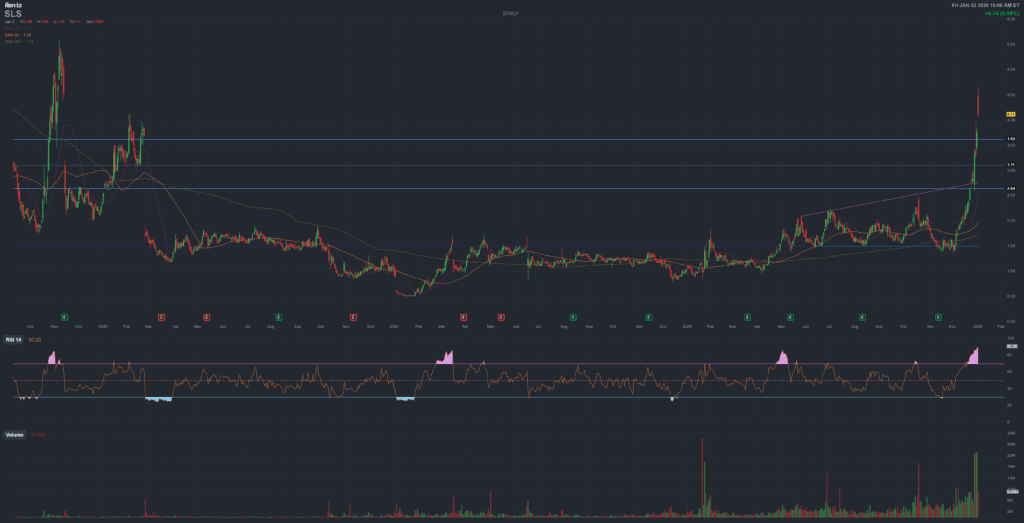
SLS – REGAL 72/80 Events Update and SLS009 ASH 2025: A High-Beta AML Story Getting Real
This update is written for both existing SLS followers and new readers who want a grounded, data-driven view of the REGAL timing and the SLS009 story, with a mildly bullish but not blind tone.
News of the day (REGAL): On 29 December 2025, SELLAS reported that the contract research organization running the Phase 3 REGAL trial notified the company that 72 of the 80 required events (deaths) had occurred as of 26 December 2025. REGAL is an overall survival study; the final analysis will be triggered once 80 events are reached. SELLAS remains fully blinded, and this one-time update does not change the statistical plan. Source: SELLAS REGAL update PR (Dec 29, 2025) .
CEO Angelos Stergiou highlighted that survival times in REGAL appear longer than the team initially expected and noted that, while the 80th event has not yet occurred and the trial remains blinded, each additional month before reaching that event may increase the probability of a successful outcome.
Direction Event timing supportive for GPS
Reality check Still one binary Phase 3
Second engine Strong SLS009 Phase 2 data
Risk Heavy dilution and single-trial dependence
REGAL status
72 / 80 OS events
Final analysis at 80 deaths; timing now purely event-driven, after a positive IDMC review in August 2025.
Source.
SLS009 (ASH 2025, R/R AML-MR)
ORR 46% / mOS 8.9m (least pretreated)
58% ORR and mOS not yet reached in patients with one prior line; no dose-limiting toxicities at 30 mg IV twice weekly.
ASH 2025 PR.
Cash (pro forma Oct 2025)
≈ 73 M USD
44.3 M USD cash at 30 Sep 2025 plus 29.1 M USD net warrant proceeds in October.
Q3 2025 PR.
1. Executive Summary
SELLAS Life Sciences (NASDAQ: SLS) is a late-stage oncology biotech with two main assets: galinpepimut-S (GPS), a WT1-targeted cancer vaccine in the pivotal Phase 3 REGAL trial as maintenance in AML CR2, and SLS009 (tambiciclib), a selective CDK9 inhibitor with promising data in relapsed/refractory AML-MR presented at ASH 2025.
The newly disclosed figure of 72 out of 80 required events in REGAL is important for two reasons:
- It confirms that the final OS analysis has not yet been triggered (no unblinding, no efficacy data disclosed).
- It implies that patients in the pooled REGAL population are, on average, living longer than originally anticipated in the statistical plan.
That second point is why many investors interpret the update as mildly bullish: in a 1:1 OS trial, longer-than-modeled survival is at least directionally supportive. However, it does not tell us how the benefit is distributed between GPS and best available therapy (BAT), and does not guarantee success on the primary endpoint.
Meanwhile, SLS009 has moved from “interesting early asset” to a real second pillar: in heavily pretreated AML-MR patients previously exposed to venetoclax, the AZA/VEN + SLS009 combination achieved a 46% overall response rate, a median OS of 8.9 months in the least pretreated cohort, and mOS not yet reached in patients with only one prior line, compared with historical expectations around 2.5–2.6 months for this setting.
With roughly 73 M USD of cash post-warrants and a yearly burn near 20–25 M USD, SELLAS is better capitalized than many small-cap peers, but this stronger balance sheet came at the cost of heavy dilution in 2024–2025.
Overall, the current setup justifies a constructively bullish stance compared to 12 months ago – provided that readers remain fully aware that REGAL is still a single pivotal OS trial and that a negative outcome would be brutal.
2. Quick Data Panel (as of early January 2026)
| Item | Snapshot |
|---|---|
| Ticker / Exchange | SLS – NASDAQ |
| Market capitalization | Around 0.5–0.6 B USD (share price in the high 3s to low 4s USD range in the days following the REGAL 72/80 update). |
| Cash and equivalents | 44.3 M USD at 30 Sep 2025 plus 29.1 M USD net warrant proceeds in October 2025, for roughly 73 M USD pro forma. Source. |
| Cash runway | The company states that available cash plus October warrant proceeds are expected to fund operations for at least 12 months from the 30 Sep 2025 financial statement date; extrapolating burn, this implies roughly 2–3 years of runway at current plans, before accounting for new trials or expansion. |
| Lead trial | Phase 3 REGAL (NCT04229979): randomized, open-label, GPS vs best available therapy as maintenance for AML patients in second complete remission (CR2) after second-line salvage; primary endpoint overall survival; final analysis at 80 deaths. ClinicalTrials.gov, IR REGAL page. |
| Key near-term catalyst | Occurrence of the 80th event in REGAL and subsequent top-line OS analysis (event-driven timing). |
| Secondary asset | SLS009 (tambiciclib), a highly selective CDK9 inhibitor. Phase 2 in relapsed/refractory AML-MR after prior venetoclax; expansion into newly diagnosed high-risk AML planned for Q1 2026. ASH PR. |
| Analyst consensus | MarketScreener shows 3 analysts with a mean rating Buy and an average 12-month price target of 6.83 USD (range 6.00–7.50 USD), implying around 80% upside from a last close near 3.77 USD. MarketScreener consensus. |
3. Phase 3 REGAL – Design, Interim Signals, and the 72/80 Update
3.1 Trial design (refresher for new readers)
REGAL is an international, open-label, registrational Phase 3 trial in AML patients in second complete remission (CR2 or CRp2) after second-line salvage therapy who are not candidates for allogeneic transplant. Patients are randomized 1:1 to:
- GPS monotherapy maintenance (subcutaneous injections with GM-CSF priming) up to 15 doses, versus
- Best available therapy (BAT) at investigator’s choice: hypomethylating agents (e.g. azacitidine, decitabine), venetoclax-based regimens, low-dose cytarabine, or observation.
Sources: NCT04229979, OncLive REGAL overview (Jan 2025).
The primary endpoint is overall survival (OS). The statistical plan specifies an interim futility/safety/efficacy analysis at 60 events and a final OS analysis at 80 events.
3.2 What we already knew before the 72/80 update
- In January 2025, SELLAS announced that the prespecified interim analysis at 60 events had been completed and that the independent data monitoring committee recommended that REGAL continue without modifications (no stop for futility and no safety issues).
- An OncLive summary of that interim analysis reported that, at a median follow-up of about 13.5 months and around ten months after enrollment completion, fewer than half of patients had died, and the pooled median OS was estimated above 12 months, longer than the roughly 6-month median OS seen historically in similar CR2 patients without transplant.
3.3 The 72/80 event update – why it matters
The 29 December 2025 press release added two key datapoints:
- The CRO informed SELLAS that the pooled number of events in REGAL was 72 out of 80 as of 26 December 2025.
- SELLAS remains fully blinded to efficacy and survival outcomes; no outcomes analysis has been performed, and this one-time update does not change the planned statistics or incur any penalty.
CEO Stergiou also noted that survival times in REGAL appear longer than expected, and reiterated that every month that passes before reaching the 80th event may raise the probability that the study demonstrates a benefit, at least in directional terms.
3.4 How to interpret “longer-than-expected survival” without overreaching
By design, an event-driven OS trial like REGAL assumes a certain median OS in the control arm and, implicitly, a pooled OS distribution. If, after enrollment completion, it takes longer than initially projected to reach 80 deaths, that essentially tells us:
- The overall trial population is living longer than the original statistical assumptions.
In a 1:1 study, that can happen because:
- The GPS arm is doing substantially better than BAT.
- Both arms benefit from modern AML care and BAT is much stronger than expected.
- A mix of both effects, or baseline imbalances that favor one arm.
Directionally, longer-than-expected survival is clearly better than the opposite; it argues against a trial where both arms perform poorly and median OS collapses quickly. However, it does not by itself tell us which arm is driving the improvement or whether the hazard ratio will meet the pre-specified success criteria.
It is therefore reasonable to treat the 72/80 update as a mildly bullish signal relative to where we were a year ago, but not as proof that REGAL has “already won”.
3.5 Phase 2 GPS data – why bulls are so confident
Early GPS trials in AML showed striking differences versus historical controls. In one Phase 2 study of AML patients in CR2, median OS in the GPS arm was around 21 months versus about 5–6 months in a contemporary standard-of-care group. OncLive summary.
Many of the most bullish SLS investors linearly extrapolate those data to REGAL and combine them with the slower event accrual to argue that success is almost guaranteed. This is where a more balanced view is necessary:
- The Phase 2 comparison used historical controls, not a randomized contemporaneous control arm.
- The current standard of care (extensive use of venetoclax, improved supportive care) is stronger than it was when those early data were generated.
In other words, the earlier GPS data strongly justify optimism and the decision to run REGAL, but they do not eliminate the risk that a randomized Phase 3 might still fall short on OS.
4. SLS009 (Tambiciclib) – From Backup Story to Real Second Pillar
4.1 Phase 2 design in R/R AML-MR (ASH 2025)
SLS009 is a highly selective CDK9 inhibitor designed to suppress MCL-1 expression, a key mechanism of resistance to BCL-2 inhibition (venetoclax) in AML. The ongoing Phase 2 expansion study in relapsed/refractory AML with myelodysplastic-related changes (AML-MR) evaluates SLS009 plus azacitidine and venetoclax in patients who have already been treated with venetoclax-based regimens and then relapsed or were refractory.
Key design points (from the ASH 2025 PR):
- 35 evaluable AML-MR patients across three cohorts, all previously exposed to VEN-based therapies.
- Median age 69; 98% with ELN adverse-risk AML; frequent mutations ASXL1, RUNX1, TP53, SRSF2.
- SLS009 dosed at 30 mg IV twice weekly on top of standard AZA/VEN.
Source: SELLAS ASH 2025 PR.
4.2 Efficacy and safety signals
At ASH 2025, SELLAS reported:
- Overall response rate (CR + CRi + MLFS) 46% across all evaluable patients, with 29% CR/CRi.
- In the least pretreated cohort, median OS 8.9 months.
- In patients with one prior line of therapy, ORR 58% and median OS not yet reached at the time of analysis.
- Patients with ASXL1 or TP53 mutations responded with ORRs of roughly 48% and 57%, respectively.
- No dose-limiting toxicities and no treatment-related deaths with SLS009 30 mg IV twice weekly plus AZA/VEN.
The PR explicitly notes that these survival outcomes compare favorably with a historical benchmark around 2.5–2.6 months for similar R/R AML populations after prior venetoclax.
For a refractory, adverse-risk cohort that has already failed VEN-based therapy, seeing median OS approaching nine months in the less heavily pretreated group and not yet reached in the “one prior line” group is legitimately impressive. The lack of added dose-limiting toxicity on top of AZA/VEN is also important, given how intensive that doublet already is.
4.3 Next steps for SLS009
The ASH PR and the Q3 2025 update state that SELLAS plans to expand SLS009 into:
- An approximately 80-patient study in newly diagnosed high-risk AML and in patients who become quickly refractory to AZA/VEN, with initiation targeted for Q1 2026.
- Additional preclinical and translational work (e.g. T-PLL models) supporting broader hematology potential.
If REGAL reads out positively, SLS009 becomes the logical growth driver beyond initial GPS AML maintenance. If REGAL were to fail, SLS009 is the “scientific safety net” – but an early Phase 2 program, even with very encouraging data, is unlikely on its own to sustain a 500+ million USD market cap without significant adjustment.
5. GPS Beyond REGAL – Brief Context
GPS has also shown early signals in other indications, including ovarian cancer, mesothelioma and multiple myeloma, often as maintenance or in combination with checkpoint inhibitors. These studies are small and mostly early phase, but they add weight to the idea that WT1-directed vaccination can produce consistent immune and survival signals across different settings.
For details, see SELLAS corporate materials and prior press releases: August 2025 corporate deck (PDF).
Still, in valuation terms, the real binary moment remains the REGAL AML maintenance trial. If REGAL succeeds, those other indications become optional upside; if it fails, they are not yet mature enough to compensate.
6. Financials, Cash Runway and Dilution
6.1 Cash position and burn
From the Q3 2025 financial results:
- Cash and equivalents at 30 September 2025: 44.3 M USD.
- Additional net proceeds from warrant exercises in October 2025: 29.1 M USD.
- R&D expenses for the first nine months of 2025: 11.3 M USD.
- G&A expenses for the first nine months of 2025: 8.7 M USD.
- Net loss for the first nine months of 2025: 19.2 M USD.
Source: Q3 2025 results PR, Form 10-Q (Sept 30, 2025).
The company indicates that this cash, together with the October warrant proceeds, should fund planned operations for at least 12 months from the date of the 10-Q. A simple extrapolation of the current burn suggests roughly 2–3 years of runway, before factoring in any cost increases from new trials.
6.2 Dilution – why some investors are upset
To get to this stronger cash position, SELLAS executed multiple equity and warrant inducement deals across 2024–2025. The share count has increased substantially over that period. For existing shareholders, especially retail, this has meant painful dilution precisely in the run-up to the REGAL binary event.
From a risk-management standpoint, management’s choice to raise capital ahead of the readout is understandable: if REGAL succeeds, having cash in hand allows them to move more quickly towards BLA and commercial preparation without being forced to finance at any price. That said, it is fair to state explicitly that much of the “de-risking” of the balance sheet has been paid for via dilution shouldered largely by shareholders.
7. Analyst Consensus and Valuation Lens
According to MarketScreener, three analysts currently cover SLS with a mean consensus rating of Buy, an average target price of 6.83 USD and a range from 6.00 to 7.50 USD, compared with a last closing price reported around 3.77 USD. This implies an upside on the order of 80%. Source.
Other aggregators (Investing.com, Public, etc.) show similar numbers, with a median 7 USD target and a consensus “Strong Buy” based on 3–4 analysts.
It is critical to remember that these targets are not floors; they embed an implicit probability of success for REGAL and some value for SLS009. If REGAL fails, these same analysts will almost certainly revise their models downward, and the fair value framework would change dramatically.
On a rough EV basis, at a 500–600 M USD market cap and expecting EBITDA-like profitability from GPS only in the success scenario, the stock is clearly high-beta: materially undervalued if REGAL succeeds, and at risk of severe repricing if it does not.
8. Retail Sentiment: Euphoria, Echo Chambers and Real Risks
Retail sentiment around SLS has become extremely intense. On platforms like Stocktwits and Reddit, SLS is often discussed as a “generational opportunity” with claims that current prices are already far below fair value even in conservative scenarios.
This has positive and negative sides:
- Positive: high engagement and deep DD threads mean that important documents (SEC filings, ASH abstracts, clinical presentations) are rapidly surfaced and dissected.
- Negative: pockets of community sometimes treat any note of caution as “FUD”, which can lead to an echo-chamber effect where binary risks and dilution history are downplayed.
For a balanced catalyst-driven strategy, it is better to use those communities as powerful information filters and sentiment gauges, while anchoring decisions to primary sources (company PRs, SEC filings, clinical trial registries) rather than to community confidence levels.
9. Scenario Map – Bull, Base and Bear (Qualitative)
9.1 Bull case (high-level)
- REGAL meets or exceeds its primary OS endpoint with a robust hazard ratio and clean safety profile.
- Regulators accept REGAL as a single pivotal trial for AML CR2 maintenance; GPS moves toward approval.
- SLS009 confirms its Phase 2 promise in newly diagnosed high-risk AML, opening a broader AML franchise story.
- Strategic interest (partnership or M&A) emerges on the back of a successful REGAL and strengthening CDK9 story.
9.2 Base case (constructively bullish)
- REGAL is positive but not a “moonshot” – hazard ratio modest but statistically significant.
- Regulatory path is viable but may require careful positioning or additional data, depending on the strength of the effect.
- SLS009 continues to look good, but remains in mid-development; its valuation contribution increases over time.
- The stock re-rates higher than current levels, but with volatility and ongoing debate on sustainability.
9.3 Bear case (what REGAL failure really means)
- REGAL fails to meet the OS primary endpoint or effect size is too small to be clinically or statistically compelling.
- The market rapidly reprices SLS closer to the value of cash plus early-stage SLS009, with GPS treated as a write-off for AML.
- Even with a decent cash runway, the company would revert to a high-risk small-cap reliant on one mid-stage program.
This is not said to create fear; it is simply the other side of the binary coin that any serious catalyst-based analysis must keep visible.
10. Timeline – Last 12 Months and What Comes Next
| Date | Event |
|---|---|
| Jan 2025 | REGAL interim analysis at 60 events: IDMC recommends continuation without modification. Pooled survival estimated above early expectations; no safety concerns. SELLAS frames this as a major milestone for GPS. |
| H1 2025 | Further REGAL updates and scientific communications (webinars, KOL commentary). GPS Phase 2 data in AML, mesothelioma and other settings continue to underpin the thesis that WT1 vaccination can extend survival in certain cohorts. |
| Nov 2025 | Q3 2025 results: cash 44.3 M USD; 29.1 M USD additional proceeds from October warrant exercises. SELLAS emphasizes that the strengthened balance sheet should support operations through upcoming catalysts. |
| 7 Dec 2025 | ASH 2025: positive Phase 2 data for SLS009 plus AZA/VEN in R/R AML-MR (ORR 46%, mOS 8.9 months in least pretreated cohort, mOS not reached in one prior line group; no DLTs). |
| 29 Dec 2025 | REGAL update PR: 72 events out of 80 have occurred as of 26 Dec 2025; SELLAS remains blinded; timing of final analysis event-driven; CEO highlights survival longer than expected and suggests each passing month may increase probability of success. |
| Q1–Q2 2026 (expected) | Occurrence of the 80th event in REGAL and subsequent top-line OS announcement (exact date unknown, event-driven). Planned initiation of an ~80-patient trial of SLS009 in newly diagnosed high-risk AML. |
11. Bottom Line – How to Read SLS After the 72/80 Update
Compared with where things stood a year ago, SLS is now in a very different place: REGAL has passed a clean interim analysis, OS timing looks better than expected, SLS009 has delivered compelling Phase 2 data at ASH 2025, and the balance sheet is no longer on life support.
That said, none of this removes the fact that REGAL is a single pivotal OS trial. If the hazard ratio and p-value fall short, the stock will almost certainly undergo a harsh reset.
A realistic stance, therefore, is:
- Directionally bullish based on the combination of survival timing, prior GPS data and SLS009 results.
- Fully aware that REGAL remains a high-stakes binary where downside is not a modest drawdown but potentially a deep repricing.
For catalyst-driven traders and investors who understand that risk profile, SLS is now one of the most closely watched AML names going into 2026.
Important note – not investment advice
This report is for informational and educational purposes only. It is not a recommendation to buy or sell SLS or any other security, and it does not take into account your individual financial situation, risk tolerance or investment objectives. Biotech catalyst trades can be highly volatile and may result in total loss of capital. Always refer to primary sources (company filings, official press releases, clinical trial registries) and consult a qualified financial advisor before making any investment decision.
This report is for informational and educational purposes only. It is not a recommendation to buy or sell SLS or any other security, and it does not take into account your individual financial situation, risk tolerance or investment objectives. Biotech catalyst trades can be highly volatile and may result in total loss of capital. Always refer to primary sources (company filings, official press releases, clinical trial registries) and consult a qualified financial advisor before making any investment decision.
SLS – Aggiornamento REGAL 72/80 Eventi e SLS009 ASH 2025: Storia AML ad Alto Beta che Entra nel Vivo
Questo aggiornamento è pensato sia per chi segue SLS da tempo, sia per i nuovi lettori: tono volutamente leggermente bullish, ma con tutti i paletti di rischio ben in evidenza.
News del giorno (REGAL): Il 29 dicembre 2025 SELLAS ha comunicato che il CRO responsabile della Fase 3 REGAL ha informato l’azienda che 72 dei 80 eventi (decessi) previsti dal piano statistico si erano verificati al 26 dicembre 2025. REGAL è uno studio su overall survival; l’analisi finale si attiverà al raggiungimento dell’80° evento. SELLAS è ancora completamente cieca ai dati e questo aggiornamento unico non modifica il piano statistico. Fonte: Comunicato REGAL 29 dic 2025 .
Il CEO Angelos Stergiou ha sottolineato che i tempi di sopravvivenza nello studio sembrano più lunghi del previsto e che, pur restando ciechi ai dati e in assenza dell’80° evento, ogni mese che passa può aumentare la probabilità che lo studio risulti positivo, almeno in termini direzionali.
Direzione Timing OS favorevole a GPS
Reality check Sempre un unico Fase 3 binario
Secondo motore Dati SLS009 convincenti
Rischio Storico di diluizione, dipendenza da REGAL
Stato REGAL
72 / 80 eventi OS
Analisi finale all’80° decesso; IDMC ad agosto 2025 ha raccomandato di proseguire senza modifiche.
Fonte.
SLS009 (ASH 2025, R/R AML-MR)
ORR 46% / mOS 8,9m (meno pretrattati)
58% ORR e mOS non ancora raggiunta nei pazienti con una sola linea precedente; nessuna DLT a 30 mg EV bisettimanali.
PR ASH 2025.
Cassa (pro-forma ottobre 2025)
≈ 73 M USD
44,3 M USD al 30/9 + 29,1 M USD da esercizio warrant in ottobre.
Q3 2025.
1. Executive Summary
SELLAS Life Sciences (NASDAQ: SLS) è una biotech oncologica late-stage con due asset principali: galinpepimut-S (GPS), vaccino mirato WT1 in Fase 3 REGAL come mantenimento in AML CR2, e SLS009 (tambiciclib), inibitore selettivo di CDK9 con dati incoraggianti in AML-MR presentati ad ASH 2025.
Il dato nuovo dei 72 eventi su 80 in REGAL è importante per due motivi:
- Conferma che l’analisi finale non è ancora stata attivata (nessun unblinding, nessun dato di efficacia diffuso).
- Implica che la sopravvivenza complessiva del campione REGAL è migliore di quanto ipotizzato nel piano statistico.
Questo secondo punto giustifica il tono moderatamente rialzista: in uno studio OS 1:1, arrivare agli eventi più lentamente è tendenzialmente positivo. Ma da solo non dice quale dei due bracci (GPS o BAT) stia guidando il beneficio, né garantisce il successo sull’endpoint primario.
Nel frattempo, SLS009 ha fatto un salto di qualità: nello studio di Fase 2 in AML-MR R/R, la combinazione AZA/VEN + SLS009 ha mostrato un ORR del 46% complessivo, mOS di 8,9 mesi nel coorte meno pretrattato e mOS non ancora raggiunta nei pazienti con una sola linea precedente, a fronte di aspettative storiche intorno ai 2,5–2,6 mesi per questa popolazione.
Con circa 73 M USD di cassa e un burn annuale vicino ai 20–25 M USD, SELLAS oggi è finanziariamente più solida di molte small-cap biotech. Questo però è stato ottenuto tramite forti diluizioni negli ultimi due anni.
Nel complesso, il quadro giustifica una posizione costruttiva ma non cieca rispetto a 12 mesi fa: scenario di base rialzista, ma con la consapevolezza che REGAL resta un singolo studio pivotale su OS, e che uno scenario negativo sarebbe pesante.
2. Quick Data Panel (inizio gennaio 2026)
| Voce | Situazione |
|---|---|
| Ticker / Borsa | SLS – NASDAQ |
| Market cap | Intorno a 0,5–0,6 miliardi USD (prezzo tra area 3,7–4+ USD nei giorni successivi all’aggiornamento REGAL 72/80). |
| Cassa e equivalenti | 44,3 M USD al 30 settembre 2025 + 29,1 M USD di proventi netti da esercizi di warrant in ottobre, per circa 73 M USD pro-forma. Fonte. |
| Runway stimato | La società indica copertura di almeno 12 mesi dalle data del 10-Q; per semplice extrapolazione del burn attuale questo implica circa 2–3 anni di runway, prima di eventuali nuovi progetti. |
| Trial chiave | Fase 3 REGAL (NCT04229979): studio registrativo randomizzato, GPS vs BAT come mantenimento in AML CR2/CRp2 dopo seconda linea; endpoint primario OS, analisi finale a 80 decessi. ClinicalTrials.gov, IR REGAL. |
| Catalyst principale | Arrivo dell’80° evento in REGAL e successivo comunicato con i dati top-line di OS (tempistica 100% event-driven). |
| Secondo asset | SLS009 (tambiciclib), inibitore CDK9 selettivo. Fase 2 in AML-MR R/R post-VEN; espansione a AML di nuova diagnosi ad alto rischio prevista per Q1 2026. PR ASH. |
| Consensus analisti | MarketScreener riporta 3 analisti, rating medio Buy, target medio 6,83 USD (range 6–7,5 USD), con ultimo close vicino a 3,77 USD. Consensus. |
3. Fase 3 REGAL – Design, segnali interim e lettura del 72/80
3.1 Design del trial (ripasso)
REGAL è uno studio internazionale, open-label e registrativo in pazienti con AML in seconda remissione completa (CR2 o CRp2) dopo terapia di salvataggio di seconda linea, non candidabili a trapianto allogenico. Randomizzazione 1:1 tra:
- GPS in mantenimento, fino a 15 somministrazioni sottocutanee con GM-CSF, versus
- Best available therapy (BAT) a scelta dell’investigatore (HMA, regimi VEN-based, LDAC oppure osservazione).
Fonti: NCT04229979, OncLive REGAL.
L’endpoint primario è la overall survival (OS). Il piano statistico prevede un’analisi interim a 60 eventi (futilità/sicurezza/efficacia) e un’analisi finale a 80 eventi (decessi).
3.2 Cosa sapevamo prima del 72/80
- A gennaio 2025 SELLAS ha annunciato che l’analisi interim a 60 eventi era stata completata e che la IDMC aveva raccomandato di proseguire lo studio senza modifiche.
- Un articolo OncLive ha riportato che, a un follow-up mediano di circa 13,5 mesi e circa dieci mesi dopo il completamento dell’arruolamento, meno del 50% dei pazienti risultava deceduto e la OS mediana pooled era stimata sopra i 12 mesi, superiore alle OS storiche di circa 6 mesi per pazienti CR2 non trapiantati.
3.3 Come leggere l’aggiornamento 72/80
Il comunicato del 29 dicembre aggiunge due informazioni chiave:
- Il CRO ha comunicato che al 26 dicembre 2025 il numero di eventi pooled era 72 su 80.
- SELLAS è ancora completamente cieca ai dati di efficacia e sopravvivenza; non è stata fatta nessuna analisi di outcome e questo aggiornamento unico non comporta penalità statistiche.
Stergiou ha rimarcato che i tempi di sopravvivenza appaiono più lunghi di quanto inizialmente previsto e che ogni mese in più prima dell’80° evento può aumentare, in senso probabilistico, le chance che il trial risulti positivo.
3.4 Sopravvivenza più lunga del previsto: cosa possiamo (e non possiamo) concludere
In un trial OS event-driven, se si impiega più tempo del previsto a raggiungere il numero target di eventi, questo significa che nel complesso i pazienti stanno vivendo più a lungo di quanto ipotizzato nel modello.
Possibili spiegazioni:
- GPS è significativamente migliore del BAT e tira verso l’alto la mediana globale.
- Entrambi i bracci beneficiano di uno standard of care più efficace del previsto.
- Un mix delle due cose e/o squilibri di baseline tra i bracci.
Quindi sì, il ritardo nel raggiungere gli 80 eventi è un segnale direzionalmente positivo, ma non basta per stimare una hazard ratio o per dichiarare “REGAL è già vinto”. Molte narrazioni ultra-bullish che circolano online vanno oggettivamente oltre ciò che i dati consentono di affermare oggi.
3.5 Dati GPS precedenti – perché i supporter sono così convinti
Negli studi precedenti in AML, GPS ha mostrato differenze importanti rispetto a controlli storici: in uno studio di Fase 2 in CR2, la OS mediana nel braccio GPS era intorno ai 21 mesi contro circa 5–6 mesi in pazienti che ricevevano solo SOC.
Questi numeri giustificano l’ottimismo e il fatto che REGAL sia stato disegnato, ma:
- Il confronto era con controlli storici, non randomizzato e non contemporaneo.
- Lo standard attuale (uso di VEN, migliore supportive care) è più forte di quello di qualche anno fa.
In sintesi, i vecchi dati sostengono il razionale e spiegano la fiducia dei bull, ma non cancellano il rischio che uno studio di Fase 3 randomizzato possa comunque fallire.
4. SLS009 (Tambiciclib) – Il Secondo Pilastro che Conta Sempre di Più
4.1 Studio di Fase 2 in AML-MR R/R (ASH 2025)
SLS009 è un inibitore selettivo di CDK9 sviluppato per sopprimere l’espressione di MCL-1, una delle principali vie di resistenza a venetoclax in AML. Nello studio di Fase 2 in espansione, SLS009 viene aggiunto alla combinazione standard azacitidina + venetoclax in pazienti con AML-MR recidivata/refrattaria che hanno già ricevuto regimi VEN-based.
Punti principali del design (da PR ASH):
- 35 pazienti AML-MR valutabili, suddivisi in tre coorti, tutti già trattati con VEN-based.
- Età mediana 69 anni; 98% con AML a rischio avverso secondo ELN; mutazioni frequenti ASXL1, RUNX1, TP53, SRSF2.
- SLS009 30 mg EV due volte a settimana in aggiunta ad AZA/VEN.
4.2 Dati di efficacia e sicurezza
All’ASH 2025 SELLAS ha riportato:
- ORR (CR+CRi+MLFS) complessivo 46%, con 29% di CR/CRi.
- Nel coorte meno pretrattato, OS mediana 8,9 mesi.
- Nei pazienti con una sola linea precedente, ORR 58% e mOS non ancora raggiunta alla data del cut.
- Nei pazienti con mutazioni ASXL1 o TP53, ORR intorno al 48% e 57% rispettivamente.
- Nessuna DLT e nessun decesso correlato al trattamento alla dose di 30 mg EV bisettimanale.
Il comunicato sottolinea che queste sopravvivenze sono nettamente superiori alle medie storiche di circa 2,5–2,6 mesi per popolazioni simili di AML R/R dopo regimi VEN-based.
Per una coorte così difficile (quasi tutti rischio avverso ELN, già passati da VEN), vedere una OS mediana nell’ordine dei 9 mesi nel sottogruppo meno pretrattato e non ancora raggiunta in quello “una sola linea” è un segnale molto interessante. Il fatto che la tripla non aggiunga tossicità limitante è altrettanto importante.
4.3 Prossimi passi per SLS009
PR ASH e Q3 2025 indicano che SELLAS intende:
- Avviare uno studio di circa 80 pazienti in AML di nuova diagnosi ad alto rischio e in pazienti che diventano rapidamente refrattari ad AZA/VEN, con partenza prevista nel Q1 2026.
- Proseguire il lavoro preclinico/traslazionale (es. modelli T-PLL) per allargare il perimetro ematologico di SLS009.
Se REGAL sarà positivo, SLS009 diventa il motore di crescita “di seconda ondata”. Se REGAL dovesse fallire, SLS009 resta un asset scientificamente promettente, ma ancora troppo indietro per reggere da solo la capitalizzazione attuale senza un forte re-rating.
5. GPS Oltre REGAL – Contesto in Breve
GPS ha mostrato segnali in altre indicazioni (ovario, mesotelioma, mieloma multiplo), spesso in setting di mantenimento o in combinazione con immunoterapia. Gli studi sono piccoli e in gran parte early-stage, ma contribuiscono alla narrativa di un “effetto WT1” ricorrente in più contesti.
Per dettagli: presentazioni corporate SELLAS, ad esempio Corporate Overview agosto 2025 (PDF).
In termini di valutazione, però, il vero spartiacque resta REGAL: se il trial è positivo, le altre indicazioni diventano optionalità; se è negativo, da sole non bastano (oggi) a giustificare il valore di borsa.
6. Financials, Runway e Diluizione
6.1 Cassa e burn
Dal comunicato Q3 2025:
- Cassa e equivalenti al 30 settembre 2025: 44,3 M USD.
- Ulteriori proventi netti da esercizi di warrant in ottobre: 29,1 M USD.
- Spese R&D 9M 2025: 11,3 M USD.
- Spese G&A 9M 2025: 8,7 M USD.
- Perdita netta 9M 2025: 19,2 M USD.
L’azienda dichiara che questa cassa, insieme ai proventi di ottobre, è sufficiente a finanziare le attività pianificate per almeno 12 mesi dalla data del 10-Q. Semplificando, con un burn nell’ordine dei 20–25 M USD/anno, la runway appare di 2–3 anni, prima di considerare eventuali ampliamenti.
6.2 Diluizione: il conto pagato dal retail
Per arrivare a questa posizione di cassa rafforzata, SELLAS ha utilizzato più round di equity/warrant tra 2024 e 2025. Questo ha aumentato in modo significativo il numero di azioni in circolazione proprio nel periodo che precede il binario REGAL.
Dal punto di vista del rischio operativo è una scelta comprensibile: se REGAL sarà positivo, avere cassa già disponibile permette di muoversi più rapidamente verso BLA e preparazione commerciale, senza dover finanziare in condizioni di emergenza. Dal punto di vista dell’azionista, significa che una parte importante del “derisking finanziario” è stata pagata in termini di diluizione.
7. Consensus Analisti e Spunto di Valutazione
MarketScreener riporta 3 analisti su SLS con rating medio Buy, target medio 6,83 USD (range 6–7,5 USD) e ultimo prezzo a circa 3,77 USD, per un potenziale upside intorno all’80%. Fonte.
Anche altri aggregatori (Investing.com, Public, ecc.) mostrano una view simile, con target mediano 7 USD e rating “Strong Buy” basato su 3–4 analisti.
È fondamentale ricordare che questi target incorporano una certa probabilità di successo di REGAL e attribuiscono valore aggiuntivo a SLS009. In caso di fallimento, gli stessi analisti aggiorneranno i modelli e il fair value scenderebbe in modo drastico.
In pratica, SLS oggi è un titolo ad alto beta: potenzialmente sottovalutato in caso di REGAL positivo, ma esposto a un repricing severo se il trial non raggiungesse l’endpoint.
8. Sentiment Retail: Euforia, Echo Chamber e Rischi Reali
Il sentiment retail su SLS è diventato estremamente intenso. Su Stocktwits e Reddit il titolo viene spesso descritto come “opportunità generazionale”, con target in doppia cifra considerati già oggi “conservativi”.
Ci sono aspetti positivi e negativi:
- Positivo: ricerca amatoriale molto spinta, link a PR, 10-Q, abstract, slide, webinar – spesso emergono documenti utili con grande velocità.
- Negativo: in alcune bolle della community qualsiasi avvertimento sui rischi viene etichettato come “FUD”, rendendo più difficile mantenere una visione bilanciata.
Per chi fa strategia sui catalyst è utile usare queste community come “sensori di sentiment” e filtro informativo, ma tenendo i piedi saldi su fonti primarie e numeri, non su quanto è convinta la parte più rumorosa dei supporter.
9. Mappa Scenari – Bull, Base, Bear
9.1 Bull case
- REGAL centra l’endpoint OS con HR robusta e profilo di sicurezza pulito.
- FDA ed EMA accettano REGAL come singolo pivotal per AML CR2; GPS entra in percorso di approvazione.
- SLS009 conferma i dati in AML di prima linea ad alto rischio, rafforzando la narrativa di piattaforma AML.
- Emergono interesse strategico e/o partnership/M&A sulla scia del binario positivo.
9.2 Base case (leggermente rialzista)
- REGAL è positivo ma non clamoroso (HR moderata ma significativa).
- Il percorso regolatorio è percorribile ma richiede posizionamento accurato e analisi supplementari.
- SLS009 continua a dare buoni segnali ma resta in fase intermedia; il suo peso in valutazione cresce nel tempo.
- Il titolo si repricing sopra i livelli attuali ma con volatilità e dibattito continuo sulla sostenibilità.
9.3 Bear case
- REGAL non raggiunge l’endpoint OS o mostra un effetto troppo debole per essere considerato registrativo.
- Il mercato repricing SLS verso il valore di cassa + pipeline early-stage, trattando GPS come “scritto a zero” in AML.
- Pur con una buona cassa, l’azienda tornerebbe ad essere una small-cap ad alto rischio centrata su un singolo programma mid-stage.
Non è allarmismo, è semplicemente l’altra faccia del rischio binario che va tenuta sempre sul tavolo quando si parla di Fase 3 su OS.
10. Timeline – Ultimi 12 Mesi e Prossimi Passi
| Data | Evento |
|---|---|
| Gen 2025 | Analisi interim REGAL a 60 eventi: la IDMC raccomanda di proseguire lo studio senza modifiche. Pooled OS stimata superiore alle attese iniziali. |
| H1 2025 | Ulteriori update REGAL e comunicazioni scientifiche (webinar, commenti KOL). I dati precedenti di GPS in AML e altre indicazioni continuano a supportare il razionale. |
| Nov 2025 | Risultati Q3 2025: cassa 44,3 M USD, ulteriori 29,1 M USD da warrant in ottobre. SELLAS sottolinea la solidità della posizione finanziaria in vista dei catalyst. |
| 7 dic 2025 | ASH 2025: dati positivi di Fase 2 per SLS009 + AZA/VEN in AML-MR R/R (ORR 46%, mOS 8,9 mesi nel coorte meno pretrattato, mOS non raggiunta nel sottogruppo “una sola linea”, nessuna DLT). |
| 29 dic 2025 | PR aggiornamento REGAL: 72 eventi su 80 al 26/12; trial ancora cieco; timing dell’analisi finale completamente event-driven; il CEO evidenzia sopravvivenza più lunga del previsto. |
| Q1–Q2 2026 (atteso) | Arrivo dell’80° evento in REGAL e comunicazione dei dati top-line OS. Avvio dell’estensione SLS009 in AML di nuova diagnosi ad alto rischio. |
11. Conclusione – Come Leggere SLS Dopo il 72/80
Rispetto a un anno fa, SLS è un titolo diverso: REGAL ha un interim pulito alle spalle, i tempi di OS sembrano migliori del previsto, SLS009 ha dati di Fase 2 convincenti e la cassa è stata irrobustita.
Nulla di tutto questo, però, cambia il fatto che REGAL è un singolo studio pivotale su OS. Se l’endpoint non venisse centrato, il repricing potrebbe essere molto duro.
Una posizione onesta oggi è:
- Moderatamente bullish per dati e tempistiche, più positiva che 12 mesi fa.
- Consapevole che lo scenario bear esiste e non va nascosto: il rischio non è un -20%, ma un potenziale reset profondo.
Per chi fa trading o investimenti sui catalyst e conosce questo tipo di profilo rischio/rendimento, SLS è una delle storie AML più interessanti entrando nel 2026, ma solo se affrontata con aspettative realistiche.
Disclaimer importante
Questo report ha finalità esclusivamente informative ed educative. Non costituisce consulenza in materia di investimenti, né raccomandazione personalizzata di acquisto o vendita di strumenti finanziari. Il trading su catalyst biotech è altamente rischioso e può comportare la perdita totale del capitale. Prima di assumere decisioni operative, verifica sempre le fonti primarie (filing SEC, comunicati ufficiali, registri degli studi clinici) e confrontati con un consulente finanziario abilitato.
Questo report ha finalità esclusivamente informative ed educative. Non costituisce consulenza in materia di investimenti, né raccomandazione personalizzata di acquisto o vendita di strumenti finanziari. Il trading su catalyst biotech è altamente rischioso e può comportare la perdita totale del capitale. Prima di assumere decisioni operative, verifica sempre le fonti primarie (filing SEC, comunicati ufficiali, registri degli studi clinici) e confrontati con un consulente finanziario abilitato.
Biotech Catalyst Calendar
Panoramica aggiornata di PDUFA, trial readout, conference call e altri eventi chiave per i titoli biotech. Utile per inquadrare la posizione di SLS rispetto al resto del settore.
Apri il Biotech Catalyst Calendar