DISCLAIMER — Not financial advice. Educational content only, not an offer or solicitation to buy or sell any security. Biotech and small/mid-cap stocks are highly speculative and volatile and can result in a partial or total loss of capital. Do your own research and consult a licensed advisor where appropriate. / Contenuti a solo scopo informativo e didattico, non costituiscono consulenza finanziaria né offerta o sollecitazione al pubblico risparmio ai sensi delle normative CONSOB e SEC. Le azioni biotech e le small/mid cap sono strumenti altamente speculativi e volatili e possono comportare la perdita parziale o totale del capitale investito. Si raccomanda di effettuare sempre le proprie ricerche e, se necessario, di rivolgersi a un consulente abilitato.

Merlintrader Trading Pub
Biotech catalyst news and analysis. FDA PDUFA tracker
Merlintrader Trading Pub
Biotech catalyst news and analysis. FDA PDUFA tracker
Corcept Therapeutics (CORT) – FDA Complete Response Letter for relacorilant (Dec 31, 2025)
Simple EN/IT update on what happened with Corcept’s relacorilant in hypertension secondary to hypercortisolism: what a Complete Response Letter is, what the FDA said and what the next steps could be.
What just happened – in plain English
CRL – NDA not approved
Indication: hypertension secondary to hypercortisolism
Ovarian cancer PDUFA (July 11, 2026) unchanged
On December 31, 2025, the FDA sent Corcept a Complete Response Letter (CRL) for relacorilant as a treatment for patients with hypertension secondary to hypercortisolism (a specific form of Cushing’s syndrome). In simple terms: the FDA has rejected the current New Drug Application and is asking for more evidence before it can approve the drug for this use.
The FDA explicitly said that:
- it recognises that the GRACE trial met its primary endpoint, and
- that GRADIENT provides confirmatory evidence,
but the Agency could not reach a positive benefit–risk conclusion for this indication without additional evidence of effectiveness.
Corcept’s CEO, Joseph Belanoff, said they are “surprised and disappointed” and that they will meet with the FDA as soon as possible to discuss what extra data or analyses are needed and how to move relacorilant forward.
In practice: the drug is not approved for this use today. Corcept must now understand exactly what the FDA
wants, gather that evidence (which may take time and money) and then come back with a new filing or a major
amendment.
What is a Complete Response Letter?
A Complete Response Letter (CRL) is the FDA’s formal way of saying:
- “We have finished reviewing your application,
- but we cannot approve it in its current form.”
The letter lists the problems the FDA sees in the application. These can be:
- missing or weak data on efficacy,
- concerns about safety, dosing or how the trial was run,
- issues with manufacturing or quality control,
- or questions about how the drug would be used in real life.
A CRL is not:
- a permanent ban on the drug,
- a statement that the drug never works,
- or the end of the story.
It is closer to an official “come back when you’ve fixed these issues” message. After a CRL, a company can:
- run new trials or collect extra data,
- re-analyse existing data to answer FDA questions,
- fix manufacturing or labelling problems,
- and then re-submit the application.
For patients and investors, the practical effect is a delay: the drug cannot launch for that indication until the issues in the CRL are fully addressed and a new positive decision is made.
What did the FDA say specifically about relacorilant?
According to the company’s statement and news reports, the FDA’s key points are:
- The FDA acknowledged that GRACE met its primary endpoint. That means, on paper, the main late-stage trial worked for the outcome it was designed to measure.
- The FDA also acknowledged that GRADIENT provides confirmatory evidence. So the second study was not dismissed as useless.
- However, the Agency still does not feel comfortable that the totality of data proves relacorilant’s benefit clearly enough for patients with hypertension secondary to hypercortisolism.
- In regulatory language: the FDA says it “could not arrive at a favourable benefit–risk assessment” without additional evidence of effectiveness.
The press release does not mention manufacturing problems or new safety crises. The issue is mainly about how convincing the efficacy data are for this particular indication and patient group, as seen through the FDA’s lens.
Translation: the FDA is not saying “relacorilant never works”, but it is saying “show us more – or clearer –
data before we let you sell it for this use”.
What this does – and does NOT – mean
What it means
- No approval now: relacorilant is not approved in the U.S. for hypertension secondary to hypercortisolism; doctors cannot prescribe it for this indication outside of trials.
- Delay in potential Cushing-related revenue: any commercial launch for this use is pushed out into the future, until new data are generated and reviewed.
- More R&D work: Corcept will almost certainly have to run extra studies, new analyses, or both, to answer the questions in the CRL.
What it does NOT mean
- It does not automatically kill the entire relacorilant program. The drug is still in development for other indications.
- It does not cancel the July 11, 2026 PDUFA for platinum-resistant ovarian cancer, which is based on the separate ROSELLA trial.
- It does not say that relacorilant is unsafe. The focus here is clearly on effectiveness, not on a new safety disaster.
What could happen next?
Corcept has already said it will meet with the FDA as soon as possible. In that meeting, the company will try to understand exactly what kind of extra evidence is required. Possible scenarios:
- The FDA asks for a new focused trial (for example, a clean, straightforward study in patients with hypertension secondary to hypercortisolism, with a simple blood-pressure endpoint).
- The FDA is open to a re-analysis or pooling of existing data but wants the results presented in a different way (for example, focusing on certain subgroups or on more robust blood-pressure metrics).
- The FDA wants more real-world-like evidence, such as long-term, prospective data in routine practice to show that benefits are consistent and clinically meaningful.
Only after this meeting will it be clear whether Corcept can address the CRL with “just” additional analyses and a smaller new study, or whether a full new Phase 3 program is needed. In timing terms, that is the difference between a delay of roughly 1–2 years versus something longer.
For patients, it means waiting longer for a potential new option. For traders and investors, it means accepting that the Cushing-related part of the relacorilant story is now on a slower and more uncertain path.
Sources and links (EN)
- Company press release via Business Wire (Dec 31, 2025) – “Corcept Receives Complete Response Letter for Relacorilant as a Treatment for Patients with Hypercortisolism”.
- Reuters – “US FDA declines to approve Corcept’s drug for rare hormonal disorder” (Dec 31, 2025) – summary of the CRL and company comments.
- Major financial news/biotech outlets – short notes on the CRL, indication details and reminder of the separate ovarian cancer PDUFA (July 11, 2026).
Important disclaimer (English)
This page is a simplified editorial update based on public information (company press release and major news outlets). It is not, and must not be interpreted as, investment advice, individual financial guidance or a recommendation to buy, hold or sell CORT or any other security. Figures and timelines may be incomplete or later revised. Always verify key details in primary sources (FDA, SEC, company IR) and consider speaking with a licensed financial professional before making any investment decision.
This page is a simplified editorial update based on public information (company press release and major news outlets). It is not, and must not be interpreted as, investment advice, individual financial guidance or a recommendation to buy, hold or sell CORT or any other security. Figures and timelines may be incomplete or later revised. Always verify key details in primary sources (FDA, SEC, company IR) and consider speaking with a licensed financial professional before making any investment decision.
Legal resources: Disclaimer · Terms & Privacy
Cosa è successo – spiegato semplice
CRL – NDA non approvata
Indicazione: ipertensione da ipercortisolismo
PDUFA ovarico 11 luglio 2026 invariata
Il 31 dicembre 2025 la FDA ha inviato a Corcept una Complete Response Letter (CRL) per relacorilant come trattamento dei pazienti con ipertensione secondaria a ipercortisolismo (una forma specifica di sindrome di Cushing). In pratica: la FDA ha respinto la richiesta di approvazione nella forma attuale e chiede altri dati prima di poter dire sì per questa indicazione.
Nella comunicazione ufficiale la FDA:
- riconosce che lo studio di Fase 3 GRACE ha centrato l’endpoint primario;
- riconosce che i dati di GRADIENT sono “confermatori”;
ma conclude che non riesce ad arrivare a un bilancio beneficio/rischio favorevole per questa indicazione senza ulteriori evidenze di efficacia.
Il CEO Joseph Belanoff ha dichiarato che l’azienda è “sorpresa e delusa” e che Corcept incontrerà la FDA il prima possibile per capire quali dati o analisi aggiuntive servono e come portare avanti il dossier.
Tradotto: per questa indicazione il farmaco oggi non è approvato. Corcept deve capire esattamente cosa vuole
la FDA, raccogliere quei dati (o rifare alcune analisi) e poi tornare con una nuova proposta o una
ripresentazione della NDA.
Che cos’è una Complete Response Letter?
Una Complete Response Letter (CRL) è il modo formale con cui la FDA dice a un’azienda:
- “Abbiamo finito di esaminare la tua domanda,
- ma non possiamo approvarla così com’è.”
Nella lettera la FDA elenca i problemi che vede nella documentazione. Possono essere:
- dati di efficacia mancanti o troppo deboli,
- dubbi su sicurezza, dose o disegno degli studi,
- questioni di produzione/qualità,
- oppure aspetti pratici di utilizzo e di etichetta.
Una CRL non è:
- un divieto definitivo sul farmaco,
- un giudizio che “il farmaco non funziona mai”,
- né la fine della storia.
È più simile a un “torna quando hai sistemato questi punti”. Dopo una CRL un’azienda può:
- fare nuovi studi o raccogliere altri dati,
- ri-analizzare gli studi esistenti per rispondere alle domande,
- sistemare problemi produttivi o di etichetta,
- e poi ripresentare la domanda di approvazione.
Per pazienti e investitori l’effetto concreto è un rinvio: il farmaco non può essere venduto per quella indicazione finché i punti della CRL non vengono risolti e la FDA non dà un nuovo via libera.
Cosa ha contestato la FDA su relacorilant
Dai comunicati e dalle notizie, i messaggi centrali della FDA sono:
- la FDA riconosce il successo di GRACE sul suo endpoint primario;
- riconosce che GRADIENT ha valore di conferma;
- ma ritiene che, messi insieme, questi studi non bastino a dimostrare in modo abbastanza netto l’efficacia di relacorilant nei pazienti con ipertensione secondaria a ipercortisolismo;
- per questo motivo l’agenzia scrive che non riesce ad arrivare a un beneficio/rischio favorevole senza altri dati di efficacia.
Non ci sono riferimenti a problemi di produzione o a nuovi segnali di sicurezza. Il punto centrale è quanto siano convincenti i dati di efficacia per questa indicazione, secondo gli standard della FDA.
In parole molto semplici: la FDA non dice che relacorilant “non funziona mai”, ma dice “con i dati così
come li vediamo ora non è abbastanza per approvare; vogliamo prove più solide”.
Cosa significa – e cosa non significa – questo esito
Cosa significa
- Nessuna approvazione adesso: relacorilant non è approvato negli USA per ipertensione secondaria a ipercortisolismo; l’uso resta confinato agli studi clinici.
- Ricavi da Cushing rinviati: qualsiasi lancio commerciale per questa indicazione viene spostato più avanti, in funzione di nuovi dati e di una futura decisione positiva.
- Più lavoro di R&S: Corcept dovrà probabilmente fare nuovi studi, nuove analisi o entrambi per rispondere alla CRL.
Cosa NON significa
- non significa che l’intero programma relacorilant sia morto; il farmaco resta in sviluppo in altre indicazioni;
- non tocca direttamente la PDUFA del 11 luglio 2026 per il tumore ovarico platino-resistente, che è basata su un altro studio (ROSELLA);
- non dice che relacorilant sia improvvisamente pericoloso; la contestazione è sugli effetti, non su un nuovo problema di sicurezza.
Possibili prossimi passi per Corcept
Corcept ha già dichiarato che incontrerà la FDA il prima possibile. In quell’incontro dovrà capire esattamente che tipo di “prova aggiuntiva” l’agenzia vuole. Alcuni scenari possibili:
- la FDA chiede uno studio nuovo e mirato (per esempio un trial semplice su pazienti con ipertensione da ipercortisolismo, con endpoint chiari di pressione arteriosa);
- la FDA è disposta a considerare una ri-analisi approfondita dei dati GRACE/GRADIENT, magari concentrata su determinati sottogruppi o misure di pressione più robuste;
- la FDA vuole dati prospettici più “real life”, con follow-up più lungo su pazienti trattati nella pratica clinica;
Solo dopo questo confronto si capirà se Corcept potrà rispondere alla CRL con “soli” nuovi numeri e un piccolo studio aggiuntivo, oppure se servirà un programma di Fase 3 completamente nuovo. In termini di tempi, è la differenza tra uno slittamento di circa 1–2 anni e qualcosa di più lungo.
Per i pazienti significa dover aspettare di più per una potenziale nuova opzione. Per chi guarda il titolo, significa accettare che la parte “Cushing” della storia relacorilant è ora più lenta e più incerta di quanto si sperava prima della PDUFA.
Fonti principali (IT)
- Comunicato Corcept via Business Wire – “Corcept Receives Complete Response Letter for Relacorilant as a Treatment for Patients with Hypercortisolism” (31 dicembre 2025).
- Reuters – “US FDA declines to approve Corcept’s drug for rare hormonal disorder” – sintesi della CRL e commenti del management.
- Note brevi su Investing.com, StockTitan e altri siti – richiamo all’indicazione precisa (ipertensione da ipercortisolismo) e promemoria sulla PDUFA ovarico 2026.
Disclaimer (italiano)
Questa pagina è un aggiornamento editoriale semplificato basato su fonti pubbliche (comunicato aziendale e principali agenzie di stampa). Non costituisce consulenza finanziaria, raccomandazione di investimento o sollecitazione al pubblico risparmio. Dati e tempistiche possono essere incompleti o soggetti a revisione; chi legge deve sempre verificare le informazioni nelle fonti primarie (FDA, SEC, IR) e valutare le proprie decisioni con l’eventuale supporto di un consulente abilitato.
Questa pagina è un aggiornamento editoriale semplificato basato su fonti pubbliche (comunicato aziendale e principali agenzie di stampa). Non costituisce consulenza finanziaria, raccomandazione di investimento o sollecitazione al pubblico risparmio. Dati e tempistiche possono essere incompleti o soggetti a revisione; chi legge deve sempre verificare le informazioni nelle fonti primarie (FDA, SEC, IR) e valutare le proprie decisioni con l’eventuale supporto di un consulente abilitato.
Link legali del sito: Disclaimer · Condizioni d’uso e privacy
Biotech Catalyst Calendar
Per avere una vista aggiornata dei principali catalyst FDA (PDUFA, Advisory Committee, letture di Fase 2/3) puoi usare il Biotech Catalyst Calendar di Merlintrader, che raccoglie gli eventi per data e ticker e li collega ai singoli report e agli update come questo.
Vai al Biotech Catalyst Calendar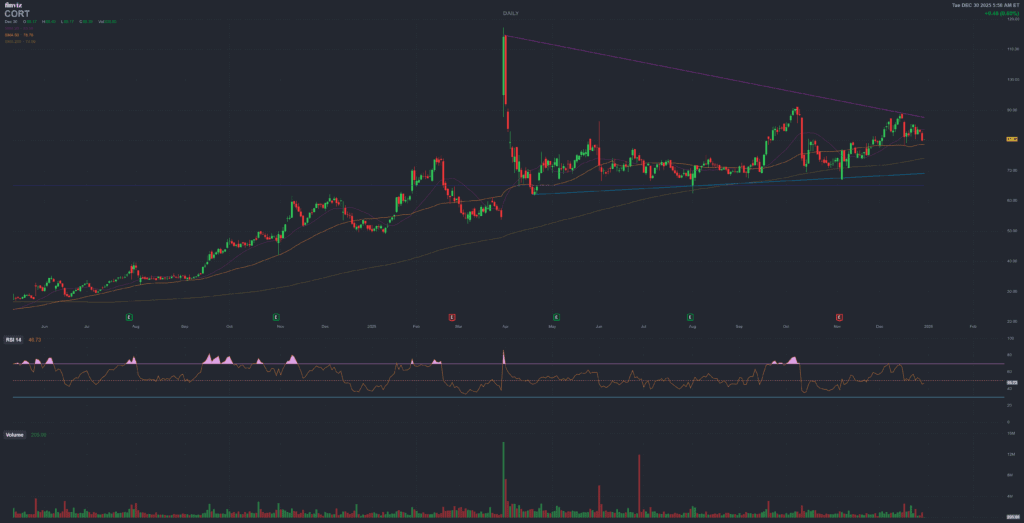
Corcept Therapeutics (CORT) – Relacorilant, Cushing’s syndrome and a pivotal FDA decision
Relacorilant for Cushing’s syndrome (hypercortisolism) with GRACE/GRADIENT Phase 3 data and a December 30, 2025 PDUFA, plus a second NDA in platinum-resistant ovarian cancer and a cash engine built on Korlym. Bilingual EN/IT switch below.
Price chart – Corcept Therapeutics (CORT)

Daily chart via Finviz. Click to open the full CORT page on Finviz (affiliate link).
News of the day – PDUFA for relacorilant in Cushing’s syndrome
FDA decision due today, still pending at time of writing
On March 3, 2025, the FDA filed Corcept’s NDA for relacorilant as a treatment for adult patients with endogenous hypercortisolism (Cushing’s syndrome), assigning a PDUFA target action date of December 30, 2025. The NDA is based on the pivotal Phase 3 GRACE study, confirmatory evidence from Phase 3 GRADIENT, long-term extension data and a Phase 2 study in hypercortisolism.
As of the time this report is written, the FDA has not yet announced an approval or a complete response letter. The decision can be released any time today or, in some cases, with a short delay relative to the formal PDUFA date.
This is a defining catalyst for Corcept. A positive outcome would:
- diversify revenue beyond Korlym, the company’s first-generation glucocorticoid receptor antagonist, and
- validate the broader strategy of building a family of selective cortisol modulators across endocrinology, oncology, neurology and metabolism.
A negative decision, on the other hand, would leave Corcept dependent on Korlym for the next few years and could force a re-rating of the stock, despite a still-strong balance sheet.
Status: PDUFA 30 Dec 2025 – decision pending at the time of publication (no official FDA or company update yet).
Executive summary – from one-drug story to multi-asset test
Corcept spent more than a decade as essentially a one-drug company built on Korlym (mifepristone), the only approved oral therapy for hyperglycemia secondary to Cushing’s syndrome in patients not eligible for surgery. Korlym delivered strong revenue growth and established Corcept as the reference name in cortisol modulation.
With relacorilant, the company is trying to move to a multi-asset, multi-indication model:
- Cushing’s / hypercortisolism: NDA filed, PDUFA today (December 30, 2025), based on GRACE and GRADIENT, with durable improvements in hypertension, hyperglycemia and weight in the main population and a more mixed picture in adrenal-driven disease.
- Oncology: relacorilant has already met the primary endpoint in the pivotal Phase 3 ROSELLA trial in platinum-resistant ovarian cancer (≈30% reduction in risk of progression; PDUFA July 11, 2026), and is being developed in additional gynecologic and pancreatic cancer settings.
- Other modulators: miricorilant in MASH, dazucorilant in ALS and a long list of cortisol-modulator programs in early-stage development.
Financially, Corcept is unusual for a “catalyst stock”: it is already profitable, with 2025 revenue guidance of 800–850 million USD, quarterly revenue around 207.6 million USD in Q3 2025, and about 524 million USD in cash and investments with no long-term debt as of September 30, 2025.
In plain terms: today’s FDA decision on relacorilant is not about “survival” – Korlym and cash provide that – but about whether Corcept can justify its current multi-billion valuation as a platform company rather than a mature niche franchise.
Quick data panel (late December 2025)
Ticker / Exchange
CORT – Nasdaq
Recent price / 52-week range
≈ 80–90 USD / near 52-week highs
Market cap
≈ 8–9 B USD (range over last weeks)
Main product
Korlym (mifepristone) – Cushing’s
Key pipeline asset
Relacorilant (Cushing’s + ovarian)
Q3 2025 revenue
207.6 M USD (+14% y/y)
Cash & investments (30 Sep 2025)
≈ 524 M USD, no long-term debt
2025 revenue guidance
800–850 M USD (revised)
Analyst consensus rating
Between Hold and Buy (mixed)
Average 12-month PT
≈ 125–135 USD (wide range)
Profitable rare-disease franchise (Korlym)
Two relacorilant NDAs (Cushing + ovarian)
High regulatory risk on today’s PDUFA
Ongoing litigation and generic pressure
All numbers here are approximate snapshots around late December 2025 and should be cross-checked against the latest company filings before use.
Company, existing product and leadership
Korlym – the cash engine in Cushing’s syndrome
Corcept’s current commercial foundation is Korlym, a mifepristone-based glucocorticoid receptor (GR) antagonist approved in 2012 for the treatment of hyperglycemia secondary to endogenous Cushing’s syndrome in adults who are not surgical candidates or in whom surgery has failed.
Korlym holds a de-facto near-monopoly in this narrow but high-value orphan space. Revenue from Korlym grew roughly 40% in 2024, and 2025 guidance – now updated to 800–850 M USD – still depends heavily on continued Korlym growth, even as relacorilant approaches potential approval.
The distribution structure, REMS requirements and specialist prescriber base make Korlym a defensible franchise, but they have also drawn scrutiny and litigation (see legal section).
Leadership – founder-CEO and cortisol obsession
Joseph K. Belanoff, M.D. co-founded Corcept in 1998–1999 and has served as its Chief Executive Officer ever since. He has a psychiatry background at Stanford and has spent more than two decades pushing the cortisol-modulation thesis across multiple disease areas.
This long-tenured leadership is a double-edged sword: on one hand it reflects deep continuity and scientific focus; on the other, it concentrates a very large amount of execution and capital-allocation responsibility in a single leadership team that is now facing its most important regulatory test to date.
Relacorilant in Cushing’s syndrome – GRACE, GRADIENT and the FDA dilemma
Mechanism and rationale
Relacorilant (CORT-125134) is a selective glucocorticoid receptor modulator designed to block cortisol’s effects at the GR without binding to other steroid hormone receptors. The aim is to preserve the metabolic and clinical benefits of cortisol blockade seen with Korlym while improving tolerability and avoiding some of mifepristone’s off-target issues.
In Cushing’s syndrome, excess cortisol drives hypertension, hyperglycemia, weight gain, myopathy, mood changes and a long list of complications. Pharmacologically lowering effective cortisol signalling is an attractive approach when surgery is not possible or not sufficient.
GRACE – main Phase 3 in general hypercortisolism
GRACE is a Phase 3 double-blind, randomized-withdrawal study in patients with endogenous hypercortisolism and either hypertension, hyperglycemia or both. After an open-label run-in on relacorilant, responders are randomized to continue the drug or switch to placebo, and the main endpoints assess the effect on blood pressure and glycemic control.
Final results presented in 2024–2025 show that relacorilant:
- met its primary endpoint in the randomized-withdrawal phase;
- produced significant and sustained improvements in systolic and diastolic blood pressure in hypertensive patients;
- improved fasting glucose and glucose AUC in patients with hyperglycemia, with some patients discontinuing or reducing diabetic medications; and
- led to clinically meaningful weight loss and improvements in other cortisol-related comorbidities, which were maintained in open-label extension (OLE) follow-up.
Importantly, relacorilant’s safety profile in GRACE and its extensions looks generally favourable, with common adverse events like back pain, headache, arthralgia and insomnia, mostly mild to moderate and manageable. No signal of adrenal insufficiency, endometrial hyperplasia or QT prolongation has emerged in this program.
GRADIENT – adrenal disease and a weaker primary endpoint
GRADIENT is a second Phase 3 study focused specifically on patients with adrenal adenoma or hyperplasia causing hypercortisolism. It is here that the story becomes more nuanced.
While relacorilant again showed improvements in blood pressure and metabolic parameters in adrenal hypercortisolism, the trial did not meet its pre-specified primary endpoint on change in systolic blood pressure versus placebo strongly enough to deliver a clean win. The company and several commentators have highlighted favourable secondary measures and consistency with GRACE, but the mixed data from GRADIENT are one of the reasons some investors fear a potential CRL from the FDA.
How the FDA might view GRACE + GRADIENT
The NDA for relacorilant in Cushing’s syndrome hinges on the totality of evidence: a robust randomized-withdrawal trial (GRACE) with durable benefits; supportive but imperfect confirmatory evidence (GRADIENT); long-term extension data; and a known, tolerable safety profile.
Historically, the FDA has approved orphan-disease drugs with imperfect data when:
- the unmet need is high,
- the mechanism is plausible, and
- the overall benefit–risk profile looks favourable versus existing options.
The risk is that regulators could ask for additional data or a narrower label if they feel the GRADIENT results do not align clearly enough with GRACE. This is the core of today’s binary event.
Relacorilant in oncology – ROSELLA and beyond
Platinum-resistant ovarian cancer – ROSELLA
The second leg of the relacorilant story is platinum-resistant ovarian cancer (PROC). The pivotal Phase 3 ROSELLA trial tested relacorilant plus nab-paclitaxel versus nab-paclitaxel alone in patients whose disease had progressed after one to three prior lines of therapy.
Key findings:
- Patients receiving relacorilant plus nab-paclitaxel experienced about a 30% lower risk of progression compared with nab-paclitaxel alone, meeting the primary endpoint of progression-free survival by blinded independent central review.
- Interim overall survival analysis showed a survival benefit (median OS ≈ 16 months versus 11.5 months for chemotherapy alone), with full data presented at major oncology meetings.
- The combination did not materially increase the safety burden compared with nab-paclitaxel alone and no new safety signals emerged.
Based on these data, the FDA has accepted Corcept’s NDA for relacorilant in PROC and assigned a PDUFA date of July 11, 2026, while the European Medicines Agency is reviewing a parallel application. Relacorilant has orphan-drug designation for both hypercortisolism and ovarian cancer in major regions.
Broader oncology and other indications
Beyond PROC, relacorilant is in earlier-stage development in:
- endometrial and cervical cancer (BELLA and STELLA studies),
- pancreatic cancer (TRIDENT – relacorilant + chemo),
- prostate cancer (relacorilant + enzalutamide),
- and potentially other solid tumors where cortisol signalling can affect chemo response or immune evasion.
These indications are not near-term revenue drivers but add to the optionality if the Cushing and ovarian approvals provide a solid commercial base.
Pipeline overview – cortisol modulation beyond Cushing
Corcept’s pipeline spans four main areas:
- Endocrinology: Cushing’s syndrome (relacorilant, NDA filed; Korlym Phase 4 studies such as CATALYST and MOMENTUM exploring prevalence and treatment in difficult-to-control diabetes and resistant hypertension).
- Oncology: PROC (ROSELLA, NDA filed), endometrial and cervical cancer (BELLA/STELLA), pancreatic cancer (TRIDENT), solid-tumor immuno-oncology with other modulators (nenocorilant + nivolumab).
- Neurology: ALS (dazucorilant, Phase 2 DAZALS), where cortisol modulation is explored as a way to influence neuroinflammation and neuronal survival.
- Metabolism: MASH/NASH (miricorilant, MONARCH trial), with early data showing rapid reduction in liver fat and favourable metabolic effects.
The breadth of this pipeline is one reason some analysts see Corcept as undervalued relative to its cash flow if relacorilant is approved. The caveat is that most of these programs are still mid-stage and will require significant time and capital.
Financials, litigation and generic pressure
Income statement and cash
- Q3 2025 revenue: 207.6 M USD, up from 182.5 M USD in Q3 2024, driven by record Korlym tablet shipments and more prescriptions.
- Operating expenses: 197.4 M USD in Q3 2025 vs 135.9 M USD a year earlier, reflecting higher R&D and commercial spend ahead of potential relacorilant launches in Cushing and ovarian cancer.
- Net income per diluted share: 0.16 USD in Q3 2025, down from 0.41 USD in Q3 2024, as spending ramps up.
- Cash and investments: about 524 M USD at September 30, 2025, after a 50 M USD share repurchase during the quarter.
- 2025 revenue guidance: 800–850 M USD (down from an earlier 850–900 M), still entirely Korlym-driven.
Korlym generics and antitrust litigation with Teva
Corcept’s moat in Cushing’s has attracted intense generic and legal pressure:
- On the patent side, Corcept asserted dosing-regimen patents (‘214 and ‘800) against Teva’s ANDA for a generic Korlym. The litigation has been complex, with mixed outcomes and appeals, but the risk of eventual generic entry is clearly on the radar.
- In parallel, Teva has filed an antitrust lawsuit accusing Corcept and its specialty pharmacy partner of monopolistic practices, including allegedly blocking generic uptake via restrictive distribution and inappropriate incentives. A U.S. federal judge recently allowed core federal antitrust claims to proceed while dismissing some state-level claims, keeping the case alive.
Corcept denies wrongdoing and argues that Teva’s legal strategy is partly retaliation for weak performance of its own generic product. Regardless of the merits, the litigation adds a layer of headline and regulatory risk that sits on top of the scientific and commercial questions around relacorilant.
The net effect is that Corcept enters the relacorilant PDUFA with a strong balance sheet but a
complex legal backdrop: the more central Korlym remains, the more relevant the Teva case
and generic risk become; the more relacorilant succeeds, the less “monopoly on Korlym” matters for the
long-term story.
Sentiment and analyst expectations
Sentiment – traders, patients and analystsRetail and trading sentiment
In trading communities, CORT has shifted from a relatively ignored “cash-rich rare-disease name” to a high-profile PDUFA trade. Over the last weeks:
- the stock has shown strong relative strength, climbing over 60% year-to-date before recent pullbacks;
- days with relacorilant headlines have produced sharp intraday swings, often in the 5–10% range;
- retail posts oscillate between “multi-product growth story” and fears of a CRL due to GRADIENT, Korlym litigation, and insider selling (CEO Belanoff and others have sold shares as the stock rallied).
Patient and physician community
In Cushing’s-focused patient forums, the tone is more clinical than financial. Key points:
- some patients and endocrinologists see relacorilant as a potentially better-tolerated alternative to mifepristone, especially for those who experienced side effects with Korlym;
- interest centres on practical aspects – blood pressure, glucose control, weight, quality of life – and on whether access and reimbursement will be reasonable if the drug is approved.
Analyst coverage
Analyst views on CORT are broadly constructive but highlight the binary nature of today’s decision:
- consensus ratings cluster between Buy and Hold, with several firms (H.C. Wainwright, Piper Sandler, Canaccord, UBS, etc.) emphasising relacorilant’s potential to transform Corcept from a “Korlym story” into a multi-asset platform.
- median 12-month price targets sit around 127–135 USD, with a range roughly from 95 to 145 USD. Many models explicitly assume Cushing approval plus ovarian cancer launch in 2026.
- recent notes ahead of the PDUFA have underlined that a CRL would likely cause a sharp de-rating, because no other pre-registration assets are expected to hit the market in the next 3–5 years.
As always, analyst targets are scenario-based and not guarantees. For a name like CORT, the regulatory binary dominates any DCF precision.
Risk map and editorial bottom line
Key risks
- Regulatory risk (Cushing PDUFA) – mixed Phase 3 package (strong GRACE, weaker GRADIENT) plus the structural complexity of randomized-withdrawal designs make today’s decision genuinely uncertain. A CRL or narrow label would materially change the growth story.
- Litigation and generic risk around Korlym – even if relacorilant is approved, Korlym will likely remain an important earnings contributor for several years, and ongoing antitrust/patent disputes with Teva could affect pricing and competitive dynamics.
- Execution risk in oncology and beyond – ROSELLA’s success is encouraging, but turning a cortisol modulator into a standard of care in PROC requires flawless regulatory, commercial and reimbursement execution in a crowded oncology landscape.
- Valuation and expectations – after a strong 2025 run into PDUFA, much of the “multi-asset platform” narrative is arguably already in the price. Negative surprises on relacorilant or Korlym litigation could unwind part of that premium.
Bottom line (editorial, not a recommendation)
Corcept enters the December 30, 2025 PDUFA for relacorilant in Cushing’s from a position of financial strength but strategic fragility. Korlym has given the company profits, cash and time; it has also concentrated legal and competitive risk. Relacorilant is the key to reshaping the story into something more diversified and durable.
Scientifically, the GRACE data and the broader hypercortisolism program make a strong case that selective cortisol modulation can deliver real clinical benefit with a manageable safety profile. The open question is how much weight the FDA will give to a less-than-perfect second Phase 3 and how comfortable it is with a complex, orphan-disease evidence package.
For traders and investors, CORT around this PDUFA is exactly what it looks like: a binary, high-stakes situation on top of a profitable base business. The upside scenario is a multi-asset, multi-indication cortisol platform; the downside is a profitable but legally contested Korlym franchise plus a more distant oncology and neurology pipeline.
This section is an editorial synthesis for educational purposes only. It is not, and must not be interpreted as, advice or a recommendation to buy, hold or sell CORT or any other security.
My tale – personal view (placeholder)
This box is reserved for the author’s personal take on CORT after reviewing the full data and FDA outcome (why the story fits – or doesn’t fit – their own strategy, time horizon and risk tolerance).
This box is reserved for the author’s personal take on CORT after reviewing the full data and FDA outcome (why the story fits – or doesn’t fit – their own strategy, time horizon and risk tolerance).
Sources and further reading (EN)
- Corcept IR – “FDA Files Corcept’s New Drug Application for Relacorilant as Treatment for Patients With Hypercortisolism” (March 3, 2025) – PDUFA December 30, 2025 and NDA summary.
- Corcept Publications – “Medical Treatment of Hypercortisolism with Relacorilant: Final Results of the Phase 3 GRACE Study” and “Results From GRACE and GRADIENT” – efficacy and safety details in Cushing’s syndrome.
- Corcept IR / press releases and ESMO/IGCS abstracts for ROSELLA and BELLA – Phase 3 and Phase 2 data in platinum-resistant ovarian cancer and gynecologic tumors.
- Corcept 10-Q and Q3 2025 earnings release – revenue (207.6 M USD in Q3 2025), cash (≈524 M USD), updated 2025 guidance (800–850 M USD) and commentary on relacorilant launch preparation.
- Zacks, MarketBeat, Yahoo Finance, Investor’s Business Daily – analyst targets and consensus ratings for CORT into the PDUFA.
- Reuters and legal commentary – Teva antitrust case and Hatch-Waxman litigation over Korlym generics.
- EMPR, cardiology and endocrinology news sites – summaries of relacorilant’s GRACE data and FDA review timeline in Cushing’s.
- CureToday, ESMO press releases and Lancet publication – details of ROSELLA outcomes in platinum-resistant ovarian cancer.
Important disclaimer (English)
This report is an editorial and educational analysis based on publicly available sources (company filings, official press releases, peer-reviewed publications and major financial news outlets). It is not, and must not be interpreted as, investment research in a regulatory sense, personalised advice or a solicitation to buy or sell any financial instrument. Figures may be incomplete or outdated; readers must always verify key data in primary sources (FDA, SEC, company IR) and consider consulting a licensed financial professional before making any investment decision. Merlintrader trading Blog may use affiliate links to third-party tools or platforms; such relationships do not change the substance of the editorial content.
This report is an editorial and educational analysis based on publicly available sources (company filings, official press releases, peer-reviewed publications and major financial news outlets). It is not, and must not be interpreted as, investment research in a regulatory sense, personalised advice or a solicitation to buy or sell any financial instrument. Figures may be incomplete or outdated; readers must always verify key data in primary sources (FDA, SEC, company IR) and consider consulting a licensed financial professional before making any investment decision. Merlintrader trading Blog may use affiliate links to third-party tools or platforms; such relationships do not change the substance of the editorial content.
Legal resources (site): Disclaimer · Terms & Privacy
News del giorno – PDUFA per relacorilant nella sindrome di Cushing
Decisione FDA attesa oggi, ancora non pubblicata al momento della stesura
Il 3 marzo 2025 la FDA ha preso in carico la NDA di relacorilant come trattamento per i pazienti adulti con ipercortisolismo endogeno (sindrome di Cushing), fissando una PDUFA target action date al 30 dicembre 2025. Il dossier si basa sullo studio pivotale di Fase 3 GRACE, sulle evidenze di supporto di Fase 3 GRADIENT, sui dati di estensione a lungo termine e su uno studio di Fase 2.
Al momento in cui questo report viene scritto la FDA non ha ancora annunciato né una approvazione né una complete response letter (CRL). La decisione può uscire in qualunque momento oggi oppure, come talvolta accade, con un leggero ritardo formale rispetto alla data PDUFA.
Per Corcept si tratta di un catalyst decisivo. In estrema sintesi:
- una approvazione permetterebbe di diversificare i ricavi oltre Korlym e di confermare la strategia sui modulatori selettivi del cortisolo;
- una CRL o un esito molto restrittivo lascerebbero l’azienda fortemente dipendente da Korlym per ancora diversi anni e imporrebbero una revisione della storia di crescita.
Stato: PDUFA 30/12/2025 – decisione ancora non pubblicata da FDA o Corcept al momento della stesura.
Executive summary – da storia “monoprodotto” a test multi-asset
Per oltre un decennio Corcept è stata di fatto una one-drug company, costruita su Korlym (mifepristone), unico farmaco orale approvato per l’iperglicemia secondaria a sindrome di Cushing in pazienti non operabili o non risolti dalla chirurgia. Korlym ha generato forte crescita dei ricavi e ha reso Corcept il riferimento nel mondo della cortisol modulation.
Con relacorilant l’azienda cerca di trasformarsi in una piattaforma multi-asset e multi-indicazione:
- Cushing / ipercortisolismo: NDA presentata, PDUFA oggi (30 dicembre 2025), basata su GRACE e GRADIENT, con benefici documentati su ipertensione, glicemia e peso nella popolazione generale e un quadro più sfumato nella malattia di origine surrenalica.
- Oncologia: relacorilant ha già centrato il primary endpoint nello studio pivotale di Fase 3 ROSELLA nel tumore ovarico platino-resistente (riduzione del rischio di progressione di circa il 30%; PDUFA 11 luglio 2026) e viene sviluppato in altre indicazioni ginecologiche e nel pancreas.
- Altri modulatori: miricorilant nel MASH, dazucorilant nella SLA e numerosi progetti early-stage incentrati sul recettore dei glucocorticoidi.
Dal lato numeri, Corcept è atipica per una “catalyst stock”: è già profittevole, con guidance 2025 di 800–850 M USD, ricavi trimestrali intorno a 207,6 M USD nel Q3 2025 e circa 524 M USD di cassa e investimenti senza debito a lungo termine al 30 settembre 2025.
Tradotto: la PDUFA di oggi non è una questione di “sopravvivenza finanziaria” – Korlym e la cassa la garantiscono – ma di sostenibilità della valutazione attuale come piattaforma multi-asset invece che come semplice franchise maturo in malattia rara.
Quick data panel (fine dicembre 2025)
Vedi pannello dati in alto: stessa lettura, ma con riferimento alla narrativa italiana. I valori chiave restano: CORT su Nasdaq, market cap nell’ordine degli 8–9 miliardi di dollari, guidance ricavi 2025 800–850 M USD, forte dipendenza da Korlym e due NDA attive per relacorilant (Cushing ora, ovarico nel 2026).
In sintesi: azienda già profittevole, ma in piena fase di transizione da “monoprodotto in Cushing” a
modello multi-indicazione, con la decisione FDA di oggi come snodo centrale.
Azienda, Korlym e leadership
Korlym – il motore di cassa nella sindrome di Cushing
Il pilastro attuale di Corcept è Korlym, antagonista del recettore dei glucocorticoidi a base di mifepristone, approvato nel 2012 come trattamento dell’iperglicemia secondaria a sindrome di Cushing in pazienti non candidabili alla chirurgia o non controllati dall’intervento.
Korlym occupa una posizione quasi monopolistica in una nicchia rara ma ad alto valore. La crescita dei ricavi è stata molto sostenuta negli ultimi anni e la guidance 2025 resta ancora oggi fortemente trainata da questo prodotto, nonostante l’avvicinarsi di relacorilant.
Management – un fondatore ossessionato dal cortisolo
Joseph K. Belanoff è co-fondatore e CEO di Corcept sin dalla fine degli anni ’90. Psichiatra di formazione (Stanford), ha costruito l’azienda attorno al concetto di modulazione del cortisolo in diverse aree terapeutiche.
La leadership di lungo corso è un misto di forza e rischio: da un lato coerenza e focus scientifico; dall’altro una forte concentrazione delle scelte di R&D e allocazione di capitale su un team che ora si trova al banco di prova più importante da quando esiste Corcept.
Relacorilant nella sindrome di Cushing – GRACE, GRADIENT e i dubbi FDA
Meccanismo e razionale
Relacorilant è un modulatore selettivo del recettore dei glucocorticoidi, progettato per bloccare gli effetti del cortisolo sul GR senza legarsi agli altri recettori steroidei. L’obiettivo è mantenere i benefici clinici dell’antagonismo del cortisolo osservati con mifepristone, migliorando al contempo la tollerabilità.
GRACE – il trial principale
GRACE è uno studio di Fase 3 in disegno randomized-withdrawal in pazienti con ipercortisolismo endogeno e ipertensione, iperglicemia o entrambe. Dopo una fase open-label con relacorilant, i responder vengono randomizzati a continuare il farmaco o passare a placebo; l’endpoint principale valuta l’impatto su pressione e controllo glicemico.
I risultati finali mostrano che relacorilant:
- ha centrato l’endpoint primario nella fase randomized-withdrawal;
- ha prodotto miglioramenti significativi e sostenuti della pressione arteriosa nei pazienti ipertesi;
- ha migliorato glicemia a digiuno e curva da carico nei pazienti con iperglicemia;
- ha indotto perdita di peso clinicamente rilevante e miglioramenti di altre comorbidità da cortisolo in eccesso, mantenuti in estensione a lungo termine.
GRADIENT – popolazione surrenalica e risultati meno lineari
GRADIENT si concentra sui pazienti con ipercortisolismo da adenoma o iperplasia surrenalica. In questo contesto il quadro è più complesso: pur mostrando segnali favorevoli su parametri pressori e metabolici, lo studio non ha centrato l’endpoint primario sulla pressione sistolica con la stessa forza di GRACE.
È proprio questa asimmetria GRACE vs GRADIENT a generare timori di CRL in parte del mercato, nonostante Corcept insista sulla coerenza dei dati globali e sul peso delle estensioni a lungo termine.
Come potrebbe leggere la FDA il pacchetto complessivo
L’agenzia dovrà valutare l’insieme: uno studio pivotale positivo (GRACE), uno confermatorio più debole (GRADIENT), estensioni di lungo periodo e un profilo di sicurezza gestibile. In passato la FDA ha concesso approvazioni in malattie rare anche con dati imperfetti, se il bisogno è alto e il beneficio netto è chiaro; ma non è un automatismo.
Relacorilant in oncologia – ROSELLA e pipeline correlata
Ovarico platino-resistente (ROSELLA)
Nel tumore ovarico platino-resistente (PROC) lo studio di Fase 3 ROSELLA ha confrontato relacorilant + nab-paclitaxel contro nab-paclitaxel da solo. Relacorilant ha:
- ridotto il rischio di progressione di circa il 30% rispetto alla sola chemioterapia, centrando l’endpoint PFS;
- mostrato un vantaggio in sopravvivenza globale all’analisi intermedia (mediana ~16 mesi vs 11,5 mesi);
- mantenuto un profilo di sicurezza allineato alla chemioterapia, senza nuovi segnali rilevanti.
Su queste basi la FDA ha accettato la NDA per PROC e fissato una PDUFA al 11 luglio 2026, mentre EMA sta valutando una domanda parallela. Relacorilant ha designazione orfana per ipercortisolismo e per tumore ovarico in Europa.
Finanza, contenziosi e rischi principali
Numeri chiave
Nel Q3 2025 Corcept ha registrato ricavi per 207,6 M USD (tutti da Korlym), in crescita rispetto ai 182,5 M dell’anno prima, con guidance annuale rivista a 800–850 M USD. La cassa e investimenti sfiorano i 524 M USD, senza debito a lungo termine, e l’azienda resta profittevole pur con un forte aumento dei costi operativi legato alla preparazione dei lanci di relacorilant.
Generici Korlym e causa antitrust con Teva
La difesa del franchise Korlym ha portato a:
- contenziosi brevettuali con Teva su regimi di dosaggio, con esiti misti e un rischio di ingresso generico nel medio periodo;
- una causa antitrust in cui Teva accusa Corcept di aver di fatto bloccato l’adozione del generico tramite accordi di distribuzione e incentivi impropri. Il giudice ha lasciato in piedi le principali contestazioni federali.
Corcept respinge le accuse, ma il contenzioso resta un fattore di rischio strutturale, soprattutto se relacorilant non dovesse arrivare rapidamente in commercio.
Mappa dei rischi e conclusione editoriale
Rischi centrali
- Esito PDUFA Cushing – il pacchetto GRACE/GRADIENT non è lineare; un eventuale rigetto o richiesta di dati aggiuntivi cambierebbe molto la traiettoria di crescita.
- Dipendenza da Korlym – finché relacorilant non è approvato e lanciato, la storia resta agganciata a un unico prodotto sotto pressione legale e potenzialmente concorrenziale.
- Esecuzione nei tumori solidi – trasformare ROSELLA in standard of care richiede anni di lavoro su prezzo, rimborsi e linee guida.
Bottom line (editoriale)
Corcept è in una posizione peculiare: cassa piena, prodotto profittevole, ma evento binario enorme che incombe. Dal punto di vista clinico, GRACE supporta bene l’uso di relacorilant in Cushing; dal punto di vista regolatorio, la palla è interamente nel campo della FDA.
Come per tutte le storie PDUFA di questo tipo, il tema non è se esista o meno upside potenziale, ma quanto rischio si è disposti ad assumere e quanto pesa, nel proprio portafoglio, un eventuale scenario di CRL.
Questa sezione è una sintesi editoriale a scopo informativo. Non è in alcun modo una raccomandazione di acquisto, vendita o mantenimento del titolo CORT.
My tale – opinione personale (placeholder)
Spazio riservato alla tua view personale su CORT dopo l’esito FDA: perché avrebbe senso (o no) inserirla nel tuo universo di trading/investimento, con quali dimensioni e con quale orizzonte.
Spazio riservato alla tua view personale su CORT dopo l’esito FDA: perché avrebbe senso (o no) inserirla nel tuo universo di trading/investimento, con quali dimensioni e con quale orizzonte.
Fonti principali (IT)
- Comunicato Corcept – FDA Files NDA per relacorilant nell’ipercortisolismo (PDUFA 30/12/2025).
- Sezione “Publications” sul sito Corcept – risultati finali GRACE, GRADIENT e studi di estensione.
- Abstract e comunicati ESMO/IGCS su ROSELLA, BELLA e altri studi oncologici con relacorilant.
- Comunicati finanziari Q3 2025 e 10-Q – ricavi Korlym, guidance, cassa e buyback.
- Note di analisti (H.C. Wainwright, Piper Sandler, UBS, Canaccord) e sintesi consensus da Zacks/MarketBeat.
- Reuters e altre fonti legali – contenzioso brevettuale e antitrust con Teva su Korlym.
Disclaimer (italiano)
Questo report è un’analisi editoriale a scopo informativo/didattico, basata su fonti pubbliche considerate affidabili (filing SEC, comunicati ufficiali, pubblicazioni scientifiche e principali testate di settore). Non costituisce ricerca in senso regolamentare, né consulenza finanziaria personalizzata, né sollecitazione al pubblico risparmio. Dati e opinioni possono essere incompleti o soggetti a variazioni; chi legge deve sempre verificare le informazioni nelle fonti primarie (FDA, SEC, IR) e valutare le proprie decisioni con l’eventuale supporto di un consulente abilitato. Eventuali link di affiliazione non modificano la sostanza del contenuto editoriale.
Questo report è un’analisi editoriale a scopo informativo/didattico, basata su fonti pubbliche considerate affidabili (filing SEC, comunicati ufficiali, pubblicazioni scientifiche e principali testate di settore). Non costituisce ricerca in senso regolamentare, né consulenza finanziaria personalizzata, né sollecitazione al pubblico risparmio. Dati e opinioni possono essere incompleti o soggetti a variazioni; chi legge deve sempre verificare le informazioni nelle fonti primarie (FDA, SEC, IR) e valutare le proprie decisioni con l’eventuale supporto di un consulente abilitato. Eventuali link di affiliazione non modificano la sostanza del contenuto editoriale.
Link legali del sito: Disclaimer · Condizioni d’uso e privacy
Biotech Catalyst Calendar
Per una vista aggiornata dei principali catalyst FDA (PDUFA, Advisory Committee, letture di Fase 2/3) puoi usare il Biotech Catalyst Calendar di Merlintrader, che raccoglie gli eventi per data e ticker e li collega ai singoli report.
Vai al Biotech Catalyst CalendarScanner for active traders

Try ChartsWatcher free, then unlock 10% OFF with SAVE10
ChartsWatcher is a real-time scanner for momentum traders: fast movers, unusual volume and rotations — so you can focus on the few tickers that matter right now, instead of watching hundreds of charts.
Start with the free version. When you upgrade, use SAVE10 for 10% OFF your first paid period.
Start free – then use SAVE10
No credit card required to start. Apply SAVE10 when upgrading.
Recommended platform

One platform. All your brokers.
Medved Trader connects multiple brokers in one workspace, with pro charts, hotkeys and fast execution — without changing your broker accounts.
A single cockpit for positions, Level II and multi-broker order routing, built for active day & swing traders.
Get 1 Month Free ➔
Multi-broker workflow + customizable layouts in one platform.
 Monica.im – the AI assistant I use every day
If you find value in the work I publish on Merlintrader and want a practical AI assistant for research and writing, you can sign up using this referral link. Click here to try Monica.im and support the site
Find out how I use AI on Merlintrader: AI, retail and Merlintrader
Disclosure: some of the links in the promotional blocks above are affiliate or referral links. If you choose to subscribe or sign up through them, Merlintrader may receive a small commission or benefit at no extra cost to you.