DISCLAIMER — Not financial advice. Educational content only, not an offer or solicitation to buy or sell any security. Biotech and small/mid-cap stocks are highly speculative and volatile and can result in a partial or total loss of capital. Do your own research and consult a licensed advisor where appropriate. / Contenuti a solo scopo informativo e didattico, non costituiscono consulenza finanziaria né offerta o sollecitazione al pubblico risparmio ai sensi delle normative CONSOB e SEC. Le azioni biotech e le small/mid cap sono strumenti altamente speculativi e volatili e possono comportare la perdita parziale o totale del capitale investito. Si raccomanda di effettuare sempre le proprie ricerche e, se necessario, di rivolgersi a un consulente abilitato.

Merlintrader Trading Pub
Biotech catalyst news and analysis. FDA PDUFA tracker
Merlintrader Trading Pub
Biotech catalyst news and analysis. FDA PDUFA tracker
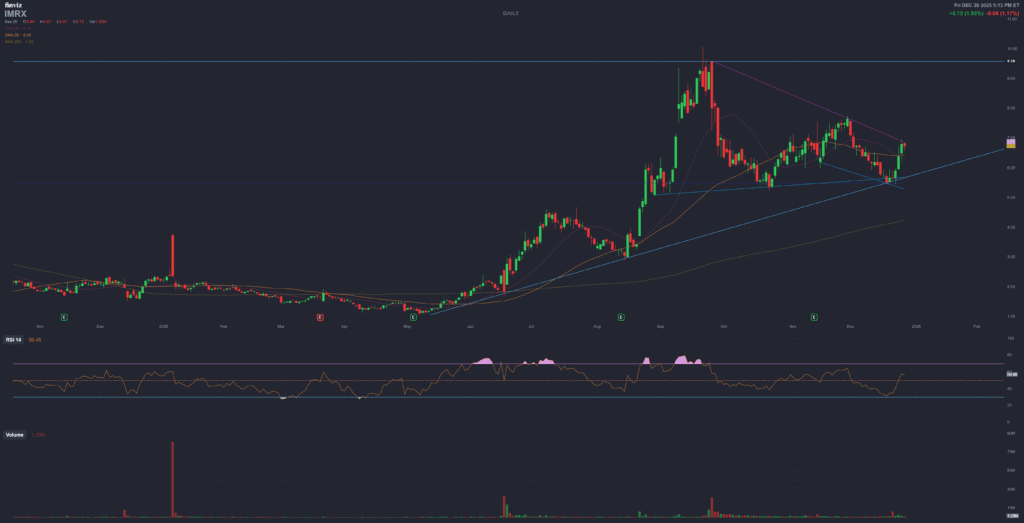
Biotech | IMRX
Immuneering – Atebimetinib in First-Line Pancreatic Cancer
IMRX – Atebimetinib 12-Month Survival Readout in First-Line Pancreatic Cancer
Context and mapping of the Immuneering (IMRX) story going into the January 7, 2026 update on 12-month overall survival (OS) for atebimetinib (IMM-1-104) plus modified gemcitabine/nab-paclitaxel in first-line pancreatic cancer, with Phase 3 MAPKeeper 301 on the horizon.
Next catalyst – January 7, 2026
12-month OS update for atebimetinib + mGnP in first-line pancreatic cancer
On January 7, 2026 Immuneering will host a conference call and webcast to present 12-month overall survival (OS) from its ongoing Phase 2a trial of atebimetinib (IMM-1-104) + modified gemcitabine/nab-paclitaxel (mGnP) in first-line pancreatic cancer. This is the logical follow-up to the 6- and 9-month data that have already attracted significant attention.
So far, in the single-arm Phase 2a cohort (N=34) Immuneering has reported:
- 94% OS and 72% PFS at 6 months, with medians not yet reached at that cut.
- 86% OS at 9 months, a figure the company itself described as “extraordinary”.
These numbers have been repeatedly contrasted with historical benchmarks from the MPACT study of gemcitabine/nab-paclitaxel, where 9-month OS and PFS are markedly lower. The upcoming 12-month update will show whether the survival curve maintains that apparent separation or starts converging back toward standard-of-care expectations.
In practical terms, the January call will answer one core question: does the atebimetinib + mGnP curve stay high enough at 12 months to justify the hype, the Phase 3 design and the equity re-rating we have seen in 2025, or do we discover that the early window was simply too small and too favorable?
All data discussed here are interim and come from a single-arm study; cross-trial comparisons with historical controls are inherently imperfect.
1. Executive summary – Why this catalyst matters
Immuneering has built a surprisingly strong narrative around a drug that is still in Phase 2a and in one of the toughest settings in oncology: first-line pancreatic cancer. The combination of oral MEK inhibitor atebimetinib plus mGnP has produced survival curves that, on interim cuts, sit well above historical benchmarks from standard-of-care regimens.
The equity market has reacted: IMRX has re-rated from micro-cap territory and now carries a market capitalization in the mid-hundreds of millions, with a very comfortable cash balance after large financings and a private placement with Sanofi.
The January 7, 2026 12-month OS update is therefore not “just another data point”: it is the moment where we start to see whether the impressive early survival data can sustain a high bar over time, or whether the curve starts to look more like an over-extrapolation of a small dataset.
This report does not attempt to predict the outcome. It aims to map: what we know so far, how the upcoming data may be interpreted, and which structural risks and opportunities surround IMRX into 2026–2028.
2. Company and platform – Deep Cyclic MEK inhibitors aimed at MAPK-driven tumors
2.1 Who is Immuneering?
Immuneering is a clinical-stage oncology company whose core thesis is that many tumors rely on chronic activation of the RAS/RAF/MEK pathway and that traditional MEK inhibitors, while effective in some contexts, are limited by toxicity and narrow mutation-specific focus. The company’s answer is a family of Deep Cyclic Inhibitors designed to more selectively impact tumor cells while improving tolerability.
The lead program, atebimetinib (IMM-1-104), is an oral once-daily MEK inhibitor targeting MAPK-driven tumors such as pancreatic cancer, melanoma and non-small cell lung cancer. A second clinical program, IMM-6-415, is a twice-daily Deep Cyclic MEK inhibitor in Phase 1/2a for RAS/RAF-mutated solid tumors. Both are embedded in a broader MAPK-focused pipeline.
2.2 Pipeline in brief
- Atebimetinib (IMM-1-104)
- Phase 2a in advanced solid tumors including first-line pancreatic cancer (PDAC), with multiple arms: mGnP, mFOLFIRINOX, monotherapy and melanoma cohorts.
- Planned global Phase 3 registrational trial (MAPKeeper 301) in first-line metastatic PDAC.
- IMM-6-415
- Phase 1/2a in solid tumors harboring RAS or RAF mutations.
- Program positioned as a second Deep Cyclic MEK inhibitor with broader solid tumor reach.
- Additional early programs in oncology leveraging the same platform logic.
For the January 2026 catalyst, everything revolves around a single question: can atebimetinib + mGnP in first-line PDAC justify its survival curve advantage when extended to 12 months?
Management and governance snapshot
Ben Zeskind, Ph.D., MBA – Co-Founder, President, CEO and Director
Trained at MIT (bioengineering, electrical engineering and computer science) and Harvard Business School
(Baker Scholar), Zeskind has led Immuneering since its inception in 2008 with a focus on data-driven
oncology and long-term durability of response rather than short-term tumor shrinkage alone.
Thomas J. Schall, Ph.D. – Chairman of the Board
Appointed in September 2025, Schall is best known as founder and longtime CEO of ChemoCentryx, where he
led the development of Tavneos and ultimately oversaw a multi-billion-dollar acquisition
by Amgen. His presence adds late-stage and commercial credibility to Immuneering’s board as the company
moves toward Phase 3.
The combination of a technically deep founder-CEO and a chairman with proven late-stage and M&A experience is a positive from a governance standpoint, but does not remove the intrinsic clinical and regulatory risk in pancreatic cancer.
3. Clinical data so far – reading the 6- and 9-month survival curves
3.1 Design of the Phase 2a pancreatic cohort
The ongoing Phase 1/2a trial of atebimetinib (IMM-1-104) includes several arms for patients with advanced solid tumors. The key cohort for the current catalyst is the first-line pancreatic cancer arm, where atebimetinib is combined with modified gemcitabine/nab-paclitaxel (mGnP) in patients with metastatic disease.
This is a single-arm study, which means all patients receive the investigational combination. Efficacy is assessed by comparing results with historical benchmarks from prior trials of standard regimens such as gemcitabine/nab-paclitaxel in the MPACT study, or more recent datasets for mGnP.
3.2 Early activity and response-based data
January 2025 marked the first major inflection point: Immuneering reported a positive data update across three pancreatic cancer arms, including combinations and monotherapy, noting response and disease control rates above historical expectations and confirming plans to expand the trial with additional arms.
While detailed ORR and DCR breakdowns are beyond the scope of this summary, the key message was that the atebimetinib combinations appeared to deliver not only tolerable safety but also promising early efficacy.
3.3 Survival data at 6 months
In June 2025, Immuneering released its first dedicated survival and progression-free survival cut from the first-line PDAC atebimetinib + mGnP cohort (N=34, median follow-up 6 months):
- Overall survival (OS) at 6 months: 94%
- Progression-free survival (PFS) at 6 months: 72%
- Median OS and PFS not yet reached at that data cut.
These numbers are substantially higher than historical references for gemcitabine/nab-paclitaxel alone, which typically show lower OS and PFS rates at the same time points. However, this remains a comparison across different trials, populations and time periods.
3.4 Survival data at 9 months
In September 2025 the company went a step further, updating survival with a median follow-up of 9 months in the same 34-patient cohort:
- Overall survival (OS) at 9 months: 86%
- Progression-free survival (PFS) at 9 months reported around 53% in third-party summaries of the dataset.
- Median OS remained not reached.
In press releases, Immuneering has explicitly contrasted these figures with the MPACT trial benchmarks for gemcitabine/nab-paclitaxel, where 9-month OS is roughly in the high-40 percent range and PFS around the high-20 percent range, depending on the specific analysis and cut used. The message to the market has been clear: at least so far, atebimetinib + mGnP seems to be tracking well above standard-of-care curves.
3.5 What we still do not know
Despite the impressive percentages, several important unknowns remain:
- Durability beyond 9 months: do survival curves stay separated at 12 months and beyond, or do they converge toward standard-of-care benchmarks?
- Distribution of responses: how many durable responders are driving the curve versus short benefit in others?
- Comparability of the population: to what extent are baseline characteristics similar to historical controls, and how much selection bias is embedded in the Phase 2a cohort?
The 12-month OS update will not answer every question, but it will be the first true test of whether this is a fundamentally different survival curve or a statistically impressive snapshot of a small cohort in its best months.
4. The January 7, 2026 catalyst – what will the market actually look at?
The company has guided that the January 7 call will focus on updated 12-month OS from the first-line PDAC atebimetinib + mGnP arm. There are a few key elements that investors and traders are likely to focus on.
4.1 OS at 12 months vs historical benchmarks
The headline number will be straightforward: what proportion of patients in the 34-patient cohort are still alive at 12 months, and how does that look when compared (with all the caveats) to historical MPACT and other frontline PDAC datasets?
The bar is now high: going from 94% at 6 months to 86% at 9 months sets an expectation that 12-month OS should remain clearly above standard-of-care benchmarks to sustain the current narrative.
4.2 Shape of the curve and medians
Beyond a single percentage, the shape of the survival curve matters:
- Has median OS been reached by 12 months? If so, at what value?
- Is there evidence of a plateau or long tail emerging?
- How many patients remain at risk at the 12-month mark, and how scattered are events over time?
A clean, slowly descending curve with a delayed or high median OS would support the thesis that atebimetinib contributes a durable survival benefit beyond what chemo alone can offer. A noisy curve with a sudden drop around 12 months would raise questions about whether early data were overly flattering.
4.3 Safety and tolerability
So far, the combination has been described as generally well tolerated, with a safety profile seen as manageable on top of mGnP. Maintaining that safety story is important not only for patients but also for Phase 3 design and eventual real-world adoption.
Any meaningful shift in tolerability, emergence of unexpected toxicities or need for frequent dose reductions would weigh against the drug’s positioning as a more “gentle” MEK modulator.
5. Financials and runway – can IMRX afford to wait for Phase 3?
One of the biggest risk-mitigating factors for IMRX today is its balance sheet. Following a series of financings and a significant equity raise with Sanofi participation, Immuneering closed the third quarter of 2025 with approximately 227.6 million USD in cash and equivalents.
Management has explicitly stated that this cash should be sufficient to fund operations into 2029, including the planned global Phase 3 trial of atebimetinib in first-line pancreatic cancer.
From an investor’s standpoint, this means:
- The company is unlikely to need another large equity raise immediately, reducing near-term dilution risk.
- It has enough capital to absorb a multi-year Phase 3 program (MAPKeeper 301) and still retain flexibility for additional combinations and pipeline work.
- On the flip side, the recent financings effectively locked in dilution at prices the market accepted in 2025; upside now increasingly depends on clinical validation rather than financial engineering.
6. Phase 3 MAPKeeper 301 – structure, regulators and timing
6.1 Trial design
In December 2025, Immuneering announced that it had completed its End-of-Phase 2 interactions with the FDA and obtained scientific advice from EMA, achieving alignment on the key elements of the planned global Phase 3 trial:
- Name: MAPKeeper 301.
- Population: first-line metastatic pancreatic ductal adenocarcinoma (PDAC).
- Arms: atebimetinib 320 mg QD + mGnP vs standard gemcitabine/nab-paclitaxel (GnP).
- Primary endpoint: overall survival (OS).
- Key secondary endpoints: PFS, ORR, DCR, quality of life measures.
- Planned enrollment: approximately 510 patients worldwide.
The trial is designed as a global registrational study, with the explicit goal of supporting regulatory filings if results are positive.
6.2 Timelines
- First patient in: expected around mid-2026.
- Topline readout: currently guided for mid-2028.
In other words, even in a positive scenario, the definitive registrational data that matter for approval and commercialisation are at least two and a half years away.
Regulatory positioning and external validation
Regulatory agencies have indicated acceptance of a Phase 3 design with OS as the primary endpoint and a direct comparison against GnP. This is not surprising, but it confirms that Immuneering has done the groundwork to move from an interesting small cohort to a trial that can actually change practice if the results are strong enough.
In parallel, atebimetinib has benefited from intellectual property strengthening (composition of matter patent with potential exclusivity into the 2040s) and from collaborations such as the clinical supply agreement with Eli Lilly to evaluate combinations in non-small cell lung cancer.
None of this guarantees success, but it does show a convergence of factors – regulatory alignment, IP protection, partnerships, cash – that are not always present in early-oncology stories at similar market caps.
7. Sentiment – how traders are framing IMRX before the 12-month OS
Retail sentiment around IMRX has gone through a visible transformation over the past year. After a long period as a low-priced, relatively obscure biotech, the stock has become a recurring presence in trading chats and social platforms.
- On Stocktwits, IMRX has repeatedly appeared among trending tickers, with periods of “extremely bullish” sentiment and surges in message volume around data and financing announcements.
- Several news recaps highlight episodes where IMRX jumped 30–40% in a single session after trial updates or financing news, accompanied by heavy retail speculation on long-term price potential.
- On Reddit, threads discussing the 6- and 9-month survival data often point to the large gap vs MPACT benchmarks, but some users also voice concern about relying on a small single-arm dataset and about the impact of dilutive financings.
- Financial blogs and commentary differ: some promote the story as an underappreciated survival play in PDAC, while others describe certain catalysts as “questionable” in the sense of being used to justify aggressive short-term trading moves.
Medium-term mood: constructive but very catalyst-sensitive
Retail tone: optimistic on data, aware of dilution already done
Key worry: small sample, high expectations into January 7
All sentiment observations are based on public posts and news summaries from Reddit, Stocktwits and X. These are opinions from non-professional traders and commentators and should never be used as a basis for investment decisions.
8. Risk map – what can go wrong from here?
- Single-arm data and small N: all survival figures so far come from a 34-patient cohort without a concurrent control arm. Even large apparent deltas vs historical benchmarks may compress in more controlled settings.
- Regression to the mean at 12 months: if OS at 12 months drops more strongly than expected or the curve shows a sharp bend downward, it will be harder to maintain the “extraordinary” narrative built at 6 and 9 months.
- Pancreatic cancer biology: this is one of the most aggressive solid tumors; many seemingly promising approaches have stumbled in larger randomized trials.
- Concentration risk: much of Immuneering’s current value is tied to atebimetinib in first-line PDAC. Setbacks here would weigh on both the MEK platform and the rest of the pipeline.
- Execution and timing risk: Phase 3 MAPKeeper 301 is large and global, with topline not expected before 2028. Delays or operational issues could erode investor patience.
- Market expectations: after substantial share price appreciation and strong analyst targets, even “good but not spectacular” 12-month data may be treated as a disappointment by some traders looking for perfection.
9. Scenarios – possible paths after the 12-month OS update
Without trying to forecast prices, it is still useful to outline a few simple conceptual scenarios.
9.1 Scenario A – Curve stays clearly above benchmarks
In this scenario, 12-month OS remains markedly higher than historical GnP/mGnP data, median OS is pushed out meaningfully, safety remains acceptable, and the survival curve looks consistent with a real, durable benefit. The Phase 3 MAPKeeper 301 design appears well justified, and IMRX continues to be framed as a high-potential late-stage oncology story with strong cash backing.
9.2 Scenario B – Good, but less dramatic separation
Here, 12-month OS is still better than historical benchmarks but the gap is narrower than hoped, median OS lands in a range that is encouraging but not transformative, and the curve shows a more ordinary pattern. The story becomes more nuanced: still worth taking into Phase 3, but with less room for error and a more balanced risk-reward.
9.3 Scenario C – Convergence toward standard-of-care
In the most negative near-term scenario, 12-month OS data show the curve dropping closer to historical GnP/mGnP outcomes, eroding much of the perceived advantage. The interpretation would be that early percentages overstated the benefit due to sample size, censoring or patient mix. Phase 3 might still go ahead, but the market would treat it as substantially riskier and less differentiated.
Reality can end up somewhere between these scenarios. What matters is not a single number, but how the 12-month update changes the perceived trajectory of atebimetinib as it moves from a promising Phase 2a curve to a Phase 3 program designed to carry the full weight of a registrational bet in pancreatic cancer.
10. Bottom line – what IMRX looks like going into January 7
Going into the January 7, 2026 catalyst, Immuneering sits in a relatively unusual position for a small-cap biotech: it has compelling interim survival data in an area of extreme unmet need, regulatory alignment on a Phase 3 design, and a cash balance that can cover operations into the end of the decade.
At the same time, the story is built on a small, single-arm cohort with inherently noisy cross-trial comparisons, in a disease where many once-promising approaches have ultimately lost their shine in larger randomized studies.
The 12-month OS call will therefore not only be a clinical update but also a reality check on expectations: a way to see how much of the current enthusiasm is anchored in durable data, and how much is still hope projected onto a promising but early survival curve.
Disclaimer (EN)
This article is provided for informational and educational purposes only and does not constitute investment advice, recommendation, solicitation or invitation to buy or sell any financial instrument or security. Immuneering Corporation (IMRX) and all other companies mentioned are presented as case studies in the context of biotech catalyst analysis. The author and Merlintrader trading Blog do not provide individualized advice and are not responsible for any investment decisions taken by readers.
Biotech and small/mid-cap equities are highly speculative and volatile. Clinical, regulatory and financial outcomes can differ materially from expectations, and investors may lose part or all of their capital. Readers are strongly encouraged to perform their own independent research and, where appropriate, consult licensed financial professionals before making any investment decisions.
This content is intended to comply with applicable disclosure principles, including those generally required by CONSOB and EU regulations for Italian readers and by SEC/FINRA good practice principles for U.S. readers. For full legal information, please refer to: Disclaimer and Condizioni d’uso e Privacy on Merlintrader.
Prossimo catalyst – 7 gennaio 2026
Aggiornamento di sopravvivenza a 12 mesi per atebimetinib + mGnP nel pancreas
Il 7 gennaio 2026 Immuneering terrà una conference call con webcast per presentare i dati di sopravvivenza globale (OS) a 12 mesi della fase 2a di atebimetinib (IMM-1-104) + gemcitabina/nab-paclitaxel modificata (mGnP) in first-line pancreatic cancer. È il naturale proseguimento dei cut a 6 e 9 mesi che hanno già acceso i riflettori sul titolo.
Finora, nella coorte single-arm di 34 pazienti, Immuneering ha riportato:
- OS al 6° mese 94% e PFS 72%, con mediane non ancora raggiunte a quel cut.
- OS al 9° mese 86%, definita dall’azienda come “extraordinaria”.
Questi numeri sono stati confrontati più volte con i benchmark storici dello studio MPACT su gemcitabina/nab-paclitaxel, in cui OS e PFS ai 9 mesi sono sensibilmente inferiori. L’aggiornamento a 12 mesi dirà se la curva di sopravvivenza mantiene un distacco netto o se inizia ad avvicinarsi alle aspettative tipiche dello standard of care.
In pratica, la call di gennaio risponde a una domanda centrale: la curva di atebimetinib + mGnP resta abbastanza alta a 12 mesi da tenere in piedi la narrativa, il disegno del fase 3 e il rerating azionario visto nel 2025, oppure scopriamo che la finestra iniziale era semplicemente troppo piccola e favorevole?
I dati discussi sono interim e derivano da uno studio single-arm; i confronti con controlli storici hanno limiti strutturali.
1. Executive summary – Perché questo catalyst è rilevante
Immuneering ha costruito una narrativa sorprendentemente forte attorno a un farmaco ancora in fase 2a e in uno degli ambiti più difficili dell’oncologia: la first-line pancreatic cancer. La combinazione atebimetinib + mGnP ha prodotto curve di sopravvivenza che, sui cut interim, si posizionano nettamente sopra i benchmark storici dei regimi standard.
Il mercato azionario ha reagito: IMRX è passato dalla fascia micro-cap a una capitalizzazione di qualche centinaio di milioni, con cassa molto robusta dopo aumenti di capitale e private placement (incluso Sanofi).
L’aggiornamento di OS a 12 mesi del 7 gennaio 2026 non è quindi un “dato come un altro”: è il momento in cui si vede se la curva di sopravvivenza regge davvero l’asticella elevata dei primi mesi, o se il quadro inizia a sembrare più simile a un’estrapolazione ottimistica di un dataset piccolo.
Lo scopo non è prevedere l’esito, ma mappare: cosa sappiamo, come potrebbero essere letti i dati e quali rischi strutturali e opportunità accompagnano IMRX nel periodo 2026–2028.
2. Azienda e piattaforma – Deep Cyclic MEK inhibitors per tumori MAPK-driven
2.1 Chi è Immuneering?
Immuneering è una biotech oncologica in fase clinica che parte da un’osservazione semplice: molti tumori dipendono dall’attivazione cronica della via RAS/RAF/MEK, ma gli inibitori MEK tradizionali sono spesso limitati da tossicità e da un focus ristretto su specifiche mutazioni. La risposta aziendale è una famiglia di Deep Cyclic Inhibitors, pensati per colpire selettivamente le cellule tumorali modulando in modo diverso la dinamica del segnale, con l’obiettivo di migliorare la tollerabilità.
Il programma guida, atebimetinib (IMM-1-104), è un MEK inhibitor orale once-daily, mirato a tumori MAPK-driven come pancreas, melanoma e NSCLC. Il secondo programma clinico, IMM-6-415, è un Deep Cyclic MEK inhibitor twice-daily in fase 1/2a per tumori solidi con mutazioni RAS o RAF.
2.2 Pipeline in sintesi
- Atebimetinib (IMM-1-104)
- Fase 2a in tumori solidi avanzati, inclusa coorte first-line pancreas (PDAC) con mGnP e bracci aggiuntivi (mFOLFIRINOX, monoterapia, melanoma).
- Trial registrativo globale di fase 3 MAPKeeper 301 in preparazione.
- IMM-6-415
- Fase 1/2a in tumori solidi RAS/RAF-mutati.
- Programmi precoci oncologici, costruiti sullo stesso approccio MAPK-focused.
Per il catalyst di gennaio, il focus resta uno: capire se atebimetinib + mGnP nel pancreas regge la promessa implicita nelle curve di sopravvivenza viste finora.
Management e governance
Ben Zeskind, Ph.D., MBA – Co-Founder, President, CEO e Director
Formazione MIT (bioingegneria, ingegneria elettrica e informatica) e Harvard Business School (Baker
Scholar), Zeskind guida Immuneering dal 2008 con un’impostazione molto data-driven e un focus dichiarato
sulla durabilità della risposta più che sulla sola risposta rapida.
Thomas J. Schall, Ph.D. – Chairman of the Board
Nominato a settembre 2025, è noto come fondatore e CEO storico di ChemoCentryx, dove ha portato allo
sviluppo e all’approvazione FDA di Tavneos e alla successiva acquisizione da parte di Amgen per miliardi
di dollari. Porta esperienza concreta di late-stage e M&A.
La combinazione di founder-CEO tecnico e chairman con track record forte aumenta la credibilità del progetto, ma ovviamente non toglie il rischio clinico e regolatorio tipico del pancreas metastatico.
3. Dati clinici attuali – leggere le curve a 6 e 9 mesi
3.1 Disegno della coorte pancreas
Il trial di fase 1/2a di IMM-1-104 comprende vari bracci in tumori solidi avanzati. Il pezzo chiave per il catalyst è la coorte first-line pancreas, dove atebimetinib viene combinato con mGnP in pazienti con malattia metastatica.
Lo studio è single-arm: tutti i pazienti ricevono la combinazione sperimentale. L’efficacia viene valutata confrontando i risultati con benchmark storici (MPACT e dataset più moderni su GnP/mGnP).
3.2 Prime evidenze di attività
A gennaio 2025 Immuneering ha comunicato un primo aggiornamento positivo su tre bracci pancreas, evidenziando tassi di risposta e disease control sopra le attese storiche e annunciando l’espansione dello studio con ulteriori combinazioni.
3.3 Sopravvivenza a 6 mesi
A giugno 2025, cut di sopravvivenza e PFS sulla coorte first-line PDAC atebimetinib + mGnP (N=34, follow-up mediano 6 mesi):
- OS a 6 mesi 94%
- PFS a 6 mesi 72%
- Mediana OS e PFS non ancora raggiunta.
3.4 Sopravvivenza a 9 mesi
A settembre 2025, con follow-up mediano di 9 mesi nella stessa coorte:
- OS a 9 mesi 86%
- PFS a 9 mesi intorno al 50% in sintesi terze parti.
- Mediana OS ancora non raggiunta.
Questi valori sono stati confrontati con i benchmark dello studio MPACT su GnP, colpendo per il distacco apparente: in sintesi, dove MPACT mostra OS e PFS ai 9 mesi intorno a metà o meno della coorte atebimetinib, qui le curve restano alte. Il tema, però, è sempre lo stesso: confronto indiretto, numeri piccoli.
3.5 Cosa manca ancora
Nonostante i numeri impressionanti, restano aperti vari punti:
- Durata oltre i 9 mesi: la curva resta staccata anche a 12 mesi o rientra nella “zona standard”?
- Distribuzione dei benefici: quanti long responder stanno guidando la curva e quanti pazienti hanno benefici brevi?
- Comparabilità della popolazione: quanto la coorte è davvero sovrapponibile ai controlli storici?
L’aggiornamento a 12 mesi non risolve tutto, ma è il primo test vero per capire se siamo di fronte a una curva davvero diversa o a una fotografia molto favorevole di un campione piccolo.
4. Il catalyst del 7 gennaio 2026 – cosa guarderà davvero il mercato
La società ha indicato che la call del 7 gennaio sarà focalizzata sull’OS a 12 mesi del braccio atebimetinib + mGnP. I punti chiave attesi:
4.1 OS a 12 mesi vs benchmark storici
Il numero di testa sarà chiaro: che percentuale di pazienti è viva a 12 mesi e come si colloca rispetto alle curve storiche GnP/mGnP. Con 94% a 6 mesi e 86% a 9 mesi, l’asticella è alta: un dato che rientra troppo verso lo storico cambierebbe il tono della storia.
4.2 Forma della curva e mediane
Oltre alla singola percentuale, conteranno:
- Se la mediana OS viene finalmente raggiunta e a che valore.
- Se emerge un plateau o una coda lunga credibile.
- Quanti pazienti restano “at risk” a 12 mesi.
4.3 Sicurezza e tollerabilità
Finora il profilo di safety della combo è stato definito gestibile. Mantenere questa narrativa è fondamentale sia per il disegno del fase 3, sia per il potenziale uso reale più avanti.
5. Finanza e runway – IMRX può permettersi di aspettare il fase 3?
A livello di bilancio, la situazione è insolitamente solida per una small-cap biotech: dopo un aumento di capitale importante e un private placement con Sanofi, Immuneering chiude il Q3 2025 con circa 227,6 milioni USD di cassa, con guidance di runway fino al 2029.
Tradotto:
- Il rischio di una diluizione immediata è relativamente contenuto.
- L’azienda ha benzina per finanziare MAPKeeper 301 e una parte significativa delle attività di piattaforma.
- La diluizione forte è stata già “incassata” nel 2025; da qui in avanti la storia dipende sempre più dal valore clinico, meno dall’ingegneria finanziaria.
6. Fase 3 MAPKeeper 301 – struttura, regolatori e timing
6.1 Disegno del trial
A dicembre 2025 Immuneering ha comunicato di aver chiuso l’End-of-Phase 2 con FDA e ricevuto scientific advice da EMA, con allineamento sui punti cardine del fase 3:
- Nome: MAPKeeper 301.
- Popolazione: PDAC metastatico first-line.
- Bracci: atebimetinib 320 mg QD + mGnP vs standard GnP.
- Endpoint primario: OS.
- Secondari: PFS, ORR, DCR, qualità di vita.
- Arruolamento previsto: circa 510 pazienti globali.
6.2 Tempistiche
- Primo paziente previsto intorno a metà 2026.
- Topline atteso a metà 2028.
Anche in caso di scenario favorevole, i dati veramente “pesanti” per l’approvazione restano comunque a oltre due anni e mezzo di distanza.
Posizionamento regolatorio
Il fatto che FDA ed EMA abbiano dato via libera a un disegno di fase 3 centrato su OS e confronto diretto con GnP indica che il pacchetto di fase 2 è considerato quantomeno degno di una prova registrativa. Inoltre, la protezione brevettuale su atebimetinib e gli accordi di fornitura con big pharma (come Lilly per combinazioni in NSCLC) costruiscono un perimetro non comune per una small-cap.
7. Sentiment – come viene vissuta IMRX da Reddit, Stocktwits e X
Nel corso del 2025 IMRX è passata da ticker quasi invisibile a nome ricorrente nelle chat di trading:
- Su Stocktwits, vari report di news segnalano fasi di sentiment “estremamente bullish” con volume di messaggi esploso in occasione di dati o aumenti di capitale.
- Ci sono state sedute con rialzi anche superiori al 30–40% in after-hours o intraday dopo update clinici, con discussioni su target molto ambiziosi e possibili scenari di acquisizione.
- Su Reddit vengono spesso citati i numeri di OS a 6 e 9 mesi, mentre altri utenti ricordano la dimensione ridotta del campione e il rischio di affidarsi troppo a confronti storici.
- Articoli e blog finanziari presentano visioni opposte: da chi vede in atebimetinib un potenziale game changer nel PDAC a chi parla di catalyst “sovraccarichi” di aspettative usati per spingere il titolo nel breve.
Umore medio: costruttivo ma molto sensibile ai dati
Retail: ottimista sui dati, consapevole della diluizione già fatta
Criticità: campione piccolo, aspettative alte sul 7 gennaio
Le considerazioni sul sentiment derivano da contenuti pubblici di Reddit, Stocktwits e X, scritti da trader non professionisti. Utili per leggere il clima, non per prendere decisioni di investimento.
8. Risk map – i punti deboli da tenere in vista
- Single-arm e N ridotto: tutta la narrativa di sopravvivenza nasce da 34 pazienti senza braccio di controllo concorrente.
- Rientro verso la media a 12 mesi: se la curva si piega in modo marcato, il gap rispetto ai dati storici si restringe e cambia il tono della storia.
- Biologia del pancreas: è un setting storicamente pieno di fallimenti, anche per programmi promettenti in fase precoce.
- Rischio di concentrazione: gran parte del valore di IMRX oggi poggia sull’esito del programma pancreas; eventuali passi falsi peserebbero sull’intera piattaforma.
- Rischio esecuzione e tempi: fase 3 globale fino al 2028; ritardi e complicazioni potrebbero logorare la pazienza degli investitori.
- Valutazione e aspettative: dopo il rerating e target ambiziosi da parte degli analisti, anche dati “buoni ma non perfetti” potrebbero essere letti come delusione da una parte del mercato.
9. Scenari – possibili traiettorie post-aggiornamento
Senza mettere in mezzo prezzi o target, si possono comunque delineare alcuni scenari qualitativi.
9.1 Scenario A – Curva ancora nettamente sopra lo storico
OS a 12 mesi resta molto sopra GnP/mGnP, mediana OS si sposta in area chiaramente attrattiva, safety ok. MAPKeeper 301 appare ampiamente giustificato e IMRX rimane una storia high-potential con cassa robusta.
9.2 Scenario B – Vantaggio ancora presente ma meno clamoroso
OS a 12 mesi resta migliore ma il gap si restringe, la mediana OS è buona ma non rivoluzionaria, la curva è più “normale”. La storia diventa più di equilibrio: valore potenziale, ma con meno margine di errore.
9.3 Scenario C – Convergenza verso lo standard-of-care
OS a 12 mesi si avvicina troppo ai benchmark, la narrazione di forte superiorità si indebolisce. Il fase 3 può comunque andare avanti, ma percepito come scommessa più rischiosa e meno differenziata.
È probabile che la realtà si collochi da qualche parte fra questi estremi. Il punto chiave è come il dato a 12 mesi modifica la percezione della traiettoria di atebimetinib, nel passaggio da piccola coorte promettente a programma che dovrà reggere il peso di un fase 3 registrativo nel pancreas.
10. Bottom line – come si presenta IMRX alla vigilia del 7 gennaio
Alla vigilia del catalyst, Immuneering si presenta in una posizione particolare per una small-cap biotech: dati interim di sopravvivenza molto forti in un setting ad altissimo unmet need, un disegno di fase 3 allineato con FDA/EMA e una cassa tale da coprire l’intero percorso fino al 2029.
Allo stesso tempo, l’intera narrativa poggia su una coorte single-arm ridotta, con confronti storici per definizione imperfetti, in una patologia in cui la storia è piena di false partenze.
L’update a 12 mesi non è quindi solo un dato clinico, ma anche un test di realtà sulle aspettative: quanto dell’entusiasmo attuale è radicato in un segnale davvero duraturo, e quanto è ancora speranza proiettata su una curva molto bella ma ancora giovane.
Disclaimer (IT)
Questo articolo ha finalità esclusivamente informative ed educative e non costituisce in alcun modo consulenza finanziaria, sollecitazione al pubblico risparmio, offerta o raccomandazione all’acquisto o alla vendita di strumenti finanziari o altri prodotti di investimento. Immuneering Corporation (IMRX) e le altre società citate sono presentate come casi di studio nel contesto dell’analisi di catalyst biotech.
Il settore biotech e, in particolare, i titoli small/mid cap legati a risultati clinici sono altamente speculativi e volatili. Esiste il rischio concreto di perdita parziale o totale del capitale investito. Ogni lettore è invitato a svolgere in autonomia le proprie analisi e, ove opportuno, a rivolgersi a consulenti finanziari abilitati prima di assumere decisioni di investimento.
I contenuti sono redatti in modo da essere coerenti con i principi generali di trasparenza previsti dalla normativa CONSOB e dalle regole europee per il pubblico italiano, nonché con le buone pratiche di disclosure richieste da SEC/FINRA per il pubblico statunitense. Per le informazioni legali complete si rimanda alle pagine: Disclaimer e Condizioni d’uso e Privacy sul sito Merlintrader.
Biotech Catalyst Calendar
Vuoi seguire le altre date chiave – PDUFA, readout clinici, advisory committee e catalyst ad alto impatto – oltre all’aggiornamento di IMRX? Trovi la panoramica completa nella sezione dedicata del Merlintrader trading Blog.
Apri il Biotech Catalyst CalendarScanner for active traders

Try ChartsWatcher free, then unlock 10% OFF with SAVE10
ChartsWatcher is a real-time scanner for momentum traders: fast movers, unusual volume and rotations — so you can focus on the few tickers that matter right now, instead of watching hundreds of charts.
Start with the free version. When you upgrade, use SAVE10 for 10% OFF your first paid period.
Start free – then use SAVE10
No credit card required to start. Apply SAVE10 when upgrading.

Recommended platform

One platform. All your brokers.
Medved Trader connects multiple brokers in one workspace, with pro charts, hotkeys and fast execution — without changing your broker accounts.
A single cockpit for positions, Level II and multi-broker order routing, built for active day & swing traders.
Get 1 Month Free ➔
Multi-broker workflow + customizable layouts in one platform.

 Monica.im – the AI assistant I use every day
If you find value in the work I publish on Merlintrader and want a practical AI assistant for research and writing, you can sign up using this referral link. Click here to try Monica.im and support the site
Find out how I use AI on Merlintrader: AI, retail and Merlintrader
Disclosure: some of the links in the promotional blocks above are affiliate or referral links. If you choose to subscribe or sign up through them, Merlintrader may receive a small commission or benefit at no extra cost to you.


