DISCLAIMER — Not financial advice. Educational content only, not an offer or solicitation to buy or sell any security. Biotech and small/mid-cap stocks are highly speculative and volatile and can result in a partial or total loss of capital. Do your own research and consult a licensed advisor where appropriate. / Contenuti a solo scopo informativo e didattico, non costituiscono consulenza finanziaria né offerta o sollecitazione al pubblico risparmio ai sensi delle normative CONSOB e SEC. Le azioni biotech e le small/mid cap sono strumenti altamente speculativi e volatili e possono comportare la perdita parziale o totale del capitale investito. Si raccomanda di effettuare sempre le proprie ricerche e, se necessario, di rivolgersi a un consulente abilitato.

Merlintrader Trading Pub
Biotech catalyst news and analysis. FDA PDUFA tracker
Merlintrader Trading Pub
Biotech catalyst news and analysis. FDA PDUFA tracker
Report language: English only version. Italian translation can be added separately.
Theravance Biopharma (TBPH) – Royalties, Ampreloxetine and the 2026 Catalyst Map
Deep dive based on SEC filings, company disclosures and major news outlets. Informational, not a buy/sell call.
TBPH
Nasdaq | Biotech (respiratory / neurology)
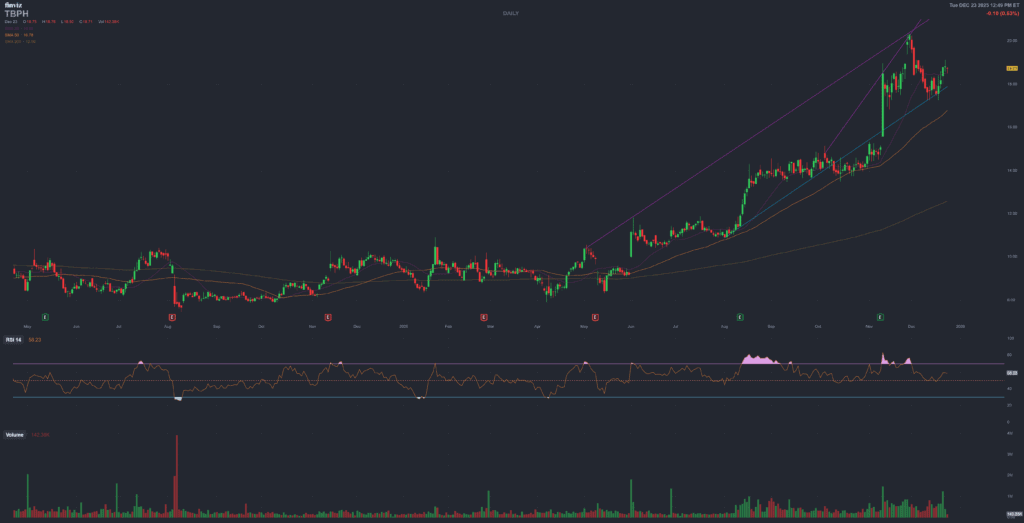
As of late December 2025, TBPH trades around the high teens in USD with a market cap just under one billion dollars, after a year of de-risking its balance sheet and showing its first sustained profitability.
In 2024 the company finished the transition from a heavy R&D story to a leaner royalty-plus-single-asset vehicle: record YUPELRI collaboration income with Viatris, a large Trelegy monetization, and a still small but increasingly visible late-stage neurology asset (ampreloxetine) in neurogenic orthostatic hypotension (nOH) for patients with multiple system atrophy (MSA).
In 2025, Theravance reported strong year-on-year revenue growth and turned profitable on a year-to-date basis by Q3, helped by operating leverage on YUPELRI and non-dilutive cash from Trelegy. In parallel, Wall Street has steadily lifted its 12-month price targets into the mid-20s, with several houses openly framing TBPH as a “growth” or “momentum” name rather than a distressed restructuring story.
News focus – what changed recently for TBPH
Over the last weeks of 2025, several themes have dominated coverage on TBPH: a clearly positive Q3 2025 earnings print (revenue up high-teens percent year-on-year, earnings swinging to a small profit), a sizeable analyst re-rating with average price targets in the mid-to-high twenties per share, and a steady drumbeat of commentary framing Theravance as a “growth” or “momentum” stock again rather than a restructuring situation.
Zacks and other outlets highlighted that Q3 2025 adjusted earnings per share came in clearly above expectations, with revenues modestly ahead of consensus and driven mainly by collaboration income from Viatris linked to YUPELRI COPD sales. Nine-month numbers show roughly one-third revenue growth year-on-year and a move from a sizeable loss to solid net income, confirming that the “lean platform” model is now visible in the financials rather than just in presentations.
On the sell-side, multiple data providers now show a consensus 12-month price target in the 26–28 USD area, implying more than 40 percent upside versus the current quote, with most firms on Buy and a couple on Hold. The most optimistic targets cluster in the low 40s, the lowest still in the low teens. This spread reflects the binary nature of the ampreloxetine story: if the Phase 3 CYPRESS data in MSA are positive and the launch is executed well, TBPH looks like a cash-generating niche neurology/respiratory platform; if not, the equity falls back to “YUPELRI + royalty tail only”.
None of these reports change the risk profile: TBPH remains highly sensitive to single-drug clinical results. The analyst and media tone has clearly shifted more constructive in late 2025, but the fundamental binary on ampreloxetine has not disappeared.
Executive summary
Theravance Biopharma is now essentially three things: a US hospital-focused COPD royalty platform through YUPELRI, a cash-rich balance sheet after fully monetizing Trelegy royalties, and a single late-stage neurology asset (ampreloxetine) that will make or break the growth story in 2026–2027. Everything else is secondary.
- Commercial backbone – YUPELRI COPD franchise. YUPELRI (revefenacin) is a once-daily nebulized LAMA for maintenance treatment of COPD, commercialized in the US by partner Viatris. 2024 US net sales reported by Viatris reached about 238.6 million USD, up around 8 percent versus 2023, with Q4 2024 net sales hitting a record 66.7 million USD. Theravance books around 35 percent of net sales as collaboration revenue and continues to see double-digit growth in hospital demand.
- Trelegy monetization largely complete, but a royalty “tail” remains. In 2022, TBPH sold most of its economic interest in Trelegy Ellipta royalties to Royalty Pharma for 1.1 billion USD upfront plus up to 250 million in milestones. In June 2025, it agreed to sell the remaining royalty interest directly to GSK for 225 million USD in cash while keeping rights to up to 150 million USD in additional milestones on 2025–2026 sales, with certain ex-US royalty rights returning from 2029 onward.
- Balance sheet – from survival mode to optionality. By the end of 2024, TBPH held about 88 million USD in cash and marketable securities even before collecting a 50 million USD Trelegy milestone in early 2025. After the 225 million USD Trelegy sale in mid-2025 and steady YUPELRI cash flows, Q3 2025 commentary points to a company with several hundred million dollars in cash, essentially no financial debt, and minimal expected non-GAAP cash burn for 2025.
- Ampreloxetine – binary Phase 3 pivot in nOH / MSA. Ampreloxetine is a once-daily norepinephrine reuptake inhibitor in Phase 3 (CYPRESS) for symptomatic neurogenic orthostatic hypotension in multiple system atrophy, with US orphan designation and a plan to seek priority review if data are supportive. The Phase 3 program is built around the MSA subgroup that appeared to benefit in earlier trials, after a broader nOH program failed in 2021 and forced a major restructuring.
- Strategic review and capital return backdrop. In November 2024, the board formed a Strategic Review Committee made entirely of independent directors to explore “all strategic alternatives”. That process is still ongoing. Management guidance for 2025 calls for minimal non-GAAP losses and minimal cash burn, leaving room for capital returns (buybacks or dividends) and, potentially, larger strategic moves once the committee has made its recommendations.
Bottom line: TBPH looks like a hybrid between a royalty fund and a single-asset biotech. The cash and royalties anchor the downside, but the equity value will likely swing around expectations for ampreloxetine’s Phase 3 data and any outcome of the strategic review.
Company and business model – how Theravance makes money now
1) YUPELRI COPD partnership with Viatris
YUPELRI is the first and only once-daily nebulized LAMA approved in the US for maintenance treatment of COPD. Viatris records total net sales; Theravance receives 35 percent of net sales via collaboration revenue, along with a proportional share of certain commercialization costs.
- 2024 US net sales reported by Viatris: around 238.6 million USD, up roughly 8 percent vs 2023.
- Q4 2024 US net sales: record 66.7 million USD, up about 10 percent vs prior year quarter, driven by increased patient demand and hospital channel growth.
- Theravance’s “implied” Q4 2024 YUPELRI share at 35 percent of net US sales was about 23.3 million USD.
- Clinical and real-world data presented at the CHEST 2025 meeting suggested that adherent YUPELRI patients had fewer and less severe COPD exacerbations post-hospital discharge compared with non-adherent patients, supporting the product’s positioning in higher-risk populations.
In June 2025, the NMPA in China approved YUPELRI for COPD, with Theravance eligible for additional sales-based milestones and tiered royalties (reported in the mid-teens to 20 percent range) on net sales in China through its licensing structure. This adds a multi-year ex-US growth leg on top of the US profit share.
2) Trelegy royalty monetization and residual exposure
TBPH’s legacy Trelegy Ellipta interest has been turned into cash in stages:
- 2022: sale of most Trelegy royalty rights to Royalty Pharma for 1.1 billion USD upfront, plus up to 250 million USD in milestones conditional on 2025–2026 global sales levels.
- February 2025: 50 million USD milestone paid from Royalty Pharma after Trelegy 2024 global net sales hit about 3.46 billion USD.
- June 2025: sale of the remaining royalty interest in Trelegy directly to GSK for 225 million USD in cash, while retaining up to 150 million USD of Royalty Pharma milestones on 2025 and 2026 sales.
- Royalties of up to 8.5 percent on Trelegy net sales are expected to return to Theravance in certain territories starting around 2029 (ex-US) and 2031 (US), creating a long-dated “tail” of high-margin income if Trelegy remains a large COPD/asthma franchise.
Management has consistently framed these deals as a way to convert a distant, uncertain royalty stream into a more manageable mix of immediate cash, near-term milestones and a long-dated tail, while freeing capital to support YUPELRI and ampreloxetine and to return cash to shareholders over time.
Snapshot – TBPH as of late 2025
| Metric | Comment (approximate) |
|---|---|
| Market cap | Just under 1 B USD, mid-cap biotech. |
| Share price | High teens USD; 52-week range roughly 7.9–20.3 USD. |
| Revenue drivers | YUPELRI COPD profit share with Viatris plus Trelegy milestones; no other major commercial products. |
| 2024 performance | Record YUPELRI net sales, 50 M USD Trelegy milestone, small GAAP loss but low cash burn. |
| 9M 2025 | Revenue up >30 percent year-on-year; move to positive net income, helped by operating leverage. |
| Cash position | 88 M USD at Dec 2024, then +50 M milestone and +225 M Trelegy sale in 2025; no meaningful financial debt. |
| 2025 guidance | R&D 32–38 M, SG&A 50–60 M (ex-SBC), minimal non-GAAP loss and cash burn versus 2024. |
| Analyst sentiment | Consensus rating between Buy and Strong Buy with average 12-month PT around 27–28 USD. |
| Key binary | Ampreloxetine Phase 3 CYPRESS readout in nOH/MSA, expected Q1 2026. |
Values are approximate snapshots based on late-2025 filings and widely-reported estimates. For trading or valuation decisions, always check the latest official data.
Ampreloxetine – from 2021 failure to 2026 binary pivot in MSA
Mechanism and target population
Ampreloxetine is an orally bioavailable, once-daily norepinephrine reuptake inhibitor developed to treat symptomatic neurogenic orthostatic hypotension (nOH), a disabling drop in blood pressure on standing that causes dizziness, falls and fainting in patients with autonomic failure. Theravance has refocused the program on patients with multiple system atrophy, a rare, rapidly progressive neurodegenerative disorder with few effective symptomatic options.
Earlier development in a broader nOH population produced negative results in 2021, prompting a major restructuring and heavy share price damage. Post-hoc analyses, however, pointed to a clinically meaningful and durable benefit in the MSA subgroup, including improvement in norepinephrine levels, blood pressure stability and symptoms, without a clear signal for worsening supine hypertension. These findings underpinned the new, narrower development path.
CYPRESS Phase 3 design and regulatory path
The pivotal CYPRESS trial is a multi-part Phase 3 program focused on symptomatic nOH in MSA. Key points disclosed by the company:
- Open-label lead-in followed by randomized withdrawal to test durability and symptom control in a real-world-like MSA nOH population.
- US orphan drug designation for ampreloxetine in nOH in MSA, with a plan to pursue priority review if the data are supportive.
- Management guidance: last patient in open-label portion completed around mid-2025, with top-line data expected roughly six months later, i.e. around Q1 2026.
- Supportive data packages include blood-pressure monitoring, catecholamine levels and symptom scales that directly address the historical regulatory concern of supine hypertension with nOH drugs.
Two ampreloxetine abstracts have already been accepted for oral presentation at the American Academy of Neurology 2025 meeting (impact on supine hypertension and catecholamines), and the company has publicly indicated that it is preparing for an expedited NDA filing if CYPRESS is positive. Launch-readiness work with key prescribers is ongoing, with early research confirming a perceived unmet need for longer-lasting, more durable therapies in this niche indication.
Key scientific and regulatory risks
- The program is coming off a failed earlier Phase 3 trial in a broader nOH population; the current design leans heavily on post-hoc subgroup analyses. There is no guarantee that these results will replicate prospectively.
- The study is enriched for MSA, a rare disease with relatively small sample sizes and high clinical variability; statistical noise and patient heterogeneity can easily erode effect size.
- Even with orphan designation and potential priority review, regulators remain cautious in the nOH space due to historical safety concerns (especially supine hypertension), and may demand stringent risk-mitigation measures or additional data.
- Commercialization will compete against established nOH treatments and off-label strategies; even with a clean label, real-world uptake can be slower than investors expect.
For TBPH’s equity, CYPRESS is essentially a binary: success means a focused CNS rare-disease launch on top of a de-risked royalty platform, while failure likely forces the market to value the company largely as a YUPELRI/Trelegy royalty vehicle with limited growth and ongoing return-of-capital.
Financial profile – from heavy cash burn to lean royalty engine
2024 – record YUPELRI year and Trelegy milestone
For the year ended December 31, 2024, Theravance reported:
- Q4 2024 revenue of about 18.8 million USD, entirely from Viatris collaboration revenue on YUPELRI.
- Record YUPELRI US net sales of roughly 238.6 million USD for 2024, up about 8 percent year-on-year, with Q4 2024 net sales of 66.7 million USD up about 10 percent versus Q4 2023.
- Global Trelegy net sales of approximately 3.46 billion USD in 2024, triggering a 50 million USD milestone payment to TBPH in early 2025.
- Q4 2024 GAAP net loss around 15.5 million USD; non-GAAP net loss around 2.5 million USD; cash, cash equivalents and marketable securities of about 88.4 million USD as of December 31, 2024.
- 2025 guidance calling for R&D 32–38 million USD and SG&A 50–60 million USD (both excluding share-based compensation), with minimal non-GAAP operating losses and minimal cash burn expected in 2025, similar to 2024.
2025 – positive inflection on income statement
For 2025 to date (through Q3) public data and summaries indicate:
- Q2 and Q3 2025 financial results showed collaboration revenue rising high-teens percent year-on-year, driven by continued YUPELRI growth.
- Q3 2025 adjusted EPS turned modestly positive (low single-digit cents), beating consensus estimates that were still expecting a loss, with revenue around 20 million USD and roughly 19 percent year-on-year growth.
- For the first nine months of 2025, revenues reached about 61.6 million USD versus around 45.6 million USD in the same period of 2024, and net income swung to around 44.9 million USD versus a net loss of about 40.9 million USD the prior year period.
- Operating expenses declined in line with prior guidance, reflecting the leaner R&D focus on ampreloxetine and a tighter SG&A structure, while collaboration revenue tracked YUPELRI growth.
Balance sheet and capital allocation
- The company emerged from 2022’s restructuring with no significant financial debt and has since layered on Trelegy monetization cash (1.1 billion USD upfront in 2022, 50 million USD milestone in early 2025, 225 million USD cash from the remaining royalty sale in mid-2025) and recurring YUPELRI cash flows.
- 2024’s 10-K and 2025 guidance emphasize “minimal” expected non-GAAP losses and limited cash burn, implying that existing cash plus expected milestones should be sufficient to fund the ampreloxetine program and normal operations without obvious near-term need for dilutive equity raises under base-case assumptions.
- The Strategic Review Committee formed in November 2024 continues to evaluate “all alternatives” to unlock shareholder value, ranging from capital returns (buybacks/special dividends) to potential strategic transactions. No final outcome has been publicly announced yet.
- Management has also hinted at flexibility to use part of the Trelegy proceeds for shareholder returns, but has been careful not to over-promise before the strategic review concludes.
In practical terms, TBPH is no longer a “cash-burn emergency” story. The key question for investors is not survivability but the allocation of a relatively strong balance sheet between R&D, royalties and capital return, and how this interacts with the outcome of CYPRESS.
Theravance catalyst map – 2025 to 2027
| Timing (approx) | Event | What to watch | Perceived risk |
|---|---|---|---|
| Q4 2025 – Q1 2026 | Strategic Review Committee update | Any concrete outcome from the strategic review initiated in late 2024: capital return framework, changes to portfolio focus, potential strategic transaction, or confirmation of a “stay independent” plan. | Medium (outcome uncertain, but balance sheet strong) |
| Q1 2026 (guided) | Ampreloxetine Phase 3 CYPRESS top-line data in nOH/MSA | Magnitude and durability of symptom improvement vs placebo, safety/tolerability (especially supine hypertension), and alignment with the subgroup signals seen in earlier MSA data. This is the core binary for TBPH. | High (single pivotal asset) |
| 2026 | Potential ampreloxetine NDA filing and FDA review path | Whether the FDA accepts an NDA with priority review, the requested indication wording (nOH in MSA only or broader), and any risk-mitigation measures that could limit commercial use. | High (regulatory judgment call) |
| 2025–2026 | Trelegy Ellipta sales milestones (up to 150 M USD) | Global Trelegy net sales thresholds in 2025–2026 that would unlock up to 150 million USD in additional milestones via Royalty Pharma. These are high-margin, low-risk cash flows. | Low (depends on GSK’s Trelegy performance) |
| 2025–2027 | YUPELRI US growth and ex-US rollout | Continued double-digit growth in US hospital demand, potential crossing of 250 million USD annual US net sales threshold that would trigger an additional YUPELRI milestone, and ramp of China/other ex-US markets after regulatory approvals. | Medium (market execution and competition) |
| 2029 onward | Trelegy royalty tail returns | Reversion of up to 8.5 percent royalties on Trelegy net sales in certain territories, providing a long-dated income stream but with substantial discounting and uncertainty at today’s horizon. | Medium (long-dated and sensitive to Trelegy’s lifecycle) |
In the nearer term, the equity narrative will mostly orbit around three nodes: YUPELRI growth, use of Trelegy cash, and the binary CYPRESS data in 2026. The long-dated Trelegy tail is important for valuation models but less relevant for short-term trading.
Management and governance – who is steering the ship
CEO Rick E. Winningham
Rick Winningham has led Theravance Biopharma since its spin-off from Innoviva in 2014 and has been on the board since 2013. Before Theravance, he served as CEO (and later Chairman) of Innoviva and previously held senior roles at Bristol Myers Squibb, including President of Oncology/Immunology and President of Global Marketing across several therapeutic areas.
He also serves on the board of Jazz Pharmaceuticals and has been active in industry advocacy through roles at the Biotechnology Innovation Organization and the California Life Sciences Association. Public filings show that he holds a meaningful equity stake in TBPH, aligning part of his personal wealth with shareholders.
Board composition and strategic review
- A board with a mix of biopharma operators, regulatory experts and capital-markets profiles, including a former senior executive from Royalty Pharma (helpful for complex royalty monetizations) and directors with deep regulatory/clinical backgrounds.
- In November 2024, the board created a Strategic Review Committee composed entirely of independent directors to evaluate “all alternatives” to unlock value. This followed activist pressure in prior years to accelerate capital returns.
- As of late 2025, the company has not yet announced the final conclusions of this review, but the 2025 Trelegy deal was explicitly framed as the first outcome of that process, and additional steps (capital returns, portfolio moves, or strategic options) remain possible.
Governance risk here is real but nuanced: on one side, the same leadership has navigated painful setbacks and a large restructuring; on the other, the presence of experienced capital allocators and a formal strategic review suggests that the issue is not whether to return capital, but how and when.
Analyst targets, retail sentiment and “message-board noise”
Analyst consensus
Street view: mostly Buy with mid-20s PT
- Across several data providers, TBPH currently carries a consensus rating between “Buy” and “Strong Buy”, with around five Buys, a couple of Holds and virtually no Sell ratings.
- The average 12-month price target clusters around 26–28 USD per share, implying roughly 40–50 percent upside versus the current quote in the high teens. High targets reach into the low 40s; low targets sit in the low-to-mid teens.
- Recent analyst notes explicitly cite: strong free-cash-flow visibility from YUPELRI, the de-risking effect of Trelegy monetization, and the binary upside from ampreloxetine, with some houses framing TBPH as a “momentum” or “growth” story for 2026.
- The spread between high and low targets, however, is wide, reflecting differing views on CYPRESS probabilities and on how aggressively management will return capital if the drug fails.
How to read the Street stance
Analyst models tend to ascribe relatively full value to the YUPELRI/Trelegy cash flows and then layer a probability-weighted contribution from ampreloxetine. In other words: the current consensus implicitly assumes that the drug works with a non-trivial probability. If you personally assign a much lower success chance than the Street, you will naturally land below consensus on fair value, and vice versa.
Retail and social chatter
Retail focus: “cash, royalties and the MSA binary”
- On Stocktwits and similar platforms, TBPH has a modest follower base (around a thousand watchers), far from meme-stock territory but enough to keep a steady stream of posts around earnings, ampreloxetine and the Trelegy deal.
- The tone in late 2025 is cautiously constructive: many retail traders highlight the cash balance, the recurring YUPELRI revenue and the 150 million USD of remaining Trelegy milestones, often arguing that the downside is “backed by cash and royalties” while the upside depends on ampreloxetine or a buyout.
- Bearish or skeptical posts tend to focus on the 2021 ampreloxetine failure, on the inherently small orphan MSA market compared with TBPH’s market cap, and on the risk that the strategic review ends in “nothing more than modest buybacks”.
- Historical value-investing and activist discussions (including letters from funds like Irenic) have argued that the sum-of-the-parts (cash + YUPELRI profit share + royalty tail + ampreloxetine option) exceeds the then-current market value, but those analyses pre-date the 2025 Trelegy deal and rely on assumptions that readers should re-check carefully.
As always, retail sentiment on Reddit, Stocktwits and X comes from non-professional traders. It can be useful to understand what might drive short-term volatility, but it is not a substitute for primary documents or independent analysis.
Risk map – what can go wrong
Fundamental risks
- Binary dependence on a single late-stage asset. Ampreloxetine is the only advanced pipeline asset. A negative CYPRESS readout or an unexpectedly restrictive label would materially reduce medium-term growth potential and likely re-rate TBPH as a lower-growth royalty platform.
- Concentration of commercial exposure. Near-term operating revenue is heavily concentrated in one product (YUPELRI) with one main commercial partner (Viatris). Any change in the partnership, competitive dynamics in nebulized COPD, or reimbursement environment would hit TBPH disproportionately.
- Long-dated Trelegy tail is uncertain. While Trelegy royalties are expected to resume in 2029+ in certain territories, the actual value depends on how long GSK can defend the franchise, the pace of generic or competing inhaler erosion, and discount rates applied by investors. Models that ascribe aggressive value to this tail may prove too optimistic.
- Regulatory and safety uncertainty in nOH/MSA. Even if CYPRESS meets its primary endpoint, regulators may demand additional safety data, require boxed warnings or risk mitigation programs, or narrow the labeled population. Any such outcome could limit real-world uptake versus bullish expectations.
- Capital allocation and governance. The Strategic Review Committee can in theory unlock value, but also carries execution risk: poorly timed buybacks, suboptimal deal structures or simply an extended period of “nothing happens” could frustrate investors and depress the multiple.
Market and trading risks
- TBPH still trades like a small/mid-cap biotech: liquidity is decent but not deep, and the stock can swing sharply around data updates, conference commentary and sell-side notes.
- The proximity of a binary Phase 3 readout in 2026 may attract more speculative flows (both long and short), amplifying volatility well beyond what the fundamentals alone would suggest.
- Any slowdown in YUPELRI growth or negative signal from Trelegy sales (e.g. royalty milestones looking less certain) can quickly change the Street’s comfort level with the “floor value” often assumed in sum-of-the-parts arguments.
Scenario map – how the story could evolve
Bullish interpretation (high level, not a recommendation)
- Ampreloxetine’s CYPRESS data in MSA are clearly positive, with a clinically meaningful effect size, good durability and no serious safety surprises, allowing for a clean label in a high-unmet-need orphan space.
- YUPELRI maintains high-single-digit to low-double-digit net sales growth in the US, benefits from better hospital penetration and captures meaningful share in China and other ex-US markets after the 2025 approvals.
- Trelegy hits sales thresholds that unlock the remaining 150 million USD milestones in 2025–2026 and continues to support a long-dated royalty tail into the next decade.
- The Strategic Review Committee uses the strong balance sheet and royalties to implement a clear capital-return framework (for example, multi-year buyback and/or special dividends) without starving R&D, leading the market to re-rate TBPH more like a cash-generating specialty pharma platform than a binary biotech.
Bearish interpretation
- CYPRESS fails to produce convincing efficacy or raises new safety issues, leading to discontinuation of ampreloxetine or a label so narrow that its commercial impact is minimal.
- YUPELRI growth slows faster than expected due to competition, reimbursement pressure or slower COPD admissions dynamics, flattening the royalty stream.
- Trelegy sales underperform expectations, making part or all of the remaining milestones less likely and reducing the perceived “floor value” of the royalty tail.
- The strategic review either leads to no meaningful action or to capital returns perceived as too small or too late relative to the balance sheet, leading to investor fatigue and a lower valuation multiple.
Neutral / middle-of-the-road view
In a more neutral scenario, YUPELRI continues to grow at mid-single digits, Trelegy milestones largely materialize, but ampreloxetine delivers more mixed results (e.g. modest efficacy, more limited label or slower uptake). TBPH then remains a cash-generating but relatively low-growth royalty platform with a modest CNS product on top, and the equity behaves more like a niche income stock with some optionality rather than a high-beta pipeline story.
These scenarios are simplified frameworks to think about the moving parts, not price targets or probability-weighted valuations. They are meant to help readers structure their own due diligence around filings, company presentations and independent clinical assessment.
Key documents and sources used for this report
- Theravance Biopharma – Form 10-K for year ended December 31, 2024 (SEC EDGAR).
- Theravance Biopharma press release – “Theravance Biopharma, Inc. Reports Record Fourth Quarter and Full Year 2024 Financial Results” (February 26, 2025).
- Theravance Biopharma press releases and Q2/Q3 2025 financial updates, including corporate presentations and conference call commentary.
- Press release and related coverage – sale of remaining Trelegy Ellipta royalty interest to GSK for 225 million USD and retention of up to 150 million USD in milestones on 2025–2026 sales.
- Press release – NMPA approval of YUPELRI in China and related milestone/royalty structure.
- CHEST 2025 conference news – new YUPELRI analyses in COPD post-discharge settings.
- Analyst consensus and price target data for TBPH from multiple providers (MarketBeat, Investing.com, StockAnalysis, TipRanks and others).
- TBPH company website – corporate overview, pipeline information, leadership biographies and governance details.
- Selected media and analysis pieces summarizing 2025 earnings, Trelegy monetization and the ampreloxetine development strategy.
Only primary documents (SEC filings, official company press releases) and major news/financial outlets have been used as factual anchors. Interpretations and scenario analysis are editorial and may differ from both management and analyst views.
Legal, regulatory and conflict-of-interest disclaimer
This article is for informational and educational purposes only and is not, under any circumstance, a recommendation to buy, sell or hold any security or financial instrument. It does not constitute investment advice, investment research, an offer or solicitation to transact, or a personalised suitability assessment. The analysis is based on public information believed to be reliable at the time of writing, but accuracy and completeness cannot be guaranteed; numbers may be rounded or simplified for readability and can change as new filings and press releases are published.
Readers should independently verify all key figures directly in the original SEC filings, official company disclosures and primary regulatory documents before making any decision. Markets, prices and fundamentals can change quickly, especially around binary clinical or regulatory catalysts. Nothing in this report takes into account the specific financial situation, risk profile or objectives of any individual reader.
The publisher of this report is not a registered investment adviser or broker-dealer in Italy, the European Union, the United States or any other jurisdiction. Any reference to analyst price targets, third-party opinions or retail sentiment is purely descriptive and does not imply endorsement. The website may maintain commercial relationships or affiliate links with some of the platforms mentioned (for example research portals or trading tools); these potential economic interests do not change the requirement to base the factual core of the report on primary documents.
For full legal information, risk warnings and privacy details, please refer to the site’s official pages:
General disclaimer and risk information and
Terms of use and privacy information.
Biotech Catalyst Calendar – full FDA and trials schedule
If you want to see how TBPH fits into the broader biotech catalyst landscape – PDUFA dates, Phase 2/3 readouts, FDA advisory committees and more – you can consult the dedicated Catalyst Calendar page, updated regularly with new events and estimates.
Open the Biotech Catalyst CalendarScanner for active traders

Try ChartsWatcher free, then unlock 10% OFF with SAVE10
ChartsWatcher is a real-time scanner for momentum traders: fast movers, unusual volume and rotations — so you can focus on the few tickers that matter right now, instead of watching hundreds of charts.
Start with the free version. When you upgrade, use SAVE10 for 10% OFF your first paid period.
Start free – then use SAVE10
No credit card required to start. Apply SAVE10 when upgrading.
Recommended platform

One platform. All your brokers.
Medved Trader connects multiple brokers in one workspace, with pro charts, hotkeys and fast execution — without changing your broker accounts.
A single cockpit for positions, Level II and multi-broker order routing, built for active day & swing traders.
Get 1 Month Free ➔
Multi-broker workflow + customizable layouts in one platform.
 Monica.im – the AI assistant I use every day
If you find value in the work I publish on Merlintrader and want a practical AI assistant for research and writing, you can sign up using this referral link. Click here to try Monica.im and support the site
Find out how I use AI on Merlintrader: AI, retail and Merlintrader
Disclosure: some of the links in the promotional blocks above are affiliate or referral links. If you choose to subscribe or sign up through them, Merlintrader may receive a small commission or benefit at no extra cost to you.