






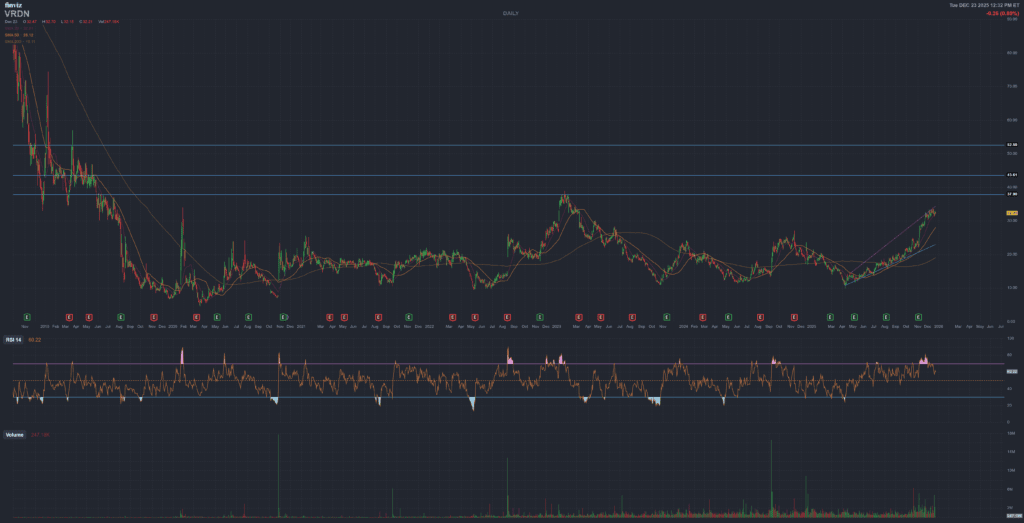
Biotech catalyst deep dive – Veligrotug / Thyroid Eye Disease
Viridian Therapeutics (VRDN) – Veligrotug Priority Review Deep Dive 2025
Language / Lingua:
Breaking catalyst – FDA Priority Review for veligrotug
On December 22, 2025 Viridian announced that the FDA has accepted the Biologics License Application (BLA) for veligrotug (VRDN-001) in thyroid eye disease (TED) and granted Priority Review with a PDUFA target action date of June 30, 2026.
- Veligrotug already has Breakthrough Therapy Designation (May 2025) based on phase 3 THRIVE and THRIVE-2 data in active and chronic TED.
- BLA is supported by two large phase 3 trials where veligrotug met all primary and secondary endpoints, with strong effects on proptosis and diplopia and a 5-infusion, 12-week treatment course.
- Company plans an EU Marketing Authorization Application in Q1 2026, aiming for a 2026 US launch if approved.
For a catalyst-driven run-up framework, this is now a classic “late-stage regulatory” setup: PDUFA date is known, data are largely de-risked, and focus shifts to label, safety, launch execution and competing TED drugs.
1. Executive summary – where VRDN stands now
Viridian Therapeutics is trying to become the second major commercial player in thyroid eye disease after Amgen’s Tepezza, with a TED franchise built around veligrotug (IV) and VRDN-003 (subcutaneous), plus an FcRn platform (VRDN-006/008) that targets broader autoimmune indications.
Set-up in one paragraph
The company now has two positive phase 3 trials in TED, an accepted BLA with Priority Review and a defined PDUFA date, a global partner in Japan (Kissei) and an expanded cash position of roughly 900 million USD after equity, royalty and credit deals. The key question into 2026 is whether veligrotug can win meaningful share vs Tepezza and, shortly after, whether VRDN-003 can expand the market with a convenient subcutaneous autoinjector.
Key strengths (high-level)
- De-risked efficacy: strong proptosis and diplopia data in both active and chronic TED; first global phase 3 to show statistically significant diplopia response and resolution in chronic disease.
- Compelling regimen: 5 infusions over 12 weeks vs 8 infusions over 21 weeks for Tepezza; potential patient-friendly profile.
- Balance sheet: post-Q3 cash plus October 2025 financing, royalty deal and Japan license give unusually strong runway for a pre-commercial biotech.
- Clear catalyst path: veligrotug PDUFA mid-2026, REVEAL-1 and REVEAL-2 topline data in 1H 2026 for VRDN-003, early FcRn data.
Key open questions / overhangs
- Label & safety: final label language on hearing events and other safety signals will matter a lot in any “class comparison” vs Tepezza.
- Pricing & payer behaviour: Tepezza is already a high-priced therapy; payers may push for step-edits or use one product preferentially, impacting share ramp.
- Execution risk: Viridian is transitioning from development-stage to commercial – field force build, access strategy and real-world data will all be scrutinized.
- Future dilution: current cash looks sufficient through initial launch under management’s planning assumptions, but large commercial build or setbacks could still imply additional equity in a negative scenario.
2. VRDN quick data panel
| Ticker / listing | VRDN – Viridian Therapeutics, Inc. (Nasdaq) |
|---|---|
| Share price (approx.) | Around low-30s USD per share (c. 32–33 USD) in late December 2025, implying a market cap around 3.0–3.1 billion USD. |
| Sector / focus | Biotechnology – antibody-based therapies for thyroid eye disease (TED) and FcRn-mediated autoimmune diseases. |
| Lead program | Veligrotug (VRDN-001, IV anti-IGF-1R) for TED – BLA accepted, FDA Priority Review, PDUFA 30 Jun 2026. Two positive phase 3 trials (THRIVE – active TED; THRIVE-2 – chronic TED). |
| Follow-on TED asset | VRDN-003 (SC anti-IGF-1R, extended half-life). Two global phase 3 trials (REVEAL-1 active TED, REVEAL-2 chronic TED) fully enrolled, topline data guided for Q1 and Q2 2026, with BLA submission targeted for late 2026. |
| FcRn platform | VRDN-006 (Fc fragment FcRn inhibitor) with phase 1 proof-of-concept IgG reduction in healthy volunteers, and VRDN-008, a half-life extended bispecific FcRn inhibitor with IND submission targeted around year-end 2025 and early clinical data expected in 2026. |
| Cash & runway | Approx. 490.9 million USD in cash, cash equivalents and short-term investments as of 30 Sep 2025; around 887.9 million USD by 31 Oct 2025 after the October equity, royalty and credit transactions. Management indicates this package, plus potential near-term milestones and future TED revenues, is expected to fund current plans through profitability if both veligrotug and VRDN-003 are approved. |
| Recent financing | October 2025 underwritten public offering of ~11.4 million shares at 22 USD (gross proceeds ~251 million USD), plus a 70 million USD upfront from Kissei (Japan license for veligrotug and VRDN-003), a 55 million USD upfront and up to 115 million USD potential near-term milestones from a DRI royalty agreement (up to 300 million USD total), and a 30 million USD term loan facility. |
| Analyst consensus | Street consensus is broadly “Strong Buy”, with roughly 13–16 covering analysts and an average 12-month price target around 40–41 USD (range roughly mid-20s to low-60s). |
Numbers are indicative and rounded, based on latest available filings and major data providers at the time of writing.
3. Business model & TED market
Company focus
Viridian positions itself as a specialist antibody company in rare and serious diseases, with an initial commercial focus on thyroid eye disease. TED is a rare autoimmune condition linked to Graves’ disease, characterised by orbital inflammation, eye bulging (proptosis), pain, diplopia and in severe cases risk of vision loss.
The backbone of the TED franchise is IGF-1R inhibition. Tepezza (teprotumumab), now marketed by Amgen, validated IGF-1R as a TED target and generated around 2 billion USD in US sales in 2024 as essentially the only approved pharmacological option. Viridian’s strategy is to come in with:
- A potentially more convenient and differentiated IV treatment (veligrotug) based on fewer infusions and strong data in both active and chronic TED; and
- A subcutaneous long half-life version (VRDN-003) designed for self-administration and lower treatment burden, possibly expanding the total TED market in a second step.
Market size and headroom
Corporate materials point to a single-product US TED market of ~2 billion USD, with only roughly 15 thousand patients treated so far out of an estimated ~190 thousand moderate-to-severe TED patients in the US. That implies substantial headroom for additional therapies, especially if subcutaneous options unlock more convenient treatment paradigms.
For veligrotug, Viridian is targeting the “new start” TED market rather than chasing every existing Tepezza-treated patient. The company estimates a relatively concentrated prescriber base (~2 thousand core US physicians), which favours a focused commercial footprint once launched.
4. Pipeline & clinical data
4.1 Veligrotug (VRDN-001, IV) – Phase 3 data recap
Veligrotug is a fully humanized anti-IGF-1R monoclonal antibody given intravenously, with a five-infusion course completed over 12 weeks. The pivotal program consists of THRIVE in active TED and THRIVE-2 in chronic TED:
- THRIVE (active TED): trial in patients with high Clinical Activity Score and recent onset TED. Veligrotug achieved a proptosis responder rate around 70% at week 15 with a large placebo-adjusted effect, and showed clinically meaningful improvements in diplopia and CAS (0–1) rates with highly significant p-values.
- THRIVE-2 (chronic TED): in chronic patients, veligrotug delivered a proptosis responder rate around 56% (placebo-adjusted ~48%) at week 15 and, crucially, achieved statistically significant diplopia response and complete resolution in a proportion of patients – the first time this has been demonstrated in a global phase 3 chronic TED study.
- Safety: veligrotug was generally well tolerated across both trials, with high completion rates (>90%) and a manageable profile; hearing-related events were observed but with incidence that appears competitive vs existing TED biologics based on company disclosures and external reviews.
These data underpinned the BLA, Breakthrough Therapy Designation and Priority Review, and form the core of the argument that veligrotug can be a best-in-class IV option if approved.
4.2 VRDN-003 – subcutaneous TED follow-on
VRDN-003 shares the same binding domain as veligrotug but with an extended half-life and subcutaneous formulation, aimed at self-administration with infrequent low-volume injections. The REVEAL-1 (active TED) and REVEAL-2 (chronic TED) phase 3 trials:
- Are fully enrolled (over 300 patients combined), with primary endpoint at week 24 and 52-week follow-up;
- Test Q4W and Q8W regimens (loading dose plus either 5 monthly or 2 bimonthly injections);
- Use the same primary endpoint as THRIVE (proptosis responder rate) with secondary endpoints including CAS and diplopia.
Topline data are guided for Q1 2026 (REVEAL-1) and Q2 2026 (REVEAL-2), with a BLA submission targeted around year-end 2026. If efficacy and safety profile are aligned with veligrotug, VRDN-003 could eventually become the preferred maintenance or front-line option due to convenience.
4.3 FcRn portfolio – VRDN-006 and VRDN-008
Beyond TED, Viridian is building an FcRn franchise:
- VRDN-006: Fc-fragment inhibitor of FcRn. Phase 1 data in healthy volunteers showed meaningful IgG reduction while sparing albumin and LDL, with a tolerable safety profile.
- VRDN-008: half-life extended bispecific FcRn inhibitor, designed for infrequent subcutaneous dosing, with IND targeted for late 2025 and first-in-human data expected in 2026.
FcRn is an increasingly crowded but large space – the combined myasthenia gravis and CIDP FcRn market alone is projected above 10 billion USD by 2030 – so the differentiation of VRDN-006/008 in depth and durability of IgG reduction and safety will matter.
5. Market & competitive landscape in TED
Current standard of care
Today, Tepezza (teprotumumab) is the only approved biologic for TED in the US and remains the main commercial benchmark. It is also an anti-IGF-1R antibody, administered as 8 IV infusions over roughly 6 months, with US sales around 2 billion USD in 2024.
How veligrotug is trying to differentiate
- Shorter course: 5 infusions over 12 weeks vs 8 over 21 weeks.
- Data in chronic TED: phase 3 evidence for diplopia response and resolution in chronic TED is a clear differentiator.
- Durability: long-term follow-up suggests durable proptosis and diplopia responses in many patients, which supports use despite high cost.
- Portfolio logic: IV veligrotug first, then SC VRDN-003 aimed at convenience and potentially broader uptake.
Other players
- Immunovant (batoclimab, FcRn blocker) continues TED development; however, competition for patients and trial enrolment has been non-trivial in recent years.
- Argenx discontinued TED development for Vyvgart after futility analysis, which removes a potential competitor in TED and is generally viewed as a positive read-through for VRDN’s IGF-1R franchise.
- Smaller and earlier-stage players are exploring IGF-1R or related pathways, but Viridian now looks well-positioned to be the second major branded TED franchise alongside Amgen.
Overall, the competitive picture in TED is favourable but not risk-free: Viridian benefits from competitor attrition and an under-penetrated market, but faces a very strong incumbent, high expectations and tight payer scrutiny.
6. Financials, cash runway & capital structure
6.1 Income statement snapshot (9M 2025)
- Revenue: about 70.7 million USD for the first nine months of 2025, almost entirely from license and collaboration revenue (not product sales).
- R&D expense: roughly 249.7 million USD (reflecting a broad late-stage pipeline and FcRn investment).
- G&A: about 61.6 million USD over 9M 2025.
- Net loss: around 222.2 million USD for 9M 2025, similar in magnitude to 2024 on a full-year basis, and typical of a company investing heavily ahead of launch.
6.2 Cash, financings & runway
- Cash, cash equivalents and short-term investments of about 490.9 million USD at 30 Sep 2025, with management stating this would fund planned operations for at least the following twelve months.
- October 2025 financing package:
- ~251 million USD gross from a follow-on equity offering at 22 USD/share;
- 70 million USD upfront and up to 315 million USD in milestones from the Kissei collaboration in Japan, plus tiered royalties in the 20s–mid-30s percentage range;
- Up to 300 million USD from a DRI royalty financing tied mainly to TED revenues, with 55 million USD received upfront and 115 million USD potential near-term milestones;
- 30 million USD from a term-loan facility.
- After these deals, Viridian reported ~887.9 million USD in cash and equivalents as of 31 Oct 2025 and expressed the view that this, plus expected royalty milestones and future TED revenues, should fund current plans through profitability.
This is a very strong cash position for a late-stage biotech, but it remains predicated on successful approval and commercial execution. Large commercial build-outs or setbacks could still prompt further equity or structured financings.
6.3 Capital structure & dilution risk
- Common stock outstanding around the low-80 million range at 30 Sep 2025, plus A and B convertible preferred shares and standard equity incentive programs.
- Debt is modest relative to cash (term loan plus lease liabilities), but royalty financing naturally reduces future TED economics.
- Recent insider buying (for example from Fairmount Funds and company leadership) has been highlighted in market commentary as a positive signal, but it doesn’t remove approval or launch risk.
7. Management & governance
Viridian’s leadership team is heavily skewed toward rare-disease commercial execution and late-stage development:
- CEO – Steve Mahoney: over two decades of experience across operational, commercial, legal and transactional roles. Previously CFO/COO at Magenta Therapeutics, part of the founding team at Kiniksa Pharmaceuticals (President & COO) and Chief Commercial Officer at Synageva Biopharma (ultra-rare diseases). Earlier in his career he was a commercial attorney at Genzyme.
- COO – Tom Beetham: background in legal, operations and corporate development with Magenta and Kiniksa.
- CMO – Dr. Radhika Tripuraneni: extensive experience in clinical development for rare and immune-mediated diseases (Prothena, MyoKardia, Alexion, Gilead, Genzyme).
- CCO – Tony Casciano: prior CCO at AMAG Pharmaceuticals with experience launching infused and subcutaneous therapies in competitive rare-disease markets.
- The board includes experienced investors (Fairmount Funds), rare-disease commercial leaders (e.g. former BioMarin CCO Jeff Ajer) and senior R&D executives from other successful biotechs.
Overall the team looks well aligned with Viridian’s ambition: build a specialised commercial organisation in TED and then leverage that infrastructure into further autoimmune indications.
8. Sentiment – analysts, institutions & retail chatter
8.1 Sell-side & institutional view
- Consensus rating around “Strong Buy” across roughly 13–16 analysts, with no major “Sell” ratings reported.
- Average 12-month price target in the 40–41 USD range, with recent target increases (e.g. Wedbush to 47 USD, RBC to 45 USD) after the financing package and BLA submission.
- Recent research notes emphasise:
- De-risked TED profile thanks to strong phase 3 data;
- Visibility toward profitability given ~888 million USD cash plus potential milestones;
- Upside from VRDN-003 and FcRn portfolio, albeit at earlier stages.
- On the cautious side, several analysts flag valuation sensitivity to TED execution, potential pricing pressure and the usual regulatory “unknowns” around label language and safety.
8.2 Retail & social sentiment
Non-professional traders – high noise
- Stocktwits: VRDN has frequently appeared among trending tickers, especially around the THRIVE/THRIVE-2 data and now around the BLA/priority review news. Sentiment clusters are often “very bullish”, with posts describing veligrotug as a potential “new standard of care” and long-term hold.
- Reddit & forums: TED patient communities and trading subreddits occasionally discuss Viridian; some posts from patients in clinical trials report subjective improvements, while trading-oriented threads tend to focus on “parabolic” moves after data releases.
- Technical-momentum angle: outlets like Investor’s Business Daily have highlighted improvements in Relative Strength ratings and inclusion on technical watch lists, which tends to attract short-term momentum traders.
Important: these comments are not from professional investors or medical experts and often contain hype, misunderstandings of trial design and limited risk discussion. They’re useful to understand retail mood but not as a basis for investment decisions.
9. Catalyst map – what to watch from here
9.1 Timeline (indicative)
Q1 2026 Topline data from REVEAL-1 (VRDN-003, active TED, subcutaneous).
Q2 2026 Topline data from REVEAL-2 (VRDN-003, chronic TED).
Q1 2026 Planned submission of EU MAA for veligrotug.
30 Jun 2026 FDA PDUFA target action date for veligrotug (priority review).
2H 2026 Initial clinical data readouts for VRDN-006/008 and potential VRDN-003 BLA submission if REVEAL data are positive.
9.2 Scenario framing (without recommendations)
- Constructive scenario:
- PDUFA decision on time with label broadly aligned with expectations and no unexpected safety restrictions;
- REVEAL-1/2 confirm a veligrotug-like profile for VRDN-003, enabling a strong SC follow-on story;
- Launch traction in TED is solid enough that management’s “cash to profitability” guidance looks realistic.
- Neutral / mixed scenario:
- Approval with a more cautious label on safety or narrower patient population;
- VRDN-003 data positive but not clearly superior on convenience/safety vs IV, slowing adoption;
- Commercial ramp slower than hoped, but without a clear “broken thesis”.
- Adverse scenario:
- PDUFA delay, CRL or major label restrictions that undercut the commercial thesis;
- Meaningful new safety concerns (for example, hearing-related) emerging from longer-term follow-up;
- Need for further large-scale equity raises before cash flow breakeven, with significant dilution.
10. Key risks & red flags
High impact
Regulatory & safety risk
Veligrotug still faces full BLA review. Any unexpected safety signal (particularly around hearing, infusion reactions or long-term autoimmune effects) or a restrictive label could materially change the commercial picture. CRLs or significant delays, while not the base case, are always a possibility in complex biologics.
High impact
Commercial execution vs Tepezza
Even with strong data, Viridian must persuade TED specialists and payers to change behaviour from an entrenched incumbent. Access hurdles, formulary decisions, and real-world safety or convenience perceptions could all tilt the balance.
Medium impact
Financing & royalty overhang
Royalty financing and ex-US licensing reduce TED economics versus a fully unencumbered asset. If TED uptake or pricing falls short, the balance between dilution avoided today and cash flows surrendered tomorrow could look less favourable in hindsight.
Medium impact
Pipeline and execution stretch
Running multiple phase 3 trials (REVEAL-1/2) plus FcRn programs and a US/EU launch in parallel is operationally demanding. Delays, cost overruns or prioritisation mistakes could erode the “cash to profitability” thesis.
Medium impact
Policy & reimbursement environment
High-priced biologics are increasingly scrutinised by payers and policy makers. TED is visually dramatic but relatively rare; any tightening in reimbursement (for example prior authorisation, step-therapy requirements or discounts) could impact peak sales.
Uncertain impact
Competition beyond TED
The FcRn space already includes approved and late-stage players. Viridian will need truly differentiated data to earn meaningful share outside TED; otherwise the platform may remain a valuable but secondary pillar.
11. Bottom line (educational only)
Viridian has moved into a clearly defined late-stage, catalyst-driven phase: strong phase 3 data in both active and chronic TED, BLA acceptance with Priority Review, a known PDUFA date, a deep cash cushion and visible REVEAL-1/2 readouts in 2026.
The core question is no longer “does veligrotug work at all?” but rather “what label does it get, how does it compete vs Tepezza, and how cleanly can Viridian execute the launch and follow-on SC program?” Market expectations are already high, as reflected in consensus ratings and price targets, so upside/downside will likely be driven by relatively fine differences in label, safety, payer behaviour and commercial uptake.
This report is intended purely as an informational, filings-based overview for readers who track biotech catalysts. It is not a recommendation to buy or sell any security, and it does not take into account any individual financial situation, objectives or risk tolerance.
12. Legal & regulatory disclaimer (EN)
No investment advice. This article is for educational and informational purposes only. It is not, and must not be interpreted as, an offer, solicitation, recommendation or advice to buy, sell or hold any financial instrument or security.
Sources and data. Company information has been obtained from publicly available sources such as SEC filings, official press releases and recognised news outlets. While efforts have been made to use accurate and up-to-date information, no guarantee is given that the data are complete or free from errors, and figures may change after publication.
Forward-looking statements. Many of the statements summarised above are forward-looking and subject to substantial risks and uncertainties, including clinical, regulatory, commercial, competitive and financial risks. Actual outcomes may differ materially from current expectations.
Regulatory note (EU / CONSOB / SEC). This content is not produced by an authorised investment firm, is not intended as investment research within the meaning of MiFID II and does not meet the requirements to promote independence of investment research. Readers should perform their own due diligence, consult official company documents and, where appropriate, seek advice from a qualified, licensed financial advisor in their jurisdiction.
For full legal information and privacy details, please refer to the official pages of Merlintrader trading Blog on disclaimer and terms of use / privacy.
Biotech Catalyst Calendar
Want to see PDUFA dates, trial readouts and key biotech events in one place? Open the updated Biotech Catalyst Calendar for an overview of upcoming catalysts across our covered tickers.
The calendar is updated regularly but dates may change or be revised by companies or regulators. Always verify against official sources (SEC filings, press releases, regulator websites).
Breaking catalyst – Priority Review FDA per veligrotug
Il 22 dicembre 2025 Viridian ha comunicato che la FDA ha accettato la BLA (Biologics License Application) per veligrotug (VRDN-001) nella thyroid eye disease (TED) e ha concesso la Priority Review con data PDUFA fissata al 30 giugno 2026.
- Veligrotug ha già ottenuto la Breakthrough Therapy Designation a maggio 2025 sulla base dei dati di fase 3 THRIVE e THRIVE-2 in TED attiva e cronica.
- La BLA è supportata da due studi pivotal di fase 3, entrambi positivi su endpoint primari e secondari, con forte impatto su proptosi e diplopia e un regime di 5 infusioni in 12 settimane.
- La società prevede di presentare una domanda EMA (MAA) in Europa nel Q1 2026, puntando a un lancio commerciale USA nel 2026 in caso di approvazione.
In ottica “run-up sui catalyst” questa è una situazione tipica di late-stage regolatorio: dati già sostanzialmente de-rischizzati, data PDUFA nota, e focus che si sposta su label, safety, dinamiche payor e execution del lancio.
1. Executive summary – posizione attuale di VRDN
Viridian Therapeutics punta a diventare il secondo player rilevante in TED dopo Tepezza di Amgen, con una franchise costruita su veligrotug (EV) e VRDN-003 (sottocute), più una piattaforma FcRn (VRDN-006/008) per indicazioni autoimmuni più ampie.
In una frase
Oggi Viridian ha due studi di fase 3 positivi in TED, una BLA accettata con Priority Review e data PDUFA definita, un accordo in Giappone con Kissei e una cassa rafforzata a circa 900 milioni di USD dopo equity, royalty e debito. Il punto chiave verso il 2026 è capire quanto spazio reale ci sia accanto a Tepezza e quanto velocemente potrà seguire VRDN-003 in forma sottocutanea.
Punti di forza
- Efficacia de-rischizzata: dati robusti su proptosi e diplopia sia in TED attiva che cronica.
- Regime più snello: 5 infusioni in 12 settimane, potenzialmente più comodo per pazienti e centri rispetto alle 8 infusioni di Tepezza.
- Cassa importante: il pacchetto finanziario 2025 dà una runway insolitamente ampia per una biotech pre-commerciale.
- Pipeline allineata: VRDN-003 come naturale follow-on SC, FcRn come secondo pilastro a medio termine.
Nodi aperti / possibili overhang
- Label e safety: linguaggio finale di scheda tecnica (in particolare su eventi uditivi e safety di lungo periodo) peserà molto nel confronto con Tepezza.
- Payer e pricing: ci si muove in un contesto di biologici ad alto prezzo; i payor potrebbero spingere per step-therapy o preferenze di formulary.
- Execution commerciale: passare da biotech di sviluppo a società commerciale in malattia rara è sempre un salto delicato.
- Diluizione futura: la tesi “cassa fino alla profittabilità” dipende da approvazione e ramp commerciale; in scenari negativi non si può escludere ulteriore equity.
2. VRDN – scheda rapida
| Ticker / listing | VRDN – Viridian Therapeutics, Inc. (Nasdaq) |
|---|---|
| Prezzo indicativo | Area bassa 30 USD per azione (circa 32–33 USD) a fine dicembre 2025, per una capitalizzazione intorno a 3,0–3,1 miliardi USD. |
| Settore / focus | Biotech – anticorpi per TED e patologie autoimmuni mediate da FcRn. |
| Programma guida | Veligrotug (VRDN-001, EV anti-IGF-1R) in TED – BLA accettata, Priority Review, PDUFA 30 giugno 2026. Due studi di fase 3 (THRIVE e THRIVE-2) positivi in TED attiva e cronica. |
| Follow-on TED | VRDN-003 (SC, emivita estesa) – due studi pivotal REVEAL-1 (TED attiva) e REVEAL-2 (TED cronica), completato l’arruolamento; topline attese Q1/Q2 2026 e BLA prevista verso fine 2026 in caso di successo. |
| Piattaforma FcRn | VRDN-006 (inibitore FcRn in frammento Fc) con dati di fase 1 su riduzione IgG e safety incoraggiante, e VRDN-008 (FcRn bispecifico a lunga emivita) con IND a cavallo di fine 2025 e primi dati clinici attesi nel 2026. |
| Cassa & runway | 490,9 milioni USD in cassa ed equivalenti al 30 settembre 2025; circa 887,9 milioni USD al 31 ottobre 2025 dopo equity, royalty e debito. Il management indica che, insieme a milestone e flussi futuri da TED, questo dovrebbe finanziare i piani correnti fino alla profittabilità se veligrotug e VRDN-003 verranno approvati. |
| Deal recenti | Aumento di capitale da circa 251 milioni USD a ottobre 2025 (22 USD/azione), partnership con Kissei in Giappone (70 milioni upfront e fino a 315 milioni di milestone + royalty a più livelli), royalty financing con DRI fino a 300 milioni (55 milioni upfront e 115 milioni di milestone potenziali a breve) e term loan da 30 milioni. |
| Consenso analisti | Rating medio “Strong Buy”, con price target a 12 mesi in area 40–41 USD (forbice approssimativa da metà 20 a inizio 60). |
Dati arrotondati e indicativi, basati su ultime fonti pubbliche disponibili al momento della stesura.
3. Modello di business e mercato TED
Posizionamento
Viridian è una biotech focalizzata su anticorpi per malattie gravi e rare, con un primo asse commerciale in TED. La thyroid eye disease è una complicanza autoimmune del morbo di Basedow, caratterizzata da infiammazione orbitale, proptosi, dolore, diplopia e rischio di perdita visiva nei casi più severi.
Il bersaglio chiave è IGF-1R, già validato da Tepezza. Strategia di Viridian:
- entrare con un IV potenzialmente best-in-class (veligrotug) con regime più corto e dati forti anche nella forma cronica;
- seguire con VRDN-003 sottocute a emivita estesa, pensato per auto-somministrazione e carico di trattamento ridotto.
Dimensione e headroom
La documentazione societaria stima un mercato TED USA intorno ai 2 miliardi USD centrato su un solo prodotto (Tepezza), con solo ~15 k pazienti trattati su una popolazione stimata di ~190 k TED moderato-severa. Questo lascia notevole spazio sia a nuovi agenti IV che a soluzioni SC che possano ampliare il bacino trattabile.
Il focus dichiarato è il mercato “new start”, con una base di prescrittori relativamente concentrata (~2 k specialisti), compatibile con una forza vendita mirata.
4. Pipeline e dati clinici
4.1 Veligrotug (VRDN-001, EV) – recap fase 3
Veligrotug è un anticorpo monoclonale anti-IGF-1R somministrato EV con 5 infusioni in 12 settimane. Il programma pivotal comprende:
- THRIVE (TED attiva): miglioramento marcato della proptosi (responder rate ~70% a week 15, forte delta vs placebo) e segnali robusti su diplopia e CAS, con p-value molto significativi.
- THRIVE-2 (TED cronica): proptosis responder ~56% con forte vantaggio su placebo e, soprattutto, risposta e risoluzione della diplopia statisticamente significative – primo studio globale di fase 3 in TED cronica a mostrare questo tipo di outcome.
- Safety: profilo in linea con la classe, con elevato tasso di completamento (>90%). Eventi uditivi presenti ma con incidenza gestibile secondo i dati finora resi pubblici.
Questi risultati sono alla base di BLA, Breakthrough Therapy e Priority Review e supportano l’idea di un veligrotug come possibile IV di riferimento in TED se approvato.
4.2 VRDN-003 – sottocute come secondo step
VRDN-003 condivide il binding domain di veligrotug ma con emivita estesa e formulazione sottocute per auto-somministrazione con iniezioni poco frequenti.
- REVEAL-1: TED attiva, endpoint primario proptosis responder a week 24, follow-up fino a week 52.
- REVEAL-2: TED cronica, stessa struttura di endpoint.
- Entrambi gli studi confrontano due regimi (Q4W e Q8W) con placebo.
Topline attese Q1 2026 (REVEAL-1) e Q2 2026 (REVEAL-2); in caso di conferma del profilo di veligrotug, VRDN-003 potrebbe diventare l’arma principale in termini di comodità.
4.3 Piattaforma FcRn – VRDN-006 e VRDN-008
Sul fronte FcRn:
- VRDN-006: dati di fase 1 mostrano riduzione di IgG coerente con la classe, con albumina e LDL preservate e buona tollerabilità.
- VRDN-008: bispecifico FcRn a lunga emivita, pensato per iniezioni SC poco frequenti; IND a fine 2025 e primi dati nel 2026.
Lo spazio FcRn è competitivo ma ampio; Viridian punta a differenziarsi per profondità e durata di soppressione IgG con un profilo di safety favorevole.
5. Concorrenza in TED
Standard attuale
Oggi Tepezza (teprotumumab) è l’unico farmaco autorizzato specificamente per TED negli USA e rappresenta il benchmark commerciale, con regime di 8 infusioni EV in ~6 mesi e vendite intorno ai 2 miliardi USD nel 2024.
Posizionamento di veligrotug
- Corso più breve: 5 infusioni in 12 settimane.
- Dati in TED cronica: primo studio globale a mostrare miglioramento significativo su diplopia in cronico.
- Durabilità: dati di follow-up indicano risposte di proptosi e diplopia sostenute in una quota rilevante di pazienti.
- Franchise logica: IV iniziale (veligrotug) quindi SC (VRDN-003) per espandere mercato e comodità.
Altri concorrenti
- Immunovant prosegue con batoclimab (FcRn) in TED, ma l’arruolamento è stato complesso.
- Argenx ha fermato lo sviluppo di Vyvgart in TED dopo analisi di futilità – evento letto in modo positivo per Viridian perché elimina un potenziale competitor diretto.
- Altri progetti IGF-1R o correlati sono più indietro; ad oggi Viridian sembra ben posizionata per diventare il secondo pilastro TED accanto ad Amgen.
In sintesi: quadro concorrenziale favorevole ma con execution risk elevato, dato il peso dell’incumbent e la sensibilità di payor e regolatori sui costi.
6. Dati finanziari, cassa e struttura del capitale
6.1 Conto economico 9M 2025
- Ricavi: ~70,7 milioni USD nei primi 9 mesi 2025, quasi tutti da licenze e collaborazioni (non vendite di prodotto).
- R&D: ~249,7 milioni USD (pipeline in fase avanzata + piattaforma FcRn).
- G&A: ~61,6 milioni USD.
- Perdita netta: ~222,2 milioni USD nei 9M 2025, in linea con una biotech che spinge forte su sviluppo e pre-lancio.
6.2 Cassa, deals e runway
- Cassa + equivalenti + investimenti a breve: ~490,9 milioni USD al 30 settembre 2025; il management indica copertura operativa di almeno 12 mesi su questa base standalone.
- Pacchetto ottobre 2025:
- aumento di capitale con incasso lordo ~251 milioni USD (22 USD/azione);
- licenza esclusiva con Kissei (Giappone) con 70 milioni USD upfront e fino a 315 milioni di milestone + royalty tiered;
- royalty financing DRI fino a 300 milioni USD (55 milioni upfront + 115 milioni milestone near-term);
- term loan per 30 milioni USD.
- Risultato: cassa totale riportata al 31 ottobre 2025 di circa 887,9 milioni USD e guidance di runway fino alla profittabilità se il piano TED va a buon fine.
È una posizione di cassa molto solida per una biotech in fase pre-lancio, ma la tesi resta sensibile ad approvazione e velocità di ramp commerciale.
6.3 Struttura del capitale e rischio diluizione
- Azioni ordinarie in area 80+ milioni, più preferred convertibili e stock option/RSU.
- Debito contenuto rispetto alla cassa, ma royalty financing e sublicenze riducono economicamente la quota TED residua per gli azionisti.
- Insider e investitori (es. Fairmount Funds) hanno effettuato acquisti significativi – segnale interpretato in modo positivo dal mercato, ma non eliminano il rischio di execution.
7. Management & governance
Il management team ha un profilo molto “rare-disease commerciale”:
- CEO – Steve Mahoney: track record in Magenta, Kiniksa, Synageva e Genzyme, con esperienza diretta in lancio di terapie rare e gestione capitale.
- COO – Tom Beetham: background in legal, strategy e operations (Magenta, Kiniksa).
- CMO – Radhika Tripuraneni: esperienza pluridecennale nello sviluppo clinico di farmaci rari e immunologici.
- CCO – Tony Casciano: ex CEO di uno spin-off MIT e CCO/COO in AMAG, con lanci in mercati specialistici e orfani.
- Board arricchita da investitori healthcare (Fairmount) e figure chiave di aziende rare-disease di successo (es. ex CCO BioMarin).
In sintesi: governance allineata con un piano di commercializzazione focalizzata TED e possibile espansione successiva in autoimmuni.
8. Sentiment – analisti, istituzionali e retail
8.1 Sell-side e istituzionali
- Rating medio Strong Buy, praticamente senza Sell dichiarati.
- Target price medio a 12 mesi ~40–41 USD, con upgrade recenti (Wedbush 47 USD, RBC 45 USD) dopo pacchetto finanziario e BLA.
- I punti ricorrenti nelle note:
- profilo TED fortemente de-rischizzato;
- visibilità verso la profittabilità grazie al pacchetto cassa + royalty + licenze;
- potenziale upside da VRDN-003 e FcRn, ma con più incertezza temporale.
- Le note più caute richiamano il rischio di execution commerciale, il tema pricing e la concentrazione della tesi sul successo TED.
8.2 Chatter retail / social
Trader non professionisti
- Stocktwits: VRDN compare spesso tra i ticker “trending”, con toni spesso euforici (“game changer”, “long-term hold”, ecc.).
- Reddit: da un lato thread di pazienti TED (soprattutto r/gravesdisease) con esperienze personali; dall’altro community trading che guardano principalmente ai salti di prezzo post-dati.
- Technical-momentum: articoli IBD e simili hanno evidenziato il miglioramento degli indici di forza relativa, attirando attenzione di trader momentum.
Tutto questo sentiment è rumoristico e non professionale. Può aiutare a capire il clima di breve periodo, ma non è una base sufficiente per decisioni d’investimento.
9. Mappa catalyst – cosa tenere d’occhio
9.1 Timeline indicativa
Q1 2026 Topline REVEAL-1 (VRDN-003 SC, TED attiva).
Q2 2026 Topline REVEAL-2 (VRDN-003 SC, TED cronica).
Q1 2026 Presentazione MAA per veligrotug all’EMA (target company).
30 giu 2026 Data PDUFA per veligrotug (Priority Review).
2H 2026 Ulteriori dati VRDN-006/008 e possibile BLA VRDN-003 se i dati lo supportano.
9.2 Scenari (senza raccomandazioni)
- Scenario costruttivo:
- approvazione PDUFA in linea con le attese, label gestibile;
- dati REVEAL-1/2 solidi, con VRDN-003 che replica il profilo di veligrotug;
- ramp TED sufficiente a sostenere la narrativa “cassa fino alla profittabilità”.
- Scenario intermedio:
- approvazione con label più prudente o popolazione più ristretta;
- dati VRDN-003 positivi ma non nettamente superiori per comodità/safety;
- lancio più lento, ma senza rottura completa della tesi.
- Scenario avverso:
- CRL, ritardi significativi o label penalizzante;
- segnali nuovi di safety nel follow-up di lungo periodo;
- necessità di nuovo equity importante prima del break-even, con diluizione pesante.
10. Rischi principali
Impatto alto
Rischio regolatorio/sicurezza
BLA ancora in pieno iter FDA. Qualsiasi segnale inatteso (soprattutto su udito, reazioni da infusione o effetti autoimmuni a lungo termine) o una label molto restrittiva possono cambiare radicalmente l’equazione commerciale.
Impatto alto
Execution commerciale vs Tepezza
Convincere specialisti TED e payor a cambiare abitudini rispetto all’incumbent non è banale, anche con dati robusti. Access, rimborsi e percezione reale del profilo rischio/beneficio saranno determinanti.
Impatto medio
Pacchetto finanziario e royalty
Le royalty e le licenze (Giappone, DRI) migliorano la cassa oggi ma riducono gli economics TED domani. Se vendite o pricing resteranno sotto le attese, il trade-off potrà apparire meno favorevole ex-post.
Impatto medio
Allargamento pipeline e carico operativo
Gestire contemporaneamente lancio TED (USA/Europa), REVEAL-1/2 e FcRn richiede execution impeccabile; ritardi o sforamenti di budget possono erodere la tesi “runway fino alla profittabilità”.
Impatto medio
Contesto regolatorio / payor per biologici costosi
Biologici ad alto costo sono sotto pressione crescente da parte di payor e regolatori (USA ed Europa). TED è spettacolare dal punto di vista clinico, ma numericamente piccola; eventuali policy più restrittive possono ridurre i picchi di vendita attesi.
Impatto incerto
Concorrenza fuori da TED (FcRn)
Il mercato FcRn sta diventando affollato; Viridian dovrà dimostrare un chiaro vantaggio di profilo per ritagliarsi spazio significativo oltre TED. In caso contrario, il contributo della piattaforma potrebbe rimanere più marginale rispetto alla storia TED.
11. Sintesi finale (solo informativa)
Viridian è entrata in una fase chiaramente catalyst-driven: dati di fase 3 forti in TED attiva e cronica, BLA accettata con Priority Review, PDUFA definita, cassa quasi 900 milioni e una pipeline TED/FcRn agganciata al 2026.
La domanda centrale non è più “funziona veligrotug?”, ma piuttosto “che label avrà, come si posizionerà vs Tepezza e quanto bene Viridian saprà eseguire il lancio e il passaggio alla SC?”. Le aspettative di mercato sono già elevate; l’esito reale dipenderà molto da dettagli di safety, rimborsi e adozione nei centri chiave.
Questo report è pensato solo come analisi informativa basata su fonti pubbliche, non come invito ad acquistare o vendere titoli. Non tiene conto della situazione specifica di alcun investitore e non sostituisce la consulenza di un professionista abilitato.
12. Disclaimer legale (IT)
Nessuna raccomandazione. Il presente contenuto ha finalità esclusivamente informative ed educative. Non costituisce in alcun modo sollecitazione, offerta, consiglio o raccomandazione personalizzata a comprare o vendere strumenti finanziari.
Fonti e dati. Le informazioni derivano da documenti ufficiali (SEC filings, press release societarie, comunicazioni regolatorie) e principali testate di news. Pur avendo prestato attenzione alla accuratezza, non si garantisce completezza o assenza di errori; dati e valutazioni possono cambiare nel tempo.
Dichiarazioni previsionali. Molti elementi descritti sono forward-looking e soggetti a rischi elevati (clinici, regolatori, competitivi, finanziari). I risultati effettivi possono differire significativamente da quanto oggi atteso.
Nota regolamentare (CONSOB / SEC). Il testo non è redatto da un intermediario autorizzato, non rientra nella definizione di “ricerca in materia di investimenti” ai sensi MiFID II e non rispetta i requisiti volti a garantire l’indipendenza della ricerca. Prima di qualsiasi decisione di investimento è opportuno svolgere analisi autonome e, se necessario, consultare un consulente finanziario abilitato.
Per le informazioni legali complete e l’informativa privacy fare riferimento alle pagine ufficiali del sito Merlintrader trading Blog.
Biotech Catalyst Calendar
Per una panoramica di PDUFA, letture dati clinici e altri eventi su tutti i titoli coperti, visita il Calendario Catalyst aggiornato .
Le date possono cambiare e vanno sempre verificate rispetto a comunicati ufficiali, SEC filings e siti dei regolatori.