DISCLAIMER — Not financial advice. Educational content only, not an offer or solicitation to buy or sell any security. Biotech and small/mid-cap stocks are highly speculative and volatile and can result in a partial or total loss of capital. Do your own research and consult a licensed advisor where appropriate. / Contenuti a solo scopo informativo e didattico, non costituiscono consulenza finanziaria né offerta o sollecitazione al pubblico risparmio ai sensi delle normative CONSOB e SEC. Le azioni biotech e le small/mid cap sono strumenti altamente speculativi e volatili e possono comportare la perdita parziale o totale del capitale investito. Si raccomanda di effettuare sempre le proprie ricerche e, se necessario, di rivolgersi a un consulente abilitato.

Merlintrader Trading Pub
Biotech catalyst news and analysis. FDA PDUFA tracker
Merlintrader Trading Pub
Biotech catalyst news and analysis. FDA PDUFA tracker
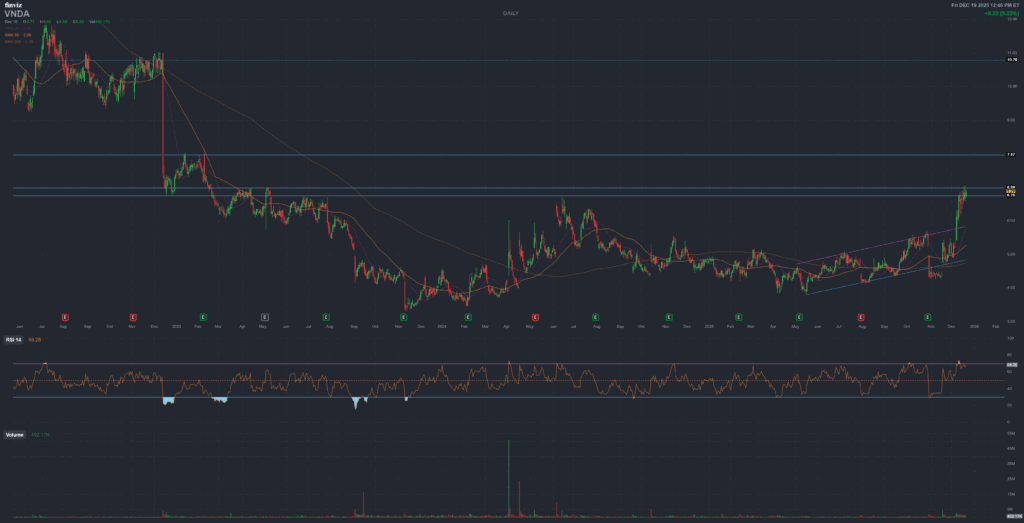
Merlintrader trading Blog – Independent Biotech Dossier
Vanda Pharmaceuticals (VNDA) – dense FDA calendar, thick pipeline, messy relationship with the regulator
This is an independent research-style overview. The goal is to understand how Vanda looks going into the
tradipitant PDUFA (December 30, 2025) and the 2026 decision cluster, not to push any trade.
Ticker: VNDA (Nasdaq)
Segment: CNS / rare / immunology
Stage: revenue-generating, loss-making
Focus: FDA events 2025–2026
Market snapshot
Share price ≈ 6–7 USD
Market cap ≈ 0.4 B USD
52w range ≈ 3.8–7.0 USD
Market cap ≈ 0.4 B USD
52w range ≈ 3.8–7.0 USD
Cash & burn (9M 2025)
Cash ≈ 294 M USD
Net loss 9M 2025 ≈ 79 M USD
No financial debt reported
Net loss 9M 2025 ≈ 79 M USD
No financial debt reported
Commercial base
Fanapt (CNS)
Hetlioz (sleep, under generic pressure)
Ponvory (MS franchise)
Hetlioz (sleep, under generic pressure)
Ponvory (MS franchise)
Upcoming FDA events
Tradipitant PDUFA: 30 Dec 2025
Hetlioz jet lag re-review: 7 Jan 2026
Bysanti PDUFA: 21 Feb 2026
Imsidolimab BLA: priority review requested (GPP)
Hetlioz jet lag re-review: 7 Jan 2026
Bysanti PDUFA: 21 Feb 2026
Imsidolimab BLA: priority review requested (GPP)
Verified key data (what we actually know)
Company profile, products, pipeline, financialsBusiness profile
- Company: Vanda Pharmaceuticals Inc. (NASDAQ: VNDA), headquartered in Washington, DC.
- Model: fully integrated biopharma, focus on CNS/psychiatry, sleep and inflammatory/rare diseases.
- Commercial products: Fanapt (iloperidone), Hetlioz (tasimelteon), Ponvory (ponesimod).
- CEO: Mihael H. Polymeropoulos, MD – co-founder, CEO and Chairman since inception; ex-Novartis VP and head of Pharmacogenetics, ex-NIH gene mapping group lead.
Commercial portfolio (2024–2025)
- Fanapt: atypical antipsychotic for schizophrenia; US label recently expanded to include acute treatment of bipolar I disorder. Sales growing double-digit in 2025.
- Hetlioz: melatonin receptor agonist for Non-24 and Smith-Magenis syndrome disturbances. Sales declining vs 2023 due to US generics, now stabilised at a lower level.
- Ponvory: oral S1P modulator for relapsing MS, US/Canada rights acquired from Janssen. Still relatively small contributor, but growing vs 2024 on a low base.
Pipeline and FDA calendar
- Tradipitant (NK-1 antagonist): NDA for prevention of motion-induced vomiting. PDUFA target action date: 30 December 2025. Partial clinical hold on long-term dosing has been lifted; labeling discussions in progress.
- Hetlioz sNDA (jet lag): after a legal win in federal court, FDA is conducting an expedited re-review of the prior rejection with a target completion date around 7 January 2026.
- Bysanti (milsaperidone): NCE antipsychotic for acute bipolar I and schizophrenia, NDA accepted; PDUFA action date 21 February 2026. Separate program in MDD is ongoing.
- Imsidolimab (IL-36R mAb, GPP): BLA submitted in mid-December 2025; priority review requested. If granted, the company and external commentators talk about a mid-2026 potential decision.
Financial snapshot
- 2024 net product sales: ~199 M USD (+3% vs 2023).
- 2024 net income: ~–19 M USD (loss, vs small profit in 2023).
- 9M 2025 net product sales: ~159 M USD (+9% vs 9M 2024).
- 9M 2025 net loss: ~79 M USD (driven by R&D and BD spend, incl. imsidolimab deal).
- Cash and marketable securities (30 Sep 2025): ~294 M USD, no financial debt reported.
- 2025 guidance: revenue 210–230 M USD; year-end cash 260–290 M USD (company guidance).
Data above is pulled from SEC filings, company earnings releases and recent corporate presentations.
Dollar figures are rounded and meant as order-of-magnitude, not as precise forecasting inputs.
Next FDA decision: tradipitant for motion sickness (PDUFA 30 December 2025)
Acute condition, binary event, strange history with FDAWhat is being reviewed
- Drug: tradipitant (VLY-686), oral NK-1 receptor antagonist.
- Indication in NDA: prevention of vomiting induced by motion (motion sickness).
- Evidence package: two Phase 3 trials in motion sickness with statistically significant reduction in vomiting episodes vs placebo in at-risk populations (details in company presentations and prior publications).
- Regulatory status: NDA accepted; FDA review ongoing; PDUFA target action date currently 30 December 2025. Labeling questions have been sent by FDA, and formal label discussions are underway.
The partial clinical hold saga
- One long-term protocol (VP-VLY-686-3403) was under partial clinical hold, limiting exposure to 90 doses.
- FDA initially considered motion sickness as a “chronic condition”, implying the need for a 6-month dog toxicology study for chronic dosing.
- In October 2025, as part of a broader “collaborative framework” to resolve disputes, FDA agreed to re-review this stance on an expedited timetable.
- On 4 December 2025, FDA officially lifted the partial clinical hold, accepting that motion sickness is acute and that the extra dog tox study is not required.
Key open questions around this PDUFA
- Label breadth: will the label be broad (“prevention of vomiting in adults with motion sickness”), or restricted to specific dosing regimens or sub-populations?
- Comparators and real-world context: the market is full of cheap OTC options (meclizine, dimenhydrinate, scopolamine patch). Even with a clean approval, uptake will depend on whether prescribers perceive a meaningful, reproducible advantage.
- Safety perception: NK-1 antagonists are not novel as a class, but this is a CNS-exposed population. Any signal in the label (QT, CNS effects, DDIs) can cool clinical enthusiasm quickly.
- Commercial execution: motion sickness is partly seasonal and lifestyle-driven. VNDA will have to decide whether to build a broad DTC-style story or keep it as a niche Rx option for “high-risk” travellers.
High-level point: the PDUFA is clearly binary at the regulatory level (approval vs CRL), but the
commercial outcome is much more continuous and depends on label, price, payer behaviour
and how aggressively VNDA chooses to resource this franchise.
Critical reading – how the pieces fit together
Facts vs interpretations, with explicit caveats1) Today’s business is Fanapt-centric, not pipeline-centric
Fact: most of the current revenue growth is coming from Fanapt (schizophrenia + new bipolar I indication), not from glamorous pipeline stories. Hetlioz is under generic pressure, Ponvory is growing but still small. Financially, VNDA is a mid-size CNS company with some diversification, not a pre-revenue biotech.
My read: when you strip the marketing slides, Vanda at this moment lives or dies more on execution in psychiatry (Fanapt, future Bysanti, eventual LAI) than on the “next big thing”. The pipeline can change the trajectory, but the base case is still “Fanapt + add-ons”.
2) 2025–2026 is a dense block of binary FDA decisions
Fact: tradipitant (Dec 30, 2025), Hetlioz jet lag re-review (Jan 7, 2026), Bysanti (Feb 21, 2026) and the imsidolimab BLA (with potential mid-2026 decision if priority review is granted) all cluster in about six months. That is unusually dense for a company of this size.
My read: statistically, it is unlikely that every dossier ends perfectly. A realistic mental model is “mixed outcome”: some approvals, some delays/CRL, some labels tighter than hoped. The interesting question is not “will everything pass?”, but “does even a partial success change the earnings power in a durable way?”.
3) The relationship with FDA is complex, not neutral
Fact: Vanda has sued FDA multiple times, publicly accused the agency of a “pattern of conduct”, pushed for Part 12 hearings, and only recently agreed to a collaborative framework that pauses or resolves disputes. At least one federal court has criticized FDA’s reasoning in the Hetlioz jet lag rejection.
My read: this history adds a political/regulatory layer that doesn’t appear in the clean pipeline diagrams. It doesn’t automatically mean the agency will penalise VNDA going forward, but it makes outcomes harder to handicap than for a company with a smoother regulatory track record.
4) Financial profile: enough cash to reach the events, not enough to ignore the aftermath
Fact: with roughly 260–290 M USD guided in cash at year-end 2025 and no financial debt, Vanda should be able to absorb negative surprises on one or two programs without immediate distress. However, the 2025 loss is already substantial, and the 9-month loss is close to 80 M USD.
My read: the balance sheet buys time, not immunity. If the 2026 FDA cycle fails to open at least one or two new meaningful revenue streams, management will eventually need to choose between slowing R&D/commercial spend or raising capital on less-than-ideal terms.
Analytical bull vs bear cases (based on current data)
Not recommendations – just mapping the narrativesStreet research and recent commentary broadly cluster around a constructive view on VNDA, with average 12-month targets roughly in the 11–16 USD range and highs around 20 USD. Numbers vary by source, but they all embed some probability of success for the 2025–2026 catalyst block. Here the idea is to lay out the logic, not to endorse it.
| Axis | Bull logic (what optimists emphasise) | Bear logic (what sceptics focus on) |
|---|---|---|
| Pipeline |
Multiple late-stage shots on goal in quick succession: tradipitant (acute motion sickness), Bysanti (NCE stacking on Fanapt), imsidolimab (first-in-class IL-36R in GPP). Even 1–2 clean approvals could materially expand revenue by 2027+. | Each dossier has specific risks: motion-sickness commercial uncertainty, antipsychotic market overcrowding, rare-derm launch complexity. History of CRL and disputes suggests FDA may be less tolerant of marginal packages. |
| Base business | Fanapt is already growing double-digit, with new bipolar I label and future LAI version to deepen the franchise. Ponvory and any future imsidolimab sales could build a meaningful immunology “leg”. | Hetlioz erosion from generics is real and likely irreversible. MS and antipsychotic markets are competitive, with larger players having more promo power and payer leverage. |
| Balance sheet | Near 300 M USD in cash and no debt provide runway through the catalyst window without forced financing. If pipeline delivers, dilution risk later could be modest. | Current burn is high; without visible growth post-2026, eventual capital raise or deep cost cuts are hard to avoid. “Option value” only works if at least some options end up in the money. |
| Regulatory | The recent collaborative framework and the removal of the tradipitant partial hold show FDA can be persuaded to revisit positions when the data supports it. The jet lag re-review is a direct result of a legal win. | The track record of disputes and harsh public letters to FDA leadership may indicate a structural mismatch in expectations. Even if technically neutral, this adds uncertainty versus peers with smoother interactions. |
| Valuation | With the stock in mid-single digits and Street targets largely in low- to mid-teens, bulls argue that current price reflects little credit for Bysanti/imsidolimab success, especially given the cash position. | Bears counter that those targets effectively price in a decent multi-asset hit rate; if the actual outcome is more muted, the “discount” may be smaller than it looks. Cash is not free if it is being burned quickly. |
None of the above should be read as advice or as a signal; it is simply a way to line up how different
observers frame the same set of facts. The numbers themselves (targets, upside percentages) come from
third-party analyst compilations and can change without notice.
Management and governance angle – the CEO at the centre
Background, behaviour toward FDA, insider signalsWho is running Vanda?
- Mihael H. Polymeropoulos, MD is co-founder, President, CEO and Chairman. He has been effectively at the helm since the early 2000s, with prior roles at Novartis (VP Pharmacogenetics) and NIH (gene mapping chief).
- He is scientifically strong and clearly comfortable debating regulators; his name appears directly in several public disputes with FDA, including strongly-worded letters after CRLs.
Signals from behaviour
- In March 2025, he purchased roughly 10,000 VNDA shares on the open market around 5 USD, increasing his personal stake. This is a modest but clear alignment signal.
- After a CRL, he sent a sharp letter to FDA leadership accusing the agency of a “disturbing pattern” in how it handled Vanda dossiers. This is not standard tone for CEO–FDA communications.
- Despite this, by October 2025 Vanda and FDA reached a collaborative agreement to resolve disputes, leading to expedited re-reviews and the lifting of the tradipitant partial hold.
The CEO clearly believes the company has been treated unfairly and is willing to escalate. Depending on how
you see it, that can be read as conviction and backbone, or as a tendency to push borderline dossiers and
litigate when the answer is “no”. The truth is probably somewhere in between.
Key risks and weak spots
Not exhaustive, but the big obvious ones- Regulatory concentration risk: several high-impact FDA decisions (tradipitant, Bysanti, jet lag, imsidolimab) bunched in 6–12 months. A string of CRLs or restrictive labels would leave the company with essentially the current base business and less cash.
- Commercial execution risk: even if approved, motion sickness, bipolar and GPP launches are non-trivial, especially for a mid-cap competing against much larger players in already crowded markets.
- Burn vs runway: current cash is substantial, but the 2025 loss shows how quickly it can shrink if the company keeps running multiple Phase 3 trials and building new franchises in parallel.
- Hetlioz erosion: generics have already taken a bite; whatever happens on the jet lag front, the original cash-cow profile of Hetlioz is unlikely to come back.
- Regulatory relationship overhang: a history of legal disputes and strongly-worded criticism of FDA remains part of the story. The collaborative framework is a positive sign, but not a guarantee of smoother review processes going forward.
The combination “dense FDA calendar + legal history + high burn” is what makes VNDA structurally risky.
The upside is tied to genuine clinical and regulatory success, not to financial engineering.
What we do not know (and should not pretend to know)
Data gaps and genuine uncertainty- Exact FDA outcomes for tradipitant, Bysanti, Hetlioz jet lag and imsidolimab. Until action letters are public, any attempt to guess “probabilities” is speculation.
- Real-world pricing and access for Bysanti and imsidolimab, if approved: payer reactions, step-therapy rules and rebate dynamics will matter as much as the clinical data.
- Final label details (warnings, contraindications, patient selection) that can meaningfully expand or shrink the effective addressable market.
- Management’s future capital allocation decisions after the catalyst window: we do not know if they will prioritise buybacks, more BD, or further late-stage expansion.
- Competing pipeline dynamics: other companies are active in GPP, CNS and MS; any new, superior data could quickly change the comparative narrative.
The honest position here is simple: we can map what is filed, what is being reviewed and what the company
says it wants to do. We cannot responsibly assign precise odds to each outcome with the information in
the public domain.
Sentiment snapshot – Reddit, Stocktwits, X
Only as colour, never as evidenceThis section looks only at public chatter from non-professional traders on Reddit, Stocktwits and X. It is useful to understand mood and crowd narratives, not to validate the investment case.
Stocktwits
VNDA has a modest follower base and message volume. Activity tends to spike around earnings and regulatory press releases. Tone in recent weeks has tilted slightly positive after the imsidolimab BLA news and updates on the tradipitant PDUFA, but posts are highly speculative and short-term in flavour.
Typical pattern: users anchor on analyst target ranges and talk about potential “multi-bagger” outcomes around the Dec 30 PDUFA, with limited discussion of downside scenarios or label risk.
VNDA is a niche topic on Reddit. It occasionally appears in biotech or small-cap threads, but does not have a large dedicated community. When it is mentioned, comments usually focus on:
- the “lottery ticket” aspect of the tradipitant PDUFA;
- anger or support regarding Vanda’s fights with FDA;
- very simple one-line bull/bear takes, rarely backed by deep reading of SEC filings.
X / Twitter
On X, VNDA appears mostly in the feeds of small biotech accounts and event-driven traders. Threads are generally short, centred on headline risk (“PDUFA Dec 30”, “Bysanti Feb 21”, “GPP BLA filed”) and only sometimes link back to primary documents.
Overall tone is cautiously optimistic but noisy. There is very little systematic discussion of the balance sheet or of the full regulatory history, which is where a lot of the real risk lives.
Bottom line on sentiment: retail chatter is skewed toward the upside scenarios and underweights execution
and regulatory complexity. It is useful as a thermometer of mood, not as a decision tool.
Sources and methodology
Where the numbers and dates come from- SEC filings: 10-K 2023, 10-Q 2025, 8-K earnings releases for FY 2024 and Q1–Q3 2025 (revenue breakdowns, cash, loss figures, pipeline status).
- Official press releases: Vanda corporate news on tradipitant regulatory updates, Bysanti NDA filing and PDUFA, imsidolimab BLA submission, collaborative framework with FDA, and quarterly results commentary.
- Company presentations: 2025 corporate slide decks summarising pipeline, timelines and management’s long-term revenue aspirations.
- Third-party news and industry coverage: focused only on corroborating regulatory dates (PDUFA, BLA timing) and not on opinion pieces.
- Sentiment data: public pages on Stocktwits, Reddit search, and X aggregators; only used qualitatively to describe mood, not as quantitative input.
Where numbers differ slightly between sources (for example, average analyst target price), I have treated
them as ranges and avoided over-precision. Any ambiguity or missing information is flagged explicitly in the
relevant section rather than glossed over.
Tools and data sources used around this report
- Finviz – equity screener, charts and basic valuation metrics.
- ChartsWatcher – real-time scanner for intraday price and volume patterns on US stocks.
- Seeking Alpha – earnings transcripts, news flow and some curated opinion pieces (used with caution).
- Stocktwits – retail sentiment and short-term chatter around VNDA and peers.
- Medved Trader – professional-grade charting and tape-reading platform.
- Merlintrader trading Blog – home for this and other deep-dive reports.
Affiliate note: some of the links above may contain referral parameters that support Merlintrader at no
extra cost to you. They are included for transparency and convenience, not as a recommendation to use
any specific service.

Support Merlintrader trading Blog
Long-form research like this takes time, data cleaning and cross-checking.
If you find value in these dossiers and want to help keep the site independent and ad-light,
you can support the project with a one-off donation via PayPal.
Open PayPal donation page

This document is for informational and educational purposes only. It is not investment advice, not a
recommendation to buy or sell any security, and not a solicitation to engage in any financial transaction.
Readers should perform their own due diligence and, where appropriate, consult a licensed professional.
Full legal and privacy information:
Disclaimer –
Terms of use & privacy.
Biotech Catalyst Calendar
If you follow VNDA for the December 30 PDUFA or the 2026 decision cluster, you will probably want to see it in the broader context of all upcoming biotech catalysts.
You can find the continuously updated Biotech Catalyst Calendar, with PDUFA dates, major readouts and other event-driven names, here: Merlintrader Biotech Catalyst Calendar .
Merlintrader trading Blog – Dossier Biotech Indipendente
Vanda Pharmaceuticals (VNDA) – calendario FDA affollato, pipeline densa, rapporto complicato con il regolatore
Questa è una panoramica in stile ricerca indipendente. L’obiettivo è capire come si presenta Vanda in vista
del PDUFA di tradipitant (30 dicembre 2025) e del blocco di decisioni 2026, non spingere nessun trade.
Ticker: VNDA (Nasdaq)
Segmento: CNS / rare / immunologia
Stadio: ricavi presenti, ma in perdita
Focus: eventi FDA 2025–2026
Snapshot di mercato
Prezzo ≈ 6–7 USD
Market cap ≈ 0,4 B USD
Range 52w ≈ 3,8–7,0 USD
Market cap ≈ 0,4 B USD
Range 52w ≈ 3,8–7,0 USD
Cassa & burn (9M 2025)
Cassa ≈ 294 M USD
Perdita 9M 2025 ≈ 79 M USD
Nessun debito finanziario riportato
Perdita 9M 2025 ≈ 79 M USD
Nessun debito finanziario riportato
Base commerciale
Fanapt (CNS)
Hetlioz (sleep, sotto pressione generici)
Ponvory (franchise SM)
Hetlioz (sleep, sotto pressione generici)
Ponvory (franchise SM)
Prossimi eventi FDA
PDUFA tradipitant: 30 dic 2025
Hetlioz jet lag re-review: 7 gen 2026
PDUFA Bysanti: 21 feb 2026
Imsidolimab BLA: priority review richiesta (GPP)
Hetlioz jet lag re-review: 7 gen 2026
PDUFA Bysanti: 21 feb 2026
Imsidolimab BLA: priority review richiesta (GPP)
Dati chiave verificati (quello che sappiamo davvero)
Profilo, prodotti, pipeline, numeriProfilo aziendale
- Società: Vanda Pharmaceuticals Inc. (NASDAQ: VNDA), sede a Washington, DC.
- Modello: biopharma integrata, focalizzata su CNS/psichiatria, disturbi del sonno e patologie infiammatorie/rare.
- Prodotti commerciali: Fanapt (iloperidone), Hetlioz (tasimelteon), Ponvory (ponesimod).
- CEO: Mihael H. Polymeropoulos, MD – co-fondatore, CEO e Chairman sin dall’inizio; background in Novartis (VP Pharmacogenetics) e NIH (gene mapping).
Portafoglio commerciale (2024–2025)
- Fanapt: antipsicotico atipico per schizofrenia; etichetta USA estesa di recente al trattamento acuto del disturbo bipolare I. Vendite in crescita double-digit nel 2025.
- Hetlioz: agonista melatoninergico per Non-24 e disturbi del sonno nella sindrome di Smith-Magenis. Ricavi in calo vs 2023 per pressione dei generici USA, con stabilizzazione su un livello più basso.
- Ponvory: modulatore S1P orale per SM recidivante, diritti USA/Canada da Janssen. Contributo ancora relativamente piccolo, ma in crescita vs 2024.
Pipeline e calendario FDA
- Tradipitant (NK-1 antagonist): NDA per prevenzione del vomito da motion sickness. PDUFA: 30 dicembre 2025. Partial clinical hold sugli studi long-term rimossa; label in discussione con FDA.
- Hetlioz sNDA (jet lag): dopo una vittoria in corte federale, la FDA sta riesaminando il precedente rifiuto con deadline intorno al 7 gennaio 2026.
- Bysanti (milsaperidone): NCE antipsicotica per bipolar I acuto e schizofrenia, NDA accettata; PDUFA 21 febbraio 2026. Programma separato in MDD in corso.
- Imsidolimab (IL-36R mAb, GPP): BLA presentata a metà dicembre 2025; priority review richiesta. Se concessa, una possibile decisione a metà 2026 è stata ventilata dalla società e da vari commentatori.
Snapshot finanziario
- Ricavi netti 2024: ~199 M USD (+3% vs 2023).
- Risultato netto 2024: ~–19 M USD (perdita, vs lieve utile 2023).
- Ricavi netti 9M 2025: ~159 M USD (+9% vs 9M 2024).
- Perdita netta 9M 2025: ~79 M USD (spesa R&S + deal imsidolimab).
- Cassa + titoli al 30/09/2025: ~294 M USD, nessun debito finanziario riportato.
- Guidance 2025: ricavi 210–230 M USD; cassa a fine anno 260–290 M USD (guidance management).
I dati arrivano da filing SEC, comunicati trimestrali e presentazioni societarie recenti.
Gli importi in dollari sono arrotondati e servono a dare l’ordine di grandezza, non previsioni puntuali.
Prossima decisione FDA: tradipitant per motion sickness (PDUFA 30 dicembre 2025)
Condizione acuta, evento binario, storia regolatoria stranaCosa c’è sul tavolo
- Farmaco: tradipitant (VLY-686), antagonista orale del recettore NK-1.
- Indicazione in NDA: prevenzione del vomito indotto dal movimento (motion sickness).
- Pacchetto dati: due studi di Fase 3 in motion sickness con riduzione statisticamente significativa degli episodi di vomito vs placebo in popolazioni a rischio.
- Status regolatorio: NDA accettata; review in corso; PDUFA fissato al 30 dicembre 2025. La FDA ha inviato richieste sul labeling e sono in corso discussioni formali sull’etichetta.
La vicenda della partial clinical hold
- Un protocollo di lungo termine (VP-VLY-686-3403) era sotto partial clinical hold, con limite a 90 dosi.
- Inizialmente la FDA considerava la motion sickness come condizione “cronica”, quindi richiedeva uno studio tossicologico canino di 6 mesi per esposizioni prolungate.
- Nell’ottobre 2025, all’interno di un “collaborative framework” più ampio, l’agenzia ha accettato una re-review accelerata di questa posizione.
- Il 4 dicembre 2025 la partial hold è stata ufficialmente rimossa: la motion sickness viene trattata come condizione acuta, e lo studio tox aggiuntivo non è più richiesto.
Le domande aperte su questo PDUFA
- Ampiezza dell’etichetta: la label sarà ampia (“prevenzione del vomito in adulti con motion sickness”) o limitata a schemi di dosaggio specifici / sottogruppi?
- Contesto reale di mercato: il segmento è pieno di soluzioni OTC a basso costo (meclizina, dimenidrinato, cerotto alla scopolamina). Anche con approvazione pulita, l’adozione dipende dal percepito vantaggio clinico.
- Percezione di sicurezza: la classe NK-1 non è nuova, ma resta esposizione centrale. Qualsiasi segnale in etichetta (QT, effetti CNS, interazioni) può raffreddare subito l’entusiasmo medico.
- Esecuzione commerciale: la motion sickness è in parte stagionale e legata allo stile di vita. VNDA dovrà decidere se puntare su una narrazione ampia (viaggi, crociere, ecc.) o se mantenerlo come Rx di nicchia per pazienti ad alto rischio.
Punto chiave: il PDUFA è binario a livello regolatorio (approval vs CRL), ma l’esito
commerciale è molto più graduale e dipende da etichetta, prezzo, payer e dal livello
di risorse che VNDA sceglie di dedicare alla franchise.
Lettura critica – come si incastrano i pezzi
Fatti vs interpretazioni, con paletti chiari1) Oggi il business è Fanapt-centrico, non pipeline-centrico
Fatto: la crescita dei ricavi viene soprattutto da Fanapt (schizofrenia + nuova indicazione bipolare I), non dai progetti di pipeline. Hetlioz è eroso dai generici, Ponvory cresce ma resta piccolo. Di fatto VNDA è una mid-cap CNS con qualche diversificazione, non una pre-revenue biotech.
Mia lettura: tolti i “cartelloni” della pipeline, in questo momento Vanda vive o muore più sull’esecuzione in psichiatria (Fanapt, futuro Bysanti, eventuale LAI) che sulla “next big thing”. La pipeline può cambiare la traiettoria, ma il caso base resta “Fanapt + derivati”.
2) Il biennio 2025–2026 è un blocco denso di decisioni binarie
Fatto: tradipitant (30/12/2025), re-review Hetlioz jet lag (7/1/2026), Bysanti (21/2/2026) e BLA imsidolimab (potenziale decisione metà 2026) si concentrano in circa sei mesi. È tanta roba per una mid-cap di queste dimensioni.
Mia lettura: statisticamente è poco credibile che vada tutto liscio. Il modello mentale sensato è “esito misto”: qualche approvazione, qualche CRL/ritardo, qualche label più stretta del desiderato. La domanda interessante non è “passa tutto?”, ma “anche con un successo parziale, cambia davvero la capacità di generare utili in modo duraturo?”.
3) Il rapporto con la FDA è complesso, non neutro
Fatto: Vanda ha citato la FDA in giudizio più volte, ha parlato di “pattern of conduct” pubblico, ha invocato hearing Part 12 e solo di recente è arrivata a un framework collaborativo che mette in pausa vari contenziosi. Una corte federale ha anche criticato la logica del rifiuto jet lag.
Mia lettura: questo aggiunge un layer politico/regolatorio che non si vede nelle solite slide della pipeline. Non significa per forza che l’agenzia “punisca” VNDA, ma rende gli esiti meno lineari rispetto a chi ha un track record regolatorio tranquillo.
4) Profilo finanziario: abbastanza cassa per arrivare agli eventi, non per ignorarne gli esiti
Fatto: con 260–290 M USD di cassa prevista a fine 2025 e zero debito finanziario, Vanda può reggere qualche sorpresa negativa senza entrare subito in zona rossa. Ma la perdita 2025 è pesante e quella 9M è intorno a 80 M USD.
Mia lettura: il bilancio compra tempo, non immunità. Se il ciclo FDA 2026 non apre almeno uno/due flussi di ricavi credibili, prima o poi il management deve scegliere tra tagliare R&S/commerciale o raccogliere capitale in condizioni poco simpatiche.
Casi bull e bear (solo a livello narrativo, non operativo)
Nessuna raccomandazione – solo mappa dei ragionamentiI report sell-side e i commenti recenti tendono a essere moderatamente costruttivi su VNDA, con target medi 12 mesi grosso modo tra 11 e 16 USD e picchi intorno a 20 USD. I numeri cambiano a seconda della fonte, ma in generale incorporano una certa probabilità di successo del blocco catalyst 2025–2026. Qui lo scopo è solo mettere in chiaro la logica, non sposarla.
| Asse | Logica bull (cosa enfatizzano gli ottimisti) | Logica bear (cosa guardano gli scettici) |
|---|---|---|
| Pipeline |
Più “shot on goal” late-stage in rapida successione: tradipitant (condizione acuta), Bysanti (NCE che capitalizza Fanapt), imsidolimab (IL-36R in GPP). Anche solo 1–2 approvazioni pulite potrebbero espandere materialmente i ricavi dal 2027 in avanti. | Ogni dossier ha rischi specifici: incertezze commerciali sulla motion sickness, mercato antipsicotici sovraffollato, complessità del lancio in GPP rara. La storia di CRL e conflitti fa pensare che la FDA possa essere poco tollerante con pacchetti “di confine”. |
| Business core | Fanapt è già in crescita double-digit, con nuova indicazione bipolare I e futuro LAI per approfondire la franchise. Ponvory e un eventuale imsidolimab potrebbero costruire una “gamba” immunologica credibile. | L’erosione di Hetlioz da parte dei generici è reale e difficilmente reversibile. I mercati SM e antipsicotici sono pieni di big pharma con più potere di marketing e di negoziazione coi payer. |
| Bilancio | Quasi 300 M USD di cassa e zero debito danno runway sufficiente per attraversare la finestra catalyst senza dover per forza fare raccolte d’urgenza. Se la pipeline consegna, il tema diluizione diventa secondario. | Il burn attuale è alto; senza crescita visibile dopo il 2026, un aumento di capitale o tagli profondi a R&S sono scenari difficili da evitare. L’“opzione” vale solo se qualche progetto va davvero a buon fine. |
| Regolatorio | Il framework collaborativo e la rimozione della partial hold su tradipitant mostrano che la FDA è disposta a rivedere posizioni quando i dati lo supportano. La re-review di Hetlioz jet lag nasce da una vittoria legale. | La sequenza di contenziosi e lettere molto dure verso la FDA può riflettere un mismatch strutturale di aspettative. Anche se formalmente neutro, questo aggiunge incertezza rispetto a peer con interazioni più lineari. |
| Valutazione | Con il titolo in area mid-single digit e target medi sell-side in area low/mid-teens, i bull sostengono che il prezzo attuale non incorpora molto del potenziale di Bysanti/imsidolimab, soprattutto considerando la cassa. | I bear ribattono che quei target presuppongono già un tasso di successo multi-asset non banale; se l’esito reale è più tiepido, lo “sconto” rispetto ai target potrebbe essere meno profondo di quanto sembra. |
Nessuno dei due lati va letto come suggerimento operativo. È solo una mappa dei modi in cui diversi osservatori
interpretano lo stesso set di fatti. I numeri (target, upside, ecc.) derivano da raccolte di report di terzi
e possono cambiare senza preavviso.
Management e governance – il ruolo centrale del CEO
Background, comportamento verso la FDA, segnali insiderChi guida Vanda?
- Mihael H. Polymeropoulos, MD è co-fondatore, Presidente, CEO e Chairman. Di fatto al timone dalla nascita, con passato in Novartis (VP Pharmacogenetics) e al NIH (gene mapping).
- Ha un profilo scientifico forte ed è chiaramente a suo agio a discutere con il regolatore; il suo nome compare direttamente in diversi scambi pubblici con la FDA, incluse lettere molto critiche dopo CRL.
Cosa dicono i fatti sul suo comportamento
- Nel marzo 2025 ha acquistato in borsa circa 10.000 azioni VNDA intorno a 5 USD, aumentando la propria quota. Segnale di allineamento moderato ma concreto.
- Dopo una CRL ha inviato una lettera dura ai vertici FDA parlando di “disturbing pattern” sul modo in cui l’agenzia trattava i dossier Vanda. Non è il tono standard nelle relazioni CEO–regolatore.
- Nonostante questo, nell’ottobre 2025 Vanda e FDA hanno raggiunto un accordo collaborativo che ha portato a re-review accelerate e alla rimozione della partial hold su tradipitant.
Il CEO è convinto che la società sia stata trattata in modo ingiusto ed è disposto a salire di tono.
A seconda della sensibilità, questo può sembrare convinzione e schiena dritta, oppure tendenza a spingere
dossier borderline e litigare quando la risposta è “no”. Probabilmente la verità sta nel mezzo.
Principali rischi e punti deboli
Non esaustivo, ma il grosso è qui- Rischio di concentrazione regolatoria: diversi eventi FDA ad alto impatto (tradipitant, Bysanti, jet lag, imsidolimab) concentrati in 6–12 mesi. Una sequenza di CRL o label restrittive lascerebbe la società con il business attuale e meno cassa.
- Rischio di esecuzione commerciale: anche con approvazione, lanciare e scalare motion sickness, bipolare e GPP non è banale per una mid-cap che compete con big player in mercati affollati.
- Burn vs runway: la cassa è importante, ma il 2025 mostra quanto velocemente può scendere se si mantengono più Fase 3 e build-out commerciali in parallelo.
- Erosione Hetlioz: i generici hanno già impattato; qualunque sia l’esito sul jet lag, è difficile che Hetlioz torni il cash cow di qualche anno fa.
- Overhang regolatorio: il track record di contenziosi e critiche alla FDA resta parte della narrativa. Il framework collaborativo è un segnale positivo, ma non un’assicurazione sulla fluidità delle future review.
La combinazione “calendario FDA denso + storia legale + burn elevato” è ciò che rende VNDA strutturalmente
rischiosa. L’eventuale upside è legato a veri successi clinici/regolatori, non a trucchi finanziari.
Cosa NON sappiamo (e non ha senso fingere di sapere)
Gap informativi e incertezze reali- Gli esiti concreti delle decisioni FDA per tradipitant, Bysanti, Hetlioz jet lag e imsidolimab. Finché le action letter non sono pubbliche, ogni “percentuale di successo” è speculazione.
- Prezzi e accesso reali di Bysanti e imsidolimab se approvati: reazioni dei payer, step therapy, rebate e policy di rimborso conteranno quanto i dati clinici.
- Dettagli definitivi di etichetta (warning, controindicazioni, pazienti target) che possono allargare o restringere in modo deciso il mercato indirizzabile.
- Le scelte future di allocazione capitale dopo la finestra catalyst: non sappiamo se il management privilegerà buyback, nuovo BD aggressivo o ulteriore espansione late-stage.
- La dinamica delle pipeline concorrenti: altri player sono attivi in GPP, CNS e SM; nuovi dati superiori potrebbero cambiare rapidamente il confronto relativo.
La posizione onesta è semplice: possiamo mappare cosa è stato depositato, cosa è in review e cosa dice il management.
Non è serio assegnare odds p
Scanner for active traders

Try ChartsWatcher free, then unlock 10% OFF with SAVE10
ChartsWatcher is a real-time scanner for momentum traders: fast movers, unusual volume and rotations — so you can focus on the few tickers that matter right now, instead of watching hundreds of charts.
Start with the free version. When you upgrade, use SAVE10 for 10% OFF your first paid period.
Start free – then use SAVE10
No credit card required to start. Apply SAVE10 when upgrading.
Recommended platform

One platform. All your brokers.
Medved Trader connects multiple brokers in one workspace, with pro charts, hotkeys and fast execution — without changing your broker accounts.
A single cockpit for positions, Level II and multi-broker order routing, built for active day & swing traders.
Get 1 Month Free ➔
Multi-broker workflow + customizable layouts in one platform.
 Monica.im – the AI assistant I use every day
If you find value in the work I publish on Merlintrader and want a practical AI assistant for research and writing, you can sign up using this referral link. Click here to try Monica.im and support the site
Find out how I use AI on Merlintrader: AI, retail and Merlintrader
Disclosure: some of the links in the promotional blocks above are affiliate or referral links. If you choose to subscribe or sign up through them, Merlintrader may receive a small commission or benefit at no extra cost to you.
