
Daily Briefing – June 5: AI gets its first real valuation shock, payrolls become the next macro test, oil keeps the risk premium alive and biotech returns to FDA discipline
The June 5 briefing opens with a market that is still AI-led, but no longer forgiving. Broadcom’s post-earnings selloff has become the cleanest warning that even strong AI numbers can disappoint when expectations are already extreme. The company’s quarterly revenue miss was small, but the stock reaction was large, and that matters because it turns the entire AI infrastructure trade into a valuation test rather than a simple growth story. Marvell remains in the spotlight after Jensen Huang’s “next trillion-dollar company” comment, but the setup has changed: today is less about excitement and more about whether second-layer AI names can hold up after Broadcom cooled sentiment across chips, memory and optical infrastructure. Nvidia remains the anchor, but the tape is asking whether leadership can keep broadening into servers, storage, power, cooling and networking without cracking under valuation pressure. Macro risk is also elevated. Global markets are cautious as Middle East tension keeps oil and inflation risk alive, the dollar is firmer, Japan remains on yen-intervention watch near the 160 level, and traders are waiting for the U.S. May jobs report, with consensus looking for slower but still positive payroll growth. In biotech, the post-ASCO tape is no longer rewarding every oncology headline. The focus is shifting back toward evidence quality, Phase 3 paths, FDA timing, PDUFA dates, cash runway and dilution risk. Pharming remains a fresh rare-disease calendar name after FDA acceptance of the pediatric Joenja/leniolisib sNDA resubmission, while the FDA’s new draft guidance on leveraging prior knowledge in gene therapy development keeps rare-disease regulatory flexibility in focus. Bottom line: June 5 is still an AI infrastructure market, but the bar is higher, the macro window is narrower, and biotech traders are moving back from conference excitement to regulatory and financing discipline.
- AVGO— Broadcom is the main AI valuation shock after a small revenue miss triggered a much larger selloff, showing that investors now demand more than strong AI growth from premium chip names.AI Earnings
- MRVL— Marvell remains the second-layer AI momentum test after Jensen Huang’s high-profile endorsement, but follow-through now matters more than the headline because Broadcom has cooled the entire custom-silicon tape.AI Momentum
- NVDA— Nvidia remains the anchor of the AI market, but today the key question is whether NVDA can keep the leadership structure stable while second-layer AI names digest valuation pressure.AI Anchor
- AMD / INTC— AMD and Intel remain chip-breadth checks: if investors keep rotating beyond Nvidia, traders will watch whether challengers can attract capital without becoming lower-quality catch-up trades.Chip Breadth
- CIEN / MRVL— Optical networking and custom silicon remain core AI bottleneck themes, but after Broadcom the group must prove that strong demand can still support stretched multiples.Optical AI
- DELL / HPE / SMCI— AI server names remain the real-demand checkpoint because the market needs proof that AI capex is converting into orders, backlog, margins and enterprise deployment.AI Servers
- NTAP / WDC / STX / MU— Storage, memory and data movement remain part of the AI infrastructure map, but MU weakness after the Broadcom reaction shows how quickly sentiment can spread through the data layer.Data Layer
- VRT / ETN / GEV— Power, cooling and grid infrastructure remain strategic AI beneficiaries because data-center growth is physically limited by electricity, substations, thermal systems and backup capacity.Power / Cooling
- GOOGL / MSFT / AMZN— Hyperscalers remain central to the AI capex debate because custom silicon, cloud infrastructure and data-center spending determine whether the AI supply chain keeps expanding.AI Capex
- GME— GameStop remains active after reporting higher quarterly revenue and announcing a new $2 billion share repurchase authorization, keeping the name relevant for retail-flow and special-situation traders.Retail / Buyback
- PHAR— Pharming remains a fresh FDA-calendar item after U.S. FDA acceptance of its Joenja/leniolisib sNDA resubmission for children aged 4 to 11 with APDS, with an October 24, 2026 PDUFA target action date.FDA / Rare Disease
- URGN / TEVA— UroGen and Teva remain on the legal/IP watchlist after the JELMYTO patent-litigation resolution, with Teva receiving a non-exclusive license to sell a generic version beginning September 15, 2030, if approved by FDA.Legal / IP
- IDYA— IDEAYA remains one of the stronger post-ASCO regulatory stories because darovasertib plus crizotinib has a visible path in metastatic uveal melanoma, making durability and FDA alignment more important than headline novelty.ASCO / Regulatory
- IMRX— Immuneering remains a pancreatic cancer validation story after ASCO survival data, but Phase 3 confirmation, study design and financing discipline remain the filters that matter most after the initial data reaction.ASCO / Pancreatic
- NXTC— NextCure remains an early ADC watch after SIM0505 data; the CDH6 angle is interesting, but patient numbers, maturity, safety and capital needs still define the risk profile.ASCO / ADC
- IMTX— Immatics remains one of the stronger institutional cell-therapy stories from ASCO, with PRAME TCR-T execution and the SUPRAME Phase 3 path still central to the setup.ASCO / Cell Therapy
- ACTU— Actuate remains a pancreatic cancer biomarker-validation story; randomized Phase 2 signals help, but traders still need clarity on Phase 3 design, timing and funding.ASCO / Biomarker
- BCTX— BriaCell remains high beta after ASCO: survival and biomarker signals matter, but the decisive event remains the unblinded Bria-ABC Phase 3 readout.ASCO / Breast
- COGT / BBIO / VERA / CORT / CELC / CAPR— The FDA calendar remains an important biotech trading map, with priority reviews and PDUFA dates across oncology, renal, rare disease, neuromuscular and endocrine/oncology indications.PDUFA Watch
- Risk-off tone— Global equities are under pressure as AI valuation anxiety and Middle East tension combine, making June 5 less about momentum and more about risk control.Market
- Payrolls test— The U.S. May jobs report is the main macro event, with consensus looking for slower but still positive job growth and unemployment around 4.3%.Jobs
- Hot jobs risk— A stronger-than-expected payroll number could lift yields and the dollar, pressuring small caps, biotech and long-duration growth even if the economy looks resilient.Rates
- Weak jobs risk— A weak number could increase growth concerns and turn AI leadership into an even narrower defensive concentration trade instead of a broad risk-on signal.Growth
- Oil still matters— Crude remains the main inflation pressure point because Middle East tension can quickly revive supply-disruption fears and compress appetite for risk assets.Oil / Geo
- Dollar and yen watch— Dollar strength and yen weakness near the 160 area keep FX volatility in focus, especially with Japanese authorities again warning about excessive currency moves.FX
- Broadcom reaction— AVGO shows the new rule for AI leaders: strong numbers can still fail if the market wanted upside, acceleration and more aggressive guidance.AI Valuation
- Marvell follow-through— MRVL is now a tape-quality signal: if it holds despite Broadcom pressure, second-layer AI remains healthy; if it fades, the chase trade may need a reset.AI Breadth
- Healthcare rotation— Healthcare and financials helped offset tech weakness in the prior session, making sector rotation an important signal if AI leadership pauses again.Rotation
- ASCO digestion— Biotech is past the easy preview stage. The tape is separating registrational data, randomized signals, single-arm survival, biomarker subgroups, early ADC data and safety lead-ins.Biotech
- FDA policy watch— The FDA’s draft guidance on leveraging prior knowledge in genome-editing gene therapy development may matter for rare-disease sponsors where traditional large trials are difficult.Regulatory
- Small-cap filter— IWM and XBI remain the breadth check. If they lag while QQQ and SOXX hold up, the rally remains narrow and catalyst-dependent.Breadth
- $ZBIO $VSTM $EDSA On the Move
- Oculis Holding AG (Nasdaq: $OCS): DIAMOND Phase 3 miss resets the story toward Privosegtor and Licaminlimab
- Fulcrum Therapeutics (Nasdaq: $FULC): Pociredir Discontinued, Strategic Review Begins After FDA Safety Concerns
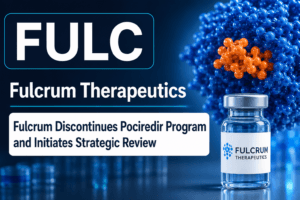
- Veru Inc. (Nasdaq: $VERU): Novo Nordisk Supply Agreement Puts Enobosarm Back on the Obesity Map
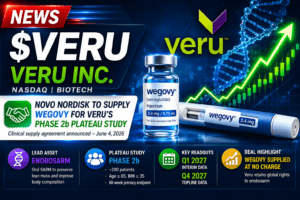
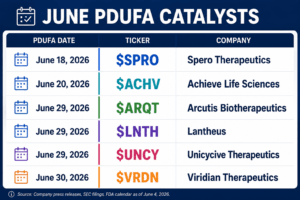
- June 2026 PDUFA Watchlist: Small and Mid-Cap Biotech Catalysts Beyond Big Pharma
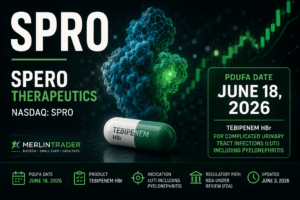
- Spero Therapeutics (Nasdaq: $SPRO): The Oral Carbapenem Bet Ahead of FDA Decision Day June 18
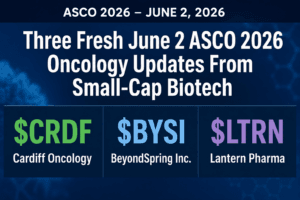
- ASCO 2026 News Watch · June 2 Data
- Apogee Therapeutics (Nasdaq: $APGE)

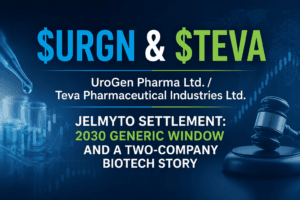
- UroGen Pharma (Nasdaq: $URGN) & Teva Pharmaceutical (NYSE: $TEVA): The JELMYTO Settlement, the 2030 Generic Window and a Two-Company Biotech Story
- Cingulate Inc. (Nasdaq: $CING): The CTx-1301 CRL, What Went Wrong And What Comes Next
- $PMI $QTTB $ICCM: Three Small-Cap Healthcare Stories Beyond the Tape
- Three Small-Cap Stories Worth Reading Beyond the Tape: Sunshine Biopharma, Jin Medical International and Cognition Therapeutics
Run-Up Biotech Masterclass
Learn how to read biotech catalysts, trial results and FDA decisions with a practical framework.
OpenBiotech Catalyst Calendar
Track FDA events, clinical readouts and biotech catalysts with a practical event-driven tool.
Open ArchiveBrowse the Blog & Archive
Explore articles, biotech deep dives, market notes, reports and archived sector content.
Open Reality CheckBiotech Trading Without the Fairy Tales
A grounded piece on risk, catalysts, dilution, volatility and biotech trading reality.
Open 2026 WatchlistThe New Era – Space, Defense & AI
A thematic watchlist built around military spending, strategic technology and AI-linked trends.
Open BriefingSPACE AI DEFENCE
A thematic briefing at the intersection of defense, space infrastructure and AI.
Open Top ListTop 10 Defense-Tech Stocks to Watch
A focused list built around defense technology, drones and strategic systems.
Open Top ListTop 5 U.S. Airlines Watchlist
A practical watchlist for pricing power, fuel sensitivity, travel demand and macro tone.
Open Top ListTop 5 Cruise Lines Watchlist
A leisure-focused list centered on major cruise operators and pricing-driven sentiment.
Open
Try ChartsWatcher free, then unlock 10% OFF with SAVE10
ChartsWatcher is a real-time scanner for momentum traders: fast movers, unusual volume and sector rotations — so you can focus on the few tickers that matter right now, instead of watching hundreds of charts.
Start with the free version. When you upgrade, use SAVE10 to get 10% OFF your first paid period.
No credit card required to start. Apply SAVE10 when upgrading.
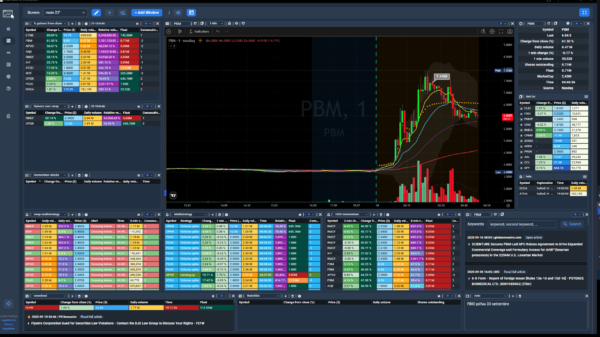

One platform. All your brokers.
Medved Trader connects multiple brokers in one workspace, with professional charts, hotkeys and fast execution — without changing your broker accounts.
A single cockpit for positions, Level II and multi-broker order routing, built for active day and swing traders.
Multi-broker workflow + customizable layouts in one platform.
 Monica.im – the AI assistant I use every day
If you find value in the work I publish on Merlintrader and want a practical AI assistant for research and writing, you can sign up using this referral link. Click here to try Monica.im and support the site
Find out how I use AI on Merlintrader: AI, retail and Merlintrader
Disclosure: some of the links in the promotional blocks above are affiliate or referral links. If you choose to subscribe or sign up through them, Merlintrader may receive a small commission or benefit at no extra cost to you.

AI usage disclosure
This report has been prepared using a human + AI workflow. Drafting, editing and data organization are supported by generative AI tools, such as large language models provided by third parties, based on prompts and instructions defined by the author. All sources used are public, and the final selection of data, checks, opinions and conclusions remains with the author, who takes full responsibility for the content.

If you find these reports useful and want to support the project, you can make a voluntary one-time donation via PayPal or Buy Me a Coffee. It helps cover data, tools and hosting costs, so the content can remain independent and freely accessible.

Biotech Catalyst Calendar
For a broader and continuously updated view of upcoming biotech catalysts — PDUFA dates, major clinical readouts, regulatory events and key conferences — you can visit the dedicated calendar on Merlintrader.
