





Small Caps of the Moment – Defense AI
Palladyne AI (PDYN) – From Embodied AI to Vertically Integrated Defense Stack
Deep dive on Palladyne AI’s pivot into Palladyne Defense: SwarmOS, GuideTech, Crucis, BRAIN avionics, Banshee and SwarmStrike, with an ambitious target to more than triple 2024 revenue by 2026.
Analisi completa sulla trasformazione di Palladyne AI in player integrato defense: SwarmOS, GuideTech, Crucis, avionica BRAIN, Banshee e SwarmStrike, con l’obiettivo dichiarato di più che triplicare i ricavi 2024 entro il 2026.
0. Why PDYN Is on the Radar
Palladyne AI is a small-cap name sitting at the intersection of two themes that markets currently love: embodied AI (intelligence that acts in the physical world) and attritable defense systems (drones, loitering munitions, massed autonomous platforms). Historically a struggling robotics/AI story, the company has now rebranded and repositioned itself as a vertically integrated defense technology player through three key assets:
- SwarmOS – autonomy core for swarming and collaborative unmanned systems.
- GuideTech – avionics and aerospace design (BRAIN compute, Banshee, SwarmStrike).
- Crucis – certified US manufacturing feeding programs like F-16, F-35, Tomahawk, Harpoon, Bradley.
Management’s message is simple but aggressive: with these acquisitions Palladyne Defense wants to deliver a full stack – AI brain, engineering muscle and American production – and aims to more than triple 2024 revenue of 7.8 M USD by 2026, while bringing flagship systems Banshee and SwarmStrike to TRL-9.
At this stage PDYN is a high-volatility, execution-heavy story:
real assets (backlog, contracts, manufacturing) but also real burn, integration risk and a long road to
scale. It belongs in a catalyst watchlist, not in the “safe compounder” bucket.
1. Business Overview – From Sarcos to Palladyne Defense
Palladyne AI is the latest evolution of what started life as Sarcos, a robotics company that spent years trying to find a scalable model. The current iteration focuses on embodied AI – systems that sense, decide and act in the real world in real time – and on embedding that intelligence into defense and industrial platforms.
The CEO, Benjamin Wolff, organizes the company’s history into four phases:
- Phase 1 – Robotics hardware: building complex machines and exoskeletons.
- Phase 2 – Robotics + software: embedding decision-making into those systems.
- Phase 3 – Software-only: pause hardware, focus on the autonomy layer (Palladyne IQ and Pilot).
- Phase 4 – Vertically integrated defense: add aerospace design and US manufacturing (GuideTech + Crucis) and launch Palladyne Defense.
The core stack now looks like this:
Commercial autonomy
- Palladyne IQ – autonomy for industrial robotics, adaptive automation for factories, logistics, aerospace manufacturing.
- Palladyne Pilot – cooperative autonomy for unmanned systems (initially aerial), planned extension to ground, maritime, space.
- These remain the backbone of Palladyne Commercial, aimed at industrial and logistics customers.
Defense stack
- SwarmOS – rebranded defense/public safety variant of Pilot for collaborative multi-agent missions and swarming.
- GuideTech – avionics and aerospace engineering (BRAIN compute, missile/UAS design, Banshee, SwarmStrike, near-hypersonic systems).
- Crucis – US manufacturing capacity already qualified for major DoD programs (F-16, F-35, Tomahawk, Harpoon, Bradley).
The stated ambition is to become a mid-tier US defense technology company that can go from concept to prototype to production on timelines aligned with the Pentagon’s demand for fast, attritable autonomous systems.
2. Fundamentals – Revenue, Cash and Burn
2.1 Revenue profile
The starting point is small and messy:
- 2024 revenue: ~7.8 M USD.
- 9M 2025: ~3.6 M USD vs ~7.0 M USD in the same period 2024, mainly because legacy hardware sales disappeared as the company pivoted to software and then to defense.
- Q3 2025: ~0.86 M USD in revenue, with core operations still loss-making.
Management’s guidance after the GuideTech and Crucis acquisitions:
- Combined acquisitions expected to more than triple 2024 revenue by 2026.
- Acquired businesses targeted to be adjusted EBITDA positive in 2026.
- Backlog: >10 M USD over 18 months from the acquired entities, already tied to existing defense programs and customers.
2.2 Cash, burn and deal structure
Financially, Palladyne enters this transformation with:
- Cash: ~57 M USD at the end of Q3 2025.
- Operating cash burn: ~6.3 M USD in the quarter, previously guided around 2.0 M USD/month during H2 2024.
- Capital raised H1 2025: roughly 34.8 M USD via ATM share sales and warrant exercises, which significantly strengthened the balance sheet ahead of the defense pivot.
- Acquisition consideration: about 31 M USD total for GuideTech and Crucis (mix of cash, stock and assumed debt) plus an earn-out up to 25 M USD tied to revenue milestones.
- Planned investment: 5 M USD to bring Banshee and SwarmStrike from TRL-6 to TRL-9.
The company is not out of the woods: it has meaningful cash, but also meaningful burn and an ambitious integration plan to execute on while developing new platforms.
3. Ownership, Float and Institutional Presence
PDYN is not a pure “retail microcap”: there is a mix of insider ownership and institutional holders.
3.1 Insider / management
- Benjamin Wolff (CEO): around 6–7% of the company.
- Other insiders (e.g. William Kerber and others) add several additional percentage points.
Roughly speaking, leadership has a high-single-digit to low-double-digit percentage of the equity, which aligns incentives but also reduces free float a bit.
3.2 Institutional holders
Institutional ownership is meaningful for a company of this size:
- BlackRock: ~4.5–4.7%.
- Vanguard: ~3.4–3.6%.
- SLB N.V.: ~3%.
- Steward Partners: ~2.7%.
- Geode Capital and several hedge funds (Millennium, Susquehanna, etc.).
Altogether, around 12.3 M shares are held by roughly 180+ institutional investors. For a high-beta small cap, this is a relatively “serious” ownership structure, even if a good chunk is likely via passive/quant strategies.
4. Price Action, Liquidity and Volatility
PDYN’s price history reflects a classic story of hype, disappointment and then repositioning:
- Market cap peaked above 1 B USD in earlier Sarcos days, then collapsed well below 100 M USD.
- End of 2024: market cap around ~370 M USD after a violent squeeze.
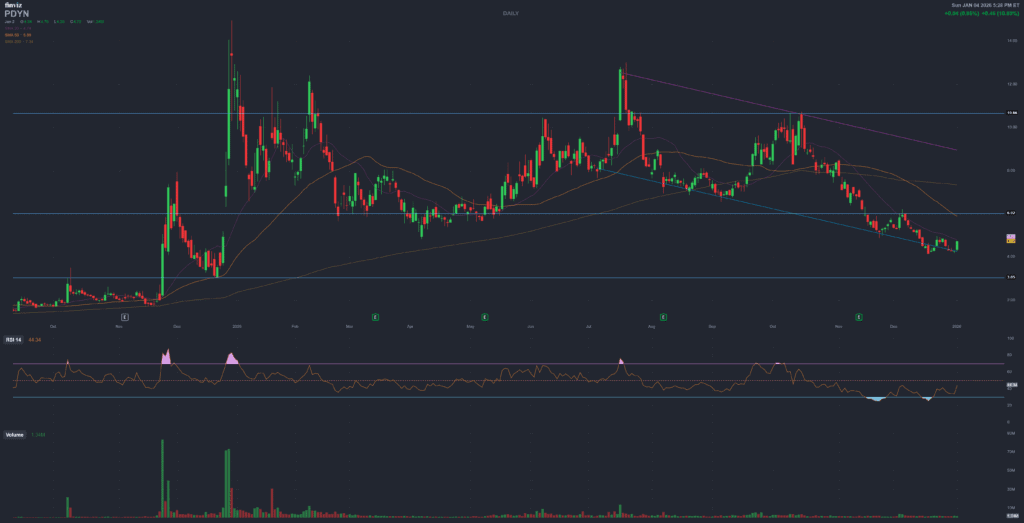
- End of 2025: market cap down to ~180 M USD, with price oscillating around 4–5 USD per share.
- As of early January 2026: market cap roughly ~200 M USD, daily volumes ~1–1.5 M shares.
Liquidity is decent for trading (millions of dollars per day), but the stock remains:
- Highly sensitive to newsflow (contracts, political headlines, AI/defense narrative).
- Exposed to multiple compression if revenue growth slips vs the “triple by 2026” target.
- Volatile both on the upside and downside, with frequent double-digit daily moves around news or earnings.
5. Strategy – SwarmOS, GuideTech, Crucis and the Defense Stack
Embodied AI
Loitering munitions
Vertical integration
Attritable systems
5.1 SwarmOS – Autonomy layer
SwarmOS is the defense/public safety version of Palladyne Pilot, focused on:
- Collaborative autonomy for multi-agent systems (drones, loitering munitions, ground robots).
- Swarming, target sharing, adaptive mission planning.
- Operating at the edge with constrained bandwidth and contested environments.
This is the “AI brain” that can, in principle, be ported across multiple platforms – internal and external to Palladyne.
5.2 GuideTech – Avionics and aerospace engineering
GuideTech is the core engineering nucleus of Palladyne Defense:
- Team of former prime contractor engineers from missile, space and UAS programs.
- Experience taking concepts from digital model to flight prototype in less than six months.
- Already supplying avionics and prototypes to multiple defense customers.
Key product: BRAIN – a mission-grade avionics architecture that aims to deliver the performance of legacy flight computers at about one-tenth the cost, ideal for attritable and autonomous systems. BRAIN is designed to integrate natively with SwarmOS.
5.3 Crucis – U.S. manufacturing backbone
Crucis (Warnke Precision Machining + MKR Fabrication) brings:
- Certified machining and fabrication already feeding programs like F-16, F-35, Tomahawk, Harpoon, Bradley.
- Expandable capacity with existing DoD-grade quality systems.
- Domestic production credentials at a time when the Pentagon is vocal about on-shore supply chains.
This turns Palladyne from a “code only” company into an entity that can actually build metal and ship components or complete systems.
5.4 Banshee, SwarmStrike and beyond
Two flagship systems highlight how Palladyne wants to turn the stack into hardware:
- Banshee – a low-cost, reusable, precision loitering munition designed for tactical and strategic missions, meant to deliver “big platform” effects at a fraction of cost.
- SwarmStrike – a long-range loitering system with cruise-missile-like reach, built for individual or swarming deployment with onboard autonomy and adaptive targeting.
Management also mentions work on a near-hypersonic, long-range mass-strike vehicle for the US Navy, built on GuideTech’s engineering base.
The high-level idea is to move from “one missile = one effect” toward “one swarm = many coordinated, intelligent effects”, aligned with the Pentagon’s cost-per-effect and massed autonomous system doctrines.
6. 2025–2026 Timeline – What Matters When
| Period | Event / Milestone | Relevance |
|---|---|---|
| H1 2025 | Cash burn guided around 2 M USD/month; focus on AI platform and restructuring legacy business. | Sets the baseline for how much runway Palladyne has before acquisitions and defense pivot. |
| H2 2025 | Acquisitions of GuideTech and Crucis announced; formal launch of Palladyne Defense. | Transforms PDYN from software pivot into full defense stack with backlog and manufacturing. |
| Q3 2025 | Revenue down vs prior year; net income distorted by non-cash warrant revaluation; operating loss still heavy. | Highlights execution risk: fundamentals lag behind the narrative. |
| Late 2025 | Detailed presentation of BRAIN, Banshee, SwarmStrike and near-hypersonic concepts to investors and DoD ecosystem. | Makes clear that Palladyne wants a seat at the table for Replicator-style programs. |
| 2026 (guidance) | Combined acquisitions expected to more than triple 2024 revenue, with acquired businesses adjusted-EBITDA positive. | Key credibility test: can they execute on backlog and win enough new work to justify valuation. |
| 2026–2027 | Banshee and SwarmStrike targeted to reach TRL-9; potential scale-up into programs of record or large production contracts. | Where the real upside (and real disappointment risk) lives. |
7. Catalyst Map – What Could Move the Stock
Actionable Catalyst Timeline (indicative)
PDYN doesn’t have fixed PDUFA-style dates like a biotech name, but several events are roughly time-bound.
The windows below are indicative only and should always be cross-checked against the company’s IR calendar
and official guidance.
- Mid–late Feb 2026: Q4 2025 earnings & full-year update – first real look at how much GuideTech/Crucis contribute (consolidated revenue, backlog, cash and burn post-acquisition).
- H1 2026: progress updates on Banshee / SwarmStrike (demos, test footage, TRL upgrades). Any language around “close to TRL-8/9” can act as a sentiment driver for traders following the story.
- Q2–Q3 2026: 2026 earnings runs – the market will check whether the “>3× 2024 revenue by 2026” ambition is still intact and supported by actual numbers rather than just slides.
- Any time: announcement of material contracts (DoD/primes) around Banshee, SwarmStrike, BRAIN avionics or sizeable Crucis backlog additions – binary news items that typically trigger sharp moves, in both directions.
7.1 Near-term (0–12 months)
- Integration progress of GuideTech and Crucis: margins, backlog growth, new contracts.
- Demonstrations and test footage of Banshee and SwarmStrike with SwarmOS and BRAIN fully integrated.
- Additional engineering or prototype contracts with primes or direct DoD units.
- Updates on cash burn trajectory vs guidance and on any further capital raises.
7.2 Medium-term (12–24+ months)
- First meaningful production contracts or program-of-record style deals for Banshee/SwarmStrike-class systems.
- Evidence that the combined entities can truly triple revenue versus 2024 by 2026 while delivering positive adjusted EBITDA in the acquired units.
- Further expansion of SwarmOS integrations into third-party platforms (air, ground, maritime).
- Any M&A activity around Palladyne (being acquired) or further bolt-on acquisitions by Palladyne.
7.5 Community Voice – What Retail Traders Are Saying on Reddit
PDYN has an active retail following across r/stocks, r/pennystocks, and dedicated defense tech forums. Here’s a snapshot of recent community sentiment from social platforms:
u/DefenseTechBull
• 2 days ago
BULLISH
“The Sarcos → Palladyne transformation is the most aggressive pivot I’ve seen in small-cap defense. SwarmOS + BRAIN + Crucis manufacturing = they’re not just selling software anymore, they can BUILD. If they hit even 80% of the 3x revenue target, this thing is severely underpriced at $200M market cap. Compare to AVAV at $6B or KTOS at $2.5B — the gap is insane.”
u/SkepticalValue
• 4 days ago
BEARISH
“Everyone’s hyped about Banshee and SwarmStrike but these are still PROTOTYPES. TRL-6 to TRL-9 is where most defense startups die. Look at the cemetery of ‘revolutionary’ drone companies that burned through cash and never shipped at scale. PDYN has $57M cash and ~$6M quarterly burn — that’s maybe 8-9 quarters. If 2026 revenue doesn’t materialize, we’re looking at dilution city.”
u/PentagonWatcher
• 1 week ago
NEUTRAL
“The GuideTech acquisition is actually legit — these guys have real relationships with primes and already deliver hardware. Crucis supplying F-35 and Tomahawk parts isn’t vaporware. BUT… the Replicator program is getting crowded fast. Anduril just raised another $1.5B, Shield AI has massive Navy contracts. PDYN needs to prove they can compete at that level, not just be ‘also participating.'”
u/SwarmBeliever
• 1 week ago
BULLISH
“Nobody’s talking about the BlackRock + Vanguard positions. ~8% institutional ownership between the two largest asset managers in the world doesn’t happen by accident. They see something. Also, Ben Wolff owns 6-7% — that’s serious skin in the game. Compare that to CEOs who dump shares at every pop. I’m holding through 2026 catalysts.”
u/OptionsGambler
• 2 weeks ago
NEUTRAL
“This is a pure volatility play for me. I’m not married to the thesis — just riding the waves. Every defense headline = 10-15% intraday move. Q4 earnings in Feb will be HUGE because that’s when we see real GuideTech/Crucis numbers. If backlog disappoints, I’m out. If it exceeds, I’m doubling down. Position sizing is everything here.”
u/SarcosVeteran
• 2 weeks ago
BEARISH
“I got burned holding this through the Sarcos implosion. Went from $10+ to under $1. Multiple reverse splits. Endless pivots. Now they’re saying ‘this time it’s different’ with defense. I’ve heard this movie before. Until I see SUSTAINED quarterly revenue growth — not just one good quarter — I’m staying away. Fool me once…”
Merlintrader Sentiment Analysis: Community is split roughly 55/45 bullish/bearish. Bulls focus on the defense transformation, institutional backing, and undervaluation vs peers. Bears highlight execution risk, capital constraints, and the graveyard of failed defense tech pivots. The most sophisticated traders treat PDYN as a catalyst-driven volatility vehicle rather than a long-term hold, sizing positions accordingly.
8. Sentiment – Reddit, Stocktwits, X
Sentiment around PDYN and its defense pivot is drawn from public discussions on Reddit, Stocktwits and X. These are non-professional traders; this section is just an emotional thermometer, not hard data.
Defense AI narrative
Tilt: optimistic but speculative
The idea of a vertically integrated “AI + drones + missiles” stack resonates with many retail investors. Threads highlight Banshee, SwarmStrike and “war machine” optics, often with very bullish takes, sometimes extrapolating DoD interest far beyond what is currently contracted.
Institutional logos as comfort
Tilt: comforting but shallow
Screenshots showing BlackRock and Vanguard in the holder list are common, used as a short-hand to justify “it must be safe”. In reality these positions are often via passive vehicles, not a deep active conviction, so the comfort level is easy to overstate.
Burn rate and dilution fears
Tilt: cautious / skeptical
Other comments focus on the history as Sarcos, repeated pivots, negative operating income and the risk that aggressive 2026 targets could be followed by additional equity raises. This camp tends to see the story as “show me” and expects more volatility ahead.
Comparison with other defense tech
Tilt: opportunistic
Some retail traders compare PDYN to better-known names like AVAV, KTOS or even private firms like Anduril, framing it as a cheaper way to play “AI + drones”. The risk is that they underweight scale and contract maturity differences between these companies.
Trading behavior
Tilt: short-term oriented
Many discussions focus on daily moves, gamma squeezes, options flow and short interest, with little attention to fundamentals. That reinforces PDYN’s profile as a high-beta trading vehicle around news rather than a quiet compounder.
AI hype overspill
Tilt: mixed
Some voices explicitly warn against projecting the mega-cap AI narrative onto small defense names: “AI” in marketing slides is not the same as proven product-market fit and scale. Others ignore this and lump anything with “AI + defense” into the same basket.
9. Peer Group and Context
PDYN sits in a crowded and evolving space of companies trying to supply next-generation autonomous systems to the US and allied defense establishments. Rough peer buckets include:
- Established defense electronics / UAS – e.g. AeroVironment (AVAV), Kratos (KTOS) and others, with long histories of working with DoD and higher revenue bases.
- AI-heavy defense tech – including private companies like Anduril or Shield AI, which also pitch autonomy, swarming and attritable systems, often with significant venture funding and already material contracts.
- Industrial AI / robotics – companies focused more on factory automation and logistics that may or may not have defense overlays.
Compared to these:
- Palladyne is smaller and earlier in its defense journey.
- The vertical integration angle (AI + avionics + manufacturing) is attractive on paper, but still to be proven at scale.
- Valuation metrics (price/sales, EV/sales) are high relative to current revenue, which makes the stock sensitive to any disappointment vs 2026 targets.
10. Key Questions to Ask Before Considering PDYN
- Revenue trajectory – what concrete milestones (contracts, deliveries, options exercised) are needed to actually triple 2024 revenue by 2026, and how visible are these today.
- Cash and dilution risk – with current burn and planned investments, how many quarters of runway are realistically available before additional capital might be needed.
- Product-market fit – beyond demos, which specific units or programs inside DoD and primes are leaning toward Banshee/SwarmStrike-type systems vs competing solutions.
- Execution bandwidth – can a company of this size simultaneously integrate acquisitions, run commercial autonomy, scale defense, and develop multiple new platforms without operational strain.
- Contract quality – how much revenue comes from repeat, high-quality defense work vs lumpy, one-off projects or low-margin manufacturing.
- Policy risk – how sensitive is the thesis to shifts in US defense budget priorities, procurement timelines, or political attitudes toward autonomous weapons.
11. Risk Map
11.1 Company-specific risks
- Execution risk: integrating multiple acquisitions while pivoting the business model and building new systems is complex for a small team.
- Financial risk: despite decent cash, operating losses and investment needs are substantial; missing revenue targets could force capital raises on unfavorable terms.
- Product risk: Banshee, SwarmStrike and future systems must prove themselves in demanding operational contexts, in competition with better-funded players.
- Customer concentration: dependence on defense customers and a small set of key programs can amplify impact of any delays or cancellations.
11.2 External risks
- Regulatory & ethical: debates around autonomous weapons, AI in targeting and cyber-security could change the pace and scope of deployments.
- Macro / rates: higher-for-longer interest rates tend to compress multiples for high-beta, long-duration stories like PDYN.
- Geopolitical: while conflict can increase demand for capabilities, sudden de-escalation or shifts in strategy can also re-prioritise budgets away from certain systems.
- Competition: established primes, large defense tech startups and foreign suppliers all compete for the same niche of attritable autonomous systems.
12. Bottom Line – Map Only, Not a Call
Palladyne AI’s transformation into Palladyne Defense is one of the more radical pivots among recent small-cap stories: from struggling robotics hardware to embodied AI software to a fully integrated defense stack with avionics and manufacturing.
On the positive side, the company now has:
- Real backlog and contracts through GuideTech and Crucis.
- A plausible strategic narrative aligned with DoD’s appetite for attritable autonomous systems.
- Net cash that, for now, provides some runway to execute.
On the negative side, it remains:
- A small, high-beta name with a history of pivots and declines in legacy revenue.
- Dependent on ambitious growth targets (tripling 2024 revenue by 2026) that require strong execution.
- Exposed to financing and dilution risk if burn and investments stay high without matching revenue ramps.
For a reader focused on catalysts, PDYN is best treated as a case study in how an AI/robotics company tries to climb into the defense value chain: interesting to follow, potentially powerful if everything clicks, but with risk levels that demand continuous verification of contracts, cash and execution rather than trust in the story.
Biotech Catalyst Calendar – Keep an Eye on Upcoming PDUFA and Readouts
Even if PDYN itself is not a biotech name, many high-beta trades on this blog revolve around clinical
catalysts and regulatory events. For an up-to-date view of upcoming PDUFA decisions, readouts and key
healthcare catalysts, you can check the dedicated Biotech Catalyst Calendar, maintained
separately from this report.
Go to the Biotech Catalyst Calendar
0. Perché PDYN è nella lista “small caps del momento”
Palladyne AI è una small cap nel punto di contatto tra due temi che il mercato ama: embodied AI (intelligenza che agisce nel mondo fisico) e sistemi militari “attritable” (droni, loitering munitions, piattaforme autonome dispiegate in massa). Dopo anni complicati come Sarcos, l’azienda si è riposizionata come player defense integrato tramite tre asset chiave:
- SwarmOS – layer di autonomia per sciami e sistemi unmanned cooperativi.
- GuideTech – avionica e progettazione aerospace (BRAIN, Banshee, SwarmStrike, sistemi quasi-ipersonici).
- Crucis – manifattura USA certificata che rifornisce già programmi F-16, F-35, Tomahawk, Harpoon, Bradley.
Il messaggio del management è semplice ma aggressivo: con queste acquisizioni, Palladyne Defense vuole offrire uno stack completo – cervello AI, ingegneria e produzione – e punta a più che triplicare i ricavi 2024 (7,8 M USD) entro il 2026, portando Banshee e SwarmStrike a TRL-9.
In questa fase PDYN è una storia a rischio ed esecuzione molto alti:
asset reali (backlog, contratti, fabbriche) ma anche burn, rischio integrazione e tanta strada da fare.
Ha senso come titolo da “catalyst watchlist”, non come compounder tranquillo.
2. Fondamentali – Ricavi, cassa e burn
2.1 Ricavi
La base di partenza è piccola e “sporca”:
- Ricavi 2024: ~7,8 M USD.
- 9M 2025: ~3,6 M USD vs ~7,0 M USD nello stesso periodo 2024, principalmente per la scomparsa dei ricavi hardware legacy durante il pivot.
- Q3 2025: ~0,86 M USD, con operatività core ancora in perdita.
Dopo le acquisizioni, il management comunica:
- Obiettivo di più che triplicare i ricavi 2024 entro il 2026.
- Business acquisiti attesi in adjusted EBITDA positivo nel 2026.
- Backlog aggregato: oltre 10 M USD su 18 mesi, già legato a programmi defense esistenti.
2.2 Cassa, burn e struttura delle acquisizioni
Alcuni numeri chiave dal lato finanziario:
- Cassa: ~57 M USD a fine Q3 2025.
- Burn operativo: ~6,3 M USD nel trimestre; in precedenza guidato a ~2 M USD/mese nel H2 2024.
- Raccolta H1 2025: circa 34,8 M USD tramite vendite ATM e exercise di warrant, che hanno rafforzato in modo significativo la struttura patrimoniale prima del pivot defense.
- Prezzo delle acquisizioni: circa 31 M USD totali (cash, azioni, debito assunto) più un earn-out fino a 25 M USD legato a milestone di ricavi.
- Investimenti pianificati: 5 M USD per portare Banshee e SwarmStrike da TRL-6 a TRL-9.
In pratica: c’è cassa, ma anche un burn significativo e un piano di integrazione/sviluppo molto ambizioso.
3.5 Voce della Community – Cosa dicono i Trader Retail su Reddit
PDYN ha un seguito retail attivo su r/stocks, r/pennystocks e forum dedicati al defense tech. Ecco un’istantanea del sentiment recente dalle piattaforme social:
u/TechDefenseITA
• 2 giorni fa
RIALZISTA
“La trasformazione Sarcos → Palladyne è il pivot più aggressivo che abbia mai visto nelle small cap defense. SwarmOS + BRAIN + produzione Crucis = non stanno solo vendendo software, possono COSTRUIRE. Se raggiungono anche solo l’80% del target 3x ricavi, questo titolo è sottovalutato ai 200M$ di market cap. Confrontalo con AVAV a $6B o KTOS a $2.5B — il gap è folle.”
u/ScetticoItalia
• 4 giorni fa
RIBASSISTA
“Tutti entusiasti di Banshee e SwarmStrike ma sono ancora PROTOTIPI. Da TRL-6 a TRL-9 è dove muoiono la maggior parte delle startup defense. Guarda il cimitero di società ‘rivoluzionarie’ di droni che hanno bruciato cash senza mai produrre su scala. PDYN ha $57M di cassa e ~$6M di burn trimestrale — sono forse 8-9 trimestri. Se i ricavi 2026 non si materializzano, benvenuti alla città della diluizione.”
u/OsservatorePentagono
• 1 settimana fa
NEUTRALE
“L’acquisizione GuideTech è effettivamente seria — questi ragazzi hanno relazioni reali con i prime e già consegnano hardware. Crucis che fornisce pezzi per F-35 e Tomahawk non è vaporware. MA… il programma Replicator si sta affollando velocemente. Anduril ha appena raccolto altri $1.5B, Shield AI ha mega contratti Navy. PDYN deve dimostrare di poter competere a quel livello, non solo di ‘partecipare’.”
u/VeteranSarcos
• 2 settimane fa
RIBASSISTA
“Mi sono bruciato tenendo questo titolo durante l’implosione Sarcos. Da $10+ a sotto $1. Reverse split multipli. Pivot infiniti. Ora dicono ‘questa volta è diverso’ con il defense. Ho già sentito questo film. Finché non vedo crescita trimestrale SOSTENUTA dei ricavi — non solo un buon trimestre — sto alla larga. Chi si brucia una volta…”
Analisi Sentiment Merlintrader: La community è divisa circa 55/45 rialzista/ribassista. I bull si concentrano sulla trasformazione defense, il backing istituzionale e la sottovalutazione vs peers. I bear evidenziano il rischio esecuzione, i vincoli di capitale e il cimitero dei pivot defense falliti. I trader più sofisticati trattano PDYN come veicolo di volatilità catalyst-driven piuttosto che hold lungo termine.
3. Azionariato e istituzionali
PDYN non è la classica microcap solo retail: la struttura del capitale è un mix di insider e istituzionali.
3.1 Insider e management
- Benjamin Wolff (CEO): circa 6–7% del capitale.
- Altri insider (es. William Kerber) aggiungono qualche punto percentuale.
In sintesi, il management ha una quota nell’ordine della decina di punti percentuali, con incentivi allineati ma free float comunque significativo.
3.2 Istituzionali
Tra i principali detentori istituzionali compaiono:
- BlackRock: ~4,5–4,7%.
- Vanguard: ~3,4–3,6%.
- SLB N.V.: ~3%.
- Steward Partners: ~2,7%.
- Geode e diversi hedge fund (Millennium, Susquehanna, ecc.).
In totale, circa 12,3 M di azioni sono in mano a oltre 180 investitori istituzionali. Per una small cap ad alto beta è una base proprietaria “seria”, anche se in buona parte passiva/quant.
12. Conclusioni – Mappa, non call
La trasformazione di Palladyne AI in Palladyne Defense è uno dei pivot più radicali tra le small cap dell’ultimo periodo: da Sarcos hardware, a software di embodied AI, a stack defense integrato con avionica e manifattura.
Lato positivo:
- Backlog e contratti reali portati dentro da GuideTech e Crucis.
- Narrativa strategica coerente con la domanda di sistemi autonomi “attritable” del DoD.
- Cassa sufficiente, almeno oggi, per finanziare una parte dell’esecuzione.
Lato negativo:
- Storia molto volatile e ad alto beta, con un passato complicato e ricavi ancora bassi.
- Target molto aggressivi sui ricavi 2026 rispetto alla base attuale.
- Rischio di funding/diluizione concreto se il roll-out dei sistemi e la crescita non tengono il passo.
Per un lettore orientato ai catalyst, PDYN è soprattutto un case study su come una società AI/robotica cerca di entrare nella catena del valore defense: interessante da seguire, potenzialmente esplosiva se tutto allinea, ma con livelli di rischio che richiedono verifica continua di contratti, cassa ed execution, non fiducia cieca nella narrativa.
Biotech Catalyst Calendar – tieni d’occhio le prossime PDUFA e readout
Anche se PDYN non è un titolo biotech, gran parte dei temi ad alto beta trattati su questo sito gira attorno
a catalyst regolatori e clinici. Per una vista aggiornata su PDUFA, readout e principali catalyst in ambito
healthcare puoi consultare il Biotech Catalyst Calendar, aggiornato separatamente dai singoli report.
Vai al Biotech Catalyst Calendar