





Ocugen (OCGN) – OCU400, Retina Gene Therapy And The Speculative Crowd
Ocugen has come a long way from the COVID era headlines. Today the story is about OCU400, a Phase 3 modifier gene therapy for retinitis pigmentosa, a growing retina pipeline, and a very loud speculative community – more than 150,000 followers on Stocktwits – watching every headline for the next double-digit move.
News of the day
November 2025 – In its Q3 2025 update, Ocugen reports 1.75 million USD in revenue and a net loss of about 20 million USD,
with operating expenses of 19.4 million USD driven mainly by gene therapy R&D.
Cash and equivalents stand around 33 million USD after a 20 million USD financing, which management believes funds operations into the second quarter of 2026.
The Phase 3 liMeliGhT trial of OCU400 in retinitis pigmentosa is enrolling towards 150 patients and remains on track for potential US and EU filings around 2026,
while OCU410 and OCU410ST receive ATMP classification in Europe and, in the case of OCU410ST, Rare Pediatric Disease designation in the US.
The aim of this report is not to argue with the OCGN community – which is one of the most active in small-cap biotech – but to put the science, the numbers and the timeline in one place so that readers can judge for themselves where the real risk and opportunity sit.
1. Thesis – where OCGN stands right now
In one sentence: Ocugen today is a concentrated bet on OCU400 and a small family of retina gene therapies, with a speculative trading culture wrapped around it.
- OCU400 is in Phase 3 liMeliGhT for retinitis pigmentosa (RP), with 150 patients planned across two arms: one RHO-mutation arm and one gene-agnostic arm. The study is designed as a one-year trial with visual function endpoints and is progressing toward potential BLA/MAA submissions around mid-2026 if data hold up.
- Phase 1/2 data look encouraging, including 2-year follow-up showing statistically significant improvements in low-luminance visual acuity (LLVA) and preservation or improvement of vision in treated eyes across multiple RP genotypes.
- The broader pipeline (OCU410 for geographic atrophy / dry AMD and OCU410ST for Stargardt disease) has ATMP classification in Europe and rare pediatric disease designation for OCU410ST in the US, which adds optionality.
- The balance sheet is thin for a company running multiple gene therapy programs: around 33 M USD in cash as of Q3 2025, with quarterly net loss around 20 M USD and management guiding for runway into 2026, implying further capital raises are likely at some point.
- Retail interest is huge: more than 154,000 Stocktwits followers and hundreds of posts per day on X mean that price action often reflects momentum and rumors as much as fundamentals.
For long-only investors this looks like a classic high-risk, high-volatility gene therapy name where timing and position size matter. For traders, OCGN is a liquid vehicle around clear clinical and financing catalysts. This report tries to walk the line: respectful of the upside case that the community believes in, but clear about what the numbers and timelines actually say.
2. Pipeline – from COVID detour to retina-centric
Most people now associate Ocugen with retina gene therapy, but the company only fully pivoted after the COVID-19 vaccine chapter faded. The current pipeline is much more coherent than the 2021 version.
2.1 OCU400 – modifier gene therapy for RP
- AAV-based gene therapy delivering NR2E3 (a nuclear hormone receptor) with the goal of restoring retinal homeostasis across multiple forms of RP.
- Phase 1/2 data show improvement or preservation of vision in all evaluable treated subjects at 2 years, with statistically significant LLVA gains versus fellow untreated eyes.
- Phase 3 liMeliGhT is designed as a one-year trial with 150 participants aged 8+ across RHO-mutation and gene-agnostic arms, randomized 2:1 treatment vs control.
- OCU400 has orphan designations in the US/EU and ATMP classification from the EMA, which can help with regulatory dialogue and timelines.
2.2 OCU410 and OCU410ST – GA and Stargardt
- OCU410: gene therapy for geographic atrophy (GA) due to dry AMD, using a RORA-based modifier gene approach targeting multiple pathways (lipofuscin, oxidative stress, complement, inflammation).
- OCU410ST: similar platform adapted for Stargardt disease and ABCA4-associated retinopathies; Phase 1/2 data show slowed lesion growth and visual function gains in treated eyes, and the FDA has granted Rare Pediatric Disease designation plus orphan designations.
- Both OCU410 and OCU410ST have received ATMP classification from the EMA, which may support future EU submissions.
Together, these programs aim to position Ocugen as a platform company in inherited retinal disease rather than a single-asset story, though from an equity-risk standpoint OCU400 still dominates.
3. OCU400 – what the data actually show
Much of the community enthusiasm rests on the idea that OCU400 is not just another mutation-specific gene therapy but a modifier that can help across different RP genotypes.
3.1 Phase 1/2 two-year update
| Measure | Key result (treated vs fellow eye) |
|---|---|
| LLVA (low-luminance visual acuity) | Statistically significant improvement, around 2-line gain (10 ETDRS letters) on average across subjects. |
| Vision preservation | All evaluable treated subjects showed improvement or preservation of visual function vs untreated eyes at 2 years. |
| Genotype coverage | Benefit observed across multiple mutations, supporting the gene-agnostic concept. |
| Safety | Acceptable safety profile over 2 years, with no unexpected serious ocular events reported. |
These are not placebo-controlled data, but for a rare, progressive disease they are still meaningful. They justify taking OCU400 into a randomized Phase 3 – exactly where we are now.
3.2 Phase 3 liMeliGhT design
- 150 participants with retinitis pigmentosa, aged 8 years and older, split into 75 with RHO mutations and 75 with any RP-related mutation (gene-agnostic arm).
- In each arm, 50 patients receive OCU400, 25 are controls (2:1 randomization), with subretinal injection as a one-time treatment.
- Primary focus on visual function endpoints over one year (for example LLVA and mobility tests), plus safety and structural imaging.
- Company guidance has been BLA/MAA submissions around mid-2026 if the trial is successful and one-year follow-up is completed on schedule.
The key point for equity is timing: even in a best-case scenario, pivotal data and filings are a 2026 story.
For traders, that means interim headlines and enrollment updates will matter more in 2025–2026 than final outcomes.
4. OCU410 and OCU410ST – valuable, but second in line
To keep expectations grounded, it helps to remember that these programs are earlier than OCU400, even if they generate exciting headlines.
4.1 OCU410 – GA / dry AMD
- Phase 1/2 ArMaDa trial has shown slowing of lesion growth and visual function improvements at 9–12 months in early data.
- ATMP classification from EMA and plans to complete one-year follow-up by 2026, targeting a potential BLA/MAA around 2028 if results hold.
- Very large market opportunity (GA/dAMD), but also intense competition from complement inhibitors and other approaches.
4.2 OCU410ST – Stargardt / ABCA4 retinopathies
- Phase 1/2 GARDian trial shows slower lesion growth and functional gains versus untreated fellow eyes in early follow-up.
- Received orphan designations and Rare Pediatric Disease designation for ABCA4-associated retinopathies, with the potential for a Priority Review Voucher in case of approval.
- Phase 2/3 pivotal GARDian trial was endorsed by the FDA in 2025 and is designed to serve as the basis for BLA/MAA submissions around 2027; the program remains several years behind OCU400.
For investors, these assets are important as long-term optionality, but the shorter-term equity story still turns mainly on how OCU400 Phase 3 data look and how the company manages its cash while getting there.
5. Financials – runway, burn and why traders care about offerings
It is impossible to talk honestly about OCGN without touching the cash situation. This is not a criticism of the science; it is just how development-stage biotech works.
5.1 Q3 2025 snapshot
- Revenue: around 1.75–1.8 M USD (largely services or collaboration-related, not product sales).
- Operating expenses: 19.4 M USD (up strongly year-on-year, driven by R&D for OCU400/410/410ST).
- Net loss: about 20.1 M USD for the quarter.
- Cash and equivalents: roughly 32.9–33 M USD after a 20 M USD direct offering, with potential additional financing via warrants.
- Management guiding for operational runway into 2026, assuming no major surprises.
This is the classic profile of a gene therapy company in late-stage development: very modest revenue, large and growing R&D expense, and a finite runway that will need to be extended if trials run on schedule.
5.2 What this means for holders and traders
- Equity raises are a normal part of the plan in this kind of company, not a surprise. But they still matter for per-share value if they come at low prices.
- Because the retail following is so large, offerings and ATM programs often trigger strong short-term reactions, sometimes overdone in both directions.
- For long-term holders who believe in OCU400, it is important to size positions with the expectation that there may be more dilution before commercial revenues arrive.
The take-away is not “avoid companies that raise capital”.
It is to understand that in OCGN the scientific risk and the financing risk walk together –
and that both are part of the price action the community trades every week.
6. Sentiment – 154k followers and a constant stream of chatter
If you ever wondered why OCGN can move 10–20 percent in a day on modest news, the social numbers explain a lot.
6.1 Where the noise comes from
- Stocktwits: about 154,000 followers for OCGN, one of the higher counts among small-cap biotech names.
- X / Twitter: historical third-party analytics suggest around 200+ OCGN-related posts per day and roughly 100–120k impressions in a typical 24-hour window.
- Mentions: a few hundred Stocktwits mentions per day on active sessions, with spikes around earnings, gene therapy conferences or rumors of partnerships.
These numbers do not tell you whether the trade is good, but they do tell you that you are sharing the order book with a very active, speculative base.
6.2 How to respect the community but keep perspective
There is nothing wrong with being optimistic about OCU400 or enjoying the trading swings; a lot of people in the OCGN crowd have been following gene therapy and inherited retinal disease for years. A constructive way to read that community is:
- As a source of fast news flow – trial updates, conference presentations, regulatory tidbits.
- As a sentiment gauge – which can be useful if you are trying to avoid chasing the most crowded spikes.
- Not as a replacement for your own due diligence. Most posters and influencers are not licensed advisers and their content is opinion, not professional research.
7. Trading profile – what makes OCGN feel like a “spec name”
A quick snapshot for readers who are more interested in how the stock trades than in the underlying biology.
7.1 Volatility and liquidity
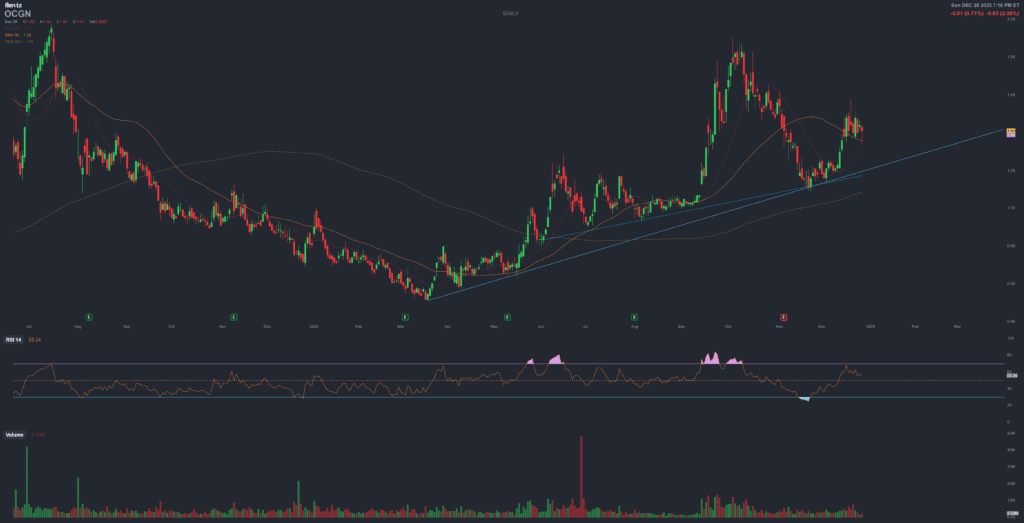
- Price around 1.4 USD, with a 52-week range between roughly 0.51 and 1.90 USD.
- Average daily volume in the low single-digit millions of shares, with spikes much higher on news days.
- Beta above 1.5 versus the market, and effectively much higher on big headline days.
That combination – low nominal share price, high volume, large social following – is exactly what attracts day traders looking for double-digit intraday or multi-day swings.
7.2 Catalysts the market watches
- Enrollment completion and first topline glimpses from the liMeliGhT Phase 3 trial of OCU400 in RP.
- Regulatory updates on BLA/MAA timelines for OCU400 and ATMP/RPDD news on OCU410 and OCU410ST.
- Financing events – any new offering, ATM usage or partnering deal can move the stock sharply.
From a trading perspective, OCGN behaves more like a small-cap biotech options contract on future gene therapy data
than like a stable “buy and hold” position.
That does not make it bad; it just means position sizing and risk management matter as much as the science.
8. Scenarios – educational, not predictive
To keep expectations grounded, it helps to map out a few plausible paths rather than just “to the moon” versus “zero”.
Scenario A – OCU400 delivers, pipeline adds layers
- OCU400 Phase 3 shows clear, clinically meaningful improvements versus control in RP patients, across RHO and gene-agnostic arms, with a safety profile consistent with Phase 1/2.
- BLA/MAA submissions in 2026 lead to approvals and a controlled but meaningful launch in a rare-disease setting.
- OCU410/OCU410ST continue to deliver positive data in GA and Stargardt, increasing the credibility of the “modifier” platform.
- Financing is managed without extreme dilution, helped by potential partnerships or non-dilutive capital.
In this world, today’s market cap could end up looking modest versus long-term revenue, but it would still take years and disciplined execution to realize that potential.
Scenario B – Good science, tougher commercial reality
- OCU400 passes the efficacy bar but faces slower-than-hoped uptake as real-world logistics, competition and pricing discussions play out.
- GA and Stargardt programs make progress, but timelines extend and regulators demand more data.
- Several capital raises are needed; long-term holders still do fine, but per-share outcomes are more muted than early models suggested.
Scenario C – Clinical or financial disappointment
- OCU400 Phase 3 fails to reproduce the Phase 1/2 effect size, or safety/tolerability issues limit its use.
- OCU410/OCU410ST run into unexpected hurdles or competition, reducing the perceived value of the platform.
- Cash needs force Ocugen into highly dilutive financings or a sale on terms that do not match community expectations.
Nobody in the OCGN crowd hopes for Scenario C, but acknowledging it is part of staying intellectually honest about the risk profile.
Whichever scenario you personally lean toward, it is worth remembering that OCGN is a high-variance story by construction.
Respecting that volatility – and the timelines of retina gene therapy – is as important as reading every new headline.
9. Sources and further reading
Key primary and high-quality sources used to build this overview.
- Ocugen, Inc. Announces Positive 2-Year Data Across Multiple Mutations from Phase 1/2 Clinical Trial of OCU400 (GlobeNewswire, 13 Jan 2025) and related coverage on Modern Retina and HCPLive.
- Ocugen, Inc. Announces First Patient Dosed in Phase 3 liMeliGhT Clinical Trial for OCU400 (GlobeNewswire, 20 Jun 2024) and the detailed article on Modern Retina – “Ocugen doses first patient in Phase 3 liMeliGhT clinical trial for OCU400” .
- Ocugen Announces Positive Opinion of EMA’s Committee for Advanced Therapies for ATMP Classification for OCU410 and OCU410ST (GlobeNewswire, 3 Mar 2025) and summary on CGTLive – “Ocugen’s Geographic Atrophy and Stargardt Gene Therapies Garner Positive ATMP Opinions from EMA” .
- Ocugen Provides Business Update with Third Quarter 2025 Financial Results (GlobeNewswire, 5 Nov 2025), together with financial coverage on MarketScreener and Yahoo Finance .
- Clinical trial registries on OCU400 liMeliGhT Phase 3 (NCT06388200), OCU410 ArMaDa Phase 1/2 (NCT06018558) and OCU410ST GARDian Phase 2/3 (NCT05956626).
- Retina-focused conference and news coverage, including Modern Retina – ArMaDa late-breaking findings and other articles on OCU410/OCU410ST lesion growth and visual function.
- Price, market cap and 52-week range from Stocktwits – OCGN symbol page and Yahoo Finance – Ocugen, Inc. (OCGN) (data accessed 29 Dec 2025).
- Social activity and sentiment metrics from Stocktwits and Financial Modeling Prep – “OCGN Stocktwits and Twitter Sentiment Trend Analysis” .
10. Disclaimer – educational only
This article is for educational and informational purposes only. It is not, and must not be interpreted as, investment advice, investment research, a recommendation to buy, sell or hold any financial instrument, or a solicitation to engage in any investment activity.
The information is based on publicly available sources believed to be reliable at the time of writing, but no representation or warranty is given as to its accuracy or completeness. Biotech and small-cap securities are highly volatile and speculative; investors can lose all or a substantial portion of their capital. Past performance and past clinical data are not indicative of future results.
Readers remain solely responsible for their own investment decisions and should consult qualified, independent financial and legal advisers before taking any action. The author and Merlintrader trading Blog accept no liability for any direct or indirect loss arising from the use of this material.
For full legal and risk disclosures, including privacy and terms of use, please refer to: Merlintrader – Disclaimer and Terms of use & privacy information.
Ocugen (OCGN) – OCU400, terapia genica retinica e la crowd speculativa
Ocugen non è più la “COVID stock” di qualche anno fa. Oggi la storia ruota attorno a OCU400, terapia genica di Fase 3 per la retinite pigmentosa, a una pipeline retina in crescita e a una community speculativa enorme – oltre 150.000 follower su Stocktwits – che guarda a ogni news come potenziale movimento a doppia cifra.
News del giorno
Novembre 2025 – Nel Q3 2025 Ocugen riporta circa 1,75 milioni di dollari di ricavi e una perdita netta di circa 20 milioni,
con spese operative di 19,4 milioni spinte soprattutto dalla R&D sulle terapie geniche.
La cassa gira intorno ai 33 milioni dopo un finanziamento da 20 milioni,
che secondo il management estende il runway operativo fino al secondo trimestre 2026.
Il trial di Fase 3 liMeliGhT di OCU400 in RP prosegue verso i 150 pazienti e resta allineato all’obiettivo di possibili filing US/UE intorno al 2026,
mentre OCU410 e OCU410ST ricevono ATMP classification in Europa e, nel caso di OCU410ST, anche la Rare Pediatric Disease designation da parte della FDA.
L’obiettivo di questo report non è “andare contro” la community OCGN – una delle più rumorose del biotech small-cap – ma mettere insieme scienza, numeri e tempistiche in modo che ognuno possa farsi un’idea chiara di rischi e opportunità.
1. Tesi – dove si trova davvero OCGN oggi
In una frase: OCGN oggi è una scommessa concentrata su OCU400 e su un piccolo “cluster” di terapie geniche retiniche, attorno a cui si muove una crowd di trader molto attiva.
- OCU400 è in Fase 3 liMeliGhT per la retinite pigmentosa, trial da 150 pazienti con braccio RHO e braccio gene-agnostico, follow-up a un anno e endpoint funzionali visivi.
- I dati di Fase 1/2 mostrano un miglioramento medio di circa due linee di LLVA e, nei soggetti valutabili, miglioramento o preservazione della funzione visiva a due anni rispetto all’occhio non trattato.
- OCU410 e OCU410ST aggiungono optionalità su GA/dAMD e malattia di Stargardt, con designazioni ATMP e Rare Pediatric Disease (per OCU410ST) che non risolvono tutto ma aiutano.
- La cassa è tirata rispetto all’ampiezza della pipeline: circa 33 M USD a fine Q3 2025, perdita trimestrale intorno ai 20 M USD, runway stimata fino al 2026.
- La community è enorme: oltre 154.000 follower su Stocktwits e centinaia di post al giorno su X rendono il titolo molto sensibile a hype, rumor e news.
Per un investitore paziente che conosce bene il settore retina, OCGN può essere una posizione “satellite” ad alto beta. Per i trader è uno strumento liquido su catalyst clinici e finanziari. Il punto di questo report è dare abbastanza contesto da non dover scegliere tra il coro dei “to the moon” e il pessimismo automatico.
2. Pipeline – dal capitolo COVID a una storia retina-centrica
Lasciata alle spalle la parentesi vaccino, la pipeline oggi è molto più coerente: quasi tutto ruota intorno alle malattie ereditarie della retina.
2.1 OCU400 – terapia genica “modifier” per RP
- Terapia genica basata su AAV che veicola NR2E3 con l’obiettivo di ripristinare l’omeostasi retinica in diverse forme di RP.
- Dati di Fase 1/2 a due anni: miglioramento significativo di LLVA e preservazione/miglioramento della visione nei soggetti trattati rispetto all’occhio controlaterale.
- LiMeliGhT (Fase 3) prevede 150 pazienti, 75 con mutazione RHO e 75 gene-agnostici, randomizzati 2:1 a OCU400 vs controllo.
- OCU400 ha designazioni orphan e ATMP in Europa, fattori che possono velocizzare il dialogo regolatorio.
2.2 OCU410 e OCU410ST – GA e Stargardt
- OCU410: candidata per la GA da dAMD, con approccio “modifier” RORA su più pathway (lipofuscina, stress ossidativo, complemento, infiammazione).
- OCU410ST: adattamento per la malattia di Stargardt e retinopatie ABCA4-correlate, con dati iniziali che mostrano rallentamento della crescita delle lesioni e segnali funzionali positivi.
- Entrambe hanno ATMP classification dall’EMA; OCU410ST ha anche Rare Pediatric Disease e orphan designation per ABCA4-retinopatie.
In ottica equity, questi asset sono un “secondo capitolo” importante, ma nel breve a muovere la quotazione sarà soprattutto l’asse OCU400 + cassa.
3. OCU400 – cosa dicono i dati
Gran parte dell’ottimismo sulla community nasce dall’idea che OCU400 non sia solo “un altro gene therapy specifico”, ma un modifier in grado di aiutare mutazioni diverse.
3.1 Update a due anni dello studio di Fase 1/2
| Misura | Risultato chiave |
|---|---|
| LLVA | Guadagno medio di circa due linee (10 lettere ETDRS) nell’occhio trattato vs controlaterale. |
| Preservazione visiva | Tutti i soggetti valutabili mostrano miglioramento o preservazione della funzione visiva a due anni rispetto all’occhio non trattato. |
| Genotipo | Beneficio osservato su più mutazioni, a supporto dell’approccio gene-agnostico. |
| Safety | Profilo di sicurezza accettabile a due anni, senza segnali inattesi di tossicità o eventi gravi oculari correlati. |
3.2 Disegno liMeliGhT (Fase 3)
- 150 pazienti con RP, età ≥8 anni; 75 con mutazione RHO e 75 con altre mutazioni RP.
- Randomizzazione 2:1 (OCU400 vs controllo) in ciascun braccio; somministrazione subretinica one-shot.
- Follow-up di un anno con endpoint funzionali (LLVA, BCVA, test di mobilità multi-luminanza) e imaging strutturale.
- Target indicativo: completare follow-up e puntare a BLA/MAA intorno al 2026 in caso di esito positivo.
Tema chiave per chi guarda al titolo: anche nello scenario migliore,
il “momento della verità” regolatorio per OCU400 è una storia da 2026 in avanti.
Fino ad allora, il mercato reagirà soprattutto a readout intermedi, update di arruolamento e news finanziarie.
4. OCU410 e OCU410ST – valore aggiunto, ma più indietro
Sono asset interessanti, con target di mercato più ampi, ma temporalmente diversi da OCU400.
4.1 OCU410 – GA / AMD secca
- Dati iniziali ArMaDa: rallentamento della crescita delle lesioni e miglioramento funzionale a 9–12 mesi nei pazienti trattati.
- ATMP classification in Europa e piano di completare il follow-up a un anno entro il 2026, con possibile timeline di filing intorno al 2028.
4.2 OCU410ST – Stargardt / retinopatie ABCA4
- Dati GARDian Fase 1/2: riduzione della crescita delle lesioni vs occhio non trattato e segnali funzionali incoraggianti.
- Rare Pediatric Disease designation e orphan designation per ABCA4-retinopatie, con potenziale accesso a Priority Review Voucher se il farmaco arrivasse all’approvazione.
- Trial GARDian di Fase 2/3, a disegno pivotal, approvato/endorsement FDA nel 2025 come possibile base per BLA/MAA intorno al 2027; resta comunque diversi anni dietro OCU400 come tempistica.
Per la narrativa sulla piattaforma è importante; per il prezzo del titolo nel breve, pesa meno del binomio OCU400 + situazione di cassa.
5. Numeri e runway – perché il tema “aumenti di capitale” torna sempre
Qui non si tratta di “parlare male” di Ocugen, ma di ricordare una verità semplice: le terapie geniche costano e qualcuno il conto lo deve pagare.
5.1 Q3 2025 in sintesi
- Ricavi: circa 1,75–1,8 M USD (non ancora prodotti commerciali su larga scala).
- Spese operative: 19,4 M USD, in crescita rispetto all’anno precedente per l’avanzamento dei programmi retina.
- Perdita netta: circa 20,1 M USD nel trimestre.
- Cassa ed equivalenti: intorno a 32,9–33 M USD dopo un finanziamento diretto da 20 M USD, con ulteriore potenziale da warrant.
- Runway stimato: fino al 2026, a parità di ipotesi di spesa.
5.2 Cosa significa per chi segue il titolo
- Nuovi aumenti di capitale non sarebbero una “sorpresa”, ma parte del percorso normale per arrivare a fine Fase 3.
- Dato il peso del retail, le operazioni di funding spesso generano reazioni violente, sia al ribasso (sell-off) sia al rialzo se percepite come “derisking”.
- Per chi crede molto in OCU400, la chiave è dimensionare la posizione sapendo che nel percorso potrebbero arrivare altre diluizioni.
Il messaggio non è “evita tutte le biotech che raccolgono capitale”,
ma “in OCGN il rischio clinico e quello finanziario viaggiano insieme”.
Essere consapevoli di entrambi aiuta a non farsi sorprendere.
6. Sentiment – 154k follower e un flusso costante di commenti
Se OCGN a volte sembra muoversi più dei fondamentali, il motivo sta anche nei numeri della community.
6.1 Da dove arriva il rumore
- Stocktwits: circa 154.000 follower, tra i numeri più alti per una small-cap biotech.
- X / Twitter: analisi storiche di terze parti indicano intorno ai 200+ post al giorno e oltre 100k impression in 24 ore.
- Menzioni: diverse centinaia di commenti giornalieri nei giorni “caldi”, con picchi su earnings, conferenze retina o rumor di partnership.
6.2 Come leggere la community senza scontrarsi
Un approccio equilibrato potrebbe essere:
- Usare la community come radar news molto rapido su OCU400/410/410ST.
- Osservarla come indicatore di sentiment per evitare di entrare proprio nei momenti più affollati.
- Ricordarsi che si tratta quasi sempre di opinioni di trader non professionisti, non di ricerca regolamentata o consulenza personalizzata.
7. Profilo di trading – perché OCGN è percepito come “spec stock”
Qualche punto di riferimento per chi guarda soprattutto al comportamento del titolo.
7.1 Volatilità e liquidità
- Prezzo intorno a 1,4 USD, range 52 settimane 0,51–1,90 USD.
- Volumi medi di qualche milione di azioni, con spike molto superiori in giornate di news.
- Beta elevato rispetto al mercato e movimenti giornalieri spesso a doppia cifra.
È il profilo tipico che attira day-trader e swing-trader: prezzo basso, molta liquidità, tanta attenzione social.
7.2 Catalyst che il mercato segue
- Update sull’arruolamento e primi segnali di efficacia/safety da liMeliGhT (OCU400).
- News regolatorie su ATMP/RPDD e avanzamento OCU410/OCU410ST.
- Eventuali partnership, licensing deal e round di finanziamento.
In pratica, OCGN si comporta più come un’opzione sul successo delle terapie geniche retina
che come un “titolo da cassetto”. Questo non è un giudizio di valore,
ma una descrizione del tipo di rischio che ci si prende.
8. Scenari – mappe mentali, non previsioni
Invece di ragionare solo in termini di “to the moon / zero”, ha senso farsi qualche scenario intermedio.
Scenario A – OCU400 centra l’obiettivo, la pipeline si consolida
- LiMeliGhT mostra un effetto chiaro vs controllo, con beneficio funzionale clinicamente rilevante e safety gestibile.
- OCU400 ottiene le approvazioni attese in RP e costruisce nel tempo una franchise rara ma significativa.
- OCU410/OCU410ST proseguono con dati positivi, rafforzando la tesi sulla piattaforma “modifier”.
- I finanziamenti necessari arrivano a condizioni ragionevoli, con diluizione gestibile.
Scenario B – Scienza buona, ma execution/commercializzazione più lenta
- OCU400 passa l’asticella, ma uptake reale è più graduale del previsto per motivi pratici o competitivi.
- Gli altri programmi avanzano ma i tempi si allungano; il mercato sconta solo parte del potenziale.
- La serie di aumenti di capitale diluisce in modo significativo ma non distruttivo; il risultato finale è “ok”, ma meno brillante dei modelli più aggressivi.
Scenario C – Dati o finanza non all’altezza
- LiMeliGhT non conferma i segnali di Fase 1/2, o emergono problemi di safety/tollerabilità.
- OCU410/OCU410ST incontrano ostacoli imprevisti e il valore percepito della piattaforma cala.
- La combinazione di risultati clinici deludenti e necessità di cassa porta a diluizione pesante o a una vendita dell’azienda a condizioni lontane dalle aspettative della community.
Il senso di questa sezione non è spaventare, ma ricordare che OCGN è, per definizione, una storia a varianza elevata.
Chi decide di esporsi lo fa meglio se ha ben chiari sia i possibili upside sia i rischi strutturali.
9. Fonti e approfondimenti
Principali fonti utilizzate per costruire questa panoramica.
- Comunicato Ocugen – “Ocugen, Inc. Announces Positive 2-Year Data Across Multiple Mutations from Phase 1/2 Clinical Trial of OCU400” (13 gennaio 2025) e articoli di sintesi su Modern Retina e HCPLive.
- Comunicato “Ocugen, Inc. Announces First Patient Dosed in Phase 3 liMeliGhT Clinical Trial for OCU400” (20 giugno 2024) e articolo di Modern Retina .
- Comunicato ATMP per OCU410 e OCU410ST (3 marzo 2025) e relativo articolo su CGTLive e Ophthalmology Times Europe per ATMP / RPDD.
- “Ocugen Provides Business Update with Third Quarter 2025 Financial Results” (5 novembre 2025) e coverage su MarketScreener e Yahoo Finance per ricavi, perdita e cassa.
- Registri ufficiali OCU400 liMeliGhT (NCT06388200), OCU410 ArMaDa (NCT06018558) e OCU410ST GARDian (NCT05956626).
- Dati di prezzo, market cap e range 52 settimane da Stocktwits – OCGN e Yahoo Finance (accesso 29 dicembre 2025); metriche di attività social e sentiment da Stocktwits e da Financial Modeling Prep – “OCGN Stocktwits and Twitter Sentiment Trend Analysis” .
10. Disclaimer – solo a scopo informativo
Questo articolo ha esclusivamente finalità informative e didattiche. Non costituisce e non deve essere interpretato come consulenza in materia di investimenti, raccomandazione personalizzata, ricerca in materia di investimenti, sollecitazione al pubblico risparmio o offerta di strumenti finanziari.
Le informazioni sono basate su fonti ritenute affidabili al momento della redazione, ma non se ne garantisce accuratezza o completezza. I titoli biotech e le small cap sono altamente speculativi e volatili; è possibile perdere una parte rilevante o la totalità del capitale investito. Rendimenti e dati clinici passati non sono indicativi di risultati futuri.
Ogni decisione di investimento rimane a esclusivo carico del lettore, che dovrebbe rivolgersi a consulenti finanziari e legali abilitati prima di assumere qualunque decisione. L’autore e Merlintrader trading Blog declinano ogni responsabilità per eventuali perdite dirette o indirette derivanti dall’uso di questo materiale.
Per testi completi su rischi, responsabilità, privacy e trattamento dati si vedano: Disclaimer Merlintrader e Condizioni d’uso e info privacy.
Biotech Catalyst Calendar
Anche per Ocugen, il contesto conta quanto il singolo titolo:
approvazioni retina, dati di Fase 3, accordi di licensing e mosse dei competitor
possono cambiare la percezione del rischio in poche settimane.
Apri il Biotech Catalyst Calendar