





Merlintrader Deep Dive
Drone Stocks 2026
EN / IT
Drone stocks explained: the listed names that matter, what they actually build, and why they are not all the same trade
A comparative, long-form guide to the main quoted drone and counter-drone names retail investors keep putting in the same basket — from AeroVironment and Kratos to Ondas, Red Cat, Draganfly and Unusual Machines — with a focus on what each company really does, where the real business sits, and where the story is still more narrative than scale.
1. Why this topic suddenly matters to retail readers again
The drone theme is hot again for a simple reason: the market is no longer treating drones as a futuristic side category. It is increasingly treating them as a core layer of modern warfare, border security, reconnaissance, attritable strike capacity and infrastructure protection.
That shift is visible both in policy and in market behavior. The Pentagon has publicly confirmed AeroVironment’s Switchblade 600 as part of the Replicator initiative, a program explicitly meant to field large numbers of relatively low-cost autonomous systems. At the same time, Reuters has reported on the broader push by defense firms and militaries to accelerate drone deployment and to expand drone partnerships in Asia and Europe. Kratos, for example, is now part of Taiwan’s effort to build low-cost attack drones, while Airbus and Kratos are also linked through a future combat drone effort for Germany.
Retail attention naturally follows when a theme has all the ingredients that usually drive fast-moving market narratives: war headlines, defense budgets, AI adjacency, hardware scarcity, export demand and the sense that the battlefield is changing faster than old procurement logic can follow. But that same intensity also creates confusion. Investors see a half-dozen tickers rise on the same headline and assume they are interchangeable. They are not.
This is exactly why a comparative article matters. The listed drone universe is not one clean category. It is closer to an ecosystem. AeroVironment is a very different animal from Ondas. Ondas is very different from Red Cat. Red Cat is very different from Kratos. Draganfly and Unusual Machines add still different risk profiles again. The retail problem is that all of them can be called “drone stocks,” while their businesses, customers, margins, maturity and strategic value are often miles apart.
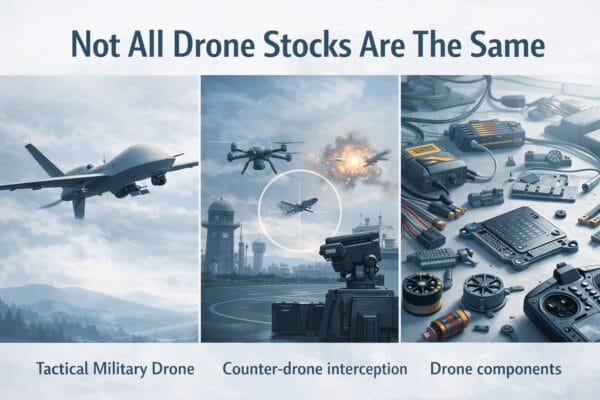
2. The six names that matter most in a public-market comparison
For a serious but readable listed comparison, the most useful group today is this one: AeroVironment (AVAV), Ondas (ONDS), Red Cat (RCAT), Draganfly (DPRO), Kratos Defense (KTOS) and Unusual Machines (UMAC). There are other names around the wider unmanned ecosystem, but these six give a very good spread across the main models investors keep confusing with each other.
AeroVironment is the clearest leader among the pure drone-adjacent public names in terms of maturity, scale and battlefield relevance. The company already sits inside the actual defense procurement logic of modern war. It is the benchmark.
Ondas is much more specialized and much less mature than AeroVironment, but also much easier for the retail crowd to read as a pure thematic winner. Through Airobotics and Iron Drone Raider, it sits much more clearly in the counter-drone and autonomous infrastructure side of the map rather than in the same exact bucket as a Switchblade manufacturer.
Red Cat has become one of the most watched small-cap defense-drone stories. Its identity is easy to summarize: U.S.-based advanced drone and robotic solutions for defense and national security, with Black Widow at the center of the current story.
Draganfly is more mixed and more speculative. It has long had a broader enterprise and public-safety profile, but recent moves show a stronger defense tilt, especially around FPV training and military-facing partnerships.
Kratos is less “pure drone” and much more “unmanned defense ecosystem,” which makes it both strategically more important and less easy to fit into simple retail labels.
Unusual Machines sits in a different lane again: components, FPV equipment, domestic supply chain and the pick-and-shovels side of the drone buildout.
AVAV
Leader
Large-scale autonomous and precision-strike systems, with real battlefield relevance and procurement depth.
ONDS
Counter-UAS
Best seen as an autonomous systems and anti-drone infrastructure story rather than a simple drone maker.
RCAT
Defense sUAS
Small-cap, military-facing, narrative-rich and increasingly central to the retail defense-drone conversation.
DPRO
Hybrid
Public safety, enterprise and defense crossover with higher speculative risk and smaller scale.
KTOS
Ecosystem giant
Broader defense and unmanned systems company; not a pure drone stock, but highly relevant to the sector.
UMAC
Supply chain
More component- and domestic-supply driven than comparable to integrated military drone producers.
3. The first distinction that matters: drone maker, anti-drone player, or drone ecosystem company?
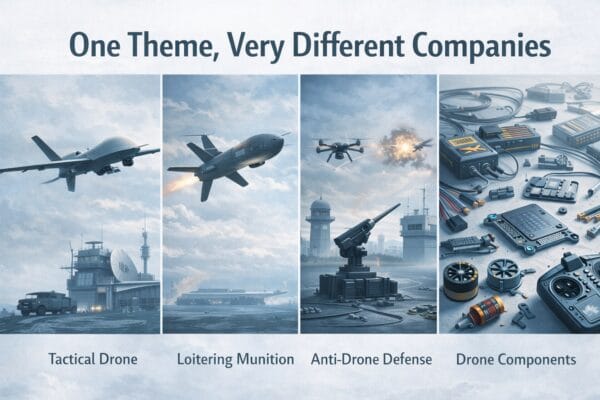
Before comparing tickers, it helps to separate the business models. There are at least three major buckets inside what the market casually calls “drone stocks.”
The first bucket is the most intuitive one: companies that make the actual aircraft systems used for surveillance, tactical reconnaissance, loitering missions or strike roles. AeroVironment sits here most clearly. Red Cat also sits much closer to this bucket than many investors realize. Draganfly sits partly here too, though with a more mixed commercial and government customer base.
The second bucket is counter-drone and autonomous infrastructure. This is where Ondas becomes more distinct. Iron Drone Raider is not simply another reconnaissance UAV. It is a counter-UAS solution designed to detect and intercept hostile drones in critical environments.
The third bucket is the wider ecosystem: companies that may include drones, but are not reducible to them. Kratos is the most obvious example. Unusual Machines is different again: it is tied to the drone ecosystem more through components, FPV equipment and domestic supply-chain positioning than through the sale of a single battlefield drone franchise.
This distinction matters because investors tend to price the three buckets differently. A proven battlefield systems company can command a different premium from an early commercial counter-drone specialist. A supply-chain company can rally on policy and procurement narratives without being directly comparable to a manufacturer of loitering munitions.
The simplest mistake in this sector: treating all drone-related tickers as if they were all selling the same product to the same customer under the same margin structure. They are not.
4. AeroVironment: the benchmark name in the quoted drone universe
If a retail reader wants one name that functions as the benchmark for “real drone and loitering munition business,” AeroVironment is the cleanest choice. The reason is not only brand recognition. It is the fact that the company already sits inside the actual defense procurement logic of modern war.
This is the kind of development that separates a real defense prime-style unmanned business from a smaller company still living mostly on future hopes. AeroVironment has real procurement depth, real systems, real battlefield use and recognized strategic relevance.
Another reason AVAV matters is that it has already moved beyond a one-product identity. It is increasingly viewed as a broader defense technology platform rather than only a niche drone manufacturer.
For readers trying to understand the sector, AeroVironment serves as a useful anchor because it represents what “maturity” looks like in this space: real procurement, a portfolio with depth, battlefield relevance, and a business model already validated by defense customers.
The practical takeaway is simple. AVAV is not the most exciting ticker in every week’s social-media rotation, but it is the clearest proof that the drone theme can scale into a genuine public-company defense franchise.
5. Ondas: not a simple drone maker, but one of the clearest counter-drone public stories
Ondas is one of the most interesting cases in the whole group because it is often talked about as a “drone stock,” but that label only tells part of the story.
The most relevant aspect of ONDS today is its identity in counter-UAS and autonomous infrastructure protection. That makes it different from a classic drone manufacturer.
There is another reason the market watches ONDS so closely: narrative elasticity. The stock can be pulled upward by at least three different themes at once. It can move on defense headlines because of counter-drone logic. It can move on autonomous systems narratives because of Airobotics. It can also move on broader robotics and critical-infrastructure protection themes.
But that flexibility is also a risk. Ondas is easier to imagine than to measure. In AVAV, investors can point to large known procurement relevance. In ONDS, the case often depends more on how quickly orders, backlog and deployments convert into repeatable commercial scale.
That makes ONDS a very good example of a public company that is not best understood as a pure drone builder, but as an autonomous security and counter-drone platform story with unusually strong retail appeal.
6. Red Cat: the small-cap military drone story that retail can understand instantly
Red Cat is one of the easiest names in the basket for the market to narrate. The company’s own description is extremely direct: advanced all-domain drone and robotic solutions for defense and national security, led by the Black Widow family of systems.
Compared with Ondas, Red Cat is easier to understand as a direct tactical drone story. Compared with AeroVironment, it is much smaller, less diversified and less proven at scale. That is exactly why it can be both more exciting and riskier.
RCAT is one of the clearest public examples of a company that sits in the sweet spot between “real defense exposure” and “small-cap narrative explosiveness.”
For retail readers, this often makes Red Cat the most intuitive speculative drone-defense name after they move beyond the giant, more institutionally owned players.
7. Draganfly: the hybrid case between enterprise drones, public safety and defense aspiration
Draganfly is a much trickier company to classify cleanly, and that is exactly why it is useful in this comparison.
It is neither as mature and procurement-heavy as AeroVironment, nor as clearly boxed into the tactical military small-drone identity of Red Cat, nor as specialized in anti-drone infrastructure as Ondas. Instead, it looks more like a company trying to migrate toward defense relevance while still carrying the DNA of a wider unmanned systems business.
That can be a strength if the transition works. It can also be a weakness if the market starts to suspect that the defense story is outrunning the financial base.
This is why DPRO often behaves like a very high-beta way to trade the drone theme: the upside imagination is real, but so is the fragility of the business profile compared with the larger leaders.
The Draganfly question in one line: is this a company successfully evolving into a defense-relevant drone platform, or a hybrid operator whose defense narrative is still ahead of its durable scale?
8. Kratos: the most important name here that is not really a “drone stock” in the retail sense
Kratos is the company most likely to be misunderstood by a reader who only encounters it through themed stock screens. The truth is that Kratos is too broad, too strategic and too embedded in wider defense technology to be reduced to the same kind of label used for a small-cap drone manufacturer.
Kratos belongs in this basket because it gives readers a reference point for what the unmanned theme looks like when it is embedded in a serious defense-industrial platform rather than in a single-ticker hype cycle.
It is less simple, less pure and often less immediately intuitive than RCAT or ONDS. But that complexity is also what makes it strategically deeper.
Investors who think in short time frames may find Kratos less “fun” than the small caps. Readers who want to understand how the drone and unmanned theme fits into actual defense-industrial planning should take it very seriously.
9. Unusual Machines: a very different kind of drone bet
Unusual Machines is perhaps the most important company in this article to place correctly, because many casual readers will misclassify it immediately.
The company does not fit neatly into the same mold as AeroVironment, Red Cat or Ondas. It is better understood as a domestic drone supply-chain and components play than as a direct public-market champion of battlefield drone systems.
This is still relevant, especially because U.S. policy has been pushing for NDAA-compliant and domestically sourced drone components.
In some ways, UMAC is a good reminder of how the drone theme can spread across the value chain. Sometimes the best-known story is the aircraft. Sometimes the more subtle story is the components, motors, cameras, transmitters and compliance-driven reshoring behind it.
10. A side-by-side map: who really belongs to which category?
One of the most useful ways to make this whole sector readable is to stop organizing it by ticker and start organizing it by what each company is actually selling into the market.
| Ticker | Company | Main category | What it really sells | How to think about it |
|---|---|---|---|---|
| AVAV | AeroVironment | Tactical / strike / autonomous systems | Loitering munitions, reconnaissance drones, broader autonomous defense systems | The benchmark public drone and precision-strike franchise |
| ONDS | Ondas | Counter-drone / autonomous infrastructure | Iron Drone Raider, Airobotics autonomous systems, airspace protection | Best read as a counter-UAS and infrastructure automation story |
| RCAT | Red Cat | Defense sUAS | Black Widow and related military/security drone platforms | Small-cap tactical drone story with clear military angle |
| DPRO | Draganfly | Hybrid enterprise / public safety / defense | Drone systems, FPV platforms, training and multi-market unmanned solutions | Transitional operator with upside and higher strategic ambiguity |
| KTOS | Kratos | Broader unmanned defense ecosystem | Drone systems plus wider defense and national-security technologies | Not a pure drone stock; a deeper defense-unmanned systems player |
| UMAC | Unusual Machines | Supply chain / drone components | Components, FPV equipment, compliant domestic parts | A pick-and-shovels style drone industry exposure |
This kind of table is more useful to readers than a ranking by market cap alone, because it helps answer the practical question most people really have: what am I actually owning if I buy one of these stocks?
11. Business reality versus market narrative
This is the section that matters most if the reader wants more than a ticker list. In this sector, the gap between business reality and market narrative can get extremely wide.
AeroVironment lives the closest to business reality. Kratos also lives much closer to business reality than to meme narrative, even if many retail traders only encounter it through drone-themed lists.
Ondas and Red Cat live in a more mixed zone. Both have enough real product logic and enough real customer traction to be taken seriously. But both also benefit enormously from thematic enthusiasm.
Draganfly and Unusual Machines sit still further along the spectrum where expectation can run ahead of present scale. That does not make them illegitimate. It simply means the reader should understand that the stock move and the current operating weight can be very different things.
Closer to current industrial scale
- AeroVironment
- Kratos
- To a lesser but real degree: Red Cat
More exposed to future narrative premium
- Ondas
- Draganfly
- Unusual Machines
This is not a judgment of good versus bad. It is simply a reading tool. Some investors want the more mature operator. Others want the earlier, more explosive story. The important thing is not to confuse one with the other.
12. What readers should actually watch before they get excited by any ticker
A comparative article is only useful if it helps readers look past the logo and the headline. In drone stocks, the first question should not be “which ticker ran the most?” It should be: who is paying for the system, how repeatable is the demand, and what exactly is the company delivering?
With AeroVironment, that question leads naturally into defense procurement depth and product family breadth. With Ondas, it leads into whether airport deployments and critical-infrastructure orders can scale into durable repeat business. With Red Cat, it leads into the quality and repeatability of military and allied demand for its systems.
With Draganfly, it leads into whether the move toward defense is becoming a structural business shift or remains opportunistic. With Kratos, it leads into how much unmanned growth contributes inside a much broader defense platform. With Unusual Machines, it leads into whether domestic sourcing and compliance become a durable parts-supply tailwind rather than a one-cycle policy boost.
The reader who understands those questions is already far ahead of someone who only knows the ticker symbols.
Five practical filters for the whole sector:
1. Is the customer military, police, public safety, enterprise or hobby/consumer?
2. Is revenue driven by recurring contracts or one-off announcements?
3. Is the company building the aircraft, the anti-drone layer, or the parts around the system?
4. Is the story domestic-policy driven, export driven or battlefield-procurement driven?
5. Is the stock being valued on current scale or on a future defense dream?
13. Final view: the sector is real, but the basket is messy
The most useful conclusion is also the simplest one. The drone sector is absolutely real. It matters militarily, strategically and financially much more than it did only a few years ago. But the public-market drone basket is messy.
It contains real battlefield incumbents, emerging small-cap operators, anti-drone specialists, broad defense ecosystem names and supply-chain stories that happen to benefit from the same trend.
This is why readers should stop thinking in terms of “the drone stock trade” as if it were a single clean object. There is no one drone trade. There are several. AVAV is one kind of story. ONDS is another. RCAT is another again. KTOS belongs to an adjacent but deeper world. DPRO and UMAC add still more layers of interpretation.
And that is precisely what makes the space worth studying. Not because every stock is the same, but because they are not.
Disclaimer (EN): This report is provided strictly for educational and informational purposes. It is not investment advice, not a solicitation and not a recommendation to buy, sell or hold any security. All company descriptions and comparative observations are based on public information and may become outdated as contracts, guidance, market prices and corporate strategies evolve.
Defense, aerospace and small-cap thematic stocks can be highly volatile, especially when narrative momentum runs ahead of fundamental scale. Readers should verify primary sources independently and consult a licensed professional where appropriate.
1. Perché questo tema interessa di nuovo così tanto ai lettori retail
Il tema droni è tornato caldo per una ragione semplice: il mercato non lo tratta più come una nicchia futuristica. Lo sta trattando sempre più come uno strato centrale della guerra moderna, della sicurezza di confine, della ricognizione, della strike capacity “attritable” e della protezione delle infrastrutture.
Questo cambio si vede sia nella policy sia nel comportamento di mercato. Il Pentagono ha confermato pubblicamente lo Switchblade 600 di AeroVironment all’interno del programma Replicator. Nello stesso tempo, governi e aziende stanno accelerando sul lato unmanned, e il mercato lo sta capendo.
L’attenzione retail segue naturalmente quando un tema ha tutti gli ingredienti che muovono il mercato: headlines di guerra, budget difesa, vicinanza all’AI, scarsità di hardware, domanda export e sensazione che il campo di battaglia stia cambiando più in fretta della vecchia logica di procurement.
Ma proprio questa intensità crea confusione. Gli investitori vedono salire diversi ticker sullo stesso titolo di giornale e immaginano che facciano tutti più o meno lo stesso lavoro. Non è così.
È per questo che un articolo comparativo ha senso. L’universo dei droni quotati non è una categoria pulita. È molto più simile a un ecosistema.
2. I sei nomi che contano davvero in un confronto quotato
Per un confronto serio ma leggibile, oggi il gruppo più utile è questo: AeroVironment (AVAV), Ondas (ONDS), Red Cat (RCAT), Draganfly (DPRO), Kratos Defense (KTOS) e Unusual Machines (UMAC).
AeroVironment è il leader più chiaro fra i nomi pubblici direttamente legati al mondo droni, sia per maturità sia per scala sia per rilevanza sul campo.
Ondas è molto più specializzata e molto meno matura di AeroVironment, ma anche molto più facile da leggere per il retail come nome tematico puro, grazie a Airobotics e Iron Drone Raider.
Red Cat è diventata una delle storie small-cap defense drone più seguite. La sua identità è facile da riassumere: advanced drone and robotic solutions per difesa e sicurezza nazionale.
Draganfly è più mista e più speculativa. Ha un passato più enterprise e public-safety, ma negli ultimi tempi ha spinto con più forza il lato difesa.
Kratos è meno “puro drone” e molto più “unmanned defense ecosystem”, quindi è insieme più importante strategicamente e meno facile da mettere in un’etichetta retail semplice.
Unusual Machines si muove ancora su una corsia diversa: componenti, FPV equipment, domestic supply chain e lato pick-and-shovels dell’industria droni.
AVAV
Leader
Autonomous systems e precision strike a scala molto più matura e con vera rilevanza di procurement.
ONDS
Counter-UAS
Più una storia di anti-drone e autonomous infrastructure che un drone maker classico.
RCAT
Defense sUAS
Small cap militare, molto leggibile, molto seguita, con narrativa forte su ISR e tactical drones.
DPRO
Hybrid
Incrocio tra enterprise, public safety e difesa, con rischio più speculativo.
KTOS
Ecosystem giant
Molto più ampia di un semplice drone stock, ma fondamentale nel mondo unmanned defense.
UMAC
Supply chain
Esposizione più da componenti, reshoring e compliance che da produttore diretto di sistemi militari completi.
3. La prima distinzione che conta: drone maker, anti-drone player o ecosystem company?
Prima ancora di confrontare i ticker, è utile separare i modelli di business. Dentro ciò che il mercato chiama genericamente “drone stocks” esistono almeno tre grandi bucket.
Il primo è quello più intuitivo: società che costruiscono direttamente gli aircraft systems usati per tactical reconnaissance, sorveglianza, strike o loitering missions. AeroVironment e Red Cat stanno qui in modo molto chiaro. Draganfly in parte pure, ma con un profilo più ibrido.
Il secondo bucket è quello counter-drone e autonomous infrastructure. Qui Ondas emerge come storia distinta. Iron Drone Raider non è semplicemente un altro UAV. È un sistema di difesa contro droni ostili.
Il terzo bucket è l’ecosistema più ampio. Kratos è il caso più evidente. Unusual Machines è diversa ancora: beneficia del tema droni più tramite componenti, supply chain e compliance domestica che tramite la vendita del velivolo finale.
Questa distinzione conta perché il mercato tende a dare multipli e aspettative diversi ai tre bucket.
L’errore più comune nel settore: trattare tutti i titoli legati ai droni come se vendessero lo stesso prodotto allo stesso cliente con la stessa struttura di margini. Non è così.
4. AeroVironment: il benchmark del mondo droni quotato
Se un lettore vuole un nome che faccia da benchmark per capire cosa significhi un business vero e maturo nel mondo droni e loitering munitions, AeroVironment è il riferimento più pulito.
La società è già dentro la logica concreta del procurement militare. Questo la separa nettamente dai nomi più piccoli che vivono ancora molto di aspettative future.
C’è poi la profondità del portafoglio. AVAV non è più una one-product story e questo conta molto nella qualità industriale del nome.
Per un lettore che cerca di capire il settore, AeroVironment è utile perché mostra cosa significa “maturità” in questo spazio: procurement reale, family of systems, rilevanza operativa e business già validato da clienti defense.
In pratica, AVAV non è sempre il ticker più “divertente” del momento, ma è la dimostrazione più chiara che il tema droni può scalare in una vera defense franchise quotata.
5. Ondas: non un semplice drone maker, ma una delle storie counter-drone più chiare del mercato
Ondas è uno dei casi più interessanti dell’intero gruppo perché viene spesso raccontata come “drone stock”, ma questa etichetta dice solo una parte della verità.
L’aspetto più importante oggi è il posizionamento nel counter-UAS e nella protezione autonoma di infrastrutture. Questo la rende diversa da un produttore di droni classico.
Il motivo per cui il mercato guarda con tanta attenzione a ONDS è anche la sua elasticità narrativa. Il titolo può muoversi sul tema difesa, robotics, autonomous systems e critical infrastructure protection.
Ma questa flessibilità è anche un rischio. Ondas è più facile da immaginare che da misurare. In AVAV l’investitore può appoggiarsi a procurement già strutturato. In ONDS, la tesi dipende molto di più dalla velocità con cui ordini, backlog e deployment si trasformano in scala commerciale ripetibile.
Il risultato è che ONDS è un ottimo esempio di società quotata che non va letta come puro drone builder, ma come storia di sicurezza autonoma e anti-drone con forte attrattiva retail.
6. Red Cat: la storia small-cap militare che il retail capisce al volo
Red Cat è uno dei nomi più facili da raccontare al mercato. La descrizione ufficiale è estremamente diretta: advanced all-domain drone and robotic solutions per defense e national security, con Black Widow come asse centrale.
Rispetto a Ondas, Red Cat è più facile da capire come storia di tactical drone puro. Rispetto ad AeroVironment, è molto più piccola, meno diversificata e meno provata su larga scala.
Ed è proprio per questo che può essere sia più emozionante sia più rischiosa. RCAT è uno degli esempi più chiari di titolo che sta a metà tra “vera esposizione defense” e “esplosività narrativa da small cap”.
Per il lettore retail, spesso questo la rende il nome più intuitivo dopo essere uscito dai grandi player più istituzionali.
7. Draganfly: il caso ibrido tra enterprise, public safety e ambizione defense
Draganfly è molto più difficile da classificare in modo netto, ed è proprio questo che la rende utile in questo confronto.
Non è matura e procurement-heavy come AeroVironment. Non è chiaramente boxed nella tactical military identity di Red Cat. Non è specialista anti-drone come Ondas.
Sembra piuttosto una società che prova a spostarsi verso la rilevanza defense mantenendo però il DNA di un operatore unmanned più ampio.
Questo può essere un punto di forza se la transizione funziona. Ma può anche essere una debolezza se il mercato inizia a sospettare che la narrativa defense stia correndo troppo avanti rispetto alla base economica.
La vera domanda su Draganfly: sta davvero evolvendo in una piattaforma drone più credibile per la difesa, oppure resta un operatore ibrido in cui la narrativa militare precede ancora la scala?
8. Kratos: il nome più importante qui dentro che non è davvero un “drone stock” in senso retail
Kratos è la società che più facilmente viene fraintesa da chi la incontra attraverso screen tematici. La verità è che è troppo ampia, troppo strategica e troppo inserita nel mondo più largo della defense technology per essere ridotta alla stessa etichetta usata per una small-cap drone maker.
Kratos appartiene a questo paniere perché offre al lettore un punto di riferimento su come il tema unmanned si inserisca in una vera piattaforma defense-industrial più ampia.
È meno pura, meno semplice e spesso meno intuitiva di RCAT o ONDS. Ma proprio questa complessità la rende strategicamente più profonda.
Chi vuole capire come il tema droni si colleghi davvero all’architettura della difesa moderna dovrebbe prenderla molto sul serio.
9. Unusual Machines: una scommessa diversa sul tema droni
Unusual Machines è probabilmente la società che più di tutte va collocata bene, perché molti lettori la classificherebbero male in automatico.
Non rientra nello stesso stampo di AeroVironment, Red Cat o Ondas. Va letta meglio come una storia di supply chain domestica e componentistica che non come champion diretto di sistemi battlefield completi.
Resta comunque rilevante, specialmente perché la policy statunitense sta spingendo verso componenti NDAA-compliant e supply chain più americane.
In un certo senso, UMAC ricorda al lettore che il tema droni non si limita al velivolo finale. A volte la storia più interessante è fatta di motori, camere, flight controllers, video transmitters e reshoring industriale.
10. Mappa comparativa: chi appartiene davvero a quale categoria?
Uno dei modi più utili per rendere leggibile il settore è smettere di organizzarlo per ticker e iniziare a organizzarlo per ciò che ogni società vende davvero.
| Ticker | Società | Categoria principale | Cosa vende davvero | Come leggerla |
|---|---|---|---|---|
| AVAV | AeroVironment | Tactical / strike / autonomous systems | Loitering munitions, reconnaissance drones, sistemi autonomi di difesa | Benchmark del mondo droni e precision-strike quotato |
| ONDS | Ondas | Counter-drone / autonomous infrastructure | Iron Drone Raider, Airobotics, protezione e automazione dello spazio aereo | Più storia counter-UAS e infrastruttura che drone maker classico |
| RCAT | Red Cat | Defense sUAS | Black Widow e piattaforme tattiche per difesa e sicurezza | Small-cap tactical drone story con lettura militare chiara |
| DPRO | Draganfly | Hybrid enterprise / public safety / defense | Sistemi drone, FPV, training e soluzioni unmanned multi-mercato | Operatore in transizione, con più optionalità ma anche più ambiguità |
| KTOS | Kratos | Broader unmanned defense ecosystem | Droni e sistemi unmanned dentro una piattaforma defense molto più ampia | Non puro drone stock; nome più profondo nell’ecosistema defense |
| UMAC | Unusual Machines | Supply chain / componenti | Componenti, FPV equipment, parti compliant di produzione domestica | Esposizione più “pick and shovels” all’industria droni |
Una tabella così aiuta più di una classifica per capitalizzazione, perché risponde alla domanda pratica che molti lettori hanno davvero: cosa sto comprando, esattamente, se compro uno di questi titoli?
11. Realtà industriale contro narrativa di mercato
Questa è la sezione più importante per chi vuole andare oltre l’elenco ticker. In questo settore, il divario fra realtà industriale e narrativa di mercato può diventare enorme.
AeroVironment vive molto più dalla parte della realtà industriale. Kratos pure, anche se il retail la incontra spesso solo attraverso watchlist tematiche.
Ondas e Red Cat stanno più nel mezzo. Entrambe hanno abbastanza logica di prodotto e abbastanza trazione per essere prese sul serio, ma entrambe beneficiano anche molto dell’entusiasmo tematico.
Draganfly e Unusual Machines stanno ancora più avanti lungo lo spettro in cui le aspettative possono correre davanti alla scala attuale. Questo non le rende illegittime. Significa solo che il movimento del titolo e il peso operativo attuale possono essere due cose molto diverse.
Più vicini alla scala industriale attuale
- AeroVironment
- Kratos
- In parte già anche Red Cat
Più esposti al premium narrativo futuro
- Ondas
- Draganfly
- Unusual Machines
Questa non è una classifica morale. È semplicemente uno strumento di lettura.
12. Cosa dovrebbe guardare davvero un lettore prima di esaltarsi per un ticker
Un articolo comparativo ha senso solo se aiuta il lettore a guardare oltre il logo e il titolo del giorno. Nei drone stocks, la prima domanda non dovrebbe essere “quale ha corso di più?”, ma piuttosto: chi paga davvero per il sistema, quanto è ripetibile la domanda, e che cosa sta realmente consegnando la società?
Con AeroVironment questa domanda porta subito su procurement depth e ampiezza della product family. Con Ondas porta su una questione diversa: deployment in aeroporti e ordini su infrastrutture critiche possono diventare business ripetibile su scala?
Con Red Cat porta sulla qualità e continuità della domanda militare e allied. Con Draganfly porta sul tema se il passaggio verso la difesa stia diventando strutturale o resti opportunistico. Con Kratos porta su quanto la crescita unmanned conti dentro una piattaforma difesa molto più larga. Con Unusual Machines porta su quanto il reshoring e la compliance diventino un vento strutturale per i componenti.
Il lettore che impara a farsi queste domande è già molto più avanti di chi conosce soltanto i ticker.
Cinque filtri pratici per leggere tutto il settore:
1. Il cliente è militare, polizia, public safety, enterprise o hobby/consumer?
2. I ricavi vengono da contratti ripetibili o da annunci isolati?
3. La società costruisce il velivolo, il layer anti-drone o le parti intorno al sistema?
4. La storia è guidata da policy domestica, export o procurement da battlefield?
5. Il titolo è valutato sulla scala attuale o su un sogno difesa futuro?
13. Sintesi finale: il settore è reale, il paniere è disordinato
La conclusione più utile è anche la più semplice. Il settore droni è assolutamente reale. Conta militarmente, strategicamente e finanziariamente molto più di pochi anni fa. Ma il paniere dei drone stocks quotati è disordinato.
Dentro ci sono incumbents veri da battlefield, small cap in crescita, specialisti anti-drone, ecosystem names difesa molto più ampi e supply-chain stories che beneficiano della stessa spinta.
È per questo che i lettori dovrebbero smettere di pensare in termini di “drone trade” unico. Non esiste un solo drone trade. Ce ne sono diversi. AVAV è una storia. ONDS è un’altra. RCAT è un’altra ancora. KTOS appartiene a un mondo vicino ma molto più profondo. DPRO e UMAC aggiungono altri livelli di interpretazione.
Ed è proprio questo a rendere il settore interessante da studiare. Non perché tutti i titoli siano uguali, ma perché non lo sono affatto.
Disclaimer (IT): Questo report ha finalità esclusivamente informative ed educative. Non costituisce consulenza finanziaria, non è una sollecitazione e non rappresenta una raccomandazione ad acquistare, vendere o detenere strumenti finanziari. Le descrizioni societarie e i confronti si basano su fonti pubbliche e possono diventare rapidamente superati con l’evoluzione di contratti, guidance, prezzi di mercato e strategie aziendali.
I titoli difesa, aerospace e small/mid-cap tematici possono essere molto volatili, soprattutto quando la narrativa corre più veloce della scala attuale del business. Chi legge dovrebbe verificare le fonti primarie in autonomia e, se opportuno, consultare un professionista abilitato.