






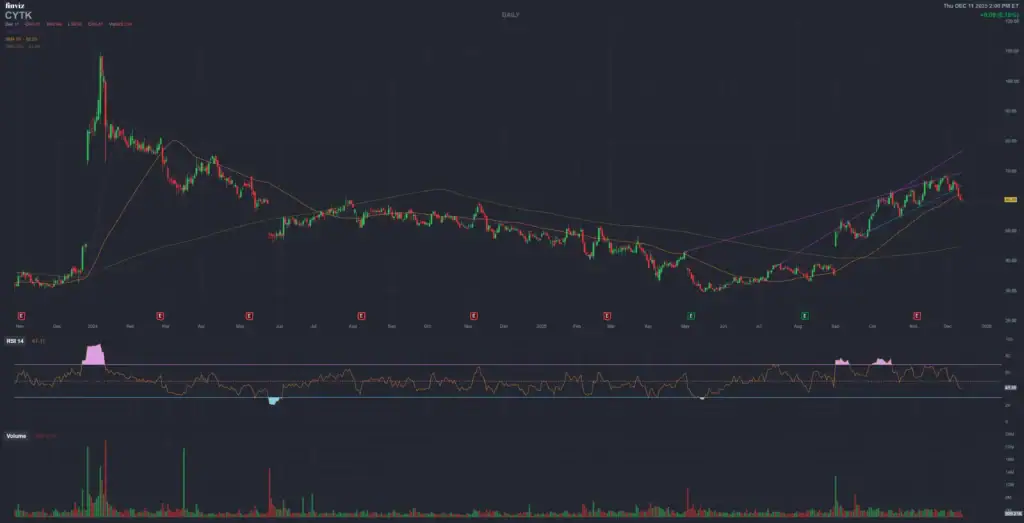
Cytokinetics (CYTK) – Aficamten Ahead of December 26, 2025 FDA PDUFA
Aficamten is entering the FDA decision window for obstructive hypertrophic cardiomyopathy (oHCM) with two positive Phase 3 programs (SEQUOIA-HCM and MAPLE-HCM). Here is a structured view of the clinical data, competition, financial position and key risks into the December 26, 2025 PDUFA date.
Ticker / Exchange
CYTK · Nasdaq
Regulatory catalyst
FDA PDUFA – 26 Dec 2025
Indication
Symptomatic oHCM
Stage
Late-stage / pre-commercial
Executive Summary
What matters into the PDUFA
Cytokinetics is a late-stage cardiovascular biotech whose investment case now turns almost entirely around aficamten, a next-generation cardiac myosin inhibitor for obstructive hypertrophic cardiomyopathy (oHCM). The clinical package in oHCM is strong: the pivotal SEQUOIA-HCM trial versus placebo and the active-control MAPLE-HCM trial versus metoprolol both met their primary endpoints with clinically meaningful gains in peak oxygen uptake (pVO₂), improved symptoms and a safety profile that appears manageable so far.
Key points on aficamten
- SEQUOIA-HCM (Phase 3, placebo-controlled) showed a least-squares mean difference in pVO₂ of about 1.7 mL/kg/min in favor of aficamten (p = 0.000002), with broad improvements across exercise and symptom endpoints and only modest, mostly reversible effects on ejection fraction.
- MAPLE-HCM (Phase 3, aficamten vs metoprolol) demonstrated superiority over a titrated beta-blocker: pVO₂ increased by around 1.1 mL/kg/min with aficamten while it declined by about 1.2 mL/kg/min with metoprolol, yielding a roughly 2.3 mL/kg/min treatment difference at 24 weeks; 51% of patients improved by at least one NYHA class on aficamten versus 26% on metoprolol.
- The FDA extended the original PDUFA date after Cytokinetics submitted a Risk Evaluation and Mitigation Strategy (REMS) proposal; the new action date is December 26, 2025. No new efficacy data were requested.
Context and risk balance
- Camzyos (mavacamten, Bristol Myers Squibb) already validated the oHCM market, but requires a REMS program and carries a boxed warning for LVEF reduction and heart failure risk.
- Aficamten’s data suggest robust efficacy with a dosing scheme that allowed reversible LVEF reductions and a low proportion of patients dropping below 50% LVEF in MAPLE-HCM; however, long-term, real-world safety is still untested.
- The company reported around 1.25 billion dollars in cash, cash equivalents and investments as of September 30, 2025, which should fund a US launch and ongoing trials, but operating losses remain substantial and the balance sheet now includes new convertible notes.
- The PDUFA is a binary regulatory event; a negative outcome or onerous REMS requirements would significantly alter both the commercial outlook and valuation.
Clinical Data – SEQUOIA-HCM vs Placebo and MAPLE-HCM vs Metoprolol
Efficacy and safety signals in symptomatic oHCM
Both pivotal programs used peak oxygen uptake (pVO₂) as the primary endpoint, supported by a dense set of secondary measures: symptoms, functional status, quality of life scores and left ventricular outflow tract (LVOT) gradients. These trials are the backbone of the aficamten regulatory dossier in oHCM.
| Trial | Design / Comparator | Primary efficacy | Symptoms & function | Key safety notes |
|---|---|---|---|---|
| SEQUOIA-HCM | Phase 3, randomized, double-blind, aficamten vs placebo in symptomatic oHCM (NYHA II–III), 24 weeks. | pVO₂ LS mean difference ~1.74 mL/kg/min in favor of aficamten vs placebo (p = 0.000002), on top of background standard therapy. | Consistent improvements across NYHA class, KCCQ clinical summary score, LVOT gradients and other CPET parameters; a larger share of patients achieved substantial (≥3 mL/kg/min) pVO₂ gains compared with placebo. | LVEF reductions were mostly modest and reversible with dose adjustments or temporary interruptions; the trial did not report a large safety signal that would preclude use, but long-term follow-up will be important. |
| MAPLE-HCM | Phase 3, aficamten monotherapy vs metoprolol monotherapy in symptomatic oHCM; 24-week treatment, uptitration allowed in both arms. | pVO₂ increased by about 1.1 mL/kg/min on aficamten and decreased by about 1.2 mL/kg/min on metoprolol; LS mean difference ≈2.3 mL/kg/min (p<0.001), exceeding the usual 1.0 mL/kg/min clinical relevance threshold. | 51% of aficamten-treated patients improved by at least one NYHA class versus 26% on metoprolol. Kansas City Cardiomyopathy Questionnaire scores, LVOT gradients and biomarkers such as NT-proBNP all favored aficamten. | Only around 1% of aficamten patients experienced LVEF <50% (vs 0% with metoprolol), again suggesting a manageable safety window with careful monitoring and dose titration. |
Sources: SEQUOIA-HCM and MAPLE-HCM press releases and publications (New England Journal of Medicine, ESC Heart Failure and ESC Congress 2025), plus subsequent analyses of pVO₂ and biomarker data.
Regulatory Timeline and Current Status
From NDA filing to the December 26, 2025 decision date
The aficamten NDA in oHCM was accepted on the basis of SEQUOIA-HCM and supportive Phase 2 data. In 2025, the FDA requested a REMS proposal focused on monitoring left ventricular ejection fraction and heart failure risk, which Cytokinetics submitted as a major amendment. As a procedural consequence, the agency extended the PDUFA date to December 26, 2025.
Late 2024 – NDA acceptance for aficamten in oHCM
SEQUOIA-HCM pivotal
File based primarily on SEQUOIA-HCM plus earlier phase studies. No advisory committee meeting has been publicly announced at the time of writing.
Mid 2025 – REMS request and major amendment
Safety / monitoring focus
The FDA requested a REMS plan addressing LVEF monitoring and mitigation of heart failure risk. Cytokinetics submitted the amendment; regulators did not ask for new efficacy trials.
December 26, 2025 – Updated PDUFA date
Binary regulatory event
The action date now falls during a period of thin holiday liquidity in the equity markets. Any decision (approval, CRL, or label/REMS constraints) may therefore be associated with amplified price moves, both to the upside and the downside.
Other geographies and label expansion
- Aficamten is also under review in Europe, with a decision expected in 2026 based on the same oHCM dataset.
- Additional programs are exploring non-obstructive HCM and possibly broader cardiomyopathy settings, but these are earlier and carry higher uncertainty.
- A Japanese program is advancing via partners, potentially expanding the addressable market beyond the US and EU if successful.
Timelines outside the US are based on current company guidance and may change as agencies review the risk–benefit profile and REMS-like requirements.
Regulatory note. An extension driven by REMS negotiations is not unusual for
agents that can depress ejection fraction. It does not guarantee any specific outcome: approval with
a manageable REMS, approval with more restrictive labeling, or a Complete Response Letter all remain
possible scenarios at this stage.
Competitive Landscape in HCM
Camzyos, EDG-7500 and other emerging approaches
The HCM field has already been reshaped by cardiac myosin inhibitors. Camzyos (mavacamten) has demonstrated strong commercial traction but requires intensive monitoring. Aficamten aims to compete directly in this space, while newer agents such as EDG-7500 are in earlier phases.
| Asset | Company | Stage / setting | Key efficacy highlights | Key safety / practical points |
|---|---|---|---|---|
| Aficamten | Cytokinetics | Late Phase 3; NDA filed for symptomatic oHCM; additional work in non-obstructive HCM and other cardiomyopathies. | SEQUOIA-HCM: significant pVO₂ improvement vs placebo with broad gains in symptoms and LVOT gradients. MAPLE-HCM: superior to metoprolol in pVO₂, NYHA class, KCCQ and LVOT gradients. | Requires LVEF monitoring but Phase 3 data so far show relatively low rates of LVEF <50% with careful titration; REMS structure will determine the real-world burden. |
| Camzyos (mavacamten) | Bristol Myers Squibb | Approved in the US and other markets for symptomatic oHCM; development in non-obstructive HCM has faced setbacks after a failed trial. | Demonstrated clinically meaningful improvements in exercise capacity, symptoms and LVOT gradients in obstructive HCM; thousands of patients are already on commercial therapy. | Carries a boxed warning for heart failure due to LVEF reduction and requires a REMS program with regular echocardiograms. This safety profile is well documented but imposes monitoring costs and practical constraints on prescribers. |
| EDG-7500 | Edgewise Therapeutics | Phase 2 CIRRUS-HCM trial in oHCM; additional early-phase work in healthy volunteers and broader cohorts. | Interim results showed rapid reductions in LVOT gradients and improvements in feel/function measures and biomarkers without major impact on LVEF at tested doses. | Reports of atrial fibrillation, including serious cases, have raised safety questions; the overall tolerability profile and regulatory view remain to be clarified in larger, controlled trials. |
| Other approaches | Multiple companies | Gene therapy programs (e.g. for sarcomeric mutations) and other modulators are in early development, mainly Phase 1–2. | Aim to address the underlying genetic cause; timelines are longer and risk is higher. | For the current PDUFA window, these programs are not expected to alter the short-term competitive dynamic between aficamten and Camzyos in oHCM. |
Camzyos safety and REMS details are drawn from the official prescribing information and REMS education materials; EDG-7500 data come from company releases and recent cardiology conference coverage.
Market Opportunity in oHCM
Prevalence, diagnosis gap and current Camzyos uptake
Hypertrophic cardiomyopathy is the most common inherited heart disease, with estimated prevalence around 1 in 500 to 1 in 200 people, but remains underdiagnosed and often detected late. Obstructive forms account for a large fraction of clinically recognized cases and are associated with significant symptom burden and risk.
Structural demand drivers
- Prior to myosin inhibitors, treatment relied mainly on beta-blockers and calcium-channel blockers, which alleviate symptoms but do not directly modulate sarcomere hypercontractility.
- With the introduction of Camzyos and, potentially, aficamten, cardiologists now have targeted agents capable of reducing LVOT gradients and improving exercise capacity in a mechanism-based way.
- Company and third-party estimates point to hundreds of thousands of adults with HCM in the US, but only a small share currently diagnosed; the diagnosed oHCM population is much smaller and will likely expand gradually as screening improves.
Early commercial signals from Camzyos
- Bristol Myers Squibb has reported Camzyos quarterly sales that have grown rapidly, with first-quarter 2025 revenues in the low-hundred-million-dollar range and year-over-year growth approaching double-digit percentages.
- Thousands of oHCM patients are already receiving Camzyos; this validates both the willingness of physicians to adopt myosin inhibitors under a REMS and the payer environment for this class.
- Analysts’ long-term models generally treat the oHCM myosin inhibitor market as a multi-billion dollar opportunity when combining Camzyos and potential competitors such as aficamten, assuming successful approvals and broader adoption.
These are expectations and model outputs, not guarantees. Actual uptake will depend on label wording, REMS design, real-world safety, pricing and payer negotiations.
Financial Snapshot and Runway
Cash war chest vs. structural losses
Cytokinetics remains a pre-commercial company with substantial operating losses, but has built a sizeable cash position ahead of potential aficamten launch. The balance sheet is a key part of the PDUFA risk analysis.
| Metric (USD) | Q2 2025 | Q3 2025 | Comments |
|---|---|---|---|
| Total revenue | ≈ 66.8 million | ≈ 1.9 million | Q2 driven by license and milestone revenue (not recurring product sales); Q3 revenues return to a very low base, highlighting pre-commercial status. |
| Net loss | ≈ 134 million | ≈ 306 million | Losses remain large; Q3 includes a sizeable non-cash charge related to debt conversion, but underlying R&D and SG&A are also high due to trial activity and commercial build-out. |
| Cash, cash equivalents and investments | Just over 1.0 billion (end of Q2) | ≈ 1.25 billion (end of Q3) | Cash balance strengthened by a convertible notes offering; management expects to end 2025 with roughly 1.2 billion, supporting launch and ongoing trials if aficamten is approved. |
| Operating expenses (R&D + G&A) | Guidance: 670–710 million for 2025 | Trend: elevated | A significant part of spending is tied to aficamten trial activity, regulatory work and commercial readiness (medical affairs, sales force build-up). |
Figures are taken from the company’s Q2 and Q3 2025 financial releases and earnings call summaries. All amounts should be read in the context of the full SEC filings and official press releases.
Sentiment – Analysts and Retail Traders
How the market is framing the PDUFA
Sell-side and institutional view
- Several large banks and specialist biotech analysts rate Cytokinetics positively, often citing the strength of SEQUOIA-HCM and MAPLE-HCM as justification for constructive views on aficamten.
- Some published notes explicitly discuss aficamten as a potential best-in-class myosin inhibitor in oHCM, while also highlighting remaining questions in non-obstructive disease.
- Price targets mentioned in public sources are generally well above recent trading levels, but they embed assumptions about approval, launch execution, and wider label expansion that may or may not play out as modeled.
These are opinions of third-party analysts and do not constitute, and should not be interpreted as, investment advice.
Retail and social sentiment
- Commentary on retail platforms (Reddit, Stocktwits, X) is heavily focused on the binary nature of the December 26 PDUFA and often concentrates on short-term price moves around the event.
- Many posts emphasize the strong Phase 3 data and compare aficamten favorably to Camzyos; others remind readers of prior biotech examples where positive data did not automatically translate into an easy approval or smooth launch.
- Overall tone is more optimistic than cautious, but this reflects non-professional trader sentiment and should be treated as anecdotal, not as a research input on its own.
Non-professional trader sentiment
High focus on catalyst timing
Limited discussion of balance sheet risk
Risk Framework into the PDUFA
Regulatory, safety, commercial and balance-sheet angles
Regulatory and safety risk
- The FDA could approve aficamten with a REMS that is more restrictive than expected, impacting adoption and physician comfort.
- A Complete Response Letter (e.g. due to concerns about long-term safety or monitoring structures) would likely force additional work and delay commercialization.
- Any unexpected signal in post-marketing surveillance would have disproportionate impact in a mechanism that modulates cardiac contractility.
Commercial execution and competition
- Camzyos already has a lead in cardiologists’ practice and relationships with centers of excellence.
- Aficamten will need to differentiate on efficacy, safety profile, dosing flexibility and REMS burden to gain share rather than only expand the market.
- New entrants such as EDG-7500 could, over time, alter the competitive balance if they address perceived limitations of first-generation agents.
Financial and dilution risk
- Even with a strong cash position, a launch ramp that is slower or more expensive than planned could lead to additional financing needs.
- Recent convertible notes increase financial leverage and potential future dilution.
- If the PDUFA outcome is negative, the current capital structure would need to be re-evaluated against a pipeline without an immediate commercial asset.
Data robustness
- The oHCM dataset is relatively large and supported by multiple Phase 3 and biomarker analyses, which strengthens the clinical story in this indication.
- However, extrapolation to other settings (non-obstructive HCM, broader cardiomyopathies) remains speculative until dedicated studies read out.
Bottom Line – What the Data Say, Without Recommendations
Structured view before the December 26, 2025 decision
Taken together, SEQUOIA-HCM and MAPLE-HCM support the view that aficamten is an effective myosin inhibitor in symptomatic obstructive HCM, capable of improving exercise capacity, symptoms and LVOT hemodynamics in a clinically meaningful way with a safety profile that appears manageable under careful monitoring.
- The regulatory discussion now focuses on how that benefit–risk profile will be reflected in label wording and REMS details, rather than on the existence of efficacy in oHCM.
- The commercial opportunity looks significant, but it is shared with an incumbent (Camzyos) and subject to practical constraints such as monitoring requirements, payer behavior and the pace at which undiagnosed patients are actually identified.
- Cytokinetics enters this binary event with a strong cash position but also with high operating losses and new debt; this amplifies the importance of the aficamten decision for the medium-term trajectory of the entire company.
This report is meant to help frame the clinical and financial picture using public data. It does not express any view on whether the stock is attractive or unattractive at current prices, nor does it suggest any specific action around the PDUFA date.
Tools and Research Platforms Used
Charts, fundamentals and sentiment tracking
Finviz Elite
Used to track technical setups, institutional ownership, short interest and quick screening of peer groups in cardiovascular biotech.
Open Finviz with Merlintrader referralChartsWatcher
ChartsWatcher is a real-time, next-generation scanner for the US stock market, useful to monitor intraday reactions to regulatory headlines and volume spikes around catalysts.
Try ChartsWatcher via Merlintrader
Seeking Alpha
For earnings call transcripts, analyst commentary and historical article coverage of Cytokinetics, aficamten and competing HCM assets.
Open Seeking Alpha with referral
Stocktwits
To monitor real-time retail sentiment and positioning in CYTK around news and PDUFA-related headlines.
Visit Stocktwits with Merlintrader referralMedved Trader
Professional trading platform used for intraday monitoring, tape reading and custom alerts on biotech catalyst moves. No affiliate link is associated with this partner.
Merlintrader trading Blog
All the analysis here is part of the wider Merlintrader trading Blog ecosystem, focused on FDA catalysts, small- and mid-cap biotech and practical tools for active traders.
Affiliate note: some of the links above are affiliate links. If you choose to subscribe or purchase through them, Merlintrader may receive a small commission at no additional cost to you. This helps keep the content and tools available to readers.

If this kind of structured, source-based report is useful to you and you would like to support the work,
you can help keep the site free for everyone with a small, one-time donation via PayPal.
Support Merlintrader on PayPal
Main primary sources used
- Cytokinetics press releases and SEC-aligned financial updates (Q2 and Q3 2025) and aficamten regulatory update and PDUFA extension notices.
- SEQUOIA-HCM and MAPLE-HCM publications and conference presentations (New England Journal of Medicine, ESC Heart Failure, ESC Congress 2025, cardiology societies’ trial summaries).
- Official Camzyos prescribing information and REMS documentation; Bristol Myers Squibb quarterly financial reports and slide decks for Camzyos sales.
- Edgewise Therapeutics press releases and cardiology conference coverage of the CIRRUS-HCM program for EDG-7500.
- Peer-reviewed and review-style articles on HCM prevalence, diagnosis gaps and treatment landscape.
Regulatory and educational disclaimer.
This report is for educational and informational purposes only. It is not intended and must not be
interpreted as investment advice, a recommendation to buy, sell or hold any security, or a solicitation
of any kind. The analysis is based on public information from official filings (including SEC
documents), company press releases, conference presentations and reputable news or scientific sources
available at the time of writing. Data may change as new information appears.
Readers should always refer back to the original filings and official documents, and should consult
a qualified financial professional before making any investment decisions. Markets are volatile and
biotech in particular involves binary regulatory and clinical risks. Nothing in this report is endorsed
by Cytokinetics or by any company mentioned.
Legal and privacy information:
Disclaimer (Merlintrader trading Blog)
·
Terms of use and privacy info