






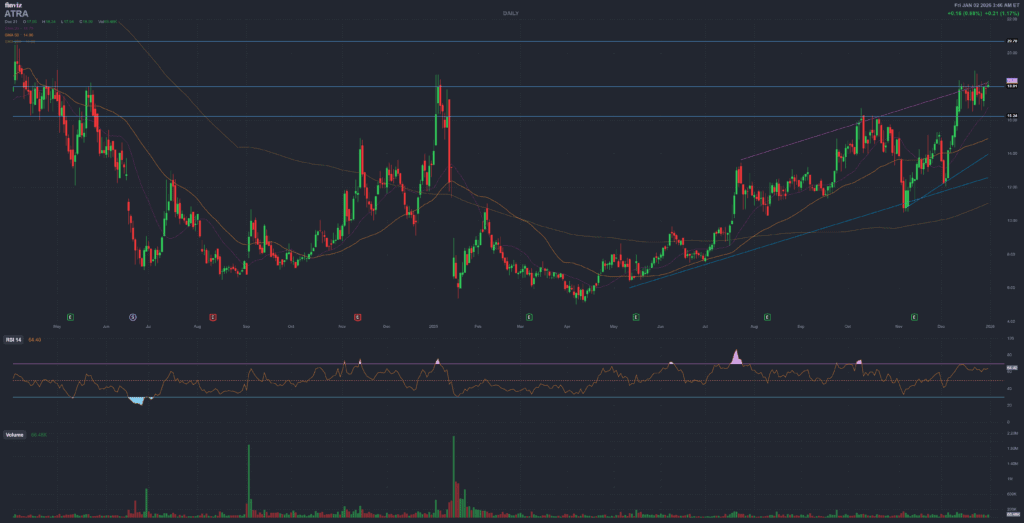
Atara Biotherapeutics · Nasdaq: ATRA · Biotech / Cell Therapy
Atara Biotherapeutics (ATRA) – Deep Dive and Tab-cel PDUFA 10 January 2026
Updated event-driven biotech deep dive on Atara Biotherapeutics and its allogeneic T-cell therapy tab-cel for EBV-positive PTLD, focused on the U.S. FDA action date (PDUFA 10 January 2026), Pierre Fabre execution, SEC-verified cash runway, updated market structure, CEO profile, ownership and retail sentiment.
$18.09
$128.9M
7.21M
4.15M
Market data: latest close available (Jan 1, 2026 close). Financials: Q3 2025 Form 10-Q (period ended Sep 30, 2025). Regulatory: PDUFA target action date Jan 10, 2026.
1. Executive Summary – What ATRA Represents Today (Updated)
Atara Biotherapeutics is now a highly concentrated, event-driven equity story centered on a single binary catalyst: the U.S. FDA decision on tab-cel (tabelecleucel) for EBV-positive PTLD, with a Priority Review PDUFA target action date of 10 January 2026. Over 2024–2025 the company materially reduced its operating footprint and shifted substantially all tab-cel operational activities and associated costs to Pierre Fabre, while Atara’s value to shareholders increasingly hinges on (i) the regulatory outcome, (ii) the associated milestone economics, and (iii) how long the balance sheet can hold without that catalyst.
High-level profile (what matters most for the next days/weeks)
- Single-asset, binary-event setup: tab-cel for EBV+ PTLD (Priority Review; PDUFA 10 Jan 2026).
- Already approved in the EU as Ebvallo (biological/clinical de-risking is meaningful; U.S. risk remains regulatory/manufacturing-focused).
- Pierre Fabre has taken on execution and (per disclosures) substantially all tab-cel operational activities and costs, reducing Atara’s burn baseline.
- The “survival lever” is the approval-linked milestone (commonly cited at $40M) plus a royalty stream on future sales.
- Balance sheet remains fragile: low cash vs liabilities and explicit going-concern language in SEC filings (Q3 2025).
Key idea: this is primarily regulatory + capital structure risk, not a diversified pipeline story. The valuation is tightly linked to the January 2026 FDA decision and the milestone/royalty optionality that follows.
Risk–return profile in one glance
Clinical signal: strong
Regulatory de-risking: medium
Balance sheet risk: very high
Concentration risk: extreme
Retail sentiment: elevated
Analyst coverage: limited
Upside side of the story: tab-cel’s dataset shows meaningful responses and survival in a high-mortality setting with no approved U.S. alternative, and approval would unlock a material cash milestone and potentially a long-tail royalty stream with Pierre Fabre running the commercial plan.
Downside side of the story: without approval and the milestone payment, Atara’s liquidity window can compress quickly. In an adverse scenario, discussion shifts to emergency financing, strategic alternatives, or restructuring dynamics.
2. Price Performance and Market Structure (Updated)
2.1 Current market snapshot
| Metric | Value | Comment |
|---|---|---|
| Last close | $18.09 | Latest close available (Jan 1, 2026 close) |
| Market capitalisation | ~$128.9M | Commonly reported market cap around ~$129–$130M with the latest price window |
| Shares outstanding | ~7.21M | Reported by multiple market data sources (consistent with Q3 2025 period) |
| Float (approx.) | ~4.15M | Low float profile contributes to amplified moves around catalyst headlines |
| Short interest (mid-Dec 2025) | ~166.9k shares | Roughly low-single-digit % of float; not an “extreme squeeze” setup by default |
| Liquidity profile | Thin / micro-cap | Spreads can widen; premarket/after-hours can exaggerate moves around PDUFA |
Note: classic valuation multiples are not very informative here because recent results include non-recurring accounting effects tied to Pierre Fabre transactions and restructuring. The trade setup is dominated by event risk, liquidity, and balance-sheet path dependency.
3. Financials and Cash Runway – SEC-Verified View (Q3 2025)
All figures in this section are sourced from Atara’s Q3 2025 Form 10-Q and the company’s Q3 2025 results communication. Values are rounded for readability.
3.1 Q3 2025 vs Q3 2024 – income statement (headline view)
| Metric | Q3 2025 | Q3 2024 | Change | Key driver |
|---|---|---|---|---|
| Total revenue | $3.5M | $40.2M | Down sharply | Prior-year period included large one-time recognition tied to the partner deal structure |
| Operating expenses | $6.9M | $54.3M | Down sharply | Restructuring + transfer of tab-cel operational activities/costs to Pierre Fabre |
| Net income / (loss) | −$4.3M | −$21.9M | Improved | Lower cost base; different mix of partner-related accounting |
| EPS (diluted) | −$0.32 | −$2.93 | Improved | Lower losses and share count effects |
| Operating cash flow | −$9.8M | −$4.0M | Burn higher | Prior period had different cash inflow timing; quarter-to-quarter noise is meaningful |
3.2 Balance sheet – the hard constraint (liquidity + negative equity)
| Quarter | Cash | Short-term investments | Total liquid assets | Total assets | Total liabilities | Stockholders’ equity |
|---|---|---|---|---|---|---|
| Q3 2025 | $5.7M | $8.0M | $13.7M | $30.2M | $66.8M | −$36.6M |
| Q2 2025 | $16.9M | $5.4M | $22.3M | $36.9M | $71.9M | −$35.0M |
| Q1 2025 | $13.8M | $13.3M | $27.1M | $62.0M | $117.1M | −$55.1M |
Liquidity and solvency risk: Q3 2025 shows total liquid assets around $13.7M against liabilities around $66.8M and a stockholders’ deficit of about $36.6M. Management includes “substantial doubt” / going-concern language in the 10-Q. This is why the January 2026 milestone is not just “nice to have”; it is structurally important.
3.3 Runway illustration (simple, not a forecast)
Approximate runway math: with ~$13.7M liquid assets and a recent operating cash burn near ~$9–10M per quarter (Q3 2025), a simplistic stand-alone runway is roughly ~1–2 quarters. This does not incorporate further cost reductions, working capital effects, financing actions, or timing differences. It is presented to show why the catalyst window dominates the narrative.
4. Tab-cel in EBV-positive PTLD – Data, Status and Market
4.1 Indication and unmet need
Tab-cel (tabelecleucel; Ebvallo in Europe) is an allogeneic EBV-specific T-cell therapy for EBV-positive post-transplant lymphoproliferative disease (EBV+ PTLD), a rare, rapidly progressive complication after solid organ or stem cell transplant. In the relevant setting, there have historically been no FDA-approved therapies in the U.S., which is the core rationale behind expedited review designations.
4.2 Regulatory timeline (what is locked, what is not)
| Region | Status | Date | Notes |
|---|---|---|---|
| European Union | Approved as Ebvallo | Dec 2022 | Meaningful external validation of benefit–risk; not a guarantee for U.S. approval |
| United States | Priority Review | PDUFA: 10 Jan 2026 | Class 2 resubmission accepted; binary event remains |
| United States (history) | Prior CRL | Jan 2025 | Prior FDA action was driven by manufacturing/inspection issues, not efficacy failure |
4.3 ALLELE program – key efficacy/safety points (rounded)
The pivotal dataset is commonly discussed around the Phase 3 ALLELE study and supportive cohorts. Reported figures below are rounded and reflect how the program is typically summarized in public company materials and scientific communications.
| Endpoint | Reported result | Interpretation |
|---|---|---|
| Overall response rate (ORR) | ~50.7% | Strong in an ultra-high unmet need setting |
| Complete response (CR) | ~28% | Meaningful CR fraction supports real clinical impact |
| Median time to response | ~1.1 months | Speed matters in acutely ill PTLD patients |
| Median duration of response | ~23 months | Durability is a core bullish pillar if label/launch occurs |
| Median overall survival | ~18.4 months | Large improvement vs historical expectations is part of the approval thesis |
| Safety (headline) | Low single-digit to ~8% treatment-related AEs (reported) | Favorable relative to many cytotoxic salvage options |
Clinical narrative remains coherent: responses + durability + survival in a setting with limited alternatives. The main FDA uncertainty, based on the company’s own history and mainstream coverage of the CRL, has been manufacturing/inspection/comparability rather than “the drug doesn’t work”.
4.4 Competitive landscape (practical)
EBV+ PTLD remains niche and ultra-rare. Potential future competitors exist (including other virus-specific T-cell approaches and combinations), but the immediate “first-to-market in U.S.” advantage is why the January 2026 date is so focal. Even with premium pricing typical of cell therapy, many external peak sales models fall into low-hundreds-of-millions globally rather than multi-billion scale, and Atara’s exposure is primarily via milestones and royalties rather than direct commercialization.
5. Pierre Fabre – Structure, Execution Shift, and Economics (Updated)
The Pierre Fabre relationship is central because it (i) reduces Atara’s operating burden, (ii) concentrates upside into milestone/royalty economics, and (iii) shifts execution risk to a larger commercial organization.
5.1 Execution shift (what changed operationally)
Public communications in 2025 repeatedly state that substantially all tab-cel operational activities and associated costs were transferred to Pierre Fabre. Later communications also reference the BLA process being handled by Pierre Fabre with Atara supporting/observing as needed. This matters because Atara’s investment case becomes less about “building a cell-therapy company” and more about “owning a royalty/milestone option on a single approval”.
5.2 Key economics (headline terms most investors track)
| Component | Commonly cited value | Timing | Why it matters |
|---|---|---|---|
| FDA approval milestone | $40M | Upon U.S. FDA approval | Transforms runway math immediately; reduces near-term solvency pressure |
| Royalties on net sales | Tiered double-digit (not fully detailed publicly) | Post-launch | Defines the “long tail” value if launch traction is real |
| Commercial milestones | Undisclosed | On sales thresholds | Optionality if commercialization outperforms conservative models |
Why the deal can be shareholder-positive:
- It keeps the asset alive through the finish line despite Atara’s constrained balance sheet.
- It converts a high-burn R&D company into a leaner “milestone/royalty” structure.
- It attaches a credible execution platform to launch and market access.
What you give up:
- Upside is structurally capped: Atara does not capture full commercial revenue.
- Atara becomes dependent on Pierre Fabre’s priorities, resourcing, and go-to-market decisions.
- If launch uptake disappoints, Atara has limited levers to “fix” it.
6. Management Snapshot – CEO Background and Board Signals (New)
6.1 CEO: Cokey Nguyen, Ph.D. (what his background signals)
The current CEO, Cokey Nguyen, Ph.D., was appointed President and Chief Executive Officer in September 2024 and was added to the Board. His profile is unusually “science + cell therapy execution” heavy for a micro-cap in a binary window: prior roles include Chief Scientific Officer at Atara (joined May 2021), prior leadership at Fate Therapeutics (innovation/R&D strategy), and earlier targeted immunotherapy work at Pfizer. His academic background includes Harvard (undergraduate biology) and a Ph.D. in Immunology from Washington University in St. Louis, with postdoctoral work at MIT’s Center for Cancer Research (DNA damage pathway research). In practical terms, this is a CEO built for platform/biology execution and partnerships, which fits the “get tab-cel across the line” mission.
Interpretation (practical, not promotional): this kind of CEO profile tends to optimize for (i) technical credibility with regulators/partners and (ii) operational rigor in complex modalities like cell therapy. It does not remove regulatory risk, but it is directionally aligned with the core weakness of the prior FDA outcome (manufacturing/inspection execution).
6.2 Board composition (why it matters into binary catalysts)
Atara’s board includes members with deep biopharma operating and finance experience (e.g., former CFOs, long-tenured directors) and also investment-firm representation. The chair role has been held by an investment manager (Gregory A. Ciongoli; founder/managing partner of Adiumentum; prior Baupost Group). One director is a managing director at Redmile Group (healthcare-focused investment firm). Another is the founder/managing partner of Panacea Venture. This mix often signals a board that is comfortable with restructuring, financing options, and strategic alternatives if the binary outcome is unfavorable.
What to watch: in micro-caps with runway stress, governance and board composition can matter as much as clinical data. It influences whether the company chooses dilution, asset sales, reverse splits, or partner-driven structures as “Plan B”.
7. Ownership, Insiders, Institutions – Structure and Implications (Expanded)
7.1 High-level ownership split (publicly reported snapshots)
| Category | Commonly reported range | Why it matters into PDUFA |
|---|---|---|
| Insiders (approx.) | ~20% (varies by source/date) | Meaningful insider stake can align incentives, but does not guarantee financing decisions favorable to retail |
| Institutions (approx.) | ~30% to ~45% (varies by source/date) | Institutional presence can stabilize post-event trading, but can also exit quickly if thesis breaks |
| Float profile | Low (around ~4.15M shares) | Amplifies both run-ups and drawdowns; small order flow can move price materially |
7.2 Top institutional holders (examples from commonly-cited public datasets)
Institutional holder lists change each quarter. Below is an illustrative snapshot based on publicly surfaced holder tables for the Sep 30, 2025 reporting window; always verify with the latest 13F/13D/13G filings.
| Holder (example) | Shares (approx.) | % Out (approx.) | Reporting date | Comment |
|---|---|---|---|---|
| EcoR1 Capital | ~573k | ~7.95% | Sep 30, 2025 | Healthcare-focused fund; size can influence liquidity post-event |
| Redmile Group | ~442k | ~6.13% | Sep 30, 2025 | Healthcare specialist; also board-level connection exists via a director |
7.3 Notable beneficial ownership disclosure example (13D/13D-A pattern)
A 13D/13D-A filing in 2025 describes Panacea Venture Healthcare Fund II holding ~1.405M shares, plus warrants (~307.9k) with an ownership cap language (19.99% limit on exercisability). This is a relevant “structure” detail because it hints at (i) sophisticated ownership and (ii) optionality via warrants while maintaining regulatory/structural caps.
Practical takeaway: ATRA is not purely “retail-owned”. There are meaningful specialist holders and board/investment-firm overlap. In binary catalysts, this can cut both ways: it can provide funding pathways if approval occurs, but it can also accelerate repricing if the event fails.
8. Retail Sentiment – Expanded View Into the Binary Window
8.1 What retail is focusing on right now
Retail discussion around ATRA tends to cluster around a few repeating themes:
- “EU approval = de-risked” framing: many posts treat the EU authorization as a strong signal that U.S. approval is likely, even though the prior U.S. CRL was manufacturing/inspection-driven.
- Milestone math: the $40M approval milestone is discussed as the key balance-sheet relief valve (often described as “runway reset”).
- Low float = volatility: the ~4.15M float profile is repeatedly cited as a reason for sharp moves on modest volume, especially in premarket.
- “Binary but asymmetric” narrative: bulls emphasize “first approved therapy in U.S. for EBV+ PTLD” and durable response data; bears focus on liquidity stress and the fact that FDA outcomes can surprise.
8.2 Stocktwits-style social data points (useful as positioning indicators)
On Stocktwits, the ATRA stream shows a relatively large watcher/follower base for a micro-cap and frequently highlights market cap, volume, and 52-week range directly on the symbol page. This matters because in binary catalysts, social attention often correlates with volatility bursts (not with correctness).
How to use this (practical): treat social sentiment as a proxy for crowd expectations and positioning, not as research. When expectations get crowded on one side, price moves can become more violent in both directions.
8.3 Typical retail bull vs bear checklist (not advice, just observation)
Retail bullish checklist (common arguments):
- EU approval already happened (Ebvallo).
- High unmet need; “first-to-market” in U.S. if approved.
- Prior CRL was not an efficacy failure.
- $40M milestone + lower burn changes survival dynamics.
- Low float can amplify upside into/after news.
Retail bearish checklist (common arguments):
- FDA is binary; manufacturing/inspection risk is hard to handicap externally.
- Runway stress can force dilution if outcome is negative or delayed.
- Thin liquidity increases slippage and gap risk.
- Royalty-only economics caps upside vs a full commercial company.
Reminder: social posts are comments from non-professional traders and can be biased, incomplete, or agenda-driven. Use them as “temperature” only.
9. Detailed Risk Analysis (Updated)
1. Liquidity / going-concern risk (structural):
Low liquid assets vs liabilities and explicit going-concern language in Q3 2025 SEC filings create a real tail-risk. Even with cost reductions, binary-event companies can face financing pressure if timelines slip.
Low liquid assets vs liabilities and explicit going-concern language in Q3 2025 SEC filings create a real tail-risk. Even with cost reductions, binary-event companies can face financing pressure if timelines slip.
2. Regulatory/manufacturing risk around 10 January 2026:
The prior CRL underscores that “strong clinical story” does not automatically equal approval. For complex biologics/cell therapies, manufacturing and inspection outcomes can dominate.
The prior CRL underscores that “strong clinical story” does not automatically equal approval. For complex biologics/cell therapies, manufacturing and inspection outcomes can dominate.
3. One-product exposure:
Atara is effectively tab-cel optionality. If tab-cel fails, there is no comparable second asset to re-anchor valuation in the near term.
Atara is effectively tab-cel optionality. If tab-cel fails, there is no comparable second asset to re-anchor valuation in the near term.
4. Micro-cap market structure:
Low float + event-driven attention equals gap risk. Bid–ask and liquidity can deteriorate exactly when you need them most (headlines, premarket).
Low float + event-driven attention equals gap risk. Bid–ask and liquidity can deteriorate exactly when you need them most (headlines, premarket).
Commercial risk (post-approval): EBV+ PTLD is ultra-rare. A “win” can still underdeliver on long-term revenue if adoption, reimbursement, or operational logistics move slower than expected. With royalties, Atara participates but does not control.
10. Illustration of Possible Scenarios (Educational Framework)
Not a forecast or recommendation. This is a structured way to think about balance-sheet impact and equity reflexivity under different regulatory outcomes.
| Scenario | Illustrative probability | Qualitative impact | Typical market reaction (conceptual) |
|---|---|---|---|
| Approval | Illustrative only | Milestone unlocked; runway extends; royalty story becomes investable | Initial jump then re-pricing based on launch execution and funding strategy |
| Approval with meaningful restrictions | Illustrative only | Milestone likely received but commercial ceiling lower | Mixed reaction; “win” but valuation capped |
| Rejection / new CRL | Illustrative only | No milestone; financing/strategic alternatives become urgent | Large drawdown risk; liquidity becomes the dominant variable |
In real markets, positioning and liquidity can dominate “fair value” in both directions. Use scenarios as a checklist for questions, not as a decision engine.
11. Key Dates and Milestones to Monitor
| Date / period | Event | Expected impact | Notes |
|---|---|---|---|
| 10 January 2026 | PDUFA target action date – FDA decision on tab-cel | Critical | The primary binary event for equity and liquidity |
| Early Jan 2026 | Volatility / positioning window | High | Low-float micro-cap dynamics can amplify moves |
| Post-event (Q1 2026) | Cash update / financing strategy / partner launch commentary | High | Defines “what happens next” after the binary print |
12. Analyst Coverage and Target Prices (Updated)
Analyst coverage is limited and generally scenario-dependent (most targets embed approval assumptions). Always verify latest notes directly from primary sources when possible.
| Firm | Analyst | Rating | Target price | Date (as reported) | Notes |
|---|---|---|---|---|---|
| Canaccord Genuity | John Newman | Buy (maintained) | $25 | Dec 19, 2025 | Material increase reported in multiple market summaries |
| Mizuho | Salim Syed | Outperform (kept) | $18 | Nov 21, 2025 | Target raised; narrative tied to cost reductions + PDUFA focus |
| Consensus (example) | Multiple | Buy (mean) | ~$19 average | Late 2025 | Consensus tables vary by provider; range often ~$16–$25 |
Targets are not guarantees. In binary catalysts, the distribution of outcomes is not “linear”. A single FDA decision can invalidate every model assumption overnight.
13. Main Sources Used (Clickable)
This update relies on primary filings and company communications, plus widely used market data pages for ownership/short interest and social sentiment indicators.
- Atara press release: FDA acceptance / Priority Review / PDUFA Jan 10, 2026: Investor Relations – Press Release
- Atara Q3 2025 results + operational update (includes milestone language and tab-cel transfer context): Investor Relations – Q3 2025 Release
- SEC filing: Form 10-Q (period ended Sep 30, 2025): 10-Q (HTML)
- CEO + board bios (official company page): Atara – Board of Directors
- Major holders snapshot (example dataset): Yahoo Finance – Holders
- Key statistics (shares/float/insiders/institutions; provider-dependent): Yahoo Finance – Key Statistics
- Short interest reference (example): MarketBeat – Short Interest
- 13D/A example (beneficial ownership detail): Schedule 13D/A (PDF)
- Retail sentiment indicator / symbol page: Stocktwits – ATRA stream
- Context on prior U.S. CRL (mainstream coverage): Reuters – Jan 16, 2025
1. Executive Summary – Cosa rappresenta ATRA oggi (Update)
Atara Biotherapeutics oggi è, in modo molto netto, una storia azionaria “event-driven” concentrata su un solo evento binario: la decisione FDA USA su tab-cel (tabelecleucel) per EBV-positive PTLD, con Priority Review e PDUFA target action date fissata al 10 gennaio 2026. Nel 2024–2025 l’azienda ha ridotto drasticamente l’operatività e ha spostato a Pierre Fabre sostanzialmente tutte le attività operative e i costi associati a tab-cel. Di conseguenza, il valore per l’azionista dipende sempre di più da (i) esito regolatorio, (ii) milestone economiche e (iii) quanto “regge” il bilancio in assenza del catalyst.
Profilo ad alto livello (cosa conta davvero nei prossimi giorni/settimane)
- Setup single-asset e binario: tab-cel per EBV+ PTLD (Priority Review; PDUFA 10 gen 2026).
- Già approvato in UE come Ebvallo (de-risking clinico/biologico reale; il rischio USA resta regolatorio/di manufacturing).
- Pierre Fabre gestisce l’esecuzione e, secondo le comunicazioni, ha assorbito quasi tutte le attività/costi operativi su tab-cel, riducendo la base di burn.
- La “leva di sopravvivenza” è la milestone legata all’approvazione (spesso citata a $40M) più royalties future.
- Bilancio fragile: cassa bassa vs passività e linguaggio di going concern nei filing SEC (Q3 2025).
Idea chiave: qui il cuore è rischio regolatorio + struttura di capitale, non una pipeline diversificata. La valutazione è legata alla decisione di gennaio 2026 e all’opzionalità milestone/royalty.
Profilo rischio–rendimento “in un colpo d’occhio”
Segnale clinico: forte
De-risking regolatorio: medio
Rischio bilancio: molto alto
Concentrazione: estrema
Sentiment retail: alto
Copertura analisti: limitata
Lato upside: i dati di tab-cel mostrano risposte e sopravvivenza in un setting ad alta mortalità senza alternative approvate in USA; l’approvazione sbloccherebbe una milestone cash rilevante e una coda di royalties con Pierre Fabre in esecuzione commerciale.
Lato downside: senza approvazione e senza milestone, la finestra di liquidità può restringersi rapidamente. In caso avverso, il focus si sposta su finanziamenti di emergenza, alternative strategiche o dinamiche di ristrutturazione.
2. Prezzo e Struttura di Mercato (Update)
2.1 Snapshot di mercato attuale
| Metica | Valore | Commento |
|---|---|---|
| Ultima chiusura | $18.09 | Ultima chiusura disponibile (close 1 gen 2026) |
| Capitalizzazione | ~$128.9M | Market cap riportata spesso intorno a ~$129–$130M nell’ultimo intervallo |
| Azioni in circolazione | ~7.21M | Valore coerente tra più fonti e con il periodo Q3 2025 |
| Float (circa) | ~4.15M | Float basso: volatilità amplificata in prossimità di news/catalyst |
| Short interest (metà dic 2025) | ~166.9k azioni | Percentuale bassa a singola cifra sul float; non è “squeeze estremo” di base |
| Profilo liquidità | Thin / micro-cap | Spread e gap risk aumentano soprattutto in premarket/after-hours |
Nota: i multipli classici contano poco qui, perché negli ultimi trimestri ci sono effetti non ricorrenti legati a Pierre Fabre e al restructuring. Il setup è dominato da rischio evento, liquidità e vincoli di bilancio.
3. Finanza e Runway – Vista “SEC-Verified” (Q3 2025)
Tutti i numeri in questa sezione provengono dal Form 10-Q Q3 2025 e dalla comunicazione risultati Q3 2025. I valori sono arrotondati per leggibilità.
3.1 Q3 2025 vs Q3 2024 – conto economico (headline)
| Voce | Q3 2025 | Q3 2024 | Variazione | Driver principale |
|---|---|---|---|---|
| Ricavi | $3.5M | $40.2M | Calo forte | Nel 2024 presenza di riconoscimenti one-off legati alla struttura del deal |
| Spese operative | $6.9M | $54.3M | Calo forte | Restructuring + trasferimento attività/costi tab-cel a Pierre Fabre |
| Utile/(perdita) | −$4.3M | −$21.9M | Migliora | Base costi più bassa; mix diverso di accounting legato al partner |
| EPS (diluito) | −$0.32 | −$2.93 | Migliora | Perdite ridotte e effetto conteggio azioni |
| Cash flow operativo | −$9.8M | −$4.0M | Burn più alto | Rumore trimestrale importante; timing incassi diverso vs anno precedente |
3.2 Bilancio – il vincolo duro (liquidità + equity negativa)
| Trimestre | Cassa | Investimenti brevi | Liquidità totale | Attivi | Passività | Equity |
|---|---|---|---|---|---|---|
| Q3 2025 | $5.7M | $8.0M | $13.7M | $30.2M | $66.8M | −$36.6M |
| Q2 2025 | $16.9M | $5.4M | $22.3M | $36.9M | $71.9M | −$35.0M |
| Q1 2025 | $13.8M | $13.3M | $27.1M | $62.0M | $117.1M | −$55.1M |
Rischio liquidità e solvibilità: Q3 2025 mostra liquidità totale ~$13.7M vs passività ~$66.8M ed equity negativa ~−$36.6M. Nel 10-Q è presente linguaggio di “substantial doubt” / going concern. Ecco perché la milestone di gennaio 2026 non è un dettaglio: è strutturalmente critica.
3.3 Runway “a spanne” (solo per capire il vincolo)
Calcolo semplice: con ~$13.7M di liquidità e un burn operativo recente vicino a ~$9–10M a trimestre (Q3 2025), una runway “stand-alone” può essere ~1–2 trimestri. Non include ulteriori tagli costi, variazioni di working capital o finanziamenti. Serve solo a visualizzare perché il catalyst domina.
4. Tab-cel in EBV+ PTLD – Dati, Stato Regolatorio e Mercato
4.1 Indicazione e unmet need
Tab-cel (tabelecleucel; Ebvallo in Europa) è una terapia allogenica con T-cellule specifiche per EBV, destinata alla EBV-positive post-transplant lymphoproliferative disease (EBV+ PTLD), una complicanza rara e spesso rapidamente fatale dopo trapianto di organo o di cellule staminali. Nel setting rilevante, storicamente non ci sono state terapie approvate FDA in USA, ed è uno dei motivi per cui il dossier riceve designazioni accelerate.
4.2 Timeline regolatoria (cosa è certo, cosa no)
| Area | Status | Data | Note |
|---|---|---|---|
| Unione Europea | Approvato come Ebvallo | Dic 2022 | De-risking importante, ma non garantisce l’esito USA |
| Stati Uniti | Priority Review | PDUFA: 10 gen 2026 | Class 2 resubmission accettata; evento binario |
| USA (storia) | CRL precedente | Gen 2025 | Esito negativo legato a manufacturing/inspection, non a fallimento di efficacia |
4.3 Programma ALLELE – punti chiave (arrotondati)
Il dataset pivotale viene spesso riassunto intorno allo studio di fase 3 ALLELE e coorti di supporto. I numeri sotto sono arrotondati e riflettono il modo in cui il programma viene tipicamente presentato pubblicamente.
| Endpoint | Risultato riportato | Interpretazione |
|---|---|---|
| ORR | ~50.7% | Molto forte in un contesto a bisogni enormi |
| CR | ~28% | Quota di risposte complete significativa |
| Tempo mediano alla risposta | ~1.1 mesi | Rapidità clinicamente rilevante |
| Durata mediana risposta | ~23 mesi | Durabilità: pilastro chiave della tesi “bull” |
| Sopravvivenza mediana | ~18.4 mesi | Molto superiore alle aspettative storiche spesso citate |
| Sicurezza (headline) | AE treatment-related in low single digit fino a ~8% (riportati) | Profilo favorevole rispetto a molte opzioni salvage |
La narrativa clinica resta coerente: risposte + durabilità + sopravvivenza in un setting con alternative limitate. L’incognita FDA, per storia e copertura mainstream, è stata soprattutto manufacturing/inspection/comparabilità più che “il farmaco non funziona”.
4.4 Competizione (pratica)
EBV+ PTLD è ultra-rara. Esistono potenziali competitori futuri (anche approcci di T-cellule virus-specifiche e combinazioni), ma l’eventuale “first-to-market in USA” è il motivo per cui gennaio 2026 è così centrale. Anche con prezzi premium tipici del cell therapy, molti modelli esterni stimano peak sales globali “low hundreds of millions”, non miliardi; e Atara partecipa soprattutto via milestone/royalties, non con commercializzazione diretta.
5. Pierre Fabre – Struttura, Spostamento dell’Esecuzione ed Economia (Update)
Pierre Fabre è centrale perché (i) riduce l’onere operativo su Atara, (ii) concentra l’upside su milestone/royalties e (iii) sposta l’execution risk verso un’organizzazione commerciale più grande.
5.1 Spostamento esecutivo (cosa è cambiato)
Nel 2025 le comunicazioni pubbliche ribadiscono che sostanzialmente tutte le attività operative e i costi associati a tab-cel sono stati trasferiti a Pierre Fabre. Altre comunicazioni indicano la gestione del processo BLA da parte di Pierre Fabre con supporto/monitoraggio Atara. Questo cambia l’equity story: meno “costruire una cell-therapy company”, più “opzione milestone/royalty su un’approvazione”.
5.2 Economia chiave (headline che il mercato segue)
| Componente | Valore spesso citato | Timing | Perché conta |
|---|---|---|---|
| Milestone approvazione FDA | $40M | Alla approvazione USA | Reset della runway; riduce pressione solvibilità nel breve |
| Royalties su vendite nette | Double-digit “tiered” (non dettagliato completamente) | Dopo il lancio | Definisce il valore “long tail” se il lancio funziona |
| Milestone commerciali | Non divulgate | Al raggiungimento soglie vendite | Opzionalità se l’adozione supera modelli conservativi |
Perché può essere positivo per l’azionista:
- Tiene vivo l’asset fino al traguardo nonostante il bilancio compresso.
- Trasforma Atara in una struttura più leggera “milestone/royalty”.
- Collega il lancio a una piattaforma commerciale più credibile.
Cosa si sacrifica:
- Upside strutturalmente limitato: Atara non incassa ricavi commerciali pieni.
- Dipendenza dalle scelte e priorità di Pierre Fabre.
- Se il lancio delude, Atara ha poche leve per cambiare traiettoria.
6. Management – Curriculum CEO e segnali dal Board (Nuovo)
6.1 CEO: Cokey Nguyen, Ph.D. (cosa suggerisce il profilo)
Il CEO attuale, Cokey Nguyen, Ph.D., è stato nominato President e Chief Executive Officer a settembre 2024 ed è entrato anche nel Board. È un profilo molto “cell therapy + esecuzione scientifica” per una micro-cap in finestra binaria: era Chief Scientific Officer in Atara (dal maggio 2021), prima ha avuto ruoli di leadership in Fate Therapeutics (strategia innovation/R&D) e ancora prima ha lavorato su targeted immunotherapy in Pfizer. A livello accademico: Harvard (laurea in biologia), Ph.D. in Immunology a Washington University in St. Louis e post-doc al MIT (Center for Cancer Research). In pratica, è un CEO costruito per credibilità tecnica con partner/regolatori e per gestire complessità tipiche delle terapie cellulari.
Interpretazione (pratica, non promozionale): un profilo del genere tende ad essere coerente con il “mission critical” di questa storia: portare tab-cel alla decisione regolatoria, con attenzione a manufacturing e qualità, cioè proprio dove la storia precedente aveva mostrato fragilità.
6.2 Board (perché conta in un evento binario)
Il board include profili con esperienza operativa e finanziaria (ex CFO e directors di lungo corso) e anche rappresentanza legata a investment firm. Il chairman è un investment manager (Gregory A. Ciongoli; Adiumentum; ex Baupost). È presente anche un managing director di Redmile Group (healthcare-focused). Un altro director è il founder/managing partner di Panacea Venture. Questo mix in genere indica un board “a suo agio” con scenari di financing, restructuring e alternative strategiche nel caso di esito negativo.
Cosa monitorare: nelle micro-cap con runway stress, governance e composizione del board possono contare quanto i dati clinici: influenzano scelte su diluizione, asset sale, reverse split, o strutture guidate dal partner.
7. Azionariato, Insiders e Istituzionali – Struttura e Implicazioni (Espanso)
7.1 Split ad alto livello (snapshot pubblici)
| Categoria | Range spesso riportato | Perché conta verso la PDUFA |
|---|---|---|
| Insiders (circa) | ~20% (varia per fonte/data) | Allineamento incentivi possibile, ma non garantisce scelte “pro-retail” sul financing |
| Istituzionali (circa) | ~30% a ~45% (varia per fonte/data) | Possono stabilizzare o accelerare repricing post-evento |
| Float | Basso (~4.15M) | Amplifica run-up e drawdown; piccoli flussi muovono molto il prezzo |
7.2 Esempi di top holders (snapshot su finestra Sep 30, 2025)
Le liste istituzionali cambiano ogni trimestre. Tabella indicativa basata su holder tables pubbliche (sempre da verificare con filing 13F/13D/13G più recenti).
| Holder (esempio) | Azioni (circa) | % Out (circa) | Data reporting | Commento |
|---|---|---|---|---|
| EcoR1 Capital | ~573k | ~7.95% | Sep 30, 2025 | Fondo healthcare; rilevante per liquidità post-evento |
| Redmile Group | ~442k | ~6.13% | Sep 30, 2025 | Specialista healthcare; presente anche legame “board-level” |
7.3 Esempio di disclosure beneficial ownership (pattern 13D/13D-A)
Un filing 13D/13D-A nel 2025 descrive Panacea Venture Healthcare Fund II con ~1.405M azioni, più warrants (~307.9k) con linguaggio di cap (19.99% limite di esercizio). È un dettaglio utile perché suggerisce (i) presenza di holder sofisticati e (ii) opzionalità via warrant mantenendo limiti strutturali.
Takeaway pratico: ATRA non è “solo retail”. Ci sono holder specializzati e overlap tra board e investment firm. In un evento binario può aiutare (path di funding) o accelerare il repricing se il catalyst fallisce.
8. Sentiment Retail – Vista espansa nella finestra binaria
8.1 Su cosa è focalizzato il retail adesso
La discussione retail su ATRA tende a ripetersi su pochi temi principali:
- “UE approvato = de-risked”: molti post trattano l’approvazione UE come segnale forte, pur essendo l’esito USA già passato da un CRL per temi di manufacturing/inspection.
- Milestone math: la milestone da $40M viene vista come “valvola” per il bilancio (reset runway).
- Float basso: con float ~4.15M, la volatilità può essere violenta anche con volumi modesti.
- Asimmetria: bull: first approved therapy in USA; bear: rischio FDA + runway stress.
8.2 Dati social “stile Stocktwits” (utili come indicatori di posizionamento)
Sulle pagine social tipo Stocktwits, ATRA mostra un seguito non banale per una micro-cap e mette in evidenza market cap, volumi e range 52 settimane. In questi eventi binari, l’attenzione social spesso correla con esplosioni di volatilità (non con la “correttezza” del trade).
Uso pratico: il sentiment va trattato come termometro di aspettative/posizionamento, non come ricerca. Quando una narrativa diventa affollata, i movimenti possono diventare più violenti in entrambe le direzioni.
8.3 Checklist tipica bull vs bear (osservazione, non consiglio)
Checklist “bull” più comune:
- Approvazione UE già avvenuta.
- Unmet need e first-to-market potenziale in USA.
- CRL precedente non era fallimento di efficacia.
- $40M milestone + burn più basso cambia la sopravvivenza.
- Float basso amplifica upside su news.
Checklist “bear” più comune:
- FDA binaria; il rischio manufacturing/inspection è difficile da valutare esternamente.
- Runway stress può forzare diluizione se esito negativo o ritardi.
- Liquidità thin = slippage e gap risk.
- Economica royalty-only limita upside rispetto a una commercial company.
Nota: i post social sono commenti di trader non professionisti e possono essere incompleti o “biased”. Servono come temperatura, non come base decisionale.
9. Analisi Rischi (Update)
1. Rischio liquidità / going concern (strutturale):
Liquidità bassa vs passività ed esplicito going-concern nei filing Q3 2025 creano tail-risk reale. Anche con tagli costi, basta uno slittamento per mettere pressione al financing.
Liquidità bassa vs passività ed esplicito going-concern nei filing Q3 2025 creano tail-risk reale. Anche con tagli costi, basta uno slittamento per mettere pressione al financing.
2. Rischio regolatorio/manufacturing su 10 gennaio 2026:
Il CRL precedente dimostra che “storia clinica forte” non garantisce approvazione. Nelle terapie complesse, manufacturing e ispezioni possono dominare.
Il CRL precedente dimostra che “storia clinica forte” non garantisce approvazione. Nelle terapie complesse, manufacturing e ispezioni possono dominare.
3. One-product exposure:
Atara è quasi solo opzionalità tab-cel. Se tab-cel fallisce, manca un secondo asset per re-ancorare la valutazione nel breve.
Atara è quasi solo opzionalità tab-cel. Se tab-cel fallisce, manca un secondo asset per re-ancorare la valutazione nel breve.
4. Struttura micro-cap:
Float basso + attenzione evento = gap risk. Spread e liquidità peggiorano proprio nei momenti cruciali.
Float basso + attenzione evento = gap risk. Spread e liquidità peggiorano proprio nei momenti cruciali.
Rischio commerciale (post-approval): EBV+ PTLD è ultra-rara. Anche un “win” può sottoperformare nelle vendite se adozione e reimbursement sono lenti. Con royalties, Atara partecipa ma non controlla.
10. Scenari Possibili (Framework Educativo)
Non è una previsione né una raccomandazione. È un modo ordinato per ragionare su impatto bilancio e reazione del titolo in base a esiti diversi.
| Scenario | Probabilità (solo illustrativa) | Impatto qualitativo | Reazione tipica (concettuale) |
|---|---|---|---|
| Approvazione | Solo illustrativa | Milestone sbloccata; runway si estende; story royalty diventa “investibile” | Jump iniziale poi repricing su lancio e strategia funding |
| Approvazione con restrizioni | Solo illustrativa | Milestone probabile ma ceiling commerciale più basso | Reazione mista: win tecnico ma upside limitato |
| Rejection / nuovo CRL | Solo illustrativa | Niente milestone; alternative strategiche e financing urgenti | Rischio drawdown molto alto; la liquidità diventa la variabile dominante |
Nei mercati reali, posizionamento e liquidità possono dominare la “fair value” in entrambe le direzioni. Usare gli scenari come checklist di domande, non come motore decisionale.
11. Date Chiave e Milestone da Monitorare
| Data / periodo | Evento | Impatto atteso | Note |
|---|---|---|---|
| 10 gennaio 2026 | PDUFA target action date – decisione FDA su tab-cel | Critico | Evento binario principale per equity e liquidità |
| Inizio gennaio 2026 | Finestra volatilità / posizionamento | Alta | Float basso amplifica i movimenti |
| Post-evento (Q1 2026) | Aggiornamento cassa / strategia financing / commenti lancio partner | Alta | Definisce “cosa succede dopo” |
12. Analisti e Target Price (Update)
Copertura limitata e fortemente scenario-dependent (molti target assumono approvazione). Verificare sempre note e aggiornamenti più recenti.
| Casa | Analista | Rating | Target | Data (come riportata) | Note |
|---|---|---|---|---|---|
| Canaccord Genuity | John Newman | Buy (mantenuto) | $25 | 19 dic 2025 | Aumento riportato da più riepiloghi di mercato |
| Mizuho | Salim Syed | Outperform (mantenuto) | $18 | 21 nov 2025 | Target alzato; focus su cost discipline + PDUFA |
| Consensus (esempio) | Multipli | Buy (media) | ~$19 medio | Fine 2025 | Tabelle diverse per provider; range spesso ~$16–$25 |
I target non sono garanzie. In un evento binario, la distribuzione degli esiti non è “lineare”: una decisione FDA può invalidare i modelli in un attimo.
13. Fonti Principali (Cliccabili)
Update basato su filing SEC e comunicazioni ufficiali, più pagine dati di mercato per ownership/short interest e indicatori di sentiment social.
- Press release Atara: accettazione FDA / Priority Review / PDUFA 10 gen 2026: Investor Relations – Press Release
- Risultati Q3 2025 + update operativo (milestone e contesto tab-cel transfer): Investor Relations – Q3 2025 Release
- SEC: Form 10-Q (periodo chiuso 30 set 2025): 10-Q (HTML)
- Bio CEO e Board (pagina ufficiale): Atara – Board of Directors
- Major holders (snapshot esempio): Yahoo Finance – Holders
- Key statistics (shares/float/insiders/institutions; dipende dal provider): Yahoo Finance – Key Statistics
- Short interest (esempio): MarketBeat – Short Interest
- 13D/A (esempio beneficial ownership): Schedule 13D/A (PDF)
- Indicatore sentiment retail / pagina simbolo: Stocktwits – stream ATRA
- Contesto CRL precedente (copertura mainstream): Reuters – 16 gen 2025
Biotech Catalyst Calendar
Track upcoming FDA decisions and key biotech catalysts in one place: https://merlintrader.com/calendario-catalyst/