





Ardelyx Inc. (NASDAQ: ARDX)
Ardelyx (ARDX) – Preliminary 2025 Revenue & 2026 Outlook
Addendum to the main Merlintrader report on Ardelyx (ARDX), following the January 8, 2026 press release with preliminary 2025 revenue and an updated 2026 strategic outlook for IBSRELA and XPHOZAH.
Versus the December 2025 base case
1. 2025 product revenue – guidance delivered
In the original report we emphasised how management had raised 2025 guidance for IBSRELA into the $270–275M range and how several analysts were framing 2025 as the last loss year, with 2026 as the first potentially profitable year if growth continued.
The January 8 press release largely confirms that narrative:
- Total 2025 product revenue ≈ $378M, about 18% year-on-year growth.
- IBSRELA ≈ $274M in 2025, up ~73% vs 2024 and squarely in the $270–275M guidance range.
- XPHOZAH ≈ $104M, with approximately $28M in Q4 alone – better than many feared after Medicare/bundling turbulence.
Put simply, Ardelyx exits 2025 with a stronger revenue base than the “stress scenario” many had in mind after the reimbursement noise around XPHOZAH. This makes the idea of 2026 as a first profitable year more realistic, even if margins will still need to be watched closely.
Source PR: GlobeNewswire – January 8, 2026
New guidance
2. 2026 outlook – a higher bar for IBSRELA and XPHOZAH
The press release does more than recap the past year; it sets a clearer bar for 2026 and beyond:
- IBSRELA 2026 net product revenue: $410–430M, i.e. at least ~50% growth vs 2025.
- Long-term objective: IBSRELA reaching $1B in annual sales by 2029, with growth beyond loss of exclusivity.
- XPHOZAH 2026: $110–120M, a modest but meaningful increase from 2025’s ~$104M.
For modelling purposes, this guidance implies a significantly larger IBSRELA contribution by the decade’s end than more conservative scenarios suggested. XPHOZAH is no longer at risk of stalling, but the heavy lifting in terms of upside clearly sits with IBSRELA.
Pipeline & intellectual property
3. CIC, new patent and the second layer of the story
On top of the revenue numbers, Ardelyx has added a few pipeline and IP elements that matter for the medium term:
- Initiation of a Phase 3 trial of IBSRELA in chronic idiopathic constipation (CIC), with completion expected in the second half of 2027.
- A notice of allowance for a new patent covering the commercial formulations of IBSRELA and XPHOZAH, with expiry on December 6, 2041.
- Continued development of RDX10531, a next-generation NHE3 inhibitor (still early relative to the commercial assets).
CIC opens a second large GI indication for tenapanor, while the extended patent term strengthens the backdrop for the “$1B by 2029” positioning. RDX10531 remains more of an option value for now, but confirms the intent to build a broader NHE3 franchise.
What doesn’t change
4. Core risks remain the same
Even with this constructive update, the key caveats from the main report still apply:
- The 2026 guide for IBSRELA is ambitious; any slowdown in prescription growth could put pressure on the “first profitable year in 2026” narrative.
- XPHOZAH’s environment has improved relative to worst-case fears, but dialysis economics and bundling mechanics remain structurally tricky.
- Pipeline success beyond IBSRELA/XPHOZAH is not guaranteed and will require time (CIC readout only in 2027, and RDX10531 is earlier-stage).
Net-net, the January 8 release shifts the balance modestly in favour of the bull case: visibility on the revenue ramp is better, and the strategic framing is clearer. But ARDX is still a name where investors will need to track execution and catalysts, not a “set and forget”.
Ardelyx Inc. (NASDAQ: ARDX)
Ardelyx (ARDX) – Aggiornamento su ricavi 2025 e guida 2026
Addendum al report principale di Merlintrader su Ardelyx (ARDX), dopo la press release dell’8 gennaio 2026 con i dati preliminari 2025 e il nuovo outlook strategico 2026 per IBSRELA e XPHOZAH.
Rispetto allo scenario di fine 2025
1. Ricavi 2025 – guidance centrata
Nel report originale avevamo sottolineato come il management avesse alzato la guidance 2025 di IBSRELA a 270–275M $ e come diversi analisti vedessero il 2025 come ultimo anno in perdita, con il 2026 come primo potenziale anno in utile se la crescita fosse proseguita.
La press release dell’8 gennaio conferma grosso modo questo quadro:
- Ricavi prodotto totali 2025 ≈ 378M $, circa +18% anno su anno.
- IBSRELA ≈ 274M $ nel 2025, +~73% rispetto al 2024, perfettamente dentro la forchetta guidata 270–275M $.
- XPHOZAH ≈ 104M $, con ~28M $ nel Q4 – meglio di quanto molti temevano dopo le turbolenze su Medicare e bundle ESRD.
In pratica, Ardelyx esce dal 2025 con una base ricavi più solida rispetto allo “scenario stressato” che si temeva dopo i problemi di rimborso di XPHOZAH. Questo rende più credibile l’idea di un 2026 in utile, anche se margini e costi andranno ancora monitorati.
Fonte PR: GlobeNewswire – 8 gennaio 2026
Nuova guida
2. Outlook 2026 – asticella più alta
Il comunicato non è solo un consuntivo del 2025: fissa in modo più chiaro la barra per il 2026 e per gli anni successivi:
- IBSRELA 2026: 410–430M $ di ricavi netti, cioè almeno ~+50% rispetto al 2025.
- Obiettivo di lungo periodo: IBSRELA a 1 miliardo di $ nel 2029, con crescita oltre la fine dell’esclusiva.
- XPHOZAH 2026: 110–120M $, step up moderato ma significativo rispetto ai ~104M $ del 2025.
Tradotto in numeri, questa guida implica un contributo IBSRELA decisamente più grande a fine decennio rispetto agli scenari più conservativi. XPHOZAH non sembra più a rischio di “deragliare”, ma il grosso della leva di valore resta chiaramente su IBSRELA.
Pipeline & proprietà intellettuale
3. CIC, nuovo brevetto e “secondo piano” della storia
Oltre ai ricavi, Ardelyx aggiunge alcuni elementi su pipeline e IP che contano sul medio periodo:
- Avvio di uno studio di Fase 3 di IBSRELA nella chronic idiopathic constipation (CIC), con completamento previsto nella seconda metà del 2027.
- Notice of allowance per un nuovo brevetto che copre le formulazioni commerciali di IBSRELA e XPHOZAH, con scadenza al 6 dicembre 2041.
- Prosecuzione dello sviluppo di RDX10531, inibitore NHE3 di nuova generazione (ancora in fase iniziale rispetto agli asset commerciali).
La CIC apre una seconda grande indicazione gastrointestinale per tenapanor oltre IBS-C, mentre l’estensione brevettuale rafforza lo sfondo per la narrativa del “1B $ a 2029”. RDX10531 oggi è soprattutto optionalità in più sulla piattaforma NHE3.
Rischi invariati
4. Dove la tesi di base non cambia
Anche con questo aggiornamento positivo, i punti di attenzione del report principale restano:
- La guida 2026 su IBSRELA è ambiziosa: se la curva di adozione dovesse rallentare, la narrativa del “primo anno in utile nel 2026” tornerebbe in discussione.
- Per XPHOZAH il contesto è migliore del temuto ma strutturalmente complesso (economica dei centri dialisi, bundle ESRD, incentivi non sempre allineati).
- Il successo della pipeline oltre IBSRELA/XPHOZAH non è garantito e richiederà tempo (CIC con readout solo nel 2027, RDX10531 ancora agli inizi).
In sintesi, la PR dell’8 gennaio sposta la bilancia leggermente verso i tori: la visibilità sulla rampa di ricavi è migliore e il messaggio strategico è più chiaro. Ma ARDX resta un titolo da seguire su dati ed esecuzione, non un “compra e dimentica”.
Ardelyx (ARDX)
NASDAQ: ARDX – IBSRELA, XPHOZAH and a compressed path toward 2026 profitability
Report generated:
Financial data through Q3 2025 – stock and consensus as of late December 2025
News of the day – catalyst cluster
Q3 2025: revenue beat, IBSRELA guidance raised, Street now models ARDX turning profitable in 2026
In Q3 2025 Ardelyx delivered total revenue of roughly $110 million, beating consensus by about 10% and
growing double digits vs. 2024. IBSRELA revenue reached more than $78 million in the quarter, up over 90%
year-on-year, prompting management to raise full-year 2025 IBSRELA guidance to the $270–275 million
range. XPHOZAH contributed around $27 million, growing sequentially despite losing Medicare Part D
coverage from January 2025 as the drug was moved into the ESRD PPS bundle, a change that materially
complicates U.S. reimbursement for dialysis patients. At the same time, several analyst updates now
model 2025 as Ardelyx’s last loss-making year and project a first net profit in 2026, assuming IBSRELA’s
growth holds up and operating leverage gradually improves.
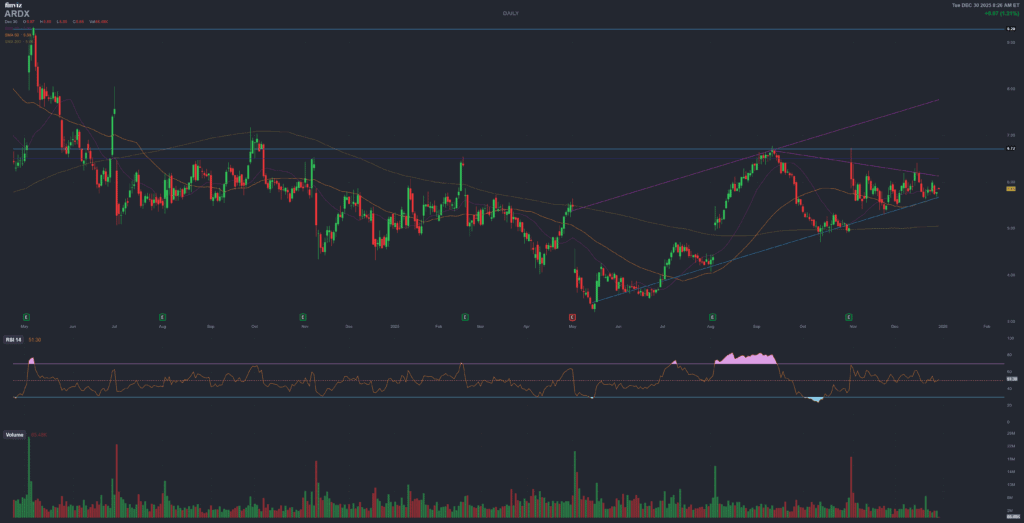
Price action and technical snapshot
Chart courtesy of
Finviz.
As of late December 2025 ARDX trades around the mid-$5s, with a 52-week range roughly $3.2–6.8,
market cap near $1.4–1.5 billion and beta slightly above 1. Always confirm live data before trading;
this report relies on static snapshots.
Quick data panel
Recent close (approx.)
$5.7–6.0
Market cap
$1.4–1.5B
2025 Q3 total revenue
$110M
Q3 2025 product revenue
$105M
Cash (Sep 30, 2025)
$240M+
Analyst avg 12-m target
$11–12
Numbers based on Ardelyx’s Q3 2025 release and recent analyst summaries. Most Street models still
show a small loss in 2025, with the median forecast pointing to positive net income in 2026 if IBSRELA
keeps compounding and operating expenses grow more slowly than revenue.
Executive summary
Ardelyx has executed one of the more striking turnarounds in the small-cap biotech space. After multiple setbacks and an initial FDA rejection of tenapanor in chronic kidney disease, the company now has two tenapanor-based products commercialized in the United States: IBSRELA for irritable bowel syndrome with constipation (IBS-C) and XPHOZAH for hyperphosphatemia in dialysis patients as add-on therapy. IBSRELA has emerged as the primary growth engine, with U.S. IBSRELA revenue almost doubling year-over-year in Q3 2025 and management targeting roughly $270–275 million for full-year 2025. XPHOZAH, while clinically differentiated as a first-in-class phosphate absorption inhibitor, has run into complex Medicare policy headwinds that constrain its near-term potential.
The overall financial picture has improved substantially: Ardelyx generated about $110 million in total revenue in Q3 2025, beating consensus by a wide margin and demonstrating double-digit growth versus the prior year. Cash stood around the mid-$200 million range at quarter-end, and the company has guided towards continued IBSRELA growth and disciplined investment in R&D. Sell-side models and recent commentary from equity research and financial media broadly converge on a narrative of 2025 as the last loss-making year and 2026 as the inflection to sustainable profitability, assuming no major negative surprises on reimbursement or pipeline execution.
At the same time, the investment case is not without controversy. XPHOZAH’s inclusion in the ESRD PPS bundle from January 2025 removed Medicare Part D coverage for the product and forced Ardelyx to lean on specialty distribution, patient-assistance programs and legislative advocacy (notably the Kidney PATIENT Act) to protect access. The company lost its lawsuit challenging CMS’s classification decision in late 2024, and legislative timing remains uncertain. Outside tenapanor, the pipeline is relatively concentrated, with a Phase 2 program (RDX013) in hyperkalemia and a preclinical NHE3 inhibitor (RDX10531) as the main areas of optionality. As a result, much of the bull/bear debate centers on IBSRELA’s medium-term growth ceiling, XPHOZAH’s real commercial potential under the bundle and the credibility of 2026–2027 earnings projections.
Key catalysts – IBSRELA, XPHOZAH and beyond
| Date / horizon | Type | Event | Status |
|---|---|---|---|
| Jan 1, 2025 | Policy / reimbursement | Start of ESRD PPS bundling for oral-only phosphate-lowering drugs, including XPHOZAH. Medicare Part D coverage is removed and dialysis centres are paid via a single bundle. This is the key structural headwind for XPHOZAH unless mitigated by policy or legislation. | Past (ongoing impact) |
| Q3 2025 | Financial | Q3 2025 revenue beat: total revenue ~$110M, product revenue ~$105M; IBSRELA up ~92% YoY and XPHOZAH up sequentially despite Medicare headwinds. Full-year 2025 IBSRELA guidance raised to $270–275M. | Recent (completed) |
| Dec 31, 2025 | Clinical | Primary completion date (estimated) for the Phase 3 pediatric IBSRELA trial in IBS-C (NCT05643534), enrolling patients aged 12–18. Sets the stage for top-line data in Q1 2026. | Just completed |
| Q1 2026 | Clinical | Top-line data from the Phase 3 pediatric IBSRELA study. A positive outcome could support a supplemental NDA for adolescents and expand the long-term IBSRELA franchise; weak data would keep the label restricted to adults. | Upcoming |
| Feb 19, 2026 (est.) | Financial / corporate | Q4 2025 earnings and full-year 2025 results, with 2026 guidance. A key moment to see whether management formally targets operating/net profitability in 2026 and how aggressively they plan to invest in R&D and SG&A. | High-impact |
| 2025–2026 | Legislative | Progress of the Kidney PATIENT Act in U.S. Congress. In its stronger versions, the bill would delay ESRD PPS bundling of oral-only drugs like XPHOZAH until 2033. A positive outcome would be a major relief for the XPHOZAH opportunity; failure or dilution keeps the current headwind in place. | Event-driven |
| 2025–2026 | Commercial | IBSRELA revenue trajectory vs. the $270–275M 2025 target and beyond. After ~92% YoY growth in Q3, investors will watch whether IBSRELA can sustain high double-digit growth into 2026. | Ongoing |
| 2024–2025 | Ex-U.S. | Tenapanor-based products launched or approved ex-U.S. through partners: PHOZEVEL in Japan and a tenapanor product for hyperphosphatemia approved in China, with regional partners responsible for commercialization and Ardelyx eligible for milestones/royalties. | Ongoing |
| 2026 (guidance) | Pipeline | Potential NDA filing for R-531 (also referred to as RDX10531), a next-generation NHE3 inhibitor. Recent company presentations suggest a 2026 timeframe is on the table if data and FDA feedback are supportive. | Medium-term |
| 2026 (est.) | Clinical | Phase 2 readouts for RDX013 in hyperkalemia. Positive data could open a new nephrology franchise and de-risk Ardelyx’s dependence on tenapanor; weak data would reinforce the “tenapanor-centric” view of the pipeline. | Upcoming |
| 2026–2027 | Financial | Transition to sustained profitability: consensus currently models a final net loss in 2025 and a first positive net income in 2026, driven by IBSRELA leverage and stabilisation of XPHOZAH. Actual trajectory will depend on R&D spend, SG&A discipline and policy outcomes. | Model-driven |
| Event | Expected timing | Impact |
|---|---|---|
| ESRD PPS bundling for oral PLTs (XPHOZAH) | Jan 1, 2025 | Critical structural headwind if not mitigated. |
| IBSRELA pediatric Phase 3 top-line (IBS-C 12–18) | Q1 2026 | Medium–high: label expansion and long-term growth. |
| Q4 2025 earnings & 2026 guidance | Feb 19, 2026 (est.) | High: first real look at profitability trajectory. |
| Kidney PATIENT Act outcome | 2025–2026 | Very high: could materially re-rate XPHOZAH. |
In practice, the ARDX story is a three-way tension between (1) IBSRELA’s commercial momentum, (2) how much of XPHOZAH’s potential can be salvaged under the ESRD bundle (with the Kidney PATIENT Act as a key swing factor) and (3) whether the early pipeline (RDX013, RDX10531/R-531) and ex-U.S. tenapanor deals can add meaningful value beyond the core U.S. GI/renal franchises.
Company overview and product profile
IBSRELA (tenapanor) – IBS-C
IBSRELA is an oral, first-in-class inhibitor of the intestinal sodium/hydrogen exchanger 3 (NHE3). By reducing sodium absorption in the gut, it increases intestinal fluid and accelerates transit, which helps relieve constipation and abdominal discomfort in patients with IBS-C. The drug is minimally absorbed and acts locally in the intestinal lumen, which differentiates it mechanistically from secretagogues like linaclotide and plecanatide.
The current U.S. label covers adult patients with IBS-C. IBSRELA carries a boxed warning about the risk of severe dehydration in young children and is contraindicated in patients under six years of age; use in patients between six and twelve years should be avoided. Safety and efficacy have not been established in patients under eighteen. In practice, this confines IBSRELA to the adult population and reinforces its positioning as a chronic therapy in a segment of the IBS-C market that has failed or not tolerated other agents.
Commercially, IBSRELA has become the centre of gravity for Ardelyx. After a slow initial ramp, revenue growth has accelerated through 2024 and 2025, with Q3 2025 sales up around 90% year-on-year and full-year guidance raised multiple times. Management and several third-party analyses now talk openly about a long-term scenario where IBSRELA could exceed one billion dollars in peak U.S. net sales if it reaches double-digit market share in IBS-C and maintains price integrity. That outcome is not guaranteed, but it is the backbone of many bullish models.
XPHOZAH (tenapanor) – hyperphosphatemia in dialysis
XPHOZAH is also tenapanor, but deployed in a very different clinical setting: control of serum phosphorus in adults with chronic kidney disease on dialysis who cannot achieve target levels with phosphate binders alone or cannot tolerate them. Instead of binding dietary phosphate in the gut, XPHOZAH inhibits its absorption by blocking the primary paracellular pathway. Clinically, the drug has demonstrated meaningful reductions in serum phosphorus levels and offers an oral tablet that can be used as an add-on to existing binder regimens.
The key issue for XPHOZAH is not scientific but economic and regulatory. As of January 1, 2025, CMS has included oral-only drugs like XPHOZAH in the ESRD PPS bundle, meaning that Medicare Part D no longer covers the drug separately and dialysis facilities receive a single bundled payment that is supposed to cover dialysis services and related drugs. Ardelyx has repeatedly warned that this change could materially restrict XPHOZAH’s use because dialysis providers may be reluctant to adopt a new, relatively expensive oral therapy without dedicated reimbursement.
The company chose not to pursue inclusion in the TDAPA add-on payment program and instead filed a lawsuit against CMS while lobbying for the Kidney PATIENT Act, which would delay or exempt oral-only phosphate-lowering therapies from the bundle. The lawsuit was dismissed in late 2024, and while the legislative route remains alive, its timing and final form are unclear. In the meantime, XPHOZAH is still generating revenue, particularly from commercially insured patients and through specialty distribution, but Medicare-related headwinds are likely to cap near-term growth.
Ex-U.S. tenapanor partnerships
Ardelyx has out-licensed tenapanor ex-U.S. to regional partners. Kyowa Kirin markets PHOZEVEL in Japan for hyperphosphatemia, and Fosun Pharma has secured approval of a tenapanor product for hyperphosphatemia in China. In Canada and some other markets, additional partners are responsible for development and commercialization. These deals typically provide milestones and royalties, offering a degree of geographic diversification, although the bulk of the near-term value still comes from the U.S. IBSRELA franchise.
Pipeline and strategic direction
RDX013 – hyperkalemia (Phase 2)
RDX013 is an oral small-molecule potassium secretagogue designed to treat hyperkalemia by promoting potassium excretion through the gut. The approach aims to give nephrologists and cardiologists a chronic management tool that allows them to keep patients on life-saving but potassium-raising drugs (such as renin-angiotensin system blockers) rather than dose-reducing or discontinuing them. Early data and external analyses describe RDX013 as a potentially convenient small-pill formulation with a different mechanism from existing binders.
As of late 2025, RDX013 is in Phase 2, with trial registries and pipeline trackers pointing to key data readouts around 2026. A positive efficacy and safety profile in hyperkalemia could open a second major nephrology franchise and de-risk Ardelyx’s dependence on tenapanor. Conversely, weak data or safety issues would reinforce concerns about a limited pipeline beyond IBSRELA/XPHOZAH.
RDX10531 – preclinical NHE3 inhibitor
RDX10531 is described by the company as a next-generation NHE3 inhibitor with potential application across multiple therapeutic areas. Details are deliberately sparse at this stage; the program remains preclinical. Strategically, RDX10531 is part of Ardelyx’s effort to leverage its expertise in intestinal ion transport into additional indications beyond IBS-C and hyperphosphatemia, but investors should treat it as long-dated optionality rather than a near-term driver.
Other research directions
Ardelyx has historically explored multiple cardiorenal and GI programs, some of which were discontinued or deprioritized after disappointing data or strategic shifts. The company’s current stated strategy is to invest R&D around core adjacencies to IBSRELA and XPHOZAH (GI and nephrology), while being selective about advancing new assets into late-stage trials. R&D spending has been rising again through 2025, reflecting renewed focus on pipeline expansion, but also contributing to the debate around expense discipline versus growth.
Financial snapshot and path to profitability
Ardelyx entered 2024 still loss-making but with rapidly expanding IBSRELA and XPHOZAH revenues. By 2024, the company reported several hundred million dollars in annual revenue with strong year-on-year growth, and by Q3 2025 quarterly revenue had reached about $110 million. Product revenue of roughly $105 million in Q3 2025 was split between IBSRELA (~$78M, up around 90% YoY) and XPHOZAH (~$27M, up sequentially but pressured by Medicare changes). Cash as of September 30, 2025 stood around $240 million, providing a reasonable, though not unlimited, runway for continued commercial and R&D investment.
| Metric (approx.) | Value / comment (latest available) |
|---|---|
| Q3 2025 total revenue | ~$110M – beat vs. consensus by high single to low double digits. |
| Q3 2025 product revenue | ~$105.5M – IBSRELA ~$78.2M, XPHOZAH ~$27.4M. |
| IBSRELA revenue trend | ~92% YoY growth in Q3 2025; full-year 2025 guidance raised to ~$270–275M. |
| XPHOZAH revenue trend | Up sequentially in Q3 but down vs. prior year due to loss of Medicare Part D coverage and bundling into ESRD PPS; mix increasingly skewed to non-Medicare payers. |
| Cash, cash equivalents, ST investments | ~$240M at Sep 30, 2025; no significant debt reported. |
| Profitability | Still net-loss making in 2025; consensus models first positive net income (on the order of a few tens of millions of dollars) in 2026 if IBSRELA trajectory holds. |
| 2025–2026 EPS expectations | Street generally expects a modest loss per share in 2025 and a swing to positive EPS in 2026, with a wide range reflecting uncertainty on R&D, XPHOZAH and any equity financing. |
Put simply, Ardelyx is transitioning from “clinical story” to “small but real commercial company”. The more IBSRELA can grow with limited incremental SG&A and the more XPHOZAH can maintain relevance despite Medicare changes, the cleaner the glide-path to 2026–2027 profitability. Conversely, any slowdown in IBSRELA, additional pricing pressure or heavier than expected R&D/funding needs would push breakeven further out.
Sentiment (X, Stocktwits, Reddit)
X (Twitter). On X, Ardelyx appears regularly in biotech watchlists whenever IBSRELA or XPHOZAH data are presented or when legislative news around the Kidney PATIENT Act surfaces. Bulls emphasise IBSRELA’s trajectory and the possibility of a “hidden small-cap compounder” if the drug approaches blockbuster status. Bears stress the Medicare overhang on XPHOZAH, the concentrated pipeline and insider sales following share-price strength. The tone oscillates between enthusiasm around quarterly beats and scepticism when policy headlines dominate.
Stocktwits. ARDX has shown repeated spikes in message volume and sentiment during earnings seasons and after major news. Following strong Q2 and Q3 2025 results and price-target hikes, Stocktwits data have at times registered sentiment in the “extremely bullish” zone with message volume jumping several hundred percent day-over-day. Traders frequently discuss ARDX as a potential multi-bagger on continued IBSRELA growth, but also react sharply to any dilution-related filings (e.g., new shelf registrations) with short-term pullbacks and heated debate.
Reddit and forums. Dedicated threads and small subreddits discuss Ardelyx’s legal battle with CMS, the Kidney PATIENT Act and perceived fairness of bundling oral-only drugs into ESRD PPS. Some posts characterise ARDX as a “50/50 legislative trade” tied to the bill’s fate, while others frame it as a longer-term story where IBSRELA alone can justify the valuation, treating any XPHOZAH reversal as upside optionality. Questions about insider selling and institutional ownership also surface periodically, reflecting the usual tension between retail conviction and management de-risking of equity exposure.
Note: this section summarises observable sentiment from public platforms (Stocktwits, X, Reddit and
general financial media). These are opinions from non-professional traders and commentators and should
be treated as anecdotal context, not as a basis for investment decisions.
Bull vs bear case
Bull case
- IBSRELA is demonstrating strong, recurring prescription growth in a large chronic market where patients often cycle through treatments; if it reaches double-digit market share in IBS-C, peak U.S. revenue could exceed a billion dollars according to some long-term scenarios.
- Q3 2025 showed that Ardelyx can deliver a “beat and raise” quarter: revenue above consensus, IBSRELA guidance raised and XPHOZAH still contributing despite Medicare changes. This reinforces the view that the business can scale into profitability without a new flagship product.
- Analyst coverage is broadly constructive, with many firms rating ARDX “Buy” or “Outperform” and average 12-month price targets roughly double the current share price, reflecting optimism around IBSRELA leverage and optionality from pipeline and ex-U.S. deals.
- RDX013 offers potential entry into the hyperkalemia market, where long-term oral therapies that allow physicians to keep patients on guideline-directed treatments are highly valuable. A positive Phase 2 outcome could add a second nephrology pillar.
- The balance sheet, while not bullet-proof, is much healthier than in the past, with around a quarter-billion dollars in cash at Q3 2025 and no large debt load, giving Ardelyx some room to navigate policy noise and fund key programs.
- Ex-U.S. partnerships spread tenapanor’s risk and could generate steady royalties. If Japan and China uptake surprise positively, this could reinforce the overall tenapanor franchise value beyond the U.S. reimbursement debate.
Bear case
- Despite stronger numbers, Ardelyx still hinges heavily on a single marketed asset (IBSRELA) in a competitive IBS-C landscape. Linaclotide and other agents are entrenched, and payers may push harder on step-edits or rebates as IBSRELA grows.
- XPHOZAH’s inclusion in the ESRD bundle and loss of Medicare Part D coverage significantly reduce its near-term economic potential. Even if some usage persists via specialty channels, the addressable market may be far smaller than originally envisioned unless legislation changes.
- The Kidney PATIENT Act, while enjoying bipartisan interest, is ultimately a political variable. Delays, dilution of the bill’s scope or outright failure would lock in a tougher reimbursement environment for XPHOZAH and leave the company reliant on commercial and non-Medicare segments.
- The pipeline beyond tenapanor is relatively thin. RDX013 and RDX10531 are still in early or mid-stage development; setbacks there would reinforce the perception of Ardelyx as a “one-and-a-half product company” rather than a diversified platform.
- Operating expenses, particularly R&D and commercial spend, have been rising. If costs keep growing faster than revenue, the 2026 profitability narrative could slip, requiring further equity raises and diluting shareholders.
- Insider selling after share-price strength and a pattern of frequent capital raising over the past years may weigh on investor trust. Bulls see this as normal de-risking; bears see it as a sign that management is more cautious than the promotional narrative suggests.
Key risk factors
Concentration risk
Ardelyx’s near-term value lives mainly in IBSRELA and, to a lesser extent, XPHOZAH. If IBSRELA’s
growth stalls due to competition, safety concerns, payer pressure or new entrants, the equity
story would be materially impaired.
Reimbursement risk (XPHOZAH)
Inclusion of XPHOZAH in the ESRD PPS bundle and removal of Medicare Part D coverage could structurally
limit the drug’s use in the majority of U.S. dialysis patients. Legislative remedies such as the
Kidney PATIENT Act are uncertain in timing and outcome; failure to secure a more favourable policy
environment would cap XPHOZAH’s long-term contribution.
Pipeline execution
RDX013 and RDX10531 are still being de-risked. Negative or inconclusive data would shrink Ardelyx’s
future opportunity set and could force the company to double down on IBSRELA/XPHOZAH alone, raising
questions about longer-term growth beyond 2027.
Profitability and dilution
While consensus currently points to a profit in 2026, this is not guaranteed. Higher than expected
R&D spend, slower XPHOZAH adoption or pricing pressure on IBSRELA could push breakeven out and
require additional equity offerings, diluting existing shareholders.
Regulatory and safety
IBSRELA carries a boxed warning regarding risk of serious dehydration in young children, and both
IBSRELA and XPHOZAH have diarrhoea as a frequent adverse event. Any new safety signal or change in
label could alter prescribing behaviour or trigger additional regulatory scrutiny.
Sources and further reading
- Ardelyx investor relations. Official press releases and financial reports, including Q2 and Q3 2025 results, commercial updates and strategic priorities: ir.ardelyx.com.
- FDA and label documents. Official prescribing information and risk-assessment reports for IBSRELA and XPHOZAH, available via the FDA’s drug database and Ardelyx safety communications.
- Medicare / ESRD PPS policy. CMS rules, ESRD PPS documentation and court filings related to XPHOZAH’s inclusion in the bundle and the Ardelyx vs. HHS litigation; background on the Kidney PATIENT Act and advocacy materials from patient groups and policy analyses.
- Analyst and data aggregators. Consensus estimates, price targets and sentiment metrics from platforms such as MarketBeat, TipRanks, TradingView, Yahoo Finance and others.
- Conference and R&D updates. Presentations and abstracts for IBSRELA and XPHOZAH at major GI and nephrology meetings (DDW, ACG, ASN) and transcripts from investor conferences (e.g. Barclays, Wedbush nephrology events).
- Ex-U.S. partners. Press releases from Kyowa Kirin, Fosun Pharma and other partners describing tenapanor’s development and approval outside the U.S.
- Sentiment and crowd data. Stocktwits ARDX feed, Reddit communities (r/ARDELYX, biotech threads) and general social-media commentary used as anecdotal input on retail sentiment.
Regulatory disclaimer
CONSOB / SEC / general disclaimer.
This document is an independent, educational commentary prepared on a best-effort basis using public
information (company filings, press releases, conference materials and reputable news sources). It is
not and must not be interpreted as investment advice, a solicitation to buy or sell securities, or a
personalised recommendation of any kind. The author is not a licensed financial advisor and does not
provide portfolio management or advisory services. Data may contain errors, be incomplete, or become
outdated after publication; all figures should be cross-checked against official sources before making
decisions. Trading and investing in equities, especially small-cap biotech, tech and healthcare names,
involves a high degree of risk, including the possible loss of the entire capital invested. Past
performance and historical reactions to catalysts are not indicative of future results. Each reader
remains solely responsible for their own decisions and for verifying that any activity complies with
the laws and regulations of their jurisdiction (including CONSOB and SEC rules where applicable).
My tale (author’s corner)
This space is intentionally left as a personal note area. Here you can later add your own subjective
view on ARDX after digesting all the data above – how you frame the risk/reward, whether you treat
XPHOZAH as core or pure optionality, how much weight you give to the Kidney PATIENT Act, and which
catalysts you actually trade (earnings beats, pipeline data, legislative headlines). Until this part is
written, the report should be read strictly as a structured collection of facts, scenarios and sentiment
snapshots, not as a call to take any specific position.
Biotech Catalyst Calendar
If you want a structured overview of upcoming biotech catalysts (PDUFA dates, major clinical readouts
and other key events), you can browse the dedicated Biotech Catalyst Calendar on Merlintrader. It is
updated on a best-effort basis and provides broader context for ARDX and other names within the overall
catalyst landscape.
Open Biotech Catalyst Calendar
Open Biotech Catalyst Calendar
Ardelyx (ARDX)
NASDAQ: ARDX – IBSRELA, XPHOZAH e la strada compressa verso la redditività 2026
Report generato:
Dati finanziari fino al Q3 2025 – prezzo e consensus a fine dicembre 2025
News del giorno – cluster catalyst
Q3 2025: beat sui ricavi, guidance alzata per IBSRELA, il consensus vede ARDX in utile dal 2026
Nel terzo trimestre 2025 Ardelyx ha riportato circa 110 milioni di dollari di ricavi totali, ben al di
sopra del consensus e in crescita a doppia cifra rispetto al 2024. IBSRELA ha generato oltre 78 milioni
nel trimestre con una crescita annua vicina al 90 per cento, portando il management ad alzare la guidance
2025 per IBSRELA a ~270–275 milioni di dollari. XPHOZAH ha contribuito per circa 27 milioni, in crescita
sequenziale nonostante la perdita della copertura Medicare Part D dal 1° gennaio 2025, a seguito
dell’inclusione nel bundle ESRD PPS. In parallelo diverse note di research indicano il 2025 come ultimo
anno in perdita e modellano un primo utile netto nel 2026, assumendo che la traiettoria di IBSRELA resti
robusta e che i costi crescano più lentamente dei ricavi.
Prezzo e quadro tecnico
Grafico fornito da
Finviz.
A fine dicembre 2025 ARDX quota nella fascia 5,7–6 dollari, con range 52 settimane circa 3,2–6,8
dollari, market cap intorno a 1,4–1,5 miliardi e beta leggermente sopra 1. Verifica sempre i dati
live prima di operare; qui usiamo solo snapshot statici.
Quick data panel
Ultima chiusura (approx.)
$5,7–6,0
Market cap
$1,4–1,5B
Ricavi totali Q3 2025
~$110M
Ricavi da prodotto Q3 2025
~$105M
Cassa (30 settembre 2025)
$240M+
Target 12 mesi medio analisti
$11–12
Numeri basati sui comunicati Q3 2025 di Ardelyx e su sintesi di consensus. La maggior parte degli
analisti si aspetta ancora una perdita nel 2025 e un primo utile netto nel 2026, se la crescita di
IBSRELA rimane solida e le spese non esplodono.
Sintesi esecutiva
Ardelyx è passata da storia “quasi fallita” a esempio di turnaround biotech in pochi anni. Dopo vari stop regolatori e una prima bocciatura della FDA su tenapanor in CKD, oggi la società ha due prodotti commercializzati negli Stati Uniti basati su tenapanor: IBSRELA per la IBS-C e XPHOZAH per l’iperfosfatemia nei pazienti in dialisi come add-on ai binder. IBSRELA è diventata il vero motore di crescita, con ricavi in accelerazione nel 2024–2025 e guidance 2025 portata a ~270–275 milioni di dollari; XPHOZAH è clinicamente interessante ma frenata da un contesto regolatorio molto più complicato.
Il quadro finanziario è nettamente migliorato: nel Q3 2025 i ricavi totali hanno toccato ~110 milioni di dollari, sopra le attese, con forte leva sull’EBITDA operando ancora in perdita ma su livelli più gestibili. La cassa a fine settembre 2025 era intorno a 240 milioni di dollari, senza debito rilevante. Una buona parte della comunità finanziaria vede il 2025 come ultimo anno in rosso e il 2026 come punto di svolta verso un utile stabile, a patto che IBSRELA continui a crescere e che XPHOZAH resti almeno rilevante in una quota significativa di pazienti.
La tesi non è però priva di ombre. L’inclusione di XPHOZAH nel bundle ESRD PPS dal 1° gennaio 2025 ha eliminato la copertura separata sotto Medicare Part D, trasferendo il costo nel pagamento unico alla struttura di dialisi: un cambiamento che può ridurre in modo significativo la propensione dei centri a prescrivere il farmaco. Ardelyx ha perso il ricorso in tribunale nel 2024 e ora punta sulla via legislativa (Kidney PATIENT Act), dal timing incerto. Al di là di tenapanor, la pipeline è relativamente concentrata, con RDX013 in Fase 2 nell’iperkaliemia e RDX10531 in preclinica. Per questo il dibattito bull/bear ruota soprattutto attorno a: tetto di crescita di IBSRELA, valore reale di XPHOZAH sotto il bundle e credibilità delle stime di utile 2026–2027.
Key catalysts – IBSRELA, XPHOZAH e oltre
| Data / orizzonte | Tipo | Evento | Status |
|---|---|---|---|
| 1 gen 2025 | Policy / rimborso | Inizio dell’inclusione dei farmaci orali per il fosfato (tra cui XPHOZAH) nel bundle ESRD PPS. Copertura separata Part D rimossa; la terapia va pagata all’interno del pagamento unico alle strutture di dialisi. È il catalyst strutturalmente più critico per XPHOZAH, a meno di correzioni regolatorie o legislative. | Passato (impatto in corso) |
| Q3 2025 | Finanziario | Ricavi Q3 2025 ~110M, sopra il consensus; ricavi da prodotto ~105M con IBSRELA ~78M (+~90% YoY) e XPHOZAH ~27M. Guidance 2025 per IBSRELA alzata a ~270–275M. | Recente (completato) |
| 31 dic 2025 | Clinico | Data di completamento primaria stimata per lo studio di Fase 3 pediatrico di IBSRELA in IBS-C (NCT05643534) su pazienti 12–18 anni. Serve da base per i dati topline attesi nel Q1 2026. | Appena completato |
| Q1 2026 | Clinico | Pubblicazione dei dati di Fase 3 IBSRELA pediatrico IBS-C. Dati solidi potrebbero supportare una supplementare NDA per gli adolescenti ed espandere la franchise; dati deludenti lascerebbero IBSRELA confinata agli adulti. | In arrivo |
| 19 feb 2026 (stima) | Finanziario / corporate | Risultati Q4 2025 ed earnings call con la prima guidance ufficiale per il 2026. È il passaggio chiave in cui il management dovrà esplicitare il percorso verso l’utile operativo e netto. | Impatto alto |
| 2025–2026 | Legislativo | Iter del Kidney PATIENT Act in Congresso. Nelle versioni più forti rinvierebbe l’inclusione delle terapie orali nel bundle ESRD fino al 2033. Un esito positivo sarebbe molto favorevole per XPHOZAH; un fallimento o una versione annacquata lascerebbero i vincoli attuali. | Event-driven |
| 2025–2026 | Commerciale | Andamento dei ricavi IBSRELA rispetto al target 2025 di 270–275M e alla traiettoria 2026. Dopo una crescita YoY ~92% nel Q3, il mercato guarda se il ritmo resterà a doppia cifra elevata. | In corso |
| 2024–2025 | Ex-USA | Lanci e approvazioni di tenapanor fuori dagli USA (PHOZEVEL in Giappone, prodotto per iperfosfatemia approvato in Cina e altre licenze regionali) con potenziale flusso di milestone e royalties. | In corso |
| 2026 (guidance) | Pipeline | Possibile deposito NDA per R-531 (RDX10531), inibitore NHE3 di nuova generazione. Le presentazioni più recenti fanno capire che l’azienda punta a un filing intorno al 2026 se dati e confronto con la FDA saranno favorevoli. | Medio termine |
| 2026 (stima) | Clinico | Readout di Fase 2 per RDX013 nell’iperkaliemia: se positivo può aprire un secondo pilastro nefrologico; se deludente rafforza la percezione di pipeline limitata oltre IBSRELA/XPHOZAH. | In arrivo |
| 2026–2027 | Finanziario | Passaggio a redditività strutturale: il consensus attuale vede l’ultimo anno in rosso nel 2025 e un primo utile netto nel 2026, con crescita 2027+ legata a IBSRELA, XPHOZAH e pipeline. | Model-driven |
| Evento | Data prevista | Impatto |
|---|---|---|
| Inizio bundling ESRD per XPHOZAH | 1 gennaio 2025 | Critico, negativo se non mitigato da policy/legge. |
| Dati Fase 3 IBSRELA pediatrico (IBS-C 12–18 anni) | Q1 2026 | Medio–alto: espansione label e rafforzamento della growth story. |
| Earnings Q4 2025 + guidance 2026 | 19 febbraio 2026 (stima) | Alto: primo vero check sul percorso verso l’utile. |
| Esito Kidney PATIENT Act / XPHOZAH | 2025–2026 (event-driven) | Molto alto: un esito positivo può generare un rerating importante. |
In pratica, ARDX è una storia a tre forze: (1) quanto IBSRELA riuscirà a crescere, (2) quanta parte del potenziale di XPHOZAH può essere recuperata nonostante il bundle ESRD (con il Kidney PATIENT Act come swing factor) e (3) se pipeline (RDX013, RDX10531/R-531) ed ex-USA riusciranno a creare valore aggiuntivo oltre il core GI/nefro USA.
Panoramica aziendale e profilo prodotti
IBSRELA (tenapanor) – IBS-C
IBSRELA è un inibitore orale di NHE3 a livello intestinale. Riducendo l’assorbimento di sodio nel lume intestinale aumenta il contenuto di acqua nel colon e accelera il transito, con beneficio su stipsi e dolori addominali nei pazienti con IBS-C. Il farmaco è minimamente assorbito e agisce localmente, con un meccanismo diverso da secretagoghi come linaclotide e plecanatide.
L’indicazione USA attuale copre solo gli adulti con IBS-C. IBSRELA presenta un boxed warning sul rischio di grave disidratazione nei bambini piccoli ed è controindicato sotto i 6 anni; l’uso tra 6 e 12 anni va evitato, e la sicurezza/efficacia sotto i 18 anni non è stabilita. Di fatto il target è quindi il paziente adulto, spesso già esposto ad altre terapie per IBS-C.
Dal punto di vista commerciale, IBSRELA è il baricentro di Ardelyx. Dopo un ramp lento, le vendite si sono accelerate nel 2024–2025, con crescita annua molto sostenuta e revisioni al rialzo della guidance. Molti modelli long-term vedono uno scenario in cui IBSRELA possa superare il miliardo di dollari di ricavi netti USA a peak se raggiunge una quota a doppia cifra nel mercato IBS-C e mantiene un pricing adeguato.
XPHOZAH (tenapanor) – iperfosfatemia in dialisi
XPHOZAH è sempre tenapanor, ma in ambito nefrologico: riduzione del fosforo sierico negli adulti con CKD in dialisi che non riescono a centrare i target solo con i binder o non li tollerano. Qui il farmaco non lega il fosfato ma ne blocca l’assorbimento paracellulare, con riduzioni significative dei livelli sierici e possibilità di uso come add-on orale ai binder esistenti.
Il problema principale di XPHOZAH non è scientifico, ma di rimborso. Dal 1° gennaio 2025 il farmaco è stato incluso nel bundle ESRD PPS per i pazienti Medicare: niente più copertura Part D separata, ma costo compreso nel pagamento unico alla struttura di dialisi. Ardelyx ha avvertito più volte che questa dinamica potrebbe limitare in modo importante l’adozione del farmaco, perché le cliniche potrebbero non essere incentivate a usare una terapia orale innovativa se il rimborso non copre adeguatamente il costo.
L’azienda non ha scelto la via TDAPA e ha invece intrapreso sia un contenzioso contro CMS (perso nel 2024) sia un’attività di advocacy forte a favore del Kidney PATIENT Act, che mira a rinviare o escludere le terapie orali dal bundle. Finché il quadro legislativo non si chiarisce, XPHOZAH resta un asset con potenziale riconosciuto ma frenato, con vendite concentrate su segmenti non Medicare e canali specialty.
Accordi ex-USA su tenapanor
Ardelyx ha licenziato tenapanor fuori dagli Stati Uniti a partner regionali. Kyowa Kirin commercializza PHOZEVEL in Giappone per l’iperfosfatemia; in Cina un prodotto basato su tenapanor è stato approvato per pazienti in dialisi tramite partner locale. Altri accordi coprono il Canada e ulteriori mercati. Per Ardelyx questi deal portano milestone e royalties, fornendo diversificazione geografica ma con peso ancora secondario rispetto al business IBSRELA USA.
Pipeline e direzione strategica
RDX013 – iperkaliemia (Fase 2)
RDX013 è un piccolo molecola orale che stimola l’escrezione intestinale di potassio, pensata per trattare l’iperkaliemia permettendo a nefrologi e cardiologi di mantenere i pazienti sui farmaci salvavita che alzano il potassio (es. ACE-inibitori, ARB, MRA) senza doverli ridurre troppo. Il meccanismo è diverso dai binder classici e mira a offrire una gestione cronica più comoda.
A fine 2025 il programma è in Fase 2, con letture dati attese intorno al 2026. Un profilo favorevole efficacia/sicurezza può aprire un secondo pilastro nefrologico; dati deboli o problemi di tollerabilità ridurrebbero invece lo spazio di crescita oltre tenapanor.
RDX10531 – NHE3 di nuova generazione (preclinica)
RDX10531 è descritto come un inibitore NHE3 di nuova generazione con potenziali applicazioni in più aree terapeutiche. I dettagli sono volutamente limitati, il programma è ancora in preclinica. Strategicamente rappresenta l’idea di costruire una “piattaforma NHE3”, ma, allo stato, è più opzionalità di lungo periodo che driver vicino.
Altri filoni di ricerca
Storicamente Ardelyx ha esplorato vari asset cardiorenali e GI, alcuni dei quali sono stati chiusi o ridimensionati dopo problemi di dati o priorità. Oggi la strategia dichiarata è concentrare l’R&D su adiacenze logiche a IBSRELA e XPHOZAH, mantenendo però disciplina sui progetti da spingere in Fase 3. La spesa R&D è tornata a crescere nel 2025, segnale di volontà di espandere la pipeline ma anche elemento di discussione sul profilo costi.
Snapshot finanziario e percorso verso l’utile
Ardelyx è entrata nel 2024 ancora in perdita ma con ricavi in forte crescita da IBSRELA e XPHOZAH. Nel 2024 i ricavi annui hanno superato i 300 milioni di dollari e nel Q3 2025 si è arrivati a ~110 milioni per trimestre. Di questi, circa 105 milioni arrivano dai prodotti, con IBSRELA che domina e XPHOZAH che contribuisce nonostante i problemi Medicare. La cassa intorno ai 240 milioni (settembre 2025) offre un margine di manovra decente, pur non infinito, per continuare a investire.
| Metrica (approx.) | Valore / commento (ultimo dato disponibile) |
|---|---|
| Ricavi totali Q3 2025 | ~110M di dollari, sopra il consensus di circa il 10%. |
| Ricavi da prodotto Q3 2025 | ~105,5M, con IBSRELA ~78M e XPHOZAH ~27M. |
| Trend IBSRELA | Crescita YoY ~92% nel Q3 2025; guidance 2025 alzata a ~270–275M. |
| Trend XPHOZAH | Crescita sequenziale ma calo rispetto all’anno precedente per effetto delle modifiche Medicare e del passaggio al bundle ESRD PPS. |
| Cassa e equivalenti | ~240M a fine Q3 2025, nessun debito rilevante; runway ragionevole per 1–2 anni di esecuzione. |
| Redditività | Ancora in perdita nel 2025; il consensus si aspetta un primo utile netto nel 2026, con ampia forchetta a seconda di costi e – soprattutto – di IBSRELA. |
In sintesi Ardelyx sta completando il passaggio da pura “clinical story” a piccola società commerciale. Più IBSRELA riuscirà a crescere con leva operativa, e più XPHOZAH riuscirà a mantenere rilevanza nonostante il bundle, più probabile sarà vedere utili stabili nel 2026–2027. Il contrario vale se ricavi o margini deludono, o se serviranno ulteriori aumenti di capitale importanti.
Sentiment (X, Stocktwits, Reddit)
X (Twitter). Su X ARDX compare regolarmente nei watchlist biotech in corrispondenza di earnings, dati IBSRELA/XPHOZAH o news sul Kidney PATIENT Act. I bullish parlano di “small-cap in trasformazione” con IBSRELA in corsa verso il blockbuster; i bearish insistono su bundle, pipeline limitata e insider selling.
Stocktwits. Nei giorni di earnings e target al rialzo il sentiment su ARDX è spesso entrato in zona “extremely bullish”, con volumi di messaggi esplosivi. Il titolo viene trattato come potenziale multi-bagger legato al ramp di IBSRELA, ma ogni filing di shelf o aumento di capitale riaccende immediatamente il dibattito sulla diluizione.
Reddit / forum. Nei thread dedicati e nei sub biotech si discute molto del contenzioso con CMS, del Kidney PATIENT Act e del peso di XPHOZAH nel modello. Alcuni vedono ARDX come trade quasi binario legato alla legge, altri come storia dove IBSRELA da sola può giustificare la valutazione attuale e XPHOZAH è solo optionality. Tornano spesso domande su insider selling e presenza istituzionale.
Nota: il sentiment qui descritto si basa su commenti pubblici di trader retail non professionisti su
piattaforme social e su aggregatori di news. È utile per capire umore e narrativa, non è una base
sufficiente per decisioni di investimento.
Tesi rialzista vs ribassista
Tesi rialzista
- IBSRELA sta dimostrando una crescita forte e ricorrente in un mercato cronico ampio; a quote a doppia cifra in IBS-C USA il potenziale di ricavi a peak supera di molto gli attuali numeri.
- Il Q3 2025 ha confermato la capacità di Ardelyx di battere le stime e alzare la guidance, con leva operativa in miglioramento.
- Il consenso degli analisti è generalmente positivo, con parecchi rating Buy/Outperform e target medi quasi doppi rispetto al prezzo corrente.
- RDX013 offre un’opzione chiara per entrare nel mercato dell’iperkaliemia con un meccanismo differenziato, e può de-rischiare la dipendenza da tenapanor.
- La posizione di cassa è molto più robusta rispetto agli anni di sviluppo, offrendo un minimo di margine per attraversare la fase 2025–2026 senza emergenze immediate.
- Le partnership internazionali su tenapanor possono generare royalties e attenuare il rischio USA-centrico nel lungo periodo.
Tesi ribassista
- Nel breve-medio termine Ardelyx dipende in modo molto forte da IBSRELA; qualsiasi rallentamento per concorrenza, pricing o problemi di safety peserebbe subito.
- XPHOZAH è sotto un importante “cap regolatorio” a causa del bundle ESRD PPS: senza cambi di policy rischia di restare un contributore solo marginale rispetto alle aspettative iniziali.
- Il Kidney PATIENT Act è un fattore politico, non scientifico: tempi, contenuto finale e probabilità di approvazione sono fuori dal controllo dell’azienda.
- La pipeline al di fuori dell’ecosistema tenapanor è ancora limitata; eventuali insuccessi di RDX013 rafforzerebbero la percezione di società “monoprodotto”.
- Una crescita troppo veloce delle spese R&D/SG&A può spostare più avanti il break-even e costringere ad ulteriori aumenti di capitale diluitivi.
- Lo storico di aumenti di capitale e vendite da parte degli insider può tenere lontana una parte degli investitori più prudenti, almeno fino alla prova concreta di utile e free cash flow.
Fattori di rischio chiave
Rischio di concentrazione
Ardelyx dipende in larga parte da IBSRELA (e in misura minore da XPHOZAH). Se IBSRELA dovesse
rallentare per concorrenza, problemi di pricing o di tollerabilità, la tesi verrebbe rapidamente
ridimensionata.
Rimborso XPHOZAH
L’inclusione nel bundle ESRD e la fine della copertura Part D possono limitare in modo strutturale
il potenziale USA di XPHOZAH. Senza un intervento legislativo o un’evoluzione favorevole della policy,
il contributo del farmaco potrebbe restare modesto.
Esecuzione pipeline
I programmi RDX013 e RDX10531 sono ancora in fasi intermedie/precliniche. Dati negativi o complicazioni
di sicurezza ridurrebbero lo spazio di crescita oltre i prodotti già approvati.
Redditività e diluizione
Il percorso verso l’utile 2026–2027 resta una proiezione, non un fatto. Se i costi resteranno elevati o
se i ricavi deluderanno, potrebbero servire nuovi aumenti di capitale con diluizione significativa.
Rischio regolatorio / safety
IBSRELA ha un boxed warning in pediatria e la diarrea è un effetto collaterale frequente sia per
IBSRELA sia per XPHOZAH. Nuovi segnali di sicurezza o restrizioni regolatorie potrebbero impattare
negativamente l’adozione.
Fonti e letture aggiuntive
- Investor relations Ardelyx. Comunicati ufficiali (risultati Q2/Q3 2025, update commerciali, priorità strategiche): ir.ardelyx.com.
- Documenti regolatori FDA. Schede tecniche e documenti di valutazione rischio per IBSRELA e XPHOZAH, disponibili sul sito FDA e tramite link di Ardelyx.
- Policy Medicare / ESRD PPS. Regole CMS, ESRD PPS Final Rule, documenti sul bundle e atti del contenzioso Ardelyx vs. HHS; analisi sul Kidney PATIENT Act e sui possibili scenari per i PLT orali.
- Consensus e rating. Target e stime su ARDX da MarketBeat, TipRanks, TradingView, Yahoo Finance e altri aggregatori di dati finanziari.
- Conference e R&D update. Abstract e presentazioni su IBSRELA/XPHOZAH a DDW, ACG, ASN ecc., oltre alle presentazioni a conference finanziarie (Barclays, Wedbush ecc.).
- Partner internazionali. Comunicati Kyowa Kirin, Fosun e altri partner sullo sviluppo e la commercializzazione di tenapanor fuori dagli USA.
- Sentiment crowd. Feed ARDX su Stocktwits, community Reddit (r/ARDELYX) e forum retail su siti come Investing.com.
Disclaimer regolamentare
Disclaimer CONSOB / SEC / generale.
Questo documento è un commento indipendente a fini esclusivamente educativi, redatto secondo il principio
del “miglior sforzo” a partire da informazioni pubbliche (filing societari, comunicati stampa, materiale
di conferenze e fonti di news ritenute affidabili). Non costituisce in alcun modo consulenza in materia di
investimenti, sollecitazione all’acquisto o alla vendita di strumenti finanziari, né raccomandazione
personalizzata di alcun tipo. L’autore non è un consulente finanziario abilitato e non svolge attività di
gestione o consulenza su portafogli. I dati possono contenere errori, essere incompleti o non aggiornati
al momento della lettura; tutte le cifre vanno verificate sulle fonti ufficiali prima di assumere decisioni.
Il trading e l’investimento in azioni – in particolare small e microcap nei settori biotech, tech e healthcare –
comportano un elevato grado di rischio, inclusa la possibile perdita dell’intero capitale investito. Le
performance passate e le reazioni storiche ai catalyst non sono indicative dei risultati futuri. Ogni lettore
resta l’unico responsabile delle proprie decisioni e della verifica del rispetto delle leggi e normative
del proprio ordinamento (incluse, ove applicabili, le regole CONSOB e SEC).
My tale (angolo personale)
Qui puoi aggiungere in seguito la tua opinione personale su ARDX: quanto pesi IBSRELA rispetto a XPHOZAH,
quanto consideri importante l’esito del Kidney PATIENT Act, che tipo di catalyst ti interessa davvero
tradare (earnings, dati clinici, news legislative) e dove, per te, il rischio non è più accettabile.
Finché questa sezione resta vuota, il report va letto solo come mappa strutturata di dati e scenari, non
come invito a comprare o vendere.
Biotech Catalyst Calendar
Se vuoi una panoramica strutturata dei prossimi catalyst biotech (date PDUFA, principali readout clinici
e altri eventi chiave), puoi consultare il Biotech Catalyst Calendar su Merlintrader. È aggiornato secondo
il principio del miglior sforzo e ti aiuta a collocare ARDX all’interno del quadro generale dei catalyst.
Apri il Biotech Catalyst Calendar
Apri il Biotech Catalyst Calendar