DISCLAIMER — Not financial advice. Educational content only, not an offer or solicitation to buy or sell any security. Biotech and small/mid-cap stocks are highly speculative and volatile and can result in a partial or total loss of capital. Do your own research and consult a licensed advisor where appropriate. / Contenuti a solo scopo informativo e didattico, non costituiscono consulenza finanziaria né offerta o sollecitazione al pubblico risparmio ai sensi delle normative CONSOB e SEC. Le azioni biotech e le small/mid cap sono strumenti altamente speculativi e volatili e possono comportare la perdita parziale o totale del capitale investito. Si raccomanda di effettuare sempre le proprie ricerche e, se necessario, di rivolgersi a un consulente abilitato.

Merlintrader Trading Pub
Biotech catalyst news and analysis. FDA PDUFA tracker
Aldeyra Therapeutics — Nasdaq: ALDX
Reproxalap PDUFA Delay, FDA Call & AbbVie Option (Dec 2025 Regulatory Update)
What the FDA’s last-minute PDUFA extension really means for reproxalap in dry eye disease, how the December 12 call reshapes the story, and why the AbbVie option still sits at the center of the ALDX thesis.
Regulatory deep dive
High-volatility small cap
Slightly bullish angle
Single-asset risk
1. Executive Snapshot
Key event On December 16, 2025, the FDA formally extended the PDUFA target action date for reproxalap in dry eye disease from December 16, 2025 to March 16, 2026, after Aldeyra submitted the Clinical Study Report (CSR) for its dry-eye field trial to the NDA at the FDA’s request.
Why the delay The CSR had already been reviewed under the IND; the extension is driven by a “major amendment” classification (moving that CSR formally into the NDA), not by a brand-new efficacy or safety requirement.
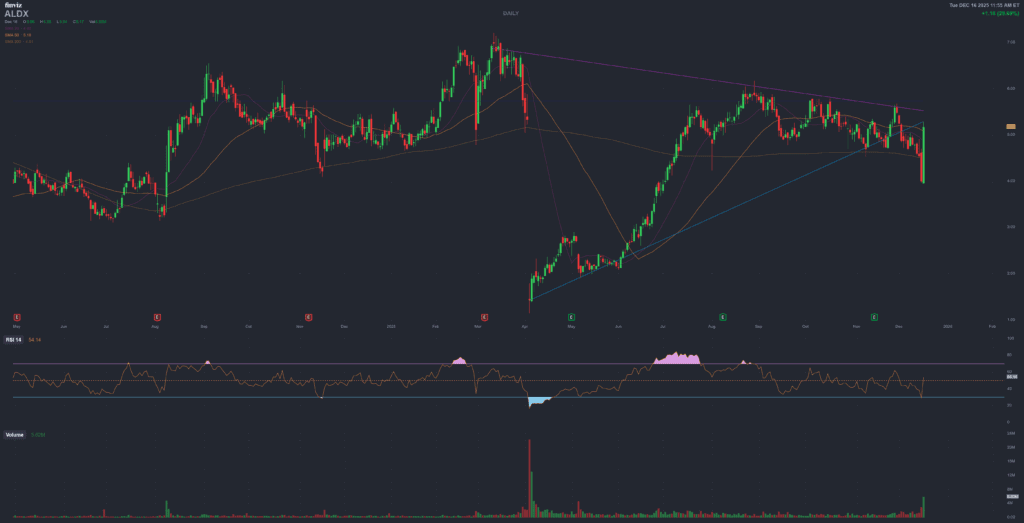
Initial reaction The stock opened the day with a sharp gap down (around high single to low double-digit percentage loss in pre-market) on the headline “PDUFA delay”, before buyers stepped in and intraday trading turned into a high-volume tug-of-war.
Quietly positive detail Before the extension, the FDA had already sent Aldeyra a draft label for reproxalap; Aldeyra has responded with comments. In the extension notice, FDA wrote that, if no major deficiencies are identified, it expects to communicate labeling requests and potential post-marketing requirements by February 16, 2026.
In practical terms: the review is described as “substantively complete” by the division. The delay looks like file-completeness housekeeping initiated by the Office of Specialty Medicine, not a sudden shift in the data package itself.
2. What the press release actually says
The company’s formal press release is deliberately short and conservative. Core points:
- The FDA has extended the PDUFA target action date for reproxalap in dry eye disease to March 16, 2026.
- The trigger is FDA’s request for the CSR of the dry-eye field trial; Aldeyra submitted that CSR to the NDA on December 12.
- Aldeyra reiterates reproxalap as a first-in-class RASP modulator for dry eye disease.
Notice what is not in the PR: there is no mention of a new safety concern, no demand for a new pivotal trial, and no signal that the agency is reconsidering the entire efficacy story. The tone sits firmly in the “procedural update” category.
3. Inside the December 12 FDA discussion and the conference call
3.1. Timeline to the extension
- June 16, 2025 – Aldeyra resubmits the reproxalap NDA in dry eye disease.
- July 16, 2025 – FDA accepts the resubmission as a “complete Class II response”, setting the PDUFA date at December 16, 2025.
- Early December 2025 – FDA sends Aldeyra a draft label; Aldeyra responds with comments.
- December 12, 2025 – In a meeting with the Division of Ophthalmology, Aldeyra is told that the Office of Specialty Medicine (the signatory office, above the division) wants the field trial CSR formally submitted into the NDA.
- December 16, 2025 – FDA issues the formal notice of a 90-day PDUFA extension, with a new target action date of March 16, 2026.
On the call, CEO Todd Brady emphasized that before resubmitting the NDA in June, Aldeyra had discussed both the positive dry-eye chamber trial and the field trial with the FDA. At that time:
- The field trial was known to be supportive vs vehicle but did not meet its primary symptom endpoint.
- The division agreed in writing that Aldeyra could submit the chamber trial alone to address the Complete Response Letter.
What changed is not the data; it is the internal reading of protocol at the Office of Specialty Medicine: all completed trials should sit inside the NDA, even if they have already been reviewed under the IND.
3.2. What FDA flagged (and did not flag)
- The Division of Ophthalmology told Aldeyra that, in their view, the review is substantively complete, including its prior review of the field trial under the IND.
- At the December 12 meeting, the division made no additional specific requests beyond the CSR inclusion.
- FDA’s extension letter states that if no major deficiencies are identified, labeling requests and potential post-marketing requirements will be communicated by February 16, 2026.
In other words: the delay is not framed as “we don’t believe the data”. It is framed as “put all the data in the right file, then we finish the paperwork”.
4. Company overview
Aldeyra Therapeutics is a clinical-stage biotech focused on diseases driven by reactive aldehyde species (RASP), a class of highly reactive molecules involved in inflammatory and immune pathways. The pipeline is compact but centered around one key driver.
4.1. Reproxalap — the core asset
- Modality: Topical ophthalmic small molecule.
- Mechanism: First-in-class RASP modulator, designed to reduce pathological aldehyde-mediated inflammation rather than acting on a single receptor.
- Lead indications: Dry eye disease and allergic conjunctivitis.
Late-stage data in dry eye are mixed:
- Chamber-based trials have shown strong signals in favor of reproxalap vs vehicle.
- The field trial requested as CSR by FDA was supportive vs vehicle but missed its primary symptom endpoint.
4.2. Other assets
Beyond reproxalap, Aldeyra is advancing:
- ADX-2191, an intravitreal methotrexate formulation for rare retinal diseases (a meaningful asset, but currently overshadowed by reproxalap).
- A group of earlier-stage systemic and CNS-focused RASP modulators (for example ADX-629 and related molecules), representing potential longer-term optionality rather than near-term value drivers.
For now, the equity story is dominated by a single question: Does reproxalap get approved in dry eye disease with a commercially meaningful label?
5. Cash, burn and runway
The latest detailed view comes from the Form 10-Q for the quarter ended September 30, 2025. Numbers below are rounded.
- Cash and cash equivalents: approximately 59.3M USD.
- Marketable securities: approximately 16.0M USD.
- Total cash and securities: about 77.5M USD.
- Total liabilities: around 28.6M USD, including roughly 15.2M USD in current debt and about 6.0M USD in deferred collaboration revenue (linked to the AbbVie agreement).
- Shareholders’ equity: about 49.2M USD.
On the P&L side for the first nine months of 2025:
- Net loss: approximately 27.4M USD, a clear improvement versus roughly 40.0M USD in the same period of 2024.
- R&D + G&A: about 28.6M USD combined, down from roughly 43.5M USD in the prior-year period.
This points to a company that has already shifted into a lean pre-launch posture. At that burn rate, ~77.5M USD in cash and securities translates into roughly two years of runway under current conditions, before considering any commercial-launch spend or potential AbbVie inflows.
As always, runway estimates are highly sensitive to strategic choices (launch intensity, pipeline spend) and to the outcome of the reproxalap decision. A negative outcome or a prolonged stalemate would likely bring financing risk back into focus.
6. The AbbVie option — where the upside lives
The amended option agreement with AbbVie is central to the upside case. If reproxalap is approved and AbbVie chooses to exercise its option, the economics reshape Aldeyra’s balance sheet and risk profile very quickly.
6.1. High-level economics
- AbbVie holds an exclusive option to a co-exclusive US license to reproxalap.
- Upon exercise, AbbVie would pay a 100M USD upfront, reduced by 6M USD previously paid in option fees (so about 94M USD net to Aldeyra).
- Aldeyra is eligible for up to 300M USD in additional regulatory and commercial milestones, including a 100M USD milestone at FDA approval of reproxalap in dry eye disease.
- In the US, AbbVie and Aldeyra would share profits and losses 60% / 40% (AbbVie 60%, Aldeyra 40%).
- AbbVie also funds 60% of certain pre-commercial costs, with Aldeyra carrying 40%.
6.2. Option timing and the impact of the delay
- AbbVie’s decision window is straightforward: it has 10 business days after FDA approval of reproxalap to decide whether to exercise the option.
- The PDUFA delay does not change this window. The terms remain in place; the clock simply has not started yet.
If reproxalap is approved and AbbVie exercises the option, Aldeyra would potentially receive around 194M USD in near-term cash (net upfront plus approval milestone). That would transform the balance sheet, remove immediate financing pressure, and leave Aldeyra with 40% of US economics in a large market.
None of this is guaranteed. Large pharma does sometimes walk away even after approval if the label is weak or the commercial landscape looks unattractive. But structurally, this is why traders keep one eye firmly on the AbbVie decision when they look at ALDX.
7. Sentiment — how the market is digesting the delay
The delay landed exactly where sentiment is most sensitive: regulated, binary biotech with a big-pharma option on the table. The reaction across trading communities and patient forums is noisy but revealing.
7.1. Trading tape and message flow
- The PDUFA extension headline immediately pushed ALDX into the list of most-discussed tickers on real-time platforms such as Stocktwits.
- Message volume and intraday range both surged, consistent with a classic “gap down on headline, then violent tug-of-war between buyers and sellers”.
7.2. Recurring themes in trader commentary
“If FDA is already sending labels and just wants the CSR in the NDA, this is the least-bad kind of delay.”
“Still a single-drug bet with a history of CRLs. If they miss again, this thing gets punished.”
“AbbVie is the real catalyst. When the drug is approved, the only question is whether they exercise the option or walk.”
A rough map of the crowd:
- Constructive camp — stresses that:
- The field trial CSR was already reviewed; moving it into the NDA is bureaucracy, not a data reset.
- Labeling discussions only happen when a drug looks approvable in principle.
- The AbbVie option remains fully alive and is structurally attractive for Aldeyra.
- Bearish camp — points out that:
- ALDX is still effectively a single-asset trade at this stage.
- The mixed efficacy history (including the negative primary endpoint in the field trial) does not disappear because of process language.
- Another negative outcome at the PDUFA date would likely trigger a severe repricing.
7.3. Patient-side emotions
On dry-eye patient boards, the tone is more personal. After years of following reproxalap through multiple PDUFA cycles and Complete Response Letters, there is a mix of frustration about “yet another delay” and cautious hope that the ongoing label discussions mean the drug is at least still under serious consideration.
8. Risk map — colour-coded view
Supportive elements
- Review described by the division as “substantively complete”.
- CSR for the field trial was already reviewed under the IND.
- Draft label has been exchanged and commented on.
- FDA explicitly points to a path for labeling and post-marketing requirements by February 16, 2026, if no major deficiencies emerge.
- The AbbVie option and economics remain intact.
Execution & timing risks
- The 90-day PDUFA extension is 90 additional days of headline risk and volatility.
- A realistic launch window shifts further into mid-2026 and beyond.
- If AbbVie eventually exercises its option, integration and co-promotion require solid execution in a crowded dry-eye market.
Structural downside risks
- History of CRLs and prior FDA skepticism in dry eye remains part of the backdrop.
- The field trial’s miss on its primary symptom endpoint is part of the totality of evidence FDA will consider.
- If the decision is negative, or if the label is too weak to support meaningful adoption, financing risk could quickly resurface.
Net-net, the PDUFA delay does not rewrite the core thesis around ALDX. It pushes the binary event into March, adds some procedural clarity about how FDA wants the file structured, and leaves the AbbVie option untouched. From a trading perspective, this is less dramatic than a new CRL, but it keeps the story firmly in the high-risk, high-volatility bucket.
9. Interpreting the delay — slightly bullish, still honest
If this regulatory chapter were a series, this would not be the episode where the FDA cancels the show. It is the episode where a new supervisor at the agency says:
“Before we sign off, make sure every single trial — even the awkward one — is formally inside the NDA.”
On the positive side:
- The agency did not issue a new CRL.
- There is no request for a fresh pivotal study.
- Label discussions are active, and the formal letter explicitly talks about next steps in labeling and post-marketing planning if no major deficiencies appear.
On the negative side:
- Investors now live with uncertainty and volatility for at least three more months.
- ALDX remains tightly bound to a single regulatory decision, with past CRLs and mixed efficacy history never far from mind.
Overall, the update is tilted modestly to the constructive side: the review is advanced, the requested CSR has already been scrutinized once, and the big-pharma option remains in play. But nothing about this changes the fundamental reality that ALDX is a binary, high-risk name, and that no approval is ever guaranteed until the action letter is in hand.
10. Sources and verification
The analysis above is built exclusively on primary and high-quality sources:
- Company press releases and investor presentations from Aldeyra Therapeutics (regulatory updates, AbbVie option agreement, pipeline overview).
- FDA-related disclosure in Aldeyra’s public communications (PDUFA extension notice, descriptions of the December 12 meeting, label discussions).
- Form 10-Q for the quarter ended September 30, 2025 (cash, liabilities, income statement, and collaboration accounting).
- Conference call transcript from the December 16, 2025 regulatory update, including Q&A with covering analysts.
- News coverage from major financial outlets summarizing the PDUFA delay and market reaction.
- Publicly accessible commentary from trader forums and social media, used only as qualitative sentiment input, not as factual evidence.
All financial figures, dates, and regulatory details are cross-checked against these sources where possible. Market prices and trading statistics refer to conditions around December 16, 2025 and will naturally evolve over time.

Important disclaimer – informational only, not investment advice
This report is prepared for informational and educational purposes only. It is not, and must not be interpreted as, investment research, investment advice, a recommendation to buy, sell or hold any financial instrument, or a solicitation to the public to invest or disinvest. The opinions expressed are generic and are not tailored to the objectives, financial situation or needs of any individual reader.
The analysis is based on publicly available information believed to be reliable at the time of writing (including SEC filings, official company communications and regulator documents), but its accuracy and completeness cannot be guaranteed. Markets, prices and circumstances may change rapidly and can make parts of this report outdated at any time.
Readers remain solely responsible for their own decisions and should, where appropriate, seek advice from an authorised financial professional. Investing in equities, especially small-cap and biotech names, involves a high degree of risk, including the risk of total loss of capital.
Biotech Catalyst Calendar
Looking beyond a single ticker, upcoming FDA decisions, clinical readouts and key conferences can move entire themes and watchlists. To keep an overview of what is coming next across the biotech universe, you can check the live Biotech Catalyst Calendar.
Scanner for active traders

Try ChartsWatcher free, then unlock 10% OFF with SAVE10
ChartsWatcher is a real-time scanner for momentum traders: fast movers, unusual volume and rotations — so you can focus on the few tickers that matter right now, instead of watching hundreds of charts.
Start with the free version. When you upgrade, use SAVE10 for 10% OFF your first paid period.
Start free – then use SAVE10
No credit card required to start. Apply SAVE10 when upgrading.

Recommended platform

One platform. All your brokers.
Medved Trader connects multiple brokers in one workspace, with pro charts, hotkeys and fast execution — without changing your broker accounts.
A single cockpit for positions, Level II and multi-broker order routing, built for active day & swing traders.
Get 1 Month Free ➔
Multi-broker workflow + customizable layouts in one platform.

 Monica.im – the AI assistant I use every day
If you find value in the work I publish on Merlintrader and want a practical AI assistant for research and writing, you can sign up using this referral link. Click here to try Monica.im and support the site
Find out how I use AI on Merlintrader: AI, retail and Merlintrader
Disclosure: some of the links in the promotional blocks above are affiliate or referral links. If you choose to subscribe or sign up through them, Merlintrader may receive a small commission or benefit at no extra cost to you.