






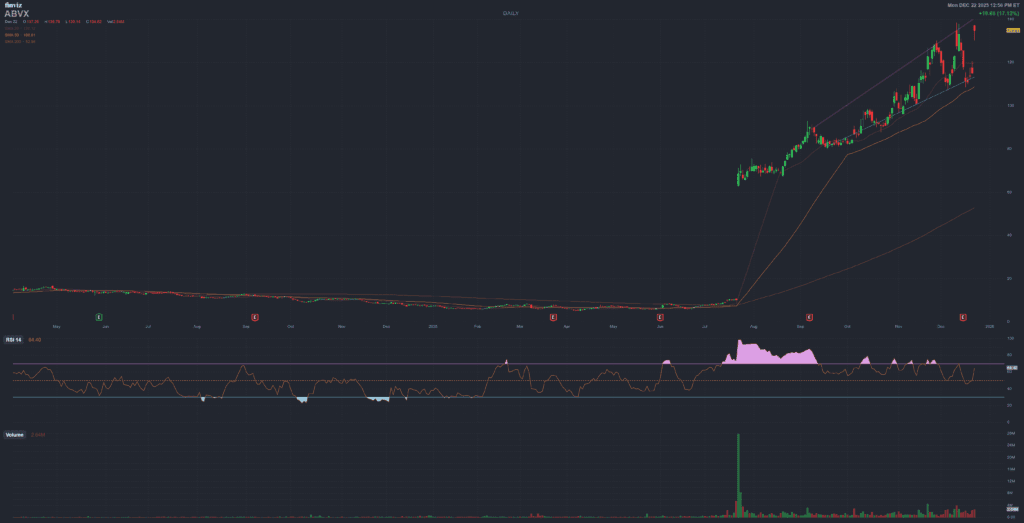
Abivax (ABVX) – Obefazimod Phase 3, UC filing path and the Lilly overhang
Long-form, filings-based deep dive on Abivax at the end of 2025: from the Phase 3 ABTECT program in ulcerative colitis to regulatory timelines, cash runway and the current wave of takeover speculation around Eli Lilly.
ABVX
Nasdaq & Euronext Paris | Abivax SA
News of the day – 22 Dec 2025
Lilly rumours back on the tape and Abivax joins the Nasdaq Biotechnology Index
Abivax shares have spiked again after media reports that Eli Lilly met with French officials to discuss a potential acquisition, on top of fresh news that ABVX is being added to the Nasdaq Biotechnology Index and will present 22 obefazimod abstracts at ECCO 2026.
- Reuters and other outlets report that Abivax stock jumped more than 20 percent on renewed rumours Lilly could make an offer; more recent intraday moves show the name up double digits again on December 22 as the story circulates.
- In parallel, Nasdaq confirmed that Abivax will join the Nasdaq Biotechnology Index, a technical catalyst that can drive incremental demand from passive and benchmarked funds.
- The company also announced that 22 abstracts on obefazimod in inflammatory bowel disease have been accepted for ECCO 2026, including an oral anti-fibrosis presentation – signalling a very heavy scientific presence at that meeting.
Executive summary
Abivax has moved from “obscure French micro-cap” to front-row UC contender in less than a year. The turning point was July 2025, when the company announced that both of its Phase 3 induction trials, ABTECT-1 and ABTECT-2, met the FDA primary endpoint of clinical remission at Week 8 with once-daily 50 mg obefazimod in moderate to severely active ulcerative colitis. Those were some of the strongest late-stage oral UC data seen in recent years and triggered a share-price move of several hundred percent in a single day.
From there, the story has bifurcated. On one side, Abivax is still a clinical-stage company with no approved product, fully dependent on the success of obefazimod in ulcerative colitis and, later, Crohn’s disease. On the other, it now sits on one of the most clinically advanced oral UC assets in a market that has already seen multi-billion deals from large pharma, making it an obvious topic for M&A speculation.
The key hard facts going into 2026 are: (1) positive Phase 3 induction data from two large trials, with a maintenance study ongoing and top-line results expected in Q2 2026; (2) a stated plan to submit regulatory dossiers to FDA and EMA in the second half of 2026, assuming maintenance data are supportive; (3) cash of roughly EUR 590M and a declared runway into Q4 2027; and (4) repeated, but still unconfirmed, press reports that Eli Lilly has been exploring a possible acquisition.
This deep dive focuses on what can actually be documented: the ABTECT program, the regulatory path, the balance sheet and the risk map. Takeover rumours are background noise – they may or may not materialise – but they clearly influence how traders and funds currently frame ABVX.
Company overview
Abivax SA is a French biotech now focused almost entirely on chronic inflammatory diseases, with obefazimod as its lead – and effectively only late-stage – asset. Originally developed for HIV, obefazimod was repositioned in ulcerative colitis after mid-stage virology data underwhelmed but immune-modulation readouts looked promising. Over time, the company abandoned its older infectious disease and oncology projects and concentrated resources on inflammatory bowel disease.
Mechanistically, obefazimod is described as a first-in-class oral small molecule that enhances the expression of microRNA-124 (miR-124), a regulatory RNA that helps stabilise immune responses and reduce pro-inflammatory signalling. The drug is taken orally once daily, positioning it as a potential competitor or complement to existing oral UC options (JAK inhibitors, S1P modulators) and biologics, especially in heavily pre-treated patients where treatment fatigue and convenience matter.
Obefazimod and the ABTECT program
| Program | Indication | Design / notes | Status |
|---|---|---|---|
| ABTECT-1 (ABX464-105) | UC induction | 8-week, randomized, placebo-controlled induction trial in moderate-to-severe UC; obefazimod 25 and 50 mg once daily vs placebo; primary endpoint: clinical remission at Week 8 (FDA definition). | Positive top-line: 50 mg once daily arm met primary endpoint of clinical remission; key secondary endpoints supportive; safety acceptable for an oral UC drug. |
| ABTECT-2 (ABX464-106) | UC induction | Parallel 8-week induction study mirroring ABTECT-1, designed for US and EU regulatory alignment; similar endpoints and patient population. | Also met primary endpoint of clinical remission at Week 8 with 50 mg; confirms reproducibility across two large Phase 3 trials. |
| ABTECT Maintenance (ABX464-107) | UC maintenance | Maintenance study enrolling about 678 responders from the induction trials, with long-term evaluation of remission, steroid-free remission and mucosal healing. | Ongoing; top-line results expected in Q2 2026; critical dataset for regulatory filings and long-term positioning. |
| Obefazimod – Crohn’s disease | Moderate-to-severe CD | Ongoing development with Phase 2/2b evaluation; details less advanced than UC but part of the broader IBD strategy. | Early-stage vs UC; potential second indication if safety and efficacy translate across diseases. |
Company materials emphasise that the ABTECT program is among the largest UC Phase 3 efforts ever run, with more than 1,200 patients randomised and several hundred responders rolled into maintenance. The plan disclosed in mid-2025 is to use a combination of induction and maintenance data to support filings with FDA and EMA in the second half of 2026, assuming the maintenance component confirms durability and safety.
Catalyst and timeline overview (mid-2025 – 2027)
22 Jul 2025
ABTECT-1 and ABTECT-2 top-line induction results
Abivax announces that both 8-week Phase 3 induction trials in moderate-to-severe UC met the primary endpoint of clinical remission at Week 8 in the 50 mg arm, with supportive secondary endpoints and a safety profile considered manageable for chronic use. This announcement sends the US-listed shares up by several hundred percent in a single session and redefines Abivax as a serious UC contender.
Oct 2025
Late-breaking presentations at UEG Week 2025
Phase 3 data on obefazimod are featured as late-breaking presentations at the United European Gastroenterology (UEG) congress in Berlin, raising the drug’s visibility among gastroenterologists and reinforcing the consistency of the induction results.
Dec 2025
ECCO 2026 abstracts, Nasdaq Biotech Index and M&A rumours
Abivax announces that 22 abstracts on obefazimod in IBD have been accepted for ECCO 2026, including an oral presentation on anti-fibrotic preclinical findings. Around the same time, the company is confirmed as a new member of the Nasdaq Biotechnology Index and media reports repeatedly mention that Eli Lilly may be exploring a potential acquisition, driving sharp share price moves.
Q2 2026 (guided)
ABTECT maintenance top-line results
Top-line data from the maintenance trial are expected in the second quarter of 2026. These results will be crucial for regulators, payers and potential partners or acquirers, as they speak directly to durability of remission, steroid-free outcomes and longer-term safety.
2H 2026 (guided)
Regulatory filings in UC
Abivax has publicly indicated that, if maintenance data are supportive, it plans to submit marketing applications for obefazimod in UC to both FDA and EMA in the second half of 2026. Approval decisions – if the data hold – would then be a story for 2027 and beyond.
Financial snapshot and runway
According to the third quarter 2025 financial update, Abivax reported cash and cash equivalents of EUR 589.7M as of 30 September 2025, and stated that this provides a cash runway into the fourth quarter of 2027. The company emphasised that this runway should be sufficient to carry the ABTECT maintenance trial through readout, fund regulatory filing work and support early commercial preparation, though additional capital may still be required for full-scale launch activities.
Abivax remains a loss-making, clinical-stage company. R&D spending is dominated by the ABTECT program and related IBD work, while G&A and commercial preparation costs have increased following the Nasdaq listing and the decision to build an international presence. Debt remains modest compared with cash, making the company primarily an equity-funded story with substantial operating leverage to eventual obefazimod revenues.
From a pure balance sheet perspective, the main point is that Abivax is not forced into immediate financing at the current stage: it has room to reach the next major clinical and regulatory inflection points. However, whether the existing cash is enough to support a full independent commercial launch – versus partnering or selling the asset – is an open strategic question.
Sentiment: analysts, hedge funds and retail
Sentiment – non-professional traders
The July 2025 Phase 3 readout turned Abivax into one of the trades of the year for healthcare hedge funds, with some specialised funds reportedly posting double-digit monthly gains on the back of the move. Since then, several brokers have upgraded their view on the stock, with at least one major shop raising its target from around USD 150 to USD 175 and framing obefazimod as a potential best-in-class oral UC therapy in a multi-billion market.
Retail sentiment on platforms like Stocktwits, Reddit and X is firmly bullish-biased but far from unanimous. Bulls highlight the combination of strong Phase 3 induction data, the size of the addressable UC population, the once-daily oral dosing and the clear M&A precedent in IBD, with several recent takeovers by large pharma. Bears point to the single-asset nature of the company, the need to still deliver maintenance data and the possibility that larger competitors could blunt obefazimod’s commercial impact with their own assets or pricing strategies.
Takeover rumours, particularly around Eli Lilly, add another layer: they support the idea that big pharma is indeed paying attention, but they also risk creating expectations that may or may not be met. A deal falling through could itself become a negative catalyst if investors were implicitly pricing in a premium.
As always, analyst targets and hedge fund trades are not guarantees of future performance. The sentiment described here reflects opinions and positioning of non-professional traders and market participants, not advice.
Scenario map: what could go right or wrong
Upside scenario (conceptual, not a prediction)
In the constructive scenario, ABTECT maintenance confirms strong, durable steroid-free remission and favourable mucosal healing, with safety consistent with the induction experience. Regulatory agencies accept obefazimod as a meaningful advance in oral UC treatment, leading to approvals in the US and EU in 2027. Uptake is solid across both bio-naive and bio-experienced patients, with key opinion leaders backing the drug.
In that world, one of two things happens: either Abivax signs a lucrative global partnership with a large pharma for co-promotion and co-funding, or a full acquisition materialises at a substantial premium to current levels. Obefazimod gradually expands into Crohn’s disease and possibly other immune-mediated conditions, reinforcing the company’s valuation.
Execution / middle path
A more neutral path assumes that maintenance data are positive but not spectacular: enough to support filings, but with some nuances in subgroups or safety that temper enthusiasm. Approvals still happen, but uptake is slower than the bull case, constrained by competition from other orals and biologics, cautious payer policies and physician familiarity with entrenched standards of care. Obefazimod becomes a valuable option, but not a dominant franchise.
Downside / risk-intensive scenario
In the downside scenario, maintenance results fail to confirm the induction signal in a way that regulators find convincing, or safety questions arise that complicate the benefit–risk profile. Regulators may request additional data, delay filings or narrow the intended label. Even if approval is eventually achieved, a weaker label or competitive pressure could materially reduce the commercial opportunity.
In that case, Abivax would still have cash to regroup, but the single-asset nature of the company would be fully exposed. With no diversified late-stage pipeline to fall back on, valuation could compress sharply, and the optionality on M&A would be significantly diminished.
Risk map
Regulatory and clinical
Maintenance data have not yet read out. Regulators may scrutinise durability of remission, steroid-sparing effects and long-term safety very closely. Any mismatch between induction and maintenance outcomes, or safety flags that emerge with longer exposure, could delay or jeopardise approvals.
Commercial and competitive
The UC market is crowded with biologics and newer oral agents. Even with strong data, obefazimod will have to win formularies, pricing battles and physician mindshare. If larger companies deploy aggressive access strategies or launch competing orals with similar or better efficacy, obefazimod’s share could be capped.
Single-asset and M&A dependency
Abivax today is essentially a one-drug company. If obefazimod stumbles or if M&A chatter fails to translate into a real transaction while expectations remain inflated, the stock could be hit hard. Even in success, deal terms matter: a partnership or acquisition that heavily favours the counterparty could limit upside for existing shareholders.
Bottom line
Abivax is now a high-profile, high-concentration bet on one of the most interesting oral UC mechanisms in late-stage development. The Phase 3 induction data have already changed the company’s trajectory; the remaining questions revolve around maintenance, safety, regulatory interpretation and commercial execution.
From a purely factual standpoint, investors are looking at: a well-funded balance sheet with runway into late 2027, very strong Phase 3 induction results, a large ongoing maintenance trial, a clear stated plan for 2H 2026 filings and increasing attention from both big pharma and index providers. How that translates into long-term value is a separate question that each reader has to answer for themselves, based on risk tolerance and time horizon.
This is not a recommendation to buy or sell ABVX. It is an attempt to map the hard data and the key moving parts so that traders and investors can frame their own view – independent of the daily noise around tweets, rumours and tape bombs.
Key sources and links
- Abivax press releases and SEC Form 6-K filings on positive Phase 3 ABTECT-1 and ABTECT-2 induction results in UC and plans to file in the second half of 2026.
- Abivax third quarter 2025 financial results (cash and cash equivalents of EUR 589.7M and runway into Q4 2027).
- News releases on ECCO 2026 abstract acceptance and inclusion of Abivax in the Nasdaq Biotechnology Index.
- Major financial and biotech media coverage (Reuters, Fierce Biotech, Investors Business Daily and others) on the July 2025 share-price surge, hedge fund involvement and oral UC market positioning.
- Articles discussing market rumours of a potential Eli Lilly bid for Abivax and recent price target changes from covering analysts.
Some external links used for charts or tools (for example Finviz, Seeking Alpha, Stocktwits or broker platforms) may include affiliate or referral parameters for Merlintrader. These do not change the content you see or the price you pay, and they do not influence the conclusions of this analysis.
Legal and risk disclaimer
Informational only, not investment advice. This report is based on public information from company filings, regulatory documents and reputable news sources available at the time of writing. It may contain errors, omissions or data that become outdated as new information emerges.
Nothing in this text is a recommendation to buy, sell or hold any security, nor a solicitation to do so. The author is not a registered investment adviser or a licensed financial professional. Any references to scenarios, upside/downside or potential market behaviour are illustrative and not predictions.
Readers should perform their own due diligence, consider their personal financial situation and risk tolerance, and, where appropriate, consult a qualified financial professional. Biotech investing, particularly in single-asset, late-stage development stories, carries significant risk and the possibility of losing part or all of the capital invested.
This content is intended for an international audience that includes readers in both the European Union and the United States. The language and structure aim to remain consistent with the spirit of applicable guidance from regulators such as CONSOB and the SEC for purely informational, non-promotional commentary.
Authors: Merlintrader and Jane.
For full legal notes and privacy information, please refer to:
Disclaimer
Termini di Servizio, Privacy, Cookie Policy // Term of Service, Privacy, Cookie Policy
Biotech Catalyst Calendar
For an updated overview of upcoming biotech and healthcare catalysts – PDUFA dates, clinical readouts, regulatory events – you can always refer to the dedicated Merlintrader Biotech Catalyst Calendar page.
Abivax (ABVX) – Obefazimod, Fase 3 nella colite ulcerosa e l’ombra Lilly
Analisi estesa, basata su documenti ufficiali, su Abivax a fine 2025: dati di Fase 3 del programma ABTECT nella colite ulcerosa, percorso regolatorio, runway di cassa e attuale ondata di voci su una possibile acquisizione da parte di Eli Lilly.
ABVX
Nasdaq & Euronext Paris | Abivax SA
News del giorno – 22 dic 2025
Ritornano le voci su Lilly e Abivax entra nel Nasdaq Biotechnology Index
Il titolo Abivax è tornato a correre dopo nuove notizie secondo cui Eli Lilly avrebbe incontrato funzionari francesi per discutere una possibile acquisizione, mentre in parallelo ABVX viene aggiunta al Nasdaq Biotechnology Index e presenta 22 abstract su obefazimod per ECCO 2026.
- Diverse testate riportano nuovi rialzi a doppia cifra su Abivax in scia alle voci su Lilly, con il titolo che si muove violentemente a ogni nuovo rumour o smentita.
- L’ingresso nel Nasdaq Biotechnology Index rappresenta un catalyst tecnico: può portare flussi da fondi indicizzati e portafogli benchmarkati sull’indice biotech.
- L’accettazione di 22 abstract su obefazimod per ECCO 2026, incluso un oral sulla componente anti-fibrotica, segnala una presenza scientifica molto pesante al prossimo congresso di riferimento in IBD.
Executive summary
In meno di un anno Abivax è passata da “micro-cap francese poco coperta” a protagonista assoluta nello spazio della colite ulcerosa. Il punto di svolta è stato luglio 2025, quando l’azienda ha comunicato che entrambi gli studi di induzione di Fase 3, ABTECT-1 e ABTECT-2, hanno centrato l’endpoint primario FDA di remissione clinica a 8 settimane con obefazimod 50 mg once-daily nei pazienti con CU moderata-severa.
Da lì in avanti la storia si è sdoppiata: da un lato Abivax resta un’azienda ancora senza prodotti approvati e fortemente dipendente dal successo di obefazimod in UC (e in prospettiva Crohn); dall’altro ha in mano uno dei dataset di Fase 3 più forti tra le terapie orali per IBD, in un contesto dove le big pharma hanno già pagato cifre molto elevate per asset simili. Non sorprende quindi che le voci di M&A si siano moltiplicate.
I punti fermi entrando nel 2026 sono: (1) due studi di induzione positivi di Fase 3; (2) uno studio di mantenimento in corso, con top-line attesi nel Q2 2026; (3) l’intenzione dichiarata di presentare le richieste di autorizzazione ad FDA ed EMA nella seconda metà del 2026 se i dati di mantenimento saranno sufficienti; (4) una cassa intorno ai 590 milioni di euro e runway dichiarata fino a fine 2027; (5) una serie di articoli che riportano interesse esplorativo da parte di Eli Lilly.
In questo report ci concentriamo sui pezzi verificabili: programma ABTECT, percorso regolatorio, numeri di bilancio e mappa dei rischi. Le voci di acquisizione restano sullo sfondo: pesano sul sentiment, ma non sono “dati” finché non c’è un annuncio formale.
Panoramica aziendale
Abivax è una biotech francese ormai concentrata quasi esclusivamente sulle malattie infiammatorie croniche, con obefazimod come unico asset avanzato. Il composto nasce come progetto HIV; i dati virologici però non hanno convinto, mentre la parte di modulazione immunitaria ha spinto l’azienda a pivotare verso la colite ulcerosa e più in generale le IBD.
Obefazimod è descritto come un small molecule orale che aumenta l’espressione di miR-124, microRNA con ruolo regolatorio sulla risposta immunitaria. La posologia once-daily lo colloca nel gruppo delle terapie orali per UC, teoricamente in concorrenza (o in combinazione) con JAK inibitori e modulatori S1P, ma con un meccanismo diverso e – se i dati saranno confermati – una potenziale finestra su pazienti molto pretrattati.
Obefazimod e programma ABTECT
| Programma | Indicazione | Design / note | Stato |
|---|---|---|---|
| ABTECT-1 (ABX464-105) | Induzione UC | Studio 8 settimane, randomizzato, controllato vs placebo in CU moderata-severa; obefazimod 25 e 50 mg once-daily vs placebo; endpoint primario: remissione clinica a Week 8 (definizione FDA). | Top-line positivo: il braccio 50 mg ha centrato l’endpoint primario; diversi secondari a supporto e safety ritenuta gestibile per terapia orale cronica. |
| ABTECT-2 (ABX464-106) | Induzione UC | Studio gemello di ABTECT-1, progettato per allineare le esigenze regolatorie US/EU, con popolazione e endpoint simili. | Anche qui centrato l’endpoint di remissione clinica a Week 8 con 50 mg; conferma di riproducibilità su due grandi trial. |
| ABTECT Maintenance (ABX464-107) | Mantenimento UC | Trial di mantenimento che arruola circa 678 responder dagli studi di induzione, con valutazione a lungo termine di remissione, remissione steroid-free e guarigione mucosale. | In corso; top-line attesi Q2 2026; dataset chiave per dossier regolatori e posizionamento di lungo periodo. |
| Obefazimod – Crohn | Malattia di Crohn moderata-severa | Programma in sviluppo (Phase 2/2b), complementare alla strategia UC nel più ampio mercato IBD. | Più indietro rispetto a UC; potenziale seconda indicazione se efficacia e safety saranno confermate. |
Il programma ABTECT è uno dei più ampi mai condotti in UC, con oltre 1.200 pazienti randomizzati e centinaia di responder entrati nel mantenimento. L’obiettivo dichiarato è usare l’insieme induzione + mantenimento per supportare le richieste di autorizzazione presso FDA ed EMA nella seconda metà del 2026, se i dati di mantenimento saranno allineati all’induzione.
Catalyst e tempistiche (metà 2025 – 2027)
22 lug 2025
Top-line induzione ABTECT-1 e ABTECT-2
Abivax annuncia che entrambi gli studi di induzione di Fase 3 hanno centrato l’endpoint di remissione clinica a 8 settimane nel braccio da 50 mg, con secondari coerenti e safety giudicata compatibile con un uso cronico. La reazione del mercato è violenta, con il titolo che moltiplica di diverse volte in una sola seduta.
Ott 2025
Late-breaking a UEG Week
I dati di Fase 3 su obefazimod vengono presentati come late-breaking al congresso UEG a Berlino, aumentando la visibilità presso la comunità gastroenterologica europea e aggiungendo credibilità al programma.
Dic 2025
ECCO 2026, indice Nasdaq Biotech e rumours M&A
Abivax annuncia l’accettazione di 22 abstract su obefazimod a ECCO 2026 (incluso un oral sull’effetto anti-fibrotico), conferma l’ingresso nel Nasdaq Biotechnology Index e finisce più volte sulle cronache finanziarie per possibili manovre di Lilly. Il titolo si muove spesso a doppia cifra in risposta a queste notizie.
Q2 2026 (guidance)
Top-line mantenimento ABTECT
I dati di mantenimento attesi nel secondo trimestre 2026 saranno la prova del nove su durata della remissione, remissione steroid-free e safety a più lungo termine – elementi chiave per regolatori, payor ed eventuali partner/acquirenti.
2H 2026 (guidance)
Filing regolatori UC
Se il mantenimento confermerà il quadro, Abivax punta a presentare le richieste regolatorie per obefazimod in UC presso FDA ed EMA nella seconda metà del 2026, con potenziali decisioni a partire dal 2027.
Situazione finanziaria e runway
Nell’aggiornamento del terzo trimestre 2025, Abivax ha riportato cassa e equivalenti per 589,7 milioni di euro al 30 settembre 2025 e una runway stimata fino al quarto trimestre 2027. L’azienda indica esplicitamente che questa liquidità dovrebbe consentire di portare a termine il mantenimento ABTECT, seguire l’iter di filing e avviare le attività preparatorie per il lancio.
Abivax resta però una realtà pre-ricavi significativi: le spese R&D sono dominate dal programma ABTECT e dalle altre iniziative su obefazimod, mentre il lato G&A/commerciale è in crescita dopo la quotazione Nasdaq e l’espansione internazionale. Il debito è presente ma non eccessivo rispetto alla cassa; il modello è ancora soprattutto equity-financed, con forte leva operativa rispetto a eventuali futuri ricavi del farmaco.
Detto in modo diretto: Abivax non è con le spalle al muro sul piano finanziario, ma la quantità di capitale già investita e quella ancora da spendere rendono fondamentale che obefazimod arrivi a un via libera regolatorio e a una traiettoria commerciale sensata – sia in autonomia, sia attraverso partnership o M&A.
Sentiment: analisti, hedge fund e retail
Sentiment – trader non professionisti
Il rally di luglio 2025 dopo i dati ABTECT ha reso Abivax uno dei trade dell’anno per diversi fondi hedge healthcare, con articoli che riportano performance mensili a doppia cifra per chi era convinto sulla tesi UC. Alcune banche d’affari hanno alzato i target price in modo aggressivo, parlando di scenario “best in class” per una terapia orale once daily in un mercato IBD da decine di miliardi.
Nei commenti retail (Reddit, Stocktwits, X) il tono è fortemente bullish ma non cieco: molti utenti sottolineano la combinazione “dati forti + asset unico + interesse big pharma” come mix esplosivo; altri mettono in guardia sul fatto che Abivax è di fatto una single-asset company e che i dati di mantenimento sono ancora attesi.
Le voci su Lilly aggiungono volatilità: finché restano rumours, supportano il sentiment ma creano anche il rischio di delusione se un’eventuale offerta non dovesse arrivare, o se i termini non fossero in linea con le aspettative create dal mercato.
Anche qui vale la solita regola: né i trade dei fondi né le discussioni social sono una garanzia di successo futuro. Sono segnali di interesse e di narrativa, non indicazioni operative.
Mappa scenari: cosa può andare bene o male
Scenario positivo (concettuale, non una previsione)
Nello scenario “roseo”, il mantenimento ABTECT conferma remissione duratura e safety gestibile; FDA ed EMA approvano obefazimod con un’etichetta competitiva e la comunità gastro lo adotta come opzione chiave in linea con i dati visti finora. Le vendite crescono progressivamente, magari accompagnate da un accordo con una big pharma o da un takeout vero e proprio.
Scenario di esecuzione intermedio
Nel caso più neutro, i dati di mantenimento sono “abbastanza buoni” per supportare un filing, ma con qualche zona grigia che frena entusiasmo di regolatori o payor. Le approvazioni arrivano, ma la curva di adozione è più lenta, compressa dalla concorrenza e da politiche di rimborso prudenti. Abivax resta una storia interessante, ma più dipendente dall’esecuzione commerciale che dal solo dato clinico.
Scenario downside / ad alto rischio
Nello scenario negativo, il mantenimento non conferma pienamente il quadro di induzione (per esempio con durata limitata o safety più pesante), oppure emergono dubbi tali da spingere i regolatori a chiedere più dati o a restringere la possibile etichetta. Il potenziale economico si riduce, il sentiment si raffredda e l’asset perde una parte dell’appeal M&A. In quel contesto, la struttura single-asset diventerebbe un problema evidente per la capitalizzazione attuale.
Mappa rischi
Rischio regolatorio/clinico
Senza dati di mantenimento pubblicati, la storia è ancora incompleta. Eventuali discrepanze tra induzione e lungo termine, o segnali di safety inattesi, potrebbero complicare molto il percorso regolatorio.
Concorrenza e accesso
UC è un mercato affollato: biologici consolidati, small molecule già in commercio e pipeline rivali. Prezzi, rimborsi e abitudini prescrittive saranno determinanti per capire quanto spazio reale potrà ritagliarsi obefazimod.
Dipendenza da un solo asset / M&A
Abivax oggi è quasi interamente legata a obefazimod. Se i dati di mantenimento deludono, o se la narrativa M&A sfuma, non ci sono molti altri asset avanzati su cui spostare rapidamente il focus. Il repricing in quel caso potrebbe essere severo.
In sintesi
Abivax è diventata una storia ad altissimo impatto ma anche molto concentrata: grande dataset di Fase 3 su un singolo farmaco, cassa robusta, visibilità crescente in IBD e M&A rumours che tengono acceso il riflettore. Il punto critico dei prossimi 12–18 mesi sarà la conferma del mantenimento e il giudizio dei regolatori.
Dal punto di vista puramente informativo, quello che possiamo dire oggi è che: obefazimod ha mostrato dati di induzione molto forti; la dimensione del programma e la strategia di filing sono in linea con un candidato “serio” per UC; la struttura finanziaria offre tempo per giocarsi la partita, ma non la rende priva di rischio. Il resto – esito dei trial, tono delle agenzie, eventuali offerte – dipenderà da fattori che nessuno può anticipare con certezza.
Questo report non è una raccomandazione operativa ma un tentativo di mettere in fila i fatti principali per chi segue la bioteca e vuole usare i dati, non le voci, come base di partenza.
Fonti principali
- Communicati Abivax su risultati positivi di Fase 3 ABTECT-1/2 in CU moderata-severa e dichiarazioni sul piano di filing in 2H 2026.
- Risultati finanziari Q3 2025 (cassa 589,7 milioni di euro, runway dichiarata fino a Q4 2027).
- Note su ECCO 2026 (22 abstract accettati) e ingresso nel Nasdaq Biotechnology Index.
- Articoli di testate primarie (Fierce Biotech, Reuters, Investors Business Daily e altre) sul rally di luglio 2025, l’interesse degli hedge fund e il posizionamento di mercato di obefazimod fra le terapie orali per UC.
- Copertura giornalistica delle voci di possibile acquisizione da parte di Eli Lilly e degli aggiornamenti sui target price da parte degli analisti.
Alcuni link esterni eventualmente utilizzati per grafici o strumenti (Finviz, Seeking Alpha, Stocktwits, piattaforme di brokeraggio) possono includere parametri di referral affiliati a Merlintrader. Questo non modifica il contenuto che vedi né il prezzo dei servizi e non influenza le conclusioni dell’analisi.
Disclaimer legale e di rischio
Contenuto puramente informativo, non è una raccomandazione. Questo testo si basa su informazioni pubbliche disponibili al momento della stesura (filings, documenti regolatori, comunicati ufficiali, media di primaria affidabilità) e può contenere errori, omissioni o dati nel frattempo superati.
Nulla di quanto scritto costituisce invito o sollecitazione ad acquistare, vendere o detenere strumenti finanziari, né consulenza personalizzata. L’autore non è un consulente finanziario abilitato. Eventuali riferimenti a scenari, upside/downside o dinamiche di mercato sono esempi concettuali, non previsioni.
Chi legge deve svolgere la propria due diligence, valutare il proprio profilo di rischio e, se necessario, confrontarsi con un professionista abilitato. Le biotech single-asset in fase avanzata comportano rischi elevati e la possibilità di perdere anche l’intero capitale investito.
Questo report è pensato per un pubblico internazionale (UE e USA) e utilizza un linguaggio coerente con lo spirito delle linee guida CONSOB e SEC per commenti informativi non-promozionali.
Authors: Merlintrader and Jane.
Per note legali e privacy complete:
Disclaimer
Termini di Servizio, Privacy, Cookie Policy // Term of Service, Privacy, Cookie Policy
Biotech Catalyst Calendar
Per una panoramica aggiornata di PDUFA, letture di dati clinici e altri eventi chiave su biotech e healthcare, puoi fare riferimento alla pagina dedicata del Biotech Catalyst Calendar di Merlintrader.
Link diretto: https://merlintrader.com/calendario-catalyst/