DISCLAIMER — Not financial advice. Educational content only, not an offer or solicitation to buy or sell any security. Biotech and small/mid-cap stocks are highly speculative and volatile and can result in a partial or total loss of capital. Do your own research and consult a licensed advisor where appropriate. / Contenuti a solo scopo informativo e didattico, non costituiscono consulenza finanziaria né offerta o sollecitazione al pubblico risparmio ai sensi delle normative CONSOB e SEC. Le azioni biotech e le small/mid cap sono strumenti altamente speculativi e volatili e possono comportare la perdita parziale o totale del capitale investito. Si raccomanda di effettuare sempre le proprie ricerche e, se necessario, di rivolgersi a un consulente abilitato.

Merlintrader Trading Pub
Biotech catalyst news and analysis. FDA PDUFA tracker
Merlintrader Trading Pub
Biotech catalyst news and analysis. FDA PDUFA tracker
AI, drones and US defence: NVDA, LHX, KTOS, AVAV, RCAT, ONDS, BA, LMT, NOC in focus after the Singapore Airshow 2026
AI, drones and US defence after the Singapore Airshow 2026
AI, drones and US defence: NVDA, LHX, KTOS, AVAV, RCAT, ONDS, BA, LMT, NOC in focus after the Singapore Airshow 2026
The Singapore Airshow 2026 is not just a nice backdrop for air displays and static jets. It is a live x-ray of how fast the Indo-Pacific balance of power is shifting, and how quickly drones and AI-enabled systems have moved from the fringe to the centre of the defence conversation. While China shows off fighters and commercial jets to signal that it wants a bigger slice of the regional market, US and allied firms are quietly doing something just as important: locking in long-term positions across drones, autonomy and “AI-ready” hardware.
You can see that story almost frame by frame in the official Singapore Airshow photo gallery, where F-35s, J-10C aerobatic teams and business jets share the same ramp and hangars. The visual message is clear: heavy metal is still the shop window, but the real competition is increasingly about the software, sensors and autonomous systems bolted around it.
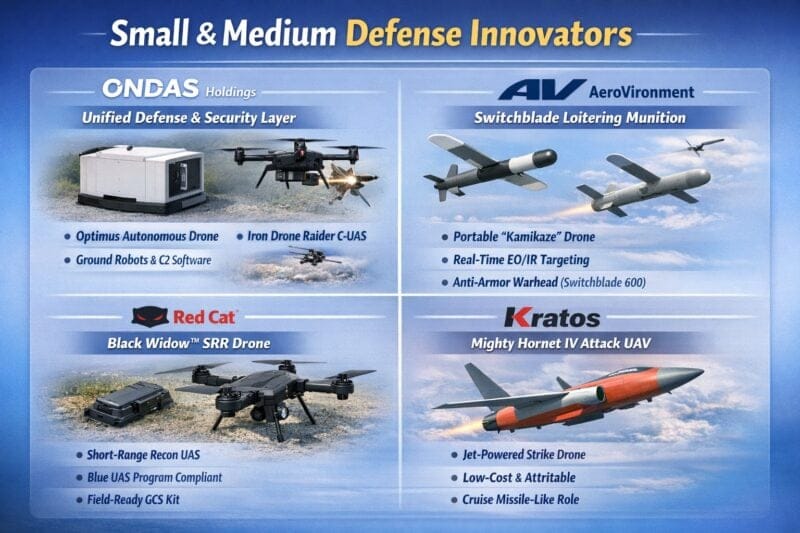
For traders, the big message is simple: drones and AI are no longer a side show, they are now a core budget line. And unlike the mega-caps, a handful of US small and mid-caps actually live or die on how well they execute into this Indo-Pacific demand. In this note we focus on four of them — ONDS, AVAV, RCAT and KTOS — and place them inside the wider picture that also includes the heavyweights NVDA, LHX, BA, LMT, NOC.
Educational only, not investment advice.
This article is an editorial trading view based on publicly available information (company filings and press releases, official defence sources and reputable news wires). Always double-check numbers and documents before any decision in real money.
1. The Indo-Pacific drone moment: from air show to arms race
Asia-Pacific is now the fastest-growing aviation and defence market in the world. Civil air traffic is expected to outpace global averages for years, while defence budgets across the region keep creeping higher as everyone from Singapore to the Philippines, Japan, Korea and Australia looks over their shoulder at China. The Singapore Airshow concentrates all of that into a single week: more than a thousand companies, delegations from across the region, and, this year, a space summit that makes it clear air and orbit are becoming one blended theatre.
The key shift this time is where the attention went. Instead of just fighters and big transport aircraft, the real energy was around AI-enabled drones and loitering munitions, counter-UAS systems and “electronic fences” for low-altitude airspace, autonomous ground robots tied into the same command layer, and system-of-systems platforms that promise to manage all of this as one network. If you scroll through the official flying-display and static-display photos, you can literally see the counter-drone turrets, jammer trucks and small UAVs creeping closer to centre stage.
Ukraine has rewritten the playbook: cheap FPV drones, loitering munitions and mass-produced autonomous systems can change the shape of a battlefield faster than adding one more gold-plated fighter jet. Taiwan, watching China across the strait, is following that script closely. For US-listed names, the question is who can supply that kind of capability at scale.
2. ONDS (Ondas) — the high-beta autonomy platform trying to grow up fast
Ticker focus — ONDSAmong the US drone and autonomy plays, Ondas (ONDS) is the one that has made the loudest move into the Singapore Airshow 2026 narrative. The company sits at the intersection of autonomous drones, unmanned ground systems, counter-UAS and private wireless networks, and is trying to weld them into a single defence and security portfolio.
2.1. A billion-dollar financing and a very ambitious roadmap
In late January, Ondas closed a large registered direct offering combining stock and pre-funded warrants, giving the company access to up to around a billion dollars in fresh capital and leaving it with a pro-forma cash pile that management describes as more than enough to execute its near-term roadmap. For a firm that, until recently, was seen mostly as a niche autonomy play, that is a radical shift in firepower and expectations.
At the same time, the company updated investors on revenue and backlog, signalling a strong jump in orders and a step-up in 2026 revenue targets. The message is clear: Ondas is trying to move from “interesting technology” to a scaled platform that defence and security customers can rely on in real deployments.
2.2. Singapore Airshow: unified defence & security portfolio
The Singapore Airshow is the launch pad for Ondas’ new Unified Lower-Altitude to Ground Defense and Security offering. In simple words, the company wants to govern low-altitude airspace and the ground beneath it as a single autonomous layer. The portfolio integrates autonomous ISR drones, counter-UAS systems such as Iron Drone Raider, unmanned ground vehicles from recently acquired businesses, and a software-defined command-and-control layer that stitches everything together.
On the company’s own site, the Singapore Airshow 2026 page shows renderings and photos of the Optimus System, Iron Drone Raider and the family of ground robots and C-UAS assets that form this “detect-to-defeat” web: Ondas — Defense and Security Offering at Singapore Airshow 2026. It is a visual way of saying: we don’t just sell drones or jammers, we sell an architecture.
2.3. Why ONDS matters for traders
For traders and active investors, ONDS is attractive precisely because it sits at the point where capital, story and execution risk collide. The recent financing gives Ondas a runway that most micro-caps can only dream of; the Singapore Airshow positioning anchors the story in a real, visible event; and the integration challenge is non-trivial. Every new contract, every slide of the backlog and every update to that product gallery will be watched through the lens of “are they really becoming a platform, or just a collection of assets?”.
For social-trading platforms and retail flows, ONDS is the textbook high-beta defence-AI story: plenty of upside if the company delivers, but equally exposed if the news flow or execution stumble.
3. AVAV — AeroVironment as the “mature” loitering munitions play
Ticker focus — AVAVAeroVironment (AVAV) plays a different role in this cluster. It is not a new kid on the block but an established contractor whose drones and loitering munitions have been battle-tested from Ukraine to the Middle East. Its Switchblade family is now part of how US and allied forces think about tactical fires.
On AeroVironment’s own Switchblade product page you see the tube-launched canisters perched on tripods and vehicles, with cutaway renders explaining how the warhead, EO/IR camera and data link fit into a five-pound loitering munition. It is a very different visual from the airshow glamour shots, but it is exactly what defence staffers and Asian procurement teams are looking at when they think about hard, repeatable capability.
Taiwan has already been cleared to receive Switchblade 300 systems as part of US efforts to beef up its deterrence posture, and the US Army has issued substantial follow-on orders for loitering munitions. For the Singapore storyline, that positions AVAV as the “loitering munitions blue-chip”: smaller than the primes, but large and proven enough to be a core supplier when Asian customers look for systems that actually work in contested airspace.
4. RCAT — Red Cat pushing Black Widow into Asia
Ticker focus — RCATRed Cat (RCAT) sits further down the size spectrum, closer to the world of FPV-style platforms and small tactical drones. The key recent move for the Singapore theme is the announcement that an Asia-Pacific ally selected its Black Widow™ small unmanned aircraft system in a competitive tender late last year, with deliveries scheduled through 2026.
If you open the official Black Widow product page, the pictures tell the rest of the story: a compact, hand-launched quadcopter, modular payloads, and a control ecosystem designed from day one to meet US “Blue UAS” requirements. The Asia-Pacific contract is essentially exporting that picture into a region that is in the middle of its own scramble to field small ISR and EW platforms.
For traders, RCAT is a classic contract-driven small cap: the fundamental story is about proving that Black Widow and other platforms can scale beyond a handful of customers, but price action in the short term is often dominated by headlines, order sizes and how the stock reacts on each press release.
5. KTOS — Kratos and the Mighty Hornet IV in the Taiwan equation
Ticker focus — KTOSKratos Defense (KTOS) connects the Singapore narrative directly to Taiwan. Together with Taiwan’s NCSIST, Kratos has been testing the Mighty Hornet IV, a jet-powered attack drone derived from the MQM-178 Firejet target drone and designed from the start to be low-cost and mass-producible.
Kratos’ own press releases and product pages show the lineage clearly. The Firejet page (MQM-178 Firejet overview) lays out the compact, modular target drone with its high-subsonic speed and high-G manoeuvring, while the Mighty Hornet IV test announcement describes how that airframe is being turned into a cruise-missile-like attack UAV with Taiwanese payloads on board.
The concept is simple and brutal: instead of relying only on a small number of exquisite fighters, you flood the airspace with relatively cheap attack drones that can soak up enemy air defences and hit high-value targets. It is Ukraine’s attrition logic applied to the Taiwan Strait.
6. Where the big caps sit: NVDA, LHX, BA, LMT, NOC
Around these smaller names there is a larger halo of big US defence and AI players whose charts set the tone for the whole complex:
NVDA
LHX
BA
LMT
NOC
NVDA remains the reference name for AI compute: the GPUs and accelerators in its own product catalogue are the invisible backbone of many of the sensor-fusion, autonomy and C2 demos that end up as glossy clips in Singapore photo galleries. LHX (L3Harris) sits at the heart of missiles, sensors and communications, with the Pentagon even willing to inject capital directly into critical motor and missile capacity to avoid bottlenecks. And BA, LMT, NOC dominate the big-ticket side: fighters, bombers, missiles, large UAVs and space systems.
Together, these heavyweights provide the “gravity field” inside which the smaller names trade. When AI, defence and space are in favour, the big caps pull the complex higher; when policy risk or valuations bite, they also set the ceiling.
7. Takeaways for traders
The 2026 Singapore Airshow confirms three simple things for anyone trading US defence and AI names. First, drones and autonomy are now central to Indo-Pacific defence planning, not a side bet. Second, US companies are aggressively targeting Asia for new orders and long-term presence. And third, a small cluster of US-listed tickers gives direct exposure to that shift.
In that cluster, ONDS is the high-beta capital-fueled autonomy platform, AVAV the mature loitering-munitions and small-UAS supplier, RCAT the tactical Black Widow and FPV-style play, and KTOS the bridge into Taiwan’s asymmetric deterrence and US attack-drone experimentation. Around them, the mega-caps NVDA, LHX, BA, LMT, NOC provide the structural backdrop and the liquidity.
None of this is a recommendation to buy or sell any security. It is a way to read Singapore’s headlines through a trading lens: understanding where the capital, the contracts and the real technology are actually moving, before you even open a chart.
AI, droni e difesa USA dopo il Singapore Airshow 2026
AI, droni e difesa USA: NVDA, LHX, KTOS, AVAV, RCAT, ONDS, BA, LMT, NOC sotto i riflettori dopo il Singapore Airshow 2026
Il Singapore Airshow 2026 non è solo scenografia per voli acrobatici e statiche da fotografare. È una radiografia in tempo reale di quanto velocemente sta cambiando l’equilibrio di potere nell’Indo-Pacifico e di quanto in fretta droni e sistemi guidati dall’intelligenza artificiale sono passati dalla periferia al centro del dibattito sulla difesa. Mentre la Cina sfoggia caccia e jet commerciali per dire al mondo che vuole una fetta più grande del mercato regionale, gli Stati Uniti e gli alleati stanno facendo un’altra cosa altrettanto importante: si stanno comprando spazio, nel senso letterale e figurato, su tutto ciò che è droni, autonomia e hardware “AI-ready”.
Questo film lo vedi quasi fotogramma per fotogramma nella galleria fotografica ufficiale del Singapore Airshow: F-35, J-10C delle pattuglie acrobatiche cinesi e business jet parcheggiati fianco a fianco, con intorno radar, pod, sensori e sistemi anti-drone. Il messaggio visivo è chiaro: il “ferro” pesante è ancora la vetrina, ma la vera competizione si sposta sempre di più su software, sensori e sistemi autonomi che girano intorno a quei velivoli.
Per chi fa trading il messaggio è semplice: droni e AI non sono più un giocattolo da brochure, sono una voce di budget strutturale. E, a differenza dei mega-cap, un pugno di small e mid-cap USA vive o muore proprio in base a quanto bene riesce a intercettare questa domanda indo-pacifica. In questa nota il focus va su quattro ticker — ONDS, AVAV, RCAT e KTOS — inseriti dentro un quadro più ampio che include anche i pesi massimi NVDA, LHX, BA, LMT, NOC.
Solo a scopo didattico, non è consulenza.
Questo articolo è un commento editoriale basato su informazioni pubbliche (documenti societari e comunicati, fonti ufficiali di difesa e agenzie stampa affidabili). Verifica sempre in autonomia numeri e documenti prima di qualsiasi scelta con soldi reali.
1. Il momento “droni” dell’Indo-Pacifico: dall’air show alla corsa agli armamenti
L’Asia-Pacifico è oggi il mercato in più rapida crescita al mondo per aviazione e difesa. Il traffico aereo civile corre più del resto del globo, mentre i budget militari di Singapore, Filippine, Giappone, Corea, Australia e altri continuano a salire perché tutti hanno lo sguardo fisso sulla Cina. Il Singapore Airshow concentra tutto questo in una settimana: oltre mille aziende, delegazioni da mezzo mondo e, quest’anno, anche un summit spaziale che chiarisce una cosa precisa: cielo e orbita stanno diventando un unico teatro integrato.
La differenza, rispetto al passato, è dove si è spostata davvero l’attenzione. Non più solo caccia e grandi velivoli da trasporto, ma soprattutto droni e munizioni circuitanti guidati da AI, sistemi anti-drone e “recinzioni elettroniche” per lo spazio a bassa quota, robot terrestri autonomi collegati allo stesso layer di comando e piattaforme “system-of-systems” che promettono di gestire tutto questo come un’unica rete. Nelle foto ufficiali delle esibizioni in volo e delle statiche riconosci jammer, torrette anti-drone e piccoli UAV sempre più al centro dell’inquadratura.
L’Ucraina ha riscritto il manuale: droni FPV economici, munizioni circuitanti e sistemi autonomi prodotti in massa possono cambiare un campo di battaglia più velocemente di un ulteriore caccia da centinaia di milioni. Taiwan, che guarda quotidianamente la Cina dall’altra parte dello stretto, sta copiando quel copione. Per i titoli USA quotati la domanda è chi riesce a fornire quel tipo di capacità, e a farlo su scala.
2. ONDS (Ondas) — la piattaforma di autonomia ad alto beta che prova a fare il salto di qualità
Focus ticker — ONDSTra i nomi USA su droni e autonomia, Ondas (ONDS) è quello che si è infilato in modo più aggressivo dentro la narrativa del Singapore Airshow 2026. L’azienda è seduta proprio all’incrocio tra droni autonomi, sistemi terrestri unmanned, soluzioni anti-drone e reti wireless private e sta cercando di saldare tutto questo in un unico portafoglio Defence & Security.
2.1. Un finanziamento da miliardi e una roadmap molto ambiziosa
A fine gennaio Ondas ha chiuso un importante aumento di capitale combinando azioni e warrant pre-sottoscritti, ottenendo accesso fino a circa un miliardo di dollari di risorse fresche e ritrovandosi con una cassa pro-forma che il management descrive come più che sufficiente per sostenere la roadmap di breve-medio termine. Per una realtà che fino a poco tempo fa il mercato vedeva soprattutto come micro-cap di nicchia sull’autonomia è un cambio di taglia e di aspettative notevole.
In parallelo la società ha aggiornato il mercato su fatturato e backlog, segnalando un forte balzo degli ordini e un rialzo della guidance 2026. Il messaggio è chiaro: Ondas vuole passare dallo status di “tecnologia interessante” a quello di piattaforma scalata su cui clienti della difesa e della sicurezza possano realmente appoggiarsi.
2.2. Singapore Airshow: il portafoglio Defence & Security unificato
Il Singapore Airshow è il palco scelto per lanciare la nuova offerta Unified Lower-Altitude to Ground Defense and Security di Ondas. Tradotto: l’azienda vuole governare lo spazio aereo a bassa quota e il terreno sottostante come un unico strato autonomo. Il portafoglio integra droni ISR autonomi, sistemi counter-UAS come Iron Drone Raider, veicoli terrestri unmanned provenienti dalle acquisizioni recenti e un layer di comando e controllo software-defined che cuce il tutto.
Nella pagina dedicata sul sito ufficiale di Ondas (Ondas — Defense and Security Offering al Singapore Airshow 2026) trovi render e foto dell’Optimus System, di Iron Drone Raider e dell’intera famiglia di robot terrestri e asset C-UAS che compongono questa rete “detect-to-defeat”. È il modo visivo con cui l’azienda dice: non vendiamo un singolo prodotto, vendiamo un’architettura.
2.3. Perché ONDS conta per chi fa trading
Per chi fa trading e per gli investitori attivi ONDS è interessante proprio perché si trova nel punto in cui capitale, narrativa e execution risk si incontrano. L’ultimo aumento di capitale ha dato a Ondas una runway che la maggior parte delle micro-cap non vede nemmeno col binocolo; il posizionamento al Singapore Airshow ancora la storia a un evento reale e visibile; la sfida di integrazione è tutt’altro che banale. Ogni nuova commessa, ogni aggiornamento del backlog e perfino ogni nuovo render su quella pagina prodotto verranno letti con la lente del “stanno davvero diventando una piattaforma o restano un collage di asset?”.
Per i flussi retail e le piattaforme social, ONDS è il classico titolo difesa+AI ad altissimo beta: potenziale importante se la società consegna, ma altrettanto esposta se il newsflow rallenta o l’esecuzione si inceppa.
3. AVAV — AeroVironment come “blue-chip” delle munizioni circuitanti
Focus ticker — AVAVAeroVironment (AVAV) gioca un ruolo diverso in questo cluster. Non è la startup emergente, ma un contractor consolidato le cui piattaforme — droni e munizioni circuitanti — sono già state provate sul campo dall’Ucraina al Medio Oriente. La famiglia Switchblade è ormai parte integrante del modo in cui forze USA e alleate pensano al fuoco tattico.
Nella pagina prodotto ufficiale di Switchblade vedi i lanciatori in tubo montati su treppiedi e veicoli, con i render che mostrano come testata, camera EO/IR e data link vengono compressi in una munizione di poco più di due chili. È un’estetica completamente diversa dalle foto glamour dell’air show, ma è esattamente il tipo di scheda tecnica che guardano gli staff militari e gli uffici acquisti asiatici quando valutano capacità concrete.
Taiwan è già stata autorizzata a ricevere sistemi Switchblade 300 come pezzo del puzzle di deterrenza contro un’eventuale mossa cinese, e l’esercito USA ha emesso ordini aggiuntivi consistenti. Per la narrativa Singapore questo rende AVAV la “blue-chip delle munizioni circuitanti”: più piccola dei grandi prime, ma abbastanza grande e collaudata per essere un fornitore centrale quando i clienti asiatici cercano sistemi che funzionano davvero in spazi aerei contestati.
4. RCAT — Red Cat e il Black Widow che entra in Asia
Focus ticker — RCATRed Cat (RCAT) si colloca ancora più in basso come capitalizzazione, vicino al mondo dei droni FPV e delle piccole piattaforme tattiche. Per il tema Singapore la mossa chiave è l’annuncio che un alleato dell’Asia-Pacifico ha selezionato il sistema Black Widow™ sUAS in una gara competitiva a fine 2025, con consegne previste per tutto il 2026.
Nella pagina ufficiale di Black Widow il racconto diventa immediato: un quadricottero compatto, lanciabile a mano, architettura modulare e un ecosistema di comando pensato fin da subito per rispettare i requisiti “Blue UAS” statunitensi. Il contratto Asia-Pacifico non fa che esportare quel set-up in una regione che è al centro della corsa globale a droni ISR ed EW di piccole dimensioni.
Per chi trada RCAT è la classica small cap guidata dalle commesse: la storia di fondo è dimostrare che Black Widow e il resto del portafoglio possono scalare oltre una manciata di clienti, ma sul breve spesso è il flusso di notizie (chi compra, per quanto, con che margini) a guidare il grafico.
5. KTOS — Kratos e il Mighty Hornet IV dentro l’equazione Taiwan
Focus ticker — KTOSKratos Defense (KTOS) collega la narrativa di Singapore direttamente a Taiwan. In collaborazione con l’istituto taiwanese NCSIST, Kratos sta testando il Mighty Hornet IV, un drone d’attacco a reazione derivato da un drone-bersaglio MQM-178 Firejet e progettato fin dall’inizio per essere low-cost e producibile in grandi quantità.
I comunicati e le pagine prodotto di Kratos lo mostrano bene. Nella scheda del MQM-178 Firejet vedi un bersaglio aereo compatto, modulare, ad alta velocità; nella presentazione di Mighty Hornet IV il discorso si sposta apertamente su un UAV d’attacco “tipo cruise missile”, con payload taiwanesi e profili di missione che parlano di saturazione delle difese e colpi di precisione a lungo raggio.
Il concetto è semplice e brutale: invece di affidarsi solo a pochi caccia “di lusso”, riempi il cielo di droni d’attacco relativamente economici che saturano le difese avversarie e colpiscono obiettivi di alto valore. È la logica dell’attrito che abbiamo visto in Ucraina applicata allo stretto di Taiwan.
6. Dove si collocano i big: NVDA, LHX, BA, LMT, NOC
Attorno a questi nomi più piccoli c’è un alone di grandi player USA dell’AI e della difesa che fanno da metronomo all’intero comparto:
NVDA
LHX
BA
LMT
NOC
NVDA resta il riferimento per il compute AI: le GPU e gli acceleratori nel suo catalogo sono la spina dorsale invisibile di molti demo di sensor-fusion, autonomia e comando-controllo che poi finiscono in clip patinate nelle gallery di Singapore. LHX (L3Harris) è un perno in missili, sensori e comunicazioni, con il Pentagono pronto a mettere capitale diretto nelle capacità critiche per evitare colli di bottiglia. E BA, LMT, NOC dominano la fascia grossa: caccia, bombardieri, missili, grandi UAV e sistemi spaziali.
Insieme, questi big creano il “campo di gravità” dentro cui i nomi più piccoli si muovono. Quando il mercato ama il tema AI+difesa+spazio i pesi massimi tirano su tutto il complesso; quando pesano valutazioni e rischio politico, spesso sono loro a mettere il tetto.
7. Cosa si porta a casa chi fa trading
Il Singapore Airshow 2026 conferma tre cose molto semplici per chi trada titoli USA legati a difesa e AI: i droni e l’autonomia sono al centro della pianificazione militare indo-pacifica, non più una curiosità ai margini; le aziende USA stanno puntando in modo aggressivo sull’Asia per nuovi ordini e presenza di lungo periodo; e un piccolo cluster di ticker quotati dà un’esposizione diretta a questo spostamento.
Dentro questo cluster, ONDS è la piattaforma di autonomia ad altissimo beta finanziata a colpi di aumento di capitale, AVAV è il fornitore più maturo di munizioni circuitanti e piccoli UAS, RCAT è la scommessa più speculativa sul Black Widow e sui droni tattici “made in USA”, e KTOS è il ponte tra la deterrenza asimmetrica di Taiwan e la sperimentazione USA sui droni d’attacco. Intorno, i mega-cap NVDA, LHX, BA, LMT, NOC fanno da sfondo strutturale e da serbatoio di liquidità.
Anche qui, nessun invito a comprare o vendere: è solo un modo per leggere le notizie di Singapore con una lente da trader, cercando di capire dove si stanno spostando davvero capitale, contratti e tecnologia, prima ancora di guardare i grafici.
Scanner for active traders

Try ChartsWatcher free, then unlock 10% OFF with SAVE10
ChartsWatcher is a real-time scanner for momentum traders: fast movers, unusual volume and rotations — so you can focus on the few tickers that matter right now, instead of watching hundreds of charts.
Start with the free version. When you upgrade, use SAVE10 for 10% OFF your first paid period.
Start free – then use SAVE10
No credit card required to start. Apply SAVE10 when upgrading.
Recommended platform

One platform. All your brokers.
Medved Trader connects multiple brokers in one workspace, with pro charts, hotkeys and fast execution — without changing your broker accounts.
A single cockpit for positions, Level II and multi-broker order routing, built for active day & swing traders.
Get 1 Month Free ➔
Multi-broker workflow + customizable layouts in one platform.

 Monica.im – the AI assistant I use every day
If you find value in the work I publish on Merlintrader and want a practical AI assistant for research and writing, you can sign up using this referral link. Click here to try Monica.im and support the site
Find out how I use AI on Merlintrader: AI, retail and Merlintrader
Disclosure: some of the links in the promotional blocks above are affiliate or referral links. If you choose to subscribe or sign up through them, Merlintrader may receive a small commission or benefit at no extra cost to you.