DISCLAIMER — Not financial advice. Educational content only, not an offer or solicitation to buy or sell any security. Biotech and small/mid-cap stocks are highly speculative and volatile and can result in a partial or total loss of capital. Do your own research and consult a licensed advisor where appropriate. / Contenuti a solo scopo informativo e didattico, non costituiscono consulenza finanziaria né offerta o sollecitazione al pubblico risparmio ai sensi delle normative CONSOB e SEC. Le azioni biotech e le small/mid cap sono strumenti altamente speculativi e volatili e possono comportare la perdita parziale o totale del capitale investito. Si raccomanda di effettuare sempre le proprie ricerche e, se necessario, di rivolgersi a un consulente abilitato.

Merlintrader Trading Pub
Biotech catalyst news and analysis. FDA PDUFA tracker
Merlintrader Trading Pub
Biotech catalyst news and analysis. FDA PDUFA tracker
Small Caps of the Moment
Applied Digital – APLD
Applied Digital Corporation (NASDAQ: APLD) designs, builds and operates high-power data centers for AI and high-performance computing workloads. It started life as a crypto-hosting story, but in 2024–2025 it executed one of the most aggressive pivots of the cycle into AI infrastructure: multi-billion, 15-year leases with hyperscalers, a funding partnership with Macquarie Asset Management for up to 5 billion USD, and now a market cap close to 8 billion USD on a revenue base barely above 200 million USD. Technically this is a mid cap, but by behaviour it is pure “small cap of the moment”: short float in the low-30s percent, high beta, violent reactions to every earnings call.
Price chart (Finviz)
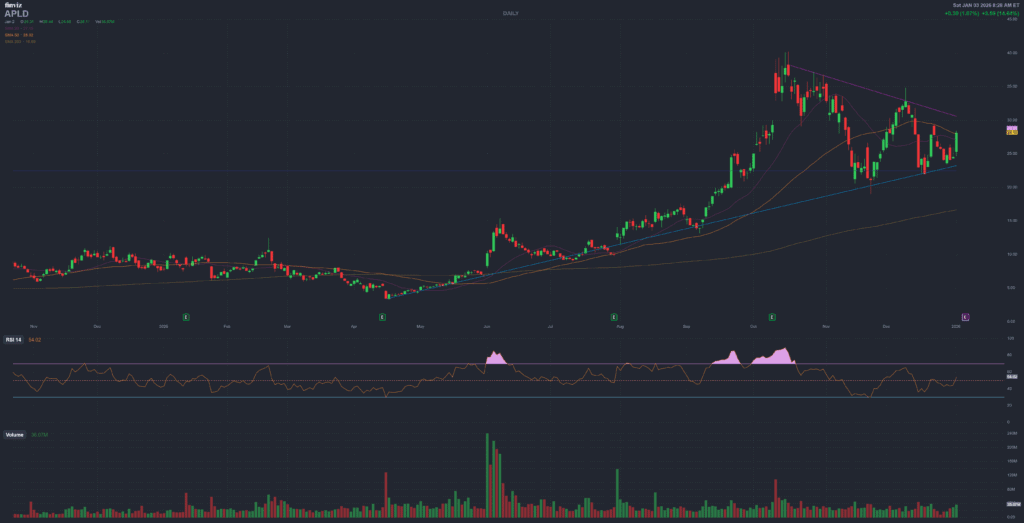
Daily candlestick chart with moving averages and volume. Click to open the full interactive page on Finviz (affiliate link). The chart is only a snapshot – useful to see the 2025 move from low single digits into the high 20s and beyond.

0. Why this stock is in the list
- AI infrastructure pure play – APLD is not another “AI software” story; it sells megawatts of power and liquid-cooled racks to host other people’s GPUs, via long-term hosting and lease contracts.
- Multi-billion, 15-year leases already signed – two 15-year leases with CoreWeave for 250 MW at Ellendale worth about 7 billion USD in total contract value, plus a separate 5-billion USD, 15-year lease with a U.S. investment-grade hyperscaler for 200 MW at the Polaris Forge 2 campus.
- Up to 5 billion USD of dedicated funding from Macquarie – Macquarie Asset Management is committing up to 900M USD up front and up to 5B USD in total to fund over 2 GW of HPC data center build-out, in exchange for a 15% stake in the HPC segment.
- Short interest above 30% of float – as of mid-December 2025, around 79–80M shares short, more than 30% of the float, with a short ratio around 3 days. Structurally primed for squeezes in both directions.
- Valuation already pricing in a lot – roughly 7.8–8.0B USD market cap on about 219M USD of trailing revenue and GAAP net losses, meaning the market is paying for the long-term contract book, not the current income statement.
1. Quick overview – what Applied Digital actually does
Applied Digital designs and operates high-power, high-density data center campuses for AI and HPC workloads across North America. The business has two main engines:
- HPC Data Center Hosting – long-term leases where APLD provides power, cooling and space for clients’ GPUs and AI infrastructure. Customers sign 10- to 15-year contracts for megawatts of “critical IT load” at campuses like Ellendale (North Dakota) and Polaris Forge (North Dakota and Texas).
- Cloud / GPU Services – a cloud-style platform where APLD sells access to GPU clusters for AI and machine-learning workloads. This segment grew fast but has been volatile and the board has approved a plan to sell or separate it in order to focus on the data center REIT-style model.
In simple terms, APLD wants to be the landlord and infrastructure provider for AI compute: get long-term take-or-pay style contracts, finance the build-out with institutional partners, and then harvest stable recurring revenue over 15 years.
2. Key fundamental data (snapshot)
Approximate values – early 2026, rounded and simplified
| Share price | around 28–30 USD per share (recent range mid-20s to low-40s) |
|---|---|
| Market cap | roughly 7.8–8.0B USD |
| Revenue (TTM) | about 219M USD |
| Q3 FY2025 revenue (quarter ended 28 Feb 2025) | 52.9M USD (+22% year over year) |
| Q3 FY2025 net loss attributable to common stockholders | −36.1M USD (−0.16 USD per share) |
| Q3 FY2025 adjusted net loss | −17.8M USD (−0.08 USD per share, non-GAAP) |
| Q3 FY2025 adjusted EBITDA | +10.0M USD (non-GAAP) |
| Cash, cash equivalents and restricted cash (28 Feb 2025) | 261.2M USD |
| Total debt (28 Feb 2025) | 689.1M USD |
| Enterprise value | around 8.5B USD |
| Price-to-sales (TTM) | about 36x |
| Shares outstanding | around 269M shares |
| Float | around 230M shares |
| Institutional ownership | about 62% |
| Insider ownership | around 18% |
| Short interest | about 79–80M shares short, roughly 31–34% of float; short ratio ~2.6–3.1 days |
In one line: Applied Digital is a heavily valued, loss-making AI infrastructure landlord with positive adjusted EBITDA, a large debt load, solid cash and a contract book that dwarfs its current revenue.
3. Ownership structure – institutions, insiders, shorts
| Institutions | around 60–62% of the float, including infrastructure and growth funds |
|---|---|
| Insiders | high-teens percentage; founder/CEO and early backers still meaningful holders |
| Short sellers | roughly one third of the float sold short, one of the higher short-interest levels in the AI infra space |
| Retail base | very active on Reddit, Stocktwits and X, often framing APLD as both “AI infra pure play” and “short squeeze candidate” |
This mix (high institutional ownership, strong insider stake and extremely elevated short interest) is exactly what you would expect in a controversial, high-beta growth story: a tug of war between believers, sceptics and momentum traders.
4. 2025 performance – business and stock
On the business side, fiscal 2025 was the year when Applied Digital stopped being “the crypto host that wants to pivot to AI” and started becoming “the AI data center landlord with real institutional capital behind it”:
- Q3 FY25 revenue of 52.9M USD, up 22% year over year, driven by Cloud Services and hosting growth,
- adjusted EBITDA of 10M USD for the quarter, up from a loss in the prior year,
- a 261M USD cash position and 689M USD debt, reflecting rapid build-out of Ellendale and other sites.
On the stock side, 2025 was brutal in both directions:
- APLD traded as low as ~3.3 USD in April 2025 and as high as just over 40 USD in October 2025,
- year-to-date moves at one point exceeded +300%, fuelled by AI enthusiasm,
- post-earnings and post-news swings of 20–40% in a single day were not unusual.
The key driver for the rerating was not a sudden explosion in current earnings, but the signing of long-dated, multi-billion leases that changed the perceived long-term economics of the platform.
5. Liquidity and volatility – trading personality
Applied Digital is heavily traded and highly volatile:
- average daily volume in the tens of millions of shares,
- beta comfortably above 2,
- double-digit intraday swings on apparently minor news when shorts and options flows interact.
For traders it behaves like a classic high-beta AI infrastructure vehicle: liquid enough to move size, but dangerous to hold blindly through earnings or major news. For longer-term investors, sizing and risk control are critical given the combination of leverage, capex and sentiment-driven volatility.
6. Analyst estimates and ratings – “official” view
Analyst coverage of APLD tends to converge on a few points:
- data center power for AI is a structural growth area and Applied has secured genuinely large contracts,
- the Macquarie partnership and other financing deals significantly de-risk the capital needed to build out the campuses,
- however, the stock trades at very high multiples of current revenue and EBITDA, with GAAP net income deeply negative.
The result is a split stance: some analysts highlight APLD as one of the most leveraged ways to play AI infrastructure, while others warn that the valuation already bakes in a smooth execution of multi-year build-outs, with little room for delays or cost overruns.
7. Outlook and projects – what Applied Digital is trying to build
Looking forward, Applied Digital is trying to assemble a scaled, partially de-risked AI data center platform:
- Ellendale HPC Campus (North Dakota) – 100 MW building under construction, with Macquarie funding and CoreWeave leases covering 250 MW over 15 years; future buildings could take the site above that capacity if options are exercised.
- Polaris Forge campuses – North Dakota site where the 5-billion USD, 15-year lease with a U.S. investment-grade hyperscaler for 200 MW is anchored, with potential expansion up to 1 GW at full build-out.
- HPC business as a quasi-REIT – management has openly discussed the idea of an eventual REIT-like structure or a more pure-play infrastructure vehicle once the portfolio is more mature and cloud services are separated.
- Cloud Services separation – the board approved a plan to sell or separate the Cloud Services business, focusing the listed entity on long-term, contracted infrastructure economics.
If this roadmap works, Applied Digital could evolve from a volatile hybrid into something closer to an AI infrastructure landlord with more predictable economics. If it does not, the leverage and valuation amplify the downside.
8. 2025–2026 operational timeline – key milestones
-
January 2025 – Macquarie partnership
Applied Digital agrees a partnership with Macquarie Asset Management for funding of up to 5B USD, including an initial 900M USD commitment for Ellendale and a 15% equity stake in the HPC business. -
April 2025 – Q3 FY2025 results
Company reports 52.9M USD revenue (+22% YoY), 10M USD adjusted EBITDA, 261.2M USD cash and 689.1M USD debt. The board approves a plan to sell or separate Cloud Services. -
June 2025 – CoreWeave leases
Applied signs two 15-year leases with CoreWeave for 250 MW at Ellendale, expecting roughly 7B USD of total revenue over the term, with an option for an additional 150 MW. -
October 2025 – 5B USD hyperscaler lease
Company signs a 15-year lease with a U.S. investment-grade hyperscaler for 200 MW at Polaris Forge 2, representing about 5B USD in total contracted revenue and first right of refusal on a further 800 MW. -
Late 2025 – construction and financing updates
Additional financing (including a 375M USD facility with SMBC) is used to repay prior Macquarie notes and accelerate Ellendale construction, while management reiterates plans to focus on the HPC/hosting model.
The 2026 narrative will depend heavily on whether the company hits construction milestones, energises the promised megawatts on time and converts the contract pipeline into actual, billing capacity.
9. Key 2026 catalysts – where the share price may react most
- Updates on Ellendale and Polaris Forge construction progress and energisation dates.
- Any new long-term leases with hyperscalers or expansions of existing deals.
- Sale or spin-off of the Cloud Services business and any discussions about REIT-type structures.
- Quarterly results versus expectations on revenue, adjusted EBITDA and cash burn.
- Changes in short interest, borrow costs or large block trades that could drive squeezes or unwind them.
- Macro developments affecting data center power costs and availability in key states.
10. Retail sentiment (Reddit, Stocktwits, X) – non-professional traders
Reddit – AI infra and squeeze narratives
On Reddit, Applied Digital shows up in AI, growth and short-squeeze subs. Typical posts:
- threads that compare APLD’s contract book (7B + 5B leases) to its current revenue and market cap,
- discussions about whether APLD is a “baby data center REIT for AI” or just a leveraged bet on one cycle,
- screenshots of short-interest charts and options positions, with heavy focus on a potential “short squeeze 2.0”.
These are opinions of non-professional traders; they give a feel for sentiment, not a reliable guide to risk or valuation.
Stocktwits – full momentum mode
On Stocktwits the tone is much more aggressive:
- constant monitoring of short % float, days-to-cover and borrow fees,
- very short-term calls (“APLD to 40+ if shorts panic”),
- focus on intraday breakouts and technical levels rather than fundamentals.
For a large portion of that audience, APLD is primarily a trading instrument tied to AI buzz and short dynamics, not a long-term infrastructure investment.
X (Twitter) – between infra investors and traders
On X, you see two worlds:
- infra and real-asset investors comparing APLD’s deals with those of data center REITs and private players,
- traders who focus on the chart, Nvidia adjacency and one-liners like “APLD is the tollbooth for AI compute”.
Overall, retail sentiment is strongly bullish at the moment but often light on risk analysis. That imbalance can make negative surprises particularly painful when they arrive.
11. Peer group and competitive landscape
Applied Digital sits at an intersection between:
- Data center REITs – names like Equinix and Digital Realty that operate large campuses and lease space and power,
- Private AI infra players – unlisted platforms backed by large funds (Aligned, Vantage, etc.) building AI-focused campuses,
- Other AI data center builders – smaller public or private firms trying to capture AI demand in specific regions.
APLD’s differentiation is its focus on very high-power, high-density build-outs in lower-cost energy markets, combined with long-term contracts and institutional capital. The flip side is that much larger players are now entering the same AI infra race, and the cost of capital and power can shift quickly.
12. Key questions to monitor
- Can APLD deliver Ellendale and Polaris Forge capacity on time and on budget?
- Will the company manage to keep leverage under control as it ramps capex for multi-GW build-outs?
- How concentrated will revenue remain in a small number of customers (CoreWeave, one hyperscaler, others)?
- Will the Cloud Services separation improve focus and valuation, or remove an upside option?
- How sensitive are long-term economics to power costs, regulation and competition from larger infra players?
13. Main risks – the real “but” in the story
- Execution and capex risk – delays, cost overruns or technical issues at key campuses can erode returns and strain the balance sheet.
- Leverage and financing – 689M USD of debt on 219M USD of sales is manageable only if the ramp materialises; more debt or equity might be needed.
- Customer concentration – heavy dependence on a few large customers increases the impact of any renegotiation or loss of a contract.
- Valuation – current market cap implies that long-term contracts will be executed almost flawlessly; any disappointment can trigger sharp re-rating.
- Regulatory and power-market risk – changes in energy policy, grid constraints or local regulation in key states can affect costs and timelines.
- Sentiment and short-interest risk – while short interest can fuel rallies, it also means that negative news can be aggressively amplified by those betting against the stock.
14. Overall summary – how to frame APLD in your watchlist
Applied Digital is one of the purest public equities tied to the physical infrastructure of the AI boom: megawatts of power, long-term leases with hyperscalers, and big-ticket funding from institutions like Macquarie and SMBC. It is also a company with high leverage, substantial execution risk and a valuation that asks investors to believe in many years of smooth build-out and occupancy.
The upside case is that APLD becomes a core piece of AI infrastructure in North America, gradually transforming into a more REIT-like platform with stable, contracted cash flows and lower perceived risk.
The downside case is that delays, cost issues, customer changes or macro/energy shocks expose the fragility of the current valuation and reminder that, for now, earnings are still negative and dependent on a small number of large relationships.
For a “small caps of the moment” list, APLD is a classic high-beta infra story: structurally interesting, but a name where both upside and downside need to be respected and where due diligence cannot stop at slogans like “AI data center = guaranteed success”.
Biotech Catalyst Calendar
If you follow high-volatility names like Applied Digital, you may also want to keep an eye on upcoming biotech catalysts (PDUFAs, trial readouts, CRLs, etc.). On Merlintrader trading Blog you’ll find a dedicated calendar with key regulatory and clinical events – all free to browse.
Open the Biotech Catalyst CalendarSmall caps del momento
Applied Digital – APLD
Applied Digital Corporation (NASDAQ: APLD) progetta, costruisce e gestisce data center ad altissima potenza per carichi di lavoro AI e high-performance computing. Nata come storia legata all’hosting per il mining cripto, tra 2024 e 2025 ha realizzato uno dei pivot più aggressivi verso l’infrastruttura AI: lease quindicennali da miliardi di dollari con hyperscaler, partnership di funding fino a 5 miliardi di USD con Macquarie Asset Management e una capitalizzazione in area 8 miliardi su ricavi appena sopra i 200 milioni. Tecnicamente ormai è una mid cap, ma per comportamento resta perfettamente nel tema “small caps del momento”: short float oltre il 30%, beta alta, reazioni violente ad ogni trimestrale.
Grafico prezzo (Finviz)
Grafico daily a candele con medie mobili e volumi. Clicca sull’immagine per aprire la pagina completa su Finviz (link affiliato). Serve solo come fotografia del movimento 2025, dai minimi intorno a 3 dollari fino ai massimi sopra 40.
0. Perché è in questa lista
- Scommessa diretta sull’infrastruttura AI – APLD non è l’ennesima “software AI” poco chiara: vende megawatt di potenza e rack raffreddati a liquido per ospitare le GPU degli altri, con contratti di hosting e lease a lungo termine.
- Lease pluriennali già firmati per miliardi – due lease da 15 anni con CoreWeave per 250 MW a Ellendale, dal valore atteso di circa 7 miliardi di USD, più un lease quindicennale da 5 miliardi di USD con un hyperscaler USA investment-grade per 200 MW al campus Polaris Forge 2.
- Fino a 5 miliardi di funding dedicato da Macquarie – Macquarie Asset Management si impegna fino a 5 miliardi di USD per supportare oltre 2 GW di sviluppo data center HPC, con 900 milioni iniziali su Ellendale e una quota del 15% nel segmento HPC.
- Short interest sopra il 30% del float – a metà dicembre 2025 ci sono circa 79–80M di azioni short, oltre il 30% del float, con short ratio attorno a 3 giorni: struttura perfetta per squeeze ricorrenti.
- Valutazione già molto “avanti” – 7,8–8,0 miliardi di USD di market cap su circa 219M di ricavi trailing e perdite GAAP, quindi il mercato sta pagando soprattutto per il valore dei contratti futuri, non per l’utile di oggi.
1. Panoramica rapida – cosa fa davvero Applied Digital
Applied Digital è, in pratica, un landlord di data center per AI e HPC. I due pilastri del business sono:
- HPC Data Center Hosting – lease pluriennali in cui APLD fornisce potenza elettrica, raffreddamento e spazio per l’infrastruttura GPU dei clienti. I contratti sono tipicamente 10–15 anni, legati a megawatt di “critical IT load” in campus come Ellendale e Polaris Forge.
- Cloud / GPU Services – una piattaforma in cui APLD vende accesso a cluster di GPU per workload AI/ML. È cresciuta rapidamente ma è volatile; il board ha approvato il piano di vendita o separazione per concentrare la quotata sul modello infrastrutturale di lungo periodo.
L’idea di fondo è semplice: diventare il “casello autostradale” dell’AI, incassando canoni ricorrenti per potenza e spazio, finanziando il build-out con capitali istituzionali e cercando di portare i campus a piena occupazione nel ciclo di vita dei lease.
2. Dati fondamentali chiave
Valori indicativi, inizio 2026, arrotondati
| Prezzo per azione | circa 28–30 USD |
|---|---|
| Market cap | circa 7,8–8,0 miliardi USD |
| Ricavi TTM | circa 219M USD |
| Ricavi Q3 FY2025 | 52,9M USD (+22% anno su anno) |
| Perdita netta Q3 FY2025 (attribuibile ai common) | −36,1M USD (−0,16 USD per azione) |
| Perdita netta aggiustata Q3 FY2025 | −17,8M USD (−0,08 USD per azione, non-GAAP) |
| Adjusted EBITDA Q3 FY2025 | +10,0M USD (non-GAAP) |
| Cassa + equivalenti + restricted cash | 261,2M USD al 28 febbraio 2025 |
| Debito totale | 689,1M USD al 28 febbraio 2025 |
| Enterprise value | circa 8,5 miliardi USD |
| Price-to-sales (TTM) | circa 36x |
| Azioni in circolazione | circa 269M |
| Float | circa 230M |
| Institutional ownership | circa 62% |
| Insider ownership | circa 18% |
| Short interest | circa 79–80M di azioni short, pari a circa 31–34% del float; short ratio intorno a 2,6–3,1 giorni |
Tradotto: Applied Digital è un landlord di infrastruttura AI con EBITDA aggiustato positivo, perdite GAAP rilevanti, leva significativa e una valutazione che riflette soprattutto i contratti futuri più che la fotografia attuale del conto economico.
3. Azionariato: istituzionali, insider, short
| Istituzionali | circa il 60–62% del float, fra fondi infrastrutturali e growth |
|---|---|
| Insider | alta singola cifra / bassa doppia cifra (intorno al 18%), con CEO e early backer ancora ben presenti |
| Short seller | circa un terzo del float venduto allo scoperto, fra i livelli più alti del settore infrastruttura AI |
| Base retail | molto attiva su Reddit, Stocktwits e X, con narrativa duale “AI infra pure play” e “short squeeze candidate” |
Il quadro è quello classico dei titoli growth controversi: istituzionali e insider convinti di avere in mano un asset strategico, contro una componente short altrettanto convinta che la valutazione sia fuori scala.
4. Performance 2025: business e prezzo
Sul piano operativo, il 2025 fiscale è stato l’anno in cui Applied Digital ha iniziato ad essere percepita davvero come piattaforma AI:
- ricavi trimestrali a 52,9M USD (+22% YoY), trainati dal cloud e dall’hosting,
- EBITDA aggiustato positivo a 10M USD, contro una perdita l’anno prima,
- cassa 261M USD, debito 689M USD, a riflettere un ritmo di costruzione molto elevato.
Sul lato borsa, il 2025 è stato un ottovolante:
- minimi intorno a 3,3 USD ad aprile, massimi oltre 40 USD a ottobre,
- fasi di rialzo cumulative oltre il +300%, spinte da entusiasmo AI e news sui contratti,
- giornate da ±20–40% in corrispondenza di trimestrali, deal o rumor sui clienti hyperscaler.
Il rerating riflette più i contratti firmati (e i capitali istituzionali entrati) che gli utili attuali: il mercato ha iniziato a trattare APLD come un pezzo dell’infrastruttura AI, non più come ex-story cripto.
5. Liquidità e volatilità
APLD oggi è molto liquida e molto volatile:
- volumi medi giornalieri nell’ordine di decine di milioni di azioni,
- beta ben sopra 2,
- oscillazioni intraday a doppia cifra possibili anche su news non eclatanti, quando si incrociano short e opzioni.
Per chi tradea è un classico “AI infra vehicle” da trattare con timing; per chi ragiona in ottica più lunga la questione è dimensionare la posizione sapendo che leva, capex e sentiment possono amplificare qualsiasi errore di esecuzione.
6. Stime e rating degli analisti
Gli analisti che coprono APLD convergono su alcuni punti:
- la domanda strutturale di potenza per AI è reale e in crescita, e Applied ha contratti importanti,
- la partnership con Macquarie e altri finanziatori istituzionali riduce il rischio di funding per i campus,
- ma a questi prezzi la valutazione incorpora già molte aspettative su crescita, margini e puntualità dei progetti.
Trovi quindi report che la indicano come uno dei modi più “puri” per puntare sull’infrastruttura AI, e altri molto più cauti che sottolineano multipli estremi su ricavi ed EBITDA rispetto al rischio di execution.
7. Prospettive e progetti
Guardando avanti, Applied Digital sta cercando di costruire una piattaforma AI data center di scala:
- Campus Ellendale (North Dakota) – primo edificio HPC da 100 MW in costruzione, con funding Macquarie e lease con CoreWeave per 250 MW su 15 anni, più opzione per ulteriore capacità.
- Campus Polaris Forge – sito dove è ancorato il lease quindicennale da 5 miliardi di USD per 200 MW con un hyperscaler investment-grade, con potenziale espansione fino a 1 GW.
- Business HPC come veicolo “quasi-REIT” – il management ha già accennato all’idea di strutture più simili a un REIT o a un’infraco dedicata, una volta separata la parte cloud.
- Separazione del Cloud Services – il board ha approvato il piano di vendita o spin-off del business cloud per concentrare la quotata sul flusso di cassa infrastrutturale a lungo termine.
Se il piano funziona, APLD potrebbe evolvere in un player infrastrutturale AI con ricavi più stabili e multipli meno “estremi”; se qualcosa va storto (ritardi, extra costi, contratti che si sgonfiano), la leva e la valutazione attuale amplificano l’impatto.
8. Timeline operativa 2025–2026
- Gennaio 2025 – partnership con Macquarie
Accordo per funding fino a 5 miliardi di USD, con 900M iniziali su Ellendale e diritto a salire a 5B su oltre 2 GW di sviluppo HPC, in cambio del 15% dell’HPC business. - Aprile 2025 – risultati Q3 FY2025
Ricavi 52,9M USD, EBITDA aggiustato 10M USD, cassa 261,2M USD, debito 689,1M USD; il board approva il piano di vendita/separazione del Cloud Services. - Giugno 2025 – lease con CoreWeave
Due lease quindicennali per 250 MW a Ellendale, per un valore complessivo atteso di circa 7 miliardi di USD; opzione per ulteriori 150 MW. - Ottobre 2025 – lease da 5 miliardi con hyperscaler
Lease quasi quindicennale da circa 5 miliardi di USD per 200 MW a Polaris Forge 2, con first right of refusal su altri 800 MW nel campus. - Fine 2025 – finanziamenti addizionali e cantieri
Nuovi finanziamenti (incluso un prestito da 375M USD con SMBC) per ripagare vecchi debiti e accelerare la costruzione di Ellendale; si rafforza la narrativa di APLD come piattaforma AI infra di lungo termine.
Il 2026 sarà una prova di esecuzione: i contratti ci sono, ma il valore dipende da tempi e costi reali dei campus e dalla capacità di portarli a piena occupazione.
9. Catalyst chiave nel 2026
- Update sui cantieri Ellendale e Polaris Forge (milestone di costruzione, energizzazione, ritardi).
- Nuovi lease di lungo periodo con hyperscaler o ampliamento di quelli esistenti.
- Chiusura e struttura finale della separazione del Cloud Services, eventuali discussioni su REIT/infraco.
- Trimestrali rispetto alle attese su ricavi, EBITDA aggiustato, cash burn e leva.
- Movimenti nello short interest (coperture, nuovi ingressi) e nel borrow cost.
- Evoluzione del contesto energetico/regolatorio nei principali stati in cui operano i campus.
10. Sentiment (Reddit, Stocktwits, X) – trader non professionisti
Su Reddit, Applied Digital compare nei thread su AI, growth e short squeeze. I pattern ricorrenti:
- post che confrontano il valore dei lease (7B + 5B) con i ricavi e la market cap attuali,
- discussioni su APLD come “baby data center REIT per AI” vs “scommessa super levereggiata su un ciclo”,
- grafici di short %, days-to-cover e screenshot di posizioni in opzioni, con narrativa “se parte lo squeeze ci travolge”.
Su Stocktwits il tono è ancora più aggressivo: focus quasi esclusivo su short interest, breakout di breve, target price euforici e orizzonte temporale di poche sedute. Per molti utenti è prima di tutto un veicolo di momentum legato al buzz sull’AI e agli squeeze, non un investimento infrastrutturale di lungo termine.
Su X si intrecciano due mondi: investitori infrastrutturali che confrontano i deal di APLD con quelli dei data center REIT e delle piattaforme private, e trader che guardano soprattutto al grafico, alla vicinanza a Nvidia e a slogan del tipo “APLD è il pedaggio obbligato dell’AI compute”.
Tutto questo sentiment è prodotto da trader non professionisti: utile per misurare dove sono eccessi di entusiasmo o panico, ma non sostituisce un’analisi dei fondamentali e del rischio.
11. Concorrenza e peer group
- Data center REIT – Equinix, Digital Realty e altri operatori di grandi campus multi-tenant.
- Player privati di infrastruttura AI – piattaforme come Aligned, Vantage, ecc., spesso non quotate.
- Altri costruttori di data center AI – aziende più piccole o focalizzate su regioni specifiche.
Il pitch di APLD è focalizzarsi su campus ad altissima potenza in mercati energetici relativamente economici, con contratti lunghi e funding istituzionale. Il rovescio della medaglia è che i grandi player globali stanno entrando nello stesso segmento e il vantaggio attuale potrebbe comprimersi se costi del capitale e dell’energia cambiano.
12. Domande chiave da monitorare
- APLD riuscirà a consegnare Ellendale e Polaris Forge nei tempi e nei budget annunciati?
- La leva resterà gestibile man mano che i capex per GW addizionali si materializzano?
- Quanto a lungo i ricavi resteranno dipendenti da pochi grandi clienti (CoreWeave, hyperscaler specifici)?
- La separazione del Cloud Services aumenterà focus e valutazione o rimuoverà una optionalità interessante?
- Quanto sono sensibili i ritorni di lungo periodo a costi dell’energia, regolazione locale e concorrenza di operatori più grandi?
13. Rischi principali
- Esecuzione e capex – ritardi, extra costi o problemi tecnici nei campus possono erodere i margini e stressare il bilancio.
- Leva e finanziamento – 689M USD di debito su 219M di vendite richiedono che il ramp vada secondo piano; in caso contrario potrebbe servire altro debito o equity.
- Concentrazione clienti – pochi nomi pesano moltissimo: rinegoziazioni o cambi di strategia dei clienti chiave avrebbero impatto immediato.
- Valutazione – con multipli molto elevati su ricavi e EBITDA, il margine di sicurezza è ridotto; brutte sorprese possono tradursi in drawdown violenti.
- Rischio regolatorio/energia – cambi nei costi e nelle regole per l’energia o in vincoli di rete possono alterare in modo significativo l’economia dei campus.
- Rischio sentiment/short – lo short interest alto è una lama a doppio taglio: può alimentare rally, ma può anche amplificare la pressione in fasi di risk-off o news negative.
14. Sintesi finale
Applied Digital è una delle scommesse più “pure” sulla parte fisica del boom AI: MW di potenza, campus in costruzione, contratti pluriennali con hyperscaler e capitali istituzionali di peso seduti al tavolo. Allo stesso tempo resta una storia con leva importante, execution risk reale e una valutazione che dà per scontati molti anni di esecuzione quasi perfetta.
Lo scenario positivo è quello in cui APLD diventa un pilastro dell’infrastruttura AI nordamericana, magari avvicinandosi nel tempo a un profilo più simile a un REIT infrastrutturale, con ricavi stabili e multipli meno estremi.
Lo scenario negativo è quello in cui ritardi, extra costi, problemi con i clienti o shock energetici mostrano i limiti del modello e il titolo viene “rimesso in riga” dal mercato.
In una watchlist “small caps del momento”, APLD è il classico titolo che merita studio e disciplina: molto interessante, ma non un posto dove affidarsi a slogan o a thread sui social al posto dell’analisi del rischio.
Biotech Catalyst Calendar
Se segui titoli ad alta volatilità come Applied Digital, può valere la pena tenere d’occhio anche i catalyst biotech (PDUFA, readout clinici, CRL, ecc.). Sul sito trovi un calendario dedicato, aggiornato regolarmente e consultabile gratuitamente.
Apri il Biotech Catalyst CalendarScanner for active traders

Try ChartsWatcher free, then unlock 10% OFF with SAVE10
ChartsWatcher is a real-time scanner for momentum traders: fast movers, unusual volume and rotations — so you can focus on the few tickers that matter right now, instead of watching hundreds of charts.
Start with the free version. When you upgrade, use SAVE10 for 10% OFF your first paid period.
Start free – then use SAVE10
No credit card required to start. Apply SAVE10 when upgrading.
Recommended platform

One platform. All your brokers.
Medved Trader connects multiple brokers in one workspace, with pro charts, hotkeys and fast execution — without changing your broker accounts.
A single cockpit for positions, Level II and multi-broker order routing, built for active day & swing traders.
Get 1 Month Free ➔
Multi-broker workflow + customizable layouts in one platform.
 Monica.im – the AI assistant I use every day
If you find value in the work I publish on Merlintrader and want a practical AI assistant for research and writing, you can sign up using this referral link. Click here to try Monica.im and support the site
Find out how I use AI on Merlintrader: AI, retail and Merlintrader
Disclosure: some of the links in the promotional blocks above are affiliate or referral links. If you choose to subscribe or sign up through them, Merlintrader may receive a small commission or benefit at no extra cost to you.