DISCLAIMER — Not financial advice. Educational content only, not an offer or solicitation to buy or sell any security. Biotech and small/mid-cap stocks are highly speculative and volatile and can result in a partial or total loss of capital. Do your own research and consult a licensed advisor where appropriate. / Contenuti a solo scopo informativo e didattico, non costituiscono consulenza finanziaria né offerta o sollecitazione al pubblico risparmio ai sensi delle normative CONSOB e SEC. Le azioni biotech e le small/mid cap sono strumenti altamente speculativi e volatili e possono comportare la perdita parziale o totale del capitale investito. Si raccomanda di effettuare sempre le proprie ricerche e, se necessario, di rivolgersi a un consulente abilitato.

Merlintrader Trading Pub
Biotech catalyst news and analysis. FDA PDUFA tracker
Merlintrader Trading Pub
Biotech catalyst news and analysis. FDA PDUFA tracker
Small Caps of the Moment
POET Technologies – POET
Optical interposers, high-speed optical engines and light sources for AI infrastructure and hyperscale data centers: POET Technologies (NASDAQ: POET) is a small cap that tries to sit in the plumbing of the AI world, not on the surface where the GPUs live. Current revenues are still tiny, but the market has already pushed the valuation close to the one-billion mark on the idea that POET could become a key enabler for the next wave of AI data centers. This page is a long-form profile meant to give you everything in one place – numbers, narrative, catalysts and a clear risk map.
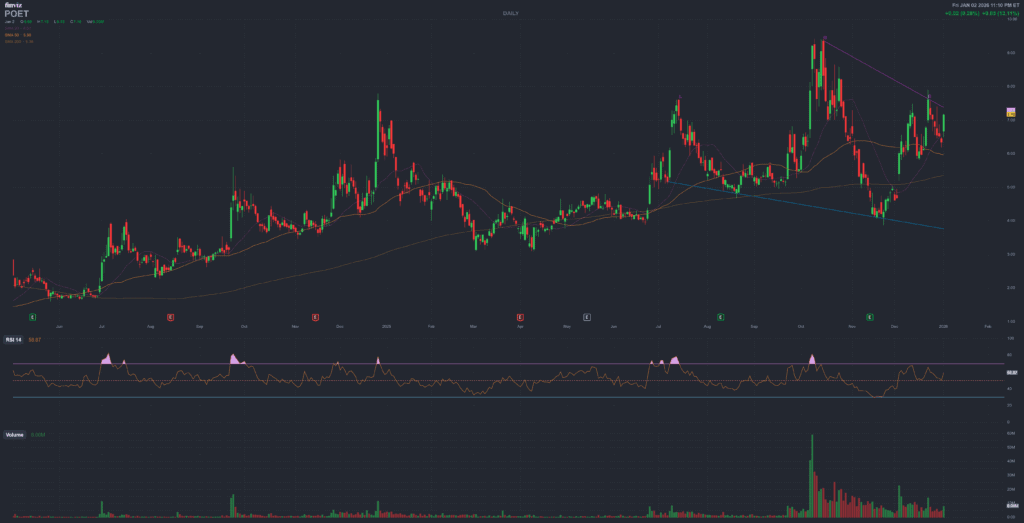
Price chart (Finviz)
Daily candlestick chart with moving averages and volume. Click to open the full interactive page on Finviz (affiliate link). As always, the chart is only a snapshot – useful to see how violent the moves have been.

0. Why this stock is in the list
- Big rerating in a short time – POET has moved from a classic micro-cap story that almost nobody followed to a small cap with a market cap in the 900–950M USD range. The stock has more than doubled in a year, and in some windows the move has been even larger if you pick the local lows and highs.
- Direct exposure to AI infrastructure – this is not another “AI software narrative”; POET tries to sit where the data flows. Optical engines and interposers live exactly in the path where GPU racks and switches talk to each other. If AI traffic keeps exploding, someone has to solve the bandwidth/power bottleneck – and POET is part of that conversation.
- Real commercial orders starting to appear – for a long time POET was a pure “story stock”: lots of technology slides, very little revenue. In 2025 the first tangible production orders for POET Infinity optical engines arrived, with shipments planned for 2026. The amounts are still small in absolute terms, but they are proof that someone is willing to pay.
- Strong retail community – there is now a dedicated base of investors who follow every press release, every conference appearance and every rumor about partnerships. That kind of “believer base” can fuel big swings, both on good and on bad news.
- At the same time, extremely high risk – low revenues, continuing losses, intense dilution and heavy reliance on future execution make this a name where things can go very well or very wrong. Precisely for this reason it qualifies as a “small cap of the moment”: strong narrative, strong volatility.
1. Quick overview – what POET actually does
POET Technologies is not a GPU vendor and not a cloud company. It is a design house focused on integrating photonics and electronics at the module level. The core idea is that classical electrical interconnects inside and between servers are hitting limits – in power, bandwidth and density – and that a new way of routing light instead of copper is needed to scale AI clusters.
The company’s main technology building block is the POET Optical Interposer. Think of it as a specialized substrate where you can mount lasers, modulators, drivers and other components and connect them through tiny optical waveguides directly at wafer level. Instead of assembling dozens of separate pieces with expensive, slow packaging steps, the interposer tries to bring a large part of that complexity into a single manufacturing flow.
On top of this platform POET builds:
- Optical engines – compact modules that contain the optics and electronics needed to send and receive very high speed optical signals (for example for 800G or 1.6T Ethernet-style links in data centers).
- Light source products – modules that provide coherent or non-coherent light for other vendors’ photonics systems, including co-packaged optics and next-generation switches.
- Custom optical modules – where POET designs a solution around a specific integrator’s needs, often as a subcomponent of a larger transceiver product.
POET does not sell finished switches or complete data-center boxes. It wants to be the supplier that sits inside other companies’ modules – a “picks and shovels” approach to the AI boom instead of a front-line GPU story.
2. Key fundamental data (snapshot)
Approximate values – early 2026, rounded and simplified
| Share price | about 7.2 USD per share (recent range 6.5–7.5) |
|---|---|
| Market cap | around 900–950M USD |
| 12-month market cap change | roughly +200–220% |
| TTM revenues | well under 1M USD (on the order of 0.8M) |
| Net income | negative – POET is still firmly loss-making |
| Cash and equivalents | roughly 90–95M USD |
| Total debt | about 7–8M USD |
| Enterprise value | around 850M USD |
| Revenue growth expectations | triple-digit growth rates once production orders ramp in 2026–2027 (from a tiny base) |
You can read this table in one sentence: the market is already valuing POET as if its technology will become relevant at scale, but the current income statement still looks like that of a pre-commercial R&D company. That tension – between promise and reality – is exactly what fuels both the excitement and the risk.
Clarification on cash: after the US$150M registered direct offering closed at the end of October 2025, POET has indicated a pro-forma cash position exceeding US$300M. The ~90–95M USD figure here reflects the last reported quarter before that transaction; future financial statements will incorporate the larger cash balance.
3. Ownership structure – who is actually holding POET
| Shares outstanding | about 132 million |
|---|---|
| Institutional ownership | roughly 6–7% of the float |
| Insider ownership | around 0.1–0.2% |
| General public (retail) | around 90%+ of the shares |
| Short interest | mid- to high-single-digit percentage of the float |
This mix tells you a lot about how the stock behaves. The company is not dominated by one or two big funds, and insiders – at least in terms of direct share ownership – are not the main force. Instead, POET trades like a classic retail-driven story, with institutions watching from the sidelines and a block of short sellers betting that expectations will need to cool down.
When you have:
- mostly retail longs who strongly believe in the long-term story;
- a visible short interest that does not control the float but is not negligible either;
- and a news flow that alternates between “big future promise” and “still tiny revenues”,
you naturally get a set-up where every press release can act as fuel, either for a spike up (short squeeze + FOMO) or for an air pocket if the news disappoints. That is exactly what you see on the chart.
4. 2025 performance – how the stock earned a place on the radar
Looking at a 12- to 18-month chart, POET moved through several distinct phases:
- Long accumulation zone – for months the stock traded in the low single digits, with limited volume and mostly ignored by mainstream media. This is the phase where only the true early believers and a few technology-focused funds accumulated.
- First “AI narrative” rerating – as AI infrastructure became the new market obsession, any company that could credibly say “we solve bandwidth/power issues for GPUs” started to attract attention. POET rode that wave, initially more on the narrative than on the numbers.
- News-driven rallies – announcements around the Optical Interposer, partnerships and early orders triggered gap-ups and days with very large percentage moves. Volatility increased sharply at the same time as liquidity improved.
- Consolidation at higher levels – after each spike the stock pulled back, but the lows tended to be higher than the previous range, slowly building a new base in the 6–8 USD area instead of the old 2–3 USD zone.
The key point is that the price action in 2025 was not random; it mirrored the process by which a micro-cap technology story gets “adopted” by the AI thematic trade. Once a name is on those radars, it rarely goes back to complete obscurity – but the swings get much larger.
5. Liquidity and volatility – what kind of beast you are dealing with
In 2023 you could look at POET and say “interesting, but it barely trades”. This is no longer true. The average daily volume in 2025 has grown significantly, and on news days the tape can easily show several millions of shares changing hands.
- On quiet days, the stock can still drift with relatively modest volume, but spreads are usually reasonable.
- On active days, intraday moves of ±5–10% are almost standard, and nothing prevents even bigger swings if news hits into a crowded positioning.
- Because ownership is retail-heavy and sentiment-driven, there is a strong tendency towards “over-reaction” in both directions: good news get extrapolated; bad news get punished fast.
- The previous dilutions also mean more shares are available to trade, so both rallies and drawdowns have more “ammo” behind them.
Practically, POET is not a stock where you set a position, forget about it and check again in six months. It is a name where volatility is part of the package. Any sizing decision has to respect that reality.
6. Analyst estimates and ratings – what the “official” view looks like
Coverage is still thin. You will not find a dozen bulge-bracket banks publishing 40-page initiation reports on POET. Instead, you see:
- a handful of specialist brokers and research boutiques focusing on photonics and semis;
- occasional pieces on investor platforms and newsletters that highlight POET as an “AI infrastructure bet”;
- a mix of cautious optimism on the technology and a clear warning on valuation and execution risk.
The common pattern in these pieces is something like:
- the addressable market for AI optical connectivity is huge if AI clusters keep scaling;
- POET’s Optical Interposer is an interesting architectural proposal that could simplify assembly and lower costs;
- however, with current revenues so low and losses continuing, it is impossible to justify the valuation using classical multiples – you have to believe in the ramp.
In other words, the “sell side” is not blind to the risks. Where they tend to be constructive is on the idea that if the optical interposer story works even partially, the upside in absolute dollar revenue could be large compared with today’s base.
7. Outlook and projects – what POET is trying to build
To understand the outlook, it helps to zoom out from quarterly numbers and think in terms of the problems AI data centers have to solve:
- Bandwidth – every new GPU generation pushes more data per second. Links between chips and racks need to keep up.
- Power consumption – copper interconnects and traditional optics consume a lot of power. At hyperscale, every watt matters both for cost and for cooling.
- Density and footprint – AI clusters eat rack space very quickly; bulky optical modules make the problem worse.
POET’s roadmap addresses these points in several ways:
- Optical Interposer as a platform – by integrating the photonic elements at wafer level, POET aims to reduce assembly steps, improve alignment tolerances and open the door to more compact, cheaper modules. Less glue, less manual tweaking, more automated production.
- POET Infinity engines – these are the workhorse products that AI data centers would actually use, sitting inside 800G or 1.6T transceiver modules or future co-packaged optics. The key is not just speed, but also how easy these engines are to integrate into existing designs.
- Light engines and custom solutions – in parallel, POET offers light sources and application-specific modules that allow integrators to “plug in” the interposer into different contexts.
- Partner-driven go-to-market – POET does not sell directly to every data center operator. Instead, it works with integrators and system vendors who act as multipliers: if one big partner adopts POET’s engines for their AI line-up, that single decision can translate into many individual modules.
The big unknown is pacing. The technology roadmap is ambitious; the revenue line will only tell us over time how much of that ambition becomes reality.
8. 2025–2026 operational timeline – milestones to keep in mind
-
2024 – platform validation phase
Focus on demonstrating that the Optical Interposer can be manufactured reliably, that it works in realistic conditions and that it plays nicely with the rest of the optical ecosystem. A lot of the work here is invisible to the market but critical in the background. -
Early 2025 – deepening of partnerships
More discussions with module makers and AI hardware players; several MOUs and collaboration announcements that do not yet translate into big revenue, but build the “optionality” story. -
Mid-2025 – visibility inflection
The AI infrastructure narrative peaks; POET is increasingly mentioned as one of the small caps to watch in photonics. The stock starts trading more like a thematic vehicle than a quiet R&D play. -
Late 2025 – first volume orders
Orders for POET Infinity optical engines are announced, including one production order of several million dollars in value, with deliveries scheduled across 2026. This is the first tangible proof that the technology is not just a lab curiosity. -
2026 – ramp and execution phase
The year where POET has to show that it can:- manufacture the ordered engines at the promised quality and yields;
- support partners in integrating those engines into shipping products;
- win additional design-ins so that 2027 does not depend on a single customer.
This is not a biotech-style one-day binary event. It is a story made of many small execution checkpoints. But each quarterly report that updates this timeline can act as a mini-catalyst.
9. Key 2026 catalysts – where the share price is likely to react
-
Progress updates on the large POET Infinity order
Investors will watch for confirmations that production is on track: any statement about volumes shipped, yields or expanded order size will be scrutinised line by line. -
New design-wins with additional integrators
Announcements that new transceiver vendors or AI hardware suppliers are adding POET engines to their platforms would support the idea that the technology is gaining traction beyond one flagship partner. -
Evidence of recurring revenue rather than one-off projects
In conference calls, wording around “multi-year programs”, “framework agreements” and “follow-on orders” will be particularly important. The more recurring the revenue looks, the less binary the story becomes. -
Clarification on the role within larger ecosystems
If partners that operate at higher layers (for example large semiconductor or networking companies) start to explicitly mention POET as part of their photonics roadmap, that would be a strong validation signal. -
Financing moves
Any new equity offering or debt deal will act as its own catalyst. Well-timed, well-priced funding that extends the runway might be digested; messy funding at low prices could trigger sharp corrections.
The simplest way to think about 2026 is: every piece of news that either confirms or challenges the idea of POET as a future “plumbing provider” for AI data centers will matter, even if the absolute dollar amounts remain small in the short term.
10. Sentiment (Reddit, Stocktwits, X) – how the crowd sees POET
Reddit and long-form forums
On Reddit and similar forums there is now a sizeable group of users that follow POET almost like a project, not just as a ticker. They share technical documents, patents, conference slides and try to map exactly how the interposer works and where it could fit. The tone is often very bullish – people who have done a lot of homework and naturally want the thesis to be right – but even there you see recurring questions about execution, dilution and timelines.
Stocktwits
On Stocktwits the story is much more price-driven. POET is treated as a high-beta AI vehicle: when the chart is breaking out, the feed fills with “next leg up” messages; when the stock pulls back, you see the usual mix of bargain hunters and frustrated holders. Time horizon there is usually days or weeks, not years.
X (Twitter)
On X, POET appears in threads about AI infrastructure, co-packaged optics and photonic interposers. Here the discussion is more macro: how do we keep scaling AI clusters without burning the grid? Is photonics the answer? In that context POET is often mentioned alongside other photonics companies and research initiatives.
Put together, the sentiment picture is this: believers see POET as a levered play on a structural problem (AI bandwidth and power), sceptics see a tiny revenue base and heavy dilution. The market price is the tug of war between those two camps.
11. Peer group and competitive landscape
POET is not trying to dominate the whole optical stack. It is competing – and potentially collaborating – inside a very specific layer. Some of the categories around it are:
- Traditional module vendors – big companies that sell datacom/transceiver modules to cloud providers. They can either adopt POET’s engines or keep building everything in-house.
- Silicon photonics players – firms that integrate photonics directly into silicon chips, in some cases under the umbrella of very large semiconductor companies. They compete for the same dollars (capex for AI connectivity) but with different technical approaches.
- Other “photonic fabric” projects – companies working on photonic interconnects for AI, in which POET can be either a supplier or a competitor, depending on the architecture.
POET’s value proposition is to say: you do not have to reinvent your whole manufacturing flow – use our interposer and our engines, and you get a large part of the integration and alignment work pre-packaged. Whether the industry will take that offer at scale is the open question.
12. Key questions to monitor
For a name like POET, the most useful approach is often to track a few clear questions over time rather than obsess over every tick of the share price. Examples:
- Adoption – are more integrators and AI hardware vendors actually committing to POET engines in their roadmaps? Are those commitments turning into signed, multi-year contracts?
- Runway – how many quarters of cash does the company have at the current burn rate, and how does that change as revenue starts to appear? Is management signalling a clear, measured funding plan or relying on opportunistic offerings?
- Technology validation – are partners reporting that POET’s solutions work as advertised in real deployments? Any major technical hiccup would weigh heavily on sentiment.
- Mix of one-off vs recurring revenue – is the business evolving towards predictable, recurring shipments, or does it still look like a sequence of isolated projects?
- Competitive moves – are larger players launching alternative solutions that directly challenge POET’s position, or are they moving in directions that can coexist with the interposer concept?
13. Main risks – the real “but” in the story
- Execution risk – transitioning from a few pilot programs and early orders to reliable, large-scale production is difficult even for bigger companies; for a small cap it is a major hurdle.
- Valuation risk – with less than a million dollars in current revenues and a market cap close to 1B, POET offers almost no cushion if growth disappoints or is simply slower than the market currently discounts.
- Dilution and funding risk – the share count has already increased materially; further rounds of equity financing are a realistic possibility if the ramp requires more investment than expected.
- Competitive pressure – large semiconductor and networking companies may choose to push their own photonics approaches, reducing the overall room available for smaller players.
- Customer concentration – in the first years of commercialisation, revenues are likely to depend heavily on a small number of partners; any delay or cancellation in one project can have a big impact.
- Macro and AI-cycle risk – if AI capex goes through a digestion phase, or if architectures shift in a way that reduces demand for POET’s type of connectivity, the company could find itself with a lot of technology and not enough buyers in the short term.
14. Overall summary – how to frame POET in your watchlist
POET Technologies is not a steady, boring compounder. It is a leveraged bet on a specific way of solving a very concrete problem: how to move enormous amounts of data inside AI data centers without blowing up power budgets and cable farms. The Optical Interposer and the Infinity engines are one proposed answer.
The upside case is simple to describe: if POET’s technology becomes a preferred building block for even a fraction of AI connectivity deployments, the revenue line could grow by multiples, and today’s valuation would look justified or even conservative in hindsight.
The downside case is equally clear: if adoption is slow, limited to a few niche projects or overshadowed by competing approaches from larger players, the combination of dilution and high expectations can be painful.
For a “small caps of the moment” watchlist, POET is an example of a stock where thesis, narrative and risk are all loud and visible. It is not a name to buy blindly; it is a name to study, follow over time and size carefully if it ends up matching your personal criteria and risk tolerance.
Biotech Catalyst Calendar
If you follow high-volatility names like POET, you may also want to keep an eye on upcoming biotech catalysts (PDUFAs, trial readouts, CRLs, etc.). On Merlintrader trading Blog you’ll find a dedicated calendar with key regulatory and clinical events – all free to browse.
Open the Biotech Catalyst CalendarSmall caps del momento
POET Technologies – POET
Optical interposer, motori ottici ad alta velocità e sorgenti di luce per l’infrastruttura AI e i data center hyperscale: POET Technologies (NASDAQ: POET) è una small cap che prova a mettersi nel “tubo” dove passa il traffico dell’intelligenza artificiale. I ricavi sono ancora piccoli, ma il mercato ha già spinto la capitalizzazione vicino al miliardo sulla base dell’idea che POET possa diventare un tassello importante dei data center del futuro. Questa scheda è volutamente lunga e ripetitiva: l’obiettivo è darti una visione completa e coerente, numeri + narrativa + rischi.
Grafico prezzo (Finviz)
Grafico daily a candele con medie mobili e volumi. Clicca sull’immagine per aprire la pagina completa su Finviz (link affiliato). Il grafico serve solo come fotografia del comportamento del titolo, non come indicazione operativa.
0. Perché è in questa lista
- Rerating violento – POET è passata in poco tempo da micro cap ignorata a small cap vicina al miliardo di dollari di market cap, con performance a tre cifre su base annua.
- Esposizione diretta all’infrastruttura AI – non è l’ennesima “AI software company” di cui non si capisce bene il prodotto: qui si parla di fotonica e di collegamenti fra rack, switch e GPU nei data center.
- Arrivo dei primi ordini veri – dopo anni di sola narrativa tecnologica, nel 2025 sono arrivati ordini di produzione per i motori ottici POET Infinity, con spedizioni previste nel 2026. I numeri assoluti non sono ancora giganteschi, ma il segnale è importante.
- Community retail molto coinvolta – esiste ormai una base di investitori che segue POET quasi quotidianamente, con thread dedicati, analisi “fai da te” e condivisione di ogni minimo aggiornamento.
- Rischio elevato e dichiarato – ricavi bassi, perdite, diluizione, concorrenza forte: è un titolo che può fare molto bene ma anche molto male. Proprio per questo rientra nella categoria “small caps del momento”.
1. Panoramica rapida – cosa fa davvero POET
POET non vende GPU, non vende server completi e non è un cloud provider. È una società di progettazione che lavora sulla integrazione di fotonica ed elettronica a livello modulo. Il problema che vuole risolvere è semplice da descrivere: i collegamenti in rame e i moduli ottici tradizionali nei data center AI stanno diventando troppo lenti, troppo energivori e troppo ingombranti.
Il mattone principale è il POET Optical Interposer: una specie di “substrato intelligente” a livello wafer su cui è possibile montare laser, modulatori, driver e altri componenti fotonici ed elettronici, collegandoli tramite waveguide interne. Invece di fare mille passaggi di packaging manuale, l’idea è spostare gran parte del lavoro direttamente sul wafer.
Sopra questo interposer POET costruisce tre famiglie di prodotti:
- Motori ottici (optical engines) per moduli 800G/1.6T usati in data center AI.
- Sorgenti di luce e light engines per co-packaged optics e switch di nuova generazione.
- Moduli custom sviluppati insieme a integratori specifici per esigenze particolari.
Il modello di business quindi non è “vendiamo un grande prodotto al cliente finale”, ma “diventiamo il fornitore di riferimento per chi costruisce i moduli ottici usati nei data center”.
2. Dati fondamentali chiave
Valori indicativi, inizio 2026, arrotondati
| Prezzo | circa 7,2 USD per azione |
|---|---|
| Market cap | intorno a 900–950M USD |
| Variazione market cap 12 mesi | circa +200–220% |
| Ricavi TTM | circa 0,8M USD (sotto 1M) |
| Utile netto | negativo, azienda ancora in perdita |
| Cassa | circa 90–95M USD |
| Debito | circa 7–8M USD |
| Enterprise value | circa 850M USD |
| Crescita ricavi attesa | crescita a tre cifre annue una volta avviato il ramp 2026–2027 |
Tradotto: oggi il mercato sta prezzando POET come se la tecnologia avesse buone chance di entrare davvero nei flussi AI, ma i numeri a bilancio dicono ancora “fase iniziale”. È la classica tensione tra sogno e realtà che caratterizza molte small cap tecnologiche ad alta crescita.
Chiarimento sulla cassa: dopo la registered direct offering da 150M USD chiusa a fine ottobre 2025, POET ha indicato una posizione di cassa pro-forma superiore a 300M USD. Il valore di ~90–95M USD riportato qui si basa sull’ultimo trimestre pubblicato prima dell’operazione; i prossimi bilanci incorporeranno il nuovo livello di cassa.
3. Azionariato: insider e istituzionali
| Azioni in circolazione | circa 132 milioni |
|---|---|
| Institutional ownership | circa 6–7% |
| Insider ownership | circa 0,1–0,2% |
| Public float | oltre il 90% in mano al pubblico retail |
| Short interest | percentuale a singola cifra medio-alta del float |
Questa combinazione (molto retail, insider e istituzionali bassi, short visibile ma non dominante) spiega perché il titolo sia così emotivo: quando esce una notizia buona, la base retail si “auto-benedice”, i fondi iniziano a inseguire e gli short devono coprirsi; quando arriva una delusione, il movimento si amplifica nella direzione opposta.
4. Performance 2025
Se si guarda a 12–18 mesi di grafico, si vede una storia in tre atti:
- Fase di accumulo bassa – pochi scambi, prezzo basso, discussione limitata a nicchie molto tecniche.
- Fase “AI trade” – il mercato si accorge che POET parla di fotonica per l’AI, e il titolo entra nel paniere mentale delle “AI infra”.
- Fase di consolidamento alto – dopo ogni spike il prezzo corregge ma tende a stabilizzarsi su livelli più alti dei precedenti, costruendo una base nuova.
Dal punto di vista psicologico, questo tipo di traiettoria è esattamente quello che piace alla platea retail: una storia di “scoperta progressiva” dove chi è entrato prima sente di avere intravisto qualcosa prima degli altri.
5. Liquidità e volatilità
- Nel 2025 i volumi medi sono aumentati sensibilmente, con giornate di forte attività su news e rumor.
- Movimenti giornalieri di ±5–10% non sono un’eccezione, soprattutto in prossimità di comunicati o articoli molto condivisi.
- La diluizione degli ultimi 12 mesi ha aumentato il numero di azioni in circolazione, rendendo più facile muovere il prezzo ma anche più costoso “difendere” un livello.
In pratica, POET non è un titolo “da cassetto tranquillo”: è un titolo da watchlist, dove il timing e la dimensione della posizione contano almeno quanto la tesi di lungo periodo.
6. Stime e rating degli analisti
Gli analisti tradizionali sono pochi, ma la narrativa che emerge è abbastanza allineata:
- mercato potenziale molto grande se l’AI continua a crescere con gli attuali fabbisogni di banda;
- tecnologia interessante e relativamente differenziata rispetto al packaging classico;
- valutazione che si regge solo se il ramp 2026–2027 sarà davvero importante.
In altre parole: la tecnologia piace, la storia affascina, ma nessuno nega che il profilo rischio/rendimento sia sbilanciato sul lato rischio se i ricavi non dovessero accelerare.
7. Prospettive e progetti
Dal punto di vista industriale, POET sta giocando una partita di lungo periodo. Alcuni pilastri:
- Optical Interposer come base comune per più linee di prodotto, riducendo complessità e costi di assemblaggio.
- Motori ottici POET Infinity mirati ai collegamenti ad altissima velocità nei data center AI.
- Light engines e moduli custom per permettere a diversi partner di riutilizzare la stessa piattaforma in contesti differenti.
- Go-to-market via partner – il successo non dipende solo da POET, ma da quanto i system integrator adotteranno i suoi motori nei propri prodotti.
L’allineamento di tutti questi pezzi (tecnologia, produzione, partner, clienti finali) è la vera sfida per i prossimi anni.
8. Timeline operativa 2025–2026
- 2024 – fase di validazione del concetto di Optical Interposer e primi accordi con partner.
- Inizio 2025 – rafforzamento delle relazioni con integratori e aziende AI; cresce la presenza nei commenti “tematici” sull’infrastruttura AI.
- Metà 2025 – il titolo entra a pieno titolo nel paniere mentale delle “AI infra small caps”.
- Fine 2025 – annunci di ordini in volume per i motori ottici POET Infinity con consegne distribuite nel 2026.
- 2026 – fase di esecuzione e ramp: spedizioni effettive, riscontro tecnico dei partner, possibili nuovi ordini.
Non c’è una singola data tipo “PDUFA”, ma una sequenza di checkpoint che, uno dopo l’altro, diranno se la storia sta andando nella direzione giusta.
9. Catalyst vicini nel 2026
- Conferme sullo stato dell’ordine di produzione POET Infinity (quantità spedite, qualità, eventuali estensioni).
- Nuovi design-win con integratori aggiuntivi oltre ai partner storici.
- Dati più concreti sulla ripetitività degli ordini (programmi multi-anno vs progetti “una tantum”).
- Eventuali citazioni esplicite di POET nei piani di grandi player dell’hardware AI.
- Decisioni su eventuali nuovi aumenti di capitale o debito, con relativo impatto sul sentiment.
10. Sentiment (Reddit, Stocktwits, X)
Su Reddit e forum simili c’è una vera e propria “tribù POET”, molto focalizzata su dettagli tecnici e partnership. Su Stocktwits il titolo vive più di grafico che di fondamentali: è un tipico high-beta AI play. Su X è spesso citato in discussioni sull’infrastruttura dei data center del futuro.
Il risultato è un sentiment polarizzato: chi ci crede tende a rafforzare la propria convinzione leggendo analisi e thread; chi è scettico si concentra su ricavi ridotti e diluizione. Il prezzo si muove fra questi due poli.
11. Concorrenza e peer group
- Vendor tradizionali di moduli ottici che possono scegliere se integrare POET o continuare in house.
- Società di silicon photonics supportate da grandi semiconduttori, con approcci diversi all’integrazione.
- Altri progetti di “photonic fabric” per AI che competono per lo stesso budget di capex.
Il punto di forza dichiarato di POET è spostare gran parte della complessità verso processi a livello wafer, potenzialmente riducendo i costi di packaging e facilitando la vita agli integratori.
12. Domande chiave da monitorare
- POET riuscirà a trasformare progetti pilota e MOU in ordini ricorrenti e multi-anno?
- La cassa attuale basterà per finanziare il ramp senza diluizioni troppo pesanti?
- L’Optical Interposer avrà vantaggi tangibili di costo/potenza rispetto alla concorrenza quando i volumi saliranno?
- Quanto peseranno pochi clienti “grandi” sulla base ricavi dei primi anni?
- Le mosse dei big dell’AI (M&A, nuovi standard, nuove architetture) renderanno POET più rilevante o meno?
13. Rischi principali
- Execution – scalare una tecnologia complessa da pochi pezzi a produzioni significative non è mai banale.
- Valutazione – ricavi sotto il milione vs market cap vicino al miliardo: margine di sicurezza molto ridotto se qualcosa va storto.
- Diluizione – finora la crescita è stata accompagnata da un aumento rilevante delle azioni in circolazione; è probabile che in futuro servano altri funding.
- Concorrenza – player grandi con più risorse potrebbero spingere soluzioni alternative.
- Concentrazione clienti – i primi anni di ramp saranno quasi certamente dipendenti da pochi partner chiave.
- Rischio ciclo AI – se la spesa capex AI dovesse rallentare, anche una buona tecnologia potrebbe faticare a trovare spazio nel breve.
14. Sintesi finale
POET Technologies è una small cap che sta giocando sul tavolo più caldo del momento: quello dell’infrastruttura per l’intelligenza artificiale. Il potenziale c’è, i numeri attuali sono ancora piccoli, il rischio non è nascosto ma evidente. Per chi ama le storie speculative “di frontiera” è un titolo da seguire con attenzione; per chi cerca visibilità sui flussi di cassa nei prossimi due anni, probabilmente no.
Biotech Catalyst Calendar
Se segui titoli ad alta volatilità come POET, può valere la pena tenere d’occhio anche i catalyst biotech (PDUFA, readout clinici, CRL, ecc.). Sul sito trovi un calendario dedicato, aggiornato regolarmente e consultabile gratuitamente.
Apri il Biotech Catalyst CalendarScanner for active traders

Try ChartsWatcher free, then unlock 10% OFF with SAVE10
ChartsWatcher is a real-time scanner for momentum traders: fast movers, unusual volume and rotations — so you can focus on the few tickers that matter right now, instead of watching hundreds of charts.
Start with the free version. When you upgrade, use SAVE10 for 10% OFF your first paid period.
Start free – then use SAVE10
No credit card required to start. Apply SAVE10 when upgrading.
Recommended platform

One platform. All your brokers.
Medved Trader connects multiple brokers in one workspace, with pro charts, hotkeys and fast execution — without changing your broker accounts.
A single cockpit for positions, Level II and multi-broker order routing, built for active day & swing traders.
Get 1 Month Free ➔
Multi-broker workflow + customizable layouts in one platform.
 Monica.im – the AI assistant I use every day
If you find value in the work I publish on Merlintrader and want a practical AI assistant for research and writing, you can sign up using this referral link. Click here to try Monica.im and support the site
Find out how I use AI on Merlintrader: AI, retail and Merlintrader
Disclosure: some of the links in the promotional blocks above are affiliate or referral links. If you choose to subscribe or sign up through them, Merlintrader may receive a small commission or benefit at no extra cost to you.