DISCLAIMER — Not financial advice. Educational content only, not an offer or solicitation to buy or sell any security. Biotech and small/mid-cap stocks are highly speculative and volatile and can result in a partial or total loss of capital. Do your own research and consult a licensed advisor where appropriate. / Contenuti a solo scopo informativo e didattico, non costituiscono consulenza finanziaria né offerta o sollecitazione al pubblico risparmio ai sensi delle normative CONSOB e SEC. Le azioni biotech e le small/mid cap sono strumenti altamente speculativi e volatili e possono comportare la perdita parziale o totale del capitale investito. Si raccomanda di effettuare sempre le proprie ricerche e, se necessario, di rivolgersi a un consulente abilitato.

Merlintrader Trading Pub
Biotech catalyst news and analysis. FDA PDUFA tracker
Merlintrader Trading Pub
Biotech catalyst news and analysis. FDA PDUFA tracker
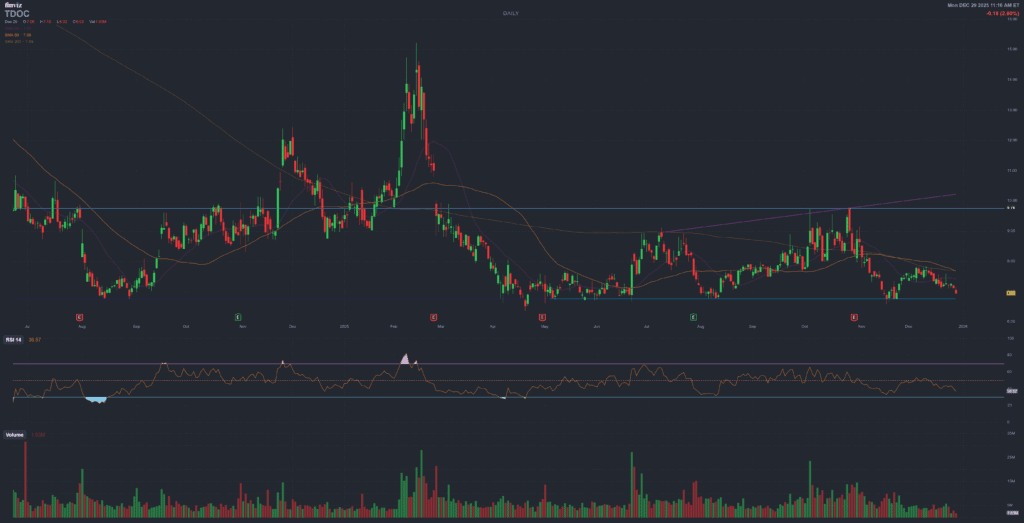
TDOC
|
Teladoc Health
Teladoc Health – From pandemic superstar to underpriced cash-flow machine?
Virtual care incumbent trading at about 0.6× revenue and mid-teens implied FCF yield,
with a new CEO, a shrinking BetterHelp segment and a slow but steady reset toward
profitable integrated care.
Teladoc Health – Dalla stella della pandemia a generatore di cassa sottovalutato?
Incumbent della telemedicina a circa 0,6× i ricavi e rendimento FCF implicito in doppia cifra,
con nuovo CEO, BetterHelp in cura dimagrante e un lento riposizionamento verso l’integrated care profittevole.
News of the day / Notizia del giorno
Latest key updates
The most recent hard catalysts for Teladoc are the Q3 2025 print and a series of strategic moves:
- Q3 2025 revenue of $626.4M (-2% YoY), net loss $49.5M and free cash flow of $67.9M, bringing 9M 2025 FCF to $113.5M. Management reiterated full-year 2025 guidance for $2.51–2.54B revenue, $270–287M adjusted EBITDA and $170–185M free cash flow.
- The company closed three strategic deals in 2025: Catapult Health (preventive & at-home testing, $65M + earn-out), UpLift (in-network digital mental health, $30M + earn-out, >100M covered lives) and Telecare in Australia (specialist virtual care), all reinforcing the integrated platform strategy.
- Long-time CFO Mala Murthy is stepping down (Nov 2025), with an interim structure under CEO Chuck Divita while a new CFO is selected.
Gli ultimi catalyst “hard” per Teladoc sono la trimestrale Q3 2025 e una serie di mosse strategiche:
- Ricavi Q3 2025 pari a 626,4M $ (-2% a/a), perdita netta 49,5M $ e free cash flow di 67,9M $, con FCF 9M 2025 a 113,5M $. La società ha confermato la guidance 2025: ricavi 2,51–2,54B $, adj. EBITDA 270–287M $ e FCF 170–185M $.
- Nel 2025 Teladoc ha chiuso tre deal strategici: Catapult Health (prevenzione e test a domicilio, 65M $ + earn-out), UpLift (salute mentale digitale “in-network”, 30M $ + earn-out, >100M vite coperte) e Telecare in Australia (specialisti in telemedicina), tutti coerenti con la strategia di piattaforma integrata.
- La storica CFO Mala Murthy sta lasciando il ruolo (novembre 2025), con struttura ad interim sotto il CEO Chuck Divita in attesa di un nuovo CFO.
1. Executive Snapshot / Sintesi veloce
Where TDOC stands at the end of 2025
Core: FCF + integrated care
Teladoc Health is no longer the hyper-growth Covid play it used to be. At roughly $6.95 per share (late December 2025), the stock sits about 96–98% below its 2021 highs, yet still runs a global virtual-care platform with:
- Two main segments: Integrated Care (B2B/B2B2C virtual & chronic care) and BetterHelp (direct-to-consumer online therapy).
- Scale: about 102.5M U.S. Integrated Care members and roughly 382k average paying users at BetterHelp in Q3 2025.
- Balance sheet with ~$726M cash, ~$1.0B debt, equity ≈$1.4B and debt-to-equity around 70%.
- FCF story: 2025 guidance implies $170–185M free cash flow, FCF yield in mid-teens on market cap and around 10–11% on EV if delivered.
The reset under new CEO Charles “Chuck” Divita III is clear: pivot from “growth at any cost” to a more disciplined, payer-oriented, cash-generative virtual-care platform. The catch is that a weakening BetterHelp segment is now visibly dragging against that effort.
Teladoc Health non è più la growth stock da pandemia che tutti tradavano nel 2020-21. A circa 6,95 $ (fine dicembre 2025), il titolo quota 96–98% sotto i massimi, ma continua a gestire una piattaforma globale di telemedicina con:
- Due segmenti principali: Integrated Care (telemedicina e gestione cronici B2B/B2B2C) e BetterHelp (psicoterapia online direct-to-consumer).
- Scala: circa 102,5M membri Integrated Care USA e circa 382k utenti paganti medi su BetterHelp nel Q3 2025.
- Bilancio: circa 726M $ di cassa, ~1,0B $ di debito, equity intorno a 1,4B $ e debt-to-equity di ~70%.
- Storia FCF: la guidance 2025 indica 170–185M $ di free cash flow, con FCF yield a doppia cifra sulla market cap e ~10–11% sull’EV, se centrata.
Il “nuovo corso” guidato dal CEO Charles “Chuck” Divita III è abbastanza netto: meno ossessione per la crescita, più focus su margini, disciplina del capitale e modelli affini al mondo assicurativo. Il punto debole è che il segmento BetterHelp in calo rende questa trasformazione più complicata e fragile.
Quick data / Dati rapidi
| Item | Value (approx.) |
|---|---|
| Share price (29 Dec 2025) | $6.95 |
| Market cap | ≈ $1.3B |
| Enterprise value | ≈ $1.6–1.7B |
| 2025 revenue guidance | $2.51–2.54B |
| 2025 FCF guidance | $170–185M |
| EV / Sales (ttm) | ≈ 0.6× |
| P / FCF (guide) | ≈ 5–6× |
| Short interest | ~14–15% of float |
| Segments | Integrated Care; BetterHelp |
Figures rounded; based on Q3 2025 reporting, company guidance and mainstream data providers (Finviz, TipRanks, SimplyWallSt). Always check latest filings and quotes for up-to-date numbers.
2. Business model & CEO profile / Modello di business & profilo CEO
What Teladoc really sells, and who is steering it
Structure & governance
2.1 Segments & revenue mix
Teladoc splits reporting into two segments:
- Integrated Care – virtual primary care, chronic condition management (diabetes, hypertension, obesity/weight, mental health), expert medical opinion and hospital solutions sold to health plans, employers, health systems and governments. Revenue is mainly subscription “access fees” per member per month, plus some visit-based and device revenue.
- BetterHelp – direct-to-consumer online therapy, historically a cash-pay monthly subscription; now in transition toward reimbursed, in-network mental health via the UpLift acquisition.
In Q3 2025, Integrated Care delivered low single-digit revenue growth and the bulk of adjusted EBITDA, while BetterHelp revenue declined high-single digit with very thin margins. The company openly acknowledges that fixing BetterHelp is one of the core execution challenges.
Teladoc riporta due segmenti operativi:
- Integrated Care – telemedicina, primary care virtuale, gestione delle patologie croniche (diabete, ipertensione, obesità, salute mentale), second opinion e soluzioni per ospedali, venduti a assicurazioni, employer, sistemi sanitari e governi. Ricavi per lo più ricorrenti (access fee per membro), più una componente di visite e dispositivi.
- BetterHelp – terapia psicologica online direct-to-consumer, nata cash-pay, oggi in piena transizione verso modelli rimborsati (in-network) grazie all’acquisizione di UpLift.
Nel Q3 2025 Integrated Care ha mostrato una crescita modesta ma positiva e genera la quasi totalità dell’EBITDA aggiustato; BetterHelp, al contrario, è in calo di ricavi a singola cifra alta e con margini molto compressi. Lo stesso management riconosce che raddrizzare BetterHelp è uno dei punti chiave del turnaround.
2.2 CEO – Charles “Chuck” Divita III
Role: CEO and director of Teladoc Health since June 2024.
Background: Divita is not a “Silicon Valley founder” profile. He is a payer-side operator and finance executive:
- GuideWell / Florida Blue – Executive Vice President, Commercial Markets overseeing >$20B+ of commercial health-plan revenue; previously CFO of GuideWell, responsible for finance, actuarial, network and product strategy.
- FPIC Insurance Group – former CFO and later President/CEO of a TPA unit; he helped turn the company around to the point it was named one of Forbes’ “100 Most Trustworthy Companies”.
- Board roles at Prime Therapeutics, Availity, Vim and non-profit boards such as Ronald McDonald House of Jacksonville and Teach for America.
Education: dual B.S. in Accounting and Finance from Florida State University; Certified Public Accountant.
The early strategic actions under Divita (Catapult, UpLift, Telecare, focus on free cash flow and reduced stock-based comp) are consistent with a more conservative, health-plan-style approach: stable contracted revenue, better unit economics and less reliance on pure DTC growth.
Ruolo: CEO e membro del board di Teladoc Health da giugno 2024.
Background: Divita è un profilo da operatore e CFO lato assicurazioni, non il classico founder tech:
- GuideWell / Florida Blue – Executive Vice President Commercial Markets, con responsabilità su oltre 20B $ di premi e ricavi commerciali; in precedenza CFO del gruppo, a capo di finanza, attuariato, rete provider e strategia di prodotto.
- FPIC Insurance Group – ex CFO e poi CEO di una controllata; sotto la sua gestione il gruppo è passato da situazione problematica a finire nella lista Forbes delle “100 aziende più affidabili”.
- Vari incarichi in board di società healthcare (Prime Therapeutics, Availity, Vim) e impegno nel non-profit (Ronald McDonald House, Teach for America).
Formazione: doppia laurea in Accounting e Finance alla Florida State University; Certified Public Accountant.
Le mosse iniziali sotto la sua guida (acquisizioni mirate Catapult/UpLift/ Telecare, riduzione della stock-based compensation, focus esplicito sul free cash flow) sono coerenti con un’impostazione più “da assicurazione”: ricavi contrattualizzati e margini, molto meno storytelling di pura crescita DTC.
3. Financials & cash flow / Conti e generazione di cassa
From GAAP losses to free cash flow
Q3 2025 snapshot
Top line:
- Q3 2025 revenue $626.4M, down 2% YoY.
- 9M 2025 revenue $1.89B, also down 2% vs 2024.
- U.S. revenue down mid-single digit; international up double digit, but still a smaller contributor.
Profitability (non-GAAP):
- Q3 adjusted EBITDA $69.9M, margin ~11%, -16% YoY.
- 9M 2025 adjusted EBITDA ≈$197M, also -mid-teens YoY.
- Integrated Care is the main profit engine; BetterHelp is near breakeven.
GAAP earnings:
- Q3 net loss $49.5M (-$0.28 per share).
- 9M 2025 net loss $175M, a dramatic improvement vs ~$952M loss in 9M 2024 (which included huge goodwill impairments).
- GAAP is still heavily distorted by non-cash amortization of intangibles and residual goodwill write-downs.
Ricavi:
- Q3 2025: ricavi 626,4M $, -2% anno su anno.
- 9M 2025: 1,89B $, anche qui -2% rispetto al 2024.
- USA in calo a singola cifra media; business internazionale in crescita a doppia cifra ma ancora relativamente piccolo.
Redditività (non-GAAP):
- Adj. EBITDA Q3 69,9M $, margine ~11%, in calo di circa 16% a/a.
- Adj. EBITDA 9M 2025 ~197M $, anch’esso in calo mid-teens.
- L’EBITDA arriva quasi tutto da Integrated Care; BetterHelp è vicino al pareggio.
Risultato GAAP:
- Perdita netta Q3 49,5M $ (-0,28 $/azione).
- Perdita netta 9M 2025 175M $, contro circa 952M $ nel 2024, quando pesavano forti impairment di goodwill.
- L’utile GAAP rimane condizionato da ammortamenti non-cash di intangibili e da eventuali aggiustamenti su goodwill.
3.1 Free cash flow & balance sheet
Free cash flow:
- Q3 2025 operating cash flow $99.3M; after capex/software, free cash flow $67.9M.
- 9M 2025 FCF $113.5M, essentially flat vs 9M 2024.
- Full-year FCF guidance $170–185M → implies Q4 FCF roughly in line with Q3 run-rate.
Balance sheet snapshot:
- Cash & equivalents ≈$726M.
- Total debt ≈$1.0B; net debt ≈$300–320M.
- Total liabilities ≈$1.49B vs equity ≈$1.39B (debt-to-equity ~70%).
- Goodwill ≈$280M, other intangibles ≈$1.3B – still heavy legacies from the Livongo era.
In other words: the equity is not “risk-free”, but leverage is moderate relative to current FCF, and there is no immediate balance-sheet stress if the turnaround doesn’t derail.
Free cash flow:
- Q3 2025: cassa operativa 99,3M $; dopo capex/software FCF di 67,9M $.
- 9M 2025: FCF 113,5M $, praticamente uguale al 2024.
- Guidance FCF 2025 170–185M $ → il Q4 deve sostanzialmente ripetere il Q3.
Stato patrimoniale (riassunto):
- Cassa e equivalenti ≈726M $.
- Debito totale ≈1,0B $; net debt intorno a 300–320M $.
- Passività totali ≈1,49B $ vs equity ~1,39B $ (debt-to-equity ~70%).
- Goodwill ≈280M $ e altri intangibili ≈1,3B $, ancora l’eredità del deal Livongo.
Tradotto: non è una struttura “senza rischio”, ma il leverage è compatibile con il FCF attuale e non sembra esserci tensione immediata sul bilancio, a meno di un peggioramento marcato del business.
4. Strategic moves, GLP-1, Amazon & AI angle
Where growth could come from (if it comes)
Optionality
4.1 M&A – Catapult, UpLift, Telecare
- Catapult Health – virtual preventive-care provider (at-home check-ups, diagnostics). Teladoc agreed to acquire it for $65M all-cash plus up to $5M earn-out; Catapult’s TTM revenue was ~$30M. It will plug into chronic-care programs as a funnel from prevention to long-term management.
- UpLift – digital mental-health company serving health plans and covering >100M lives. Teladoc paid $30M cash plus up to $15M earn-out; 2024 revenue was ~$15M. UpLift is folded into BetterHelp to support in-network, reimbursed therapy.
- Telecare (Australia) – virtual specialist & allied-health provider acquired to expand Teladoc’s international footprint and specialist network in Australia.
- Catapult Health – provider di prevenzione e check-up virtuali (screening a domicilio). Teladoc ha siglato un deal da 65M $ cash più fino a 5M $ di earn-out; ricavi TTM ~30M $. Logica: usare Catapult come imbuto dalla prevenzione verso i programmi chronic care.
- UpLift – player di salute mentale digitale in-network, con relazioni con assicurazioni che coprono oltre 100M di vite. Prezzo: 30M $ cash + 15M $ di earn-out max; ricavi 2024 ~15M $. UpLift viene integrata in BetterHelp per abilitare la terapia rimborsata.
- Telecare (Australia) – provider di specialisti virtuali e allied-health, acquistata per rafforzare la presenza in Australia e la rete di specialisti.
4.2 GLP-1 & BALANCE model
Teladoc is positioning its chronic-care suite (diabetes, hypertension, obesity) as a natural complement to GLP-1 therapies:
- CMS’s new BALANCE model aims to expand GLP-1 coverage for weight loss and diabetes under Medicaid (from May 2026) and Medicare Part D (from January 2027), with a bridge demo starting July 2026.
- Teladoc’s programs can ride that wave by offering virtual coaching, monitoring and comorbidity management around GLP-1 prescriptions.
This is a medium-term tailwind: the 2026–2027 roll-out shapes the TAM, but the market usually starts to discount it earlier if member uptake and partnerships are visible.
Teladoc cerca di posizionare la propria suite di gestione cronici (diabete, ipertensione, peso) come complemento naturale alle terapie GLP-1:
- Il modello CMS BALANCE punta ad ampliare la copertura GLP-1 per perdita di peso e diabete in Medicaid (da maggio 2026) e Medicare Part D (da gennaio 2027), con un demo ponte già da luglio 2026.
- I programmi Teladoc possono agganciarsi offrendo coaching virtuale, monitoraggio e gestione delle comorbidità attorno alle prescrizioni GLP-1.
È un vento favorevole di medio periodo: il roll-out 2026–27 allarga il mercato potenziale, ma il mercato azionario tende a prezzarlo prima, se si vedono numeri concreti di adozione.
4.3 Amazon & AI narrative
- Amazon Health Benefits Connector – Teladoc’s cardiometabolic programs (diabetes, hypertension, pre-diabetes, weight management) are now discoverable and enrollable directly from Amazon for eligible users, making it easier to turn insurance benefits into actual program uptake.
- AI angle – Citron Research and others have framed TDOC as an “under-the-radar AI play”, highlighting ~90M+ members, heavy R&D and the use of AI to triage, reduce ER visits and improve margins rather than as pure buzzword.
This doesn’t magically fix BetterHelp, but supports the case for Teladoc as infrastructure-level virtual care rather than a one-trick pandemic stock.
- Amazon Health Benefits Connector – i programmi Teladoc per diabete, ipertensione, pre-diabete e weight management sono ora visibili e attivabili direttamente da Amazon per gli utenti idonei, facilitando il passaggio da “beneficio teorico” a utilizzo reale.
- Angolo AI – Citron e altri descrivono TDOC come “AI play sottovalutato”, più focalizzato su triage, automazione e riduzione di ricoveri evitabili che su hype, con base di oltre 90M di membri.
Non è la panacea per i problemi di BetterHelp, ma rafforza l’idea di Teladoc come infrastruttura di telemedicina, non semplice residuo della pandemia.
5. Sentiment & Street view / Sentiment retail & analisti
How others are positioned around TDOC
Mixed signals
5.1 Retail & alternative data
Reddit sentiment (AltIndex)
79 / 100 – bullish
Short interest
~26.4M shares (~15% float)
Reddit-style retail seems net constructive (value + turnaround angle), but the elevated short interest and “crowd wisdom” neutral rating on some dashboards confirm that institutional money is still very skeptical.
Sentiment Reddit (AltIndex)
79 / 100 – rialzista
Short interest
~26,4M azioni (~15% flottante)
Il retail “social” appare in media positivo (value + turnaround), ma lo short elevato e i punteggi neutri di crowd wisdom indicano che la parte istituzionale resta molto scettica.
5.2 Sentiment note
Sentiment data from Reddit, Stocktwits or X reflect non-professional traders’ opinions, which can be noisy, leveraged and strongly biased. They are not a reliable indicator on their own and should only be used as a flavour of crowd positioning, never as a standalone signal.
I dati di sentiment da Reddit, Stocktwits o X riflettono opinioni di trader non professionisti: possono essere rumorosi, guidati da leva e fortemente distorti. Non sono un indicatore affidabile da soli e vanno usati solo come colore sul posizionamento della “folla”, mai come segnale di trading autonomo.
5.3 Analyst consensus
- Rating: consensus Hold from 14 Wall Street analysts (TipRanks).
- Target price: average 12-month PT $9.22, with a high at $12 and a low at $8 – about +30% upside from ~7 $.
- Street models project 2025 revenue around the midpoint of company guidance and GAAP EPS still negative (-$1.1 to -$1.25).
In plain English: most analysts see upside, but not enough conviction to move beyond a “Hold” given BetterHelp uncertainty and competitive pressure.
- Rating: consenso Hold da parte di 14 analisti (TipRanks).
- Target price: TP medio 9,22 $, forchetta 8–12 $, cioè circa +30% rispetto ai livelli attuali.
- Le stime Street vedono ricavi 2025 in linea con la guidance e EPS GAAP ancora negativi (intorno a -1,1 / -1,25 $).
Tradotto: molti vedono spazio di rialzo, ma non abbastanza visibilità per alzare la mano oltre un “Hold”, finché la storia BetterHelp e la concorrenza non si chiariscono.
5.4 Tools & data links
6. Risk map & scenario thinking / Mappa rischi & scenari
Why this is a true turnaround story
High-volatility profile
6.1 Main risk buckets
Structural risk – BetterHelp
Declining revenue, slim margins and intense competition in DTC mental health. The UpLift insurance pivot may take time; if it fails, the segment could remain a chronic drag on consolidated margins and FCF.
Execution – Insurance ramp
Aligning reimbursement, contracting and therapist supply for in-network mental health is complex. Near-term, it can depress profitability before any volume payoff materializes.
Regulatory – Telehealth & GLP-1
Telehealth flexibilities for Medicare beyond early 2026 depend on new legislation; GLP-1 coverage expansion via BALANCE is promising but still in design and demo phase.
Balance sheet & debt
Net debt is moderate vs FCF, but the heavy intangible base leaves room for further impairments if the business underperforms.
6.2 Scenarios (illustrative, not advice)
Bullish case (turnaround works)
Revenue stabilizes and edges back toward ~$2.6B by 2027, Integrated Care grows mid-single digit, BetterHelp returns to modest growth with mid-teens margins, and FCF margin climbs to high single digits. At that point, even a conservative 11–12× FCF multiple on ~$230M FCF would imply equity value significantly higher than today.
I ricavi si stabilizzano e risalgono verso ~2,6B $ entro il 2027, Integrated Care cresce a singola cifra media, BetterHelp torna a crescere con margini mid-teens e il margine FCF sale a high-single digit. Con un multiplo 11–12× su ~230M $ di FCF, l’equity starebbe ben sopra i livelli attuali.
Base case (slow, messy reset)
Revenue remains roughly flat around $2.4–2.5B; Integrated Care offsets the drag from BetterHelp, but without a clean inflection. FCF fluctuates around the current ~$170–180M band. In this case TDOC might grind sideways, with returns driven more by volatility and entry timing than by clear multiple expansion.
Ricavi sostanzialmente piatti in area 2,4–2,5B $; Integrated Care bilancia il peso di BetterHelp senza un vero cambio di passo. Il FCF oscilla attorno agli attuali 170–180M $. In questo scenario il titolo potrebbe muoversi più “di lato”, con il risultato dipendente dal timing d’ingresso più che da una rerating deciso.
Bear case (value trap)
BetterHelp continues to shrink, pricing pressure hits Integrated Care, and FCF slips below $100M. Even at an 8× multiple the equity would be worth less than today, making TDOC a classic value trap despite looking “cheap” on surface multiples.
BetterHelp continua a contrarsi, la pressione competitiva colpisce anche Integrated Care e il FCF scende sotto i 100M $. Anche con multipli modesti (8× FCF) il valore equitiy sarebbe inferiore a quello attuale: la classica value trap che resta “apparentemente a sconto” ma non paga.
Questi scenari sono solo schemi di ragionamento, non previsioni né suggerimenti operativi. Non sostituiscono un’analisi quantitativa (es. DCF) e non tengono conto della situazione specifica di nessun investitore.
7. Sources & disclosure / Fonti & disclosure
Where the numbers come from
Data quality
7.1 Main data sources
This report is based primarily on:
- Teladoc Q3 2025 earnings press release and 10-Q
- Teladoc investor presentations and M&A press releases (Catapult, UpLift, Telecare)
- TipRanks, Finviz, SimplyWallSt, StockAnalysis for market data and balance sheet snapshots
- AltIndex and other alternative data sources for Reddit/social sentiment
- CMS and U.S. Congressional documentation on telehealth and GLP-1 (BALANCE model, Telehealth Modernization Act)
All figures have been double-checked against at least one primary source (SEC filings, official press releases or major newswires) where possible.
Questo report si basa principalmente su:
- Comunicato e 10-Q Teladoc Q3 2025
- Presentazioni investor e press release M&A (Catapult, UpLift, Telecare)
- TipRanks, Finviz, SimplyWallSt, StockAnalysis per dati di mercato e bilanci
- AltIndex e fonti simili per il sentiment social/Reddit
- Documenti CMS e Congresso USA su telemedicina e GLP-1 (modello BALANCE, Telehealth Modernization Act)
I numeri sono stati verificati, dove possibile, contro almeno una fonte primaria (SEC, comunicati ufficiali o agenzie stampa principali).
7.2 Affiliate & conflict disclosure
Some external links (for example, to Finviz, Seeking Alpha or Stocktwits) may be affiliate links. If a reader clicks and later signs up or subscribes, Merlintrader trading Blog may receive a commission. This does not change the nature of the analysis or the selection of tickers discussed, which is editorial and independent to the best of our knowledge.
Alcuni link esterni (ad esempio verso Finviz, Seeking Alpha o Stocktwits) possono essere link di affiliazione. Se il lettore clicca e in seguito si registra o sottoscrive servizi, Merlintrader trading Blog può ricevere una commissione. Questo non modifica l’impostazione dell’analisi né la scelta dei titoli trattati, che resta editoriale e indipendente per quanto ci è possibile.
8. Regulatory disclaimer / Avvertenze regolamentari
Educational only – not investment advice
Important
This report is provided for educational and informational purposes only. It is not, and must not be interpreted as, investment research, investment advice, a recommendation to buy or sell any financial instrument, or a solicitation to engage in any investment strategy. The information discussed here is based on public sources believed to be reliable, but it may be incomplete or inaccurate and can change without notice.
Nothing herein takes into account your individual objectives, financial situation or needs. Before making any investment decision you should perform your own analysis, possibly including quantitative valuation models, and, if necessary, consult a licensed financial adviser or other qualified professional. Investing in equities, especially turnaround and high-volatility names like TDOC, involves a significant risk of capital loss.
This content aims to be compatible with general principles in both EU/CONSOB and U.S. SEC jurisdictions: it avoids price targets, ratings and personalised calls to action, and focuses on a structured mapping of risks, drivers and publicly available data.
Questo report ha finalità esclusivamente informative e didattiche. Non costituisce, e non deve essere interpretato come, ricerca in materia di investimenti, consulenza in materia di investimenti, raccomandazione di acquisto o vendita di strumenti finanziari o sollecitazione al pubblico risparmio. Le informazioni qui riportate si basano su fonti ritenute affidabili ma possono essere incomplete o inesatte e sono soggette a cambiamenti senza preavviso.
Nulla di quanto scritto tiene conto degli obiettivi, della situazione finanziaria o delle esigenze specifiche di alcun lettore. Prima di assumere decisioni d’investimento è necessario svolgere analisi autonome (anche con modelli quantitativi ove opportuno) ed eventualmente consultare un consulente finanziario abilitato o altro professionista qualificato. Investire in azioni, in particolare in storie di turnaround e alta volatilità come TDOC, comporta un rilevante rischio di perdita del capitale.
Il contenuto è redatto in ottica conforme alle linee generali CONSOB/UE e SEC USA: evita target price, rating operativi e indicazioni personalizzate, concentrandosi su una mappa strutturata di rischi, driver e dati pubblici.
Biotech Catalyst Calendar – strumenti pratici per tenere d’occhio i catalyst
If you trade healthcare and biotech names alongside TDOC, you can use the Merlintrader Catalyst Calendar to track upcoming FDA decisions, clinical readouts and key events across the healthcare universe, all in one place.
Se affianchi TDOC ad altre posizioni su healthcare/biotech, puoi usare il Calendario Catalyst di Merlintrader per monitorare in un unico pannello le prossime decisioni FDA, le letture cliniche e gli eventi chiave del settore.
Scanner for active traders

Try ChartsWatcher free, then unlock 10% OFF with SAVE10
ChartsWatcher is a real-time scanner for momentum traders: fast movers, unusual volume and rotations — so you can focus on the few tickers that matter right now, instead of watching hundreds of charts.
Start with the free version. When you upgrade, use SAVE10 for 10% OFF your first paid period.
Start free – then use SAVE10
No credit card required to start. Apply SAVE10 when upgrading.
Recommended platform

One platform. All your brokers.
Medved Trader connects multiple brokers in one workspace, with pro charts, hotkeys and fast execution — without changing your broker accounts.
A single cockpit for positions, Level II and multi-broker order routing, built for active day & swing traders.
Get 1 Month Free ➔
Multi-broker workflow + customizable layouts in one platform.

 Monica.im – the AI assistant I use every day
If you find value in the work I publish on Merlintrader and want a practical AI assistant for research and writing, you can sign up using this referral link. Click here to try Monica.im and support the site
Find out how I use AI on Merlintrader: AI, retail and Merlintrader
Disclosure: some of the links in the promotional blocks above are affiliate or referral links. If you choose to subscribe or sign up through them, Merlintrader may receive a small commission or benefit at no extra cost to you.