DISCLAIMER — Not financial advice. Educational content only, not an offer or solicitation to buy or sell any security. Biotech and small/mid-cap stocks are highly speculative and volatile and can result in a partial or total loss of capital. Do your own research and consult a licensed advisor where appropriate. / Contenuti a solo scopo informativo e didattico, non costituiscono consulenza finanziaria né offerta o sollecitazione al pubblico risparmio ai sensi delle normative CONSOB e SEC. Le azioni biotech e le small/mid cap sono strumenti altamente speculativi e volatili e possono comportare la perdita parziale o totale del capitale investito. Si raccomanda di effettuare sempre le proprie ricerche e, se necessario, di rivolgersi a un consulente abilitato.

Merlintrader Trading Pub
Biotech catalyst news and analysis. FDA PDUFA tracker
Merlintrader Trading Pub
Biotech catalyst news and analysis. FDA PDUFA tracker
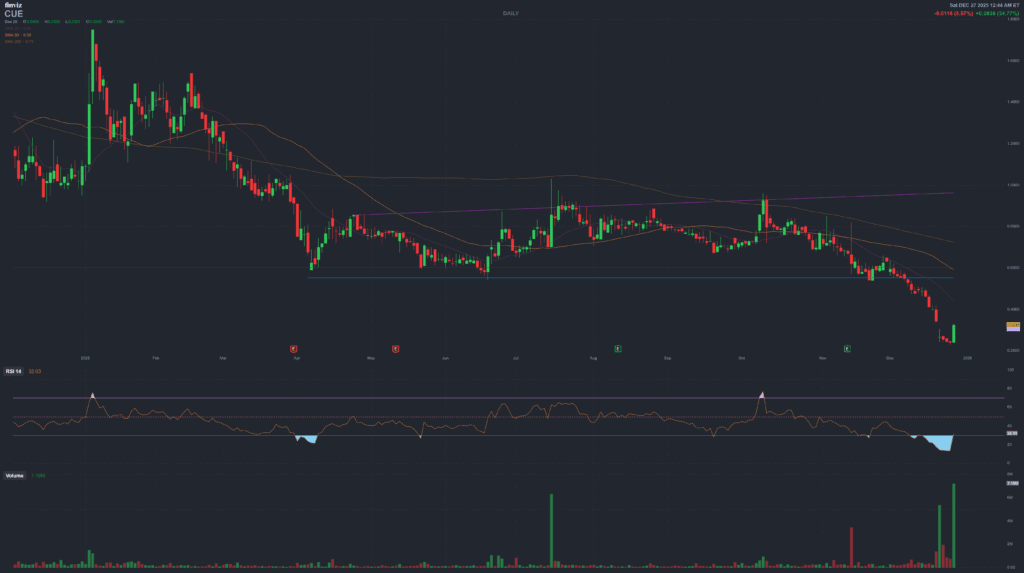
Editorial note to readers and traders
Dear readers and fellow traders,
I am sorry to have to write a piece like this, which does not talk about success stories, but about further potential problems. As a small retail trader myself, I have more than once found myself in situations similar to the one that people with positions in CUE are living through today.
I have often asked myself the same questions: what happens now? How does the Nasdaq delisting rule really work? What are the real timelines, often buried in long and difficult-to-read SEC filings? From what exact point does the clock start? There are many questions, and the answers are often not obvious; if you are not experienced, you can easily feel at the mercy of the waves.
I do not pretend to provide every answer, and I certainly do not intend to tell anyone what they should do with their money. I am not a financial advisor or an investment professional.
What I can do, however, is to pull together all the relevant public information, read the filings line by line, and reorganize it in a more readable and understandable way, so that you can have a broader and clearer view of the situation around CUE and the Nasdaq listing rules.
I hope this work will be useful as a starting point for your own independent analysis. Nothing in this note or in the report that follows is investment advice or a recommendation.
Good trading to all.
Cue Biopharma (CUE) – Equity Structure, Dilution History and Nasdaq Minimum Bid Rule
Data current through 27 December 2025 – based only on SEC filings, official Cue press releases and Nasdaq rules.
This dossier is informational and educational only. It is not financial advice, not investment research and not a recommendation to buy, sell or hold CUE or any other security.
0. Scope and methodology
This report focuses on three highly sensitive aspects of Cue Biopharma’s situation:
- Equity structure and dilution history (last ~24 months) – public offerings, at-the-market (ATM) sales, pre-funded warrants and long-dated warrants.
- Nasdaq minimum bid price rule (“$1.00 rule”) – including the deficiency letter sent on 12 May 2025, the initial 180-day window ending 10 November 2025, and Cue’s own statement in its Form 10-Q for the quarter ended March 31, 2025 that it may cure the deficiency via a reverse stock split if necessary.
- Forward-looking pressure – what the next months look like, how much time the company realistically has, and in which window a reverse split becomes a likely tool if the share price does not recover.
All numbers and dates are taken from SEC filings (10-K, 10-Q, 8-K, 424B5), official press releases and Nasdaq rule documents. Where something is not explicitly stated in those documents (for example, whether Nasdaq has already granted a second 180-day period), this is treated as unknown and not assumed. A consolidated list of the main official sources is provided in Section 8.
1. Company and equity snapshot
1.1 Business profile (very short)
Cue Biopharma, Inc. (Nasdaq: CUE) is a clinical-stage biotech developing Immuno-STAT biologics to modulate disease-specific T cells in oncology and autoimmune disease. It has:
- No approved products and no product revenues.
- Recurring operating losses and “going concern” language in its Form 10-K for the year ended Dec 31, 2024 .
- A strategy that mixes internal development (CUE-101, CUE-102, CUE-401) with partnerships such as the Boehringer Ingelheim collaboration on CUE-501 (press release) and the ImmunoScape Seed-and-Boost cell therapy deal (Q3 2025 press release).
1.2 Share count trajectory (2023–2025)
Share count has already grown markedly before the December 2025 deal, as shown by the 10-K and 10-Q filings:
- 30 Sept 2023: 45,123,281 common shares outstanding (disclosed in 2023/2024 filings; see 2024 Form 10-K).
- 6 May 2024: 48,643,316 common shares outstanding in the Q1 2024 Form 10-Q .
- 31 Dec 2024 / 31 Mar 2025: 61,819,101 common shares issued and outstanding (FY 2024 10-K and Q1 2025 10-Q).
- 8 May 2025: 75,349,881 common shares outstanding after the April 2025 follow-on (disclosed in the Q1 2025 10-Q and related Q1 2025 10-Q PDF).
- 8 Aug 2025: 76,845,904 shares (Q2 2025 10-Q, sec.gov link ).
- 30 Sept 2025: 77,781,743 common shares outstanding, as stated in the December 2025 424B5 prospectus supplement for the $10M offering.
From 30 Sept 2023 (~45.1M shares) to 30 Sept 2025 (~77.8M shares) Cue increased its common share count by roughly 73%, even before the December 2025 $10M offering.
2. Dilution history (last ~24 months)
2.1 Main equity financings – timeline
| Date | Transaction | Key terms (shares, pre-funded, warrants) | Key official sources |
|---|---|---|---|
| Sept 26–30, 2024 | $12M underwritten public offering |
Cue prices a ~$12M offering:
| Cue PR – $12M offering (Sept 26, 2024) |
| 2024–H1 2025 | ATM program (Jefferies) |
|
Q2 2025 10-Q (ATM details)
424B5 summary of ATM (Dec 2025) |
| Apr 14–16, 2025 | ~$20M underwritten public offering |
|
GlobeNewswire – $20M offering (Apr 14, 2025)
Cue website news page |
| 2025 (through Sept) | Additional ATM usage |
| 424B5 (Dec 18, 2025) |
| Dec 19, 2025 (pricing) | $10M underwritten offering at $0.28 |
|
GlobeNewswire – $10M offering (Dec 19, 2025)
Nasdaq press release mirror 424B5 prospectus supplement (Dec 18, 2025) |
2.2 How much dilution is that, in practice?
Using the 30 Sept 2025 share count (77,781,743 shares from the 424B5 prospectus) as the “pre-December” base:
- The base issuance of 35.7M new common/pre-funded units implies an immediate increase of roughly +46% in common-equivalent shares.
- The 17.9M new warrants at $0.30 add considerable potential future dilution if the stock ever trades above that level for a sustained period.
- If the full greenshoe is exercised, the immediate share count increase exceeds +50% vs the Sept 2025 baseline.
All of this stacks on top of the ~$12M Sept 2024 and ~$20M April 2025 offerings plus ATM sales. Over roughly two years Cue has repeatedly used structures combining shares, pre-funded warrants and 5-year warrants.
From a structural standpoint, Cue’s recent history is clear: low-priced follow-on offerings heavily structured with pre-funded and long-dated warrants, with the ATM program running in the background. The December 2025 $10M offering at $0.28 is another iteration of this pattern under greater cash pressure.
3. Capital structure and warrant overhang
3.1 Instruments outstanding before the December 2025 deal
The December 2025 424B5 prospectus provides a detailed snapshot of outstanding instruments as of 30 September 2025:
(See the 424B5 prospectus supplement filed Dec 18, 2025, accessible via StockTitan/SEC mirror .)
| Instrument | Outstanding | Exercise price | Comment |
|---|---|---|---|
| Common shares | 77,781,743 | – | Issued and outstanding common stock. |
| Stock options | 13,777,199 | $3.73 (weighted avg.) | Employee/management equity compensation. |
| Common stock warrants | 21,401,905 | $2.06 (weighted avg.) | Includes Sep 2024 warrants (strike $0.50) and Apr 2025 warrants (strike $0.79), along with older warrants. |
| Pre-funded warrants | 23,904,815 | $0.001 | Economically almost equivalent to common shares; exercisable immediately at a token price. |
| Shares reserved (2025 Equity Plan) | 4,621,596 | – | Reserved for future equity awards. |
Even before the December 2025 deal, Cue’s capital structure is crowded: more than 77M common shares, nearly 24M pre-funded warrants, over 21M traditional warrants and almost 14M options outstanding.
3.2 Adding the December 2025 transaction
The December 2025 $10M offering adds:
- 35.7M new common/pre-funded units (~+46% vs 77.8M). GlobeNewswire PR, 19 Dec 2025.
- 17.9M new 5-year warrants at $0.30 (immediate exercise, 5-year term).
- Up to 5.36M extra shares and 2.68M extra warrants through the underwriters’ 30-day option.
From a fully-diluted perspective, the equity overhang now consists of: common shares + pre-funded warrants (effectively shares) + multiple layers of legacy warrants (2024 and April 2025) + the new December 2025 warrants at $0.30, plus options and plan reserves. The precise fully diluted count depends on which instruments are exercised, but the potential supply is much larger than the basic 77.8M share figure.
4. Nasdaq $1 minimum bid rule and Cue’s communications
4.1 How the rule works
Under Nasdaq Listing Rule 5550(a)(2) (and Rule 5810(c)(3)(A)), issuers on the Nasdaq Capital Market must maintain a minimum bid price of at least $1.00 per share. If the closing bid price is below $1.00 for 30 consecutive business days, Nasdaq issues a deficiency letter and grants a 180-day compliance period.
Within that period, the issuer must bring the bid back to ≥ $1.00 and maintain it for at least 10 consecutive trading days (Nasdaq, at its discretion, may require more than 10). If this happens, Nasdaq issues a compliance notice. If not, and if other listing criteria are met, Nasdaq may grant a second 180-day period; otherwise it typically moves towards a delisting determination.
These mechanics are described both in Nasdaq’s rulebook and in Cue’s own discussion of the minimum bid price requirement in its Q1 2025 10-Q.
4.2 Cue’s history with Nasdaq’s bid price rule
(a) 2024 episode – resolved
- In 2024, Cue received a sales-price based deficiency from Nasdaq (minimum bid rule) and later regained compliance by 18 October 2024, as disclosed in its FY 2024 Form 10-K and related Q&A.
(b) 2025 episode – active
- On 12 May 2025, Cue received a new Nasdaq deficiency letter stating that the bid price of its common stock had closed below $1.00 per share for 30 consecutive business days. This is explicitly disclosed in the risk factors of the Q1 2025 10-Q.
- Under Rule 5810(c)(3)(A), Cue was granted an initial 180-day grace period ending 10 November 2025 to regain compliance by trading at or above $1.00 for at least 10 consecutive business days.
4.3 Where Cue explicitly mentions a possible reverse split
In the same Q1 2025 10-Q, Cue sets out what would happen if it fails to cure the deficiency by 10 November 2025:
- If Cue does not regain compliance by that date, it may be eligible for a second 180-day compliance period, provided it meets all other initial listing standards for the Nasdaq Capital Market (except the minimum bid price requirement).
- To obtain that additional period, Cue states that it will need to give Nasdaq written notice of its intention to cure the deficiency by effecting a reverse stock split, if necessary.
- If Cue still fails to regain compliance or is not eligible for the second period, Nasdaq may issue a notice that its common stock is subject to delisting; Cue would then be able to appeal to a Hearings Panel.
This language is taken directly from the risk factor section of Form 10-Q for the quarter ended March 31, 2025 , and is one of the most important official confirmations that a reverse stock split is already part of the company’s cure strategy towards Nasdaq.
4.4 What remains uncertain (second 180-day period)
As of 27 December 2025, the public record shows:
- The May 12, 2025 deficiency letter and the initial 180-day window to 10 November 2025.
- Cue’s explicit statement that it intends to seek an additional 180-day compliance period and to cure the deficiency through a reverse split if necessary.
- No separate SEC filing or press release that clearly states “Nasdaq has granted Cue a second 180-day compliance period ending on [specific date].”
Therefore, from a strictly documented point of view, one cannot claim with absolute certainty that the second 180-day period has been formally granted; what is documented is the company’s plan and the mechanism to request it.
5. Forward-looking implications: time pressure and reverse split probability
5.1 Time pressure, price and structure
Combining price, structure and rules:
- CUE trades significantly below $1.00, with the December 2025 offering priced at $0.28 and warrants at $0.30.
- Cue has formally told Nasdaq in the Q1 2025 10-Q that it may cure the deficiency via a reverse split.
- The capital structure is already leverage-heavy: substantial common share base, large pre-funded warrant pool, multiple layers of 5-year warrants and options.
- The company has just raised additional capital at very low prices, signalling both cash needs and investor willingness to accept deep dilution.
Under these conditions, an “organic” recovery above $1.00 for the required number of days would likely demand a combination of strong clinical / business news and favourable market sentiment, all while the warrant/pre-funded overhang remains.
5.2 Reverse split probability and plausible timing window
Based on the documented facts:
- Management has already flagged a reverse split as a cure mechanism in a formal SEC filing.
- Cue has gone through repeated dilutions with little share price relief, raising questions about further organic recovery in the short term.
- The bid price has remained well below $1.00 for an extended period, and the initial 180-day grace window expired on 10 November 2025 without evidence of cured compliance.
While only the board can decide, the conditional probability of a reverse split over the next months is high if:
- the share price does not move convincingly and durably above $1.00; and
- Nasdaq either grants a second compliance period or moves closer to a delisting decision.
The key message for readers is not that a reverse split is guaranteed, but that: (1) Cue has publicly told Nasdaq it may use a reverse split to cure the deficiency, and (2) the combination of deep sub-$1 share price, heavy warrant overhang and the minimum bid rule makes a reverse split a realistic scenario in the near-to-medium term if no strong organic recovery occurs.
6. Other relevant catalysts (brief)
Beyond Nasdaq and capital structure, Cue’s medium-term fundamentals still hinge on its pipeline:
- CUE-401 (autoimmune): on 24 June 2025 Cue announced it had received FDA feedback on its Pre-IND briefing document, supporting its intention to advance an IND submission for CUE-401 in autoimmune disease (see MarketScreener summary: link ).
- CUE-501 with Boehringer Ingelheim: strategic research collaboration and license signed April 2025, with $12M upfront and up to ~$345M in milestones plus royalties – see Boehringer’s press release here and Cue’s own EX-99.1 first-quarter highlights here .
- ImmunoScape Seed-and-Boost: a November 2025 deal granting ImmunoScape rights to certain CUE-100 series assets for use as in-vivo boosters in TCR-T cell therapy; upstream economics detailed in the Q3 2025 financial results press release here .
These R&D catalysts matter for the long-term investment case, but in the short term they are less time-certain than the Nasdaq compliance clock and Cue’s visible pattern of dilutive financings.
7. Overall assessment (non-advisory)
Structurally, Cue Biopharma now presents:
- A common share base that has grown from ~45M (Sept 2023) to ~78M (Sept 2025) and will increase further once the December 2025 deal is fully reflected.
- A heavy layer of pre-funded warrants, long-dated warrants and options, and a new 5-year warrant block at $0.30 from the latest offering.
- Repeat minimum bid price issues with Nasdaq, culminating in a May 2025 deficiency letter and a first 180-day period to 10 November 2025, with a possible second period subject to conditions.
- A clear statement in the Q1 2025 10-Q that a reverse stock split is one of the tools management intends to use to cure the deficiency during an additional compliance period, if necessary.
- A pipeline with real scientific interest but a financing structure that heavily leans on equity and warrants, making short-term share price dynamics particularly sensitive to Nasdaq rules and financing needs.
This report does not judge whether CUE is “cheap” or “expensive” and does not recommend any action. Its sole aim is to document, with explicit references to official filings and press releases, how Cue’s capital structure has evolved, how the Nasdaq minimum bid rule applies to its current situation and why the company itself is already talking about a reverse stock split in formal SEC documents.
8. Official sources / Fonti ufficiali
8.1 Key SEC filings (EN)
-
Form 10-K FY 2024 (filed 31 Mar 2025) – capital structure, going concern, Nasdaq 2024 compliance:
https://www.sec.gov/Archives/edgar/data/1645460/000095017025047677/cue-20241231.htm -
Form 10-Q for quarter ended Mar 31, 2025 (filed 12 May 2025) – details of the 12 May 2025 Nasdaq deficiency
letter, initial 180-day period to 10 Nov 2025, and reverse split language:
https://www.sec.gov/Archives/edgar/data/1645460/000095017025069125/cue-20250331.htm -
Form 10-Q for quarter ended Jun 30, 2025 – ATM usage, updated share counts:
https://www.sec.gov/Archives/edgar/data/1645460/000095017025107270/cue-20250630.htm -
Q3 2025 financials (10-Q + press release) – collaboration revenue, ImmunoScape upfronts, updated cash:
SEC filings index: https://cuebiopharma.gcs-web.com/financial-information/sec-filings
PR: Q3 2025 Results and Business Highlights -
EX-99.1 – Q1 2025 financial results and Boehringer collaboration:
https://www.sec.gov/Archives/edgar/data/1645460/000095017025069124/cue-ex99_1.htm -
424B5 prospectus supplement (Dec 2025 $10M offering) – share counts as of Sept 30, 2025, terms of the
December 2025 offering:
https://www.stocktitan.net/sec-filings/CUE/424b5-… (mirror of SEC filing)
8.2 Key company and partner press releases (EN/IT)
-
Sept 26, 2024 – $12.0M public offering:
https://cuebiopharma.gcs-web.com/news-releases/news-release-details/cue-biopharma-announces-pricing-120-million-public-offering -
Apr 14, 2025 – ~$20M public offering:
GlobeNewswire – Approximately $20 Million Public Offering
Cue Biopharma – company news page -
Dec 19, 2025 – $10M public offering at $0.28:
GlobeNewswire – $10 Million Public Offering
Nasdaq – Cue Biopharma Announces Pricing of $10 Million Public Offering -
Dec 18, 2025 – Proposed public offering:
GlobeNewswire – Proposed Public Offering -
Apr 15, 2025 – Boehringer Ingelheim & Cue Biopharma collaboration on CUE-501:
Boehringer Ingelheim / Cue Biopharma collaboration press release -
Jun 24, 2025 – CUE-401 FDA Pre-IND feedback (summary of official PR):
MarketScreener – Cue Biopharma Receives FDA Feedback on Pre-IND Briefing Document -
Nov 12, 2025 – Q3 2025 financial results and ImmunoScape collaboration:
Cue Biopharma – Q3 2025 Financial Results & Recent Highlights
Nota editoriale ai lettori / trader
Stimati lettori e trader,
mi dispiace dover scrivere un articolo come questo, che non parla di successi ma di possibili ulteriori problemi. Da piccolo trader mi sono trovato anche io più volte in situazioni simili a quella che oggi stanno vivendo coloro che hanno posizioni in CUE.
Mi sono spesso posto le stesse domande: cosa succede adesso? Come funziona davvero la regola del delisting sul Nasdaq? Quali sono i tempi reali, spesso nascosti negli interminabili e difficili da leggere SEC filing? Da quando si inizia a contare? Le domande sono tante, e le risposte non sono sempre chiare; se non si è esperti ci si sente facilmente in balia delle onde.
Non pretendo di poter dare tutte le risposte, e soprattutto non ho alcuna intenzione di consigliare che cosa fare con i vostri soldi. Non sono un consulente finanziario né un professionista dell’investimento.
Quello che posso fare, invece, è mettere insieme in modo ordinato l’informazione pubblica disponibile, leggere i documenti ufficiali riga per riga e renderli più “leggibili” e comprensibili, in modo da aiutarvi ad avere una visione più ampia e chiara della situazione di CUE e delle regole di listing del Nasdaq.
Spero che questo lavoro possa esservi utile come punto di partenza per le vostre analisi autonome. Nulla in questa nota o nel report che segue costituisce consulenza finanziaria o raccomandazione operativa.
Buon trading a tutti.
Cue Biopharma (CUE) – Struttura azionaria, storia diluitiva e rischio Nasdaq sul prezzo minimo
Dati aggiornati al 27 dicembre 2025 – basati solo su documenti SEC, comunicati ufficiali Cue e regolamento Nasdaq.
Questo dossier è esclusivamente informativo e didattico. Non costituisce consulenza finanziaria, non è ricerca d’investimento e non rappresenta una raccomandazione ad acquistare, vendere o detenere CUE o altri titoli.
0. Ambito e metodologia
Il report si concentra su tre aspetti molto sensibili della situazione di Cue Biopharma:
- Struttura azionaria e storia diluitiva (ultimi ~24 mesi) – aumenti underwritten, vendite at-the-market (ATM), pre-funded warrants e warrant a lunga scadenza.
- Regola Nasdaq sul prezzo minimo di 1 dollaro – inclusa la deficiency letter del 12 maggio 2025, la finestra di 180 giorni fino al 10 novembre 2025 e il fatto che Cue, nel proprio Form 10-Q del trimestre chiuso al 31 marzo 2025 , dichiarI di poter sanare la carenza tramite reverse stock split se necessario.
- Pressione prospettica – come si presentano i prossimi mesi, quanto tempo realistico ha la società e in quale finestra temporale un reverse split diventa verosimile, se il prezzo non si riprende.
Tutti i numeri e le date provengono da documenti SEC (10-K, 10-Q, 8-K, 424B5), comunicati ufficiali Cue e testi delle regole Nasdaq. Dove qualcosa non è dichiarato esplicitamente (per esempio se il secondo periodo di 180 giorni sia stato effettivamente concesso), l’informazione viene trattata come non nota, non ipotizzata. La lista dei principali documenti ufficiali è riportata nella Sezione 8.
1. Profilo società e fotografia azionaria
1.1 Profilo molto sintetico
Cue Biopharma, Inc. (Nasdaq: CUE) è una biotech in fase clinica che sviluppa biologici Immuno-STAT per modulare i linfociti T in modo selettivo in oncologia e nelle malattie autoimmuni. Ad oggi:
- non ha prodotti approvati né ricavi da vendite;
- registra perdite operative ricorrenti e richiami al “going concern” nel Form 10-K 2024 ;
- persegue un modello misto di sviluppo interno (CUE-101, CUE-102, CUE-401) e partnership, fra cui la collaborazione con Boehringer Ingelheim su CUE-501 (PR ufficiale) e l’accordo con ImmunoScape sulla piattaforma Seed-and-Boost (PR Q3 2025).
1.2 Evoluzione del numero di azioni (2023–2025)
Prima ancora dell’ultimo aumento di dicembre 2025, il numero di azioni è già cresciuto in modo significativo:
- 30 settembre 2023: ~45,1M azioni ordinarie (dato ricostruibile dai filing 2023/2024).
- 6 maggio 2024: 48.643.316 azioni ordinarie nel Form 10-Q Q1 2024 .
- 31 dicembre 2024 / 31 marzo 2025: 61.819.101 azioni ordinarie emesse e in circolazione (10-K 2024 e Q1 2025 10-Q).
- 8 maggio 2025: 75.349.881 azioni ordinarie (dato in Q1 2025; dopo l’aumento di aprile).
- 8 agosto 2025: 76.845.904 azioni (10-Q Q2 2025, link SEC ).
- 30 settembre 2025: 77.781.743 azioni ordinarie (dato riportato nel prospetto 424B5 di dicembre 2025, vedi qui).
Dal 30 settembre 2023 (~45,1M) al 30 settembre 2025 (~77,8M) le azioni ordinarie sono aumentate di circa +73%, prima ancora dell’operazione da 10M$ di dicembre 2025.
2. Storia diluitiva (ultimi ~24 mesi)
2.1 Principali operazioni di equity – timeline
| Data | Operazione | Dettagli (azioni, pre-funded, warrant) | Fonti ufficiali |
|---|---|---|---|
| 26–30 settembre 2024 | Aumento underwritten da ~12M$ |
Cue prezza un’offerta da circa 12M$ che comprende:
| PR Cue – Pricing of $12.0M Public Offering (26/09/2024) |
| 2024–H1 2025 | ATM (Open Market Sale Agreement con Jefferies) |
|
10-Q Q2 2025 – dettagli ATM
424B5 (dicembre 2025) |
| 14–16 aprile 2025 | Aumento underwritten da ~20M$ |
|
GlobeNewswire – Approximately $20M Offering
Sito Cue – news su aumento da 20M$ |
| 2025 (fino a settembre) | Uso continuativo dell’ATM | Il 10-Q Q3 2025 riporta che nei nove mesi chiusi al 30/09/2025 sono state vendute via ATM 2.431.862 azioni per ~1,8M$ netti, per un totale storico di 11.504.093 azioni/42,2M$. | 424B5 (riepilogo ATM) |
| 19 dicembre 2025 (pricing) | Offerta underwritten da 10M$ a 0,28$ |
|
GlobeNewswire – $10M Public Offering
Nasdaq – annuncio pricing |
2.2 Impatto quantitativo
Prendendo come base le 77,78M azioni al 30/09/2025 (dato del prospetto 424B5):
- l’emissione “base” di 35,7M nuove azioni/pre-funded implica un aumento immediato di circa +46% del numero di azioni;
- i 17,9M nuovi warrant a 0,30$ aggiungono ulteriore diluizione potenziale se il titolo dovesse tornare stabilmente sopra quel livello;
- con l’uso completo del greenshoe l’aumento sul capitale emesso supera il +50% rispetto alla base di settembre.
Il tutto si aggiunge all’aumento da ~12M$ di settembre 2024, a quello da ~20M$ di aprile 2025 e all’ATM: in due anni Cue ha adottato strutture ripetute azioni + pre-funded + warrant quinquennali.
Il “cursus operandi” degli ultimi 24 mesi è chiaro: aumenti di capitale a prezzi bassi, fortemente strutturati con pre-funded e warrant quinquennali, con ATM in sottofondo. L’operazione di dicembre 2025 a 0,28$ è un nuovo capitolo di questo schema.
3. Struttura azionaria e overhang dei warrant
3.1 Situazione al 30 settembre 2025 (prima dell’operazione di dicembre)
Nel prospetto 424B5 pubblicato a dicembre 2025, Cue riporta la fotografia al 30 settembre 2025:
| Strumento | Outstanding | Prezzo di esercizio | Note |
|---|---|---|---|
| Azioni ordinarie | 77.781.743 | – | Azioni emesse e in circolazione. |
| Stock options | 13.777.199 | 3,73$ (media) | Equity per management e dipendenti. |
| Warrant su azioni ordinarie | 21.401.905 | 2,06$ (media) | Include i warrant 2024 (strike 0,50$) e quelli di aprile 2025 (0,79$), oltre a warrant più datati. |
| Pre-funded warrants | 23.904.815 | 0,001$ | Strumenti di fatto assimilabili ad azioni: esercitabili subito a prezzo simbolico. |
| Azioni riservate (piano 2025) | 4.621.596 | – | Spazio per future assegnazioni di equity. |
Anche senza l’operazione di dicembre, la struttura è già molto “affollata”: oltre 77M azioni, quasi 24M pre-funded, più di 21M warrant e quasi 14M stock option.
3.2 Aggiungendo l’operazione di dicembre
L’offerta da 10M$ di dicembre 2025 aggiunge:
- 35,7M nuove azioni/pre-funded (~+46% vs base 77,8M);
- 17,9M warrant a 0,30$ (5 anni, esercitabili subito);
- potenziale extra 5,36M azioni e 2,68M warrant con over-allotment.
In ottica fully-diluted, il perimetro potenziale include: azioni ordinarie + pre-funded (quasi azioni) + warrant 2024/2025 + nuovi warrant a 0,30$, oltre a opzioni e stock grant future. L’overhang è dunque molto superiore al semplice dato “77,8M azioni”.
4. Regola Nasdaq sul prezzo minimo e comunicazioni verso Cue
4.1 Come funziona la regola
La Nasdaq Listing Rule 5550(a)(2) impone alle società del Nasdaq Capital Market un prezzo bid minimo di 1,00$. Se il bid chiude sotto 1,00$ per 30 sedute consecutive, scatta una deficiency letter e la società ottiene un primo periodo di 180 giorni per rientrare.
Per rientrare, il titolo deve scambiare con bid ≥ 1,00$ per almeno 10 sedute consecutive all’interno della finestra (Nasdaq può chiedere di più). Se non riesce, e se soddisfa gli altri criteri di listing, Nasdaq può concedere un secondo periodo di 180 giorni; altrimenti procede verso la delisting determination.
4.2 Storia delle deficiency letter per Cue
(a) Episodio 2024 – risolto
- Nel 2024 Cue riceve una deficiency letter per mancato rispetto del prezzo minimo, ma rientra in compliance entro il 18 ottobre 2024, come riportato nel 10-K 2024.
(b) Episodio 2025 – tuttora rilevante
- Il 12 maggio 2025, Cue riceve una nuova deficiency letter da Nasdaq: il bid era sotto 1,00$ per 30 sedute consecutive; l’informazione è descritta nel Form 10-Q Q1 2025 .
- In base alla Rule 5810(c)(3)(A), la società ottiene un primo periodo di 180 giorni con scadenza 10 novembre 2025 per riportare il bid sopra 1$ e mantenerlo per almeno 10 sedute consecutive.
4.3 Dove la società cita esplicitamente il reverse split
Nello stesso Form 10-Q Q1 2025 Cue precisa che, se non rientrerà entro il 10 novembre 2025:
- potrebbe essere idonea a un secondo periodo di 180 giorni se soddisfa gli altri requisiti di listing per il Nasdaq Capital Market (eccetto il requisito del prezzo minimo);
- per ottenere tale periodo addizionale dovrà fornire notifica scritta a Nasdaq della propria intenzione di curare la carenza tramite reverse stock split, se necessario;
- se non rientra in regola entro la fine del primo periodo (o del secondo), o se non è idonea alla seconda estensione, il titolo potrà essere oggetto di delisting e la società potrà solo presentare appello a un Hearings Panel.
Tutto questo è tratto direttamente dal Form 10-Q per il trimestre chiuso al 31 marzo 2025 , che per questo rappresenta la fonte primaria del rischio Nasdaq e del piano di reverse split.
4.4 Cosa non sappiamo con certezza (secondo periodo)
Dai documenti pubblici disponibili fino al 27 dicembre 2025:
- è confermata la deficiency letter del 12 maggio 2025 e il primo periodo di 180 giorni fino al 10 novembre 2025;
- è spiegata la possibilità di un secondo periodo di 180 giorni e la necessità di comunicare a Nasdaq un eventuale piano di reverse split;
- non c’è però un filing esplicito che riporti: “Nasdaq ha concesso un secondo periodo di 180 giorni con scadenza il giorno X”.
Ne consegue che, sebbene la società si stia preparando a chiedere (o abbia chiesto) un’estensione e un reverse split come cura, l’esistenza di un secondo periodo formalmente concesso non può essere affermata con certezza solo sulla base dei documenti pubblici.
5. Implicazioni prospettiche: pressione temporale e probabilità di reverse split
5.1 Pressione temporale e struttura
Riassumendo:
- il titolo CUE da tempo quota ben al di sotto di 1$ (ultimo aumento prezzato a 0,28$; warrant a 0,30$);
- il Form 10-Q Q1 2025 afferma che, per ottenere un’eventuale estensione, la società intende curare la carenza anche tramite reverse stock split;
- la struttura azionaria è fortemente diluita e carica di strumenti derivati (pre-funded + warrant 2024/2025 + nuovi warrant a 0,30$ + stock options);
- gli ultimi aumenti di capitale mostrano un bisogno di cassa significativo e una disponibilità del mercato solo a prezzi molto bassi.
In queste condizioni, un rientro “naturale” sopra 1$ e mantenuto per almeno 10 sedute è possibile ma difficile, salvo news molto forti e sentiment favorevole.
5.2 Probabilità di reverse split e finestra temporale
Alla luce delle fonti ufficiali:
- la società ha già messo per iscritto in un filing SEC che potrebbe ricorrere al reverse split per rientrare nei requisiti Nasdaq;
- le ripetute diluizioni e il linguaggio sul “going concern” segnalano un contesto delicato sul fronte finanziario;
- il prezzo di mercato permane ampiamente sotto la soglia di 1$.
La probabilità condizionata di un reverse split nei prossimi mesi è quindi elevata se:
- il titolo non torna in modo convincente sopra 1$ per un periodo prolungato;
- Nasdaq concederà un secondo periodo di 180 giorni o si avvicinerà a una delisting determination, chiedendo a Cue un piano credibile di cure.
Il punto chiave per il lettore non è “il reverse split è certo”, ma che: (1) l’ipotesi è già formalmente sul tavolo nei documenti SEC della società e (2) dato il mix di prezzo, overhang e regole di listino, il reverse split è uno scenario concreto nel breve-medio termine se non interviene un forte recupero spontaneo del titolo.
6. Altri catalyst rilevanti (in breve)
A parte Nasdaq e diluizione, la storia di medio-lungo termine di Cue dipende dalla pipeline:
- CUE-401 (autoimmuni): il 24 giugno 2025 viene diffuso un comunicato (ripreso, fra gli altri, da MarketScreener) sulla ricezione di feedback FDA sul Pre-IND Briefing Document per CUE-401, che rafforza l’intenzione di procedere a una sottomissione IND (link).
- CUE-501 (Boehringer Ingelheim): collaborazione strategica annunciata il 15 aprile 2025, con 12M$ di upfront e fino a ~345M$ di milestone più royalties – vedi comunicato congiunto (qui) e press release Q1 2025 (EX-99.1 su SEC).
- ImmunoScape Seed-and-Boost: accordo di novembre 2025 su Immuno-STAT CUE-100 per TCR-T, descritto nel PR Q3 2025 pubblicato sul sito investor di Cue (link).
Questi catalyst di R&D incidono sul valore di lungo periodo, ma nel breve sono meno “calendarizzati” rispetto alla timeline regolatoria Nasdaq e alla dinamica degli aumenti di capitale.
7. Sintesi finale (non è una raccomandazione)
In sintesi:
- la base azionaria è cresciuta sensibilmente dal 2023 al 2025 e gli strumenti diluitivi (pre-funded, warrant, opzioni) sono numerosi;
- la società ha fatto ricorso a più aumenti di capitale strutturati a prezzi bassi, più un uso importante dell’ATM;
- la regola Nasdaq sul prezzo minimo di 1$ è stata violata almeno due volte, con l’episodio più recente (maggio 2025) ancora aperto dal punto di vista informativo;
- nel Form 10-Q Q1 2025 Cue dichiara esplicitamente che, per ottenere un eventuale secondo periodo di 180 giorni, potrebbe ricorrere a un reverse stock split per rientrare nella regola Nasdaq;
- se il titolo non tornerà sopra 1$ in modo robusto e duraturo, un reverse split nei prossimi mesi è uno scenario realistico, se non probabile, per soddisfare i requisiti di listino.
Questo report non esprime giudizi sulla convenienza ad investire in CUE e non suggerisce operazioni. Serve a offrire una fotografia dettagliata e supportata da fonti ufficiali del percorso diluitivo, della struttura azionaria, del rapporto con le regole Nasdaq e del motivo per cui il management discute già pubblicamente di un possibile reverse split.
8. Fonti ufficiali (SEC & comunicati)
L’elenco qui sotto riporta i principali documenti ufficiali utilizzati per i dati del report. Per i dettagli completi, si rimanda all’originale; i link puntano direttamente a SEC EDGAR, al sito di Cue Biopharma o ai comunicati GlobeNewswire/Boehringer.
-
Form 10-K FY 2024 (depositato 31/03/2025):
https://www.sec.gov/Archives/edgar/data/1645460/000095017025047677/cue-20241231.htm -
Form 10-Q Q1 2025 (31/03/2025, depositato 12/05/2025):
https://www.sec.gov/Archives/edgar/data/1645460/000095017025069125/cue-20250331.htm -
Form 10-Q Q2 2025 (30/06/2025):
https://www.sec.gov/Archives/edgar/data/1645460/000095017025107270/cue-20250630.htm -
Indice SEC filings Cue Biopharma:
https://cuebiopharma.gcs-web.com/financial-information/sec-filings -
Prospetto 424B5 (dicembre 2025 – offerta da 10M$):
https://www.stocktitan.net/sec-filings/CUE/424b5-… -
PR 26/09/2024 – Pricing of $12.0 Million Public Offering:
https://cuebiopharma.gcs-web.com/…/pricing-120-million-public-offering -
PR 14/04/2025 – ~$20M Public Offering:
GlobeNewswire – Approximately $20 Million Offering
Sito Cue – news su aumento da 20M$ -
PR 19/12/2025 – $10M Public Offering a 0,28$:
GlobeNewswire – $10M Public Offering -
PR collaborazione Boehringer–Cue su CUE-501 (15/04/2025):
Boehringer Ingelheim – press release ufficiale -
PR Q1 2025 – Risultati e highlights (EX-99.1):
https://www.sec.gov/Archives/edgar/data/1645460/000095017025069124/cue-ex99_1.htm -
PR Q3 2025 – Risultati e accordo ImmunoScape:
Cue Biopharma – Q3 2025 Financial Results -
PR – Feedback FDA Pre-IND su CUE-401 (24/06/2025, riassunto MarketScreener):
MarketScreener – Cue Biopharma Receives FDA Feedback on Pre-IND Briefing Document
CUE Biopharma – extra resources
Approfondimenti su Cue Biopharma (CUE)
Per chi vuole andare oltre il semplice ticker e capire davvero cosa sta succedendo su diluizione, regole Nasdaq e prospettive della piattaforma Immuno-STAT.
Focus Nasdaq & diluizione
CUE Emergency Deep Dive – Dilution, Nasdaq Rule & Reverse Split
Analisi “di emergenza” su equity, storia diluitiva e rischio delisting per chi è già
esposto sul titolo.
Scheda titolo & pipeline
Cue Biopharma (CUE) – Scheda completa
Panoramica generale su azienda, piattaforma Immuno-STAT, pipeline e principali partnership.
Nota: contenuti per soli fini informativi ed educativi. Non sono una raccomandazione di acquisto, vendita o mantenimento di CUE o di altri titoli.
Scanner for active traders

Try ChartsWatcher free, then unlock 10% OFF with SAVE10
ChartsWatcher is a real-time scanner for momentum traders: fast movers, unusual volume and rotations — so you can focus on the few tickers that matter right now, instead of watching hundreds of charts.
Start with the free version. When you upgrade, use SAVE10 for 10% OFF your first paid period.
Start free – then use SAVE10
No credit card required to start. Apply SAVE10 when upgrading.
Recommended platform

One platform. All your brokers.
Medved Trader connects multiple brokers in one workspace, with pro charts, hotkeys and fast execution — without changing your broker accounts.
A single cockpit for positions, Level II and multi-broker order routing, built for active day & swing traders.
Get 1 Month Free ➔
Multi-broker workflow + customizable layouts in one platform.
 Monica.im – the AI assistant I use every day
If you find value in the work I publish on Merlintrader and want a practical AI assistant for research and writing, you can sign up using this referral link. Click here to try Monica.im and support the site
Find out how I use AI on Merlintrader: AI, retail and Merlintrader
Disclosure: some of the links in the promotional blocks above are affiliate or referral links. If you choose to subscribe or sign up through them, Merlintrader may receive a small commission or benefit at no extra cost to you.