DISCLAIMER — Not financial advice. Educational content only, not an offer or solicitation to buy or sell any security. Biotech and small/mid-cap stocks are highly speculative and volatile and can result in a partial or total loss of capital. Do your own research and consult a licensed advisor where appropriate. / Contenuti a solo scopo informativo e didattico, non costituiscono consulenza finanziaria né offerta o sollecitazione al pubblico risparmio ai sensi delle normative CONSOB e SEC. Le azioni biotech e le small/mid cap sono strumenti altamente speculativi e volatili e possono comportare la perdita parziale o totale del capitale investito. Si raccomanda di effettuare sempre le proprie ricerche e, se necessario, di rivolgersi a un consulente abilitato.

Merlintrader Trading Pub
Biotech catalyst news and analysis. FDA PDUFA tracker
Merlintrader Trading Pub
Biotech catalyst news and analysis. FDA PDUFA tracker
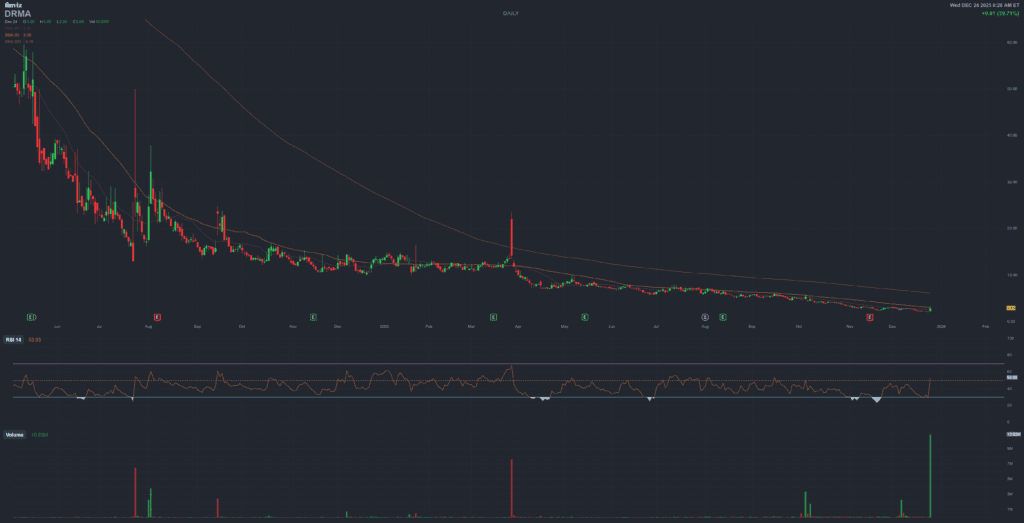
Dermata Therapeutics (DRMA) – 58% Rally, Low Float and OTC Pivot Deep Dive 2025
Independent research note on Dermata’s +58% move: financing news, ultra-low float dynamics, OTC acne pivot, clinical data, catalysts, technical picture, retail sentiment and CEO profile. Educational only, not investment advice.
Language
Executive summary
+58% one-day move on financing + low-float momentum
Dermata Therapeutics (DRMA) exploded roughly 58% in a single session after announcing a private placement priced at the market, with CEO and CFO participating on the same terms as other investors. The deal injects around 4.1 million dollars in cash upfront and potentially more through warrants, extending the company’s runway into the planned launch of an over-the-counter once-weekly acne kit around mid-2026.
The move is amplified by an extreme structural feature: an ultra-low float below one million shares in the hands of predominantly retail investors and insiders. This setup, coupled with real clinical data (positive Phase 3 acne results) and a strategic pivot from Rx to OTC skincare, created the classic “low-float runner with a story” that social-media traders love to push.
This report does not provide buy/sell advice or personal price targets. It simply reconstructs what happened, how the fundamentals line up with the move, which catalysts are visible into 2026 and which risks come with such a thin, illiquid micro-cap.
Quick data snapshot
Price move: about +58% intraday
Float: roughly 0.9–1.0M shares
Ownership: ~26–27% insiders, ~9% institutions
Financing: ~4.1M dollars upfront, up to ~12.4M including warrants
Strategy: pivot to OTC dermatology (once-weekly acne kit)
Timing: OTC acne kit targeted launch mid-2026
Clinical data: Phase 3 STAR-1 in acne met all primary endpoints
Risk profile: micro-cap biotech, high volatility, dilution risk
Figures are indicative and rounded; micro-cap data can change quickly as financings, reverse splits and corporate actions occur.
Official news of the day and catalyst
The immediate trigger for DRMA’s 58% rally was an official press release on 24 December 2025 announcing a private placement financing. Dermata entered definitive agreements to sell roughly 2.02 million shares of common stock (or equivalent pre-funded warrants) at 2.04 dollars per share, together with Series C and D warrants. The transaction is expected to provide about 4.1 million dollars in gross proceeds upfront and up to roughly 8.3 million additional dollars if the warrants are fully exercised, for a total potential raise of around 12.4 million dollars.
A crucial detail: company insiders, including the CEO and CFO, are participating in the offering on the same economic terms as external investors. H.C. Wainwright & Co. acted as the exclusive placement agent. The deal is priced “at-the-market”, meaning at approximately the prevailing share price at the time of the agreement, rather than at a deep discount. In a micro-cap that had been depressed for months, insiders stepping in at market price is understandably read as a confidence signal and as relatively contained dilution versus the classic “toxic” small-cap raises.
The company stated that the proceeds are primarily intended to support Dermata’s strategic pivot into over-the-counter dermatology, with a focus on the once-weekly acne treatment kit planned for mid-2026. Funds will go toward general corporate purposes, consumer research, launch preparation, potential acquisitions or in-licensing of synergistic technologies, and further development of the Spongilla-based skincare platform. Importantly, the raise extends the cash runway. As of the third quarter of 2025, Dermata reported around 4.7 million dollars in cash, which management expected to fund operations into the second quarter of 2026. The new 4.1 million upfront (plus potential warrant exercises) strengthens the balance sheet right as the company prepares for commercialization.
Today’s volume and pre-market action
DRMA’s price reaction came with an equally violent shift in trading activity. In the pre-market session following the 8:00 AM news release, the stock quickly gapped higher, with indicative gains in the 50–60% range even before the opening bell. At the regular session open, shares printed a clear gap up (around 2.16 dollars versus a 2.04 dollar prior close) and immediately pushed higher as momentum traders joined in.
By mid-session, DRMA was trading roughly in the 2.90–3.00 dollar zone, up around 44% at that time, and eventually reached an intraday gain of about 58%. This is an extraordinary one-day move by any standard, and the volume profile confirms it was not a “ghost rally” on a few thin prints. By midday, trading volume was close to double the 20-day average, with DRMA transacting at about 1.9 times its usual volume. In absolute terms, hundreds of thousands of shares changed hands, a huge jump compared with the roughly 50 thousand shares that had been trading on a typical day before the news. Pre-news, DRMA had been almost asleep; the press release effectively woke the stock up.
Most of the move took place in the pre-market and early regular trading hours, which is textbook behavior for a small biotech reacting to fresh news. The important point is that the rally did not completely fade: by the afternoon DRMA was still hovering in the low 3 dollar area, and volume stayed elevated through the session. That pattern suggests genuine follow-through buying rather than a quick spike and evaporation. The pre-market gap, the strong open and the sustained intraday interest all combined to send a clear message to the market that something material was unfolding in DRMA, attracting further momentum traders and algorithmic flows.
Ultra-low float and ownership structure – a key driver
One of the most important structural factors behind DRMA’s outsized rally is its exceptionally low float. Dermata has on the order of 1.0–1.2 million shares outstanding, and the effective float – shares freely tradable and not held by insiders or otherwise restricted – is in the ballpark of 0.9 million shares, i.e. under one million. For a NASDAQ-listed stock, that is extremely thin. Many names on the exchange have floats in the tens or hundreds of millions; DRMA’s float is closer to what one might expect in an obscure OTC listing.
In such a setup, it does not take enormous dollar amounts to move the price. When a new catalyst hits and demand spikes even modestly, the lack of available supply can create dramatic price swings. Low-float stocks are well known in trader communities for exactly this reason: they are capable of explosive upside moves (and equally violent pullbacks) because a relatively small flow of capital has to compete for a small pool of shares. In Dermata’s case, the 58% price jump is clearly amplified by this scarcity effect. As buyers rushed in on the financing news and low-float alerts started circulating, the limited availability of shares acted like a spring, propelling quotes upward.
The ownership profile reinforces this dynamic. Insiders (management and directors) hold roughly 26–27% of the company, which further constrains the float and signals that leadership’s interests are meaningfully aligned with shareholders. The fact that the CEO and CFO are buying in the current raise under the same terms as external investors is interpreted as a vote of confidence in Dermata’s prospects. On the other hand, institutional ownership is very low – on the order of 9% of the shares, likely split among a handful of small biotech-focused funds or specialist investors. That leaves the bulk of the stock in the hands of retail traders and insiders, with little participation from large, long-term institutions that might otherwise stabilise volatility.
Short interest is modest relative to float, so this particular move looks less like a classic short squeeze and more like a pure low-float momentum run sparked by real news. Put simply, the combination of a micro float, high insider ownership and retail-heavy participation created the perfect backdrop for an outsized one-day reaction. It is a powerful bullish driver on the way up, but it should also be seen as a vulnerability: in such thin names, profit-taking or risk-off sentiment can push the price down just as aggressively as bullish flows pushed it up.
Pipeline and fundamental implications – catalysts going forward
Dermata’s new direction: from Rx biotech to OTC skincare
Dermata has been repositioning its business model. Originally structured as a classic clinical-stage biotech developing prescription drugs, the company announced in late 2025 that it would pivot to focus on over-the-counter (OTC) dermatology products sold directly to consumers. The flagship of this new strategy is an OTC once-weekly acne treatment kit that leverages Dermata’s proprietary Spongilla (freshwater sponge) technology in combination with an FDA-approved OTC acne ingredient (likely something in the benzoyl peroxide or salicylic acid family).
The goal is to launch this acne kit around mid-2026, marketing it directly to patients without requiring a prescription or insurance coverage. Management has openly cited the high costs, long timelines and reimbursement complexities associated with the prescription dermatology market as reasons for the pivot. By going OTC, Dermata hopes to shorten time to market, lower regulatory barriers and reach a broader audience. The company’s messaging emphasises not just cosmetic skincare but a science-backed product that sits somewhere between traditional cosmetics and prescription drugs.
Phase 3 data – Xyngari (DMT310) in acne
Importantly, the pivot is not the result of failed clinical data. On the contrary, Dermata’s lead candidate DMT310, now branded as Xyngari, delivered strong results in its pivotal Phase 3 trial (STAR-1) in moderate-to-severe acne. In March 2025 the company reported that STAR-1 met all three primary endpoints with statistical significance versus placebo, with improvements visible as early as week 4. The once-weekly topical treatment was also well tolerated, with a favourable safety profile and no serious treatment-related adverse events reported.
Normally, such data would set up a straightforward path toward an FDA New Drug Application (NDA). Dermata initially planned a second Phase 3 study (STAR-2) plus an open-label extension to complete the package for an NDA filing. However, in its pivot announcement the company disclosed that it had withdrawn its investigational new drug (IND) application for Xyngari and decided not to pursue near-term prescription approval. Instead, Dermata intends to repurpose the underlying technology into an OTC configuration that fits within the FDA OTC monograph framework.
In practice, that means taking a clinically validated concept and reformatting it into a consumer product that can be sold without going through the full, lengthy Rx approval process. This approach trades the pricing power and formal label of a prescription drug for speed, lower regulatory risk and a wider accessible market. The bet is that the combination of once-weekly dosing and clinical backing will differentiate Dermata’s kit in an overcrowded acne aisle.
Additional pipeline and upcoming catalysts
Beyond the acne kit, Dermata has indicated it wants to extend its Spongilla platform to other common dermatologic conditions such as psoriasis and seborrheic dermatitis. The company has been active on the intellectual property front, securing patents in multiple jurisdictions (for example, in the United States and Australia) for its Spongilla-based acne treatments. These patents could provide a useful moat if and when products reach the market.
Historically, Dermata also had prescription-oriented programs such as DMT410 (exploring topical botulinum toxin combinations for aesthetic indications like wrinkles or hyperhidrosis). Under the new strategy, those efforts may be paused, slowed or potentially out-licensed if a suitable partner emerges. For now, investor attention is focused on the near-term, commercially relevant OTC acne opportunity.
Key fundamental catalysts to watch over the next 12–18 months include:
- Concrete progress updates on the acne kit: formulation finalisation, manufacturing agreements, packaging design and the unveiling of the consumer brand identity Dermata has hinted at.
- Pre-launch marketing plans and distribution strategy. Dermata may choose to sell primarily online direct to consumer, via dermatologists, through pharmacies or a combination of these channels.
- Potential commercial partnerships with established dermocosmetic companies or distribution partners who could amplify reach and reduce the burden on Dermata’s own small infrastructure.
- Financial execution: whether the current 4.1 million dollar raise (and any warrant exercises) is sufficient to carry the company to launch, or whether additional capital will be required before revenue starts to come in.
- Compliance milestones around OTC monograph listing, quality and stability testing and any other regulatory steps needed to place the kit on the market.
Taken together, the financing and pivot reinforce a narrative of resourceful adaptation: instead of trying to force a classic biopharma path with limited capital, Dermata is trying to monetize clinically validated technology through a faster and more flexible business model. That does not remove execution risk, but it does give the company a more realistic path to generating revenue relative to its size.
Technical analysis – key levels and price action
Technically, DRMA’s chart has flipped from “washed-out micro-cap” to “in potential reversal” in a single day, but with a lot of work still ahead to repair the longer-term downtrend.
- Pre-news range: In the weeks leading up to the financing, DRMA was trading near historic lows. The 52-week low sat around 1.97 dollars, and for most of the fourth quarter of 2025 the stock oscillated roughly between 2.00 dollars (short-term support) and 2.50 dollars (resistance), occasionally stretching toward 3.00 dollars before rolling over. The stock remained below both its 50-day and 200-day moving averages, reflecting a clear downtrend.
- Support levels after the move: Following the rally, former resistance zones may become support. The 2.50 dollar area, which had capped the stock repeatedly earlier in the month, is a first region to watch on any pullback. Below that, the 2.00 dollar zone – near the recent 52-week low and a psychologically important round number – is the critical line in the sand. If DRMA were to retrace, a “higher low” above 2.00 dollars would be a constructive sign; slipping back into the 1.90s would suggest the news spike is being fully faded.
- Resistance levels: On the upside, the intraday high recorded during the rally, roughly in the 3.20–3.30 dollar band, now marks the first important resistance. A decisive breakout above that area on strong volume would establish a new post-news high and could trigger further momentum flows. The next round-number level is 4.00 dollars, which overlaps with previous trading congestion and with at least one small-cap analyst’s published 12-month target. Beyond that, the technical landscape is more open until the 200-day moving average around the mid-6 dollar area, a distant reference that would likely require multiple positive catalysts to be approached.
- Indicators and trend: The one-day jump pushed DRMA above its 20-day moving average and toward its 50-day moving average in the high 2 to low 3 dollar region. If the stock can hold above the 50-day in the coming sessions, that would strengthen the case for a short-term trend reversal. The Relative Strength Index (RSI) has almost certainly flipped from near-oversold levels to overbought territory, which often precedes a period of consolidation or sideways movement. Before the news, technical indicators overwhelmingly pointed to a bearish trend; the financing rally has at least broken that pattern in the short term.
Volatility is extremely high: DRMA has shown daily percentage swings in the double digits even before this event, and the 58% move only underlines the point. For short-term traders, such volatility can be attractive; for anyone with a longer horizon, it is a clear reminder that position sizing and risk controls matter a lot more in micro-caps than in large, liquid names.
Post-news price targets and outlook
After such a dramatic move, the natural question is “what now?”. With sparse analyst coverage, there is no deep consensus to lean on. Historically, very bullish targets in the 10 dollar range existed on the back of a pure Rx drug development story, but those numbers now look outdated given dilution and the strategic pivot.
A more recent small-cap research note had adjusted its 12-month price target to around 4.00 dollars, down from a much higher prior level. That 4 dollar zone now functions both as a technical level (psychological round number and a logical extension after reclaiming the 3 dollar handle) and as a published external reference point. From the post-news 3 dollar area, reaching 4 dollars would imply roughly another 25–30% upside, which is not unrealistic in a name that can move 50% in a day when conditions line up.
Beyond 4 dollars, any sustainable move toward the mid-single digits would likely require tangible progress: clear steps toward the mid-2026 OTC launch, evidence of early demand in test markets, or a commercial partnership that validates Dermata’s positioning. There is also the capital structure to consider. If all newly issued warrants are exercised and if the company taps its existing shelf registration for further capital, the fully diluted share count could increase substantially. More shares outstanding cap per-share upside for a given enterprise value.
In rough terms, a realistic medium-term scenario for a functioning OTC pivot, with decent execution and without extreme additional dilution, could place DRMA somewhere in the mid-single digit range at best. That is a broad and highly uncertain bracket, not a recommendation. At the same time, downside scenarios – in which execution slips, costs run ahead of plan or risk appetite for micro-cap biotech dries up – can easily see prices sliding back toward, or below, pre-news levels.
The key point: these ranges are not personal price targets or advice. They simply sketch how the current move fits relative to external analyst notes and to plausible fundamental outcomes, underlining that both upside and downside remain wide in a thin, early-stage story like Dermata.
Social media buzz and retail sentiment
DRMA’s move quickly became a talking point on social platforms frequented by active traders, especially Twitter/X, Stocktwits and Reddit. The main narrative that emerged was straightforward: fresh, tangible news (insider participation in a financing) intersecting with an ultra-low float and a micro-cap chart at depressed levels.
Many posts focused on the float, with repeated comments pointing out that “only around a million shares” were available in the public float. Low-float stock lists circulating on trader sites highlighted DRMA as one of the thinnest names on NASDAQ, marking it as a classic “low-float runner”. As more alerts and watchlists flagged the ticker, momentum players piled in, amplifying the move in a feedback loop: the bigger the percentage gain, the more the stock appeared on top-gainer screens, drawing in additional traders.
Discussions did not stop at technicals. Several users summarised the financing details, emphasising that the CEO and CFO were buying alongside investors and that the deal was priced at the market rather than at a steep discount. Others pointed out Dermata’s acne program, the positive Phase 3 results and the shift to OTC skincare, framing DRMA as more than just a random shell name. In other words, there was at least some fundamental awareness mixed into what was mostly a technical and structural trade.
As usual in such environments, there was a spectrum of opinions: from aggressive posts throwing out ambitious price targets like 5 or 10 dollars in the heat of the moment, to more cautious voices reminding readers how many low-float rallies have retraced sharply once volume dried up. Overall, though, the tone during the session was clearly positive and speculative, with DRMA treated as the “play of the day” by many day traders.
It is important to stress that comments on X, Reddit and Stocktwits come from non-professional traders and anonymous accounts. They can be useful to gauge short-term sentiment, but they are not research and not a basis for long-term decisions. In micro-caps, social buzz can move prices dramatically and then disappear just as quickly when attention shifts elsewhere.
CEO profile – leadership background
Dermata’s CEO, Gerald “Gerry” Proehl, is a notable figure for a company of this size. He brings over 30 years of experience in the pharmaceutical and biotech industry. Most prominently, he co-founded Santarus, Inc., a specialty pharmaceutical company focused on gastroenterology and related fields, and served as its President and Chief Executive Officer from 2002 until its sale to Salix Pharmaceuticals in 2014 for approximately 2.6 billion dollars.
Before Santarus, Proehl spent around 14 years at Hoechst Marion Roussel (now part of Sanofi) in roles of increasing responsibility, including Vice President of Global Marketing. There he oversaw products across cardiology, immunology, neurology and other therapeutic areas, gaining extensive experience in both drug development and commercialisation.
After the Santarus exit, Proehl co-founded Dermata Therapeutics around 2014–2015 and has led it as President and CEO since inception. He also serves as Chairman of Dermata’s board and has held board positions in other biotech companies, including Tenax Therapeutics. His track record of building and exiting a multi-billion dollar company is a rare credential in the micro-cap space and is frequently cited by investors as one of Dermata’s key intangible assets.
Proehl’s participation in the current financing aligns his interests further with those of shareholders. He already owned a meaningful stake in Dermata, and by investing alongside the market in the latest raise he is effectively doubling down on the OTC pivot strategy. His industry network and experience could prove critical if Dermata seeks commercial partners, needs to negotiate manufacturing and distribution agreements, or eventually explores strategic alternatives.
In short, for many market participants DRMA is as much a “jockey bet” as a “horse bet”: they are not just backing an acne product or an OTC plan, but a CEO with a history of creating value in a complex industry. That does not guarantee success – Dermata is still a very small, high-risk story – but it is a non-trivial positive element in the overall risk/reward puzzle.
Riassunto esecutivo
+58% in una seduta su news e struttura low-float
Dermata Therapeutics (DRMA) ha messo a segno un rally di circa il 58% in una sola seduta dopo l’annuncio di un aumento di capitale tramite private placement, prezzato “at-the-market” e con partecipazione diretta di CEO e CFO alle stesse condizioni degli altri investitori. L’operazione porta in cassa circa 4,1 milioni di dollari subito, con la possibilità di arrivare a circa 12,4 milioni includendo l’esercizio dei warrant, prolungando la visibilità finanziaria verso il lancio previsto nel 2026 di un kit anti-acne da banco a uso settimanale.
Il movimento è stato amplificato da un elemento strutturale estremo: un flottante effettivo sotto il milione di azioni, in gran parte nelle mani di investitori retail e insider. Questa combinazione – low float e una storia concreta (pivot verso OTC dermatologici con dati di Fase 3 positivi nell’acne) – ha trasformato DRMA nel classico “low-float runner con catalyst” che le community di trading tendono a cavalcare.
Questa analisi non contiene raccomandazioni di acquisto o vendita né target price personali. L’obiettivo è ricostruire cosa è successo, collegare il movimento ai fondamentali, identificare i principali catalyst futuri e mettere in evidenza i rischi tipici di una micro-cap così sottile e volatile.
Dati rapidi
Movimento: circa +58% intraday
Float: all’incirca 0,9–1,0M azioni
Azionariato: ~26–27% insider, ~9% istituzionali
Aumento: ~4,1M dollari subito, fino a ~12,4M con warrant
Strategia: pivot verso prodotti dermatologici OTC
Tempistica: lancio kit acne OTC previsto per metà 2026
Dati clinici: studio Fase 3 STAR-1 nell’acne con tutti gli endpoint centrati
Profilo di rischio: micro-cap biotech, volatilità e rischio diluizione elevati
I numeri sono indicativi e arrotondati; nei micro-cap la struttura azionaria può cambiare rapidamente con nuovi aumenti, reverse split e altre operazioni straordinarie.
Notizia ufficiale del giorno e catalyst
Il catalizzatore immediato del rally di DRMA è stato un comunicato stampa ufficiale del 24 dicembre 2025 che annunciava un finanziamento tramite private placement. Dermata ha siglato accordi definitivi per emettere e vendere circa 2,02 milioni di azioni ordinarie (o warrant “pre-funded” equivalenti) al prezzo di 2,04 dollari per azione, insieme a warrant di serie C e D. L’operazione dovrebbe fruttare circa 4,1 milioni di dollari in proventi lordi immediati, con la possibilità di ulteriori ~8,3 milioni di incasso qualora tutti i warrant venissero esercitati, per un totale potenziale di circa 12,4 milioni di dollari.
Un dettaglio cruciale: alcuni insider della società, inclusi il CEO e il CFO, partecipano all’operazione alle stesse condizioni degli altri investitori. H.C. Wainwright & Co. ha agito in qualità di placement agent esclusivo. Il finanziamento è stato condotto “at-the-market”, ossia a prezzi di mercato correnti e non con forte sconto rispetto al prezzo di borsa. Per una micro-cap reduce da mesi di debolezza questo è generalmente percepito come un segnale di fiducia da parte del management e, al tempo stesso, come un aumento di capitale relativamente meno diluitivo rispetto alle classiche strutture “tossiche” spesso viste nel settore.
Il comunicato spiega che i nuovi fondi saranno destinati a sostenere la svolta strategica di Dermata verso i prodotti dermatologici da banco, con particolare focus sul lancio di un kit per l’acne a uso settimanale previsto per metà 2026. I proventi andranno a finanziare scopi aziendali generali, ricerche sui consumatori, attività di pre-lancio e lancio, eventuali acquisizioni o licenze di tecnologie sinergiche e l’ulteriore sviluppo della piattaforma a base di Spongilla. Dal punto di vista finanziario, l’operazione estende concretamente la “runway” della società: al terzo trimestre 2025 Dermata dichiarava circa 4,7 milioni di dollari di cassa, ritenuti sufficienti a coprire le operazioni fino al secondo trimestre 2026. I 4,1 milioni aggiuntivi (più l’eventuale extra da warrant) rafforzano la posizione proprio nel momento in cui l’azienda entra nella fase esecutiva verso la commercializzazione.
Volume odierno e andamento del pre-market
In parallelo alla notizia, il titolo DRMA ha registrato un’esplosione di volumi e volatilità. Nel pre-market successivo alla pubblicazione del comunicato (ore 08:00), il prezzo è schizzato rapidamente verso l’alto, con indicazioni di rialzo nell’ordine del 50–60% già prima dell’apertura ufficiale. All’open, il titolo ha aperto in netto gap up (intorno a 2,16 dollari contro 2,04 della chiusura precedente) e ha subito accelerato ulteriormente mentre si attivavano i trader momentum.
A metà seduta, DRMA gravitava in area 2,9–3,0 dollari, con un guadagno di circa il 43–44%, per poi spingersi fino a circa +58% intraday nel corso della giornata. Si tratta di un movimento notevole, accompagnato da volumi eccezionali. In mattinata il volume di scambio aveva raggiunto quasi il doppio dei livelli medi recenti (circa 1,9 volte il volume medio a 20 giorni). In termini assoluti, sono state scambiate centinaia di migliaia di azioni, un’enormità se confrontata con le circa 50 mila azioni che caratterizzavano una seduta tipica prima della news. In pratica, il titolo era semi-ibernato e il comunicato lo ha “risvegliato”.
Come spesso accade nei piccoli biotech, gran parte della reazione si è concentrata tra pre-market e prime ore di contrattazione. La differenza, rispetto ad altri casi più effimeri, è che il rally non è stato completamente riassorbito: nel pomeriggio DRMA si muoveva ancora nella parte alta del nuovo range (area 3 dollari) e i volumi sono rimasti sopra la norma fino al close. Questo pattern suggerisce che non si è trattato solo di uno spike momentaneo, ma di un afflusso di interesse più solido, con acquisti di follow-through che hanno sostenuto il movimento nell’arco dell’intera seduta.
Float estremamente basso e struttura degli azionisti
Un elemento chiave per capire l’ampiezza del rally è il flottante eccezionalmente ridotto. Dermata ha all’incirca 1,0–1,2 milioni di azioni totali in circolazione e, di queste, solo circa 0,9 milioni costituiscono il float effettivo liberamente negoziabile. Per un titolo quotato al NASDAQ si tratta di numeri molto bassi: molte società hanno float nell’ordine delle decine di milioni di azioni, mentre DRMA gioca in una categoria quasi “nano”.
In uno scenario del genere basta una domanda relativamente modesta per provocare movimenti forti di prezzo. Quando arriva un catalyst e gli ordini di acquisto aumentano, la scarsità di azioni disponibili può generare oscillazioni molto ampie. I titoli low-float sono noti nelle community di trading proprio per questo motivo: sono in grado di mettere a segno salite esplosive (e altrettanto bruschi ritracciamenti) perché un flusso di capitale relativamente contenuto deve “competere” per poche azioni. Nel caso di Dermata, il balzo del 58% è chiaramente amplificato da questa dinamica: una volta diffusa la notizia del finanziamento con insider buying, l’attenzione degli scanner low-float e dei day trader ha fatto il resto.
Anche la struttura dell’azionariato rafforza questo effetto. Gli insider (management e consiglio) detengono circa il 26–27% del capitale, riducendo ulteriormente il flottante e segnalando un allineamento significativo tra management e azionisti. Sul fronte istituzionale, la quota in mano a fondi e investitori professionali è molto ridotta (intorno al 9%), probabilmente concentrata in pochi piccoli fondi specializzati in biotech. Questo significa che la maggior parte del titolo è nelle mani di retail e insider, con poca presenza di grandi investitori di lungo periodo che potrebbero avere un ruolo stabilizzante.
L’interesse short appare contenuto rispetto al float, per cui il movimento odierno sembra più una tipica corsa low-float alimentata da news e momentum che non un vero e proprio short squeeze. In sintesi, la combinazione di micro-float, forte quota insider e predominanza retail ha creato le condizioni perfette per una reazione sovradimensionata a una singola notizia. È un fattore potente sul lato rialzista, ma va ricordato che può agire in senso opposto qualora il sentiment dovesse girare o i trader decidessero di prendere profitto in massa.
Analisi dei catalyst e implicazioni fondamentali
Nuova strategia OTC
Sul piano strategico, Dermata ha intrapreso una svolta importante. Nata come biotech focalizzata su farmaci su prescrizione, l’azienda ha annunciato nel 2025 un pivot verso prodotti dermatologici da banco (OTC) venduti direttamente ai consumatori. Il fulcro di questa nuova strategia è un kit per il trattamento dell’acne a uso settimanale basato sulla tecnologia proprietaria a base di Spongilla (spugna d’acqua dolce) combinata con un principio attivo approvato dall’FDA per l’uso OTC (es. derivati del perossido di benzoile o acido salicilico).
L’obiettivo dichiarato è lanciare il kit acne OTC verso metà 2026, con vendita diretta al paziente senza necessità di prescrizione o copertura assicurativa. Il management ha indicato esplicitamente i costi, la durata e l’incertezza regolatoria tipiche del percorso dei farmaci etici come principali motivazioni del cambio di rotta. Sfruttando il quadro normativo degli OTC, Dermata punta ad abbreviare i tempi di ingresso sul mercato e ad accedere a un pubblico potenzialmente più ampio, posizionando il proprio prodotto in un’area intermedia tra la cosmetica tradizionale e il farmaco su ricetta.
Risultati di Fase 3 (Xyngari/DMT310)
È importante sottolineare che la decisione di passare agli OTC non deriva da dati clinici negativi. Al contrario, il candidato principale DMT310, oggi brandizzato come Xyngari, ha fornito risultati solidi nello studio pivotal di Fase 3 (STAR-1) nell’acne moderata-grave. Nel marzo 2025 la società ha comunicato che STAR-1 ha centrato tutti e tre gli endpoint primari con significatività statistica rispetto al placebo, con miglioramenti osservabili già alla quarta settimana di trattamento. Il profilo di sicurezza è risultato favorevole, senza eventi avversi gravi correlati al trattamento.
In uno scenario “classico”, questi dati avrebbero dovuto condurre a un percorso relativamente lineare verso la presentazione di una NDA all’FDA. Dermata stava infatti pianificando uno studio Fase 3 aggiuntivo (STAR-2) e uno studio in aperto di estensione per completare il pacchetto. Con l’annuncio del pivot, però, l’azienda ha comunicato di aver ritirato la propria IND relativa a Xyngari, scegliendo di non perseguire nel breve l’approvazione come farmaco soggetto a prescrizione. Il focus si sposta dunque sull’adattamento della tecnologia al contesto OTC, all’interno del quadro regolatorio dell’OTC Monograph.
In pratica, Dermata cerca di monetizzare una tecnologia clinicamente validata attraverso un prodotto da banco, rinunciando al “bollino” di farmaco etico ma guadagnando in velocità, flessibilità e ampiezza del mercato potenziale. La scommessa è che la combinazione tra dosaggio settimanale e solidità dei dati clinici possa rappresentare un elemento distintivo in un segmento (quello dei prodotti anti-acne OTC) estremamente affollato.
Pipeline aggiuntiva e catalyst futuri
Oltre all’acne, Dermata intende estendere la piattaforma Spongilla ad altre condizioni dermatologiche comuni come psoriasi e dermatite seborroica. La società ha continuato a rafforzare il proprio portafoglio brevetti, assicurandosi protezioni in vari Paesi per i propri trattamenti a base di Spongilla. Questi brevetti potranno diventare un vantaggio competitivo importante qualora i prodotti arrivino sul mercato.
In passato Dermata aveva anche programmi più “classici” in ambito estetico (ad esempio DMT410, che combinava Spongilla con tossina botulinica topica). Con il nuovo corso, tali progetti potrebbero essere rallentati, messi in stand-by o eventualmente ceduti in licenza a partner interessati. Per ora, l’attenzione degli investitori è concentrata quasi esclusivamente sulla leva commerciale più vicina: il kit anti-acne OTC.
I principali catalyst fondamentali da monitorare nei prossimi 12–18 mesi includono:
- Avanzamento concreto verso il lancio del kit acne: formulazione definitiva, contratti di produzione, packaging, presentazione del marchio consumer e prime attività di marketing.
- Scelte di canale distributivo (vendita online diretta, tramite dermatologi, in farmacia, ecc.) ed eventuali partnership commerciali con player del dermocosmetico.
- Gestione della cassa: se i 4,1 milioni raccolti (più l’upside dei warrant) basteranno per arrivare al lancio o se sarà necessario un ulteriore aumento di capitale prima che arrivino i primi ricavi.
- Step regolatori legati alla conformità con l’OTC Monograph, alla qualità del prodotto e agli standard di produzione (GMP), con relative comunicazioni al mercato.
Nel complesso, l’effetto combinato di news e pivot è quello di restituire a Dermata una traiettoria credibile verso la monetizzazione della propria tecnologia. Il percorso resta rischioso e competitivo, ma per una micro-cap con risorse limitate rappresenta probabilmente un sentiero più realistico rispetto a quello di un classico sviluppo farmaceutico completo.
Analisi tecnica – livelli chiave
Dal punto di vista grafico, DRMA è passata in poche ore da “micro-cap depressa” a titolo in potenziale fase di inversione, pur con molta strada ancora da fare per ricostruire il quadro di lungo periodo.
- Range pre-news: Nelle settimane precedenti il finanziamento, DRMA trattava vicino ai minimi storici. Il minimo a 52 settimane era intorno a 1,97 dollari e per gran parte del quarto trimestre 2025 il titolo oscillava tra area 2,00 (supporto di brevissimo) e 2,50 dollari (resistenza), con sporadiche puntate verso 3,00 dollari poi respinte. Le quotazioni si mantenevano al di sotto sia della media mobile a 50 giorni, sia della 200 giorni, a testimonianza di un chiaro trend ribassista.
- Supporti post-rally: Dopo il balzo, alcune ex-resistenze potrebbero ora fungere da supporti. L’area 2,50 dollari, che aveva respinto più volte il titolo nel mese precedente, rappresenta un primo livello importante da monitorare in caso di ritracciamento. Più in basso, la zona 2,00 dollari – vicina al recente minimo a 52 settimane e psicologicamente significativa – è il livello chiave: un “higher low” sopra 2,00 sarebbe un segnale costruttivo, mentre un ritorno sotto quella soglia indicherebbe un quasi completo riassorbimento dell’euforia.
- Resistenze: Sul lato rialzista, il massimo intraday registrato durante il rally (area 3,20–3,30 dollari) rappresenta ora la prima resistenza da superare in maniera convinta. Una rottura netta di questa fascia, accompagnata da volumi significativi, aprirebbe la strada a ulteriore momentum. Il successivo livello psicologico è 4,00 dollari, che coincide con un’area di congestione passata e con un target a 12 mesi pubblicato da almeno un broker. Oltre, la “prossima tappa” grafica rilevante è la media mobile a 200 giorni in area 6 e oltre, un riferimento distante che richiederebbe con ogni probabilità molti catalyst positivi per essere anche solo avvicinato.
- Indicatori: Il salto di giornata ha spinto DRMA al di sopra della media mobile a 20 giorni e verso la 50 giorni nella fascia alta dei 2–3 dollari. Un eventuale consolidamento sopra la 50MA nelle prossime sedute rafforzerebbe l’ipotesi di inversione di trend nel breve. È altamente probabile che l’RSI sia passato da valori quasi oversold a zona di ipercomprato, dinamica che in genere anticipa una fase di consolidamento laterale o con moderati ritracciamenti dopo un movimento così violento. Prima della news, gli indicatori tecnici erano quasi unanimemente ribassisti; il rally del finanziamento ha quantomeno interrotto questo pattern nel breve periodo.
La volatilità resta comunque estrema: un titolo che può salire del 50–60% in un giorno può anche scendere a doppia cifra in una singola seduta se il sentiment gira. Per i trader di breve termine questo è un ambiente interessante; per un investitore con orizzonte medio-lungo è un chiaro segnale che dimensione della posizione e gestione del rischio sono centrali.
Target di prezzo post-news e scenario atteso
Dopo un movimento di questa entità, la domanda naturale è “e adesso?”. Con una copertura analitica limitata, non esiste un vero “consenso” su cui appoggiarsi. In passato, su una Dermata ancora pienamente impostata come biotech da prescrizione, erano circolati target molto ottimistici intorno ai 10 dollari, che oggi appaiono poco ancorati alla nuova realtà fatta di pivot OTC e diluizione aggiuntiva.
Una nota di ricerca più recente ha indicato un target a 12 mesi di circa 4,00 dollari, ridotto da livelli ben più elevati. Tale area dei 4 dollari assume ora un duplice ruolo: livello tecnico (numero tondo e naturale estensione dopo la riconquista della soglia dei 3 dollari) e riferimento esterno pubblicato. Dai livelli attuali post-news (circa 3 dollari), un eventuale approdo in area 4 implicherebbe un upside ulteriore intorno al 25–30%, cifra che in un titolo capace di muoversi del 50% in un giorno non è fuori scala.
Oltre i 4 dollari, un apprezzamento sostenibile verso la fascia mid-single digit richiederebbe con ogni probabilità progressi tangibili: passi misurabili verso il lancio OTC di metà 2026, primi feedback positivi in eventuali test di mercato o l’annuncio di una partnership commerciale significativa. Va inoltre considerato il tema della struttura del capitale: se i nuovi warrant verranno esercitati e se la società dovesse attingere alla shelf registration esistente per ulteriori raccolte, il numero di azioni in circolazione potrebbe salire sensibilmente. A parità di valore complessivo dell’azienda, più azioni significano meno spazio di crescita per singola quota.
In termini molto ampi, uno scenario intermedio per una Dermata che esegue in modo decente il proprio pivot OTC, senza diluizione eccessiva, potrebbe collocare il titolo da qualche parte nella fascia dei mid-single digit nel medio termine. Si tratta comunque di una forchetta larga e altamente incerta, non di un obiettivo operativo. Allo stesso modo, non è difficile immaginare scenari ribassisti in cui problemi esecutivi, costi superiori al previsto o un cambio di sentiment verso i micro-cap biotech riportano il titolo verso (o sotto) i livelli pre-news.
Il punto chiave è che queste considerazioni non vanno lette come target price personali o suggerimenti operativi, ma come contestualizzazione del movimento rispetto a quanto emerge da fonti di terze parti e da scenari ipotetici. Il profilo rischio/rendimento resta molto aperto in entrambe le direzioni.
Commenti dai social e sentiment retail
Il movimento di DRMA è rapidamente diventato un tema caldo sulle piattaforme frequentate dai trader retail, in particolare Twitter/X, Stocktwits e Reddit. La narrazione dominante è stata piuttosto chiara: notizia concreta (aumento di capitale con partecipazione del management) che si innesta su una struttura azionaria low-float e su un grafico depresso.
Molti commenti si sono concentrati sul float, sottolineando come in circolazione vi siano “solo circa un milione di azioni” effettivamente disponibili. Le liste di titoli low-float che circolano sui siti per trader hanno evidenziato DRMA come uno dei nomi più sottili sul NASDAQ, inquadrandolo subito nella categoria dei “low-float runner”. Con l’aumentare della percentuale di rialzo, il titolo è entrato nelle classifiche dei top gainer di giornata, attirando ulteriori flussi di trader momentum in una sorta di effetto eco: più saliva, più se ne parlava; più se ne parlava, più nuovi partecipanti entravano sul titolo.
Non sono mancati riferimenti alla notizia sottostante. Diversi utenti hanno riassunto i termini del finanziamento, mettendo l’accento sul fatto che CEO e CFO stessero comprando alle stesse condizioni del mercato e che il deal fosse prezzato a valori di borsa e non con sconti profondi. Altri hanno richiamato l’attenzione sui dati di Fase 3 nell’acne e sul pivot verso il mercato OTC, chiarendo che dietro il movimento non c’era solo “shell vuota” ma una storia aziendale più strutturata.
Come sempre, la gamma di opinioni sui social è ampia: da post molto aggressivi con target iper-ottimistici (5, 10 dollari) scritti sull’onda dell’entusiasmo, a interventi più cauti che ricordano come molti low-float runner abbiano poi restituito buona parte dei guadagni una volta calato il volume. Nel complesso, però, il sentiment nella giornata del rally è stato nettamente positivo e speculativo, con DRMA percepito come il “giocattolo del giorno” da buona parte dei day trader.
È importante ricordare che i commenti su X, Reddit e Stocktwits provengono da trader non professionisti e account anonimi. Possono essere utili per misurare il sentiment di brevissimo periodo, ma non rappresentano ricerca indipendente né basi solide per decisioni di lungo termine. Nei micro-cap, il buzz social può spingere i prezzi in modo violento, ma tende anche a spostarsi rapidamente da un titolo all’altro man mano che emergono nuove “storie del giorno”.
Profilo del CEO – esperienza e rilevanza
Il CEO di Dermata Therapeutics è Gerald T. “Gerry” Proehl, figura di rilievo per una società di queste dimensioni. Vanta oltre 30 anni di esperienza nell’industria farmaceutica e biotech. È noto in particolare per essere stato co-fondatore, Presidente e Amministratore Delegato di Santarus, Inc., azienda farmaceutica specializzata in gastroenterologia, che ha guidato dal 2002 fino alla sua acquisizione da parte di Salix Pharmaceuticals nel 2014 per circa 2,6 miliardi di dollari.
Prima di Santarus, Proehl ha lavorato per circa 14 anni presso Hoechst Marion Roussel (oggi parte di Sanofi), ricoprendo ruoli di crescente responsabilità fino a diventare Vice President of Global Marketing. In quel contesto ha gestito prodotti in aree terapeutiche quali cardiologia, immunologia e neurologia, maturando una combinazione rara di competenze scientifiche e commerciali.
Dopo la vendita di Santarus, Proehl ha fondato Dermata Therapeutics intorno al 2014–2015 e ne è CEO sin dall’inizio. È anche Chairman del consiglio di amministrazione e siede nel board di altre realtà biotech, tra cui Tenax Therapeutics. Il track record di aver costruito e venduto un’azienda da 2,6 miliardi di dollari è un elemento non comune nel mondo delle micro-cap e viene spesso citato dagli investitori come uno dei principali asset intangibili di Dermata.
La sua partecipazione all’attuale aumento di capitale rafforza l’allineamento con gli azionisti: già deteneva una quota significativa di DRMA e, investendo nuovamente alle condizioni di mercato, dimostra di credere nel pivot OTC che sta guidando. La sua rete di contatti e l’esperienza maturata potrebbero rivelarsi cruciali in caso di trattative per partnership commerciali, accordi di produzione e distribuzione o eventuali scenari strategici alternativi.
In sintesi, per molti operatori DRMA è tanto una “scommessa sul cavallo” quanto una “scommessa sul fantino”: non si guarda solo al kit anti-acne o al pivot OTC, ma al curriculum di un CEO che in passato ha dimostrato di saper creare valore in contesti complessi. Questo non annulla i rischi – Dermata resta una storia micro-cap ad alto beta – ma rappresenta un elemento positivo non trascurabile nell’analisi complessiva.
Sources and methodology
This report is based on publicly available information from Dermata Therapeutics’ official press releases and investor presentations (including the 24 December 2025 private placement announcement, the September 2025 OTC pivot update and prior acne trial communications), SEC filings (10-Q, S-3 shelf registration and related documents), reputable financial data aggregators and news outlets, and observable pricing and volume data from major market platforms.
Market commentary and social-media sentiment sections draw on discussions on X/Twitter, Reddit and Stocktwits around the time of the move. These platforms host comments by non-professional traders; they are used here only to illustrate retail sentiment and should not be confused with professional research.
Legal and risk disclaimer
This document is for educational and informational purposes only. It does not constitute, and must not be interpreted as, investment advice, an offer, a solicitation or a recommendation to buy or sell any security or financial instrument. The analysis is based on public information believed to be reliable at the time of writing, but no representation or warranty is given as to its accuracy or completeness. Micro-cap biotech companies such as Dermata Therapeutics are highly speculative, illiquid and subject to extreme volatility, financing risk and potential total loss of capital. Readers should perform their own due diligence and, where appropriate, consult a qualified financial professional before making any investment decision.
Comments on target ranges, technical levels or potential scenarios are illustrative only and reflect a personal interpretation of publicly available data and third-party sources. They are not price targets or personalised investment recommendations. Past performance, including past rallies of similar low-float stocks, is not indicative of future results. The author and Merlintrader trading Blog do not assume any responsibility for decisions taken by readers based on this report.
Questo report ha finalità esclusivamente informative e didattiche. Non rappresenta in alcun modo una raccomandazione di investimento, né un invito all’acquisto o alla vendita di strumenti finanziari. I dati utilizzati provengono da fonti pubbliche ritenute affidabili al momento della redazione, ma non se ne garantisce l’accuratezza o la completezza. Le micro-cap biotech come Dermata sono titoli intrinsecamente speculativi, poco liquidi e soggetti a forti oscillazioni di prezzo, rischi di diluizione e potenziale perdita totale del capitale investito. Prima di assumere qualsiasi decisione, è opportuno svolgere analisi autonome e, se necessario, rivolgersi a un consulente finanziario abilitato.
Qualsiasi riferimento a livelli di prezzo, scenari bull/bear o possibili evoluzioni di mercato ha valore puramente illustrativo e non deve essere interpretato come target price o consiglio operativo. Le performance passate non sono indicative di risultati futuri. Merlintrader trading Blog potrebbe utilizzare, all’interno del sito, link di affiliazione verso piattaforme terze; eventuali commissioni derivanti da tali link non modificano il contenuto indipendente di questa analisi.
Per ulteriori dettagli su condizioni d’uso, privacy e avvertenze legali, si rimanda alle pagine ufficiali: Disclaimer legale e Condizioni d’uso e Privacy .
Biotech Catalyst Calendar
Per seguire in modo strutturato le prossime PDUFA, i dati di Fase 2/3 e gli altri eventi price-sensitive nel settore biotech (inclusi i titoli citati in questo report), è disponibile il Biotech Catalyst Calendar aggiornato su Merlintrader trading Blog.
Una panoramica rapida e centralizzata degli upcoming catalyst può aiutare a inquadrare meglio storie come Dermata all’interno del contesto di mercato complessivo, sempre in ottica informativa e non come strumento di raccomandazione.
Apri il Biotech Catalyst CalendarScanner for active traders

Try ChartsWatcher free, then unlock 10% OFF with SAVE10
ChartsWatcher is a real-time scanner for momentum traders: fast movers, unusual volume and rotations — so you can focus on the few tickers that matter right now, instead of watching hundreds of charts.
Start with the free version. When you upgrade, use SAVE10 for 10% OFF your first paid period.
Start free – then use SAVE10
No credit card required to start. Apply SAVE10 when upgrading.

Recommended platform

One platform. All your brokers.
Medved Trader connects multiple brokers in one workspace, with pro charts, hotkeys and fast execution — without changing your broker accounts.
A single cockpit for positions, Level II and multi-broker order routing, built for active day & swing traders.
Get 1 Month Free ➔
Multi-broker workflow + customizable layouts in one platform.

 Monica.im – the AI assistant I use every day
If you find value in the work I publish on Merlintrader and want a practical AI assistant for research and writing, you can sign up using this referral link. Click here to try Monica.im and support the site
Find out how I use AI on Merlintrader: AI, retail and Merlintrader
Disclosure: some of the links in the promotional blocks above are affiliate or referral links. If you choose to subscribe or sign up through them, Merlintrader may receive a small commission or benefit at no extra cost to you.


