DISCLAIMER — Not financial advice. Educational content only, not an offer or solicitation to buy or sell any security. Biotech and small/mid-cap stocks are highly speculative and volatile and can result in a partial or total loss of capital. Do your own research and consult a licensed advisor where appropriate. / Contenuti a solo scopo informativo e didattico, non costituiscono consulenza finanziaria né offerta o sollecitazione al pubblico risparmio ai sensi delle normative CONSOB e SEC. Le azioni biotech e le small/mid cap sono strumenti altamente speculativi e volatili e possono comportare la perdita parziale o totale del capitale investito. Si raccomanda di effettuare sempre le proprie ricerche e, se necessario, di rivolgersi a un consulente abilitato.

Merlintrader Trading Pub
Biotech catalyst news and analysis. FDA PDUFA tracker
Merlintrader Trading Pub
Biotech catalyst news and analysis. FDA PDUFA tracker
Language / Lingua:
Cassava Sciences (SAVA) – Simufilam Aftermath, TSC Pivot & Controversies
Long-form, filings-based deep dive after the collapse of the Alzheimer’s program. Highly controversial name; informational only, not a buy/sell call.
SAVA
Nasdaq | CNS / Alzheimer’s legacy
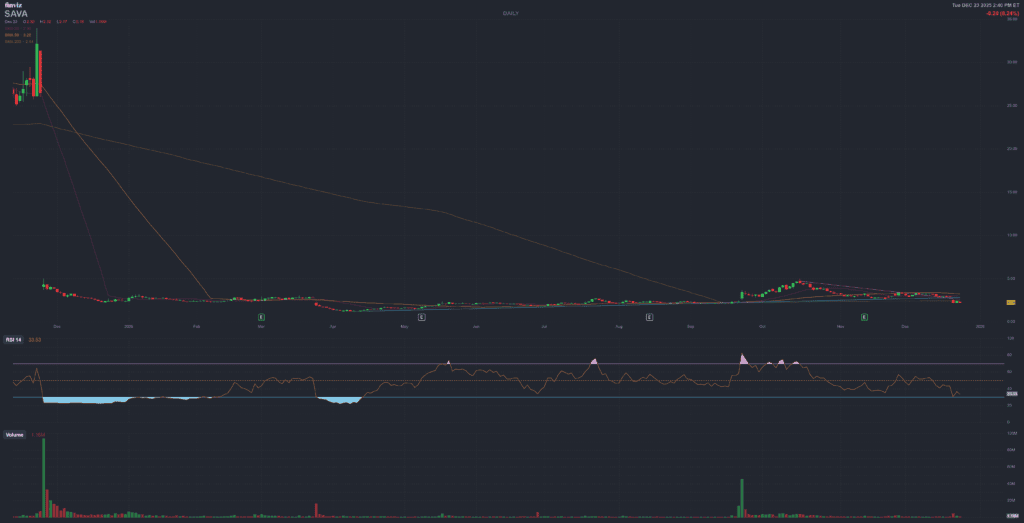
As of late 2025, Cassava is a small-cap CNS company trading in the low-single-digit USD range after its lead Alzheimer’s drug, simufilam, failed in Phase 3 and the program was discontinued.
In November 2024, top-line results from the Phase 3 RETHINK-ALZ trial did not meet their co-primary endpoints in mild-to-moderate Alzheimer’s disease.:contentReference[oaicite:0]{index=0} On March 25, 2025, the company reported Phase 3 REFOCUS-ALZ data and announced that simufilam had failed again, this time across primary, secondary and exploratory endpoints. Management stated that all efforts to develop simufilam for Alzheimer’s would be discontinued and the program phased out by the end of Q2 2025.:contentReference[oaicite:1]{index=1}
At the same time, Cassava has been at the center of intense controversy: citizen petitions asking FDA to halt trials (later denied), an SEC case alleging misleading data disclosure (settled without admitting wrongdoing), and a separate criminal case against an academic collaborator accused of falsifying NIH grant data.:contentReference[oaicite:2]{index=2} In March 2025, a US judge allowed critics to pursue a malicious-prosecution lawsuit against the company over its prior defamation suit.:contentReference[oaicite:3]{index=3}
Cassava is now trying to reposition simufilam in a completely different area: TSC-related epilepsy (tuberous sclerosis complex), currently in preclinical/IND-enabling work with a first human study planned around the first half of 2026.:contentReference[oaicite:4]{index=4} That pivot is very early and does not remotely offset the collapse of the Alzheimer’s franchise.
News focus – where Cassava stands after 2024–2025
The key turning point was November 2024, when Cassava announced that RETHINK-ALZ, one of its two Phase 3 simufilam trials in mild-to-moderate Alzheimer’s, had failed to meet its co-primary endpoints. Independent coverage from Science and other outlets framed this as a major blow to a program that had already been under intense scrutiny for data integrity concerns.:contentReference[oaicite:5]{index=5}
On March 25, 2025, top-line REFOCUS-ALZ data confirmed the pattern: simufilam again failed to show meaningful benefit on cognition or function versus placebo, across primary, secondary and exploratory endpoints. In the same press release, Cassava stated it would discontinue all efforts to develop simufilam for Alzheimer’s disease and expected to phase out the AD program by the end of Q2 2025.:contentReference[oaicite:6]{index=6} Major neurology news outlets highlighted that safety looked acceptable, but efficacy was essentially absent.
A separate but related storyline has unfolded in the courts. In October 2024, specialized media noted that Cassava agreed to pay 40 million USD to settle an SEC case involving allegations that it had misled investors about data from a Phase 2b study of simufilam.:contentReference[oaicite:7]{index=7} In March 2025, Reuters reported that a US judge allowed a malicious-prosecution lawsuit from critics and short-sellers to proceed, after Cassava’s earlier defamation suit against them had been dismissed.:contentReference[oaicite:8]{index=8}
Finally, in its own communications, Cassava is now emphasizing a pivot: positive preclinical work suggesting simufilam may reduce seizure activity in TSC-related epilepsy models, with a first-in-human study targeted for the first half of 2026.:contentReference[oaicite:9]{index=9} This is scientifically interesting, but it is still preclinical; there is no clinical efficacy data in TSC yet.
Net effect: the original Alzheimer’s equity story is effectively dead, replaced by a very early-stage epilepsy program and a heavy overhang of legal, scientific and reputational issues.
Executive summary
- Alzheimer’s program shut down. Both Phase 3 trials of simufilam in mild-to-moderate Alzheimer’s disease – RETHINK-ALZ and REFOCUS-ALZ – failed their primary endpoints. The company has formally ended development of simufilam for Alzheimer’s and is phasing out the program.:contentReference[oaicite:10]{index=10}
- New, much earlier story: TSC-related epilepsy. Cassava now promotes simufilam as a potential treatment for epilepsy associated with tuberous sclerosis complex, based on preclinical data showing reduced seizure activity in animal models. An IND-enabling package is in progress, with a first human study planned for H1 2026 if all goes well.:contentReference[oaicite:11]{index=11}
- Legal and regulatory backdrop is very complex. The company has faced citizen petitions to FDA (denied), critical coverage from scientific journals, an SEC enforcement action settled for 40 M USD, and a parallel criminal case against an academic collaborator accused of falsifying NIH grant data used in simufilam research.:contentReference[oaicite:12]{index=12}
- Financially, this is no longer a classic growth story. Cassava historically had minimal revenue and relied on capital markets. After the Phase 3 failures, the key questions become: how much cash is left, how fast expenses are reduced, and whether any monetization or settlement inflows offset ongoing costs.
- Analyst and retail sentiment are extremely polarized. Some bulls still argue that the TSC pivot and earlier open-label signals justify optionality; most mainstream analysts have low single-digit price targets and stress the high uncertainty. Retail communities remain split between believers and skeptics, with strong emotions on both sides.
Bottom line: SAVA is now a post-failure, litigation-heavy CNS micro/mid-cap, driven more by legal news flow and sentiment than by near-term fundamental catalysts. Any position – long or short – sits at the extreme end of the risk spectrum.
Pipeline – from Alzheimer’s to TSC-related epilepsy
Simufilam in Alzheimer’s: what actually happened
Simufilam is a small-molecule drug targeting “altered filamin A,” a protein Cassava has argued becomes misfolded and drives Alzheimer’s pathology. Early Phase 2 and open-label data were presented as highly positive, showing cognitive improvement over baseline, which is extraordinarily rare in Alzheimer’s. Those claims attracted both investor euphoria and heavy scientific skepticism.:contentReference[oaicite:13]{index=13}
The definitive test came with two large Phase 3 trials:
- RETHINK-ALZ – ~750 patients, 18-month randomized trial in mild-to-moderate AD (NCT05026177).:contentReference[oaicite:14]{index=14}
- REFOCUS-ALZ – ~1,100 patients, similar design with different geographic footprint and endpoints mix.:contentReference[oaicite:15]{index=15}
In November 2024, Cassava reported that RETHINK-ALZ failed its prespecified co-primary endpoints.:contentReference[oaicite:16]{index=16} On March 25, 2025, the company announced that REFOCUS-ALZ likewise failed to demonstrate benefit on its primary, secondary and exploratory endpoints, and that development of simufilam in Alzheimer’s disease would be discontinued.:contentReference[oaicite:17]{index=17}
The TSC-related epilepsy pivot
Cassava’s current pipeline strategy is to reposition simufilam for epilepsy related to tuberous sclerosis complex (TSC), a rare genetic disorder characterized by benign tumors and severe epilepsy in many patients. According to the company’s official pipeline page and press releases:
- Simufilam is being evaluated in preclinical TSC epilepsy models, where it has reportedly reduced seizure activity in mice.
- The company plans to complete IND-enabling activities and start a first-in-human study in TSC-related epilepsy in the first half of 2026, subject to regulatory clearance.:contentReference[oaicite:18]{index=18}
- Safety data from the Alzheimer’s program (over 1,900 patients exposed in Phase 3) are referenced as supportive for moving into a new indication, although they do not speak to efficacy in epilepsy.
In practical terms, this means that the main value driver is no longer a late-stage Alzheimer’s program, but an earlier-stage epilepsy idea with no human efficacy data yet. For equity holders, that is a very different risk/reward profile.
Financial overview and analyst snapshot
Financial profile
Cassava historically generated little to no product revenue and funded itself mainly through capital markets and research grants. The Alzheimer’s program was large and expensive; after its failure, management has communicated cost-cutting and a shift to a leaner structure focused on TSC-related epilepsy.
The January 2025 business update, still pre-REFOCUS readout, discussed cash on hand and expected operating expenses for 2025.:contentReference[oaicite:19]{index=19} Post-March 2025, investor attention has shifted to three questions: how much cash remains after trials and legal costs, how quickly R&D and SG&A are reduced, and whether any settlements or insurance arrangements partially offset litigation exposure.
Because the situation is evolving and quarterly reports after the Phase 3 failure may materially change the picture, anyone trading SAVA should read the latest 10-Q/10-K filings line by line rather than relying on older “runway” estimates.
Analyst coverage and targets
- Several data aggregators now show a small number of analysts covering SAVA, with average 12-month targets in the low single digits. For example, MarketBeat reports a consensus target around 2 USD from 2 analysts, while other platforms show a broader 2–8 USD range.:contentReference[oaicite:20]{index=20}
- Many valuation models have effectively written off the Alzheimer’s program and treat TSC epilepsy as a high-risk option with limited probability of success and long timelines.
- Some speculative analyses and AI-driven “price predictions” online show low single-digit projections through 2026–2030 – but these are model-based forecasts, not formal equity research.:contentReference[oaicite:21]{index=21}
Overall Street stance: high uncertainty, low conviction, relatively small coverage universe. The name still trades, but mainly in the “special situations / speculative” bucket rather than classic growth biotech.
Controversies, investigations and legal context
Cassava’s story cannot be understood without acknowledging the controversy:
- Citizen petitions and FDA response. In August 2021, critics submitted a citizen petition to the FDA expressing “grave concerns” about the quality and integrity of simufilam-related research and asking the agency to halt trials. In February 2022, FDA denied the petition, stating that enforcement actions are outside the scope of the citizen petition process and that it retains full discretion to investigate separately.:contentReference[oaicite:22]{index=22}
- SEC enforcement and settlement. In October 2024, clinical-trials media reported that Cassava agreed to pay 40 million USD to settle an SEC case alleging that the company misled investors regarding Phase 2b simufilam data. The settlement was reached without the company admitting or denying the allegations.:contentReference[oaicite:23]{index=23}
- Criminal charges against external collaborator. A Reuters report in July 2022 described a US criminal probe related to Cassava’s Alzheimer’s data. Later coverage notes that a professor at City University of New York who consulted on simufilam research was charged with fraud over allegedly falsified data in NIH grant applications. He has pleaded not guilty.:contentReference[oaicite:24]{index=24}
- Litigation between Cassava and its critics. Cassava previously filed a defamation lawsuit against several scientists and short-sellers who had publicly criticized simufilam data. In 2024 that suit was dismissed; in March 2025, a judge ruled that those critics can proceed with a malicious prosecution case against Cassava, arguing that the original defamation filing may have been intended to intimidate critics.:contentReference[oaicite:25]{index=25}
- Scientific skepticism. Prominent chemist Derek Lowe and other commentators have published long critiques of simufilam’s data, pointing to inconsistencies and image-manipulation concerns in some supporting papers. These are opinions, but they have influenced how the scientific community views the program.:contentReference[oaicite:26]{index=26}
None of the above, by itself, proves or disproves intentional fraud by the company as a whole – that is for regulators and courts to determine. What matters for investors is that SAVA carries an unusually heavy legal and reputational overhang, and this strongly affects how both institutions and sophisticated retail traders look at the name.
Retail sentiment and social-media chatter (non-professional)
What retail bulls say
Bullish cluster: “sunk-cost overreaction + TSC optionality”
- Some SAVA bulls on Reddit and Stocktwits argue that the market has “over-punished” the stock after Phase 3 failure, leaving only little value assigned to TSC epilepsy optionality or to any settlement/insurance-related outcomes.
- Others highlight the large number of patients exposed to simufilam with an apparently benign safety profile, suggesting this de-risks the molecule for other CNS indications.
- A minority of posters still believe that earlier Alzheimer’s data were real and that the Phase 3 trials were flawed or biased against the drug; this view is strongly contested by scientists and most professional observers.
What skeptics emphasize
Bearish cluster: “data integrity + litigation + no efficacy”
- Skeptics point to the total failure of both Phase 3 trials, the SEC settlement, the criminal charges against the academic collaborator, and the ongoing malicious-prosecution lawsuit as reasons to avoid the stock altogether.
- Many posts stress that TSC epilepsy is still preclinical, with no human efficacy data, and that pivoting a controversial Alzheimer’s drug into a rare epilepsy is, at this stage, purely speculative.
- There is widespread concern that further negative legal or scientific headlines could trigger additional downside, regardless of day-to-day trading patterns.
Reminder: sentiment from Reddit, Stocktwits and X comes from non-professional traders and should be treated as anecdotal mood, not as due diligence or investment research.
Risk map and scenario thinking
Main risk categories
- Clinical risk: the TSC epilepsy program is preclinical. There is no guarantee simufilam will be effective in humans for this indication.
- Regulatory and legal risk: ongoing litigation and past SEC enforcement create a complex environment that could lead to additional costs, management distraction or restrictions.
- Financing risk: absent revenue, Cassava may need to raise capital again if costs are not reduced enough or if legal expenses climb.
- Reputational risk: once a company is widely perceived as controversial, institutions often avoid it, which can depress the valuation multiple regardless of fundamentals.
- Trading/volatility risk: SAVA is a classic high-volatility ticker; news flow can trigger sharp moves in both directions, and liquidity may be thin at inflection points.
Very high-level bull / bear / neutral frames (not advice)
Bull-ish frame: simufilam shows convincing efficacy in TSC epilepsy with clean safety; litigation gets resolved on manageable terms; cash is sufficient to bridge; market re-rates SAVA as a small CNS company with a differentiated seizure mechanism.
Bear-ish frame: TSC program stalls or fails; litigation and reputational damage keep institutions away; financing comes at punitive terms; equity drifts or grinds lower, with optionality essentially priced out.
Neutral / trading frame: no major data for some time; stock oscillates on headlines and sentiment, used mainly as a trading vehicle by high-risk biotech traders rather than as a long-term investment.
These are not price targets or probabilities – just ways to structure your own thinking around a very complex and controversial situation that depends as much on courts and regulators as on science.
Key sources and documents
- Cassava Sciences – corporate website and pipeline overview for simufilam (Alzheimer’s and TSC-related epilepsy).:contentReference[oaicite:27]{index=27}
- Cassava Sciences – press releases and business updates, including RETHINK-ALZ/REFOCUS-ALZ top-line results and discontinuation of the Alzheimer’s program.:contentReference[oaicite:28]{index=28}
- ClinicalTrials.gov entries for simufilam Phase 3 trials in Alzheimer’s disease (NCT05026177 and related).:contentReference[oaicite:29]{index=29}
- FDA documents and coverage of the 2021 citizen petition and its 2022 denial.:contentReference[oaicite:30]{index=30}
- Reuters and other major outlets on SEC settlement, criminal probe and malicious-prosecution lawsuit.:contentReference[oaicite:31]{index=31}
- Science, Alzforum and other specialist outlets on simufilam clinical results and scientific controversy.:contentReference[oaicite:32]{index=32}
- MarketBeat, Nasdaq and other aggregators for analyst coverage, ratings and consensus targets on SAVA.:contentReference[oaicite:33]{index=33}
Figures are approximate and may have changed after publication of this report. Always re-check the most recent filings and official press releases.
Legal and regulatory disclaimer (EN)
This article is for informational and educational purposes only and does not constitute investment advice, investment research, an offer or solicitation to buy or sell any security or financial instrument. It is not prepared in accordance with legal requirements designed to promote the independence of investment research, and it is not subject to any prohibition on dealing ahead of the dissemination of investment research.
The analysis is based on public information believed to be reliable at the time of writing, including SEC filings, regulatory documents and company press releases, but no representation or warranty is made as to its accuracy or completeness. All numbers may be approximate or rounded. Markets, prices and fundamentals can change quickly, especially around clinical, regulatory or legal catalysts.
Nothing in this report takes into account the personal circumstances, financial situation or risk tolerance of any reader. You should do your own research, read the original documents and, where appropriate, consult a licensed financial professional before making any investment decision. The website may maintain commercial relationships or affiliate links with some platforms mentioned; these do not change the requirement to base the factual core of the report on primary documents.
For full legal information, risk warnings and privacy details, please refer to:
General disclaimer and risk information |
Terms of use and privacy information.
Biotech Catalyst Calendar – full FDA and trials schedule
For a broader view of upcoming biotech catalysts – PDUFA dates, key Phase 2/3 readouts, FDA advisory committees and more – you can consult the dedicated Catalyst Calendar page, updated regularly with new events and estimates.
Open the Biotech Catalyst CalendarCassava Sciences (SAVA) – Dopo il crollo di Simufilam: pivot TSC ed ombre legali
Analisi estesa, basata su documenti ufficiali, dopo il fallimento del programma Alzheimer. Titolo estremamente controverso; contenuto puramente informativo, non è un invito a comprare o vendere.
SAVA
Nasdaq | SNC / eredità Alzheimer
A fine 2025 Cassava è una small cap del settore SNC che scambia a pochi dollari per azione, dopo che il farmaco di punta per l’Alzheimer, simufilam, ha fallito in Fase 3 e il programma è stato chiuso.
A novembre 2024 i risultati top-line dello studio di Fase 3 RETHINK-ALZ non hanno raggiunto gli endpoint primari nell’Alzheimer lieve-moderato.:contentReference[oaicite:34]{index=34} Il 25 marzo 2025, con i dati di Fase 3 REFOCUS-ALZ, Cassava ha confermato un ulteriore fallimento su endpoint primari, secondari ed esploratori, annunciando la fine dello sviluppo di simufilam nell’Alzheimer e la chiusura del programma entro il Q2 2025.:contentReference[oaicite:35]{index=35}
Parallelamente il titolo è al centro di un contesto molto pesante: citizen petition alla FDA (poi respinta), un caso SEC su comunicazioni considerate fuorvianti (chiuso con un accordo economico), e un procedimento penale separato contro un professore universitario esterno accusato di aver falsificato dati per ottenere fondi NIH usati anche nella ricerca su simufilam.:contentReference[oaicite:36]{index=36} A marzo 2025 un giudice USA ha inoltre autorizzato alcuni critici a procedere con una causa per “malicious prosecution” contro Cassava, dopo che la precedente causa per diffamazione presentata dall’azienda era stata archiviata.:contentReference[oaicite:37]{index=37}
L’azienda sta provando a riposizionare simufilam in un’area completamente diversa: l’epilessia associata a complesso della sclerosi tuberosa (TSC), oggi in fase preclinica/IND-enabling con avvio del primo studio sull’uomo previsto, nelle intenzioni, per la prima metà del 2026.:contentReference[oaicite:38]{index=38} Si tratta però di un’idea ancora molto embrionale, che non compensa la perdita del programma Alzheimer.
News del momento – dove si trova Cassava dopo il 2024–2025
Il punto di svolta è stato novembre 2024, quando Cassava ha comunicato che lo studio di Fase 3 RETHINK-ALZ su simufilam nell’Alzheimer lieve-moderato non aveva raggiunto gli endpoint co-primari. La copertura da parte di Science e di altri media specialistici ha presentato l’evento come un duro colpo per un programma già sotto forte scrutinio per possibili problemi di integrità dei dati.:contentReference[oaicite:39]{index=39}
Il 25 marzo 2025, i dati top-line di REFOCUS-ALZ hanno sostanzialmente confermato il quadro: nessun beneficio significativo su cognizione e funzione rispetto al placebo, né sugli endpoint primari, né su quelli secondari ed esploratori. Nello stesso comunicato Cassava ha dichiarato che avrebbe interrotto ogni sviluppo di simufilam nell’Alzheimer e che il programma sarebbe stato chiuso entro fine Q2 2025.:contentReference[oaicite:40]{index=40}
In parallelo si è sviluppato il filone legale: nel 2024 Cassava ha accettato di pagare 40 milioni di dollari per chiudere un caso SEC che la accusava di aver fornito informazioni fuorvianti su uno studio di Fase 2b di simufilam (senza ammettere né negare le contestazioni).:contentReference[oaicite:41]{index=41} A marzo 2025 Reuters ha riportato che un giudice federale ha consentito a un gruppo di medici e short-seller di procedere con una causa per “malicious prosecution” contro l’azienda, collegata alla precedente causa per diffamazione che Cassava aveva intentato contro di loro e poi ritirato.:contentReference[oaicite:42]{index=42}
Nelle comunicazioni più recenti l’azienda sta ora puntando i riflettori su un pivot: dati preclinici che suggeriscono un effetto di simufilam sulla riduzione delle crisi epilettiche in modelli animali di epilessia associata a TSC, con un primo studio clinico previsto indicativamente per la prima metà del 2026.:contentReference[oaicite:43]{index=43} È un concept interessante, ma siamo molto lontani da qualsiasi prova clinica sull’uomo.
Tradotto: la storia equity originale sull’Alzheimer è sostanzialmente finita. Quello che rimane è un’idea in fase preclinica in TSC e un contesto legale/reputazionale molto pesante.
Executive summary (IT)
- Programma Alzheimer chiuso. Entrambi gli studi di Fase 3 di simufilam nell’Alzheimer (RETHINK-ALZ e REFOCUS-ALZ) sono risultati negativi sugli endpoint primari. L’azienda ha ufficialmente interrotto lo sviluppo della molecola in questa indicazione.:contentReference[oaicite:44]{index=44}
- Nuova storia: epilessia associata a TSC. Cassava ora propone simufilam come potenziale trattamento per l’epilessia correlata a complesso della sclerosi tuberosa, basandosi su dati preclinici in modelli murini e con un primo studio clinico previsto dopo il 2026, se l’IND verrà accettata.:contentReference[oaicite:45]{index=45}
- Background legale/regolatorio molto complesso. L’azienda ha affrontato una citizen petition alla FDA (respinta), un caso SEC chiuso con accordo da 40 mln USD, un procedimento penale contro un collaboratore accademico e una causa per “malicious prosecution” da parte di alcuni critici.:contentReference[oaicite:46]{index=46}
- Profilo finanziario fragile. Cassava storicamente ha avuto pochissimi ricavi; dopo il fallimento del programma AD il focus è su quanto cash resta in cassa, quanto scenderanno le spese e quale impatto avranno eventuali costi legali.
- Sentiment estremamente polarizzato. Alcuni retail continuano a credere nella molecola e nel pivot TSC; la maggior parte degli analisti mantiene target bassi e sottolinea rischi elevati su tutti i fronti.
In sintesi: SAVA oggi è una scommessa ad altissimo rischio in una storia già “bruciata” sull’Alzheimer, con una nuova ipotesi in epilessia TSC ancora lontanissima dal mercato e un forte overhang legale. Non adatta a chi cerca storie lineari o conservative.
Pipeline – dall’Alzheimer all’epilessia TSC
Simufilam nell’Alzheimer: il film, non il trailer
Simufilam è una piccola molecola orale che agisce su una forma “alterata” della proteina filamin A, indicata da Cassava come driver di alcune componenti della patologia di Alzheimer. Gli studi precoci e l’open-label avevano mostrato miglioramenti cognitivi nel tempo, cosa quasi mai vista in questa malattia – ed è proprio questo che aveva acceso l’hype, ma anche i dubbi di molti ricercatori.:contentReference[oaicite:47]{index=47}
Il verdetto vero è arrivato con i due studi di Fase 3:
- RETHINK-ALZ – ~750 pazienti, 18 mesi, Alzheimer lieve-moderato, randomizzato vs placebo.:contentReference[oaicite:48]{index=48}
- REFOCUS-ALZ – ~1100 pazienti, disegno simile con differenze di dettagli e geografia.:contentReference[oaicite:49]{index=49}
A novembre 2024 RETHINK-ALZ ha fallito gli endpoint co-primari.:contentReference[oaicite:50]{index=50} A marzo 2025 REFOCUS-ALZ ha ripetuto lo schema, fallendo su endpoint primari, secondari ed esploratori; poche settimane dopo l’azienda ha annunciato la chiusura del programma Alzheimer.:contentReference[oaicite:51]{index=51}
Pivot: epilessia legata a sclerosi tuberosa (TSC)
La nuova scommessa è riposizionare simufilam nell’epilessia associata a complesso della sclerosi tuberosa (TSC), malattia genetica rara con crisi epilettiche spesso difficili da controllare. Secondo le slide e i comunicati aziendali:
- Simufilam ha ridotto l’attività epilettica in modelli murini TSC preclinici.
- Il programma è in fase IND-enabling, con avvio del primo studio clinico previsto indicativamente per H1 2026, subordinato all’ok regolatorio.:contentReference[oaicite:52]{index=52}
- L’azienda fa leva sul fatto di avere dati di sicurezza in oltre 1.900 pazienti Alzheimer, ma questi non dicono nulla sull’efficacia nell’epilessia TSC.
Per un investitore questo significa passare da una storia già “matura” (Fase 3 Alzheimer, ora chiusa) a una scommessa ancora in fase preclinica, dove il rischio binario torna molto alto ma l’orizzonte temporale si allunga parecchio.
Profilo finanziario e analisti (IT)
Finanza aziendale
Cassava non ha (ad oggi) un prodotto in commercio; i ricavi storici derivano in larga parte da grant e da piccole voci accessorie. Il programma Alzheimer di Fase 3 è stato costoso e, dopo il fallimento, la narrativa di management è passata su contenimento costi e nuova focalizzazione.
L’aggiornamento di gennaio 2025, precedente al fallimento definitivo, riportava la cassa disponibile e le spese previste per il 2025.:contentReference[oaicite:53]{index=53} Dopo marzo 2025 l’attenzione si è spostata su tre elementi: quanta cassa resta dopo i trial, quanto verranno ridotti R&D/SG&A e che impatto avranno i procedimenti legali (costi diretti ed eventuali polizze assicurative).
È fondamentale, per chiunque voglia anche solo valutare il titolo, leggere le ultime 10-Q/10-K complete, perché il profilo di cassa può cambiare rapidamente con i nuovi eventi.
Copertura analisti e target price
- I database mostrano oggi pochissimi analisti attivi su SAVA, con target medi a 12 mesi nell’area dei pochi dollari. MarketBeat, ad esempio, riporta un consensus intorno a 2 USD basato su 2 analisti, mentre altre fonti mostrano una forbice 2–8 USD.:contentReference[oaicite:54]{index=54}
- Molti modelli ormai azzerano completamente il valore dell’Alzheimer e trattano il progetto epilessia TSC come optionality a bassa probabilità, su orizzonte lungo.
- In giro si trovano anche “previsioni” automatiche basate su modelli AI o puramente quantitativi che proiettano il titolo in area 2–3 USD nel 2025–2026; non sono ricerca azionaria regolamentata, ma rumor di contesto.:contentReference[oaicite:55]{index=55}
Sintesi lato sell-side: copertura ridotta, poca convinzione, target bassi e forte enfasi su rischi legali e reputazionali.
Controversie, indagini e contesto regolatorio
- Citizen petition alla FDA. Nel 2021 alcuni medici hanno presentato una petition chiedendo alla FDA di sospendere gli studi su simufilam citando “seri dubbi” sulla qualità dei dati. Nel febbraio 2022 l’FDA ha respinto la richiesta, spiegando che le azioni di enforcement non passano tramite la procedura di citizen petition ma tramite iniziative autonome dell’agenzia.:contentReference[oaicite:56]{index=56}
- Caso SEC e accordo transattivo. Nel 2024 Cassava ha accettato di pagare circa 40 mln USD per chiudere un procedimento SEC che la accusava di aver fornito informazioni fuorvianti sui dati di uno studio di Fase 2b. L’accordo è stato raggiunto senza ammissione di responsabilità da parte dell’azienda.:contentReference[oaicite:57]{index=57}
- Procedimento penale su collaboratore esterno. Un professore della City University of New York, consulente per la ricerca su simufilam, è stato incriminato per presunta falsificazione di dati in domande di grant NIH. Ha dichiarato di essere non colpevole. Alcuni documenti alla base delle critiche a Cassava derivano proprio da questa vicenda.:contentReference[oaicite:58]{index=58}
- Cassava vs critici, round legale. L’azienda aveva intentato una causa per diffamazione contro alcuni scienziati e short-seller che avevano criticato i dati di simufilam. La causa è stata successivamente archiviata; nel marzo 2025 un giudice ha consentito agli stessi critici di procedere con una causa per “malicious prosecution” contro Cassava, legata all’uso della causa per diffamazione.:contentReference[oaicite:59]{index=59}
- Scetticismo scientifico strutturale. Autori come Derek Lowe e varie analisi su Science hanno documentato criticità nei dati e nelle immagini di laboratorio a supporto di simufilam, alimentando un clima di scetticismo profondo nella comunità scientifica.:contentReference[oaicite:60]{index=60}
Non spetta a un report come questo decretare colpe o innocenze; quello che conta per chi guarda il titolo è che SAVA porta addosso un livello di rischio legale e reputazionale fuori scala rispetto alla media del settore.
Sentiment retail e chatter social (IT)
Cosa dicono i “bull”
Cluster rialzista: “mercato esagera + optionality TSC”
- Una parte dei trader retail su Reddit e Stocktwits ritiene che il mercato abbia punito il titolo oltre il dovuto dopo la Fase 3, lasciando poco o nulla in conto all’eventuale successo in TSC.
- Altri insistono sul profilo di sicurezza osservato nei trial AD, visto come base per esplorare nuove indicazioni nel SNC.
- Una minoranza continua a credere che i dati positivi iniziali nell’Alzheimer fossero reali e che ci siano problemi nel design o nell’interpretazione dei trial di Fase 3; posizione fortemente contestata dal mondo accademico.
Cosa sottolineano gli scettici
Cluster ribassista: “no efficacia + rischio legale”
- Gli scettici mettono in fila: fallimento dei due trial di Fase 3, accordo con la SEC, procedimenti legali aperti e pivot su un’indicazione ancora preclinica come motivi per tenersi alla larga.
- Molti commenti sottolineano che il passaggio all’epilessia TSC, ad oggi, è più un’ipotesi da laboratorio che una pipeline concreta.
- Il timore ricorrente è che nuove notizie negative (legali o scientifiche) possano generare altre ondate di sell-off indipendentemente dal newsflow tecnico sul TSC.
Come sempre, i commenti su Reddit, Stocktwits e X sono opinioni di trader non professionisti; utili per capire l’umore di breve, ma non sostitutivi della due diligence su documenti ufficiali.
Mappa dei rischi e scenari possibili
Macro-rischi
- Rischio clinico: il progetto TSC è ancora preclinico; non sappiamo se simufilam funzionerà mai nell’uomo per questa indicazione.
- Rischio legale/regolatorio: cause in corso, passato con SEC e indagini su dati di ricerca creano una cappa di incertezza difficile da modellare.
- Rischio di funding: senza ricavi, qualsiasi rallentamento nel taglio costi o shock legale può rendere necessari nuovi aumenti di capitale a condizioni sfavorevoli.
- Rischio reputazionale: molti investitori istituzionali evitano per policy titoli con forte odore di controversia; questo può comprimere il multiplo a prescindere dai numeri.
- Rischio volatilità: SAVA resta un ticker da fortissima volatilità, con movimenti ampi su ogni headline e book non sempre profondo nei momenti chiave.
Frame bull / bear / neutro (solo schema, non consigli)
Frame bull: simufilam mostra segnali convincenti nell’epilessia TSC con buon profilo di sicurezza; le principali cause si chiudono in modo gestibile; la cassa regge; il mercato rilegge SAVA come piccola story di nicchia nel SNC.
Frame bear: il programma TSC non decolla, il contesto legale si complica, la cassa si assottiglia e gli aumenti di capitale diventano molto diluitivi; il titolo resta schiacciato in basso o scende ancora.
Frame trading neutro: nessun dato clinico forte per un po’, il titolo resta una “pallina da flipper” per trader biotech ad alto rischio, con movimenti guidati più da newsflow legale e sentiment che da fondamentali.
Anche qui, l’obiettivo non è stimare target o probabilità, ma dare un telaio mentale per valutare se – e come – la storia rientra nel proprio profilo di rischio.
Fonti principali utilizzate
- Sito aziendale di Cassava Sciences e sezione pipeline (simufilam in Alzheimer e TSC).:contentReference[oaicite:61]{index=61}
- Comunicati stampa e business update di Cassava Sciences, inclusi i dati RETHINK-ALZ/REFOCUS-ALZ e l’annuncio di chiusura del programma Alzheimer.:contentReference[oaicite:62]{index=62}
- ClinicalTrials.gov per le registrazioni degli studi di Fase 3 su simufilam.:contentReference[oaicite:63]{index=63}
- Documenti FDA e articoli sulla citizen petition 2021 e sulla sua bocciatura nel 2022.:contentReference[oaicite:64]{index=64}
- Articoli Reuters e altri media su accordo con la SEC, indagine penale e causa per “malicious prosecution”.:contentReference[oaicite:65]{index=65}
- Analisi su Science, Alzforum e blog scientifici riguardo ai dati di simufilam e alle critiche metodologiche.:contentReference[oaicite:66]{index=66}
- Database come MarketBeat e Nasdaq per coverage e target price su SAVA.:contentReference[oaicite:67]{index=67}
Dati indicativi e basati su informazioni disponibili al momento della stesura. È essenziale verificare sempre le ultime filing SEC e i comunicati ufficiali prima di qualsiasi decisione operativa.
Disclaimer legale (IT)
Questo articolo ha esclusivamente finalità informative ed educative e non costituisce in alcun modo una raccomandazione di investimento, un invito all’acquisto o alla vendita di strumenti finanziari, né un servizio di consulenza personalizzata. Non è redatto secondo le regole previste per la ricerca in materia di investimenti e non è soggetto a divieti di negoziazione prima della sua diffusione.
Le informazioni utilizzate provengono da documenti pubblici ritenuti affidabili (filing SEC, comunicati ufficiali, documenti regolatori), ma non se ne garantisce l’accuratezza o la completezza. Dati e cifre possono essere approssimativi o arrotondati e sono suscettibili di variazioni nel tempo, in particolare in presenza di catalyst clinici, regolatori o legali.
Nulla di quanto scritto tiene conto della situazione individuale di ciascun lettore (patrimonio, obiettivi, propensione al rischio). Prima di assumere decisioni di investimento è opportuno svolgere autonome verifiche e, se necessario, consultare un consulente finanziario abilitato. Il sito può avere rapporti commerciali o link di affiliazione con alcune piattaforme citate; ciò non modifica l’obbligo di basare l’analisi fattuale su fonti primarie.
Per informazioni complete su rischi, condizioni d’uso e privacy si rimanda alle pagine:
Disclaimer e avvertenze di rischio |
Condizioni d’uso e informativa privacy.
Biotech Catalyst Calendar – calendario completo catalyst
Per avere una visione d’insieme dei principali catalyst biotech – PDUFA, letture di Fase 2/3, advisory committee FDA e altro – puoi consultare la pagina dedicata al Catalyst Calendar, aggiornata periodicamente con nuovi eventi e stime.
Vai al Biotech Catalyst CalendarScanner for active traders

Try ChartsWatcher free, then unlock 10% OFF with SAVE10
ChartsWatcher is a real-time scanner for momentum traders: fast movers, unusual volume and rotations — so you can focus on the few tickers that matter right now, instead of watching hundreds of charts.
Start with the free version. When you upgrade, use SAVE10 for 10% OFF your first paid period.
Start free – then use SAVE10
No credit card required to start. Apply SAVE10 when upgrading.
Recommended platform

One platform. All your brokers.
Medved Trader connects multiple brokers in one workspace, with pro charts, hotkeys and fast execution — without changing your broker accounts.
A single cockpit for positions, Level II and multi-broker order routing, built for active day & swing traders.
Get 1 Month Free ➔
Multi-broker workflow + customizable layouts in one platform.
 Monica.im – the AI assistant I use every day
If you find value in the work I publish on Merlintrader and want a practical AI assistant for research and writing, you can sign up using this referral link. Click here to try Monica.im and support the site
Find out how I use AI on Merlintrader: AI, retail and Merlintrader
Disclosure: some of the links in the promotional blocks above are affiliate or referral links. If you choose to subscribe or sign up through them, Merlintrader may receive a small commission or benefit at no extra cost to you.