DISCLAIMER — Not financial advice. Educational content only, not an offer or solicitation to buy or sell any security. Biotech and small/mid-cap stocks are highly speculative and volatile and can result in a partial or total loss of capital. Do your own research and consult a licensed advisor where appropriate. / Contenuti a solo scopo informativo e didattico, non costituiscono consulenza finanziaria né offerta o sollecitazione al pubblico risparmio ai sensi delle normative CONSOB e SEC. Le azioni biotech e le small/mid cap sono strumenti altamente speculativi e volatili e possono comportare la perdita parziale o totale del capitale investito. Si raccomanda di effettuare sempre le proprie ricerche e, se necessario, di rivolgersi a un consulente abilitato.

Merlintrader Trading Pub
Biotech catalyst news and analysis. FDA PDUFA tracker
Merlintrader Trading Pub
Biotech catalyst news and analysis. FDA PDUFA tracker
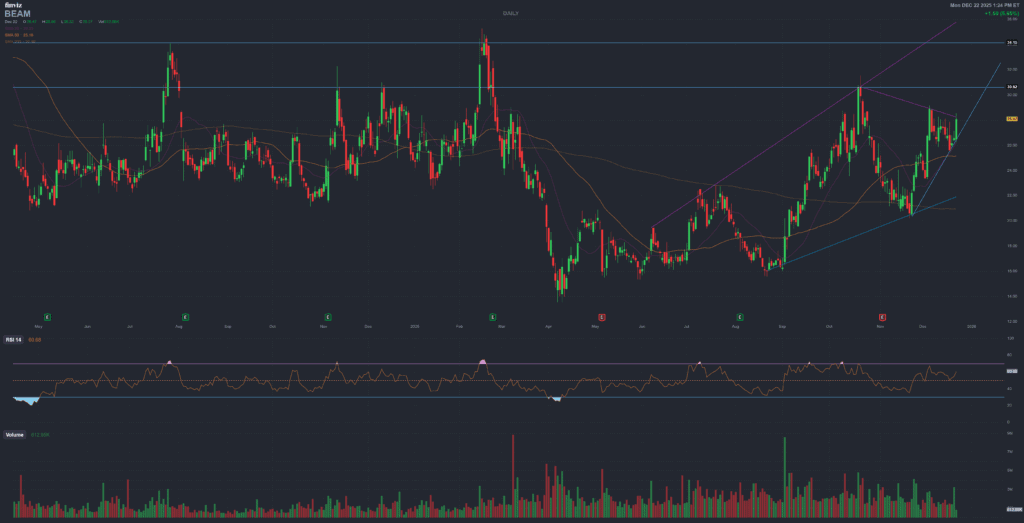
Beam Therapeutics (BEAM) – Base editing in sickle cell, AATD and GSD1a
Long-form, filings-based look at Beam Therapeutics at the end of 2025: risto-cel (BEAM-101) in sickle cell disease, in vivo base editing programs BEAM-301 and BEAM-302, and how the balance sheet supports a multi-shot base editing strategy.
BEAM
Nasdaq | Beam Therapeutics Inc.
News of the day – 22 Dec 2025
BEAM-101 (risto-cel): updated BEACON data and RMAT designation in sickle cell disease
Beam has reported updated data from the BEACON Phase 1/2 trial of BEAM-101 (now named risto-cel) in sickle cell disease: 30+ treated patients with robust and durable fetal hemoglobin induction and near-elimination of severe vaso-occlusive crises in most evaluable patients, alongside an FDA RMAT designation granted in August 2025.
- At the December 2025 ASH update, risto-cel showed strong HbF induction and substantial improvement in anemia and VOC rates over a median follow-up approaching one year, reinforcing a differentiated profile versus other gene-edited SCD approaches.
- In August 2025, the FDA granted Regenerative Medicine Advanced Therapy (RMAT) designation to BEAM-101 for sickle cell disease, reflecting the potential of base editing in this indication and providing an enhanced regulatory interaction pathway.
- Beam has also reported a patient death in BEACON attributed to busulfan conditioning, highlighting that a key residual risk is the myeloablative transplant backbone rather than the base-editing construct itself – a driver behind the company’s ESCAPE effort to move toward non-genotoxic conditioning.
Executive summary
Beam Therapeutics is one of the purest listed plays on base editing. Its pipeline spans ex vivo and in vivo programs: risto-cel (BEAM-101) for sickle cell disease, BEAM-201 for aggressive T-cell malignancies, BEAM-301 for glycogen storage disease type Ia (GSD1a) and BEAM-302 for severe alpha-1 antitrypsin deficiency, plus an engineered stem-cell antibody-paired evasion (ESCAPE) platform aimed at non-genotoxic conditioning.
In 2025 the company has delivered: (1) updated BEACON data for BEAM-101 with strong hemoglobin F induction and VOC reduction; (2) continuing clinical progress with BEAM-201 in T-ALL/T-LL; (3) first-in-human advancement of in vivo base-editing candidates BEAM-301 and BEAM-302; and (4) an RMAT designation from FDA for BEAM-101 in sickle cell disease. At the same time, the BEACON busulfan-related death has reminded investors that even elegant editing does not remove transplant risks.
Financially, Beam is very well capitalised for a mid-cap biotech, with around USD 1.1B in cash and marketable securities as of Q3 2025 and guidance that this is sufficient to fund operations into 2028. Revenue remains modest and mostly collaboration-derived; Beam is firmly pre-commercial and burning money to build a broad proof-of-concept portfolio.
This report focuses on: (1) the BEACON data and BEAM-101’s evolving place in the SCD competitive landscape; (2) the in vivo base editing pipeline in AATD and GSD1a; (3) financial runway and spending; and (4) a scenario and risk map that captures why BEAM’s valuation is so sensitive to perceived platform quality.
Company overview
Beam Therapeutics is a Cambridge-based biotechnology company built around base editing, a CRISPR-derived technology designed to introduce precise single-base changes in DNA without creating double-stranded breaks. The core claim is that base editing can, in many cases, reduce unwanted genomic rearrangements and p53 activation compared with traditional nuclease editing, while still achieving durable therapeutic editing.
The pipeline is explicitly diversified across ex vivo and in vivo modalities: risto-cel (BEAM-101) as an autologous base-edited hematopoietic stem cell product for sickle cell disease; BEAM-201, an allogeneic CAR T for relapsed/refractory T-ALL/T-LL; and in vivo LNP-delivered or AAV-delivered base editing for severe monogenic liver diseases such as GSD1a and AATD.
Corporate updates in late 2025 repeatedly stress two themes: first, that the company aims to generate robust proof-of-concept data across multiple indications to validate base editing as a therapeutic class; second, that the large cash position is meant to support this multi-program approach through key clinical milestones, rather than a single “all-in” bet.
Pipeline snapshot: BEAM-101, BEAM-201, BEAM-301, BEAM-302
| Program | Modality / target | Indication | Stage |
|---|---|---|---|
| BEAM-101 (risto-cel) | Ex vivo base-edited autologous HSPCs (HbF induction) | Severe sickle cell disease | Phase 1/2 BEACON, ongoing; RMAT designation; updated ASH 2025 data showing robust HbF induction, improved anemia and VOC reduction, with one busulfan-related death reported. |
| BEAM-201 | Multiplex base-edited allogeneic CAR T (CD7) | R/R T-ALL and T-LL | Phase 1/2, early safety and response data presented at ASH 2024; continued enrollment and follow-up through 2025. |
| BEAM-301 | In vivo base editing for GSD1a (LNP delivery) | Glycogen storage disease type Ia (R83C mutation focus) | Early clinical-stage program; designed to correct the common G6PC R83C mutation in the liver; ongoing dose escalation in 2025. |
| BEAM-302 | In vivo base editing (AATD) | Severe alpha-1 antitrypsin deficiency | Clinical-stage program targeting the Z-variant mutation; data presented at the Alpha-1 Foundation 2025 conference; Beam joined C-Path’s CPA-1 consortium to help shape future AATD endpoints and imaging standards. |
| ESCAPE platform | Engineered antibody + stem-cell pair | Non-genotoxic conditioning for ex vivo therapies | Preclinical/early clinical work exploring antibody-based conditioning to reduce reliance on busulfan, particularly for BEAM-101-like approaches. |
Together, these programs illustrate Beam’s effort to cover both classic ex vivo transplant-style therapies and in vivo, single-infusion edits in liver diseases. The platform thesis is that if Beam can demonstrate safety and durable efficacy in a handful of high-value monogenic indications, base editing could be extended more broadly.
Catalyst and timeline overview (2025 – 2028)
Jun 2025
EHA 2025 – BEACON data and RMAT groundwork
At the 2025 European Hematology Association meeting, Beam presents updated BEACON data for BEAM-101 and lays the foundation for its RMAT request, highlighting strong HbF induction and early VOC reduction. This becomes the basis for the August 2025 RMAT designation.
Aug 2025
RMAT designation for BEAM-101
FDA grants RMAT designation to BEAM-101 for sickle cell disease, enabling more intensive interactions with the agency and a potential path to accelerated approval if data continue to be compelling.
Dec 2025
ASH 2025 – updated BEACON dataset
At ASH 2025, Beam presents updated BEACON results with more patients and longer follow-up, including analysis of HbF levels, VOC rates and safety. The company positions risto-cel as a differentiated SCD option in a crowded gene-editing field.
2025–2026
BEAM-301 and BEAM-302 clinical progress
Early clinical data for the GSD1a and AATD programs are expected to emerge, focused primarily on safety, pharmacodynamics (biomarker changes) and early functional readouts. These will be watched closely as some of the first in vivo base-editing experiences in humans.
2026–2028
Pivotal decisions and scaling
Assuming BEACON and the liver programs continue to deliver positive data, Beam will need to make decisions about pivotal trial designs, potential registrational strategies and commercial partnerships. The current cash runway is designed to carry the company through this phase of portfolio “sorting” – deciding which shots on goal are mature enough to carry into late-stage development.
Financial snapshot and runway
As of 30 September 2025, Beam reported approximately USD 1.07–1.10B in cash, cash equivalents and marketable securities, driven in part by a sizable equity raise in March 2025. Operating cash burn for the first nine months of 2025 was in the mid-200M range, and management guided that the current cash should fund operations into 2028.
Q3 2025 revenue was roughly USD 9.7M, primarily from collaboration and service arrangements, with no product revenue. R&D expenses were on the order of USD 110M for the quarter, reflecting multiple concurrent clinical programs, while G&A stood around USD 27M. EPS for Q3 2025 was approximately −1.10, modestly below consensus expectations but broadly in line with what you would expect from a multi-program clinical-stage platform.
In practical terms, Beam is not in the “cash-strapped micro-cap” bucket; it has capital to execute. The risk is not immediate dilution pressure but whether the company can convert that balance sheet into durable, registrational-grade data before investors run out of patience for long-dated stories.
Sentiment: analysts and retail
Sentiment – non-professional traders
Analyst commentary in late 2025 often frames Beam as one of the higher-quality gene-editing platforms, with the RMAT designation for BEAM-101 and the breadth of the in vivo liver programs cited as key strengths. Several reports highlight BEAM-301 and BEAM-302 as underappreciated “shots on goal” in severe monogenic liver disease, while acknowledging that SCD remains the near-term sentiment driver.
On Stocktwits, Reddit and X, BEAM has a typical “platform biotech” split: bulls focus on the elegance of base editing, the strong HbF data for BEAM-101 and the relatively long runway; bears focus on the lack of near-term commercial catalysts, the busulfan-related death in BEACON and competition from CRISPR, lentiviral and other editing or genetic therapies in SCD and liver disease.
Overall, sentiment is constructive but nervous: many traders see BEAM as a long-duration option on base editing as a modality, not as a quick trade around a single binary event.
As always, these are opinions from non-professional traders and third-party commentators. They are useful as context, not as investment advice.
Scenario map: what could go right or wrong
Upside scenario (conceptual, not a prediction)
In a constructive scenario, BEAM-101 continues to generate strong, durable data, with long-term follow-up reinforcing a low VOC rate and high HbF levels, while regulators accept a feasible registrational path under RMAT. BEAM-301 and BEAM-302 produce clean safety and compelling biomarker shifts in GSD1a and AATD, setting up pivotal plans. The combined picture establishes Beam as a first-mover in base editing with multiple programs that could realistically reach the market.
Execution / middle path
In a more neutral world, BEAM-101 remains promising but faces practical challenges: slow enrollment due to competition from other genetic SCD options, ongoing concerns about conditioning risk and a complex commercial landscape. Liver programs show good but not spectacular data, requiring larger, (expensive) follow-up studies. Beam remains a high-potential platform name, but the timeline to any significant revenue continues to stretch out, making the stock trade more as a “show-me” story.
Downside / risk-intensive scenario
On the downside, base editing programs could run into unexpected safety issues (for example, unexpected off-target effects or immunogenicity) or fail to produce sufficient benefit in pivotal-grade studies. Competing SCD and liver disease programs from other companies might also erode the potential addressable market. In that environment, even a strong balance sheet would merely extend the runway for experimentation rather than secure a clear path to commercial success.
None of these outcomes is certain; they simply illustrate why BEAM tends to trade with high volatility and why the market cares as much about “platform quality” as it does about any single data readout.
Risk map
Scientific / safety risk
Base editing is still a relatively new modality in the clinic. Long-term safety (including off-target edits, clonal expansions and immunogenicity) is not yet fully characterised. The BEACON busulfan-related death also underlines the risk of conditioning regimens in ex vivo programs.
Regulatory and competitive
Sickle cell disease and monogenic liver diseases are already crowded with gene therapy and gene-editing approaches. Regulatory agencies may set a high bar for approving new modalities when other options exist, and payers may be reluctant to reimburse multiple, expensive one-time treatments for overlapping populations.
Execution and time-to-value
Beam’s cash runway is a strength, but also a test: investors will expect visible progress across several programs over the next few years. Delays, equivocal data or strategic drift could lead to valuation compression even without a single dramatic clinical failure.
Bottom line
Beam Therapeutics is not a simple “one-trial” biotech. It is a broad, well-funded base editing platform with four main clinical shots on goal and a long list of preclinical ideas behind them. BEAM-101 is the visible tip of the iceberg; BEAM-301 and BEAM-302 are the in vivo tests that will decide how far base editing can go in systemic diseases.
From a factual, filings-based standpoint, Beam enters 2026 with: a strong balance sheet, multiple clinical programs, RMAT designation for its lead asset and early but promising data in both hematology and liver disease. Whether that ultimately justifies the current share price is a separate question that depends on risk tolerance, time horizon and personal conviction about base editing as a therapeutic technology.
This text is not a recommendation to buy or sell BEAM. It is a map of what the company has actually delivered and what still needs to happen, so that readers can decide for themselves how – or if – Beam fits into their own approach.
Key sources and links
- Beam Therapeutics – Q3 2025 financial results and Form 10-Q (cash position, runway into 2028, R&D and G&A expenses, revenue breakdown).
- Beam Therapeutics – press releases and ASH/EHA updates on BEACON Phase 1/2 data for BEAM-101 (risto-cel) in sickle cell disease, including RMAT designation.
- Beam corporate presentations and pipeline overview describing BEAM-201, BEAM-301, BEAM-302 and the ESCAPE conditioning platform.
- ClinicalTrials.gov and academic reviews summarising BEACON design and the in vivo base editing programs in GSD1a and AATD.
- Major financial media and analysis pieces (Nasdaq, Zacks, Investing, etc.) discussing Beam’s cash runway, base editing platform and 2025 clinical milestones.
Some external links used for charts or tools (for example Finviz, Seeking Alpha, Stocktwits or broker platforms) may include affiliate or referral parameters for Merlintrader. These do not change the content you see or the price you pay, and they do not influence the conclusions of this analysis.
Legal and risk disclaimer
Informational only, not investment advice. This report is based on public information from company filings, regulatory documents and reputable news sources available at the time of writing. It may contain errors, omissions or data that become outdated as new information emerges.
Nothing in this text is a recommendation to buy, sell or hold any security, nor a solicitation to do so. The author is not a registered investment adviser or a licensed financial professional. Any references to scenarios, upside/downside or potential market behaviour are illustrative and not predictions.
Readers should perform their own due diligence, consider their personal financial situation and risk tolerance, and, where appropriate, consult a qualified financial professional. Gene editing and base editing carry significant scientific, regulatory and commercial risk, and it is possible to lose some or all of the capital invested.
This content is intended for an international audience that includes readers in both the European Union and the United States. The language and structure aim to remain consistent with the spirit of applicable guidance from regulators such as CONSOB and the SEC for purely informational, non-promotional commentary.
Authors: Merlintrader and Jane.
For full legal notes and privacy information, please refer to:
Disclaimer
Termini di Servizio, Privacy, Cookie Policy // Term of Service, Privacy, Cookie Policy
Biotech Catalyst Calendar
For an updated overview of upcoming biotech and healthcare catalysts – PDUFA dates, clinical readouts, regulatory events – you can always refer to the dedicated Merlintrader Biotech Catalyst Calendar page.
Beam Therapeutics (BEAM) – Base editing tra anemia falciforme, AATD e GSD1a
Analisi estesa, basata su documenti ufficiali, su Beam Therapeutics a fine 2025: risto-cel (BEAM-101) nella sickle cell disease, i programmi in vivo BEAM-301 e BEAM-302 e come la cassa sostiene una strategia multi-programma sul base editing.
BEAM
Nasdaq | Beam Therapeutics Inc.
News del giorno – 22 dic 2025
BEAM-101 (risto-cel): nuovi dati BEACON e RMAT nella sickle cell disease
Beam ha presentato nuovi dati dallo studio Fase 1/2 BEACON su BEAM-101 (ora risto-cel) nella sickle cell disease: oltre 30 pazienti trattati con forte induzione di emoglobina fetale, miglioramento dell’anemia e quasi completa scomparsa delle crisi vaso-occlusive gravi nella maggior parte dei pazienti valutabili, insieme a una designazione RMAT FDA concessa nell’agosto 2025.
- All’ASH 2025, i dati BEACON hanno mostrato livelli di HbF elevati e mantenuti nel tempo e una drastica riduzione delle VOC, posizionando risto-cel come opzione competitiva nel panorama delle terapie genetiche per SCD.
- Ad agosto 2025 la FDA ha concesso la designazione RMAT a BEAM-101, riconoscendo il potenziale del base editing nella SCD e aprendo a interazioni regolatorie più intensive.
- Nello stesso studio è stato però riportato un decesso attribuito al busulfan di condizionamento, che ricorda come una parte importante del rischio resti legata al trapianto mieloablativo, non solo alla tecnologia di editing – motivo per cui Beam sta sviluppando la piattaforma ESCAPE per un condizionamento non genotossico.
Executive summary
Beam Therapeutics è una delle scommesse più “pure” sul base editing quotate al Nasdaq. Il portafoglio copre programmi ex vivo e in vivo: risto-cel (BEAM-101) per SCD, BEAM-201 per leucemie/linfomi T aggressivi, BEAM-301 per la glicogenosi tipo Ia e BEAM-302 per il deficit grave di alfa-1 antitripsina, oltre alla piattaforma ESCAPE per ridurre la dipendenza da condizionamento chemioterapico.
Nel 2025 l’azienda ha portato avanti: (1) aggiornamenti BEACON con dati sempre più solidi su BEAM-101; (2) progressi clinici su BEAM-201; (3) avanzamento in clinica dei programmi in vivo BEAM-301 e BEAM-302; (4) ottenimento della RMAT per SCD. Allo stesso tempo, il decesso legato al busulfan ha riportato l’attenzione sui rischi residui del trapianto, anche in presenza di editing elegante.
Sul fronte finanziario, Beam è insolitamente ben capitalizzata per una mid-cap biotech: circa 1,1 miliardi di dollari di cassa e titoli a fine Q3 2025 e runway guidata fino al 2028. I ricavi sono modesti e legati a collaborazioni; l’azienda resta totalmente pre-commerciale e sta spendendo molto per costruire prove di concetto multiple.
Qui ci concentriamo su: (1) cosa raccontano davvero i dati BEACON; (2) lo stato dei programmi in vivo in AATD e GSD1a; (3) la tenuta della cassa rispetto al burn; (4) una mappa scenari e rischi che spiega perché il titolo è così sensibile alla percezione del “valore di piattaforma”.
Panoramica aziendale
Beam Therapeutics è una biotech con sede a Cambridge costruita attorno al base editing, tecnologia derivata da CRISPR che mira a modificare singole basi del DNA senza creare rotture a doppio filamento. L’idea è ridurre eventi indesiderati (riarrangiamenti, attivazione p53) mantenendo un editing stabile e duraturo.
La pipeline è volutamente diversificata: risto-cel (BEAM-101) come terapia ex vivo basata su HSPC autologhe per SCD; BEAM-201 come CAR T allogenico per T-ALL/T-LL; e programmi in vivo BEAM-301 e BEAM-302 per malattie monogeniche epatiche (GSD1a e AATD), con delivery LNP/AAV.
L’azienda dichiara come obiettivo chiave la creazione di “proof-of-concept multipli” che dimostrino che il base editing può essere usato in sicurezza ed efficacia in più indicazioni, piuttosto che puntare tutto su un singolo programma.
Pipeline: BEAM-101, BEAM-201, BEAM-301, BEAM-302
| Programma | Modalità / target | Indicazione | Stadio |
|---|---|---|---|
| BEAM-101 (risto-cel) | HSPC autologhe base-editate (induzione HbF) | Sickle cell disease severa | Studio Fase 1/2 BEACON in corso; designazione RMAT; dati ASH 2025 con forte induzione di HbF, riduzione VOC e un decesso attribuito al busulfan di condizionamento. |
| BEAM-201 | CAR T allogenico con editing multiplo (CD7) | T-ALL / T-LL recidive/refrattarie | Fase 1/2, dati preliminari presentati a ASH 2024; arruolamento e follow-up in corso. |
| BEAM-301 | Base editing in vivo per GSD1a (LNP) | Glicogenosi tipo Ia (mutazione R83C) | Programma clinico iniziale che mira a correggere la mutazione più comune a livello epatico; prime coorti in dose-escalation in corso nel 2025. |
| BEAM-302 | Base editing in vivo per AATD | Deficit grave di alfa-1 antitripsina | Programma clinico per correggere la variante Z; dati presentati alla conferenza Alpha-1 Foundation 2025; Beam fa parte del consorzio C-Path CPA-1 per definire endpoint e imaging in AATD. |
| ESCAPE | Piattaforma anticorpo + cellule staminali | Condizionamento non genotossico per terapie ex vivo | Lavoro preclinico/inizi clinici per ridurre la dipendenza da busulfan e da regimi mieloablativi classici, in particolare per programmi tipo BEAM-101. |
Nel complesso, la pipeline mostra sia l’intenzione di competere nel campo SCD/HSPC sia l’ambizione di portare il base editing direttamente al fegato per malattie monogeniche con forte unmet need.
Catalyst e tempistiche (2025 – 2028)
Giugno 2025
Dati BEACON a EHA 2025
Beam presenta a EHA dati aggiornati su BEAM-101 con più pazienti e follow-up più lungo, sottolineando HbF elevata e riduzione VOC e preparando il terreno per la richiesta di RMAT.
Agosto 2025
RMAT per BEAM-101
La FDA concede la designazione RMAT a BEAM-101 per SCD, aprendo a una via potenziale verso approvazione accelerata se i dati futuri saranno all’altezza.
Dicembre 2025
ASH 2025 – aggiornamento BEACON
All’ASH 2025 vengono presentati nuovi dati con più pazienti e follow-up esteso, con analisi dettagliate su HbF, VOC e safety. Beam posiziona risto-cel come opzione potenzialmente differenziata all’interno della “classe” SCD.
2025–2026
Progressi BEAM-301 e BEAM-302
Per i programmi in vivo, nei prossimi 12–24 mesi sono attesi soprattutto dati su safety e biomarcatori (correzione molecolare, parametri di funzione epatica, marcatori di carico glicogenico e AAT).
2026–2028
Decisioni pivotal e scaling
Se i dati reggono, Beam dovrà decidere come impostare studi registrativi per SCD e malattie epatiche monogeniche, valutando eventuali partnership e la profondità di impegno su ciascuna indicazione. Il runway di cassa dichiarato è calibrato proprio per arrivare a queste decisioni con margine.
Situazione finanziaria e runway
A fine Q3 2025, Beam riportava circa 1,07–1,10 miliardi di dollari tra cassa ed equivalenti/marketable securities, grazie anche a un aumento di capitale importante a marzo 2025. Il burn operativo dei primi nove mesi è nella fascia 260 milioni circa e l’azienda guida su runway fino al 2028.
I ricavi trimestrali (circa 9,7 milioni di dollari) derivano principalmente da collaborazioni; non c’è ancora fatturato da prodotti. La spesa R&D trimestrale è intorno ai 110 milioni, G&A circa 27 milioni. L’EPS Q3 si aggira su −1,10 per azione, in linea con una piattaforma multi-programma ancora in piena fase di espansione.
Tradotto: c’è benzina per correre diversi anni, ma gli investitori si aspettano che da qui al 2028 emergano segnali chiari su quali programmi meritano uno sviluppo registrativo e quali no. Il rischio non è tanto “finisco i soldi domani”, ma “quanto valore concreto avrò creato quando i soldi saranno stati spesi?”.
Sentiment: analisti e retail
Sentiment – trader non professionisti
Molti analisti inquadrano Beam come uno dei nomi meglio capitalizzati e tecnicamente più interessanti nel segmento gene editing, con RMAT su BEAM-101 e una pipeline in vivo che copre AATD e GSD1a. I report più ottimisti parlano di una “piattaforma base editing con più potenziali first-in-class”, sottolineando però che il percorso è ancora lungo.
A livello retail, BEAM è una storia polarizzata: c’è chi vede la combinazione di cassa, tecnologia e dati iniziali come base per un rerating importante in caso di execution buona, e chi teme che timeline lunghe, rischi di safety e concorrenza nel gene editing possano comprimere il multiplo prima che arrivino veri ricavi.
Anche qui, il sentiment serve a capire l’umore del mercato, non a sostituire un’analisi dei numeri e dei dati clinici.
Mappa scenari: cosa può andare bene o male
Scenario positivo (non è una previsione)
In uno scenario favorevole, BEAM-101 consolida un profilo forte e regolatori definiscono un percorso chiaro verso approvazione; BEAM-301 e BEAM-302 mostrano effetti su biomarcatori tali da giustificare programmi registrativi; Beam diventa un riferimento nel base editing con più asset con potenziale commerciale reale.
Scenario intermedio
Nel caso intermedio, i dati restano buoni ma con abbastanza complessità (safety, concorrenza, logistica) da rendere la storia più lenta e “da dimostrare”: tanto potenziale ma monetizzazione spostata in avanti, con la cassa che si consuma e il mercato che chiede sempre più prova concreta.
Scenario downside
Nello scenario negativo, emergono problemi di safety o mancano segnali forti in uno o più programmi chiave; SCD e malattie epatiche vengono catturate da concorrenti con tecnologie diverse; Beam si ritrova con parecchia spesa alle spalle e meno asset “forti” di quanto il mercato si aspettasse, con compressione intensa della valutazione.
Mappa rischi
Rischio scientifico/sicurezza
Il base editing è giovane in clinica; safety a lungo termine e off-target non sono ancora pienamente conosciuti. Il caso BEACON legato al busulfan mostra come anche le componenti “tradizionali” del protocollo possano impattare la percezione di rischio.
Rischio regolatorio/competitivo
In SCD e nelle malattie epatiche monogeniche esistono già altre terapie genetiche approvate o in sviluppo avanzato; le agenzie potrebbero voler vedere un beneficio chiaro e distinto per giustificare un’ulteriore opzione costosa.
Rischio di execution e tempistiche
La cassa è ampia ma non infinita; se i programmi si muovono lentamente o i dati sono ambigui, il mercato può perdere pazienza prima che arrivi la monetizzazione, costringendo a finanziamenti in contesti di sentiment più debole.
In sintesi
Beam Therapeutics non è la classica small-cap mono-programma: è una piattaforma base editing con più programmi clinici, molta cassa e un orizzonte lungo. Questo rende la storia potenzialmente interessante per chi ragiona a 3–5 anni, ma anche molto sensibile alle percezioni sulla qualità della piattaforma e sulla capacità del management di concentrarsi sui programmi migliori.
Il quadro attuale dice che: i dati di BEAM-101 sono promettenti, i programmi in vivo sono entrati in clinica, la cassa è robusta e le principali incognite riguardano safety, concorrenza e tempistiche. Il resto – prezzo del titolo incluso – dipenderà da come questi pezzi si incastreranno nei prossimi anni.
Fonti principali
- Comunicati Beam su risultati finanziari Q3 2025 e Form 10-Q (cassa, runway, spese R&D e G&A, ricavi da collaborazioni).
- Comunicati e presentazioni BEACON per BEAM-101 (risto-cel) a EHA/ASH 2025, richieste e concessione della RMAT.
- Presentazioni pipeline Beam su BEAM-201, BEAM-301, BEAM-302 ed ESCAPE, inclusi abstract a conferenze genetiche e sull’AATD.
- ClinicalTrials.gov e review accademiche su BEACON, GSD1a e AATD in chiave base editing.
- Articoli e analisi di terzi (Nasdaq, Zacks, Investing, ecc.) su cassa, runway e stato di avanzamento dei programmi Beam.
Alcuni link esterni utilizzati per grafici o strumenti (Finviz, Seeking Alpha, Stocktwits, piattaforme di brokeraggio) possono includere parametri di referral affiliati a Merlintrader. Questo non modifica il contenuto che vedi né il prezzo dei servizi e non influenza le conclusioni dell’analisi.
Disclaimer legale e di rischio
Contenuto puramente informativo, non è una raccomandazione. Questo testo si basa su informazioni pubbliche disponibili al momento della stesura (filings, documenti regolatori, comunicati ufficiali, media di primaria affidabilità) e può contenere errori, omissioni o dati nel frattempo superati.
Nulla di quanto scritto costituisce invito o sollecitazione ad acquistare, vendere o detenere strumenti finanziari, né consulenza personalizzata. L’autore non è un consulente finanziario abilitato. Eventuali riferimenti a scenari, upside/downside o dinamiche di mercato sono esempi concettuali, non previsioni.
Chi legge deve svolgere la propria due diligence, valutare il proprio profilo di rischio e, se necessario, confrontarsi con un professionista abilitato. Le biotech di gene editing/base editing sono intrinsecamente rischiose e possono portare a perdite significative fino all’intero capitale investito.
Questo report è pensato per un pubblico internazionale (UE e USA) e utilizza un linguaggio coerente con lo spirito delle linee guida CONSOB e SEC per commenti informativi non-promozionali.
Authors: Merlintrader and Jane.
Per note legali e privacy complete:
Disclaimer
Termini di Servizio, Privacy, Cookie Policy // Term of Service, Privacy, Cookie Policy
Biotech Catalyst Calendar
Per una panoramica aggiornata di PDUFA, letture di dati clinici e altri eventi chiave su biotech e healthcare, puoi fare riferimento alla pagina dedicata del Biotech Catalyst Calendar di Merlintrader.
Link diretto: https://merlintrader.com/calendario-catalyst/
Scanner for active traders

Try ChartsWatcher free, then unlock 10% OFF with SAVE10
ChartsWatcher is a real-time scanner for momentum traders: fast movers, unusual volume and rotations — so you can focus on the few tickers that matter right now, instead of watching hundreds of charts.
Start with the free version. When you upgrade, use SAVE10 for 10% OFF your first paid period.
Start free – then use SAVE10
No credit card required to start. Apply SAVE10 when upgrading.
Recommended platform

One platform. All your brokers.
Medved Trader connects multiple brokers in one workspace, with pro charts, hotkeys and fast execution — without changing your broker accounts.
A single cockpit for positions, Level II and multi-broker order routing, built for active day & swing traders.
Get 1 Month Free ➔
Multi-broker workflow + customizable layouts in one platform.
 Monica.im – the AI assistant I use every day
If you find value in the work I publish on Merlintrader and want a practical AI assistant for research and writing, you can sign up using this referral link. Click here to try Monica.im and support the site
Find out how I use AI on Merlintrader: AI, retail and Merlintrader
Disclosure: some of the links in the promotional blocks above are affiliate or referral links. If you choose to subscribe or sign up through them, Merlintrader may receive a small commission or benefit at no extra cost to you.