DISCLAIMER — Not financial advice. Educational content only, not an offer or solicitation to buy or sell any security. Biotech and small/mid-cap stocks are highly speculative and volatile and can result in a partial or total loss of capital. Do your own research and consult a licensed advisor where appropriate. / Contenuti a solo scopo informativo e didattico, non costituiscono consulenza finanziaria né offerta o sollecitazione al pubblico risparmio ai sensi delle normative CONSOB e SEC. Le azioni biotech e le small/mid cap sono strumenti altamente speculativi e volatili e possono comportare la perdita parziale o totale del capitale investito. Si raccomanda di effettuare sempre le proprie ricerche e, se necessario, di rivolgersi a un consulente abilitato.

Merlintrader Trading Pub
Biotech catalyst news and analysis. FDA PDUFA tracker
Merlintrader Trading Pub
Biotech catalyst news and analysis. FDA PDUFA tracker
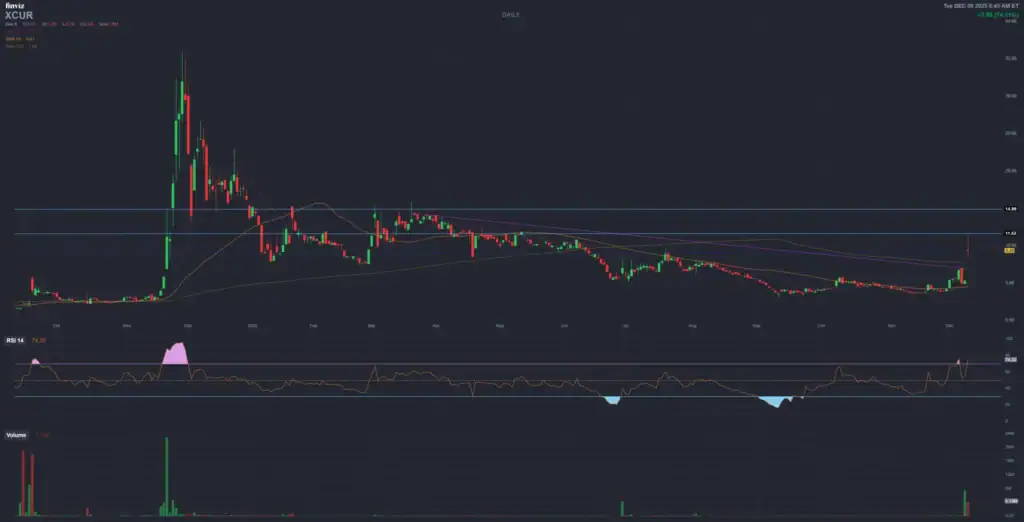
Merlintrader trading Blog – Biotech Deep Dive
Exicure Inc (XCUR)
Burixafor Phase 2 data at ASH 2025 versus a very thin balance sheet, high dilution risk and a binary path to any eventual approval.
Report date: December 9, 2025 – Data based on ASH 2025 communications and latest public financials. Numbers are approximate and for education only.
High-risk micro-cap – liquidity and dilution overhang
Binary regulatory and financing outcomes
Retail-focused educational research – no investment advice
Ticker / Exchange
XCUR – Nasdaq
Last price (close)
$5.33
After-hours move
$8.87 (+66.4%)
Market cap (approx)
$34M → $56.5M AH
Price and market-cap figures are indicative snapshot levels around the report date and can change very quickly in a name with this liquidity profile. Always check a real-time quote and official filings before making any decision.
Section 1
Executive summary
Exicure has repositioned itself around burixafor, a CXCR4 antagonist designed to mobilize hematopoietic progenitor cells (HPCs) for autologous stem-cell transplant in multiple myeloma and potentially other settings. At the ASH 2025 annual meeting, the company presented Phase 2 data showing high rates of successful HPC collection, including in daratumumab-exposed patients who are traditionally harder to mobilize.
On the scientific side, the data look competitive: 89.5 percent of patients achieved the primary collection endpoint, neutrophil and platelet engraftment times sit comfortably inside typical ranges, and no Grade 3 or higher adverse events were attributed to burixafor. Operationally, a same-day dosing and leukapheresis strategy could simplify hospital workflows versus the standard overnight plerixafor approach.
The problem is not the molecule; the problem is the capital structure. With around 4.4 million dollars of cash, an operating loss of roughly 2.4 million dollars per quarter and a going-concern warning, Exicure has less than two quarters of runway at current burn. A financing transaction is not an abstract risk; it is a central part of the story.
This report separates facts from interpretations: it walks through the ASH data, the stem-cell mobilization market, the competitive landscape, the balance sheet, dilution scenarios and a risk matrix, so that traders can frame their own view of risk and reward without relying on social-media narratives.
Section 2
ASH 2025 burixafor Phase 2 data
What was actually shown in Orlando, and how it compares with standard benchmarks.
| Endpoint | Result | Benchmark comment |
|---|---|---|
| Primary endpoint | 17/19 patients (89.5 percent) achieved ≥ 2×10⁶ CD34+ cells/kg | In line with or above typical CXCR4 antagonist performance, including challenging subgroups. |
| Daratumumab-treated cohort | 14/16 patients (87.5 percent) success | Strong signal in a population recognized as difficult to mobilize. |
| Combined daratumumab + lenalidomide | 12/14 patients (85.7 percent) success | Maintains high success despite dual prior therapy. |
| Neutrophil engraftment | Median 13 days | Standard range is roughly 11–15 days. |
| Platelet engraftment | Median 17.5 days | Standard range is roughly 14–21 days. |
| Safety profile | No Grade 3 or higher burixafor-related adverse events | Important qualitative differentiator versus some CXCR4-directed agents. |
| Operational design | Same-day dosing and leukapheresis | Contrasts with plerixafor use, which typically requires an overnight pre-treatment. |
From a pure data perspective, this is not a negative study. The main limitation is not the level of response achieved but the size of the trial (19 patients) and the open-label, non-comparative design, which may influence how regulators view the strength of evidence versus long-established standards.
Mechanistically, burixafor blocks the CXCR4 receptor on hematopoietic progenitor cells, mobilizing them from the bone marrow into peripheral blood. The concept is the same axis targeted by plerixafor, but with a pharmacokinetic profile focused on very rapid mobilization and same-day apheresis.
Investigators at ASH highlighted the practical implications of a same-day regimen: for patients, one trip rather than a two-day sequence; for centers, the potential to simplify scheduling and reduce the burden of overnight stays. Whether payers and transplant programs would view this as sufficient justification for a premium price or a change in protocol is still an open question.
Quote summaries from principal investigators emphasize the rapid peak in circulating HPC levels and the potential to improve the patient experience by compressing the mobilization process into a single day.
Section 3
Stem-cell mobilization market and CXCR4 competition
Market size and structure
Burixafor is being positioned primarily for autologous stem-cell transplant (ASCT) mobilization in multiple myeloma. Globally, there are on the order of fifty to sixty thousand ASCT procedures per year, with mobilization agents representing a several-billion-dollar addressable market when pricing and geographic differences are considered.
Within that broader space, CXCR4 antagonists constitute a growing subsegment with an estimated market of roughly 150–200 million dollars in the mid-2020s and a high-single-digit to low-double-digit annual growth rate as more centers adopt these agents and additional indications emerge.
| Segment | Estimate | Comment |
|---|---|---|
| ASCT procedures (global) | 50,000–60,000 per year | Primarily multiple myeloma, but also some lymphoma and related indications. |
| CXCR4 antagonist market | 150–250 million dollars mid-decade | Projected growth around 9 percent per year in some market analyses. |
| Revenue per mobilization course | 3,000–5,000 dollars per patient | Rough order-of-magnitude range, subject to payer and geography. |
Key competitors and differentiators
| Product | Company | Format / status | Position |
|---|---|---|---|
| Plerixafor (Mozobil) | Sanofi and generics | Subcutaneous, approved 2009 | Entrenched standard of care, with generic competition now present. |
| Generic plerixafor | Multiple generic firms | Subcutaneous, US/EU approvals 2023–2024 | Increases price pressure and raises the bar for premium positioning. |
| Mavorixafor | X4 Pharmaceuticals | Oral CXCR4 antagonist, recently approved in a different setting | Demonstrates the breadth of CXCR4 modulation but not a direct ASCT mobilization competitor yet. |
| Burixafor | Exicure | Intravenous, Phase 2 data presented at ASH 2025 | Same-day mobilization concept with promising results in difficult patients. |
On paper, burixafor offers a convenience and workflow story rather than a dramatic efficacy overhaul. That can still be important: hospital systems and patients notice the difference between one and two days of logistics. The challenge is that plerixafor is deeply embedded in protocols and now has generic versions, which limits the price premium that any new agent can realistically command.
Section 4
Burixafor peak-sales thinking and scenarios
Translating ASCT procedure counts and pricing into a revenue number requires strong assumptions about market share and adoption. A simplified framework, based on the ranges in your notes, looks roughly as follows:
| Scenario | Market share assumption | Peak sales range | High-level comment |
|---|---|---|---|
| Conservative | 15–20 percent of accessible CXCR4 cases | 25–50 million dollars | Burixafor finds a niche, particularly in difficult-to-mobilize patients, but adoption is constrained. |
| Base case | 20–30 percent share | 50–100 million dollars | Exicure achieves solid penetration and proves the operational benefits to payers and transplant centers. |
| Optimistic | 30–40 percent share | 100–150 million dollars | Burixafor becomes a go-to mobilizer in a meaningful slice of ASCT programs. |
| Downside | Less than 10 percent | Below 25 million dollars | Either regulatory hurdles, pricing pressure or competitive responses cap adoption. |
With an enterprise value in the tens of millions of dollars, even mid-range peak-sales scenarios can look attractive on paper. The key friction is not whether the science can justify 25–100 million dollars of sales eventually, but whether the company can reach that point without exhausting shareholders through repeated financings.
Section 5
Financial profile, cash runway and dilution mechanics
Why the balance sheet sits at the center of the XCUR story right now.
| Metric (Q3 2025) | Approximate value | Status |
|---|---|---|
| Cash and equivalents | 4.44 million dollars | Critical – very limited cushion versus operating needs. |
| Quarterly operating loss | 2.44 million dollars | Heavy for a company with no revenue and this cash level. |
| Quarterly burn rate (operating expenses) | About 2.39 million dollars | Implied runway roughly one and a half to two quarters. |
| Runway estimate | About 5–6 months from the September quarter | Points toward a Q1 2026 decision point. |
| Going-concern disclosure | Present | Management explicitly flags “substantial doubt” about ability to continue without new capital. |
The combination of low cash, meaningful quarterly burn and a going-concern statement is often what drives micro-cap biotech share prices more than clinical data in the short term. For any holder or trader, the timing and structure of the next equity raise is not a side detail; it is one of the main variables.
Illustrative dilution scenarios
The numbers below are not forecasts or recommendations; they are simple algebra, showing how different raise sizes and price levels affect share count and ownership. Exact figures depend on the current fully diluted share base and the terms of any future financing.
| Scenario | Raise size / price | New shares | Indicative dilution |
|---|---|---|---|
| Moderate raise | 30 million dollars at 5.50 dollars per share | About 5.45 million new shares | On the order of 80–90 percent increase in share count versus the current base. |
| Larger raise | 40 million dollars at 6.00 dollars per share | About 6.67 million new shares | On the order of 100 percent or more increase in share count. |
| Smaller but lower price | 25 million dollars at 4.50 dollars per share | About 5.55 million new shares | Similar dilution as the “moderate” scenario, with different cash outcome. |
Conceptually, the after-hours spike toward 8–9 dollars on the ASH news creates a window where selling new shares at a discount to that spike but a premium to pre-data levels is feasible. Many micro-cap biotechs in this situation choose to raise quickly after positive data; others try to wait and risk missing the window if the stock retraces.
Section 6
Key catalysts and 2025–2028 timeline
| Timing (indicative) | Event | Type | Potential impact |
|---|---|---|---|
| Q4 2025 / Q1 2026 | Financing transaction announcement | Financing | Highly likely, given runway; structure and pricing will influence near-term share price more than anything else. |
| Q1 2026 | Full Phase 2 data set publication | Clinical | Positive, clean data could support regulatory interactions; any new safety or efficacy issues would be a concern. |
| 2026 | Formal FDA feedback on development path (Phase 3 requirements, BLA design) | Regulatory | Determines whether the current data package can support an accelerated pathway or whether a larger controlled study is needed. |
| 2026–2027 | Start of additional trials in sickle cell disease, AML or cell/gene therapy support | Pipeline | Demonstrates platform breadth, but adds cost and complexity in a constrained cash environment. |
| 2027–2028 | Potential BLA filing and review for multiple myeloma mobilization | Regulatory | Binary long-term catalyst; timing depends heavily on whether a Phase 3 trial is requested. |
From a trading perspective, the near-term gravity points to financing and updated regulatory guidance rather than approval or launch, which remain several years away in most realistic scenarios.
Section 7
Risk matrix and red flags to monitor
| Risk | Type | Comment | Indicative level |
|---|---|---|---|
| Imminent financing and dilution | Financial | With roughly five to six months of cash, a capital raise is central to the story; terms will shape the equity case. | High |
| Regulatory evidence standard | Regulatory | Small, open-label Phase 2 with no head-to-head comparator may be viewed as insufficient, leading to Phase 3 requirements. | High |
| Market adoption versus entrenched plerixafor | Commercial | Payers and transplant centers may be slow to switch from established regimens, especially with generics now available. | Medium |
| Competition from other CXCR4 approaches | Competitive | Oral CXCR4 agents and other mobilization strategies could reduce the perceived need for an IV same-day option. | Medium |
| Going-concern and insolvency risk | Existential | If financing is delayed or fails, the company may be forced to halt programs or explore restructuring options. | High |
Section 8
Ownership structure and retail sentiment
Institutional and insider picture
According to recent public data, institutional ownership in XCUR is very low, in the low single-digit percentage range of the float. A handful of smaller funds and advisory firms hold positions, but there is no broad base of large, long-only institutions yet.
Short interest appears limited in absolute terms, with days-to-cover metrics that do not suggest a classic “crowded short” setup. In practice, the main risk is not a short squeeze scenario but rather a lack of deep pools of capital on either side of the tape, which contributes to sharp moves on relatively modest volume.
Low institutional penetration can cut both ways: it caps downside support today, but leaves theoretical room for future accumulation if the story is de-risked. That is a long path in a name with this balance sheet, and there is no guarantee it will happen.
Reddit, Stocktwits and X sentiment
Around the ASH data release, discussion on retail platforms has focused on two themes in parallel: the scientific excitement around the mobilization data, and the expectation of a financing transaction in the near term. That tension is typical for high-beta micro-cap biotech names.
Stocktwits: focus on ASH data, spike and placement risk
Reddit: mixed threads on science versus balance-sheet stress
X: coverage from a small number of biotech- and trading-focused accounts
Sentiment indicators here refer to discussions among non-professional traders and investors. They are useful to gauge crowd psychology but are not a substitute for regulatory review, formal valuation work or independent due diligence.
Section 9
Valuation lenses and scenario ranges (no recommendation)
With micro-caps like XCUR, formal discounted cash-flow work can give a sense of the implied probabilities in the current price, but the range of possible outcomes is very wide. The numbers in your notes correspond to a rough framing where:
- A high-end scenario with 120 million dollars of peak sales and high margins could, on paper, justify enterprise values in the 150–200 million dollar range, which equates to double-digit per-share levels.
- A mid-range scenario with 75 million dollars of peak sales and moderate dilution could support values closer to 70–90 million dollars of equity value, implying prices in the low double digits.
- A downside scenario where peak sales stay around 30 million dollars and financing becomes more difficult sits closer to 20–30 million dollars of equity value, which aligns with single-digit per-share levels.
In practice, the current price and the after-hours spike can be interpreted as the market putting some probability on successful approval and reasonable market share, and some probability on heavy dilution or failure. None of these brackets are guarantees; they are simply a way to see how sensitive the equity story is to both clinical and financing outcomes.
This section is not a rating, not a target-price service and not a suggestion to buy, sell, short or avoid any security. It is only an attempt to make the trade-off between science, market opportunity and capital structure more explicit.
Section 10
Bottom line for traders and longer-term investors
On the scientific and clinical side, burixafor has done what it needed to do at this stage: show that a same-day CXCR4 mobilization strategy can achieve high rates of successful CD34+ collection, even in patients exposed to daratumumab, with engraftment times within standard ranges and a clean safety profile in a small cohort.
On the business side, the situation is far more stressed. A cash position of roughly four and a half million dollars, a quarterly operating loss close to two and a half million dollars and a formal going-concern warning place financing risk front and center. A financing transaction that doubles the share count is not a remote tail risk; it is a realistic path, and its timing will shape the chart at least as much as any scientific update.
This is therefore not a “good versus bad data” story. It is a combination of promising science, a real commercial opportunity, and a capital structure that demands caution and careful sizing from anyone who chooses to get involved. The aim of this report is not to tell you what to do, but to make the trade-offs visible so that any decision you make is grounded in the underlying numbers and constraints rather than just in headlines or social-media enthusiasm.
Tools and partners
Research tools, platforms and support
- Finviz Elite – screeners, sector maps and intraday charts used to track XCUR and peer price action.
- ChartsWatcher – ChartsWatcher is a real-time, next-generation scanner for the US stock market.
- Seeking Alpha – fundamental articles, earnings call transcripts and quant metrics.
- Stocktwits – live sentiment and intraday crowd positioning on biotech tickers.
- Medved Trader – professional trading platform used for execution, depth and tape reading.
- Merlintrader trading Blog – home base for catalyst calendars, dashboards and future updates on names like XCUR.
Note on affiliate links: some of the tools above use referral links. If you decide to try them, a small commission may go to Merlintrader trading Blog at no extra cost to you. This does not change the independent and educational nature of the analysis.

If this type of long-form research helps you and you want to support the project, you can make a one-time donation via
PayPal. This helps keep the content free for everyone.
Sources and legal
Official sources and regulatory-style disclaimer
Main primary sources
- Exicure Inc. SEC filings on EDGAR (10-Q, 10-K and related corporate presentations).
- Company press releases and ASH 2025 communications regarding burixafor Phase 2 data.
- Scientific and conference materials on CXCR4 antagonists and stem-cell mobilization standards.
- Public market-data aggregators for price, volume, ownership and short-interest metrics.
Only primary or high-quality institutional sources have been used as the backbone for this report. No figures have been taken from anonymous blogs or unverified message-board posts. All numbers should still be verified directly from official documents before use in any decision process.
Disclaimer (CONSOB / SEC aligned spirit)
This document is provided exclusively for educational and informational purposes. It does not constitute, and must not be interpreted as, an offer, solicitation, recommendation or advice to buy or sell any financial instrument or to engage in any investment strategy. The author is not a licensed financial advisor, portfolio manager, broker or research analyst under the rules of CONSOB, the SEC or any other regulator.
All opinions expressed here are personal interpretations of publicly available data and may be wrong, incomplete or out of date. Biotech and healthcare equities, especially small-cap names around binary clinical or regulatory events, are highly volatile and can result in a total loss of capital. Anyone reading this must perform their own independent research, verify all numbers directly from official filings and company documents, and consult qualified professionals where appropriate before taking any investment decision.
All opinions expressed here are personal interpretations of publicly available data and may be wrong, incomplete or out of date. Biotech and healthcare equities, especially small-cap names around binary clinical or regulatory events, are highly volatile and can result in a total loss of capital. Anyone reading this must perform their own independent research, verify all numbers directly from official filings and company documents, and consult qualified professionals where appropriate before taking any investment decision.
Authors
About the author and methodology

Language: EN content only in this version.
Addendum
Verified facts vs analytical scenarios
Important clarification:
All clinical data, financial figures, cash metrics, operational disclosures and risk statements referenced in this report are based exclusively on verified primary sources such as SEC filings, official corporate press releases, and ASH 2025 conference materials.
All valuation frameworks, dilution models, probability estimates, fair value ranges and scenario analyses included in this document are hypothetical and represent analytical modelling only. These models are not official company guidance, not analyst consensus and must not be interpreted as predictive factual statements.
All clinical data, financial figures, cash metrics, operational disclosures and risk statements referenced in this report are based exclusively on verified primary sources such as SEC filings, official corporate press releases, and ASH 2025 conference materials.
All valuation frameworks, dilution models, probability estimates, fair value ranges and scenario analyses included in this document are hypothetical and represent analytical modelling only. These models are not official company guidance, not analyst consensus and must not be interpreted as predictive factual statements.
Addendum
Extended legal notice (SEC + CONSOB aligned)
Projections, dilution scenarios, valuation ranges and probability estimates presented
in this document are hypothetical and provided solely for educational and informational
purposes. These analytical assumptions do not constitute:
• investment advice
• recommendations
• forward-looking statements endorsed by the company
• or guaranteed financial outcomes
Readers must base any financial or investment decisions exclusively on official documentation (SEC filings, audited financial statements, corporate disclosures and regulatory submissions) and, where necessary, consult qualified professionals. This addendum supplements and strengthens all existing disclaimers to ensure full alignment with both SEC and CONSOB regulatory expectations.
• investment advice
• recommendations
• forward-looking statements endorsed by the company
• or guaranteed financial outcomes
Readers must base any financial or investment decisions exclusively on official documentation (SEC filings, audited financial statements, corporate disclosures and regulatory submissions) and, where necessary, consult qualified professionals. This addendum supplements and strengthens all existing disclaimers to ensure full alignment with both SEC and CONSOB regulatory expectations.
Scanner for active traders

Try ChartsWatcher free, then unlock 10% OFF with SAVE10
ChartsWatcher is a real-time scanner for momentum traders: fast movers, unusual volume and rotations — so you can focus on the few tickers that matter right now, instead of watching hundreds of charts.
Start with the free version. When you upgrade, use SAVE10 for 10% OFF your first paid period.
Start free – then use SAVE10
No credit card required to start. Apply SAVE10 when upgrading.
Recommended platform

One platform. All your brokers.
Medved Trader connects multiple brokers in one workspace, with pro charts, hotkeys and fast execution — without changing your broker accounts.
A single cockpit for positions, Level II and multi-broker order routing, built for active day & swing traders.
Get 1 Month Free ➔
Multi-broker workflow + customizable layouts in one platform.
 Monica.im – the AI assistant I use every day
If you find value in the work I publish on Merlintrader and want a practical AI assistant for research and writing, you can sign up using this referral link. Click here to try Monica.im and support the site
Find out how I use AI on Merlintrader: AI, retail and Merlintrader
Disclosure: some of the links in the promotional blocks above are affiliate or referral links. If you choose to subscribe or sign up through them, Merlintrader may receive a small commission or benefit at no extra cost to you.
