DISCLAIMER — Not financial advice. Educational content only, not an offer or solicitation to buy or sell any security. Biotech and small/mid-cap stocks are highly speculative and volatile and can result in a partial or total loss of capital. Do your own research and consult a licensed advisor where appropriate. / Contenuti a solo scopo informativo e didattico, non costituiscono consulenza finanziaria né offerta o sollecitazione al pubblico risparmio ai sensi delle normative CONSOB e SEC. Le azioni biotech e le small/mid cap sono strumenti altamente speculativi e volatili e possono comportare la perdita parziale o totale del capitale investito. Si raccomanda di effettuare sempre le proprie ricerche e, se necessario, di rivolgersi a un consulente abilitato.

Merlintrader Trading Pub
Biotech catalyst news and analysis. FDA PDUFA tracker
Merlintrader Trading Pub
Biotech catalyst news and analysis. FDA PDUFA tracker
EN
IT
Fulcrum Therapeutics (FULC) – Pociredir in Sickle Cell Disease Deep Dive (December 2025)
0. Executive Summary and Quick Profile
0.1 High-level takeaway
Fulcrum Therapeutics, Inc. (NASDAQ: FULC) is a clinical-stage biopharma company focused on small-molecule treatments for rare genetic diseases. After discontinuing losmapimod in FSHD in 2024, the company’s value is now concentrated primarily on pociredir, an oral fetal hemoglobin (HbF) inducer for sickle cell disease (SCD). This report summarizes the clinical, regulatory, financial and competitive status of the company, integrating recent information from SEC filings, company press releases and market sources.
The key investment driver is whether pociredir can deliver a combination of robust HbF induction, meaningful reduction in vaso-occlusive crises (VOC) and an acceptable long-term safety profile in a landscape reshaped by the withdrawal of voxelotor and the practical limitations of ex vivo gene therapies.
0.2 Snapshot (non-investment, factual only)
Ticker: FULC (NASDAQ) Stage: Phase 1b (pociredir in SCD)
- Main program: pociredir (FTX-6058), oral EED/PRC2 inhibitor, HbF inducer for sickle cell disease.
- Secondary assets: early-stage hematology programs (CAMP4 license, inherited aplastic anemias), losmapimod discontinued in FSHD.
- Cash and equivalents around 200–225 million USD across 1Q–3Q 2025, with management guiding a runway to 2028 under current plans.
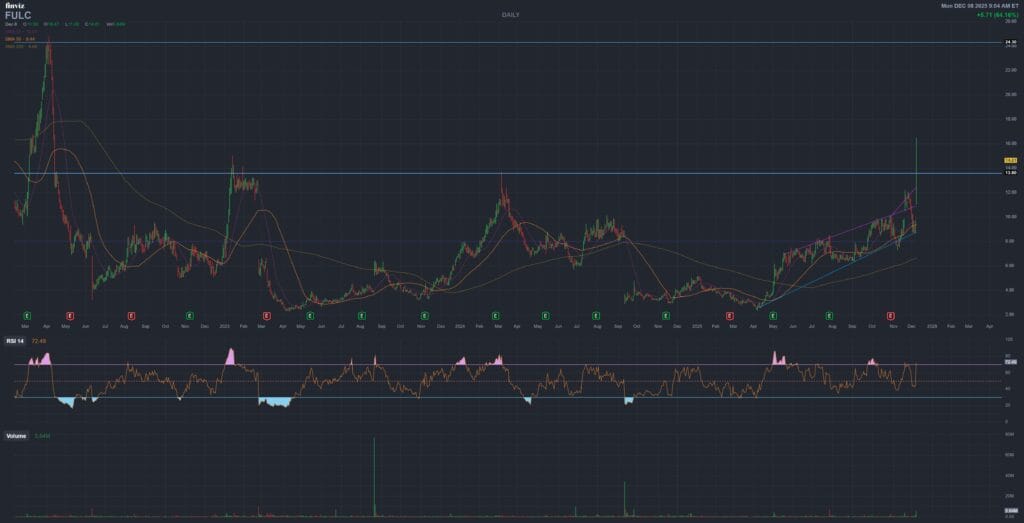
- Market capitalization roughly 480 million USD around the time of 20 mg data release; share price reaction indicated a move above 15 USD in pre-market/after-hours trading.
- Clinical risk is highly concentrated on a single late-stage asset; long-term epigenetic safety remains a critical open question.
1. Company Profile and Pipeline
1.1 Business overview
Facts
– Fulcrum is a clinical-stage biopharma company developing small molecules for rare genetic diseases in areas of high unmet need.
– The 2023 Form 10-K and subsequent 10-Qs indicate two main assets in the pipeline: losmapimod (FSHD, now discontinued) and pociredir (SCD).
– The company is classified as a “smaller reporting company”, with accumulated losses exceeding 500 million USD and no approved products.
– Starting from 2024–2025 Fulcrum has realigned its strategy, concentrating resources on pociredir and on preclinical hematology programs (for example inherited aplastic anemias).
– Fulcrum is a clinical-stage biopharma company developing small molecules for rare genetic diseases in areas of high unmet need.
– The 2023 Form 10-K and subsequent 10-Qs indicate two main assets in the pipeline: losmapimod (FSHD, now discontinued) and pociredir (SCD).
– The company is classified as a “smaller reporting company”, with accumulated losses exceeding 500 million USD and no approved products.
– Starting from 2024–2025 Fulcrum has realigned its strategy, concentrating resources on pociredir and on preclinical hematology programs (for example inherited aplastic anemias).
Analyst view
The shift from a dual-asset model (FSHD + SCD) to a single-asset profile centered on pociredir increases leverage on that one program but makes the investment case more linear. The focus on hematology, where endpoints such as HbF and VOC rates are relatively well established, is consistent with an attempt to maximize the value of the company’s epigenetic modulation platform.
The shift from a dual-asset model (FSHD + SCD) to a single-asset profile centered on pociredir increases leverage on that one program but makes the investment case more linear. The focus on hematology, where endpoints such as HbF and VOC rates are relatively well established, is consistent with an attempt to maximize the value of the company’s epigenetic modulation platform.
1.2 Pipeline overview
| Program | Target / Mechanism | Indication | Clinical stage | Status |
|---|---|---|---|---|
| Pociredir (FTX-6058) | EED / PRC2 inhibitor, HbF inducer | Sickle Cell Disease (SCD) | Phase 1b (PIONEER study) | 12 mg and 20 mg cohorts completed, end-of-phase meeting with FDA in preparation |
| CAMP4 preclinical programs | Transcriptional modulation (CAMP4 license) | Inherited aplastic anemias (DBA, SDS, Fanconi) | Preclinical | IND for DBA tentatively expected around 4Q25 |
| Losmapimod | p38α/β inhibitor | FSHD | Phase 3 REACH (failed) | Program discontinued after failure to meet endpoints |
2. Pociredir in SCD – Rationale and Clinical Data
2.1 Mechanism of action and biological rationale
Facts
– Pociredir is an oral inhibitor of EED, a subunit of the Polycomb Repressive Complex 2 (PRC2).
– Inhibition of EED reduces H3K27 methylation and leads to downregulation of BCL11A and other fetal hemoglobin repressors, resulting in increased HbF expression.
– In vitro and healthy volunteer studies have shown a dose-dependent increase in HbF mRNA and protein with daily doses between 2 and 20 mg.
– Pociredir has received Fast Track and Orphan Drug Designation from the FDA for the treatment of SCD.
– Pociredir is an oral inhibitor of EED, a subunit of the Polycomb Repressive Complex 2 (PRC2).
– Inhibition of EED reduces H3K27 methylation and leads to downregulation of BCL11A and other fetal hemoglobin repressors, resulting in increased HbF expression.
– In vitro and healthy volunteer studies have shown a dose-dependent increase in HbF mRNA and protein with daily doses between 2 and 20 mg.
– Pociredir has received Fast Track and Orphan Drug Designation from the FDA for the treatment of SCD.
Analyst view
Reactivating HbF is one of the most strongly validated strategies in SCD, supported by epidemiological evidence and gene therapy data linking HbF levels ≥20% and pancellular distribution to marked reductions in VOC and organ complications. An oral agent capable of achieving such levels in a meaningful fraction of patients could represent a paradigm shift relative to hydroxyurea and injectable therapies.
Reactivating HbF is one of the most strongly validated strategies in SCD, supported by epidemiological evidence and gene therapy data linking HbF levels ≥20% and pancellular distribution to marked reductions in VOC and organ complications. An oral agent capable of achieving such levels in a meaningful fraction of patients could represent a paradigm shift relative to hydroxyurea and injectable therapies.
2.2 PIONEER Phase 1b – Study design and regulatory history
Facts
– PIONEER is a Phase 1b, open-label, dose-escalation study in adults (18–65 years) with severe SCD, often not candidates for hydroxyurea.
– Cohorts evaluated: 2 mg, 6 mg, 12 mg and 20 mg once daily, with exposure up to 12 weeks.
– In 2023 the FDA placed a full clinical hold on the pociredir SCD IND due to concerns related to preclinical data and the PRC2 class; the hold was lifted after protocol adjustments (stricter inclusion criteria, exclusion of higher-risk categories and intensified hematologic monitoring).
– To date pociredir has been administered to a total of 148 adults (103 healthy volunteers and 45 SCD patients) for up to 12 weeks, with no serious adverse events considered related to treatment.
– PIONEER is a Phase 1b, open-label, dose-escalation study in adults (18–65 years) with severe SCD, often not candidates for hydroxyurea.
– Cohorts evaluated: 2 mg, 6 mg, 12 mg and 20 mg once daily, with exposure up to 12 weeks.
– In 2023 the FDA placed a full clinical hold on the pociredir SCD IND due to concerns related to preclinical data and the PRC2 class; the hold was lifted after protocol adjustments (stricter inclusion criteria, exclusion of higher-risk categories and intensified hematologic monitoring).
– To date pociredir has been administered to a total of 148 adults (103 healthy volunteers and 45 SCD patients) for up to 12 weeks, with no serious adverse events considered related to treatment.
Analyst view
Clearance of the clinical hold, together with a favorable safety profile in the 12 mg and 20 mg datasets, significantly de-risks PRC2 class concerns. However, key questions remain around long-term safety, which will need to be addressed through multi-year open-label extensions and a robust pharmacovigilance framework during the registration phase and beyond.
Clearance of the clinical hold, together with a favorable safety profile in the 12 mg and 20 mg datasets, significantly de-risks PRC2 class concerns. However, key questions remain around long-term safety, which will need to be addressed through multi-year open-label extensions and a robust pharmacovigilance framework during the registration phase and beyond.
2.3 12 mg cohort data
Facts
– Dose: 12 mg once daily for 12 weeks (n ≈ 12 patients).
– Absolute HbF: mean increase of about 8.6 percentage points at 12 weeks; approximately 44% of patients reached HbF ≥20%.
– F-cells: about 67% on average, indicating an initial distribution across a large fraction of erythrocytes.
– Markers of hemolysis and erythropoiesis: LDH −28%, indirect bilirubin −37%, reticulocytes −33%, total Hb +0.9 g/dL at 12 weeks.
– VOC: trend toward reduction relative to the pre-study period, although VOC were not prespecified endpoints and were not adjudicated.
– Safety: no treatment-related SAEs, no treatment discontinuations; treatment-related AEs were at most Grade 1 in severity.
– Dose: 12 mg once daily for 12 weeks (n ≈ 12 patients).
– Absolute HbF: mean increase of about 8.6 percentage points at 12 weeks; approximately 44% of patients reached HbF ≥20%.
– F-cells: about 67% on average, indicating an initial distribution across a large fraction of erythrocytes.
– Markers of hemolysis and erythropoiesis: LDH −28%, indirect bilirubin −37%, reticulocytes −33%, total Hb +0.9 g/dL at 12 weeks.
– VOC: trend toward reduction relative to the pre-study period, although VOC were not prespecified endpoints and were not adjudicated.
– Safety: no treatment-related SAEs, no treatment discontinuations; treatment-related AEs were at most Grade 1 in severity.
Analyst view
The 12 mg cohort delivered a solid proof-of-concept signal: significant HbF increases, improvements in hemolysis and anemia biomarkers, and a trend toward fewer VOC, with a very acceptable tolerability profile. However, the proportion of patients reaching HbF ≥20% suggested room for dose-dependent improvement, which was explored in the 20 mg cohort.
The 12 mg cohort delivered a solid proof-of-concept signal: significant HbF increases, improvements in hemolysis and anemia biomarkers, and a trend toward fewer VOC, with a very acceptable tolerability profile. However, the proportion of patients reaching HbF ≥20% suggested room for dose-dependent improvement, which was explored in the 20 mg cohort.
2.4 20 mg cohort data (ASH 2025)
Facts
– Dose: 20 mg once daily; 13 patients enrolled, 12 evaluable for pharmacodynamic analyses.
– At 6 weeks (day 42): mean absolute HbF increase of 9.9 percentage points, with mean HbF levels around 16.9%; all patients had increases ≥6.5 percentage points.
– 58% of patients (7 out of 12) reached HbF ≥20% as early as week 6, outperforming the 12 mg cohort at week 12.
– Among the first 6 patients completing 12 weeks, mean HbF fold induction exceeded 3.75x versus baseline, compared with 2.4x in the 12 mg cohort.
– F-cells increased on average from 31% to 58% at week 6, indicating broad pancellular distribution.
– Hemolysis markers: indirect bilirubin −37%, LDH −37%, reticulocytes −33%, RDW −22%.
– Total hemoglobin: +0.8 g/dL at week 6, with no transfused patients (unlike the 12 mg cohort, which included two transfused subjects).
– VOC: historical data suggested around 16 VOC events would be expected in the observed period; 5 VOC were recorded across 4 patients, with 8 out of 12 patients (67%) experiencing no VOC during treatment.
– Safety: no DLTs, no permanent treatment discontinuations; one case of reticulocytopenia in a patient with Parvo B19 infection and concomitant antibiotics, resolving after temporary interruption and re-initiation of treatment; no drug-related SAEs.
– Dose: 20 mg once daily; 13 patients enrolled, 12 evaluable for pharmacodynamic analyses.
– At 6 weeks (day 42): mean absolute HbF increase of 9.9 percentage points, with mean HbF levels around 16.9%; all patients had increases ≥6.5 percentage points.
– 58% of patients (7 out of 12) reached HbF ≥20% as early as week 6, outperforming the 12 mg cohort at week 12.
– Among the first 6 patients completing 12 weeks, mean HbF fold induction exceeded 3.75x versus baseline, compared with 2.4x in the 12 mg cohort.
– F-cells increased on average from 31% to 58% at week 6, indicating broad pancellular distribution.
– Hemolysis markers: indirect bilirubin −37%, LDH −37%, reticulocytes −33%, RDW −22%.
– Total hemoglobin: +0.8 g/dL at week 6, with no transfused patients (unlike the 12 mg cohort, which included two transfused subjects).
– VOC: historical data suggested around 16 VOC events would be expected in the observed period; 5 VOC were recorded across 4 patients, with 8 out of 12 patients (67%) experiencing no VOC during treatment.
– Safety: no DLTs, no permanent treatment discontinuations; one case of reticulocytopenia in a patient with Parvo B19 infection and concomitant antibiotics, resolving after temporary interruption and re-initiation of treatment; no drug-related SAEs.
Analyst view
Moving to 20 mg demonstrated a clear dose–response gradient, achieving HbF levels and degrees of pancellularity that may approach a “functional cure” profile in a subset of patients, without new short-term toxicity signals. The apparent reduction in VOC versus expected events, though based on small numbers and without adjudicated endpoints, is strongly encouraging and supports the launch of a registrational study centered on hard clinical endpoints (annual VOC rate, hospitalization days, hemolysis parameters).
Moving to 20 mg demonstrated a clear dose–response gradient, achieving HbF levels and degrees of pancellularity that may approach a “functional cure” profile in a subset of patients, without new short-term toxicity signals. The apparent reduction in VOC versus expected events, though based on small numbers and without adjudicated endpoints, is strongly encouraging and supports the launch of a registrational study centered on hard clinical endpoints (annual VOC rate, hospitalization days, hemolysis parameters).
3. Competitive Landscape in SCD and Pociredir Positioning
3.1 Standard of care and competing therapies
Facts
– Standard SCD treatment includes hydroxyurea, chronic transfusions and management of complications.
– Voxelotor (Oxbryta) was withdrawn globally in 2024 for an unfavorable benefit–risk profile (increased VOC and fatal events).
– Crizanlizumab delivered negative results in confirmatory studies, with weak commercial uptake.
– Ex vivo gene therapies (for example Casgevy, Lyfgenia) show high efficacy but are constrained by costs, need for transplant/autotransplant and long-term risks, making them difficult to scale globally.
– Emerging programs include gene editing (EDIT-301), modulation of inflammatory pathways and novel combination regimens.
– Standard SCD treatment includes hydroxyurea, chronic transfusions and management of complications.
– Voxelotor (Oxbryta) was withdrawn globally in 2024 for an unfavorable benefit–risk profile (increased VOC and fatal events).
– Crizanlizumab delivered negative results in confirmatory studies, with weak commercial uptake.
– Ex vivo gene therapies (for example Casgevy, Lyfgenia) show high efficacy but are constrained by costs, need for transplant/autotransplant and long-term risks, making them difficult to scale globally.
– Emerging programs include gene editing (EDIT-301), modulation of inflammatory pathways and novel combination regimens.
Analyst view
The withdrawal of voxelotor and the commercial weakness of crizanlizumab have reopened space for a new oral therapy with a compelling benefit–risk profile. Gene therapies will likely serve only a minority of SCD patients, leaving a large population in need of a scalable oral treatment. In this context, if pociredir confirms in registrational studies a mix of efficacy on HbF/VOC and tolerability, it has the potential to become a standard of care in more severe cohorts and then expand into broader populations.
The withdrawal of voxelotor and the commercial weakness of crizanlizumab have reopened space for a new oral therapy with a compelling benefit–risk profile. Gene therapies will likely serve only a minority of SCD patients, leaving a large population in need of a scalable oral treatment. In this context, if pociredir confirms in registrational studies a mix of efficacy on HbF/VOC and tolerability, it has the potential to become a standard of care in more severe cohorts and then expand into broader populations.
3.2 Potential competitive advantages of pociredir
| Parameter | Pociredir (20 mg) | Hydroxyurea / traditional SOC | Gene therapy (e.g. Casgevy) |
|---|---|---|---|
| Route of administration | Oral, once daily | Oral | One-time infusion, with conditioning |
| Main mechanism | HbF increase via EED/PRC2 inhibition | HbF increase, multiple mechanisms | HbF increase or HbS correction via gene editing/gene insertion |
| Expected HbF levels | ≥20% in ~60% of patients at 6 weeks (Phase 1b) | Variable, often lower | Very high, often in a “curative” range |
| Scalability | High, potentially global | High | Limited to highly specialized centers |
| Key risks | Long-term epigenetic risk (PRC2), need for prolonged follow-up | Myelosuppression, long-term toxicity | Conditioning toxicity, malignancy risk, rare and unpredictable events |
4. Financial Profile and Capital Structure
4.1 Balance sheet and income statement
Facts
– As of March 31, 2025, Fulcrum reported about 42 million USD in cash and 184 million USD in marketable securities, for total liquidity of approximately 227 million USD.
– Total assets stood at 243 million USD, total liabilities at 14 million USD and shareholders’ equity at 228 million USD.
– The 1Q25 quarter showed R&D expenses of 13.4 million USD and G&A of 7.0 million USD, with a net loss of 17.7 million USD.
– 2Q25 confirmed R&D around 13 million USD and further reductions in G&A, with total liquidity of about 214 million USD as of June 30, 2025.
– 3Q25 closed with 200.6 million USD in cash and equivalents, R&D 14.3 million USD, G&A 7.6 million USD and a net loss of 19.6 million USD.
– Management guides to a “cash runway” through 2028 based on current plans.
– As of March 31, 2025, Fulcrum reported about 42 million USD in cash and 184 million USD in marketable securities, for total liquidity of approximately 227 million USD.
– Total assets stood at 243 million USD, total liabilities at 14 million USD and shareholders’ equity at 228 million USD.
– The 1Q25 quarter showed R&D expenses of 13.4 million USD and G&A of 7.0 million USD, with a net loss of 17.7 million USD.
– 2Q25 confirmed R&D around 13 million USD and further reductions in G&A, with total liquidity of about 214 million USD as of June 30, 2025.
– 3Q25 closed with 200.6 million USD in cash and equivalents, R&D 14.3 million USD, G&A 7.6 million USD and a net loss of 19.6 million USD.
– Management guides to a “cash runway” through 2028 based on current plans.
Analyst view
A quarterly burn rate in the 17–20 million USD range, combined with cost reductions following the losmapimod discontinuation and proceeds from previous collaborations, makes a multi-year runway credible, covering the execution of the main registrational studies for pociredir. It is still likely that, in the event of positive late-stage study outcomes, the company will turn to additional equity raises or strategic partnerships to finance commercialization and post-marketing commitments.
A quarterly burn rate in the 17–20 million USD range, combined with cost reductions following the losmapimod discontinuation and proceeds from previous collaborations, makes a multi-year runway credible, covering the execution of the main registrational studies for pociredir. It is still likely that, in the event of positive late-stage study outcomes, the company will turn to additional equity raises or strategic partnerships to finance commercialization and post-marketing commitments.
4.2 Market valuation and stock behavior
Facts
– In the two weeks preceding the release of 20 mg data, FULC shares corrected from above 11.5 USD to the 8.7–9 USD range.
– Market capitalization sits around 480 million USD, with a negative P/E ratio and no dividend.
– Following the announcement of 20 mg cohort results, the stock experienced a strong move in pre-market/after-hours trading, with indications of prices above 15 USD (roughly +70% versus the prior close).
– Sentiment on financial social platforms (Stocktwits, Reddit) is predominantly bullish in the short term, with discussions centered on potential squeeze dynamics and the strategic value of pociredir in the SCD landscape.
– In the two weeks preceding the release of 20 mg data, FULC shares corrected from above 11.5 USD to the 8.7–9 USD range.
– Market capitalization sits around 480 million USD, with a negative P/E ratio and no dividend.
– Following the announcement of 20 mg cohort results, the stock experienced a strong move in pre-market/after-hours trading, with indications of prices above 15 USD (roughly +70% versus the prior close).
– Sentiment on financial social platforms (Stocktwits, Reddit) is predominantly bullish in the short term, with discussions centered on potential squeeze dynamics and the strategic value of pociredir in the SCD landscape.
Analyst view
The market reaction is consistent with a major clinical de-risking event, but the current valuation does not fully price multi-billion-dollar peak sales scenarios. At the same time, the high dependence on a single asset and the non-trivial risk of failure in later-stage development justify a cautious assessment of the risk/reward balance, suitable only for investors with a long-term horizon and tolerance for high volatility.
The market reaction is consistent with a major clinical de-risking event, but the current valuation does not fully price multi-billion-dollar peak sales scenarios. At the same time, the high dependence on a single asset and the non-trivial risk of failure in later-stage development justify a cautious assessment of the risk/reward balance, suitable only for investors with a long-term horizon and tolerance for high volatility.
5. Governance, Shareholding and Compliance
5.1 Governance and management
Facts
– Fulcrum restructured governance and management after the losmapimod failure, with a new focus on SCD.
– The board includes individuals with significant experience in rare diseases and clinical development of hematology drugs.
– Corporate communications (SEC filings, press releases) have described both setbacks (REACH) and pociredir progress in a relatively transparent way.
– Fulcrum restructured governance and management after the losmapimod failure, with a new focus on SCD.
– The board includes individuals with significant experience in rare diseases and clinical development of hematology drugs.
– Corporate communications (SEC filings, press releases) have described both setbacks (REACH) and pociredir progress in a relatively transparent way.
Analyst view
Governance’s reaction to the losmapimod failure (program termination, resource realignment, new focused strategy) is a positive sign of capital allocation discipline. Management’s credibility remains tied to execution in the registrational phase of pociredir and to the ability to shape industrial partnerships that maximize value for shareholders.
Governance’s reaction to the losmapimod failure (program termination, resource realignment, new focused strategy) is a positive sign of capital allocation discipline. Management’s credibility remains tied to execution in the registrational phase of pociredir and to the ability to shape industrial partnerships that maximize value for shareholders.
5.2 Shareholding structure and insider transactions
Facts
– 13G/13D filings show the presence of significant institutional investors (for example RA Capital, BlackRock, Vanguard and other specialist biotech funds).
– The recent insider trading history mostly reflects scheduled sales under 10b5-1 plans and movements linked to stock options, without anomalous patterns in recent months.
– 13G/13D filings show the presence of significant institutional investors (for example RA Capital, BlackRock, Vanguard and other specialist biotech funds).
– The recent insider trading history mostly reflects scheduled sales under 10b5-1 plans and movements linked to stock options, without anomalous patterns in recent months.
Analyst view
The presence of specialized institutional investors supports access to capital and reduces governance risk. The absence of “aggressive” insider selling around key events is consistent with an alignment of interests between management and shareholders, although it does not eliminate the intrinsic risk of early-stage biotech investing.
The presence of specialized institutional investors supports access to capital and reduces governance risk. The absence of “aggressive” insider selling around key events is consistent with an alignment of interests between management and shareholders, although it does not eliminate the intrinsic risk of early-stage biotech investing.
6. Main Risk Factors (Investor-Oriented View, Not Investment Advice)
6.1 Clinical development and regulatory risk
- Single-asset risk: failure of pociredir in registrational studies would substantially impair the standalone value of the company.
- Endpoints: translating biological metrics (HbF, F-cells, hemolysis biomarkers) into recognized clinical endpoints (VOC rate, quality of life, complication-free survival) will be crucial for approval.
- Clinical hold history: although lifted, the previous FDA clinical hold on pociredir increases regulatory scrutiny and the risk of requests for additional data.
6.2 Long-term safety risk
- EED/PRC2 is a central epigenetic node; chronic exposure could theoretically be associated with risks of hematologic malignancies or altered hematopoietic stem cell function.
- Current data cover exposures up to three months; long-term extension studies and dedicated pharmacovigilance registries will be required.
6.3 Financial risk
- The company is structurally loss-making and depends on risk capital and equity markets to finance its pipeline.
- Even with a multi-year runway, delays in studies or an expanded development perimeter could force new capital raises under less favorable market conditions.
6.4 Competitive and market risk
- The rapidly evolving SCD landscape (new therapies, combinations, gene editing) could reduce the addressable market for pociredir.
- Pricing and access in low-income markets (for example Africa, India) will be critical for global penetration; regulatory pressure on pricing could compress margins.
7. Operational Conclusions and Color-Coded Summary
In conclusion, Fulcrum Therapeutics is at an inflection point: on the one hand, the stock still reflects the memory of the losmapimod failure; on the other, new pociredir data at the 20 mg dose show transformative potential in SCD, with an efficacy and safety profile that, if confirmed, could position the molecule as an oral standard of care in a context of significant global unmet need.
GREEN – strengths: significant clinical de-risking from PIONEER 12 mg and 20 mg results; competitive HbF induction profile, consistent improvements in hemolysis markers and a tendency toward fewer VOC; solid cash position and multi-year runway; competitive window opened by voxelotor’s withdrawal and by the scalability limits of gene therapies.
YELLOW – elements to monitor: definition with the FDA of the registrational pathway and endpoints; confirmation of tolerability with longer exposures and in broader populations (including pediatric patients); evolution of the competitive and regulatory environment in SCD.
RED – risks: almost complete dependence on a single asset; uncertainty around long-term epigenetic safety; probability of future equity dilution; risk that registrational studies fail, potentially leaving Fulcrum as a near “cash-box” profile.
For an investor with a multi-year horizon and tolerance for the high volatility typical of high-beta biotech names, FULC is a high-risk situation with significant upside potential in the event of regulatory and commercial success for pociredir. This is an educational assessment, not a recommendation to buy or sell the stock.
8. Bull vs Bear Framework (Educational Only)
Bull case (optimistic scenario)
- Registrational trials confirm 20 mg-level HbF induction and pancellular distribution, with robust reductions in adjudicated VOC and hospitalization metrics.
- Long-term safety monitoring does not reveal meaningful PRC2-related toxicity signals over several years of exposure.
- Pociredir secures a label positioning it as a foundational oral therapy, either as monotherapy or in combination with hydroxyurea or other agents.
- Global adoption in severe SCD cohorts, with later expansion to broader populations, drives multi-billion USD peak sales potential.
- Fulcrum signs a major global commercial partnership or becomes a takeover candidate for a large hematology/rare disease franchise.
Bear case (pessimistic scenario)
- Registrational trials fail to translate biomarker gains (HbF, F-cells, hemolysis markers) into clear clinical benefits on VOC and long-term outcomes.
- Signals emerge suggesting increased long-term risk of hematologic malignancies or other epigenetic toxicities, leading to label restrictions or development setbacks.
- Competitive dynamics shift rapidly due to new gene editing or combination approaches, compressing pociredir’s addressable market.
- Cash runway is consumed without a clear path to approval, forcing dilutive financings at low valuations.
- The company ends up trading close to net cash, with limited strategic options beyond asset sales or liquidation.
Base-case considerations
A neutral or “base-case” view typically assumes that pociredir continues to show strong biomarker performance but faces a more nuanced regulatory and competitive path, with smaller-than-bull-case market penetration and ongoing debate around long-term safety. In such a framework, valuation becomes highly sensitive to assumptions on peak sales, duration of therapy, and risk-adjusted discounting. Again, this is a conceptual framework only and not investment advice.
9. Retail and Market Sentiment (Stocktwits, Reddit, X)
Recent discussions around FULC and pociredir on Stocktwits, Reddit and X (Twitter) have been predominantly bullish in the short term, especially after the 20 mg data, with many retail traders focusing on:
- the proportion of patients reaching HbF ≥20% and the idea of a possible “functional cure” profile for a subset of SCD patients;
- the perceived gap left in the oral treatment space after voxelotor’s withdrawal;
- speculation around potential short squeezes and strategic interest from larger hematology players.
At the same time, more cautious voices highlight:
- uncertainty around long-term PRC2-related safety and possible class effects not yet visible in short Phase 1b exposures;
- the single-asset nature of the story, with limited diversification if pociredir encounters setbacks;
- the still preliminary nature of the data set and the distance to full approval and commercialization.
All of these comments come from non-professional traders and should be interpreted strictly as raw sentiment, not as research, due diligence or investment advice.
10. Sources and Useful Tools
Core sources used for this report include:
- Fulcrum Therapeutics SEC filings: Form 10-K 2023; Forms 10-Q 1Q25, 2Q25, 3Q25.
- Company press releases and presentations related to pociredir and the PIONEER Phase 1b study.
- Hematology conference materials and abstracts (including ASH 2025 pociredir updates where available).
- Standard hematology and SCD literature regarding HbF biology, VOC outcomes and gene therapy benchmarks.
Finviz – FULC overview
Technicals, chart, valuation metrics and institutional ownership snapshot.
Seeking Alpha – FULC research

Earnings transcripts, articles and valuation debates around Fulcrum Therapeutics and the SCD space.
Stocktwits – FULC sentiment

Real-time retail sentiment and message flow around FULC and SCD catalysts.
ChartsWatcher – Catalyst scanner
Visual tools for catalyst timelines, price action and pattern recognition across biotech names.
Medved Trader – Trading platform
Advanced trading and charting platform frequently used for intraday monitoring of biotech movers.
11. Support Merlintrader trading Blog
Support Merlintrader – keep the research free for everyone


If this report helped you better understand the risk and opportunity profile of Fulcrum Therapeutics and pociredir in SCD, you can support the project with a small one-time donation. This helps keep the site ad-light and the content free for everyone.
Donate via PayPal12. Author Note
Global disclaimer (educational content, not investment advice)
This report is for informational and educational purposes only. It is not, and must not be interpreted as, a solicitation or recommendation to buy or sell any security, financial product or instrument. The analysis reflects the personal views of the authors at the time of writing and may change without notice. The authors are not registered investment advisers or licensed financial professionals.
Investing in biotech and healthcare equities involves substantial risk, including the possible loss of the entire capital invested. Clinical, regulatory and market outcomes can differ materially from expectations. Readers are solely responsible for their own investment decisions and should perform independent due diligence and, where appropriate, consult a qualified financial professional.
Some of the links in this report are affiliate or referral links (for example Finviz, Seeking Alpha, Stocktwits, ChartsWatcher, PayPal). If you use them, Merlintrader trading Blog may receive a small commission at no extra cost to you. This helps support the site and the production of free educational content.
For full legal information and privacy details, please refer to:
– Merlintrader – Disclaimer
– Terms of use and privacy information
This report is for informational and educational purposes only. It is not, and must not be interpreted as, a solicitation or recommendation to buy or sell any security, financial product or instrument. The analysis reflects the personal views of the authors at the time of writing and may change without notice. The authors are not registered investment advisers or licensed financial professionals.
Investing in biotech and healthcare equities involves substantial risk, including the possible loss of the entire capital invested. Clinical, regulatory and market outcomes can differ materially from expectations. Readers are solely responsible for their own investment decisions and should perform independent due diligence and, where appropriate, consult a qualified financial professional.
Some of the links in this report are affiliate or referral links (for example Finviz, Seeking Alpha, Stocktwits, ChartsWatcher, PayPal). If you use them, Merlintrader trading Blog may receive a small commission at no extra cost to you. This helps support the site and the production of free educational content.
For full legal information and privacy details, please refer to:
– Merlintrader – Disclaimer
– Terms of use and privacy information
Scanner for active traders

Try ChartsWatcher free, then unlock 10% OFF with SAVE10
ChartsWatcher is a real-time scanner for momentum traders: fast movers, unusual volume and rotations — so you can focus on the few tickers that matter right now, instead of watching hundreds of charts.
Start with the free version. When you upgrade, use SAVE10 for 10% OFF your first paid period.
Start free – then use SAVE10
No credit card required to start. Apply SAVE10 when upgrading.

Recommended platform

One platform. All your brokers.
Medved Trader connects multiple brokers in one workspace, with pro charts, hotkeys and fast execution — without changing your broker accounts.
A single cockpit for positions, Level II and multi-broker order routing, built for active day & swing traders.
Get 1 Month Free ➔
Multi-broker workflow + customizable layouts in one platform.

 Monica.im – the AI assistant I use every day
If you find value in the work I publish on Merlintrader and want a practical AI assistant for research and writing, you can sign up using this referral link. Click here to try Monica.im and support the site
Find out how I use AI on Merlintrader: AI, retail and Merlintrader
Disclosure: some of the links in the promotional blocks above are affiliate or referral links. If you choose to subscribe or sign up through them, Merlintrader may receive a small commission or benefit at no extra cost to you.

